Listen to this chapter
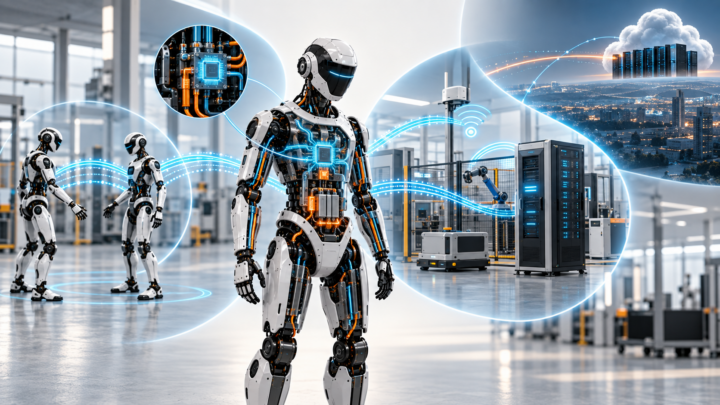
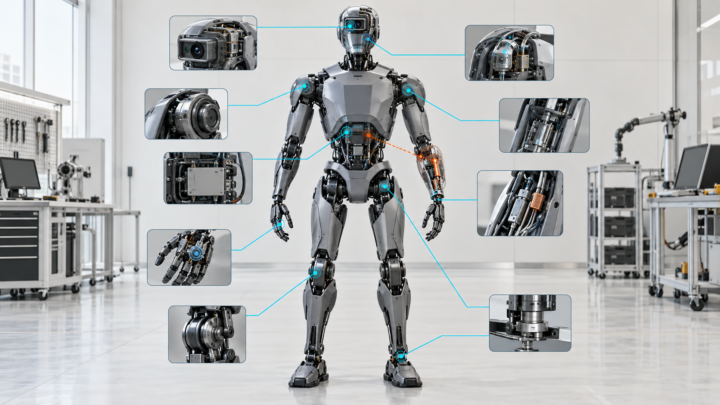
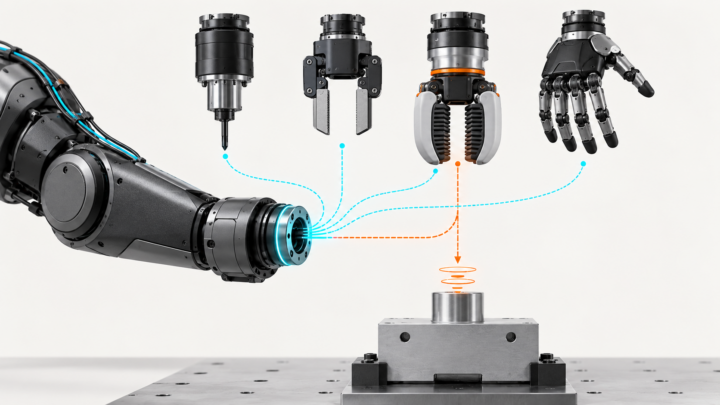
Wired for Motion

Sensing and Physical Intelligence

Chapter 5

When Robots Learn to Feel

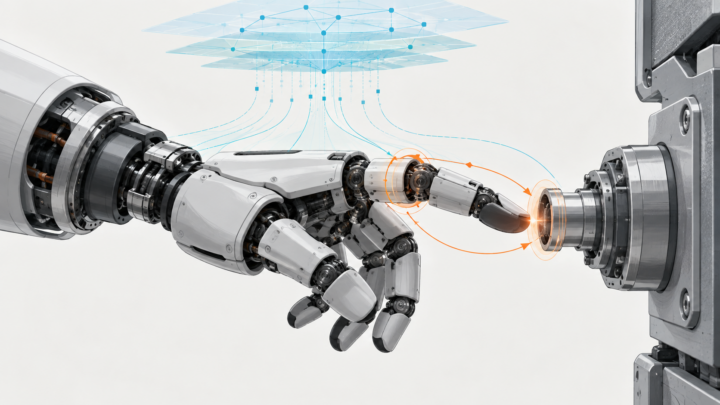
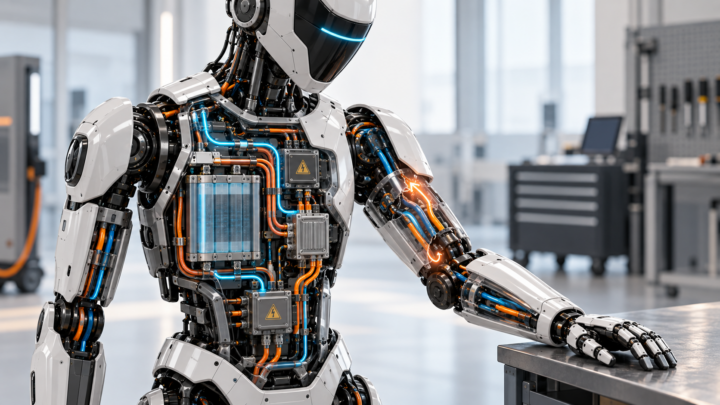
Humanoid robotic hand illustrating tactile sensing and physical interaction
13 min readVersion 1.0
Humanoid robots are rapidly improving their ability to see, move and interpret spoken instructions, yet physical interaction remains constrained by a less visible limitation: most robotic hands still understand contact far less effectively than human hands. Cameras can identify an object before the robot reaches it, and joint encoders can describe where each finger is positioned, but neither measurement reveals what is happening inside an occluded contact interface. The object may be secure, rotating, deforming or beginning to slip while appearing almost unchanged to the external vision system.

Tactile intelligence closes this information gap. It combines contact detection, normal force, shear, vibration, deformation and local geometry with the processing required to transform these signals into action. The engineering objective is not a literal electronic reproduction of human skin. It is task-equivalent touch: a sensing and control system that provides the information required to manipulate real objects safely, reliably and efficiently.

This distinction turns tactile sensing into a semiconductor and system-architecture challenge. A commercially useful hand needs sensor interfaces, local microcontrollers, deterministic communication, real-time control, motor drives, power management, diagnostics and, where required, functional-safety mechanisms. The decisive capability is therefore larger than the tactile material itself. It is the complete signal chain connecting contact with controlled motion.

Visual 01 – Human Touch and the Task-Equivalent Robotic Hand

Vision Ends at the Contact Surface

A humanoid approaching a component bin can use cameras to identify the correct object, estimate its pose and plan a grasp. Once the fingers close around that object, the critical information changes. The robot must determine whether sufficient contact has been established, whether the grip is stable and whether the object is moving relative to the fingertips.

This information is difficult to recover from external vision because the relevant surfaces are frequently hidden by the hand. Motor current and joint torque offer indirect evidence, but their interpretation is complicated by gearbox friction, cable tension, actuator dynamics and structural compliance. A tactile sensor measures the interaction much closer to its physical origin.

Verified fact: Research using optical, magnetic, capacitive and other tactile technologies has demonstrated that tactile feedback can improve grasp stability, object manipulation and slip detection. GelSight research, for example, showed that deformation within an elastomer can reveal normal loading, tangential loading and partial slip before the object enters uncontrolled gross slip (Reference 01 – Measurement of Shear and Slip with a GelSight Tactile Sensor). Contactile’s PapillArray similarly uses independently deformable pillars to measure multidimensional contact and identify the onset of slip (Reference 02 – PapillArray: An Incipient Slip Sensor for Dexterous Robotic Manipulation).

Pressure alone therefore provides an incomplete representation of contact. Normal force indicates how strongly the finger is pressing into an object. Tangential force describes loading along the surface, while vibration and local deformation reveal movement within the contact area. A robot can be pressing firmly and still be close to losing the object if friction is low or the external load changes.

Author interpretation: Incipient-slip detection is likely to deliver greater near-term value than pursuing maximum tactile-image resolution throughout the entire hand. High-resolution sensing remains important for texture, geometry and precision insertion, but industrial reliability begins with the ability to maintain a stable grasp.

The Human Hand as Reference, Rather Than Specification

The human hand does not operate as a regular matrix of pressure pixels. Its tactile performance emerges from the interaction between deformable skin, fingerprints, fingernails, joints, muscles, multiple receptor families and learned neural control.

Four principal low-threshold mechanoreceptive channels are generally identified in the glabrous skin of the hand. Slowly adapting type I receptors contribute to sustained pressure, edges, curvature and fine spatial structure. Fast-adapting type I receptors respond strongly to skin motion and low-frequency events associated with object handling. Pacinian or fast-adapting type II receptors are highly sensitive to small, higher-frequency vibrations. Slowly adapting type II receptors contribute information about skin stretch and hand configuration (Reference 03 – The Roles and Functions of Cutaneous Mechanoreceptors).

Classic human studies estimated receptor densities of up to approximately 241 low-threshold mechanoreceptive units per square centimetre at the fingertip and approximately 58 per square centimetre in the palm. Around 17,000 such units were estimated across the glabrous skin of one hand (Reference 04 – Tactile Sensibility in the Human Hand). These receptors have overlapping and irregular receptive fields rather than the uniform geometry of an image sensor. More recent evidence indicates that individual afferents can respond to remarkably fine spatial details through complex substructures within their receptive fields (Reference 05 – Human Touch Receptors Are Sensitive to Spatial Details on the Scale of Single Fingerprint Ridges).

A robot does not need to reproduce this biological arrangement component by component. Optical tactile sensors can already resolve surface details much smaller than normal human tactile acuity. Meta and GelSight report that Digit 360 can detect spatial details down to 7 μm and forces as small as 1 mN in controlled conditions (Reference 06 – Advancing Embodied AI Through Progress in Touch Perception and Dexterous Manipulation). These figures demonstrate exceptional sensor performance, although they do not establish human-equivalent hand capability. Coverage, durability, reaction time, calibration stability and integration into manipulation control remain equally important.

Assumption: Commercial humanoids will initially use non-uniform tactile coverage. High-value surfaces such as the thumb, index finger and middle fingertips will receive richer multidimensional sensors, while finger sides, remaining digits and palms may use simpler pressure or contact arrays. Wrist force-and-torque sensors, joint-position feedback and motor-current measurements will complete the perception system.

Author interpretation: The appropriate benchmark is functional equivalence. A robot should reproduce the outcomes enabled by human touch while selectively exceeding biology through precise electronic measurement, repeatable diagnostics and fusion with machine-only information.

More Than Four Ways to Create Artificial Touch

Tactile technologies are often grouped into four prominent approaches: camera-based gels, magnetic skins, optical pillars and capacitive arrays. These are important examples, although they do not form a complete taxonomy.

Technology Principal strength Main system challenge
Piezoresistive Thin, straightforward and potentially inexpensive pressure mapping Drift, hysteresis and limited directional-force information
Capacitive High sensitivity, low static power and scalable arrays Parasitic capacitance, moisture, electromagnetic interference and calibration
Piezoelectric or acoustic High-bandwidth detection of vibration, impact and slip Limited measurement of sustained static force
Optical gel and camera Very high spatial detail, geometry and deformation information Camera volume, computation, illumination control and elastomer wear
Optical papillae or fibre Multidimensional displacement, vibration and slip information Optical and mechanical integration complexity
Magnetic and Hall-based Compact multidimensional sensing and replaceable contact layers Magnetic interference, temperature dependence and unit-to-unit calibration
Triboelectric Flexible, dynamic and potentially self-powered contact sensing Environmental sensitivity and limited static-force capability
Fluidic or barometric Softness, compliance and overload tolerance Plumbing, temperature effects and scalability
Fibre Bragg grating Electromagnetic immunity and optical multiplexing Interrogator cost and packaging
Hybrid multimodal Combines complementary static and dynamic information Cost, fusion complexity and qualification

A robotic fingertip may ultimately combine several of these principles. A capacitive or magnetic array could measure sustained multidimensional force, while a piezoelectric element or MEMS acoustic sensor detects high-frequency vibration and micro-slip. A temperature sensor could identify thermal contact, while the robot’s proprioceptive system supplies joint configuration and actuator state.

This resembles the functional diversity of biological touch without copying its anatomy. Each channel is optimised for a different temporal or spatial domain, and local processing combines their outputs into a concise description of the contact.

Verified fact: Commercial and research systems already demonstrate several of these paths. GelSight and Digit use camera-based elastomer deformation. XELA Robotics’ uSkin employs magnetic sensing to provide distributed three-axis tactile measurements. Contactile’s PapillArray uses optical sensing in deformable pillars. Tashan Technology develops capacitive and multimodal tactile platforms, while Meta and Carnegie Mellon’s ReSkin separates a replaceable magnetised interface from reusable sensing electronics (Reference 07 – ReSkin: A Versatile, Replaceable, Low-Cost Skin for AI Research on Tactile Perception).

From Taxels to a Tactile Nervous System

A high-density tactile surface produces a demanding data problem. If every finger continuously streams raw measurements or camera images to the central AI computer, bandwidth, latency and synchronization requirements increase rapidly. The architecture also becomes vulnerable to connector failures and central-compute scheduling delays.

The stronger architecture is hierarchical. Individual tactile elements, commonly called taxels, connect to nearby analogue or digital interfaces. A finger-level processor performs calibration, compensation, filtering and elementary feature extraction. Instead of forwarding every raw sample, it can report contact events, force vectors, vibration signatures, grip margin and sensor-health information.

A hand controller then combines information from multiple fingers with joint position, motor current and wrist force-and-torque measurements. This controller can implement rapid reflexes, such as increasing grip force when incipient slip is detected or stopping finger motion when a fragile object begins to deform unexpectedly.

The main Physical-AI computer remains responsible for interpretation, planning and learning. It may infer that the object is a glass, cable, fabric layer or connector and select an appropriate manipulation strategy. It should not need to decide every millisecond whether one fingertip requires a small corrective movement.

Visual 02 – Hierarchical Tactile Nervous System from Taxel to Physical-AI Compute

Verified fact: Event-driven tactile research demonstrates an alternative to continuously sampled arrays. NeuTouch uses asynchronous encoding to transmit tactile events with low and comparatively constant latency as the number of taxels increases (Reference 08 – Event-Driven Visual-Tactile Sensing and Learning for Robots). Event-based architectures are especially attractive for whole-body skins because most taxels are inactive during normal operation.

Author interpretation: The tactile architecture of a scalable humanoid will increasingly resemble a distributed nervous system. Intelligence will exist at several levels: sensing intelligence in the fingertip, reflex intelligence in the hand, coordinated control in the robot and cognitive intelligence in the main compute platform.

The Semiconductor Signal Chain Behind Artificial Touch

The tactile material receives considerable attention because it is the visible interface between robot and object. Yet its output becomes useful only when supported by a complete semiconductor signal chain.

A resistive, capacitive, magnetic, optical or piezoelectric sensor requires appropriate excitation, analogue conditioning, conversion and compensation. Capacitive systems need interfaces capable of resolving small changes in the presence of parasitic effects. Magnetic systems need sensitive and stable magnetic measurement. Optical sensors require image or photodiode acquisition, illumination control and more substantial processing. Vibration channels require sufficient bandwidth and carefully designed filtering.

Local microcontrollers turn these electrical signals into contact information. They calibrate sensor elements, detect faults, extract features and reduce data volume. A higher-level real-time controller coordinates the hand, supervises diagnostics and closes the loop with the actuators. Communication devices connect fingers, hands, arms and central compute through robust and synchronized networks. Motor-control ICs, gate drivers and power MOSFETs convert the resulting commands into precise finger movement. Voltage regulators and power-management devices supply stable rails in an environment containing switching motors, long wiring paths and rapidly changing loads.

Infineon’s relevance lies across these surrounding functions rather than in claiming the complete tactile material. PSOC™ 4 devices with CAPSENSE™ capabilities and the wider PSOC™ microcontroller portfolio are relevant to capacitive interfacing and local processing. XENSIV™ sensing technologies provide magnetic, current, position, pressure and acoustic competencies that can contribute to multimodal robotic perception. AURIX™ microcontrollers bring real-time processing, diagnostic and functional-safety experience to supervisory control. CAN, Ethernet and EtherCAT®-supporting solutions help connect distributed controllers, while MOTIX™, EiceDRIVER™ and OptiMOS™ families address motor-control signal chains. OPTIREG™ and related power-management solutions support stable and efficient local power conversion (Reference 09 – Humanoid Robots: Semiconductor Solutions for Physical AI).

Visual 03 – Semiconductor Building Blocks of a Tactile Humanoid Hand

Verified fact: Infineon describes its humanoid-robot portfolio across motor control, environmental sensing, dexterous hands, battery management, power distribution, communication, memory and hardware-based security. Its robotics positioning similarly covers power semiconductors, microcontrollers, sensors, connectivity, safety and security (Reference 10 – Robotics Semiconductor Solutions).

Author interpretation: Tactile intelligence is a particularly strong example of semiconductor value extending beyond a single component. The business opportunity arises from the interaction of sensing, embedded control, connectivity, actuation and power. A tactile skin supplier may provide the contact interface, while the semiconductor architecture determines whether the resulting system is responsive, manufacturable and dependable.

Reliability, Maintenance and Safety

Laboratory demonstrations often emphasise sensitivity or resolution. Commercial humanoids will be judged by how these properties survive abrasion, contamination, temperature cycles, protective covers and millions of grasping operations.

Elastomers creep and age. Adhesive interfaces can delaminate. Optical illumination changes over time. Capacitive measurements are influenced by moisture and neighbouring conductive objects. Magnetic systems experience mechanical tolerances and external-field disturbances. Flexible traces must survive repeated bending, while exposed fingertips may encounter oil, sharp edges and cleaning chemicals.

A production design therefore needs replaceable contact surfaces, calibration procedures, sensor-health monitoring and graceful degradation. The robot should detect a drifting or damaged tactile region and adapt its task behaviour instead of silently trusting incorrect data.

Safety also requires architectural separation. Rich tactile data can improve contact awareness, but not every tactile channel should automatically be treated as safety-qualified. A safety-related contact or collision function may need independent plausibility checks using joint torque, motor current, wrist-force sensing or redundant skin zones. The machine-learning model interpreting texture should not become the sole protection against excessive force.

Assumption: Early industrial humanoids will use tactile data primarily to improve manipulation performance, while certified safety functions continue to rely on more deterministic and independently monitored channels. As tactile components and diagnostics mature, selected tactile functions may become part of higher-integrity safety architectures.

A Market Forming Around the Contact Interface

The tactile-sensing market remains fragmented and innovation-driven. It has not yet developed the clearly defined Tier-1 structure familiar from the automotive industry.

Market role Representative organisations Strategic contribution
Tactile specialists GelSight, XELA Robotics, Contactile, Tashan Technology, PaXini, Tacterion, Tekscan, Pressure Profile Systems, Touchlab Sensor principles, tactile modules, skins, algorithms and integration
Dexterous-hand suppliers Shadow Robot, Tesollo, Wonik Robotics, Inspire Robots, BrainCo, Psyonic, qbrobotics Mechanical hand platforms and integration of sensing with actuation
Humanoid OEMs Sanctuary AI, Boston Dynamics, Tesla, Figure AI, 1X, Apptronik, Agility Robotics, UBTECH, Fourier Intelligence, Unitree System integration, task requirements and manipulation-data generation
Research innovators Meta FAIR, MIT, Carnegie Mellon, Waseda University, IIT, Bristol Robotics Laboratory and leading Asian, European and US universities New transduction methods, representations, benchmarks and control strategies
Semiconductor enablers Infineon and other analogue, sensor, MCU, communication and power suppliers Interfaces, processing, networking, actuation, diagnostics and energy management

Sanctuary AI has explicitly connected richer tactile sensing with improved manipulation performance and the generation of higher-quality embodied-AI data (Reference 11 – New Tactile Sensors Enable a Richer Sense of Touch). Shadow Robot offers multiple tactile fingertip options within a human-scale dexterous-hand platform containing more than 100 sensors (Reference 12 – Shadow Dexterous Hand Series). XELA combines tactile hardware with software intended to make distributed touch information accessible to robot-control and learning systems (Reference 13 – Tactile Sensing Technology for Robots).

Author interpretation: The strongest market positions may belong to companies that can bridge layers. A high-performance taxel is valuable, but customers ultimately need a durable fingertip, calibrated electronics, usable data, robot interfaces, control software and replacement processes. The winning proposition will be measured in manipulation reliability rather than sensor specifications alone.

Touch Becomes Action

Tactile sensing changes the humanoid from a machine that executes trajectories into a machine that negotiates physical contact. It allows a hand to adapt force after contact, identify instability before failure and continue operating when vision is partially occluded.

The progression is logical. Basic contact detection establishes whether the hand has reached the object. Normal-force measurement controls how firmly it is held. Shear and vibration reveal whether the contact remains stable. Geometry and texture support more sophisticated insertion, exploration and material handling. Temperature becomes increasingly relevant in healthcare, domestic service and hazardous environments.

This progression does not require every robot to begin with a perfect electronic skin. It requires designers to select the tactile information that changes task outcomes and build an architecture capable of acting on it.

The essential lesson is therefore simple: a sense of touch is created at the surface, but tactile intelligence emerges across the entire robot. It begins with the deformation of a fingertip and continues through sensor interfaces, local processing, deterministic communication, real-time control, power electronics and precise actuation. When those elements operate as one system, contact becomes data, data becomes reflex and reflex becomes dexterity.

Glossary

Analogue front end

Electronic circuitry that conditions sensor signals before processing or conversion.

AURIX™

Infineon microcontroller family designed for real-time, safety-oriented and high-reliability control applications.

CAPSENSE™

Infineon capacitive-sensing technology associated with PSOC™ microcontrollers.

Contact area

Region over which a robot and object physically interact.

EiceDRIVER™

Infineon gate-driver product family.

EtherCAT

An Ethernet-based industrial fieldbus optimized for deterministic cyclic process data and synchronized motion.

Incipient slip

Local partial motion within a contact interface occurring before complete object slippage.

Mechanoreceptor

Biological receptor responding to mechanical deformation, pressure, vibration or stretch.

MOTIX™

Infineon product family for motor-control and automotive-motion applications.

OptiMOS™

Infineon power-MOSFET family.

OPTIREG™

Infineon power-supply and voltage-regulation product family.

Physical AI

Artificial intelligence embodied in machines that sense, decide, and act within the physical world.

PSOC™

Infineon programmable embedded-processing and microcontroller family.

Shear Force

Force acting tangentially along a contact surface.

Tactile Pixel

A spatially discrete sensing element within a tactile array, analogous to a pixel in an image sensor.

Tactile servoing

Closed-loop control in which robot movement is adjusted using tactile feedback.

Task-equivalent touch

Tactile capability designed around required manipulation outcomes rather than literal biological replication.

XENSIV™

Infineon sensor portfolio covering magnetic, current, pressure, acoustic and environmental sensing technologies.

References

  1. Advancing Embodied AI Through Progress in Touch Perception and Dexterous Manipulation. Introduces Digit 360 and related platforms for multimodal tactile research, dexterous manipulation and embodied-AI learning. Source
  2. Event-Driven Visual-Tactile Sensing and Learning for Robots. Presents NeuTouch and asynchronous tactile encoding for low-latency, scalable robotic perception and visual-tactile learning. Source
  3. Human Touch Receptors Are Sensitive to Spatial Details on the Scale of Single Fingerprint Ridges. Shows that individual tactile afferents contain sensitive subfields capable of encoding spatial structures at approximately fingerprint-ridge scale. Source
  4. Humanoid robots. Maps humanoid sensing, motor control, power, connectivity, safety, security, and compute functions to semiconductor technologies and system design priorities. Source
  5. Measurement of Shear and Slip with a GelSight Tactile Sensor. Demonstrates normal, tangential and torsional contact measurement and identifies partial slip through deformation patterns within a GelSight elastomer. Source
  6. PapillArray: An Incipient Slip Sensor for Dexterous Robotic Manipulation. Introduces independently deformable silicone pillars that detect incipient slip before complete grasp failure under varying normal forces and friction conditions. Source
  7. ReSkin: A Versatile, Replaceable, Low-Cost Skin for AI Research on Tactile Perception. Presents a magnetic tactile skin separating replaceable mechanical interfaces from reusable electronics to improve durability, adaptability and research accessibility. Source
  8. Robotics Semiconductor Solutions. Describes Infineon robotics competencies spanning power semiconductors, microcontrollers, sensors, connectivity, safety, security and energy management. Source
  9. Sanctuary AI New Tactile Sensors Enable Richer Sense of Touch. Connects integrated tactile sensing in Phoenix humanoids with faster manipulation, improved task success and richer embodied-AI training data. Source
  10. Shadow Dexterous Hand Series. Describes a human-scale tendon-driven robotic hand with multiple tactile options, extensive sensing and high-frequency data acquisition. Source
  11. Tactile Sensibility in the Human Hand: Relative and Absolute Densities of Four Types of Mechanoreceptive Units. Quantifies mechanoreceptor distribution across fingertips, fingers and palm, establishing the strongly non-uniform sensory density of the human hand. Source
  12. Tactile Sensing Technology for Robots. Describes uSkin sensor modules, configurable integration and software for distributed three-dimensional tactile perception. Source
  13. The Roles and Functions of Cutaneous Mechanoreceptors. Reviews four principal mechanoreceptive afferent types and their complementary roles in pressure, motion, vibration and skin-stretch perception. Source