
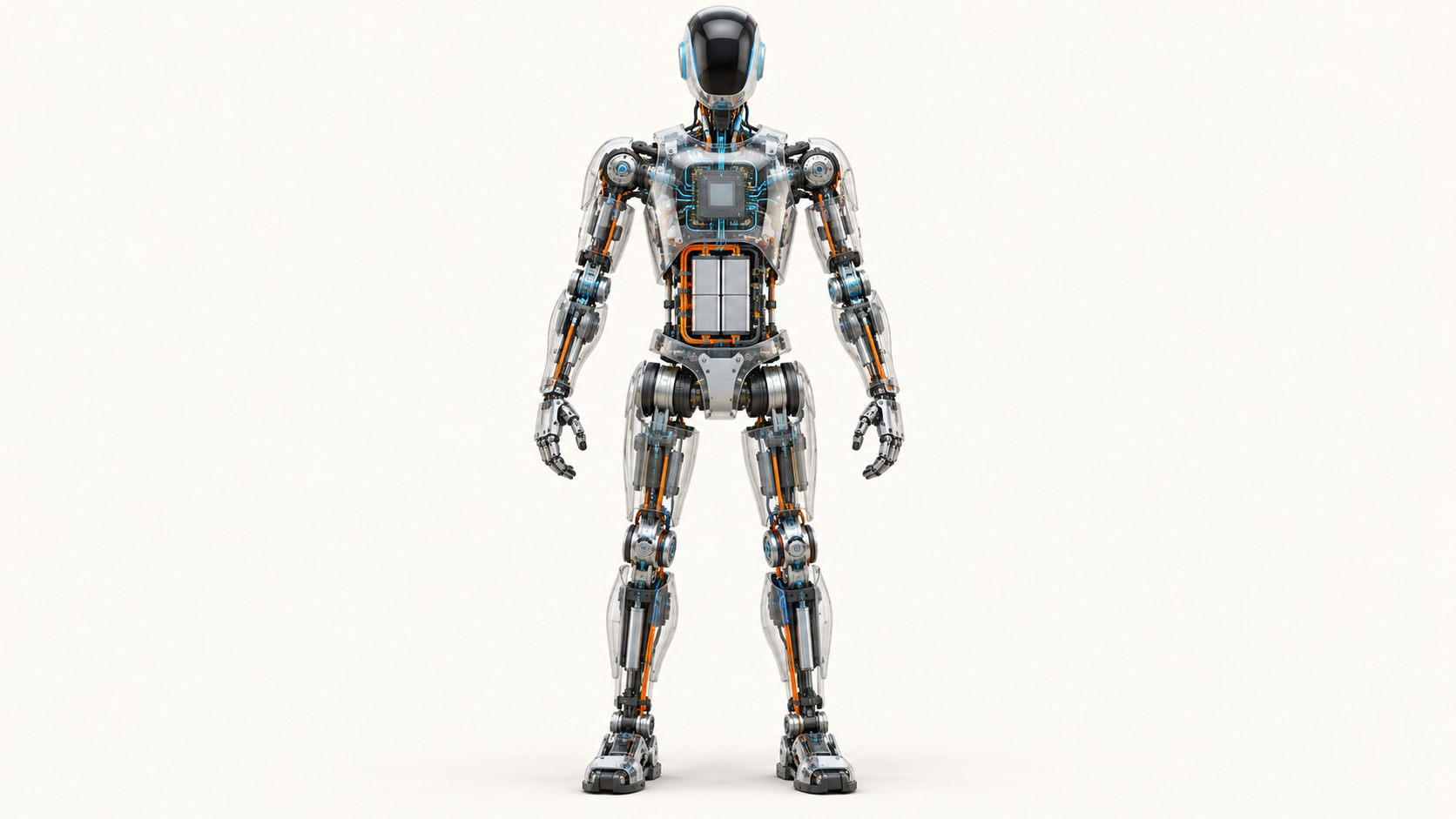
Magazine Article
Where Humanoid Value Meets Scarcity
The race to scale humanoid robots will be decided where hardware value, supplier readiness and system integration meet—with semiconductor platforms contributing across the stack.
Humanoid robots are advancing quickly, yet their path to scale depends on a supply chain whose readiness varies sharply by subsystem. Actuation represents the largest hardware value pool, while precision motion, force sensing and system integration carry the highest bottleneck risk. The emerging opportunity is to industrialize complete, dependable functions across sensing, control, actuation, connectivity, power and manufacturing.
A humanoid can cross a stage, sort a tote or carry a component after months of concentrated engineering. The harder test begins the next morning: can the same machine be built again, at predictable cost, with the same behaviour—and then repeated across a fleet?
That question shifts attention from the visible intelligence to the industrial system underneath it. Humanoid scale depends on two overlapping maps. One shows where hardware value is concentrated. The other shows where supply and integration are most constrained. The overlap points to the capabilities that can hold back production and create durable value for suppliers.
McKinsey estimates that actuation represents 40–60% of a humanoid robot’s hardware bill of materials. Sensing and perception account for 10–20%, compute and control for 10–15%, while structural components and battery modules each represent 5–10%. Together, these five domains cover most unit hardware cost.[1]
The percentages become strategically useful when paired with readiness. Actuation is the largest value pool. Precision transmissions, force sensing and system integration carry the sharpest constraints. Figure 1 combines those views and adds a functional map of the wider ecosystem.
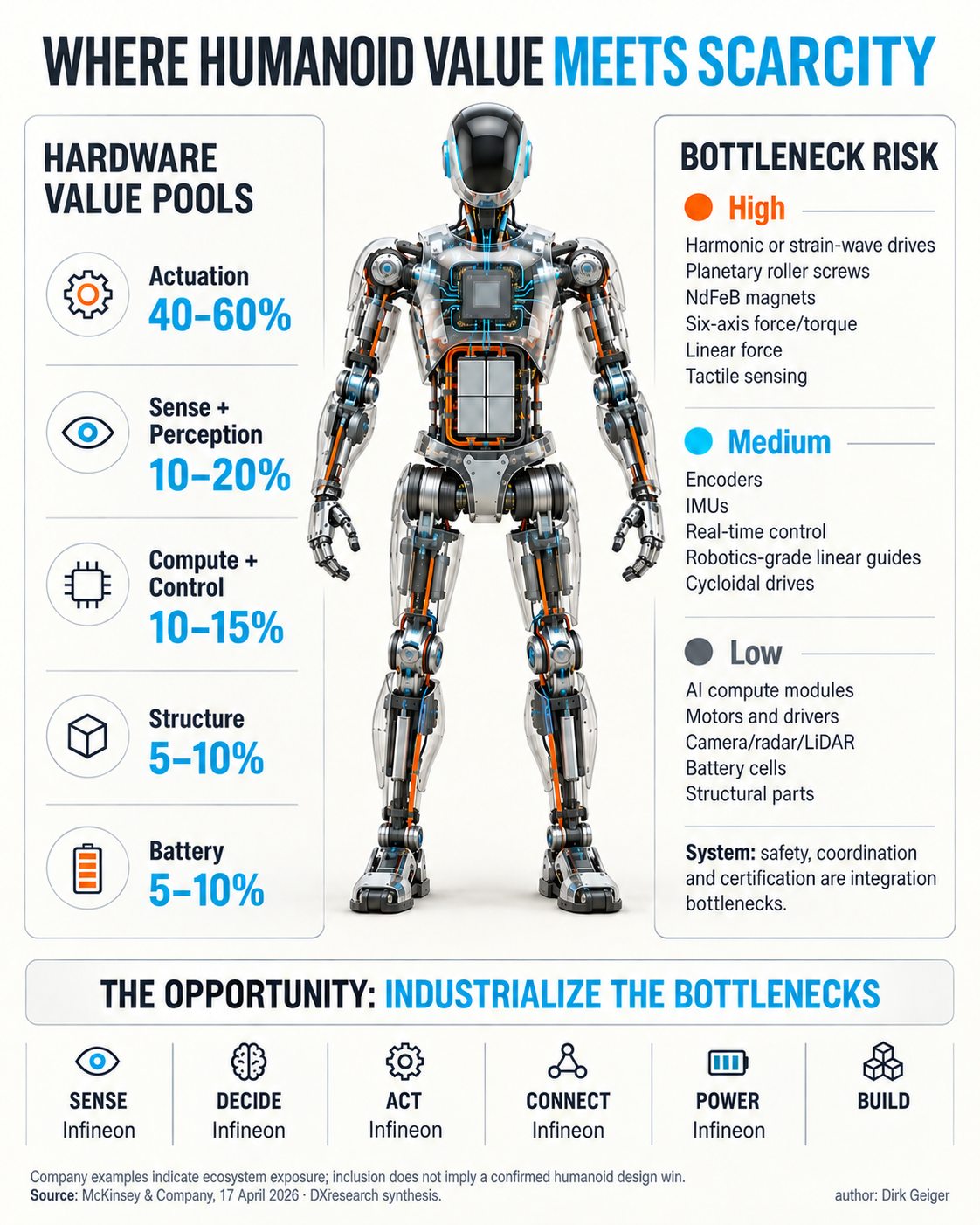
The hardware map behind the market story
Every movement passes through a tightly coupled chain. An intention from the autonomy stack becomes a real-time command, electrical current, motor torque and mechanical motion. Position, force, temperature and inertial data return through the control loop. Battery condition, communication timing, security state and safety supervision influence the result.
This coupling explains why available components can still produce a difficult system. Motors, power semiconductors, processors, cameras and battery cells benefit from mature adjacent markets. Humanoids combine them in compact moving bodies exposed to impact, backdriving, heat and frequent contact with people.
| Hardware domain | Indicative share of hardware BOM | Primary scaling question |
|---|---|---|
| Actuation | 40–60% | Can precision motion be produced, calibrated and qualified at volume? |
| Sensing and perception | 10–20% | Can measurements remain accurate and traceable across a fleet? |
| Compute and control | 10–15% | Can heterogeneous processing operate as one safe, real-time platform? |
| Structural components | 5–10% | Are geometries stable enough for volume manufacturing? |
| Battery modules | 5–10% | Can compact packs support dynamic loads, thermal stability and useful uptime? |
These ranges are directional market estimates from McKinsey’s April 2026 analysis, Turning humanoid supply chain constraints into billion-dollar wins. Robot size, payload, dexterity, duty cycle and maturity can move the mix considerably. Hands add uncertainty because their actuators and sensors may sit inside broader categories or appear as a separate subsystem.
Figure 2 makes the imbalance visible. The scale opportunity extends beyond individual parts into the manufacturing, calibration, qualification and lifecycle capabilities needed around them.
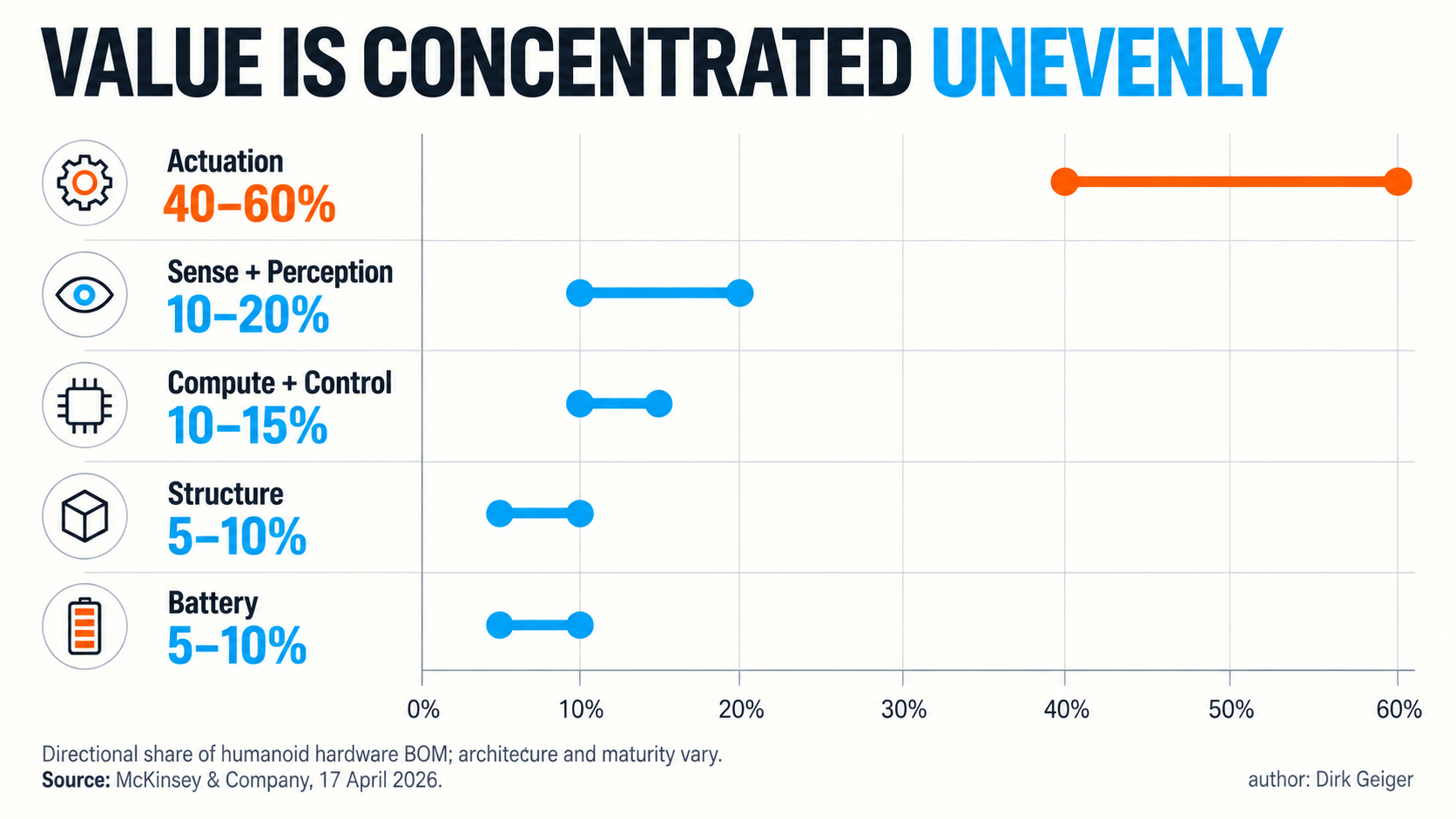
Actuation carries the largest value—and the hardest physical work
Humanoids distribute compact actuators through legs, torso, arms, hands and neck. Each unit influences torque, speed, efficiency, precision, compliance and contact behaviour. It must also tolerate repetitive loads, shock and unexpected external forces without becoming too heavy or too hot.
McKinsey divides a representative integrated actuator into gearbox, driver electronics, motor, mechanical components and sensors. Its indicative cost ranges assign 30–50% to the gearbox, 15–20% to the driver, 10–20% to the motor, 10–20% to mechanical components and 5–10% to sensors.[1] Figure 3 shows why actuation behaves like a market inside the machine.
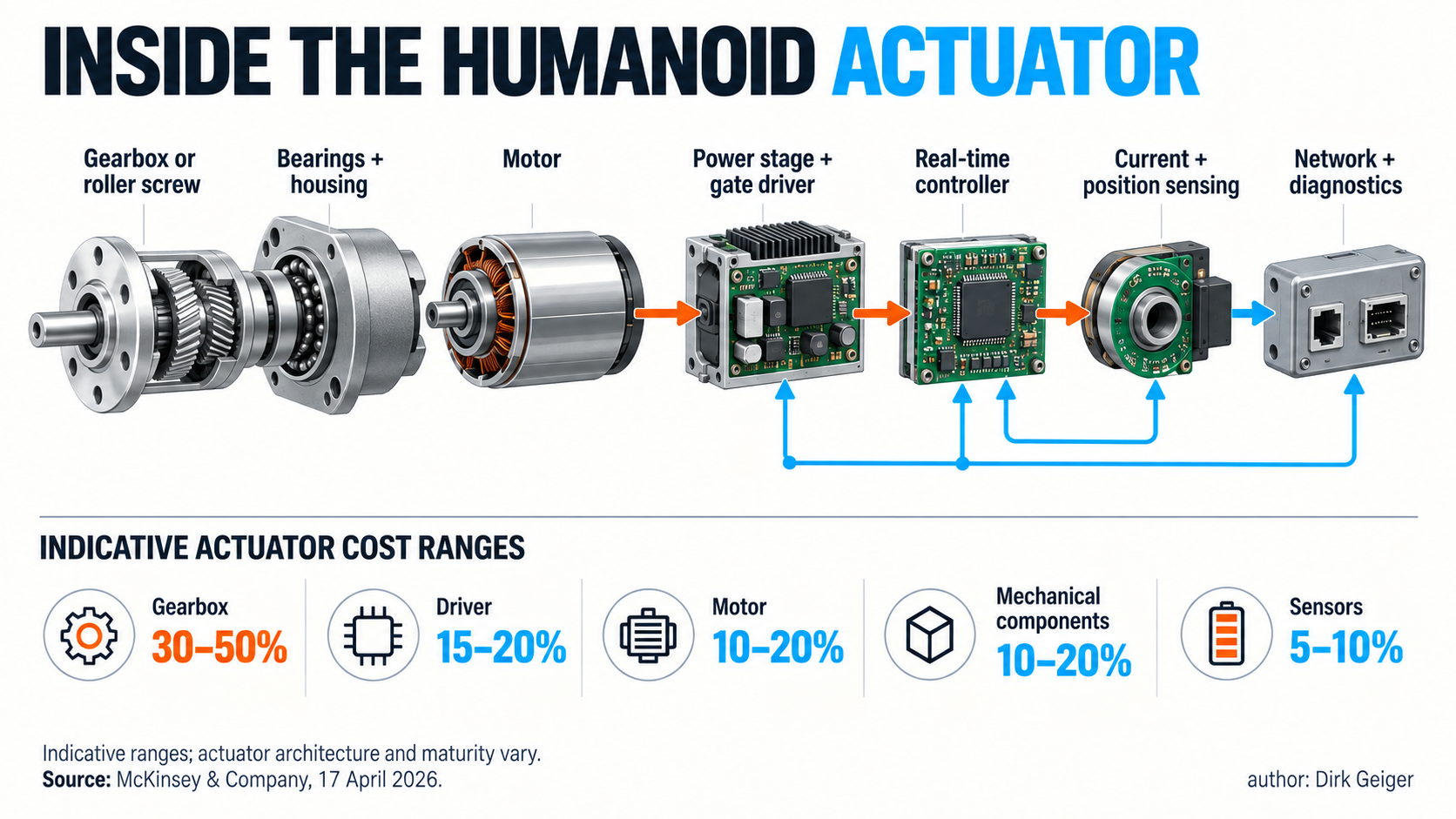
The strongest structural risks sit in precision elements. Harmonic or strain-wave drives offer compact, high-ratio transmission with low backlash. Planetary roller screws support demanding linear actuators. Their supply depends on specialist tooling, metrology, materials and process knowledge. High-performance bearings, linear guides and neodymium-iron-boron magnets add further dependencies.
Electrical actuation draws on deeper automotive and industrial ecosystems. Brushless motors, power devices, gate drivers, current sensors and real-time microcontrollers are widely established technologies. Humanoid form factors still demand adaptation: a conventional servo solution may be too large, thermally constrained or inefficient for a moving limb.
The opportunity is to industrialize the complete motion function. A scalable actuator coordinates transmission, motor, inverter, control, feedback, communication, protection, diagnostics and thermal behaviour. Reusable designs and characterization data can remove repeated integration work from every robot developer.
System balance matters. A smaller inverter that pushes more heat into a sealed joint transfers the constraint. A strong motor paired with the wrong transmission can shorten lifetime. Useful platforms balance power density, efficiency, acoustic behaviour, backdrivability, controllability, durability, serviceability and cost.
That balance has to survive the production line. Gear preload, bearing alignment, adhesive curing, magnetic tolerances and sensor zero points can all change joint behaviour. End-of-line characterization therefore becomes as important as component selection. A scalable actuator family needs defined acceptance limits, traceable calibration and enough diagnostic visibility to identify drift before it becomes a fleet-wide maintenance problem.
Sensing becomes valuable when measurements can be trusted
A humanoid needs environmental perception and an accurate understanding of its own body. Cameras, radar, time-of-flight sensors and microphones observe the surroundings. Encoders, magnetic position sensors, inertial measurement units, current sensors, temperature sensors and force sensors describe internal state. Tactile arrays convert contact into information for manipulation.
Supply risk varies widely. Cameras, radar and many inertial or position-sensing technologies benefit from established consumer, automotive and industrial markets. Six-axis force/torque sensors, compact linear-force sensors and tactile systems have shallower ecosystems and demanding calibration requirements. McKinsey places force and tactile sensing among the higher-risk bottleneck clusters.[1]
The deeper challenge is repeatable measurement across thousands of machines. Sensors operate inside mechanical assemblies affected by temperature, vibration, ageing and production tolerances. Calibration equipment, compensation models, end-of-line testing and field diagnostics therefore become part of the product.
Hands expose the problem clearly. Small actuators, position feedback, force estimation and tactile contact compete for space, energy and bandwidth. Flexible surfaces wear. Replacing a fingertip can alter calibration. Fleet operators need enough diagnostic evidence to separate software error, object variation, sensor drift and mechanical change.
Industrial sensing solutions gain value through integration guidance, self-test, traceable calibration, synchronization and diagnostic outputs. Timing belongs to the measurement: accurate data that arrives late or without a common time reference can destabilize control and weaken safety evidence.
A fleet also changes the definition of accuracy. One sensor can be tuned carefully in a laboratory; thousands of robots need calibration that is fast, reproducible and recoverable after service. Temperature compensation, replacement procedures and versioned parameters become operational infrastructure. Suppliers that make these routines measurable can turn sensing from a fragile prototype feature into a dependable production capability.
Compute becomes a system bottleneck
Central AI modules are prominent, yet a humanoid also contains distributed real-time controllers, sensor-processing nodes, battery management, communication gateways, safety supervision and secure service interfaces. It is a moving network of embedded systems.
McKinsey describes compute and control primarily as a platform-integration constraint. The challenge is to coordinate heterogeneous processing with low-latency control and safety behaviour while autonomy software changes quickly. Processor availability solves only part of that problem.
A robust division of responsibility helps. Central accelerated compute can handle perception, planning and learned behaviour. Local controllers close fast loops and retain defined behaviour when higher layers are delayed, restarted or unavailable. Independent supervision detects hazardous states and initiates a controlled response.
Connectivity binds these layers together. Bandwidth, latency, synchronization, topology, fault containment and cable mass shape the architecture. Security extends through the lifecycle because a connected fleet contains models, calibration data, credentials and operational evidence.
Figure 4 captures the core point: components become a dependable robot only when timing, faults, updates, diagnostics, safety and certification work across the complete system.
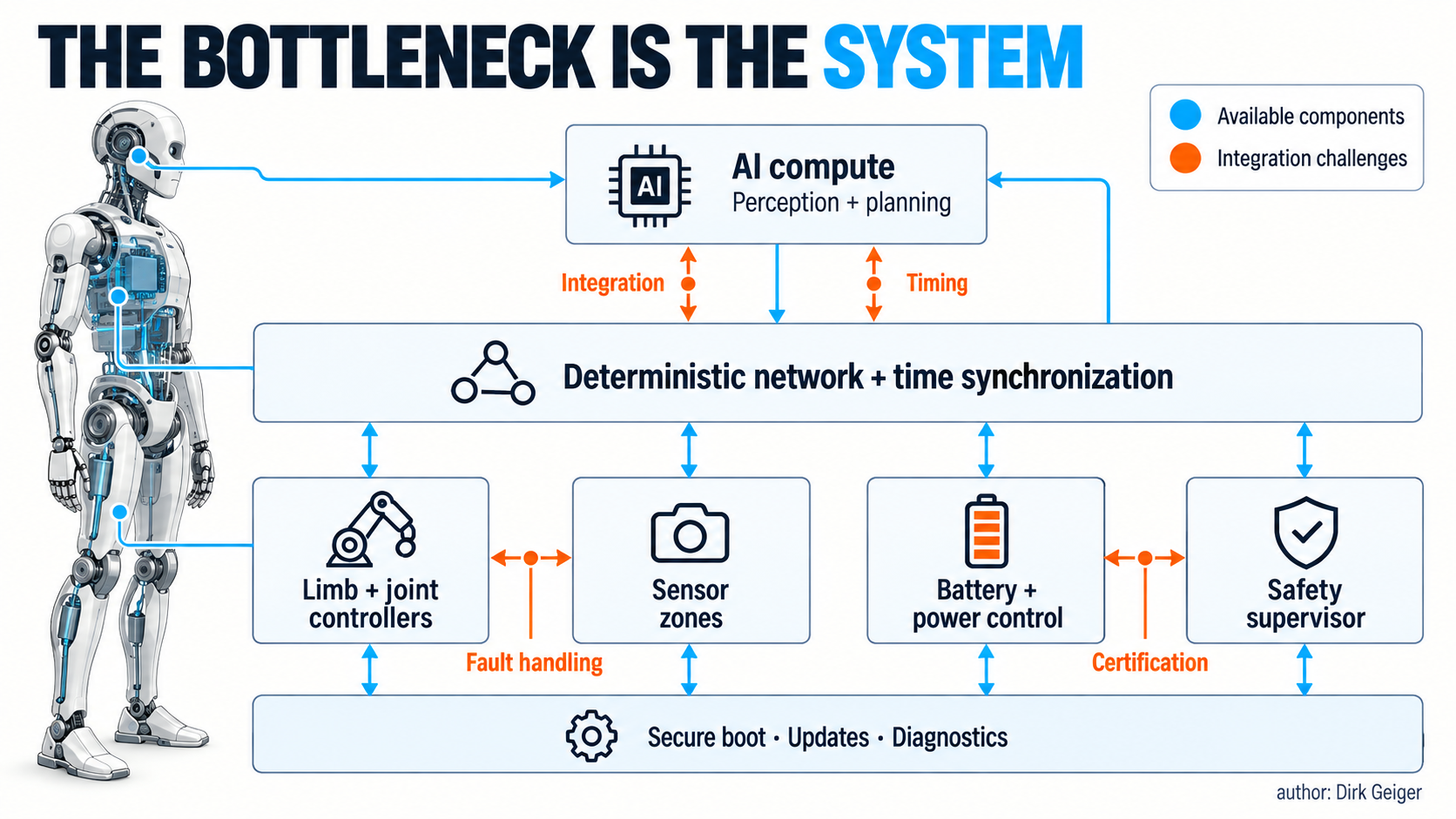
Digital twins and reference architectures can bring integration forward. Infineon and NVIDIA announced expanded collaboration in March 2026 covering smart-actuator and sensor digital twins, motor control, microcontrollers, power systems and security alongside NVIDIA robotics and simulation platforms.[2] Virtual models create value when they expose thermal, timing, control and safety interactions before tooling and scarce hardware are committed.
Adjacent industries provide scale—adaptation makes it useful
Batteries, power electronics, conventional motors, cameras and structural manufacturing can draw on electric-vehicle, consumer-electronics and industrial-automation supply chains. Existing capacity can shorten development and compress cost. Humanoid duty cycles, packaging and safety requirements determine how much transfers directly.
A robot battery experiences rapidly changing loads as joints accelerate, decelerate and recover energy. The pack moves, may experience a fall and works close to people. Power crosses several voltage domains and needs protection against local faults. Battery management must estimate state, balance cells, measure current and communicate reliably while thermal design absorbs both average demand and short peaks.
The semiconductor contribution spans the route from stored energy to useful motion and compute: conversion, protection, load switching, gate drive, power devices, sensing, communication, memory and security. Infineon’s public humanoid overview presents capabilities across these functions.[3] This indicates broad ecosystem exposure; content in a specific production robot depends on actual selection and qualification.
Structures follow a different industrialization curve. Early geometries favour flexible machining while designs change frequently. Stable platforms can support casting, forging, stamping, moulding and automated assembly. Standard mechanical envelopes, mounting points, power interfaces and service access help aggregate volume across variants.
Energy efficiency links these domains. A lighter distal structure reduces the torque demanded from upstream joints. Lower losses reduce heat, which can shrink cooling hardware and preserve battery energy. Better power management can protect peak performance while extending useful operating time. These cascades make system optimization commercially important: a modest improvement in one layer can release mass, thermal and cost margin elsewhere.
Follow the function, then evaluate the company
Many visible robot developers remain private, while listed companies participate through components, platforms and manufacturing. A functional map gives investors and strategists a practical starting point.
| Function | What it contains | Illustrative listed-company exposure |
|---|---|---|
| Sense | Vision, position, current, inertial, force and touch sensing | ams OSRAM, Infineon, LG Innotek, Novanta, Sony, TDK |
| Decide | AI compute, real-time control, safety processing and coordination | Infineon, NVIDIA, NXP, Qualcomm, Renesas, STMicroelectronics |
| Act | Motors, transmissions, bearings, power stages, control and feedback | Harmonic Drive, Hyundai Mobis, Infineon, Nabtesco, Nidec, Schaeffler |
| Connect | Communication, synchronization and interfaces | Amphenol, Broadcom, Infineon, Marvell, NXP, TE Connectivity |
| Power | Cells, battery management, conversion, distribution and protection | CATL, Infineon, LG Energy Solution, onsemi, Texas Instruments |
| Build | Contract manufacturing, assembly, test and scale-up | Flex, Foxconn, Jabil |
Figure 5 turns this table into a quick navigation map. Every name indicates relevant capability or market exposure. Inclusion does not establish a confirmed design win, material humanoid revenue or a supply relationship with a specific robot.
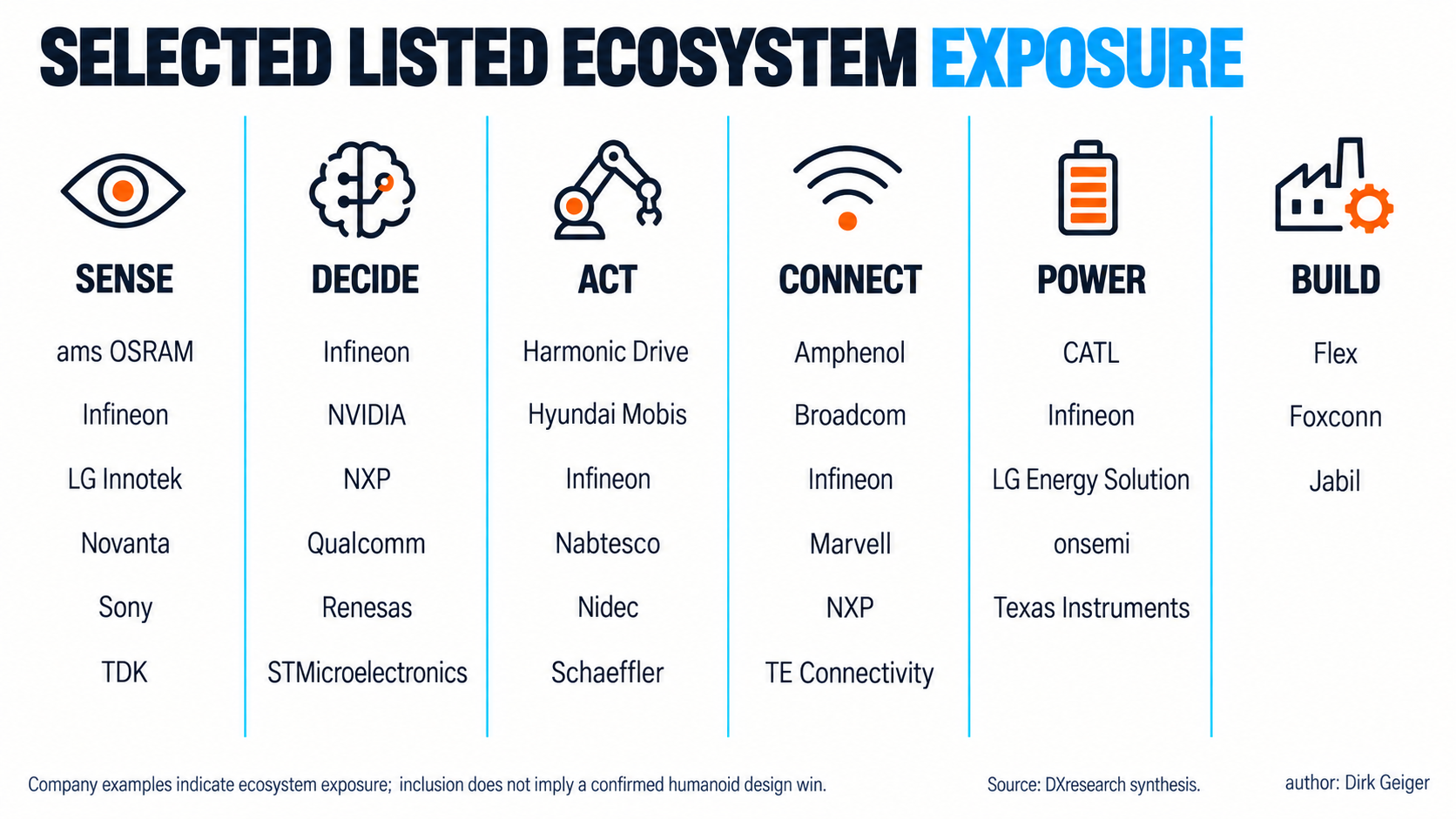
Infineon appears across several columns because semiconductor functions cross subsystem boundaries. Its announced work with NVIDIA combines microcontrollers, sensors and smart-actuator expertise with Jetson Thor, while its public positioning extends to power, connectivity, battery management, memory, functional-safety support and hardware security.[4] The broader insight is architectural: motion depends on sensing, control, communication, energy and trust working together.
Evidence should lead the exposure story
Relevance and commercial traction describe different things. A useful evidence ladder starts with named production supply, followed by formal development agreements, shipping humanoid-specific products, demonstrated integrations and transferable capability from adjacent industries.
Each level supports a different conclusion. A broad product portfolio can be technically relevant while current humanoid revenue remains small. A development agreement can change before production. A valuable component can still represent a minor share of a diversified supplier’s business.
Credible assessment asks six questions:
- Identity: Which legal entity and customer are involved?
- Function: What exact subsystem, component or capability is supplied?
- Status: Is the evidence positioning, evaluation, development, supply agreement or production?
- Timing: Does it concern a prototype, planned ramp or established production?
- Materiality: Could it become meaningful relative to the supplier’s existing business?
- Dependency: Which volumes, interfaces, materials and qualifications must arrive first?
Evidence also ages. Partnerships record intent at a moment in time, product pages reflect current positioning and market studies combine disclosure with assumptions. Research dates and direct sources keep the map maintainable as the market changes.
The opportunity: industrialize the bottlenecks
The opportunity reaches beyond a temporary shortage. Many robot developers still integrate deeply because reusable modules and stable interfaces remain immature. As credible volume grows, suppliers can convert repeated engineering into qualified platforms.
Four capabilities define that transition:
- Capacity with process control. Precision products need tooling, metrology, calibration and stable yield.
- Qualification with evidence. Behaviour across load, temperature, vibration, ageing and faults must be traceable.
- Modularity with bounded interfaces. Mechanical, electrical and software boundaries should support reuse across joints and robot variants.
- Dependable system integration. Hardware, software, diagnostics, safety concepts and digital models should reduce effort on the robot builder’s critical path.
Platform reuse also changes the economics. An actuator controller, sensing platform or power stage that serves humanoids, mobile robots, cobots and industrial automation can aggregate fragmented demand. Common validation assets create learning curves before any single humanoid reaches very high volume.
Automotive and industrial automation offer a useful precedent. Their advantage comes from disciplined interfaces, controlled change, qualification evidence and long-term service processes. Humanoids will develop different architectures and operating envelopes, yet the industrial lesson transfers: scale arrives when specialised innovation can sit inside a repeatable system of engineering, manufacturing and support.
Robot builders need subsystem answers. A motion platform may include a characterized control signal chain, communication profile, diagnostic behaviour, thermal model and safety concept. A sensing offer may include calibration, synchronization and confidence information. A power architecture should coordinate battery protection, high-current joint rails and sensitive compute supplies.
What the map means for the market
Robot manufacturers
Manufacturers can use the value-and-scarcity map to decide where vertical integration protects differentiation and where partners can accelerate scale. Shared road maps, platform families and bounded configurations give suppliers stronger reasons to invest in tooling and qualification.
Stable interfaces are especially valuable. They allow a robot platform to evolve its AI, hands or payload without forcing every joint controller, power branch and service tool to change at the same pace. Clear ownership of diagnostics and fault responses also shortens integration cycles and makes supplier performance easier to compare.
Component and semiconductor suppliers
The strongest opportunities sit where established industrial capability meets humanoid-specific requirements. Early codevelopment reveals duty cycles, packaging constraints, failure modes and software needs. Advantage grows when that learning becomes reusable modules, tools, models and manufacturing processes.
Industrial users
End users create useful demand by defining the job, environment, duty cycle and safety case. Procurement should examine actuator lifetime, second sources, calibration, replaceable modules, software updates, diagnostics and spare-parts strategy. Fleet economics depend on serviceability as much as demonstration performance.
Operational evidence then becomes a market signal. Hours worked, interventions, energy use, component replacements and recovery time reveal which constraints matter in practice. Suppliers can use that evidence to refine qualification and maintenance models; operators gain a firmer basis for expanding a pilot into a fleet.
Investors and ecosystem strategists
The map supports research across several layers of value capture. Conviction should reflect evidence level, timing, customer concentration and materiality. Companies serving multiple Physical AI markets can justify capacity and qualification investment earlier while reducing dependence on a single humanoid platform.
The map will keep moving
Hardware bills differ by architecture and maturity. Supplier relationships change, announced ramps can move and integration cost often sits outside component percentages. The current map is a dated decision view and should be refreshed as evidence changes.
Several questions will reshape it:
- Will bipedal and wheeled humanoids converge on common actuator classes and electrical interfaces?
- Which force and tactile sensing designs will survive wear, replacement and fleet calibration?
- How much real-time control will remain local as central compute becomes more capable?
- Which safety and cybersecurity practices will become practical deployment requirements?
- Can suppliers aggregate demand across humanoids, cobots, quadrupeds and mobile robots?
Technical capability, commercial selection and production revenue should remain separate claims. Exact product commitments, qualification, availability and longevity require confirmation from the relevant suppliers.
The next race is industrial
Better models will continue to expand what humanoids can do. The ability to build, validate, service and improve the physical machine will determine how quickly those capabilities reach factories, warehouses and other real environments.
Actuation is the largest hardware value pool. Precision motion and force sensing carry concentrated component risk. Compute and control face a platform-integration challenge. Power, batteries, structures and semiconductor functions can leverage scale from adjacent industries when adapted to humanoid requirements.
Durable value will come from capacity, qualification, modularity and dependable integration. Semiconductor platforms contribute across sensing, real-time decisions, motion, communication, energy and trust. Infineon is one participant in that wider ecosystem, with public activity across several of these functions.
The humanoid race is entering its industrial phase. The next breakthrough is repeatability.
Glossary
- Actuator
- An integrated system that converts electrical energy and control commands into controlled mechanical movement or force.
- Backdrivability
- The degree to which an external force can move a powered joint through its transmission.
- Bill of materials
- The structured list and cost of parts and assemblies required to build a product.
- Digital twin
- A virtual representation used to simulate or evaluate the behavior of a physical component, subsystem or system.
- Ecosystem exposure
- A company’s relevant products, capabilities or partnerships within a market, without implying confirmed revenue or selection.
- Functional safety
- The part of overall safety that depends on a system responding correctly to inputs, faults and operating conditions.
- Harmonic drive
- A compact strain-wave transmission used where high reduction ratios, low backlash and high torque density are valuable.
- Industrialization
- The transition from prototypes to repeatable, qualified, economical and serviceable production at increasing volume.
- Physical AI
- Artificial intelligence embodied in machines that perceive, decide and act within the physical world.
- Planetary roller screw
- A precision mechanism that converts rotary movement into high-load linear movement using threaded rollers.
- Smart actuator
- An actuator combining power conversion, control, sensing, communications, diagnostics or safety functions near the joint.
- System bottleneck
- A scaling constraint created by architecture, software, integration, verification or certification rather than component availability alone.
Abbreviations
- AI
- Artificial Intelligence
- BOM
- Bill of Materials
- DC
- Direct Current
- OEM
- Original Equipment Manufacturer
- PMSM
- Permanent-Magnet Synchronous Motor
Sources
- Turning humanoid supply chain constraints into billion-dollar wins · 2026-04-17
Maps humanoid hardware value pools, component bottlenecks, adjacent-industry spillovers, modularization paths and strategic priorities for suppliers pursuing production scale globally.
https://www.mckinsey.com/industries/industrials/our-insights/turning-humanoid-supply-chain-constraints-into-billion-dollar-wins - Infineon accelerates deployment of robots with improved safety and security features using digital twins in collaboration with NVIDIA · 2026-03-16
Describes Infineon and NVIDIA collaboration on humanoid reference architectures, digital twins, motor control, safety, security, power and scalable deployment capabilities.
https://www.infineon.com/press-release/2026/infxx202603-073 - Humanoid robots
Outlines semiconductor functions across humanoid motor control, sensing, hands, connectivity, power, battery management, security, memory and functional-safety support for designers.
https://www.infineon.com/applications/industrial/robotics/humanoid-robots - Infineon to enable humanoid robots with precise motion and efficiency powered by NVIDIA Technology · 2025-08-25
Announces integration of Infineon microcontrollers, sensors and smart-actuator expertise with NVIDIA Jetson Thor for scalable humanoid motor-control solutions and development.
https://www.infineon.com/press-release/2025/INFXX202508-134