

Technical Article
A Robot Fleet Is a Controlled Production System
How configuration discipline, service evidence and bounded intervention turn autonomous machines into dependable operations
Robot fleets become economically useful when every machine, software release, intervention and incident remains traceable. A disciplined operating model joins commissioning, configuration control, monitoring, maintenance, remote assistance and retirement into one evidence loop—protecting safety, availability and learning as fleet size, mission diversity and update cadence increase.
The fleet becomes the system
At 02:17, one robot stops at the entrance to a narrow aisle. Its route planner reports an obstacle. The safety controller reports no protective stop. The fleet manager sees a mission timeout. A camera shows an empty floor. Three dashboards describe one event, and none explains it.
The temptation is to restart the machine. The operational question is harder: which verified system state would the restart restore? The robot carries a hardware configuration, software release, model bundle, calibration set, map, safety parameters, battery condition and work-order context. The aisle has its own geometry, traffic rules, wireless conditions and human activity. The fleet service has scheduling logic, identity records and dependencies. A restart that ignores those relationships may clear the symptom while erasing the evidence.
A production fleet is a controlled production system whose behavior emerges from machines, infrastructure, software, people and operating rules. ISO 55001:2024 frames asset management around value, decision-making, risk, data, knowledge and lifecycle operations. That logic fits robot fleets unusually well: the productive asset is the service delivered by the complete operating configuration [src-iso-55001].
The control problem grows faster than the robot count. Ten identical robots performing one stable mission may need tens of tracked relationships. One hundred robots across several sites, payloads and software branches can create thousands. Each change introduces a possibility that a machine remains technically functional while becoming operationally incompatible. Fleet discipline is the method for keeping those combinations understandable.
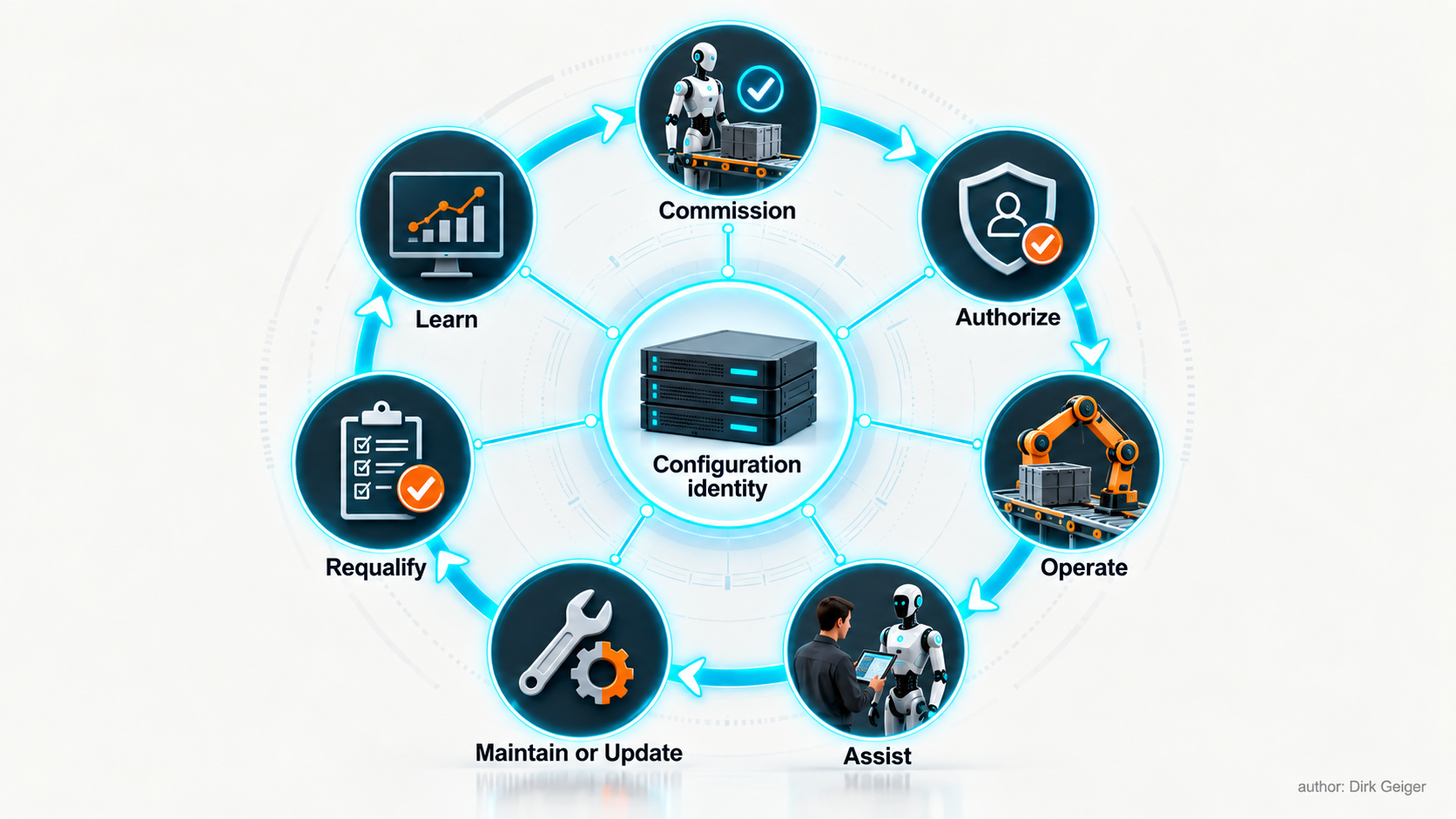
The closed fleet operating loop makes configuration identity the common reference for every handover. Commissioning produces evidence; authorization turns that evidence into bounded permission; operation generates new observations; assistance, maintenance and updates change state; requalification restores justified confidence. Learning enters the loop only after the evidence remains attributable to the configuration and conditions that produced it.
The lifecycle is a closed evidence loop: commission a known configuration; authorize it for a bounded mission and environment; observe service; intervene under controlled authority; maintain or update; requalify; learn from aggregated evidence; and retire identities cleanly. The loop protects continuity and also determines whether field experience becomes trustworthy product knowledge.
Commissioning creates operational identity
A robot arriving at a site is an inventory item. It becomes an operational asset only after the organization can answer four questions: What exactly is it? What is it allowed to do? Under which conditions is that permission valid? Who owns the decision?
The commissioning record should bind the physical unit to a configuration identity. That identity covers serialized hardware, replaceable modules, firmware, operating system, applications, AI models, parameter sets, calibration, safety configuration, certificates, maps and external service dependencies. A cryptographic hash can establish integrity for digital artifacts; it cannot establish that a particular artifact is appropriate for a mission. Authorization remains an engineering and governance decision.
A practical deployment authority record includes:
- robot and safety-controller identities, hardware revision and installed options;
- approved software, model, parameter and calibration versions;
- mission class, payload range, tools and permitted operating modes;
- mapped operating zone, traffic interfaces and environmental limits;
- required infrastructure, network services and minimum localization quality;
- supervision mode, remote-assistance permissions and escalation contacts;
- validation evidence, approver, validity period and explicit restrictions.
Site acceptance must test the combined system. ISO 3691-4:2023 treats the control system, guidance means and power system as parts of a driverless industrial-truck system and emphasizes the operating zone’s effect on safe operation [src-iso-3691]. For industrial robot applications, ISO 10218-2:2025 similarly places system integration and application context within the safety problem [src-iso-robotics]. Humanoid and mobile-manipulation deployments may fall under different standards depending on intended use, environment and product classification, yet the operational lesson holds: safety evidence is contextual.
Commissioning should exercise nominal missions and foreseeable degradation. Tests need to cover blocked paths, localization loss, network interruption, low battery, payload mismatch, protective-device activation, emergency stop, manual recovery and restart. The result is a baseline of observed behavior and a list of residual constraints. A green status without recorded test conditions has little value.
Release into service then becomes a state transition. The asset moves from installed to qualified, and from qualified to authorized. Only an authorized configuration receives production work. This simple separation prevents repaired, updated or partially commissioned units from drifting back into operation through scheduling pressure.
Operate from a shared state model
Fleet monitoring often begins with telemetry because telemetry is easy to collect. The result can be thousands of values, alert fatigue and weak operational understanding. Useful supervision starts with a shared state model that connects machine condition to service consequence.
| State | Operational meaning | Permitted response |
|---|---|---|
| Productive | Authorized mission is progressing within expected bounds | Continue and record service evidence |
| Degraded | Mission may continue with a known capability restriction | Apply degradation contract and increase observation |
| Waiting | Robot is healthy but blocked by work, traffic or infrastructure | Resolve upstream constraint |
| Assistance required | Local autonomy cannot resolve ambiguity within its authority | Route a bounded request to a qualified operator |
| Safe stopped | Motion is inhibited after a safety or operational condition | Diagnose, control hazards and authorize recovery |
| Maintenance | Unit is isolated from production scheduling | Execute controlled work and capture as-maintained identity |
| Quarantined | Integrity, safety or configuration confidence is insufficient | Preserve evidence and block return to service |
Signals should feed these states through explicit rules. Battery state alone rarely decides productivity. The decision may depend on charge, temperature, predicted mission energy, charger availability and route congestion. A localization-confidence threshold may permit slow travel in one zone and require a stop near an exposed edge. Context converts measurements into operating decisions.
Alert design follows the same principle. Each actionable alert needs an owner, severity, required response time, evidence bundle and closure condition. Repeated warnings without an expected action become noise. A fleet can be healthy while producing many informational events, and unhealthy while producing none because a reporting path has failed. Monitoring must therefore include observability health: clock synchronization, telemetry completeness, communication delay, logger capacity and identity consistency.
The control room should expose dependencies as first-class status. A robot waiting for an elevator, map service or work-cell handshake is unavailable to the process even when every onboard diagnostic is green. The causal chain matters because local resets cannot repair an upstream constraint. Good operational views answer three questions in one glance: What service is affected? Which dependency is limiting it? Which competent role owns the next decision?
State transitions also need timers and invariants. A unit may remain in waiting for ten minutes because a workstation is busy, then cross an operational threshold because its next mission and remaining charge no longer fit. A robot marked degraded may complete the current delivery while being barred from accepting another. The fleet service should evaluate these conditions consistently and record why each transition occurred. Otherwise, the dashboard becomes a collection of labels applied after the fact.
Local autonomy and fleet orchestration should exchange contracts instead of assumptions. The fleet assigns a mission with payload, destination, priority, validity window and required capability. The robot accepts, rejects or counteroffers using its current capability and energy state. Acceptance creates a traceable commitment. If circumstances change, the robot reports the reason and the service reschedules work. This prevents a central optimizer from treating every robot as interchangeable while allowing the machine to protect limits known only locally.
Capacity planning emerges from the same data. Peak fleet count alone says little about resilience. Operators need to know how many units can be unavailable while priority service remains achievable, which chargers or gateways create single points of congestion, and how assistance demand behaves during disturbances. Scenario tests can combine demand surges, reduced charging capacity, wireless degradation and maintenance backlog. The result is an operational envelope for the fleet itself.
Shift handover should transfer this state explicitly. The outgoing team records unresolved degradations, quarantined units, temporary zone restrictions, active release cohorts, spare constraints and open incident actions. The incoming team confirms ownership and expiry conditions. Verbal context remains useful, while the authoritative state stays in the controlled record. A fleet that depends on remembering yesterday's exception is already operating outside its documented configuration.
Remote assistance needs bounded authority
As autonomy expands, human work shifts from continuous control to exception handling. This can improve scale, provided remote assistance is engineered as a controlled interface. A person seeing one camera view and a simplified map has incomplete physical context. Latency, stale data, occlusion and interface compression can make a confident intervention unsafe.
Assistance should resolve ambiguity without silently transferring unlimited motion authority. The robot submits a structured request containing its state, reason for escalation, relevant observations, uncertainty, proposed options and applicable constraints. The operator may classify an object, select a route candidate, approve a bounded maneuver or dispatch local support. Local real-time and safety functions continue to enforce speed, force, collision, stability and zone limits.
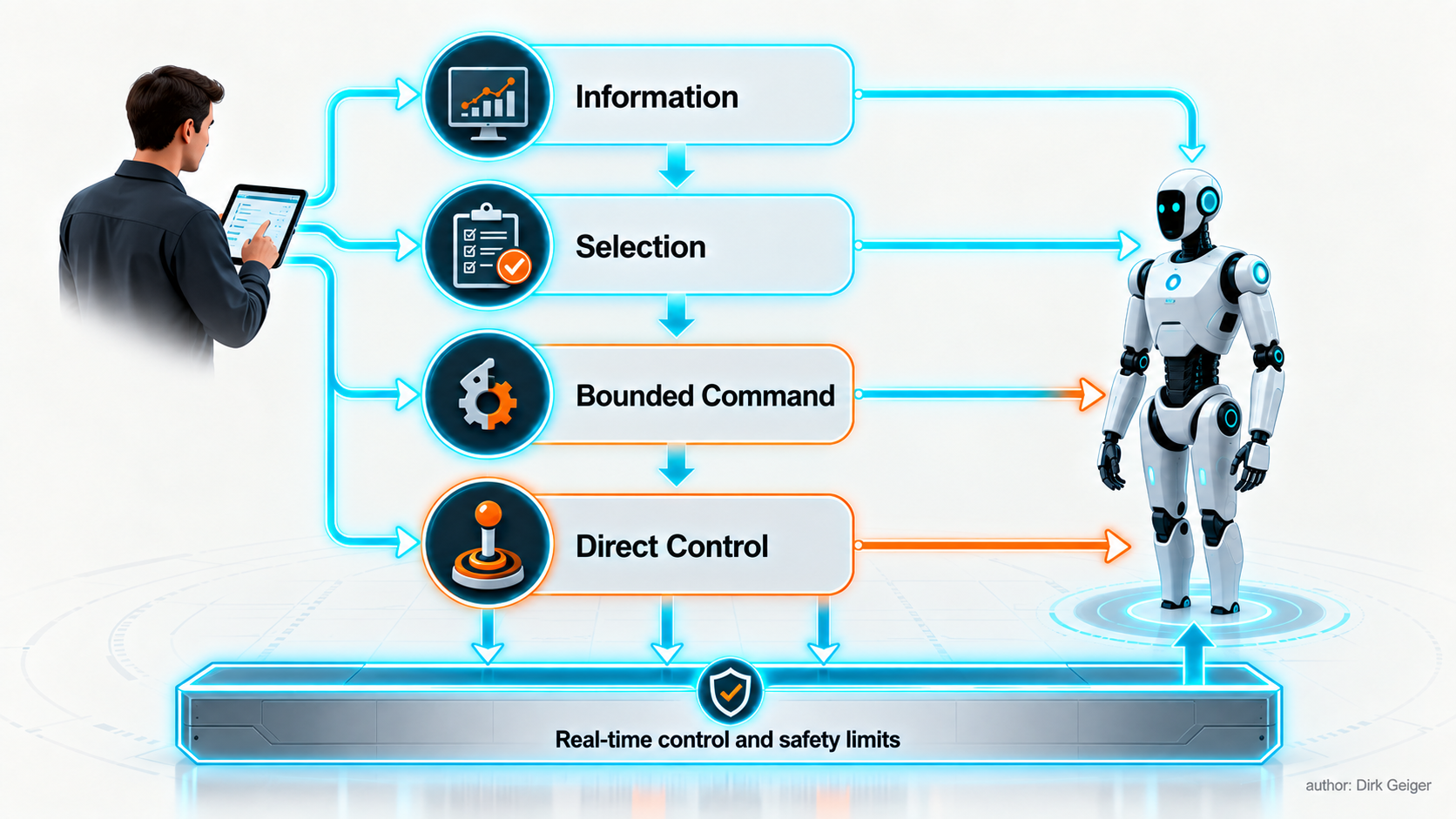
The authority-layer model preserves one invariant: local real-time control and safety limits remain active beneath every assistance mode. Information changes interpretation. Selection chooses among checked options. A bounded command requests a limited physical outcome. Direct control carries the greatest exposure and therefore needs the tightest conditions. Each level changes the human role without dissolving the robot's local containment.
Four authority levels create a usable escalation ladder:
- Information: the operator adds a label or confirms a condition; the robot plans the action.
- Selection: the operator chooses among robot-generated options already checked against constraints.
- Bounded command: the operator requests a limited displacement or mode change under local containment.
- Direct control: a specifically authorized mode with defined latency, visibility, speed and site controls.
Every session requires authenticated identity, role-based permission, timestamps, command provenance and an auditable start and end. The interface must show data age and communication quality because an apparently live image may already describe a world that has changed. If the channel degrades, the robot follows a predetermined degradation contract.
Intervention rate is also a product signal. It should be segmented by mission, site, software, environment and cause. A falling average can hide a severe cluster in one configuration. A rising rate may indicate degraded sensors, changed lighting, poor map governance, a software regression or a newly assigned task outside the validated envelope. Operations closes the immediate exception; engineering owns the recurring pattern.
Every update is a controlled experiment
Software gives a fleet its learning velocity and its largest source of configuration drift. A release can improve perception while changing compute load, thermal behavior, network traffic, stopping response or battery endurance. AI model updates add dataset and behavior dependencies beyond conventional version labels.
NIST’s Secure Software Development Framework organizes secure development around preparing the organization, protecting software, producing well-secured software and responding to vulnerabilities [src-nist-ssdf]. NIST’s AI Risk Management Framework adds governance, mapping, measurement and management of AI risks across the lifecycle [src-nist-airmf]. Fleet change control should translate these broad practices into a deployment gate:
- identify every changed artifact, dependency and expected behavioral effect;
- link requirements, tests, known limitations, cybersecurity review and rollback conditions;
- test in simulation and representative hardware where each provides meaningful evidence;
- deploy to a canary group selected for observability and controlled exposure;
- compare safety, service, intervention, energy and resource metrics against a baseline;
- expand in stages with automatic pause criteria and preserved rollback compatibility;
- reissue deployment authority for the new configuration.
A canary is useful only when its operating conditions are known. Five lightly loaded robots on a clean route provide weak evidence for a release destined for ramps, reflective surfaces and heavy payloads. The canary matrix should cover the risks introduced by the change.
Rollback also needs engineering. Database schemas, calibration formats, maps, certificates and learned state may become incompatible with an older release. A safe rollback plan defines which state can be restored, which must be migrated, and how the machine is requalified. If state restoration is uncertain, the correct operational state is quarantine.
Configuration cohorts keep staged deployment understandable. A cohort should be defined by the variables that can materially change behavior: hardware generation, sensor set, site type, mission class, payload, safety configuration and relevant environment. Version numbers alone create false uniformity. Two robots running identical code may experience different inference latency because of thermal conditions or accelerator revisions. Cohort analysis makes that difference visible before it becomes a fleet-wide argument about averages.
Approval evidence should be proportional to consequence. A user-interface correction may need focused regression testing. A change to obstacle classification, motion constraints, battery limits or safety communications warrants broader verification and explicit authority. The classification decision, its rationale and the resulting test scope belong in the release record. This creates a repeatable threshold for future changes and prevents urgency from redefining risk at every deployment.
Software provenance extends into the supply chain. Operations needs an inventory of first-party components, third-party libraries, model artifacts and device firmware sufficient to evaluate vulnerability or compatibility notifications. The practical question after a supplier alert is immediate: which authorized robots contain the affected component, in which mission contexts, and with what containment options? A fleet that cannot answer must inspect machines individually while exposure continues.
The European Union’s Machinery Regulation 2023/1230 explicitly addresses safety risks associated with new digital technologies and becomes generally applicable on 20 January 2027 [src-eu-machinery]. Product classification and legal obligations require case-specific assessment, yet the direction is clear: software and cybersecurity changes can affect machinery safety. Release governance belongs inside the safety and asset-management system.
Maintenance begins with evidence
Preventive schedules remain useful for wear items and mandated inspections. Condition evidence can make interventions more precise. Motor current residuals, temperature, vibration, encoder disagreement, battery impedance, connector errors, localization quality and intervention history may reveal degradation before loss of function. Prediction supports accountable decisions when engineers combine model output with known failure modes, measurement quality and inspection evidence. Removing a robot from service or extending a safety-critical interval still requires an authorized decision.
A maintenance work order should begin with the observed symptom, event context and configuration identity. The technician records isolation, diagnosis, measurements, replaced serialized parts, firmware or parameter changes, calibration actions and final tests. The resulting as-maintained configuration becomes a new controlled state.
Energy isolation deserves explicit procedures. OSHA’s control-of-hazardous-energy standard requires an energy-control program and procedures to prevent unexpected energization, start-up or release of stored energy during servicing [src-osha-loto]. Mobile and humanoid robots complicate this task through batteries, DC links, spring forces, elevated limbs, gravitational loads and remote wake paths. Site procedures must address every hazardous energy source and the applicable local law.
Spares management is configuration management in physical form. A mechanically compatible joint may contain a different encoder, controller revision or calibration process. A battery may fit while carrying a different firmware or current limit. Approved substitution rules should state the compatible hardware range, required software, commissioning tests and traceability. Emergency substitutions without those controls exchange a visible downtime problem for a hidden fleet divergence.
Service planning should combine criticality, failure mode, lead time, observed consumption and recoverability. A low-cost proprietary connector can stop an entire unit. A costly compute module may justify few local spares if secure replacement and rapid logistics are reliable. The target is service continuity at controlled risk.
Maintenance effectiveness needs its own feedback loop. A replaced part followed by recurring symptoms suggests incomplete diagnosis, an upstream cause or an unsuitable repair instruction. First-time-fix rate, repeat failure, diagnostic time and post-maintenance intervention rate reveal whether the service system is learning. These measures should be segmented by failure mode and configuration because an aggregate can reward easy repairs while hiding chronic complex defects.
Technician tools are part of the trusted operating environment. Service laptops, diagnostic adapters and calibration equipment require controlled identities, approved software and access appropriate to the task. Temporary credentials should expire. Parameter changes should be validated against permitted ranges and written to the maintenance record automatically where possible. A handwritten note describing an untracked adjustment is operational debt with a physical consequence.
An incident is an operational and learning event
When a robot makes contact, drops a load, crosses a boundary or behaves unexpectedly, the first obligations are human safety, hazard control and scene stabilization. The next is evidence preservation. Power cycling, log rotation and ad hoc software changes can destroy the causal record within minutes.
An incident trigger should freeze a time window containing synchronized sensor summaries, state estimates, safety-controller events, commands, operator actions, network status, software and model identity, calibration, map and mission context. Privacy and data-minimization rules still apply. The evidence contract defines what is recorded, who can access it, how integrity is protected and how long it is retained.
Investigation separates observations from interpretations. The robot stopped 0.6 metres beyond the expected point is an observation if measurement provenance and uncertainty are known. The planner ignored the boundary is a hypothesis until the command path, map version, localization state and controller response are reconstructed. Competing explanations should remain open until evidence eliminates them.
Escalation paths need preassigned roles: site operations controls the area and service; safety leads the hazard assessment; cybersecurity handles suspected compromise; engineering reconstructs behavior; quality controls corrective action; legal and privacy specialists address reporting and data obligations; the fleet authority decides quarantine and return to service. One person may hold several roles in a small deployment, but the decisions remain distinct.
Return to service requires a documented cause or bounded uncertainty, completed corrective action, relevant regression tests and renewed authorization. A symptom that disappeared after restart is unresolved. A fleet-wide containment action may be necessary before root cause is complete: disable one mission, reduce speed, exclude a zone or pause a software cohort. This is operational prudence, provided the temporary restriction is recorded and later reviewed.
Measure useful service
A robot can be moving and producing no value. It can be stationary while performing a useful inspection. Fleet metrics therefore need a service denominator connected to the job.
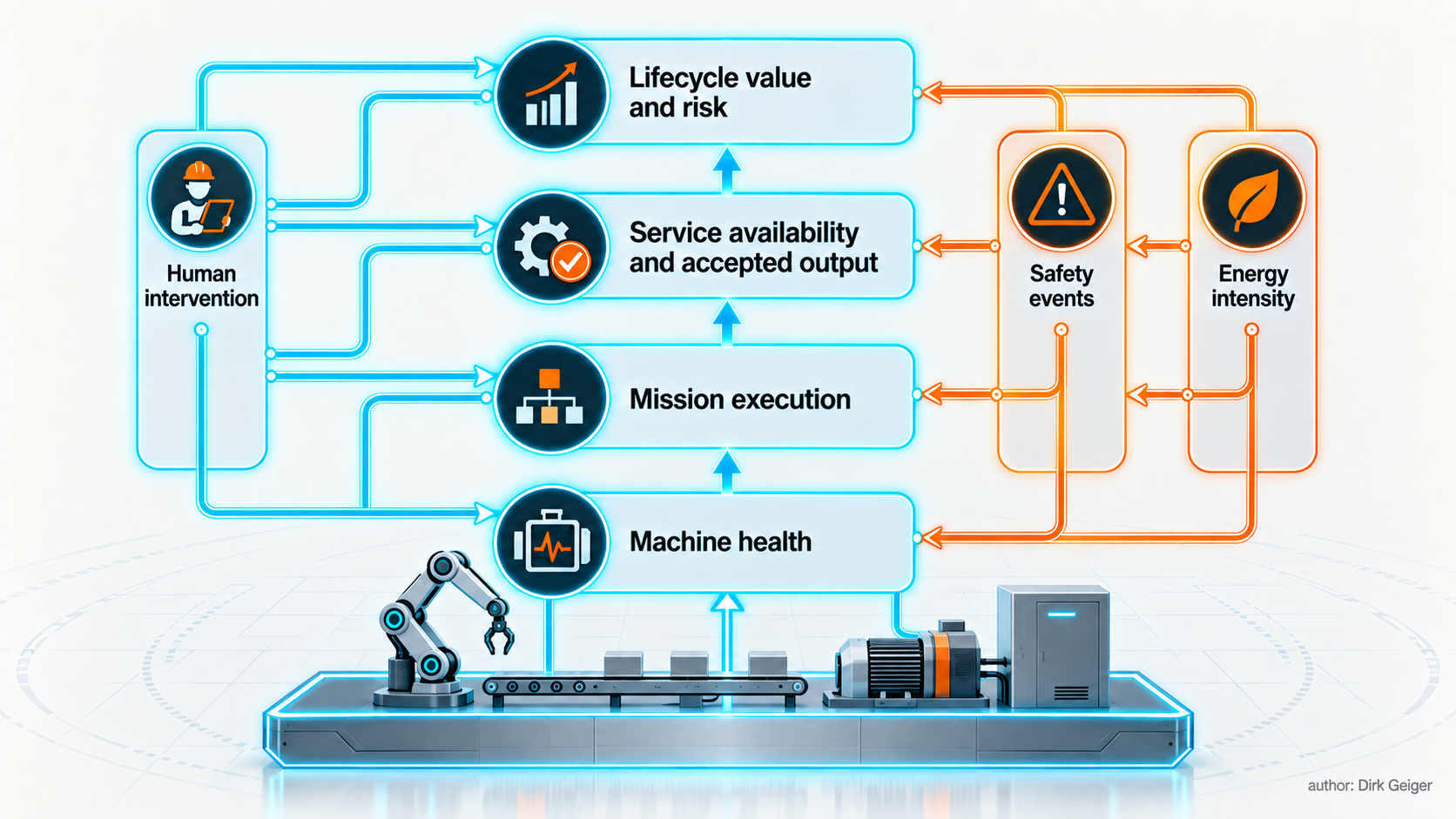
The fleet metric stack connects machine health to mission execution, accepted service and lifecycle value. Human intervention, safety events and energy intensity cross several layers because each can reveal a local technical issue or a system-level operating constraint. This prevents a healthy-device signal from being mistaken for productive service and keeps executive outcomes traceable to engineering evidence.
| Metric | Working definition | Interpretation risk |
|---|---|---|
| Productivity | Accepted output per defined operating period | Counts can reward incomplete or low-quality work |
| Service availability | Time the required service was capable when demanded | Machine uptime may ignore blocked infrastructure |
| Mission success | Accepted missions divided by attempted missions | Easy missions can mask weak capability |
| Intervention rate | Qualified human interventions per mission or operating hour | Definitions must separate assistance from routine approval |
| Safety events | Events by severity, exposure and operating context | Raw counts ignore changing fleet hours and near-miss quality |
| Energy intensity | Energy per accepted unit of service | Charging and infrastructure losses may be omitted |
| Lifecycle cost | Full cost per accepted unit of service | Remote labor, spares, integration and downtime are easily hidden |
Availability should be decomposed into robot, infrastructure, scheduling and process causes. Mean time to repair is insufficient when diagnosis consumes most of the outage or a unit waits days for approval. Useful submetrics include time to detect, time to classify, hands-on repair time, logistics delay, requalification time and time to resume accepted service.
Safety reporting needs exposure. Ten contact events across one million completed handling cycles tell a different story from ten events during a short pilot. Severity, potential severity, proximity to people, speed, force, task and safeguard response all matter. Near-miss reporting can expose weakening margins earlier, provided the organization protects reporting quality and avoids incentives that simply suppress event classification.
Energy metrics should include the service boundary. Onboard battery discharge captures only part of the demand. Charger conversion losses, battery conditioning, idle infrastructure and failed missions can materially change energy per accepted task. A robot that completes a route with lower onboard energy may still increase facility energy if it causes congestion or more frequent charging. The chosen boundary should be declared next to the metric.
Metrics require controlled definitions, clocks and data lineage. A mission success rate changes meaning if retries are silently combined, cancelled work is excluded or acceptance criteria vary by site. The metric dictionary is part of configuration control. Changes need versioning so trends remain interpretable.
Executive reporting should connect technical performance to economic consequence. Energy per task, assisted minutes per shift, scheduled-maintenance compliance, lost production and configuration divergence explain where value is gained or leaked. The strongest fleet metric is often the percentage of service delivered by a currently authorized configuration. It reveals whether operational growth is supported by control or by accumulated exceptions.
Scale the operating model before the fleet
A pilot can survive through the memory of three engineers. A fleet cannot. Scaling requires role clarity, machine-readable identity, standardized evidence and decisions that can be repeated across sites and shifts.
The minimum organization includes an accountable fleet-service owner; site operations; safety and compliance; platform and application engineering; release and configuration management; cybersecurity; maintenance and spares; data governance; and supplier escalation. A responsibility matrix should name who proposes, verifies, approves, executes and audits each high-impact action. Separation of duties becomes important when one software team could otherwise develop, approve and deploy its own safety-relevant change.
Competence must scale with the technology. Operators need to recognize degraded behavior and preserve evidence. Remote assistants need a precise understanding of authority modes, data age and local site constraints. Technicians need safe isolation, configuration and calibration competence. Engineers need enough operational context to interpret fleet data without reducing every anomaly to a software defect. Refresher training should follow meaningful changes in missions, interfaces, safety functions and recovery procedures.
Retirement is the final controlled transition. The organization removes the unit from scheduling, captures its final configuration and service history, revokes credentials, preserves required evidence, sanitizes data, records reusable or regulated components and closes supplier and asset records. A refurbished module entering another robot receives a new traceable context. A retired identity must never remain able to authenticate to fleet services.
The evidence loop then reaches product improvement. Field observations are aggregated by configuration and operating context; recurring problems become engineering hypotheses; changes are verified; release evidence returns to operations. Fleet learning is valuable only when the organization can distinguish causation from coincidence and can trace an improvement back to the machines and conditions that justified it.
That discipline can appear slower than an emergency patch or a quick restart. At scale, it is the faster system. It reduces repeated diagnosis, ambiguous incidents, incompatible spares, hidden configuration forks and updates that improve one metric while damaging another. A dependable robot fleet is built twice: once as machines, and again as an operating institution.
Glossary
- Configuration identity
- An attributable description of hardware, software, models, parameters, calibration and dependencies defining a deployed robot state.
- Deployment authority record
- A controlled record binding permission to a mission, configuration, environment, supervision mode, constraints and validity period.
- Health state
- A continuously updated representation of component and system condition derived from diagnostics, telemetry, confidence and mission context.
- Degradation contract
- A defined system response describing what function remains, what is restricted and how recovery occurs after communication is lost or degraded.
- Command provenance
- Traceable relationships linking an action request to acceptance, modification, transmission, application and observed response.
- Causal event log
- A time-coherent record of cause-effect relationships among observations, decisions, safety interventions, commands and outcomes.
- Circular buffer
- Finite storage that replaces its oldest entries as new data arrives unless records are preserved.
- Evidence integrity
- The property that recorded evidence remains attributable, complete enough for its purpose and protected against undetected alteration.
- Fleet learning
- Use of aggregated operational evidence from multiple deployed robots to improve models, thresholds, maintenance and future designs.
- Deterministic recommissioning
- A controlled restart process verifying identity, configuration, hardware health, safety state and readiness before operational release.
Abbreviations
- AI
- Artificial intelligence
- AMR
- Autonomous mobile robot
- DC
- Direct current
- ISO
- International Organization for Standardization
- NIST
- National Institute of Standards and Technology
- OSHA
- Occupational Safety and Health Administration
- SSDF
- Secure Software Development Framework
Sources
- ISO launches new standards in the 55000 Asset Management series · 2024-07-03
ISO describes updated requirements for asset decisions, value, risk, data, knowledge and lifecycle operations in ISO 55001:2024.
https://committee.iso.org/home/tc251 - ISO 3691-4:2023 — Driverless industrial trucks and their systems · 2023-06
The standard specifies safety requirements and verification for driverless industrial trucks, their control systems, guidance and operating zones.
https://www.iso.org/standard/83545.html - ISO Robotics — Top standards · 2025
ISO lists current robot safety standards, including 2025 requirements for industrial robots, applications and integrated robot cells.
https://www.iso.org/sectors/engineering/robotics - Secure Software Development Framework Version 1.1: Recommendations for Mitigating the Risk of Software Vulnerabilities · 2022-02-03
NIST defines outcome-based secure software practices covering organizational preparation, software protection, secure production and vulnerability response.
https://csrc.nist.gov/pubs/sp/800/218/final - Artificial Intelligence Risk Management Framework · 2023-01-26
NIST provides a voluntary framework for governing, mapping, measuring and managing trustworthiness risks throughout AI system lifecycles.
https://www.nist.gov/itl/ai-risk-management-framework - Regulation (EU) 2023/1230 on machinery · 2023-06-14
The regulation establishes EU machinery requirements and addresses safety risks arising from connected and evolving digital technologies.
https://eur-lex.europa.eu/eli/reg/2023/1230/oj - 29 CFR 1910.147 — The control of hazardous energy · 1989-09-01
OSHA requires energy-control programs and procedures protecting workers from unexpected energization, start-up or stored-energy release during servicing.
https://www.osha.gov/laws-regs/regulations/standardnumber/1910/1910.147