
Technical Paper / IEEE-style
Building Robots at Scale
From Prototype Freedom to Configuration-Controlled Product Families
Robot industrialization is a lifecycle engineering problem. Scalable product families require controlled interfaces, qualified suppliers, traceable production, repeatable calibration, end-of-line evidence, software configuration integrity, repairable modules and disciplined circular flows. The decisive capability is preserving trustworthy configuration identity as robots are built, updated, serviced and remanufactured.
Abstract
Robot industrialization is a system-engineering problem spanning architecture, manufacturing, quality, software configuration, service and end-of-life control. A prototype proves that a machine can work; a scalable product family must demonstrate that thousands of nominally equivalent machines can be built, tested, updated, repaired and traced with predictable cost and performance. The required operating discipline centers on modularity, variant control, supplier qualification, end-of-line testing, calibration, digital thread, repairability and circular product flows.
1. Industrialization Changes the Engineering Problem
A robot prototype is usually optimized for learning. Engineers want access, flexibility and the freedom to change components quickly. A production robot is optimized for repeatability. Every connector, fastener, calibration parameter, software image and replacement procedure becomes part of a controlled system. The decisive change is a change in the unit of engineering: the object becomes a reproducible population of robots whose identities and configurations remain trustworthy throughout their lives.
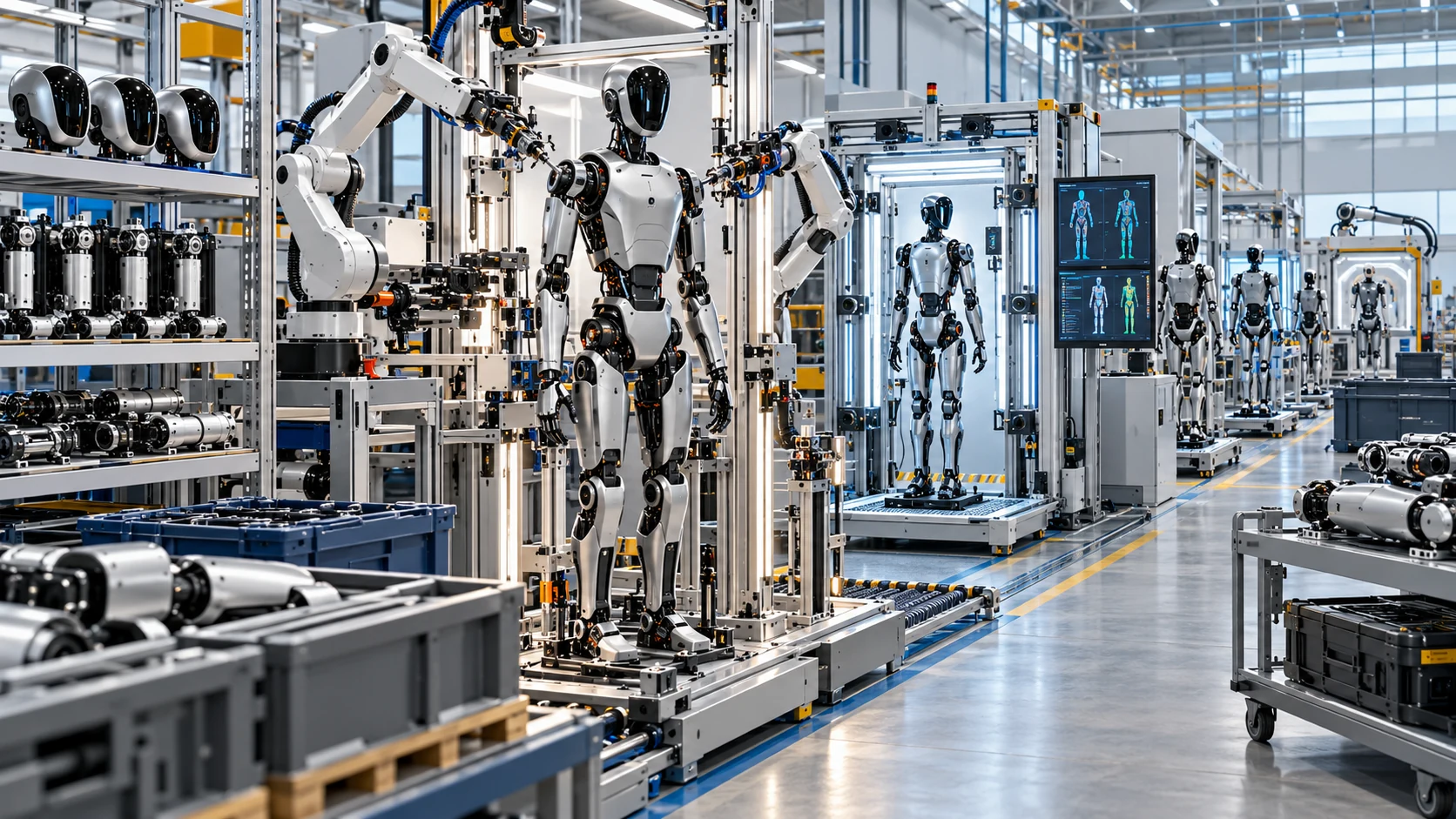
That distinction is now becoming concrete. Agility Robotics announced its RoboFab facility with a stated capability above 10,000 Digit robots per year, while BMW has used humanoid robots in an automotive production environment to learn what practical integration requires [1], [2]. These examples remain early relative to mature automotive or consumer-electronics volumes, yet they expose the same industrialization physics. Scale amplifies variation. A small geometric tolerance becomes an assembly yield problem. A manually entered calibration value becomes a fleet-quality risk. A convenient engineering substitution becomes a configuration-management burden. A poorly located connector becomes minutes of service time multiplied across thousands of field interventions.
Industrialization is the controlled conversion of engineering variation into manufacturing capability. Product families need variants, suppliers change, software evolves and robots age. Each permitted difference must therefore be intentional, identified, testable and supportable.
Quality-management systems formalize this logic at organizational level. ISO 9001:2026 describes requirements for establishing, maintaining and continually improving a quality management system [3]. Robotics adds machine-specific requirements. ISO 10218-1:2025 addresses industrial robot safety at the robot level, while ISO 10218-2:2025 covers robot applications and cells through integration, commissioning, operation, maintenance and decommissioning [4], [5]. These standards provide lifecycle safety requirements and leave detailed manufacturing methods to the product and production system. They reinforce an important industrial principle: lifecycle obligations begin in architecture and continue well beyond final assembly.
2. Platform Architecture, Modularity and Variant Control
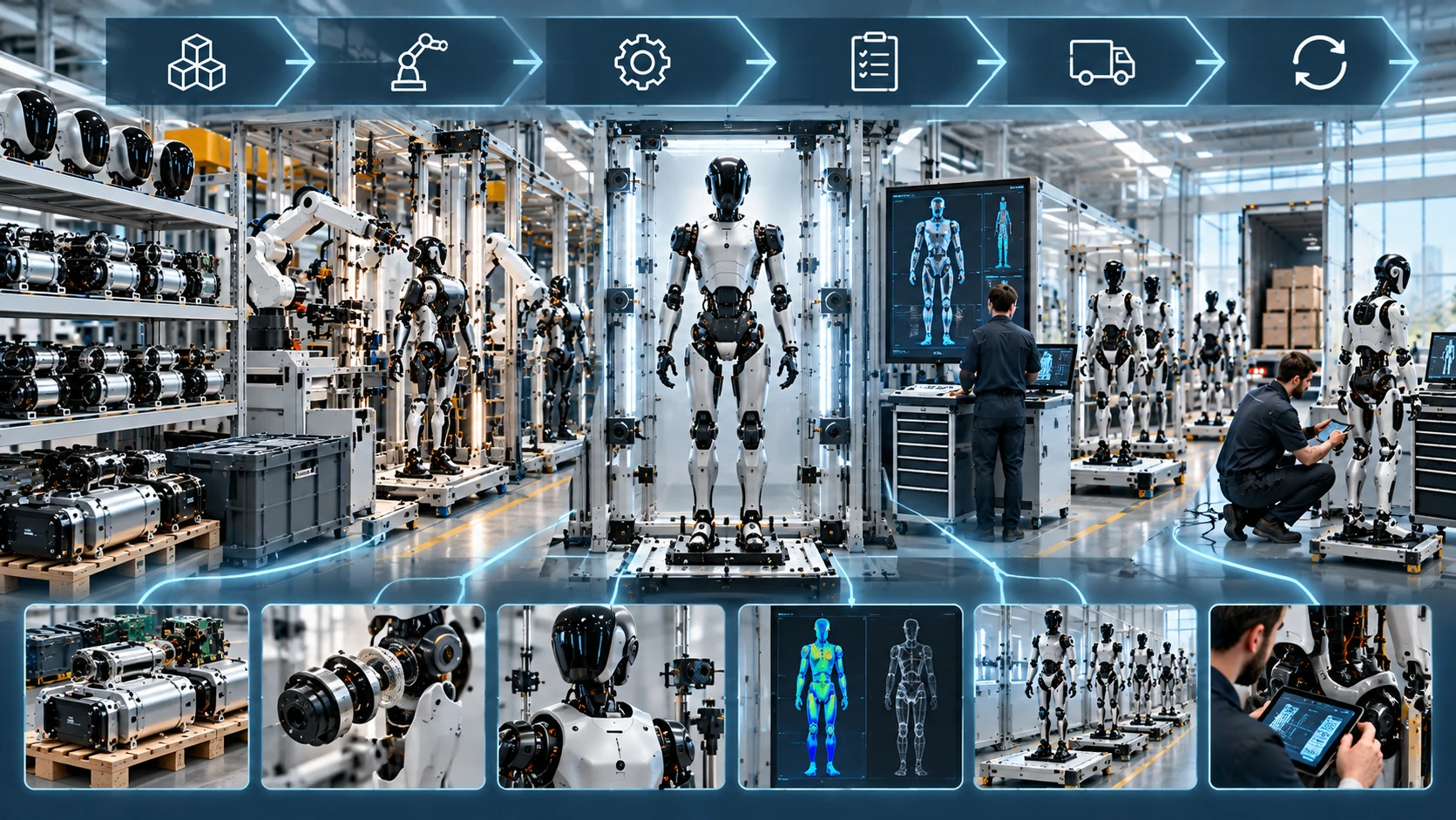
Volume production rewards architectures that separate stable interfaces from replaceable modules. In robotics, useful platform boundaries often include battery and power distribution, compute, communication, actuator families, joint modules, sensor clusters, end effectors and safety supervision. The exact partition depends on robot morphology, payload, environment and service model. The engineering test is whether a module can change while the rest of the machine remains inside controlled interface and qualification boundaries.
A scalable platform should define mechanical, electrical, thermal, communication and software contracts at each module boundary. Mechanical contracts include datums, allowable tolerance stack-up, fastener strategy and load paths. Electrical contracts include voltage range, inrush, current limits, grounding and protection behavior. Communication contracts include physical layer, addressing, timing, diagnostics and update mechanisms. Software contracts define interfaces, version compatibility and fallbacks. Thermal contracts define heat-flow assumptions and permissible derating. These contracts turn modularity from a block diagram into a production mechanism.
The most expensive variant is often the one that appears small. A second encoder, a different motor winding, an alternate connector or a region-specific wireless module can create new drawings, work instructions, fixtures, spare parts, software branches and test limits. Variant count therefore needs explicit governance. A practical architecture distinguishes between customer-visible variants, which create market value, and internal variants, which primarily create operational complexity. The latter should be aggressively reduced unless they improve availability, cost, sourcing resilience or regulatory coverage.
Platform reuse is strongest when one qualification investment serves many products. A common joint family can share motor-control electronics, firmware, diagnostic coverage and production test infrastructure. A common compute carrier can support several performance grades through controlled population or software configuration. A standardized service interface can reduce repair tooling. The economic value comes from repeated use of the same validated process across product configurations.
Architecture decisions should therefore be evaluated with a manufacturing multiplier. A component saving one euro but creating an additional calibration station, supplier path or field spare may increase lifecycle cost. Conversely, a more expensive standardized module can lower total cost if it improves yield, shortens end-of-line test, reduces training or allows rapid field replacement. The useful optimization target is lifecycle cost and availability across the complete product system.
3. Supplier Qualification and Part-Variety Discipline
Robots combine high-current power electronics, precision mechanics, batteries, sensors, computing, networking and software. This creates a supplier landscape with very different maturity levels. Industrialization requires a common qualification logic across those domains while preserving domain-specific evidence.
Supplier selection should move beyond nominal specification matching. For each critical component, qualification should address process capability, change control, traceability, failure analysis, lifecycle support, second-source feasibility and the supplier's ability to sustain production excursions. A prototype team asks whether a component works. A production team must also ask whether its manufacturing distribution is stable, whether revisions are communicated before shipment, whether lot genealogy can be reconstructed and whether a failure can be contained without stopping the entire robot line.
Part-variety reduction is one of the highest-leverage industrialization actions because its benefits compound. Fewer unique components reduce incoming-inspection complexity, inventory, warehouse positions, feeder setups, operator training, firmware combinations and service stock. They also increase purchasing leverage and simplify alternate sourcing. The objective should be a controlled parts library in which preferred components and approved alternates are defined at platform level.
Criticality should determine qualification depth. A decorative cover and a joint-position sensor do not deserve the same process. Components whose failure can cause unsafe motion, loss of state estimation, thermal overstress, battery hazards or immobilization need stronger evidence and tighter change control. Supplier qualification should also consider latent defects whose effects appear after many operating hours. For high-utilization robots, lifecycle testing, accelerated stress, contamination exposure, connector cycling and thermal-cycling data can become as important as initial functional inspection.
A mature sourcing model links approved manufacturer part numbers, supplier sites, process revisions and incoming lots to the robot serial numbers that consume them. This link becomes indispensable during containment. Without it, a suspected supplier problem can force broad fleet action. With it, the affected population can be isolated precisely.
4. End-of-Line Test as a Product Architecture
End-of-line testing is frequently treated as the last manufacturing operation. For complex robots it should be designed as an architectural function from the beginning. A robot contains too many interacting domains for a single “power on and move” check to provide adequate coverage. Effective end-of-line test combines component genealogy, electrical integrity, communication health, sensing, actuation, calibration, safety mechanisms, software identity and system performance.
The digital-thread work at NIST emphasizes reuse and traceability of product information across engineering, manufacturing and inspection, including model-based manufacturing and quality data [6]–[8]. That principle applies directly to robots. Test limits should originate from controlled engineering definitions. Test results should return to the same product information environment. A limit edited locally at a station without configuration control creates a gap between design intent and shipment evidence.
A layered end-of-line strategy is useful:
- Identity and configuration: verify serial numbers, hardware revisions, firmware, safety configuration, calibration set and security credentials.
- Electrical integrity: check insulation where applicable, rail voltages, current consumption, protection functions, battery communication and grounding behavior.
- Network integrity: verify expected nodes, communication quality, time synchronization and diagnostic status.
- Sensor integrity: evaluate offsets, plausibility, noise, field of view where practical and cross-sensor consistency.
- Actuator integrity: measure direction, current response, torque or force proxies, encoder alignment, friction signatures and thermal response.
- Safety functions: exercise defined protective and shutdown functions with traceable pass/fail evidence.
- System performance: execute a bounded motion or task sequence that detects integration failures invisible at component level.
ISO 9283 defines performance criteria and test methods for manipulating industrial robots and remains current after review, providing established concepts for accuracy, repeatability and related performance evaluation [9]. A humanoid or mobile manipulator may need additional tests beyond ISO 9283, especially for locomotion, multi-contact manipulation and perception. The broader lesson remains valuable: performance needs measurable criteria, controlled test conditions and repeatable methods.
Test coverage should be designed with fault isolation in mind. A station that only reports “robot failed” creates rework queues. A station that identifies the failed subsystem, suspect signal and relevant genealogy reduces mean time to repair and generates engineering data. End-of-line testing is therefore both a gate and a sensor for the factory.
5. Calibration Must Become a Controlled Production Asset
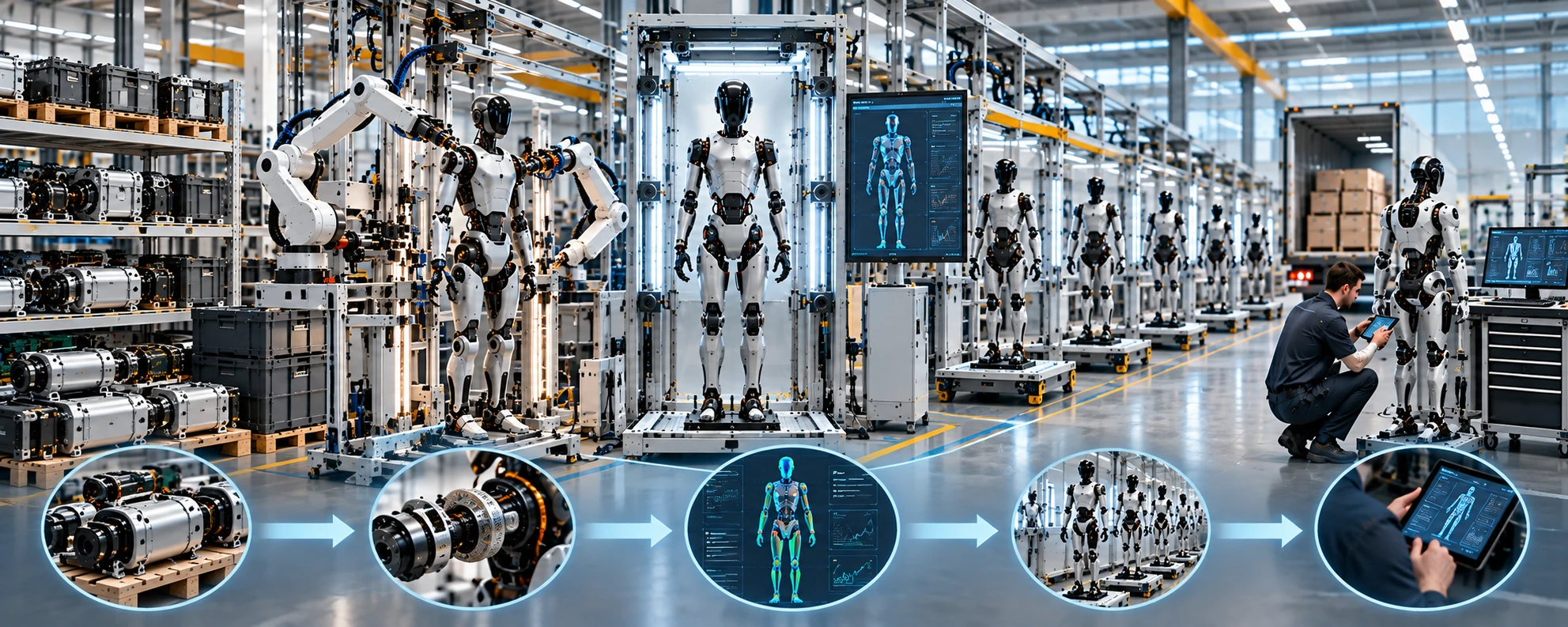
Modern robots depend on calibration for kinematics, joint zero positions, cameras, inertial sensors, force or torque sensors, tactile systems and battery or thermal models. In prototypes, calibration is often a technician activity. At scale it becomes a production data product.
Each calibration result should answer five questions: what was calibrated, against which reference, with which method, under which conditions and for which identified hardware and software configuration. The resulting parameter set needs versioning, provenance and validity rules. A replacement camera may invalidate an extrinsic transform. A changed gearset may require joint recalibration. A firmware update may alter compensation behavior. Treating calibration as an anonymous file copied onto a robot hides these dependencies.
Calibration stations should separate measurement uncertainty from product tolerance. If the test fixture is only slightly more accurate than the requirement, apparent production variation can be dominated by the measurement system. Gauge capability, reference maintenance and fixture verification therefore belong in the industrialization plan. The highest-value station has understood measurement uncertainty and links its output unambiguously to product configuration.
Calibration also affects service strategy. Some procedures require factory equipment, while others can be performed automatically after module replacement. Designing self-calibration or guided calibration into the product can reduce depot time and enable modular repair. This is particularly important for fleets where availability matters more than the cost of an individual spare.
6. Digital Thread and Configuration Integrity
The digital thread is the connective tissue between product definition, manufacturing evidence and field history. NIST describes it as information flowing through design, manufacturing and product support, with traceability and reuse across lifecycle processes [6]. For robots, the thread must extend into software and learned capability as well as hardware.
A useful robot identity record should bind the product serial number to its major modules, critical component lots, manufacturing route, test results, calibration records, software baseline and security identity. The field record then adds repairs, module replacements, firmware updates, configuration changes, significant faults and, where appropriate, usage counters. The result is an attributable configuration history that extends the bill of materials through field life.
Two visually identical robots may behave differently when firmware, calibration data, actuator revisions or model packages diverge. At fleet scale, configuration ambiguity becomes an operational risk. A field issue cannot be reproduced reliably if engineering does not know the exact configuration that produced it. A software rollout cannot be risk-managed if hardware compatibility is uncertain.
Global identifiers and structured quality information are recurring themes in manufacturing digitalization. NIST's current digital-thread program specifically identifies gaps around globally unique identifiers, semantic product and manufacturing information, conformance testing and trust in data assets [6]. Robots intensify these requirements because their configuration changes after shipment.
The design target should be a configuration identity that can be queried at any point in the lifecycle. For a given robot, authorized systems should be able to determine the hardware baseline, software and model baseline, calibration state, safety configuration and service history. Changes should generate a new attributable state while retaining the previous state for audit and rollback analysis.
Cybersecurity belongs inside this mechanism. IEC 62443-4-1 defines secure product-development lifecycle processes including requirements, secure design, implementation, verification, defect management, patch management and end-of-life [10]. Where a robot product falls outside the direct application profile of a particular industrial-automation standard, the lifecycle discipline can still provide useful engineering guidance. Manufacturing must provision device identities securely, prevent unauthorized software substitution and preserve trustworthy configuration records.
7. Quality Systems for Hardware, Software and Learning Systems
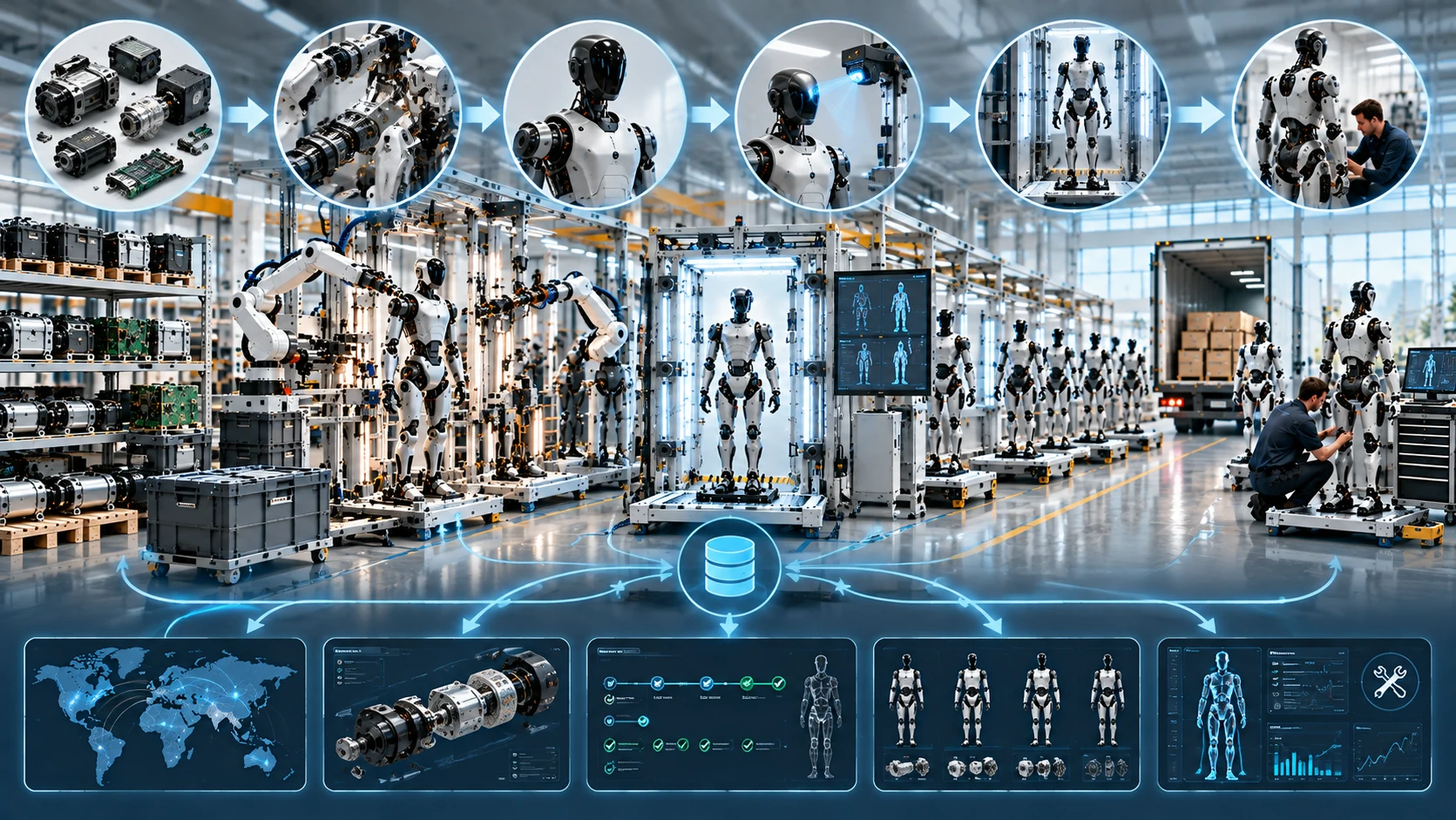
Traditional manufacturing quality focuses strongly on physical conformance. Robots add software-defined behavior and, increasingly, AI models whose performance may change with version, data and operating context. The quality system must therefore manage three interacting layers: physical product quality, software/configuration quality and behavior validation.
Physical quality still begins with capable processes. Critical dimensions, fastening processes, adhesive cure, cable routing, thermal interfaces and connector mating require measurable controls. Statistical process control is useful where process distributions are stable and repeated. Automated inspection should be applied where the failure mode, detection coverage and process economics justify it.
Software quality requires controlled builds, reproducible release artifacts, compatibility rules and signed deployment packages. Production must know exactly which release is authorized for which hardware configuration. A workstation should not depend on an engineer remembering the correct image. The software load process should be as controlled as installing a safety-critical physical component.
Learning systems add another challenge: a model version may be technically installable yet operationally unsuitable for a particular task or sensor configuration. Model identity, training or validation provenance, deployment approval and rollback capability should be treated as configuration-managed assets. Behavioral acceptance testing should be separated from open-ended demonstration. Production needs deterministic criteria wherever possible: task completion boundaries, maximum allowed deviations, diagnostic status and defined safe outcomes.
Quality feedback must close the loop. Factory failures, early-life failures, service replacements and fleet anomalies should map back to design and process data. This is where the digital thread becomes economically useful. A defect trend associated with one supplier lot, one torque-tool program or one software release can be isolated faster when product genealogy and field evidence share identifiers.
8. Production Ramp: Yield, Rework and the Economics of Learning
A production ramp is a controlled learning process. Output is important, but the more informative indicators are first-pass yield, rework hours, station cycle-time distribution, test escape rate, supplier defect rate and failure Pareto. These metrics reveal whether volume growth is supported by process maturity or by adding people and inspection around unstable processes.
Yield loss should be classified by origin. Design-driven failures arise when tolerances, interfaces or component choices are inherently fragile. Process-driven failures arise when a capable design is assembled inconsistently. Supplier-driven failures originate before the line. Test-driven failures occur when fixtures, limits or measurement systems create false rejects or miss real defects. Configuration-driven failures arise when the wrong hardware, software or calibration combination is built. Each class demands a different countermeasure.
Rework deserves special attention because it can disguise poor process capability. A line may achieve shipment targets while consuming large hidden labor in diagnosis and repair. Rework also breaks the ideal manufacturing route and can create undocumented variation. Every rework action should therefore be controlled, attributable and reflected in product genealogy when it changes configuration or critical characteristics.
Automation should be introduced according to process maturity. Automating an unstable task often freezes problems into expensive equipment. Manual or semi-automatic stations can be preferable early in ramp because they generate learning and allow fast iteration. Once process windows stabilize, automation can improve repeatability and cycle time. Agility's description of a modular workcell approach for RoboFab is consistent with the value of expandable manufacturing architectures during scale-up [1].
A particularly revealing ramp metric is time-to-causal-understanding. When a failure occurs, how quickly can the organization connect it to design revision, supplier lot, station history, calibration evidence and software configuration? A factory with high data volume but weak relationships may learn slowly. A smaller data set with strong identity and provenance can produce faster corrective action.
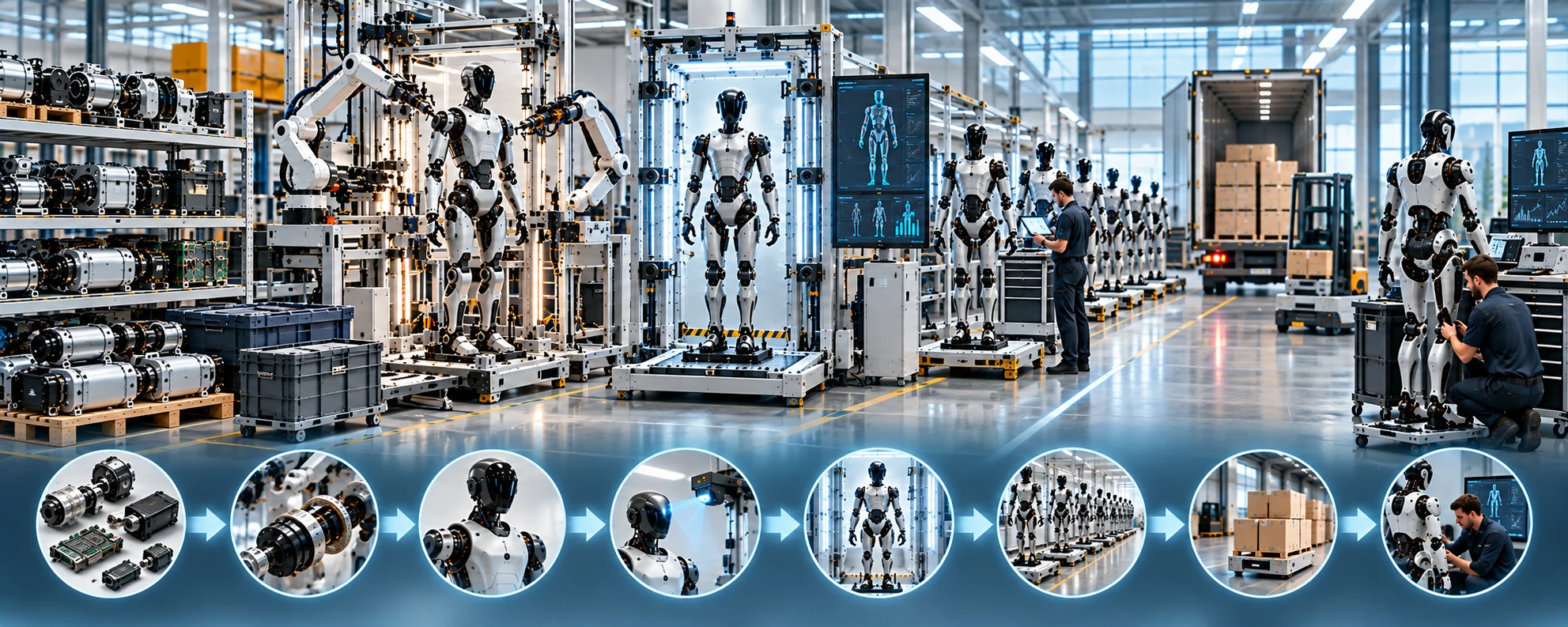
9. Serviceability, Repair and Fleet Availability
For commercial robot fleets, manufacturing economics continue after shipment. A robot unavailable for repair produces no task output. The product architecture should therefore optimize maintainability alongside assembly efficiency.
Repairability starts with fault isolation. Diagnostics should distinguish failed modules from upstream symptoms and retain enough event history to support service decisions. Physical service design should provide access to common replacement items without extensive disassembly. Connectors, fasteners and cable routes should tolerate the expected number of service cycles. Replacement modules should carry identity so that the system can detect what changed and trigger the correct commissioning or calibration procedure.
Service strategy can be expressed through four quantities: failure frequency, diagnosis time, replacement time and recommissioning time. A sophisticated modular joint that can be swapped in minutes may outperform a theoretically cheaper design requiring hours of disassembly and factory recalibration. The correct economic comparison includes spare inventory, technician skill, transport, downtime and the probability of repeat repair.
Fleet availability also depends on software serviceability. Field updates need staged deployment, compatibility checks, health monitoring and rollback. A robot returning from repair should re-enter service only after its configuration, calibration and safety state have been requalified against a defined release process.
BMW's humanoid trials emphasize that successful deployment requires involvement from production IT, safety, process management and shop-floor logistics, highlighting the integration burden surrounding the robot itself [2]. The same principle applies to service: the robot is one element in an operating system that includes work orders, spare parts, software distribution, identity management and human procedures.
10. Refurbishment, Remanufacturing and Circular Material Flows
Robots are attractive candidates for circular lifecycle models because they contain high-value electromechanical modules, batteries, semiconductors, precision transmissions and structural materials. The feasibility of refurbishment or remanufacturing, however, is largely determined at initial design.
ISO 14001's lifecycle perspective explicitly considers stages from raw-material acquisition through design, production, use and end-of-life treatment [11]. European product regulation is also moving toward more structured product information. Regulation (EU) 2024/1781 establishes the framework for Ecodesign for Sustainable Products and the Digital Product Passport, while the European Commission launched the DPP Registry and test environment in July 2026 [12]. For batteries, Regulation (EU) 2023/1542 requires an electronic battery passport from 18 February 2027 for specified categories including industrial batteries above 2 kWh [13]. Applicability to a given robot battery depends on the battery category and product context, but the direction is clear: lifecycle identity and product data are becoming more important regulatory infrastructure.
A circular robot architecture should support inspection and grading of returned modules. A gearbox may be reusable after wear measurement. A compute module may be redeployed into a lower-performance configuration. A battery may require separate state-of-health assessment and regulated handling. Structural parts may be recoverable if they are not permanently bonded into mixed-material assemblies.
Remanufacturing requires configuration discipline equivalent to new production. A rebuilt robot must have an attributable bill of material, software baseline, calibration state and test record. Mixing recovered and new parts without precise genealogy creates hidden populations that are difficult to support. Circularity therefore strengthens the case for a persistent digital thread.
Design choices that support repair often support circularity as well: separable modules, standardized fasteners, accessible diagnostics, durable connectors, replaceable wear components and persistent identity. The business value can include lower service cost, recovered asset value, reduced material exposure and improved spare availability. Environmental benefits depend on actual recovery yields, logistics and the energy or material intensity of the remanufacturing process; credible claims therefore require measurement.
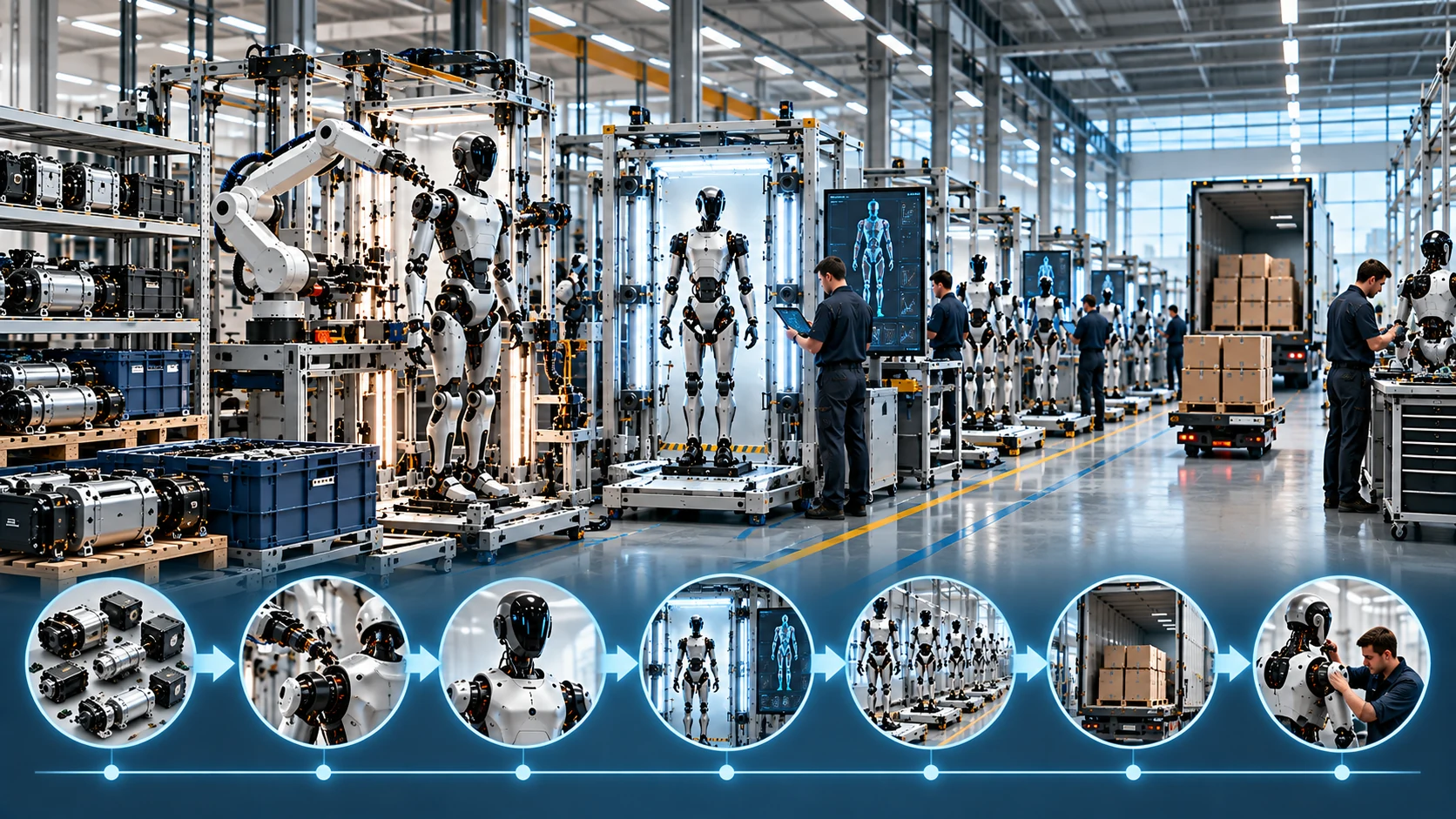
11. A Scalable Robot Industrialization Operating Model
A practical operating model emerges from a set of linked controls spanning product architecture, manufacturing, configuration, service and circular lifecycle management.
| Control domain | Primary question | Key evidence | Typical failure if missing |
|---|---|---|---|
| Platform architecture | Which interfaces and variants are intentionally supported? | Interface contracts, approved variant matrix | Variant explosion and integration churn |
| Supplier quality | Can critical parts be reproduced and changes contained? | Qualification records, lot genealogy, change notices | Broad containment and unstable incoming quality |
| Manufacturing process | Can each critical operation remain inside a known process window? | Work instructions, process capability, tool records | High rework and operator-dependent output |
| End-of-line test | Can shipment conformance be demonstrated and failures isolated? | Controlled limits, test results, diagnostic evidence | Escapes, false rejects and slow troubleshooting |
| Calibration | Are calibration values valid for this exact configuration? | Reference identity, method, uncertainty, provenance | Behavioral variation and irreproducible field faults |
| Configuration management | What exactly is this robot now? | Hardware/software/model/calibration identity | Unsafe updates and poor reproducibility |
| Service | Can failed functions be restored quickly and correctly? | Diagnostics, modular repair, recommissioning record | Low fleet availability and high service cost |
| Circular lifecycle | Can returned assets be graded and reintroduced with integrity? | Usage history, inspection, remanufacturing genealogy | Lost residual value and uncontrolled mixed populations |
The governing metric across these domains is configuration integrity: the ability to know what the product is, why it is in that state, whether that state is permitted and what evidence supports release. This concept connects seemingly separate topics such as modularity, software updates, calibration, supplier traceability and remanufacturing.
Four design rules follow. First, every critical module should have explicit interfaces and identity. Second, every production and service transformation should create traceable evidence. Third, every released configuration should be testable against controlled criteria. Fourth, every field change should preserve a path back to an attributable prior state or an explainable new baseline.
These rules also shorten ramp time. Platform reuse reduces the amount of new qualification. Controlled variants reduce combinations. Automated testing converts engineering intent into repeatable release evidence. Field feedback reveals real failure distributions, allowing design and process teams to concentrate on the dominant causes of downtime and cost. The resulting learning loop is faster because the data carries context.
12. Conclusion
Building robots at scale requires a different engineering discipline from building impressive prototypes. The decisive capability is the creation of a controlled product system in which architecture, parts, process, software, calibration, test and service remain linked by identity and evidence.
Modular architectures create leverage when their interfaces are explicit and their variants are governed. Supplier qualification becomes effective when lot genealogy and change control connect directly to affected robots. End-of-line test becomes valuable when it is designed for coverage and fault isolation. Calibration becomes scalable when it is versioned, attributable and tied to hardware and software state. Quality management expands from physical conformance into configuration and behavior. Serviceability becomes an availability mechanism. Circular product flows become credible when returned assets can be inspected, identified and requalified without losing history.
The factory therefore extends beyond the walls of final assembly. It includes engineering data, supplier processes, software release systems, service depots and the field fleet itself. Each robot remains part of a controlled learning system throughout its life.
The industrialized robot is the robot whose permitted variation can be understood, verified and supported repeatedly across production and field life. That is the foundation for yield, fleet availability, fast corrective action and economically sustainable scale.
Glossary
- Industrialization
- The transition from prototypes to repeatable, qualified, economical and serviceable production at increasing volume.
- Configuration identity
- An attributable description of hardware, software, models, parameters, calibration and dependencies defining a deployed robot state.
- Digital thread
- Connected product and process information linking design, manufacturing, inspection, service and lifecycle evidence through traceable identifiers.
- First-pass yield
- Share of units completing a defined manufacturing or test process successfully without rework or repair.
- End-of-line test
- Final controlled manufacturing test sequence used to verify product configuration, function, safety mechanisms and release criteria before shipment.
- Calibration provenance
- Evidence describing how, when, under which conditions and for which identified hardware a calibration value was produced and authorized.
- Remanufacturing
- Industrial restoration of a used product or module to a defined functional and quality state through controlled inspection, replacement, reassembly and testing.
- Part variety
- Number and diversity of unique parts or controlled alternatives required to manufacture and support a product family.
- Product genealogy
- Traceable record connecting a finished product to constituent modules, critical components, lots, process steps, tests and later service changes.
- Recommissioning
- Controlled verification that a repaired or changed robot is correctly configured, calibrated, safe and ready to return to operation.
Abbreviations
- DPP
- Digital Product Passport
- EOL
- End of Line
- QIF
- Quality Information Framework
- QMS
- Quality Management System
- IEC
- International Electrotechnical Commission
- ISO
- International Organization for Standardization
- NIST
- National Institute of Standards and Technology
Sources
- Opening RoboFab: World’s First Factory for Humanoid Robots · 2023-09-18
Agility describes RoboFab, its modular humanoid manufacturing facility, initial ramp expectations and stated capacity above 10,000 Digit robots annually.
https://www.agilityrobotics.com/content/opening-robofab-worlds-first-factory-for-humanoid-robots - Humanoid Robots for BMW Group Plant Spartanburg · 2024-09-11
BMW reports Figure 02 production trials and the integration learning required across manufacturing systems, safety and practical shop-floor operation.
https://www.bmwgroup.com/en/news/general/2024/humanoid-robots.html - ISO 9001:2026 — Quality management systems — Requirements · 2026-09-01
ISO describes the current quality-management-system requirements for controlled processes, customer expectations, organizational performance and continual improvement.
https://www.iso.org/standard/9001 - ISO 10218-1:2025 — Robotics — Safety requirements — Part 1: Industrial robots · 2025-02-05
ISO specifies robot-level industrial safety requirements, including inherent safe design, risk reduction measures and information for safe use.
https://www.iso.org/standard/73933.html - ISO 10218-2:2025 — Robotics — Safety requirements — Part 2: Industrial robot applications and robot cells · 2025-02-01
ISO addresses integration, commissioning, operation, maintenance and decommissioning safety requirements for industrial robot applications and robot cells.
https://www.iso.org/standard/73934.html - Digital Thread for Manufacturing · 2022-05-01
NIST describes standards, conformance and trusted product-definition infrastructure needed to connect design, manufacturing, inspection and quality information.
https://www.nist.gov/programs-projects/digital-thread-manufacturing - Testing the Digital Thread in Support of Model-Based Manufacturing and Inspection · 2016-03-08
NIST documents digital-thread methods linking model-based definition, manufacturing and inspection, including measured evidence and process-data exchange gaps.
https://www.nist.gov/publications/testing-digital-thread-support-model-based-manufacturing-and-inspection - End-to-End Quality Information Framework (QIF) Technology Survey · 2016-05-09
NIST surveys QIF as a standardized information model supporting metrology-data exchange and feedback across design, inspection and manufacturing quality.
https://www.nist.gov/publications/end-end-quality-information-framework-qif-technology-survey - ISO 9283:1998 — Manipulating industrial robots — Performance criteria and related test methods · 1998-04-01
ISO provides established performance criteria and test methods for manipulating industrial robots; the standard remains current after later review.
https://www.iso.org/standard/22244.html - IEC 62443-4-1:2018 — Secure product development lifecycle requirements · 2018-01-01
IEC defines secure product-development lifecycle processes including requirements, design, implementation, verification, defect management, patching and product end-of-life.
https://webstore.iec.ch/en/publication/33615 - Life-cycle perspective — what ISO 14001 includes · 2015-09-01
ISO explains lifecycle thinking across raw materials, design, production, distribution, use and end-of-life within environmental management systems.
https://committee.iso.org/sites/tc207sc1/home/projects/published/iso-14001---environmental-manage/life-cycle.html - Digital Product Passport (DPP) — Regulation (EU) 2024/1781 · 2024-06-28
European Commission summarizes the Ecodesign for Sustainable Products framework and Digital Product Passport infrastructure for product-information transparency and compliance.
https://single-market-economy.ec.europa.eu/single-market/goods/european-standards/harmonised-standards/digital-product-passport-dpp_en - Regulation (EU) 2023/1542 concerning batteries and waste batteries · 2023-07-28
EU battery regulation establishes digital battery-passport requirements from 18 February 2027 for specified battery categories and individual battery information.
https://eur-lex.europa.eu/eli/reg/2023/1542/2023-07-28