
Technical Article
Physical AI: When Intelligence Gains a Body
A practical engineering primer on automation, robotics, embodied intelligence and machines that close the loop with the physical world
Physical AI connects perception, world models, decisions and controlled action in a continuous physical loop. This engineering primer distinguishes it from automation, robotics and embodied AI, then explains how embodiment reshapes architecture, safety and value. A practical taxonomy and seven-question framework translate an emerging label into precise working language.
Intelligence Gains Consequences When It Moves Matter
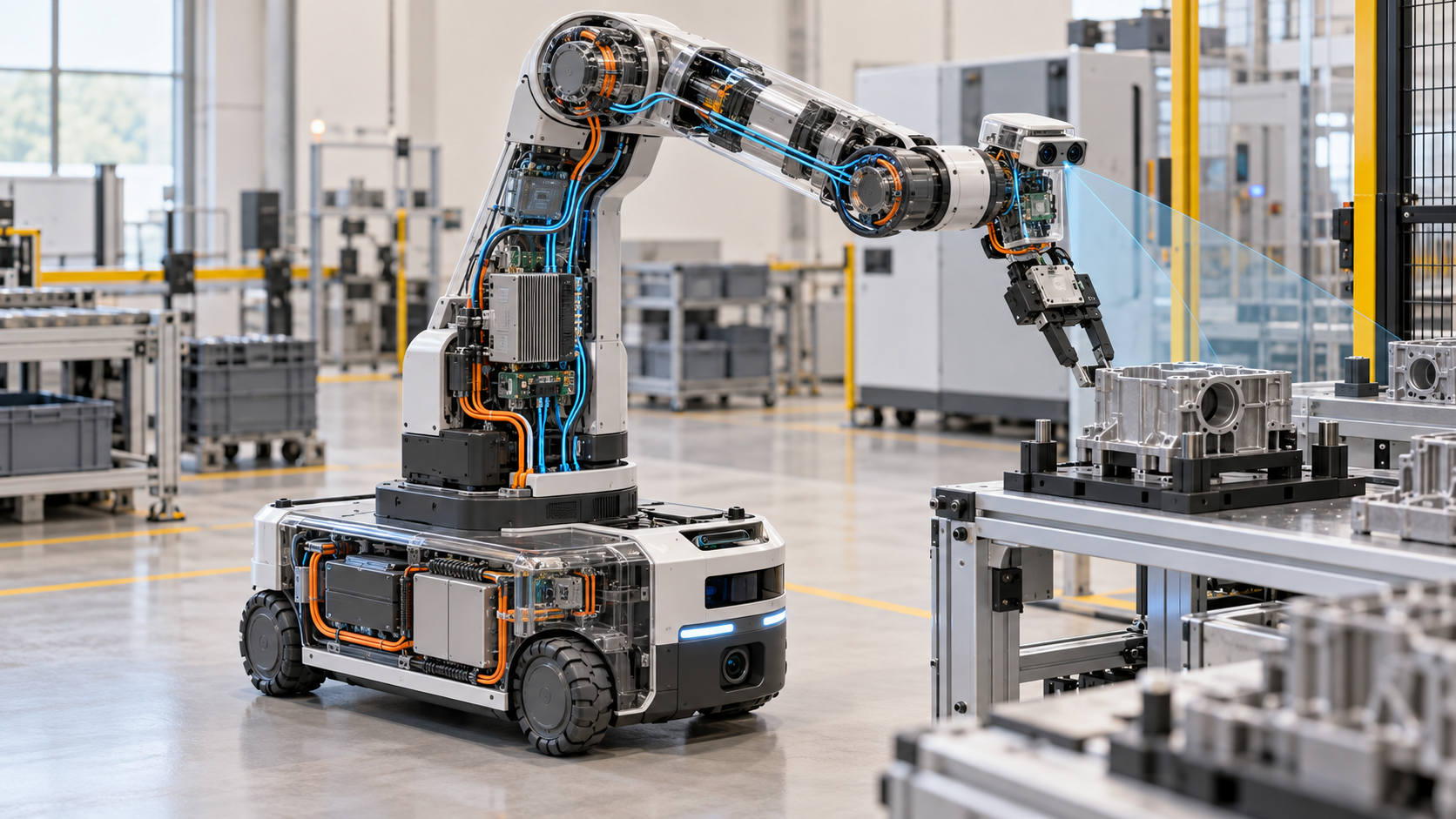
A worker asks a mobile manipulator to bring a partly filled container from a crowded workbench. The request sounds simple. The machine must locate the correct container, distinguish it from similar objects, estimate whether it is open, choose a stable grasp, approach without striking a person, lift without spilling, navigate around a newly parked trolley and place the load where it remains reachable. Each action changes the conditions for the next one.
A digital system can produce a poor answer and revise it in a later exchange. A physical machine carries momentum. A weak estimate can become a crushed component, a dropped payload or an injured person before a remote service returns an improved answer. Physical AI begins where computational intelligence receives meaningful authority over matter, motion and energy.
The phrase now appears across robotics and autonomous systems. NVIDIA describes Physical AI as models that understand instructions, perceive the physical world and generate actions for embodied systems.[3] Google DeepMind uses closely related language for embodied reasoning and vision-language-action models that understand, act and react in the physical world.[6] These formulations show a clear technical direction. They have yet to converge into one standards definition. ISO 8373:2021 defines established robotics terminology, while its published vocabulary predates the recent industry-wide use of Physical AI as an umbrella term.[1]
A useful working definition needs explicit boundaries:
Physical AI is an artificial-intelligence system that interprets physical conditions, selects or shapes actions, and closes a feedback loop through an embodied machine under real-world constraints.
Three properties carry the definition. The system has a body or controls one. Its decisions influence physical action. It observes consequences and uses that evidence to govern subsequent behaviour. Learning can strengthen the capability, although online learning is not required. A trained policy qualifies when it generalises across relevant situations and directs action through a closed physical loop. A highly automated machine may remain conventional automation when it executes validated sequences inside a tightly engineered envelope.
The distinction matters because labels guide investment, architecture and responsibility. Calling every robot Physical AI hides where intelligence resides, how much authority it holds and which risks must be contained. Treating every adaptive machine as conventional automation can obscure the shift created by perception-driven, context-sensitive action. Useful language exposes engineering obligations and economic potential at the same time.
Four Related Ideas, Four Different Boundaries
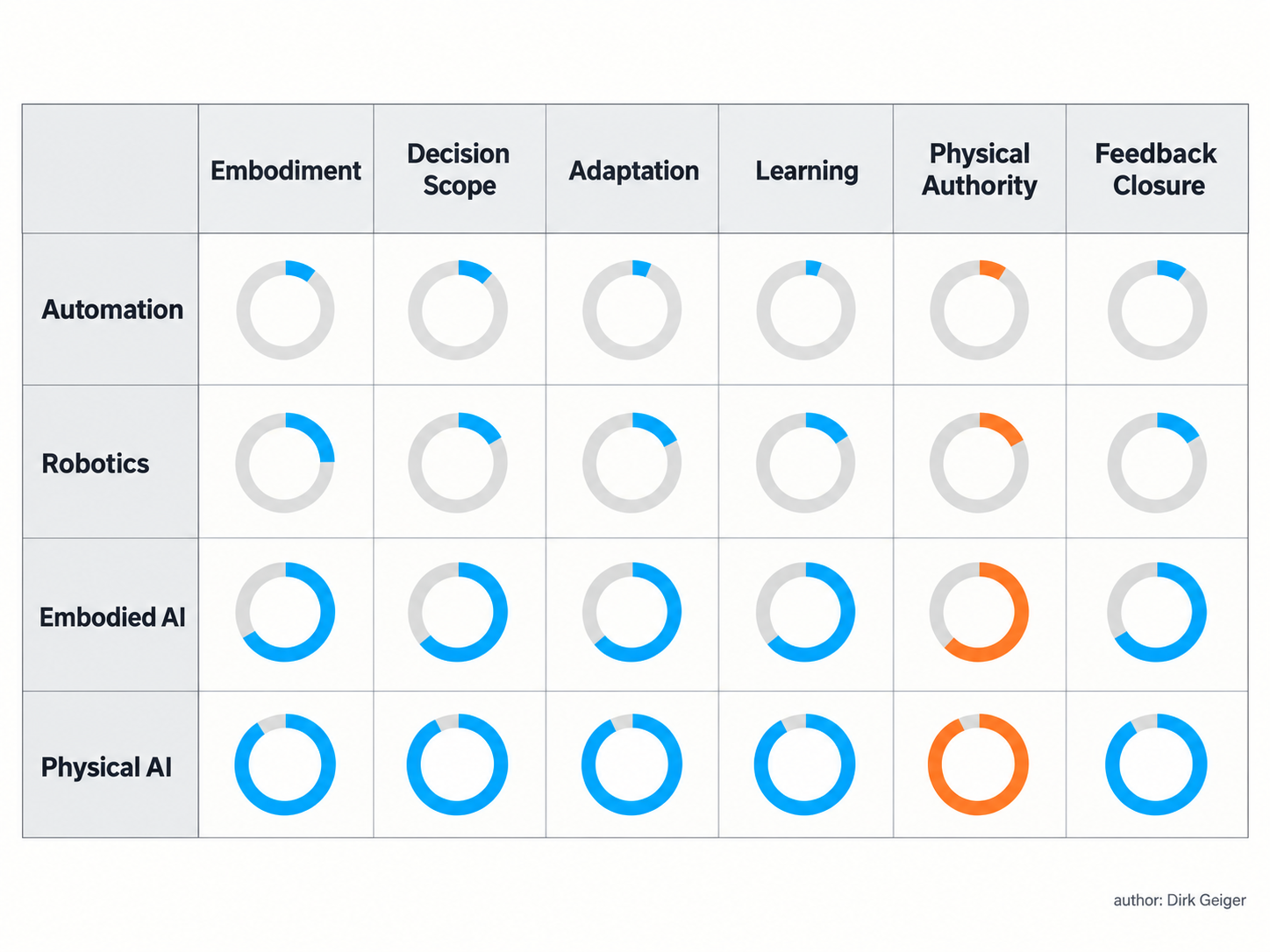
Automation, robotics, embodied AI and Physical AI overlap. Each term illuminates a different boundary. Automation asks whether a process executes with limited direct human intervention. Robotics asks whether an actuated mechanism performs locomotion, manipulation or positioning with a degree of autonomy. The International Federation of Robotics grounds its industrial-robot definition in ISO 8373:2021.[2] Embodied AI asks how intelligence emerges through the coupling of computation, body and environment. Physical AI emphasizes deployable AI capability that perceives and changes the physical world.
The taxonomy below uses six dimensions. It describes typical implementations and supports engineering discussion; it is not a legal or standards classification.
| Category | Physical embodiment | Decision scope | Adaptation | Learning | Physical authority | Feedback closure |
|---|---|---|---|---|---|---|
| Automation | Optional | Defined workflow | Usually configured | Optional | None to substantial | Process-specific |
| Robotics | Required | Programmed motion or task autonomy | Varies | Optional | Intrinsic | Motion and task loops |
| Embodied AI | Physical or simulated body | Perception-action intelligence | Central concern | Usually important | May remain simulated or experimental | Central research principle |
| Physical AI | Physical system | Context-sensitive physical action | Expected across relevant variation | Training usually central; online learning optional | Meaningful and bounded | Continuous operational requirement |
Automation is the broadest operational category. A software service that transfers invoices is automation without robotics. A conveyor cell with fixed sensors, interlocks and programmable logic is physical automation. Its value can be immense without machine learning.
A robot is defined by actuated capability and autonomy, not by its shape. An industrial arm executing a repeatable weld path is a robot. Its environment may be deliberately fenced and controlled. Predictability is a valuable design property because it supports cycle time, quality and validation.
Embodied AI is a scientific lens as well as a technology field. It treats the body and environment as participants in intelligence. A compliant gripper can simplify control because its mechanics absorb small alignment errors. A leg shape can reduce the control effort needed for walking. Intelligence is distributed across morphology, sensing, dynamics and computation.
Physical AI is an architectural and operational proposition. RT-2 represented robot actions as tokens, allowing knowledge learned from vision and language data to influence robotic control.[5] Google DeepMind’s Gemini Robotics work adds physical actions as an output modality and combines embodied reasoning with robot-specific controllers.[6] The label earns practical value when it identifies a system that interprets changing conditions and converts inference into bounded physical execution.
The boundaries remain permeable. A fixed cell may include one learned inspection function. A mobile robot may use classical localisation and planning without a foundation model. A humanoid may depend on learned perception while every joint closes deterministic motor-control loops. Classification works best at the level of capability and authority: identify the function, trace its evidence, locate its decision boundary and follow the resulting physical action.
The Physical Intelligence Loop
A Physical-AI system lives in a loop. Sensors produce observations. State estimation turns incomplete measurements into a working account of the robot and its surroundings. A world model represents objects, geometry, relationships, dynamics and uncertainty. Planning selects a path toward the task goal. Control converts the plan into time-sensitive commands. Actuators generate force and motion. New observations reveal whether reality followed the prediction.
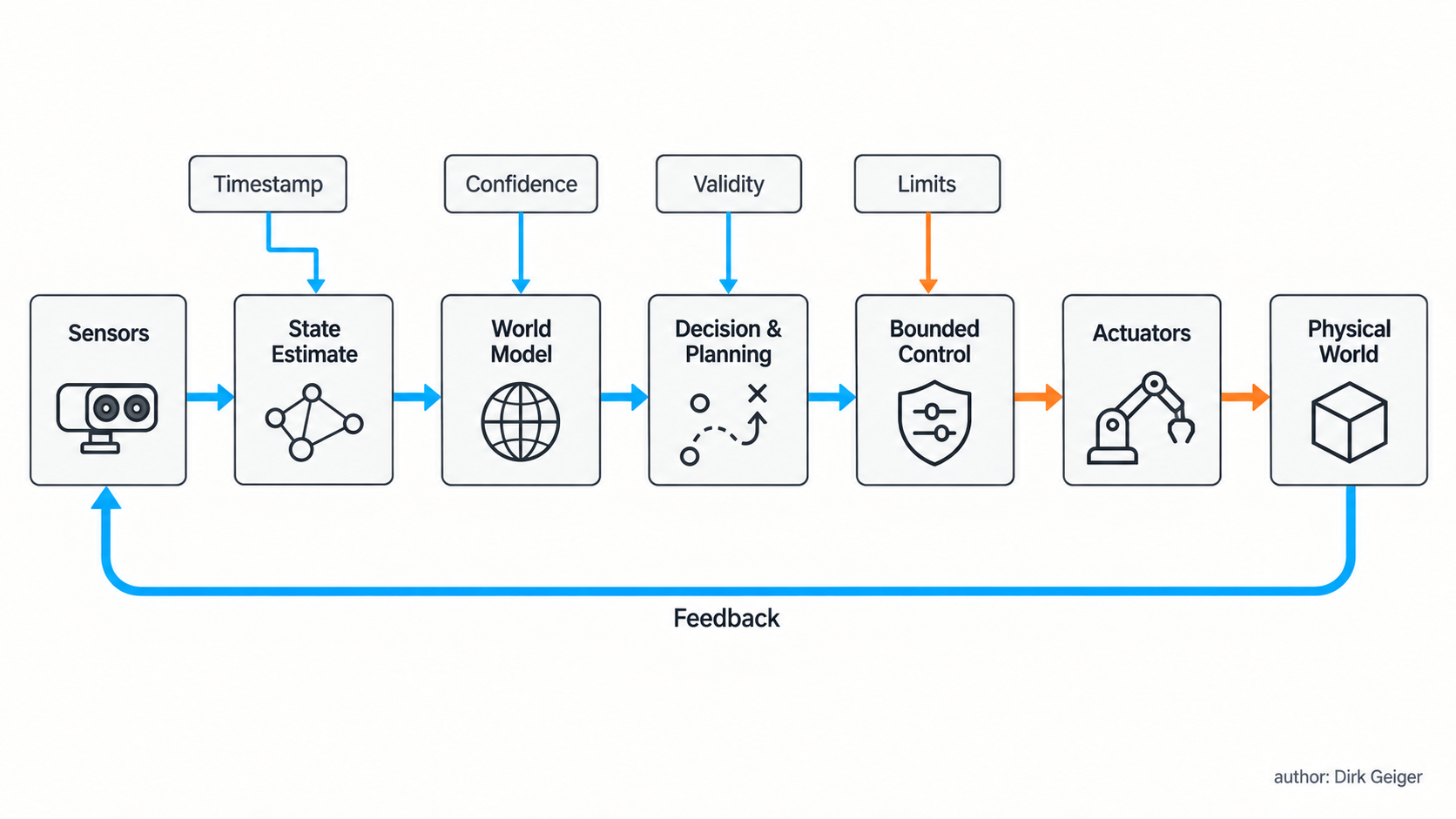
Every arrow in the loop carries a contract. A camera frame needs an acquisition timestamp because reception can occur later. A detected object needs a coordinate frame and confidence estimate. A planned grasp needs validity conditions: object identity, pose tolerance, permitted force and expiry time. A motor command needs limits for current, torque, speed and temperature. Feedback needs enough temporal integrity to detect divergence before it becomes hazardous.
Timing is a system property with several distinct components. Acquisition time describes when the physical quantity was sampled. Processing latency covers conversion, inference and estimation. Communication delay adds transport and queueing. Control rate determines how frequently the local function corrects error. Actuation response includes electrical, electromagnetic and mechanical dynamics. A single end-to-end latency number can hide the part of the chain that consumes stability margin.
The loop therefore operates across several timescales:
- Electrical protection: power-stage responses can operate on microsecond timescales to limit destructive current or voltage excursions.
- Motor control: current, torque and velocity loops require deterministic execution close to the actuator.
- Whole-body coordination: balance, contact and trajectory control combine multiple joints and sensors.
- Task reasoning: perception, semantic interpretation and planning operate over longer and more variable intervals.
- Fleet learning: accumulated operational evidence supports offline training, validation and controlled deployment of improved models.
A single AI computer cannot sensibly own every timescale. High-level intelligence can propose a grasp or route. Local control preserves stability and enforces actuator limits during execution. Google DeepMind describes a comparable separation for Gemini Robotics-ER: embodied reasoning can connect with existing low-level controllers, while classical measures address collision avoidance, contact-force limits and dynamic stability.[6]
This leads to bounded authority. High-level functions receive enough freedom to create useful behaviour. Deterministic local functions enforce the physical envelope. The boundary can be expressed through an action contract containing the intended motion, allowed region, force and speed limits, confidence, validity time, abort conditions and expected completion evidence.
The world model also deserves precision. It is a task-dependent estimate, not a perfect replica of reality. A mobile robot may need traversability, obstacle motion and localisation uncertainty. A manipulator needs object pose, affordances, contact state and grasp stability. A humanoid adds whole-body dynamics and support relationships. The most effective representation is often the smallest one that supports a safe decision within available time, compute and energy.
Closed-loop operation makes uncertainty actionable. Low confidence can trigger slower motion, a new viewpoint, a tactile probe, a request for help or a controlled stop. Intelligence becomes operationally useful when the machine can improve its evidence and reduce authority as evidence weakens.
The Body Is Part of the Intelligence
A robot’s body determines which problems software must solve. A rigid parallel gripper demands accurate object geometry and alignment. Soft fingertips create a larger tolerance window by conforming to the surface. A wheeled base gains energy efficiency on smooth floors and gives up the ability to climb ordinary stairs. A humanoid can reach infrastructure designed around human proportions, while its tall articulated body creates demanding balance, power and reliability problems.
Morphology is an algorithm expressed in material. Link lengths define reach. Gear ratios trade speed against torque. Backdrivability changes how external forces reach the motor and sensors. Compliance stores energy and moderates impacts; excessive compliance can reduce precision and complicate control. Distal mass increases rotational inertia and pushes higher loads into upstream joints. These properties shape the feasible action envelope before a model produces its first command.
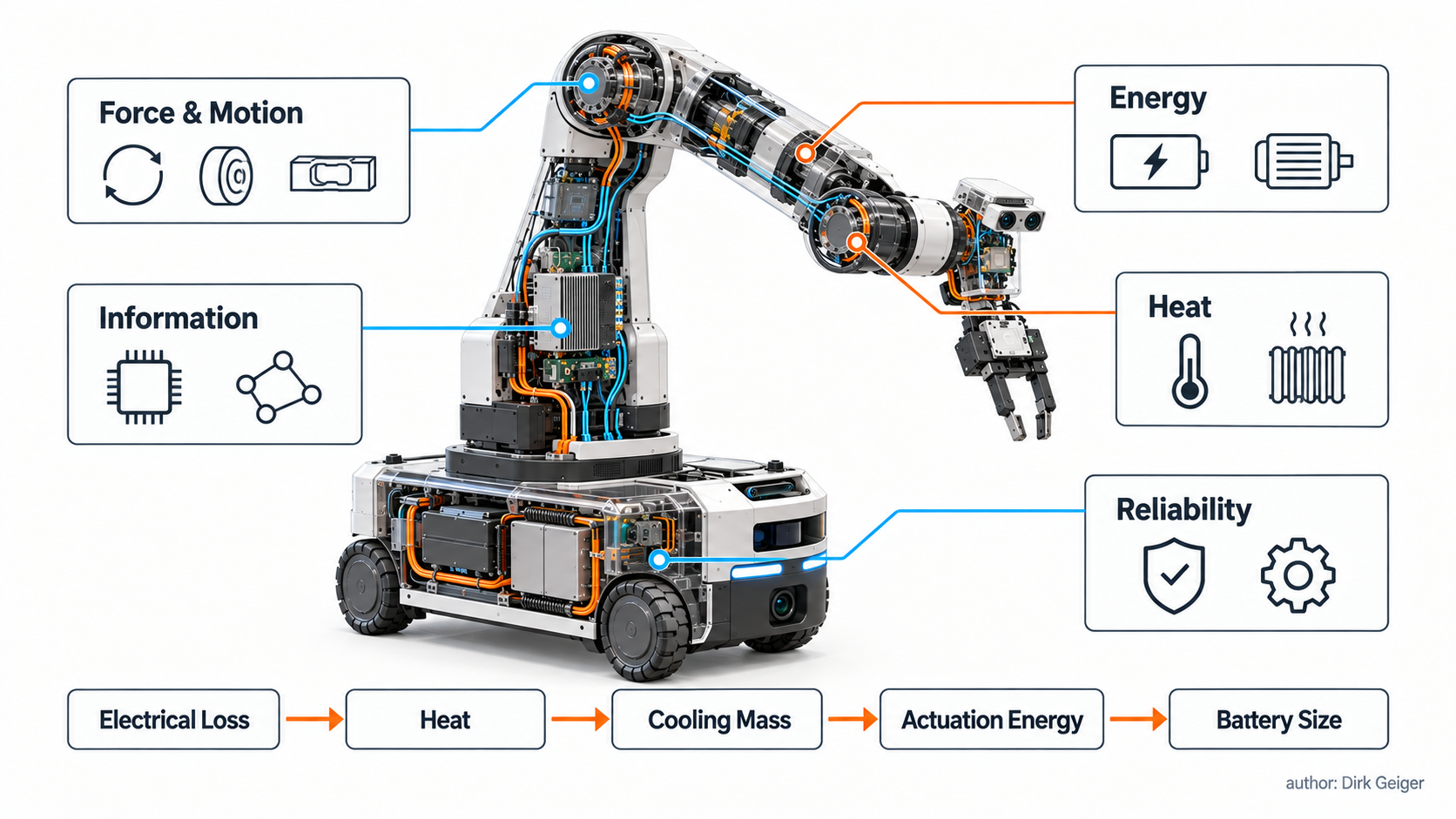
Embodiment introduces five budgets that remain coupled throughout the machine:
- Force and motion: torque, speed, acceleration, friction and contact geometry determine feasible movement and interaction.
- Energy: batteries, converters, inverters and motors determine mission duration, peak capability and regeneration behaviour.
- Heat: electrical and mechanical losses accumulate in compact joints, compute modules and enclosed electronics.
- Information: sensing quality, bandwidth, latency and timing determine what the system can know soon enough to act.
- Reliability: load cycles, contamination, cable motion, connector stress and component aging determine how long capability remains dependable.
The budgets form an efficiency cascade. Higher electrical loss creates heat. Heat demands cooling. Cooling adds mass and consumes power. Added mass increases actuation energy. A larger battery restores endurance and adds still more mass. Improved efficiency can reverse the cascade by shrinking cooling and energy storage, producing a system benefit greater than the component-level watt saving.
Contact makes the body part of the sensing system. Motor current can indicate load. Joint torque sensing can reveal unexpected force. Tactile arrays can detect pressure distribution and incipient slip. Mechanical compliance can filter impact energy before electronics respond. Each signal has limits: current-based torque estimates depend on motor parameters and friction; tactile measurements depend on calibration and surface conditions; compliance can store energy that later returns to the mechanism.
The body also changes the data problem. Internet data contains abundant descriptions and images, with much less calibrated evidence about friction, force, deformability, mass distribution or the exact result of a motor command. RT-2 showed how web-scale knowledge could transfer into robotic action under defined evaluations.[5] Semantic knowledge helps a robot identify what may be relevant. Embodied experience reveals what happens here, with this body and under these conditions.
Simulation expands training coverage and exposes rare conditions safely. Real hardware remains the final judge. Contact, wear, tolerances, backlash, sensor drift and cable dynamics create discrepancies that models must detect and engineering teams must bound. A productive development loop combines simulation, controlled testing and fleet evidence while preserving configuration and calibration identity across all three.
From AI Model to Machine Architecture
A capable model is one component in a physical system. Deployment needs an electrical and electronic architecture that connects sensing, compute, communication, control, power and protection. The model may interpret a scene in tens of milliseconds. A gate driver protecting a power switch cannot wait for that interpretation. Architecture assigns each responsibility to the layer that can meet its deadline, evidence requirement and required integrity.
| Layer | Primary responsibility | Typical design concern |
|---|---|---|
| Energy and power | Store, convert, distribute and isolate electrical energy | Peak current, regeneration, efficiency, thermal margin, fault isolation |
| Actuation | Convert commands into controlled force and motion | Torque density, sensing, switching loss, controllability, wear |
| Sensing | Measure body, contact and environment | Coverage, calibration, timestamping, confidence, environmental robustness |
| Real-time control | Close fast loops and enforce limits | Determinism, independence, diagnostics, degraded modes |
| Perception and reasoning | Interpret context and propose actions | Compute, memory, generalisation, uncertainty, energy proportionality |
| Communication | Move time-sensitive and semantic information | Latency, jitter, bandwidth, synchronization, fault containment, security |
| Supervision and trust | Authorize, monitor, record and recover | Identity, secure boot, update integrity, evidence, human oversight |
The architecture is naturally heterogeneous. Graphics and neural processors handle parallel perception and inference. General-purpose processors coordinate applications. Microcontrollers execute deterministic control and diagnostics. Dedicated circuits enforce current, voltage and temperature boundaries. Protected hardware establishes device identity and safeguards keys. The correct split follows the consequence and deadline of each function.
Local intelligence keeps physics on a short leash. A joint controller maintains current and torque while the central computer handles perception. A gripper detects incipient slip and raises force inside an approved range before a task planner observes the change. A mobile base executes a protective stop when an independent safety path detects intrusion. Higher layers then revise the task using the resulting state.
Communication must carry time, identity and validity alongside payload. A high-bandwidth camera stream can be unsuitable for control when timestamps drift. A low-rate contact event can be decisive when its origin and acquisition time are trustworthy. Networks therefore need differentiated service for cyclic control, event traffic, diagnostics, bulk sensor data and software updates. Loss behaviour matters as much as nominal throughput: each receiving function needs a defined response to stale, missing, duplicated or contradictory information.
World models and large policies create a lifecycle architecture as well. Training data, simulation assets, model versions, calibration sets and safety constraints must remain attributable. Deployment requires compatibility checks against the body, sensors, controller interfaces and operational domain. A model update that improves semantic reasoning can still change timing, memory load or command distributions. Configuration management for Physical AI must treat software and hardware as one operational identity.
NVIDIA presents Physical-AI development across model training, simulation and runtime deployment, illustrating how the engineering chain spans several computing environments.[3] That chain creates leverage. The runtime machine still owns bounded behaviour when remote services are slow, unavailable or outside their validated conditions.
Partitioning also creates verification boundaries. Teams can validate that a planner produces requests within a defined command vocabulary, that a local controller rejects expired or out-of-envelope requests, and that electrical protection remains effective when higher layers fail. Clear contracts reduce the number of interactions that require whole-system reasoning while preserving end-to-end tests for the complete physical loop.
Physical Authority Changes the Risk Equation
Risk grows with authority, exposure and uncertainty. A model that classifies an image creates an informational output. A system that uses the classification to move a heavy machine adds kinetic energy, contact and time pressure. The same model error can travel through a causal chain: misidentification, unsuitable plan, accepted command, actuator torque and physical impact.
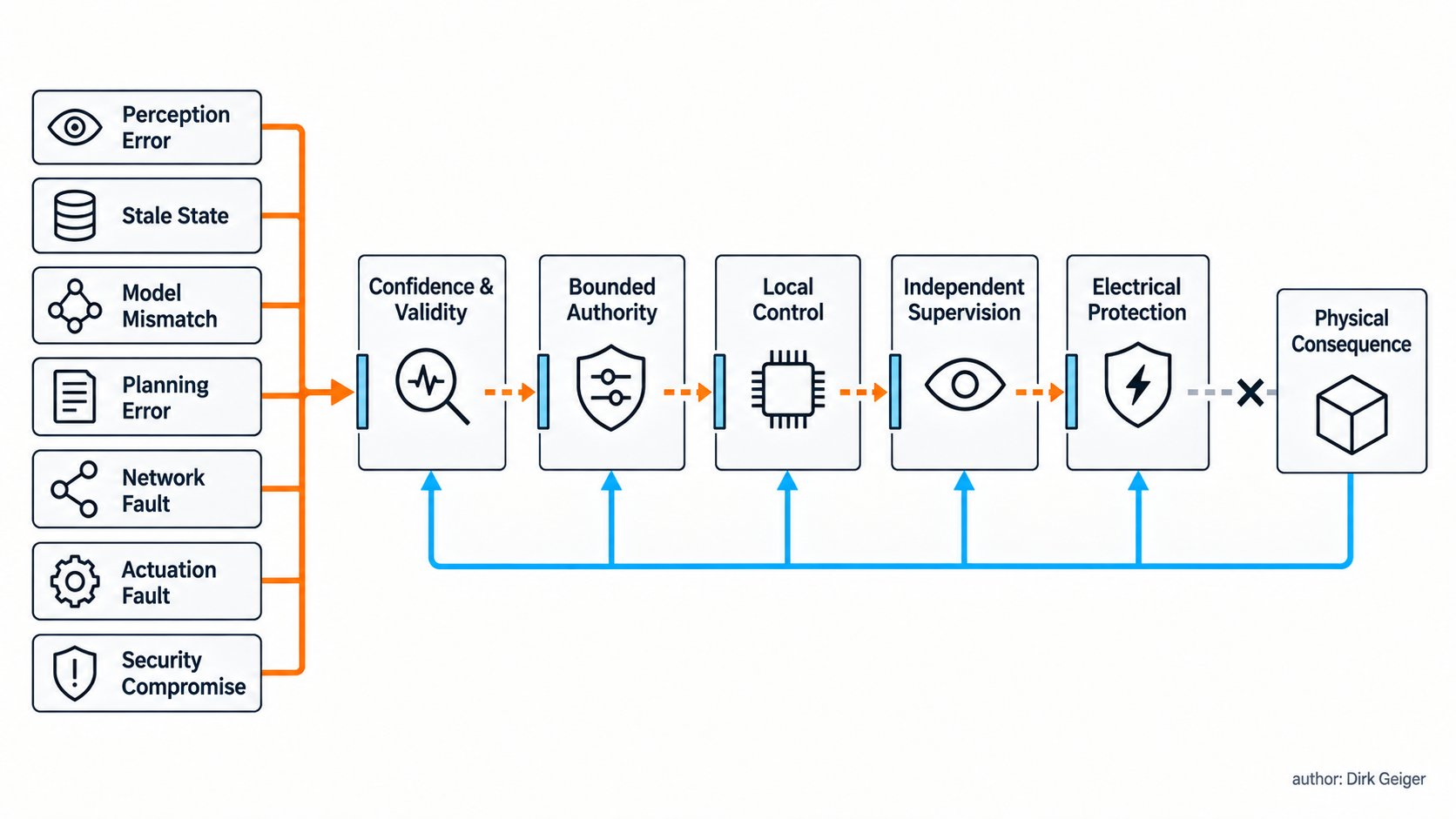
Several failure mechanisms deserve explicit treatment:
- Perception error: an object, person, surface or contact is missed or misclassified.
- Stale state: information was accurate when acquired and became invalid before use.
- Model mismatch: predicted dynamics, friction, payload or actuator response differs from the physical system.
- Planning error: the goal is valid while the selected action violates an operational constraint.
- Communication fault: delay, loss, duplication, corruption or synchronization failure changes execution.
- Actuation fault: electronics, motors, transmissions or sensors deliver a response outside the commanded envelope.
- Security compromise: identity, software, data or commands lose authenticity or integrity.
A strong architecture interrupts these chains at several layers. Confidence-aware perception restricts action when evidence is weak. Validity windows prevent old plans from executing under new conditions. Local controllers enforce torque, speed and workspace limits. Independent supervision detects divergence. Electrical protection contains current, voltage and temperature faults. Human oversight provides understandable state, intervention and stop capability.
NIST’s AI Risk Management Framework provides a voluntary structure for incorporating trustworthiness into the design, development, use and evaluation of AI systems.[4] Machinery and robotics obligations add physical specificity. ISO 13482:2014 addresses hazards and risk reduction for defined categories of personal-care robots, including applications involving human-robot physical contact.[7] The European Union’s Machinery Regulation establishes essential health and safety requirements, including provisions for control systems with fully or partially self-evolving behaviour or logic and varying levels of autonomy.[8]
These references guide engineering and classification; Physical AI itself is not a certification category. Applicable requirements follow intended use, operating environment, machine type, jurisdiction and the safety functions involved. A household assistant, collaborative industrial manipulator and autonomous vehicle can share perception-action principles while facing very different conformity routes and acceptable risk.
Graceful degradation is an engineered capability. Loss of a remote connection might allow a stationary manipulator to finish a bounded placement, require a mobile robot to reach a safe waiting area, or demand immediate torque removal in another application. The correct response depends on contact, payload, balance and surroundings. A safe state is contextual and can include controlled motion.
Cybersecurity belongs inside the same causal analysis. A compromised update, falsified calibration or unauthorized command can produce physical consequences through ordinary control paths. Secure boot, authenticated updates and protected identity establish trust in configuration. Network segmentation and least authority limit propagation. Independent monitoring and event evidence support detection and recovery. Security controls become operationally valuable when they preserve or safely withdraw physical capability.
Evidence matters after an event as well as during it. Time-coherent logs should distinguish sensed conditions, estimated state, AI action requests, controller acceptance, safety interventions, commands and observed outcomes. This causal record supports diagnosis, accountability and fleet improvement. It also keeps persuasive post-event explanations separate from actual execution evidence.
Where Physical AI Creates Value
Physical AI creates value when adaptive capability improves the economics of real work. A modest machine that completes a high-frequency task reliably can outperform a spectacular general-purpose prototype whose availability, speed and service cost remain uncertain.
Industrial automation already operates at enormous scale. The International Federation of Robotics reported 542,000 industrial robots installed during 2024, with annual installations above 500,000 for the fourth consecutive year.[9] This installed base establishes a demanding benchmark: repeatability, cycle time, integration, maintainability and safety are core product qualities. Physical AI extends the feasible task envelope where variation makes conventional engineering expensive or brittle.
Value commonly appears through six mechanisms:
- Task flexibility: one system handles a wider range of objects, layouts or instructions.
- Deployment speed: learning, demonstration or semantic configuration reduces bespoke programming and fixture work.
- Utilization: adaptive systems address more jobs and recover from ordinary variation with fewer interruptions.
- Quality: richer perception and closed-loop correction detect drift and improve process consistency.
- Human leverage: people supervise, teach and resolve exceptions across several machines.
- Resilience: robots preserve useful bounded operation when conditions, materials or schedules change.
The economic unit should be the completed job. Purchase price is one input. Integration, fixtures, floor-space changes, training, energy, consumables, maintenance, software, supervision and downtime belong in the same calculation. The costs of false stops, damaged materials and process variation also belong there. A robot that is technically capable for eight hours and productively available for four has a different business case from its specification sheet.
Physical AI can move cost between engineering domains. Better perception may reduce fixture precision. A compliant hand may tolerate object variation and reduce planning complexity. Local reflexes may lower communication requirements. Simulation may reduce hazardous real-world training. Each shift requires system-level measurement because savings in one component can create complexity elsewhere.
| Evidence class | Meaning | Decision use |
|---|---|---|
| Demonstrated | Capability shown under defined test conditions | Supports technical feasibility |
| Deployed | Capability used in a real operating process | Supports integration and operational learning |
| Economically validated | Measured benefit exceeds full lifecycle cost at required performance | Supports scaling and portfolio decisions |
The distance between these classes explains why forecasts can become fragile. A laboratory success can be strategically important without proving throughput or payback. A pilot can create valuable learning without proving fleet economics. The durable promise of Physical AI is economically useful adaptation under physical constraints.
Decision-makers therefore need operational denominators: successful jobs per shift, intervention minutes per operating hour, energy per completed task, quality escapes per batch and service hours per fleet month. These measures connect model improvement to a business result. They also reveal whether complexity is creating value or merely moving effort from programming into supervision, data operations and maintenance.
A Machine Taxonomy in Practice
Concrete examples reveal why one label cannot describe every intelligent machine adequately.
A fixed packaging line senses product presence, coordinates conveyors and executes validated sequences. It is automation and may contain robots. Machine vision can add AI-based inspection. When the inspection result selects bounded handling actions, part of the cell may qualify as Physical AI while the overall line remains a highly structured automation system.
An industrial robot arm following taught points is robotics and automation. Add perception that identifies randomly oriented parts, estimates grasp poses and replans after a failed pickup, and the cell gains embodied intelligence. It becomes a strong Physical-AI example when AI-derived decisions hold meaningful physical authority and feedback governs continued execution.
An autonomous mobile robot localises, maps, avoids obstacles and selects routes through a changing facility. Its navigation loop is a mature form of Physical AI, even without a humanoid body or foundation model. Fleet orchestration adds task allocation above local autonomy. Safety-related functions preserve bounded motion inside the operating environment.
An autonomous vehicle couples multimodal perception, prediction, planning and control at speed. It belongs to the Physical-AI family under the working definition, while its regulatory, verification and failure-consequence profile differs sharply from a warehouse robot.
A quadruped brings perception-driven navigation onto uneven ground. Whole-body control and contact planning become central. Its embodiment offers mobility where wheels struggle, with higher energy, actuation and balance demands.
A humanoid combines locomotion, manipulation and human-scale reach. Its form can use doors, stairs, tools and workstations designed around people. It also concentrates nearly every Physical-AI difficulty: many actuated axes, limited onboard energy, frequent contact, uncertain environments, whole-body balance and close human interaction. Its economic case depends on task coverage and availability.
Google DeepMind presents Gemini Robotics around generality, interactivity, dexterity and transfer across multiple embodiments.[6] These are useful capability dimensions. Operational assessment adds completion rate, intervention frequency, cycle time, energy per job, recoverability and safe behaviour outside nominal conditions.
Classification can occur at subsystem level. A humanoid may use learned perception and planning while its motor drives use classical field-oriented control. A conventional industrial cell may use an AI vision subsystem. A teleoperated robot has physical embodiment and authority, while much of its decision-making remains human. Describe the loop, the authority and the evidence; the label then becomes clear.
Seven Questions for Evaluating a Physical-AI System
A compact evaluation can begin before detailed component selection. Seven questions expose the central architecture and business assumptions.
- What job must be completed? Define the outcome, objects, environment, frequency, quality, cycle time and permitted human contribution. A verb such as “assist” gains meaning only when tied to measurable work.
- Which variation must the machine absorb? Identify changes in geometry, pose, lighting, friction, payload, people, layout and instructions. This is the practical reason for adding adaptive intelligence.
- What evidence supports each decision? Map sensors to estimated states, confidence, coordinate frames, acquisition time and validity. Include missing evidence and the actions available to obtain more.
- Where does decision authority reside? Separate high-level proposals, whole-body coordination, local control and independent protection. Define which layer can change force, speed, trajectory or operating state.
- What physical envelope is enforceable? Specify energy, torque, speed, workspace, stability, contact, temperature and electrical limits. Include dynamic limits that change with payload, battery state or component health.
- How does the system fail and recover? Define responses to stale data, sensor disagreement, network loss, model uncertainty, actuator degradation and power faults. State the conditions for restart and recommissioning.
- Which metric proves value? Measure completed work, availability, interventions, quality, energy, lifecycle cost and risk. Separate technical demonstration from economic validation.
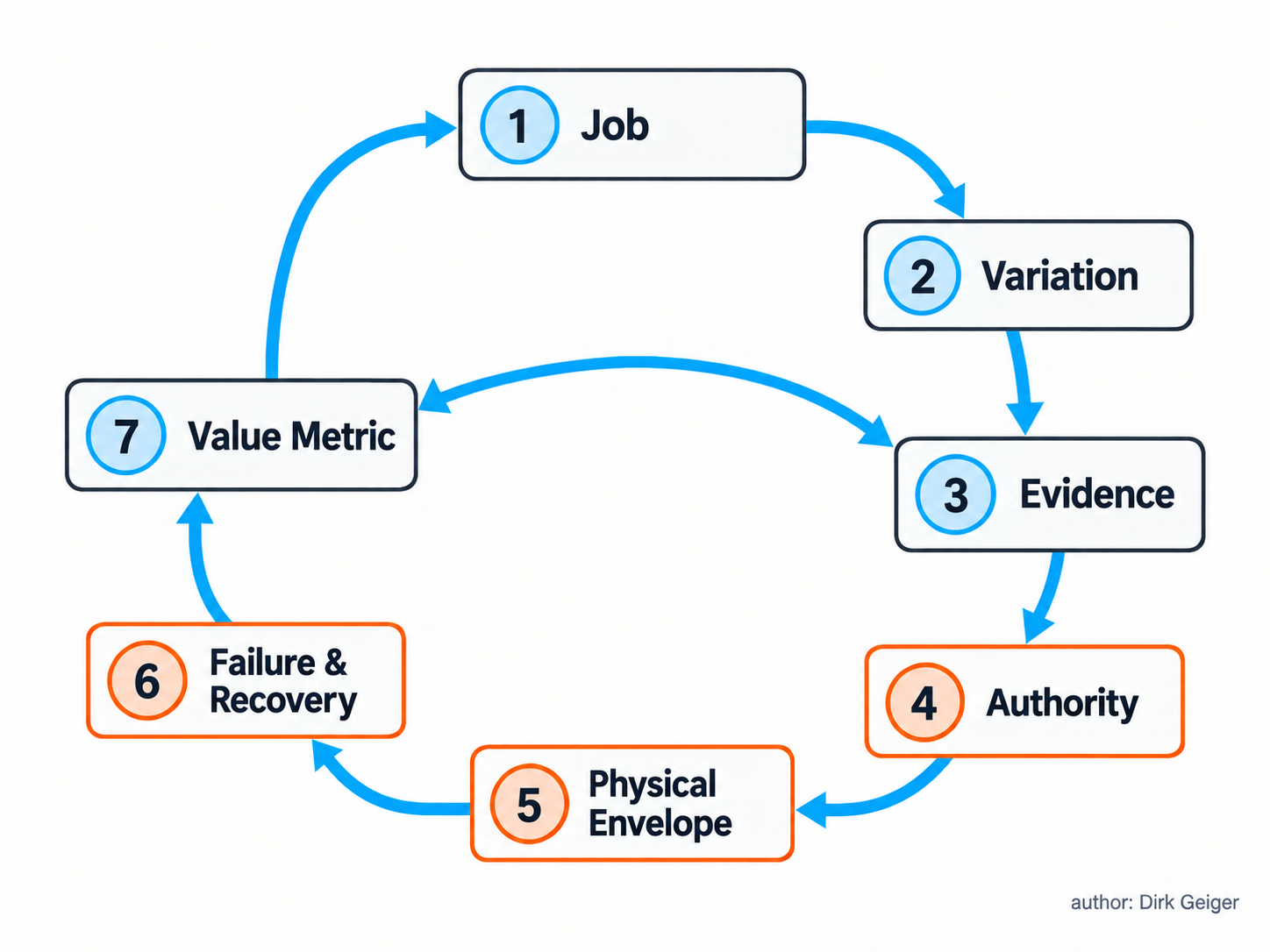
The answers form an interaction contract between business purpose and engineering reality. They clarify whether Physical AI is necessary, which subsystem needs it, how much authority it should receive and where deterministic containment belongs.
They also prevent technology-first architecture. A foundation model may improve instruction understanding and task generalisation. It may contribute little to a repetitive current-control loop with a microsecond-scale protection deadline. A tactile array can transform delicate manipulation and add little value to long-distance inspection. The job and its variation select the intelligence.
Procurement benefits from the same discipline. “AI-enabled” reveals little about operational capability. Buyers need the supported task set, operating domain, exception-handling behaviour, update policy, evidence retention, safety concept and measured fleet performance. Suppliers gain a clearer boundary for validation and product responsibility.
The seven answers should remain versioned as the machine evolves. A new payload changes the physical envelope. A model update can change command distributions. A battery aging profile changes available power. A new workplace layout changes environmental variation. Reassessment keeps the business case, operating domain and technical authority aligned through the product lifecycle.
A Shared Language for the Physical Machine
Automation executes processes. Robots provide actuated autonomy. Embodied AI studies and builds intelligence through the coupling of computation, body and environment. Physical AI turns that intelligence into adaptive, consequential action through a closed physical loop.
The categories overlap by design. Their value lies in the questions they bring into view. Where is the body? What does the system perceive? Which representation supports the decision? How much physical authority does the AI hold? Which controller enforces the boundary? What evidence proves the outcome?
The decisive engineering object is the complete loop. Sensors without timing create ambiguous evidence. Models without calibration misunderstand the body. Plans without validity windows age badly. Networks without bounded behaviour weaken control. Actuators without local protection turn software errors into hardware events. Safety without recovery can produce unnecessary downtime. Intelligence emerges as a system property because every layer contributes to the quality and consequence of action.
Physical AI rewards teams that connect disciplines early. Mechanical design shapes controllability. Power electronics shapes endurance and heat. Semiconductors shape sensing, compute, actuation and protection. Communication shapes temporal coherence. Software shapes interpretation and adaptation. Safety and cybersecurity shape permissible authority. Operations shapes the value metric that lasts: dependable work completed in the real world.
The terminology will continue to evolve. A robust working vocabulary can evolve with it. Define the operational domain, trace the perception-action loop, bound authority, measure evidence and count value at the job. Physical AI then becomes a practical way to engineer machines whose intelligence has a body—and whose body can be trusted with consequences.
Glossary
- Physical AI
- Artificial intelligence that interprets physical conditions, selects or shapes actions, and closes a feedback loop through an embodied machine under real-world constraints.
- Body-state estimation
- Continuous estimation of robot posture, velocity, orientation, contact state and related internal variables from multiple measurements.
- World model
- A task-oriented representation of relevant objects, geometry, relationships, dynamics and uncertainty used to predict and select action.
- Acquisition timestamp
- The time at which a physical quantity was sampled rather than received by software.
- Deterministic communication
- Communication with bounded predictable timing for coordinated real-time control.
- Distributed control
- Architecture in which real-time control functions are placed close to joints, sensors or subsystems rather than concentrated in one central computer.
- Heterogeneous compute
- Architecture combining different processor types selected for AI, general computation, deterministic control and protection responsibilities.
- Vision-language-action model
- A model that maps visual observations and language context into representations or outputs that can direct physical action.
- Operational domain
- The defined environments, conditions, tasks, users and constraints within which a system is intended and validated to operate.
- Configuration identity
- An attributable description of hardware, software, models, parameters, calibration and dependencies defining a deployed robot state.
- Efficiency cascade
- System interaction in which lower electrical losses reduce cooling and battery requirements, potentially lowering mass and further actuation energy.
- Data age
- Elapsed time between acquisition of information and the instant at which a receiving function evaluates or uses it.
- World model
- A task-dependent representation of objects, geometry, relationships, dynamics and uncertainty used to support decisions.
- State estimation
- The process of combining measurements and models to infer the current condition of a robot and its environment.
- Physical AI
- Artificial intelligence that interprets physical conditions, selects or shapes actions and closes a feedback loop through an embodied machine under real-world constraints.
- Graceful degradation
- Maintaining bounded, reduced functionality after a fault instead of abruptly losing all operational capability.
- Fault containment
- Detection, isolation, protection and architectural separation used to limit the scope of a fault.
- Functional safety
- The part of overall safety that depends on a system responding correctly to inputs, faults and operating conditions.
- Confidence estimation
- Explicit quantification of the uncertainty or trustworthiness associated with a measurement, inferred state or decision.
- Action contract
- A bounded, time-valid and confidence-aware instruction translating semantic intent into permissible physical execution.
- Bounded authority
- An architecture in which high-level functions propose actions while local functions enforce physical and safety limits.
- Actuator
- An integrated system that converts electrical energy and control commands into controlled mechanical movement or force.
- Embodiment
- The physical form, sensing, actuation and mechanical constraints through which a robot interacts with its environment.
- Embodied intelligence
- AI capability grounded in sensing, action and interaction with a physical environment.
- Economic validation
- Evidence that measured operational benefit exceeds full lifecycle cost at the required performance, availability and risk level.
Abbreviations
- AMR
- Autonomous Mobile Robot
- E/E
- Electrical and Electronic
- RMF
- Risk Management Framework
- VLA
- Vision-Language-Action
- AI
- Artificial Intelligence
- IFR
- International Federation of Robotics
- ISO
- International Organization for Standardization
- NIST
- National Institute of Standards and Technology
- RT-2
- Robotics Transformer 2
Sources
- Robot Definitions at ISO · n.d.
IFR summarizes ISO-derived definitions for robots, industrial robots and service robots, clarifying autonomy, actuation and intended tasks.
https://ifr.org/standardisation - AI Robotics Platform, Tools & Simulation · n.d.
NVIDIA describes Physical AI as systems that perceive, reason, learn and act in dynamic real-world environments.
https://www.nvidia.com/en-us/industries/robotics/ - AI Risk Management Framework · 2023-01-26
NIST presents a voluntary framework for incorporating trustworthiness into AI design, development, deployment, use and evaluation.
https://www.nist.gov/itl/ai-risk-management-framework - RT-2: Vision-Language-Action Models Transfer Web Knowledge to Robotic Control · 2023-07-28
RT-2 represents robot actions as tokens, transferring vision-language knowledge into end-to-end robotic policies and evaluated tasks.
https://arxiv.org/abs/2307.15818 - Gemini Robotics Brings AI into the Physical World · 2025-03-12
Google DeepMind introduces vision-language-action and embodied-reasoning models, multiple embodiments, interactive adaptation and layered robot safety.
https://deepmind.google/blog/gemini-robotics-brings-ai-into-the-physical-world/ - ISO 13482:2014 — Safety Requirements for Personal Care Robots · 2014-02
ISO specifies design, protective and risk-reduction requirements for mobile servant, physical assistant and person-carrier robots.
https://www.iso.org/standard/53820.html - Regulation (EU) 2023/1230 on Machinery · 2023-06-29
European Union machinery law establishes safety and conformity requirements, including provisions involving machine-learning-enabled safety components.
https://eur-lex.europa.eu/eli/reg/2023/1230/oj/eng - ISO 8373:2021 — Robotics — Vocabulary · 2021-11-08
International vocabulary standard defining terms used across robotics and providing the reference foundation for robot-related technical language.
https://www.iso.org/standard/75539.html - Global Robot Demand in Factories Doubles Over 10 Years · 2025-09-25
IFR reports 542,000 industrial-robot installations in 2024 and four consecutive years above 500,000 annual installations.
https://ifr.org/ifr-press-releases/news/global-robot-demand-in-factories-doubles-over-10-years - Industrial Robots — Definition, Statistics and Benefits · n.d.
IFR explains its ISO-based industrial-robot definition and the terms used for controlled, reprogrammable, multipurpose robotic manipulators.
https://ifr.org/industrial-robots - What Is Physical AI? · n.d.
NVIDIA defines Physical AI and describes model training, simulation and runtime deployment for embodied autonomous systems.
https://www.nvidia.com/en-us/glossary/generative-physical-ai/ - Artificial Intelligence Risk Management Framework (AI RMF 1.0) · 2023-01-26
NIST structures voluntary AI risk management and integrates trustworthiness into system design, development, use and evaluation.
https://www.nist.gov/itl/ai-risk-management-framework - RT-2: Vision-Language-Action Models Transfer Web Knowledge to Robotic Control · 2023-07-28
RT-2 expresses robot actions as tokens and transfers web-scale vision-language knowledge into end-to-end robotic control.
https://arxiv.org/abs/2307.15818 - Gemini Robotics Brings AI into the Physical World · 2025-03-12
Google DeepMind introduces Gemini Robotics and Gemini Robotics-ER, covering embodied reasoning, physical action, controller integration and safety.
https://deepmind.google/blog/gemini-robotics-brings-ai-into-the-physical-world/ - ISO 13482:2014 — Robots and Robotic Devices — Safety Requirements for Personal Care Robots · 2014-02-03
International safety standard addressing personal-care robot hazards, protective measures, information for use and human-robot physical contact.
https://www.iso.org/standard/53820.html - Regulation (EU) 2023/1230 on Machinery · 2023-06-29
European Union regulation establishes health and safety requirements for machinery, including autonomous and self-evolving control behaviour.
https://eur-lex.europa.eu/eli/reg/2023/1230/oj