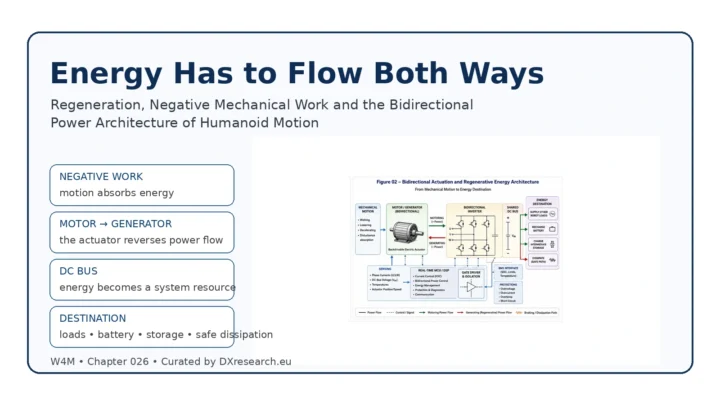
Energy Has to Flow Both Ways
Humanoid efficiency depends on capturing, routing and absorbing negative mechanical work through coordinated bidirectional actuation, power electronics and energy control.

Humanoid efficiency depends on capturing, routing and absorbing negative mechanical work through coordinated bidirectional actuation, power electronics and energy control.
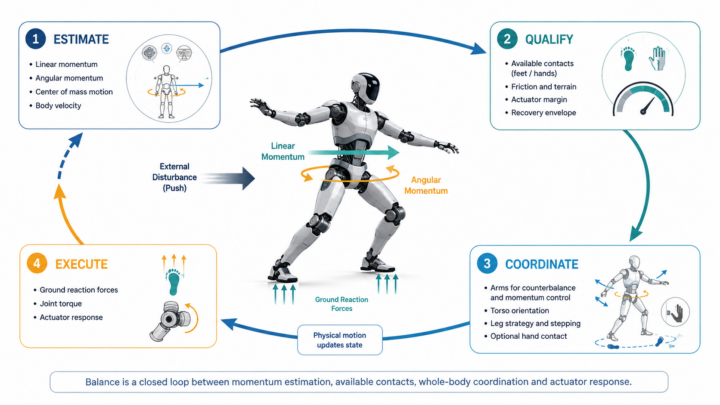
Humanoid balance depends on managing whole-body momentum through sensing, contact forces, coordinated limbs and fast control before disturbances become falls.
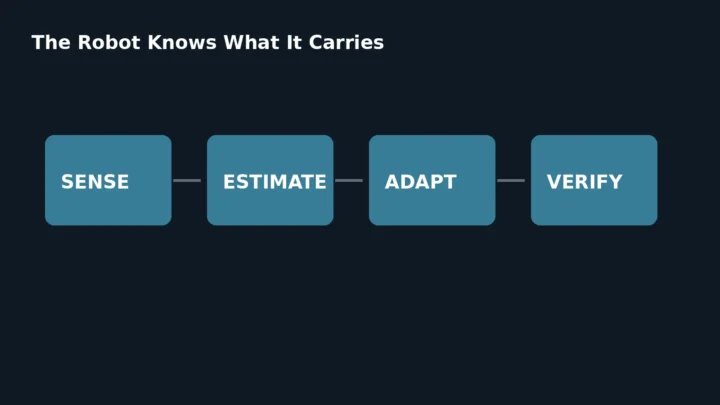
Payload awareness lets humanoids estimate mass, center of gravity and external forces so motion remains stable, efficient, responsive and safe.
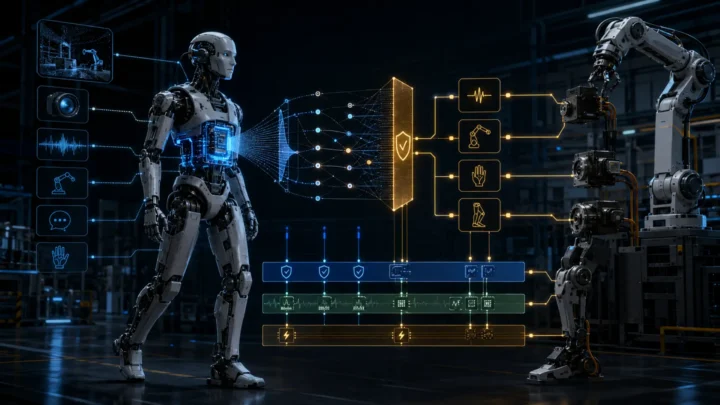
Humanoid intelligence becomes dependable when probabilistic AI proposals become bounded, time-valid, confidence-aware commitments executed and verified by deterministic physical-control architectures.
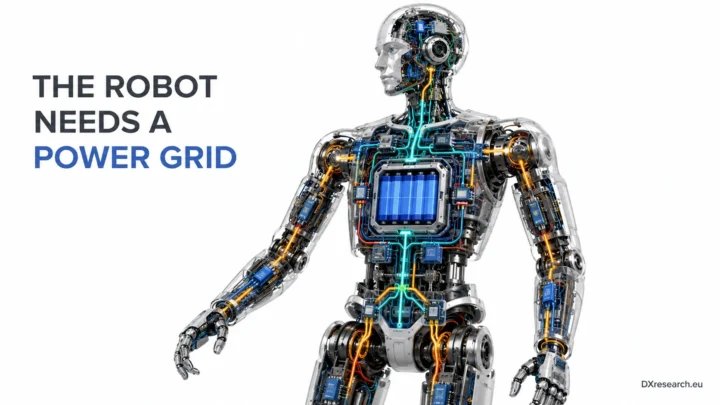
Humanoid power must become a distributed, protected, observable grid that routes energy safely across actuators, compute, sensing, and regenerative loads.
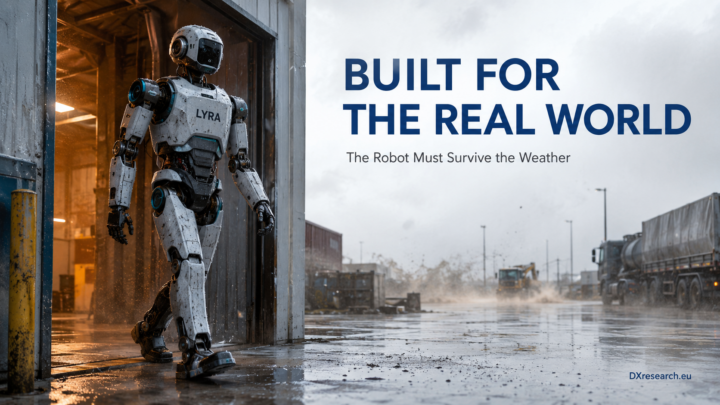
Outdoor deployment exposes every robot zone to a different combination of water, dust, condensation, temperature and contamination. Original technical artwork © DXresearch.eu
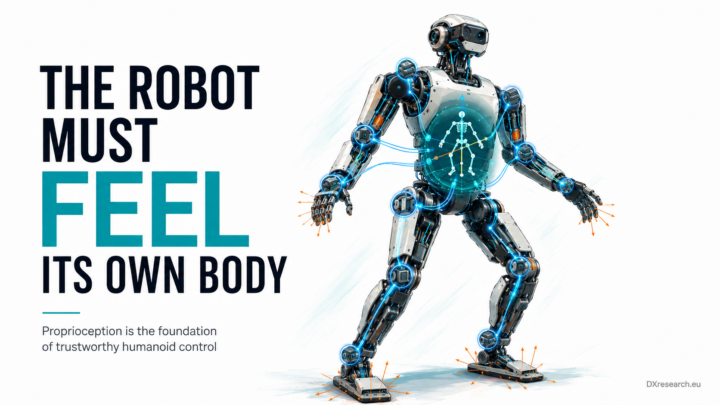
Proprioception turns joint, inertial, contact and load measurements into trustworthy body-state estimates for safer, more capable, serviceable humanoid motion systems.
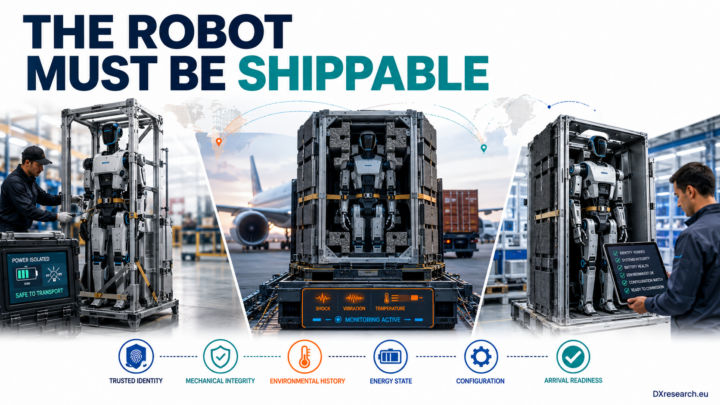
Humanoid robots scale only when transport, storage, battery isolation, shock resilience, commissioning, and traceability are engineered into architecture from inception.
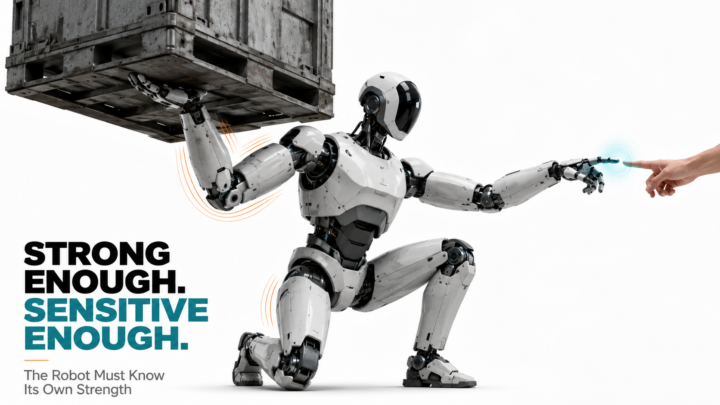
Force and torque awareness turns humanoid actuation into measurable physical intelligence, enabling safer contact, better dexterity, diagnostics, learning, and control.
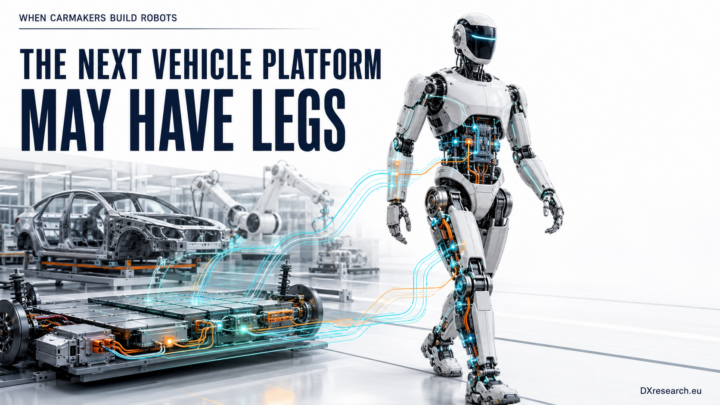
Automotive OEMs become robot makers transferring electric drive sensing safety AI manufacturing and supplier architectures into emerging Physical AI ecosystems.