
Technical Article
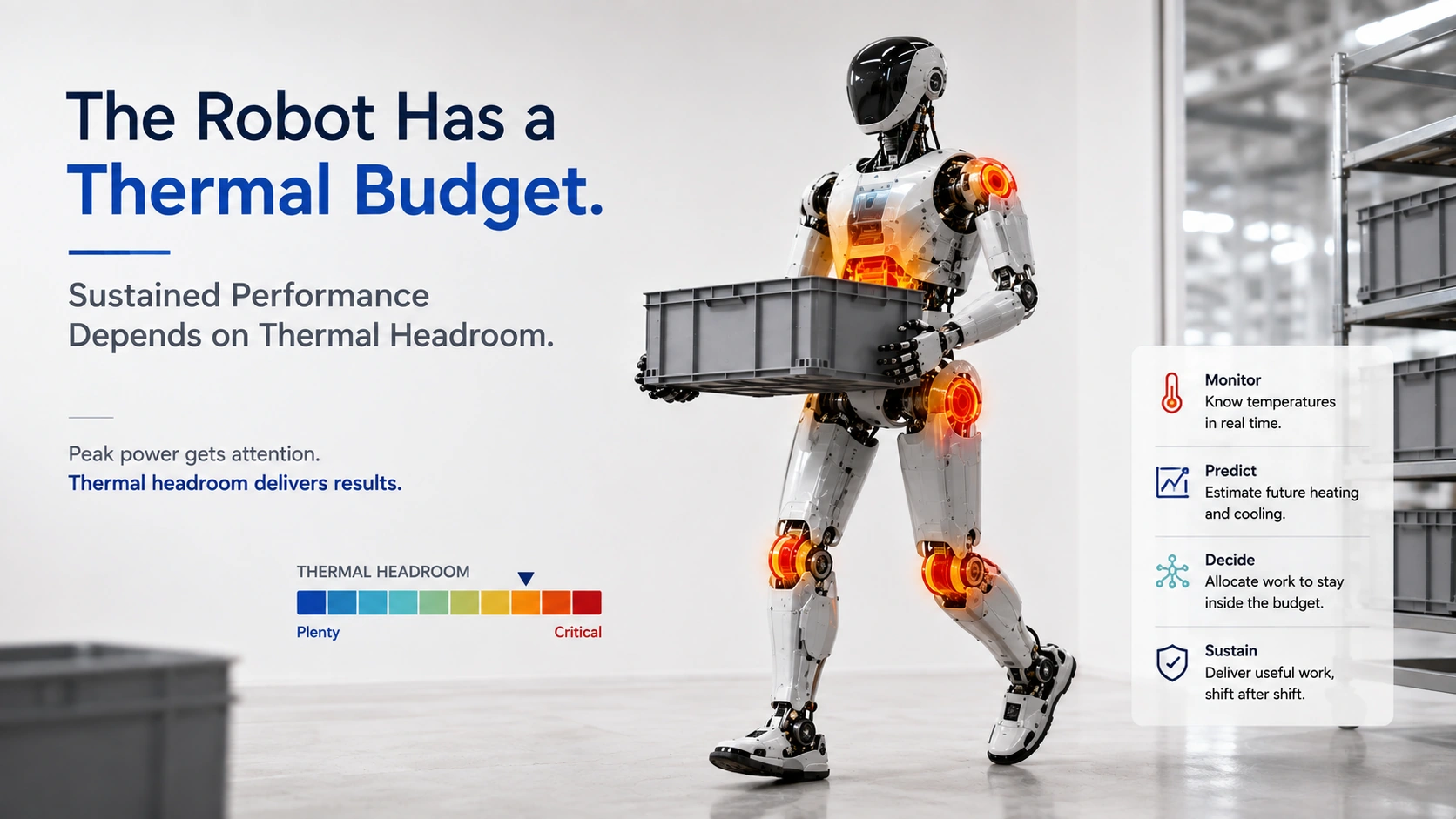
The Robot Has a Thermal Budget
Why Sustained Humanoid Performance Depends on Managing Heat as a Shared System Resource
Thermal headroom determines whether humanoid peak performance can become sustained useful work across actuators, compute, batteries and power electronics reliably.
Executive Summary
Humanoid performance is usually specified through peak torque, peak compute, battery capacity and nominal cooling, yet useful work is governed by what the machine can sustain after heat accumulates. This chapter defines the robot’s thermal budget as a dynamic resource spanning actuators, power electronics, compute, batteries and embedded electronics. Motor copper losses, inverter switching losses, AI processing and battery current create heat in different locations, while compact packaging, sealing and low mass constrain rejection paths. The key architectural requirement is therefore thermal observability: temperature sensing, loss estimation, thermal models and workload prediction must expose remaining thermal headroom to motion planning and control. Instead of waiting for local protection thresholds, the robot should allocate work according to temperature, predicted heating and cooling opportunity. Semiconductor efficiency matters twice: it reduces heat generation and preserves performance margin. A robot’s real capability is not what it can do once, but what it can repeat.Visual pending: Systems concept
The Specification Sheet Hides Time
Humanoid specifications naturally emphasize maximum torque, speed, compute performance and battery energy. Those numbers are useful, but they omit a decisive variable: duration. A motor can produce a high current for a short burst because its copper, magnets, housing and structure temporarily absorb heat. A processor can run an intensive inference workload while its heat spreader and cooling system absorb a transient. A battery can deliver a power pulse that would be inappropriate as a continuous load. The difference between a demonstration and a work shift is therefore not merely energy capacity. It is whether the robot can repeatedly reject the heat created by useful work. This distinction separates Peak torque from Continuous torque. The former is bounded by electrical, magnetic and mechanical limits over short intervals; the latter is fundamentally coupled to temperature and cooling. Humanoid research has demonstrated online motor-temperature estimation used to adapt maximum joint torque during high-load whole-body tasks. [1] That is an important architectural clue: temperature is not only a protection input. It can become part of the motion-control envelope.Heat Is Generated Everywhere, but Not at the Same Rate
A humanoid contains many distributed heat sources. Motor windings produce approximately current-squared copper losses. Magnetic and mechanical losses rise with speed and operating point. Inverters add conduction and switching losses. DC/DC converters, regulators, sensors and communication electronics add smaller but spatially distributed loads. Central AI compute can become one of the most concentrated heat sources in the torso. Battery cells generate heat through internal resistance and electrochemical processes, particularly under high charge or discharge power. The consequence is a robot-wide Thermal budget: not a single temperature limit, but a collection of local constraints with different Thermal time constant values and different paths to ambient. A knee winding may heat rapidly during repeated squats while torso compute remains comfortable; later, sustained perception and planning may constrain compute while locomotion is light. The useful question is therefore not “Is the robot hot?” but “Where is the remaining Thermal headroom, how quickly is it changing, and which future actions will consume it?”The Temperature You Need Is Often the Temperature You Cannot Measure
Direct sensing is necessary but incomplete. A thermistor on a motor housing does not instantaneously equal Winding temperature; a board sensor does not equal MOSFET Junction temperature. Thermal gradients and delays mean that the most safety-relevant internal temperature can lead or lag an accessible sensor. Semiconductor junction temperature similarly depends on dissipated loss, case temperature and the device’s thermal path. Infineon describes junction-temperature estimation using load current, on-resistance, case temperature and transient thermal behavior, and emphasizes thermal resistance as a system-reliability parameter. [10] [11] This creates the need for Thermal observability. Current, voltage, switching state, motor speed, torque command, measured temperatures, compute utilization and cooling state become evidence for a thermal observer. Current sensing is especially valuable because it already exists in high-performance field-oriented motor control. TI notes that humanoid motor current measurements support torque control, performance monitoring and detection of abnormal overload conditions that can contribute to overheating. [6] The thermal architecture should reuse this evidence instead of treating temperature monitoring as an isolated protection circuit.Visual pending: Systems concept
From Sensors to a Thermal Digital Twin
A practical thermal observer can combine direct measurements with Loss estimation. Motor copper loss can be estimated from phase current and winding resistance; inverter loss can be estimated from current, switching frequency, device characteristics and temperature; compute telemetry can provide power or utilization evidence; battery management provides cell temperatures, current and state information. These inputs feed a Thermal model, ranging from simple first-order RC networks to higher-order models or learned estimators. The objective is not perfect temperature reconstruction everywhere. It is decision-grade prediction: enough fidelity to estimate present margin and predict which component will become limiting over the next motion or task horizon. Research on NASA Valkyrie demonstrated a first-order, data-driven actuator thermal model used to find contact-constrained robot configurations that reduce future actuator temperatures. [2] More recent legged-robot research has incorporated whole-body thermal state into locomotion policy, explicitly trading performance against motor overheating under sustained payload operation. [3] These examples point toward a general principle for Physical AI: thermal state belongs in the robot state vector.Thermal Headroom Should Become a Control Constraint
Traditional protection is threshold-oriented: detect overtemperature, reduce current, throttle clocks or shut down. That remains essential as the last line of defense, but it is a poor operating strategy for an autonomous worker. By the time a hard threshold is crossed, the robot has already lost freedom to choose a graceful response. Predictive management instead exposes a Dynamic torque limit, allowable compute power, battery power limit and cooling capacity before emergency action is required. For locomotion, a controller can redistribute work across joints, modify gait, shorten steps, reduce acceleration or select a posture that unloads a hot actuator. For manipulation, it can alter grasp or whole-body posture so gravity loads move away from a thermally constrained shoulder. For stationary work, it can exploit Thermal recovery: change configuration, use an alternative contact, reduce holding torque or schedule a brief low-load phase. For compute, the system can reduce model frequency, defer noncritical inference or migrate tasks to lower-power execution paths. These are not independent optimizations; they compete for mission performance and should be coordinated.Compute Proves Why Protection Alone Is Not Enough
Modern robotics compute already exposes sophisticated power and thermal mechanisms. NVIDIA’s Jetson Thor documentation describes module power budgets, current monitoring, software and hardware clock throttling, multiple thermal zones, active cooling and staged shutdown mechanisms. [4] Its thermal design documentation emphasizes that system design must keep module and SoC temperatures within specified limits and that unbalanced or higher-power workloads require additional thermal analysis. [5] This illustrates the hierarchy a humanoid needs across the entire body: measure, estimate, manage, derate and only then protect. The deeper opportunity is to connect compute thermal management with physical control. If the torso has little headroom while the legs remain cool, slowing locomotion may not solve the actual bottleneck. Conversely, reducing perception workload cannot rescue an overheating knee. A robot-wide headroom map allows the task planner to identify the limiting resource rather than applying generic derating.Semiconductors Influence Both Sides of the Thermal Equation
Semiconductors matter first because they create and measure the control evidence: MCUs synchronize current and temperature acquisition, ADCs digitize analog sensors, current sensors reveal electrical load, communication devices transport telemetry, and processors execute observers and predictive control. They matter again because power-device efficiency directly changes the amount of heat generated. Infineon’s humanoid motor-control architecture emphasizes tight joint-space and thermal margins and positions efficient MOSFET and GaN power stages as enablers of compact actuator designs. [8] Its broader robotics material links lower power losses with cooler operation and higher power density. [9] This creates a system-level leverage effect. Lower inverter loss reduces junction temperature and local cooling demand; it may also reduce heatsink mass, fan power or structural volume. Yet higher integration can concentrate heat, so power density must never be confused with thermal capability. The design metric should therefore move beyond peak inverter efficiency. What matters is loss across the mission profile, the resulting temperature trajectory, and the thermal impedance from semiconductor junction to ambient. Thermal resistance describes steady heat-flow difficulty, while Transient thermal impedance captures the fact that short power pulses can be tolerated differently from continuous dissipation. Those concepts connect semiconductor selection directly to robot duty cycle.Thermal Limits Should Be Mission-Profile Aware
A thermal budget only becomes meaningful when evaluated against time. Repeated lifting, stair climbing, crouching, carrying and static holding produce very different loss histories even when their average mechanical work appears similar. Static holding can be especially deceptive: little visible motion may still require sustained motor current. A useful mission simulation therefore needs electrical loss models and thermal states at one-second or faster resolution, not only average energy consumption. Workload prediction allows the controller to reserve headroom for known future events. A robot approaching stairs while carrying payload should not spend the last thermal margin on an optional high-compute task. Likewise, a robot that knows a low-load transport phase follows a demanding lift may temporarily accept higher temperature because recovery is imminent. Thermal management becomes analogous to energy management, except the resource is spatially distributed and cannot be instantly moved from one joint to another.From Derating to Graceful Degradation
Thermal derating should not mean one global percentage applied to the entire robot. The better architecture is hierarchical. Local electronics enforce hard device and winding limits. Joint controllers expose allowable torque and current. Compute modules expose allowable processing power. Battery management exposes charge and discharge limits. A supervisory layer combines those limits with task priorities and chooses a feasible behavior. Power throttling is then one option among several, not the default response. The robot may slow, redistribute load, change posture, change contacts, reduce payload acceleration, postpone a nonessential task, alter compute quality of service or intentionally enter a cooling pose. Thermal-aware motion planning turns heat from an afterthought into a planning variable. The resulting behavior is more graceful because the robot acts while choices remain available.Visual pending: Systems concept
A Better KPI: Sustainable Capability
The industry needs metrics that distinguish a spectacular ten-second maneuver from repeatable useful work. Candidate measures include continuous joint torque under defined ambient and cooling conditions; time-to-derating under a specified mission profile; recovery time after overload; minimum thermal headroom during a cycle; fraction of mission time spent derated; and useful work completed per unit of cooling mass or cooling power. TI’s industrial robot design guidance illustrates how temperature-sensor accuracy itself can translate into additional derating margin, reinforcing that observability quality affects usable performance. [7] For humanoids, the most meaningful benchmark may be task throughput under thermal equilibrium: how much useful work can the robot repeat without progressively accumulating heat? That KPI naturally connects motor design, power semiconductors, compute, battery, cooling, mechanical packaging and control software.Conclusion
The robot’s thermal budget is a dynamic, distributed resource. It cannot be represented by one maximum temperature or solved by adding a larger fan after the architecture is fixed. The robot needs direct sensing, electrical loss evidence, predictive thermal models and control interfaces that expose remaining headroom. Efficient semiconductors reduce the rate at which that resource is consumed; thermal observers reveal where it remains; whole-body and compute control decide how to spend it. Peak capability answers what a humanoid can do once. Sustainable capability answers whether it can perform useful work for hours, recover intelligently and repeat the task tomorrow. For industrial Physical AI, the second question is the one that ultimately determines productivity.References
- IEEE-RAS International Conference on Humanoid Robots. Whole body joint load reduction control for high-load tasks of humanoid robot through adapting joint torque limitation based on online joint temperature estimation. 2014. https://doi.org/10.1109/HUMANOIDS.2014.7041402
- arXiv / NASA Valkyrie research. Thermal Recovery of Multi-Limbed Robots with Electric Actuators. 2019. https://arxiv.org/abs/1902.00187
- arXiv. Learning to Balance Motor Thermal Safety and Quadrupedal Locomotion Performance with Residual Policy. 2026. https://arxiv.org/abs/2605.27046
- NVIDIA. Jetson Thor Product Family — Platform Power and Performance. 2026. https://docs.nvidia.com/jetson/archives/r38.4/DeveloperGuide/SD/PlatformPowerAndPerformance/JetsonThor.html
- NVIDIA. Jetson Thor Series Thermal Design Guide. 2026. https://developer.nvidia.com/embedded/downloads/
- Texas Instruments. Current Sensing in Humanoid Robots. 2026. https://www.ti.com/document-viewer/lit/html/SBOA627
- Texas Instruments. An Engineer’s Guide to Industrial Robot Designs. 2020. https://www.ti.com/lit/eb/ssiy006/ssiy006.pdf
- Infineon Technologies. Humanoid robot motor control. 2026. https://www.infineon.com/applications/industrial/robotics/humanoid-robots/humanoid-robot-motor-control
- Infineon Technologies. Robotics. 2026. https://www.infineon.com/applications/industrial/robotics
- Infineon Technologies. Estimation of the MOSFET junction temperature for short pulse durations. 2025. https://community.infineon.com/t5/Knowledge-Base-Articles/Estimation-of-the-MOSFET-junction-temperature-for-short-pulse-durations/ta-p/1019909
- Infineon Technologies. Rth_jc estimation: Analytical approach. 2026. https://community.infineon.com/t5/Knowledge-Base-Articles/Rth-jc-estimation-Analytical-approach/ta-p/1231261
Glossary
- Dynamic torque limit
- A torque ceiling adjusted online using estimated actuator thermal state and predicted heating.
- Thermal resistance
- A measure relating steady heat flow to temperature difference along a thermal path.
- Thermal recovery
- Deliberate reduction or redistribution of load to cool constrained components while preserving useful robot operation.
- Thermal observability
- The ability to infer relevant internal thermal states from temperature, current, voltage, workload and model-based evidence.
- Thermal model
- A mathematical representation of heat generation, storage and transfer used to estimate or predict temperatures.
- Thermal headroom
- The remaining temperature and heat-rejection margin before a component or subsystem reaches a defined operating limit.
- Thermal derating
- Intentional reduction of allowable torque, current, compute frequency or power as thermal margin decreases.
- Thermal budget
- The time-varying amount of thermal capacity available across robot subsystems before temperature-dependent limits constrain operation.
- Power throttling
- Reducing electrical or compute power to remain inside power or thermal constraints.
- Peak torque
- Short-duration torque capability that cannot necessarily be maintained thermally.
- Loss estimation
- Calculation or inference of heat-generating electrical and mechanical losses from measured operating variables.
- Junction temperature
- The semiconductor die temperature used to assess electrical performance, protection margin and reliability.
- Heat Flux
- A thermal-management concept used to describe sustainable robot operation and control.
- Continuous torque
- Torque that an actuator can sustain under specified thermal and cooling conditions without exceeding limits.
- Thermal time constant
- A characteristic timescale describing how quickly a thermal state responds to a change in losses or cooling.
- Thermal-aware motion planning
- Motion planning that considers thermal state and future heat generation when selecting posture, contacts, trajectories or task timing.
- Transient thermal impedance
- A time-dependent representation of temperature rise caused by transient power dissipation.
- Winding temperature
- The temperature of motor windings, often more relevant to actuator thermal safety than an external housing measurement.
- Workload prediction
- Forecasting future actuator, compute and battery demand so thermal consequences can be anticipated.
Sources
- An Engineer’s Guide to Industrial Robot Designs · 2020 · Texas Instruments
https://www.ti.com/lit/eb/ssiy006/ssiy006.pdf - Current Sensing in Humanoid Robots · 2026 · Texas Instruments
https://www.ti.com/document-viewer/lit/html/SBOA627 - Estimation of the MOSFET junction temperature for short pulse durations · 2025 · Infineon Technologies
https://community.infineon.com/t5/Knowledge-Base-Articles/Estimation-of-the-MOSFET-junction-temperature-for-short-pulse-durations/ta-p/1019909 - Humanoid robot motor control · 2026 · Infineon Technologies
https://www.infineon.com/applications/industrial/robotics/humanoid-robots/humanoid-robot-motor-control - Jetson Linux Developer Guide — Power Management · 2026 · NVIDIA
https://docs.nvidia.com/jetson/ - Jetson Linux Developer Guide — Thermal Management · 2026 · NVIDIA
https://docs.nvidia.com/jetson/ - Jetson Thor · 2026 · NVIDIA
https://www.nvidia.com/en-us/autonomous-machines/embedded-systems/jetson-thor/ - Jetson Thor Product Family — Platform Power and Performance · 2026 · NVIDIA
https://docs.nvidia.com/jetson/archives/r38.4/DeveloperGuide/SD/PlatformPowerAndPerformance/JetsonThor.html - Jetson Thor Series Thermal Design Guide · 2026 · NVIDIA
https://developer.nvidia.com/embedded/downloads/ - Learning to Balance Motor Thermal Safety and Quadrupedal Locomotion Performance with Residual Policy · 2026 · arXiv
https://arxiv.org/abs/2605.27046 - Robotics · 2026 · Infineon Technologies
https://www.infineon.com/applications/industrial/robotics - Rth_jc estimation: Analytical approach · 2026 · Infineon Technologies
https://community.infineon.com/t5/Knowledge-Base-Articles/Rth-jc-estimation-Analytical-approach/ta-p/1231261 - Thermal Recovery of Multi-Limbed Robots with Electric Actuators · 2019 · arXiv / NASA Valkyrie research
https://arxiv.org/abs/1902.00187 - Whole body joint load reduction control for high-load tasks of humanoid robot through adapting joint torque limitation based on online joint temperature estimation · 2014 · IEEE-RAS International Conference on Humanoid Robots
https://doi.org/10.1109/HUMANOIDS.2014.7041402