
Technical Article
Onboard Compute Is Becoming a Robot’s Qualification Anchor
Digit 5 and IGX Thor reveal how one compute baseline can bind intelligence, timing, safety evidence and long-term serviceability.
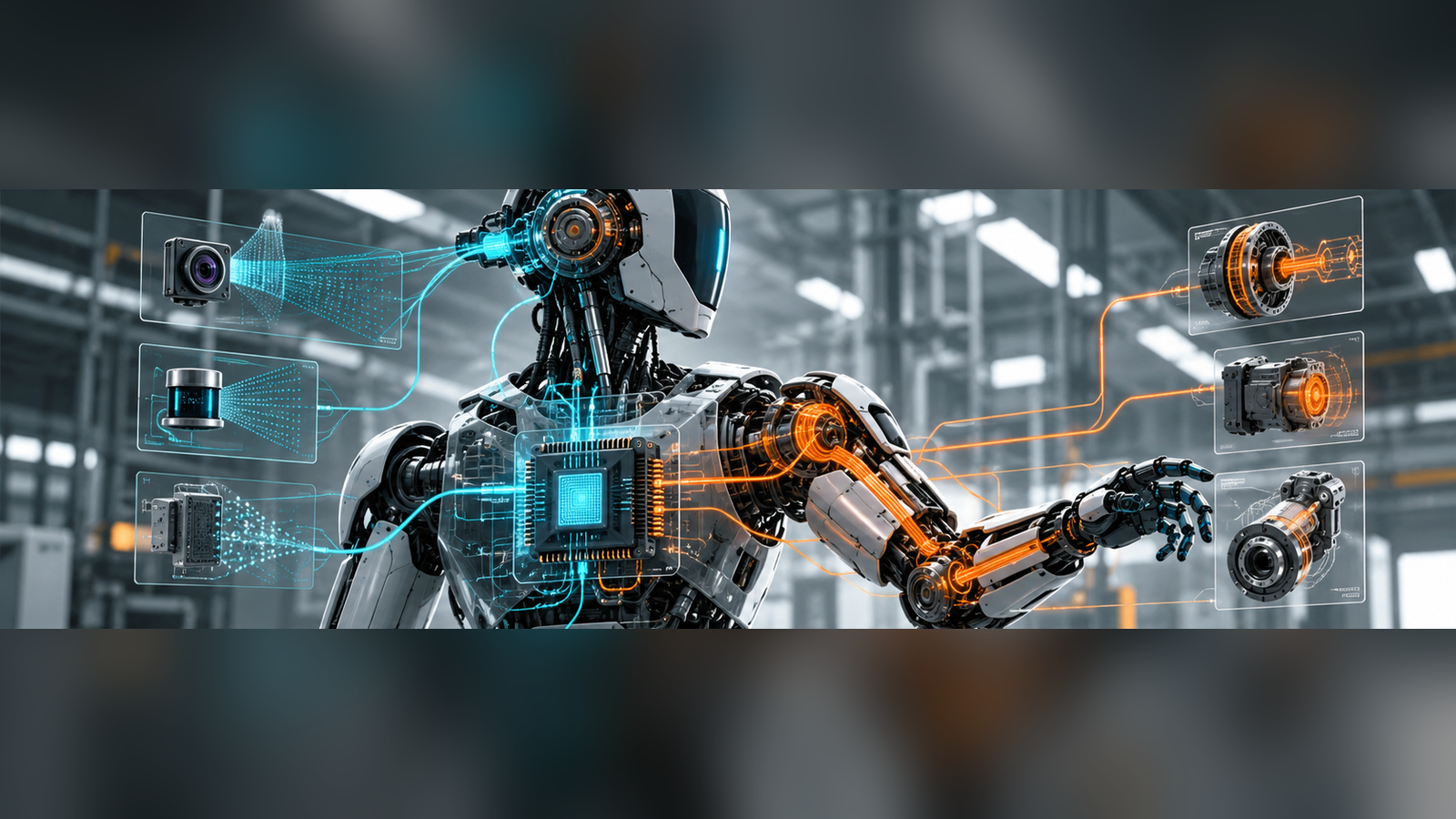
Agility Robotics’ decision to standardize Digit 5 on NVIDIA IGX Thor marks a shift in humanoid architecture. Compute now connects AI capabilities to deterministic execution, safety assurance and lifecycle governance. The commercial test is whether a controlled platform can reduce qualification effort while managing faults, updates and supplier dependence.
The significance of exclusive onboard compute
On 22 October 2026, Agility Robotics used a consequential phrase in its announcement about Digit 5: “exclusive provider of onboard compute.” The company said its next-generation humanoid would standardize on NVIDIA IGX Thor modules for the general-availability configuration. The transition was presented alongside ongoing work on safe human detection, software inspection and third-party certification. A processor selection had become a public statement about the robot’s industrialization strategy [S1].
For an engineer responsible for keeping a humanoid working through a production shift, exclusivity has a different meaning from a benchmark victory. The critical question is what will happen when a sensor produces stale data, a model changes its output distribution, a compute rail sags during a high-torque movement, or a firmware patch alters communication timing. Every such event touches the accepted configuration of the machine. The compute decision influences how those changes are investigated, tested, documented and rolled out.
Agility expects early access to Digit 5 in the first half of 2027 and greater availability in subsequent months. Those dates are company plans, and the announcement supplies no complete publicly accessible qualification dossier. Even so, the architectural signal is material: once an onboard processor becomes the shared foundation for perception and safety-related software, replacing it becomes a systems-engineering change with safety, cybersecurity and maintenance consequences.
Just one day earlier, NVIDIA announced Isaac OS, described as a deterministic runtime for robotics, alongside a reference humanoid, Isaac Lab updates, validation workflows and the Halos safety platform [S2]. Together, the announcements suggest a market transition in which compute suppliers compete to become the configuration and evidence anchor for deployed robots. The ultimate advantage will have to be demonstrated in certification effort, fault containment and service outcomes, not inferred from the names on the silicon.
From accelerator module to controlled robot platform
An onboard computer used to be shortlisted by throughput, memory, power, envelope, software support and price. Those criteria still determine whether perception and manipulation workloads fit. These attributes remain important, especially as multimodal models compete for memory bandwidth while camera pipelines and motion planning consume predictable resources. A humanoid introduces an additional burden: perception and intelligence coexist with a physical machine that may be carrying a load, stepping onto an uncertain surface or moving beside a person.
Its architecture therefore spans several timing domains. Visual perception can tolerate some frame-to-frame variation, provided that age and confidence are understood. Task planning may operate at relatively slow rates. Whole-body controllers need timely state estimates. Motor-current loops and protective functions demand substantially tighter limits and, frequently, independent execution paths. A single processor family can simplify the first two domains while leaving the others distributed. Where to place the boundaries is a robot-level design choice.
The useful concept is a qualified configuration baseline: a named assembly of hardware revisions, firmware, operating-system components, middleware, AI models, controllers, calibration data, security policy and enabled functions, with specific supporting tests. Baselines make a failure reproducible. They permit a service engineer to determine whether two ostensibly identical robots actually execute the same logic. They also expose the scope of a change request before a field update starts.
A module upgrade that preserves electrical connectors may still alter interrupt behavior, memory ordering, thermal characteristics or driver scheduling. Even unchanged inference outputs can reach a controller at different times. Treating a replacement as equivalent solely because its nominal performance is higher overlooks the properties that determine field behavior. A qualified platform is a documented relationship among components and operating conditions, while an accelerator benchmark measures only a narrow computational property.
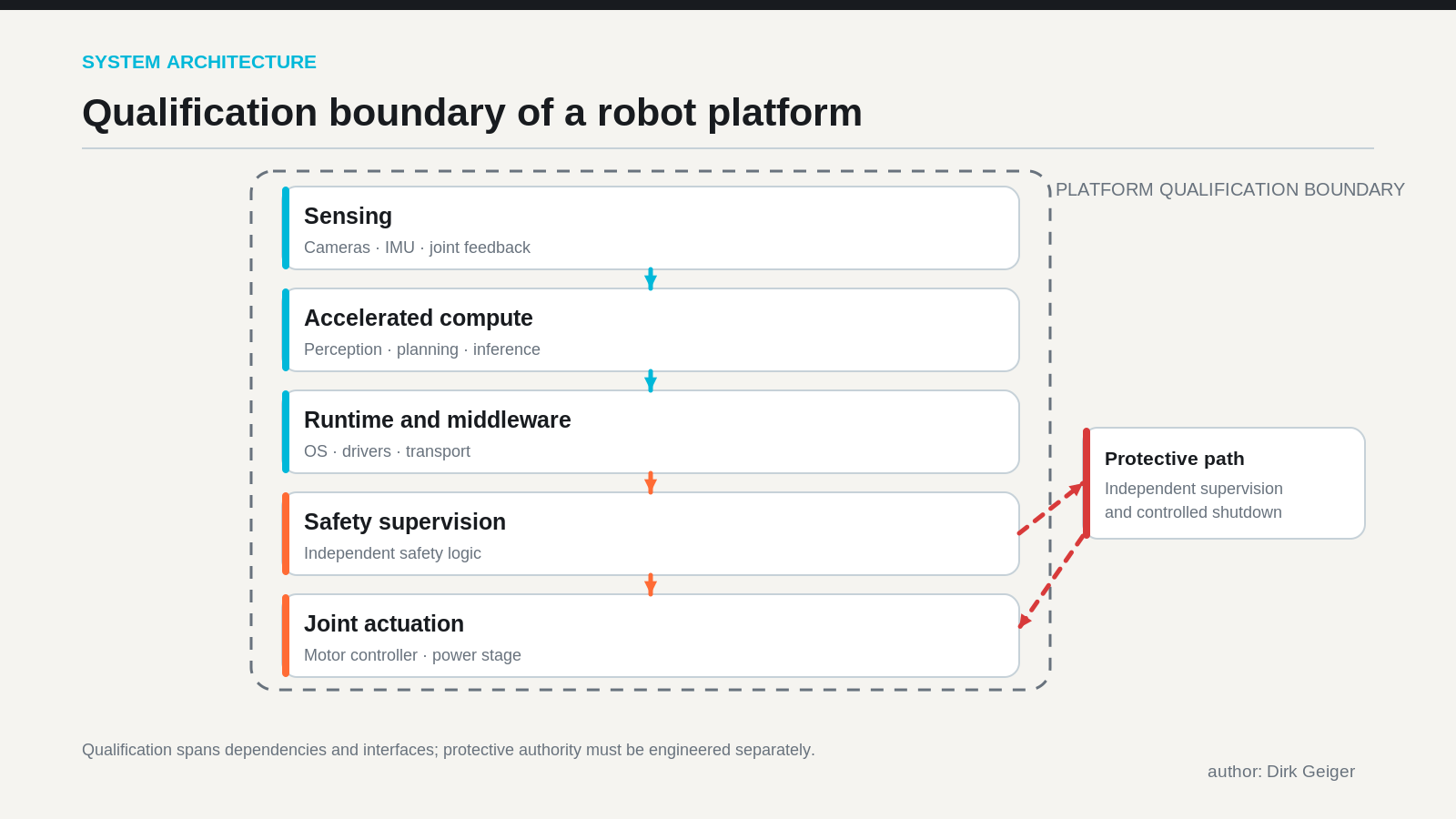
The qualification boundary shown in the platform architecture is an engineering model of accountable interfaces, not a disclosed Digit 5 implementation.
Deterministic runtime is a system property
NVIDIA describes Isaac OS as introducing deterministic real-time robotics capabilities [S2]. That is an important direction, but the engineering term needs a carefully defined boundary. Determinism is established by a measurable timing contract for an identified workload, deployment configuration and set of disturbances. It cannot be attributed to the entire humanoid simply because one software layer has deterministic mechanisms.
Consider a camera-based human-detection path. The relevant latency begins at photon integration and sensor acquisition, continues through transport, memory transfers, preprocessing, inference, filtering, decision logic and command propagation, and ends when an actual actuator response is achieved. An inference kernel can have repeatable execution time while network contention, clock drift, image buffering or actuator command age determines the dangerous tail of the distribution. For safety purposes, the oldest valid observation and latest permitted response may matter more than mean throughput.
The same complication appears in coordinated locomotion. A planner can provide a desired foothold while a fast local controller continuously checks contact state, torque demand and stability constraints. If the high-level compute freezes, the local architecture must have defined authority and energy to reach a risk-reduced state. A heavy payload, a flight phase and a supported standing posture may require different responses. The relevant fault tolerance is situational and must be assessed under explicitly identified operating conditions.
Useful validation includes end-to-end timestamping, worst-case execution-time assessment where applicable, load-induced latency measurement, deadline-miss handling and bounded behavior during partial failures. Testing should deliberately combine model load, storage access, communications traffic, thermal throttling and power transitions. Workload isolation and scheduling design matter, but they are only meaningful when evaluated with the entire sensing-to-motion chain.
In practice, good qualification teams will maintain two views of time: software timing inside the compute platform and physical timing across sensors, networks and actuators. The second view determines whether the machine responds while a hazard is still avoidable.
Safety authority must remain legible
Agility says it is integrating IGX Thor and additional NVIDIA Halos models into its proprietary safe human detection system and plans to participate in NVIDIA’s Halos AI Systems Inspection Lab, ahead of eventual third-party certification [S1]. These commitments describe a development and evaluation path. Public material leaves the allocation of safety functions, assessed standards, certification scope and independent findings open. Halos integration should therefore be understood as part of a proposed safety architecture, with assurance claims bounded by the evidence eventually produced.
The distinction matters because detecting a person is only one step in preventing harm. A detection must be sufficiently credible for the operational context, delivered before a deadline and translated into a permissible motion or stop response. Independent protection may be required for faults that disable perception, corrupt output, interrupt communication or remove actuator control. Safety-related hardware, software and operational measures can carry different responsibilities.
Agility’s October 1 announcement with FORT Robotics describes an evolving three-part architecture: safety pendant, on-robot communications and off-robot interfaces connecting Digit with external safety systems. The companies also describe an independent manual override for setup, maintenance and unexpected situations [S4]. That announcement is a useful reminder that the safety boundary can extend into the building, operator interfaces and the integration contract with customer machinery.
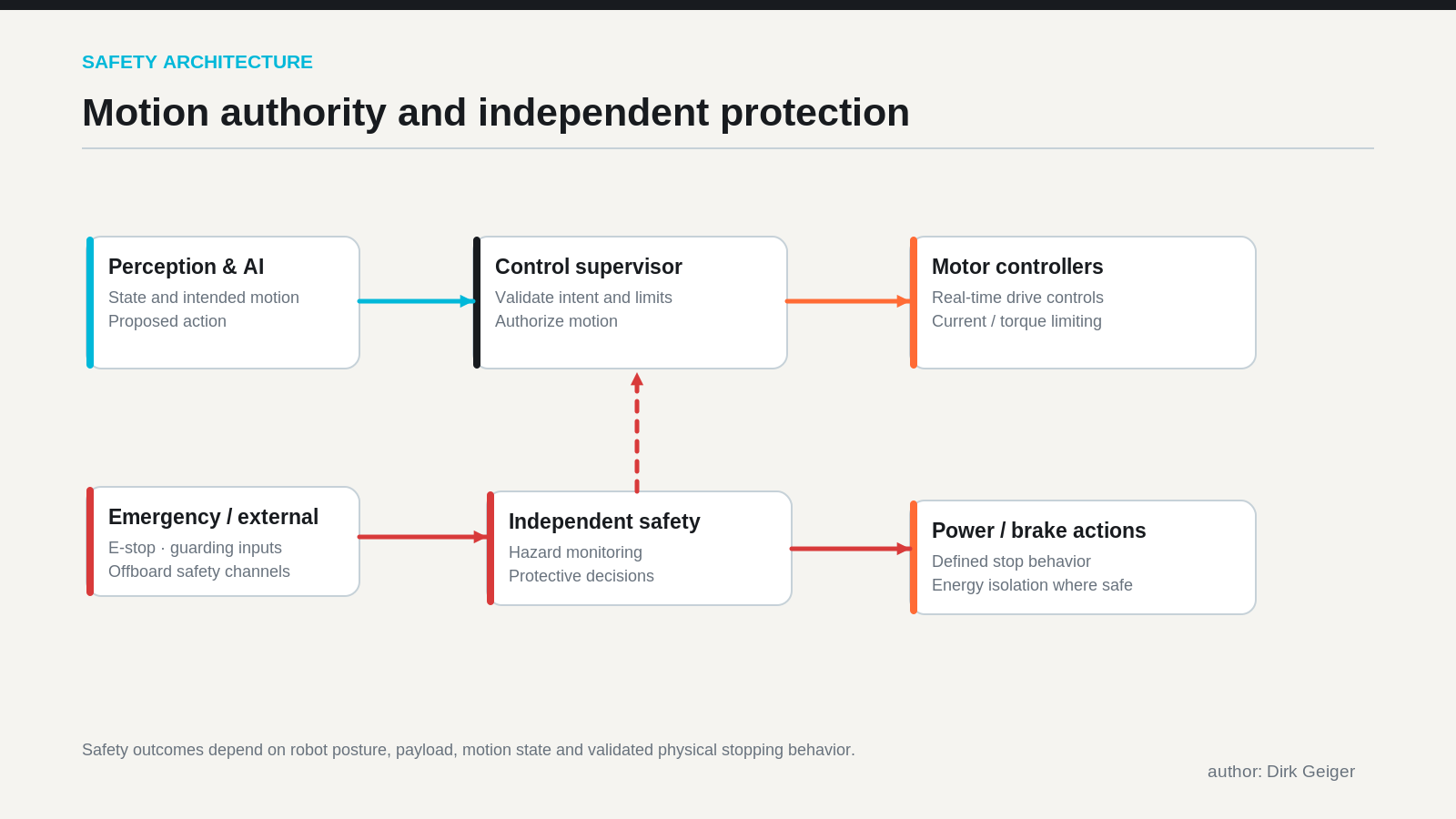
One possible architectural partition assigns perception and high-level behavior to an accelerated computer, constraint enforcement to safety-oriented supervisors, and immediate energy limitation or safe braking to drive-level functions. This is an illustrative partition, not a representation of Digit 5’s disclosed internal wiring. A safety assessor would ask which channel detects which fault, which channel retains authority when another fails, and how common-cause exposure is limited.
Machine safety ultimately resides in specified hazards, mitigations and validated behavior. A standard module can stabilize the evidence package, but each new application still introduces people, payloads, floors, traffic patterns, speeds and interfaces that affect risk. A trusted computing base is valuable when its assumptions and limits are traceable.
The safety partition identifies where an independent protective function can retain authority when perception, network access or the accelerated runtime deteriorates.
The version number becomes an industrial control
Picture a fleet of fifty nominally identical robots spread across three distribution centers. Two sites update their perception model because newly installed shelving changes the visual background. The third site remains on its approved image while a customer completes a safety review. Meanwhile, an actuator supplier introduces an encoder revision, and the runtime vendor releases a security patch. The fleet now contains a matrix of configurations even though each robot carries the same headline compute module.
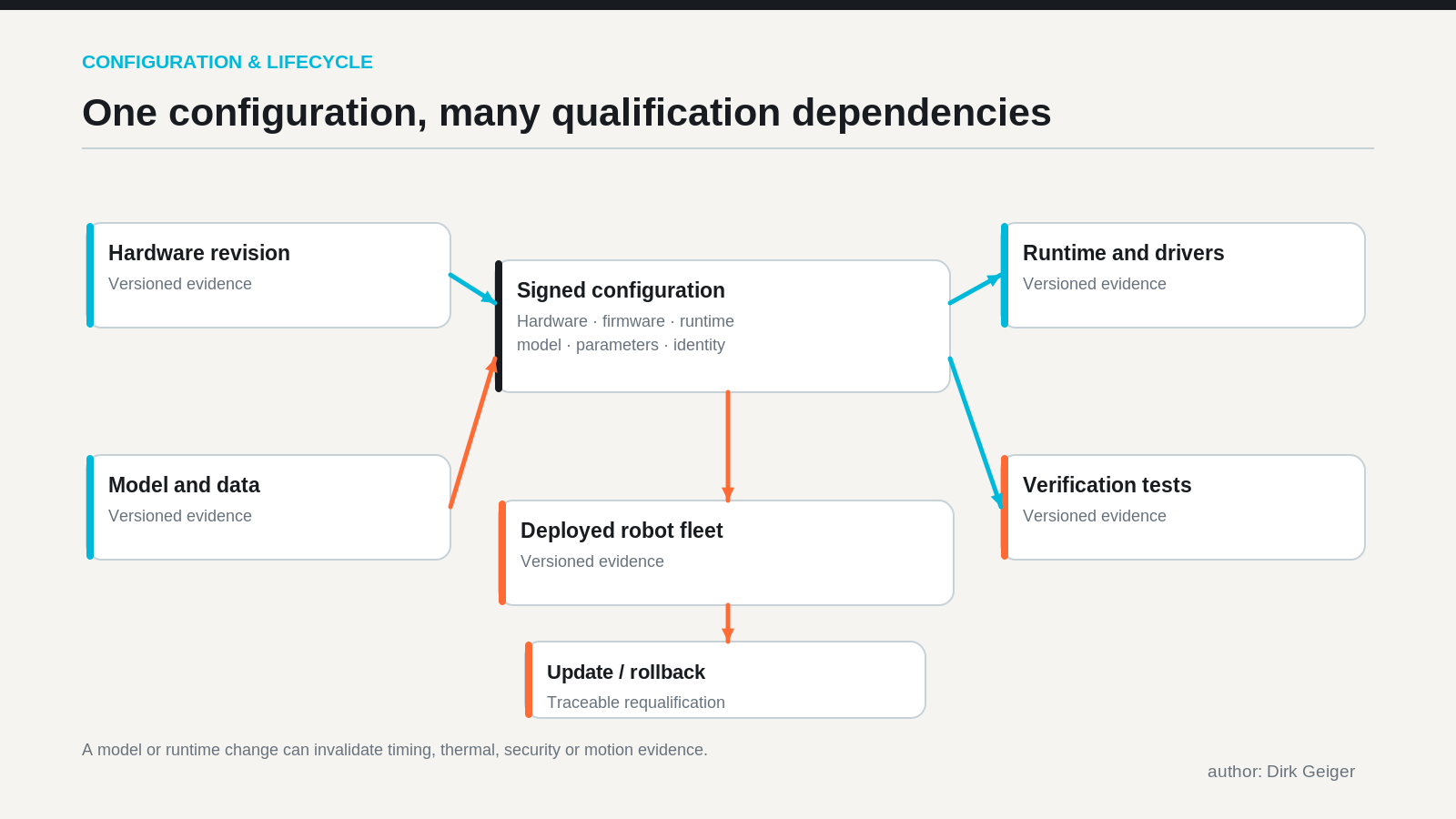
Industrial governance requires an inventory finer than a marketing product name. Each machine needs attributable hardware identity; signed firmware and software versions; installed AI-model identity; calibration provenance; policies governing permitted autonomy; a validated configuration identifier; and records of relevant operational changes. Software provenance and secure boot can establish what executed, but they cannot alone show that a changed model remains fit for its task.
An update pipeline should begin with change classification. A user-interface patch, a scheduler modification, an encoder change and a safety-model update have different implications. The impact analysis should identify affected requirements, fault trees, timing margins and validation cases. Simulation and hardware-in-the-loop testing can narrow the search space. Physical regression testing remains necessary for interactions whose fidelity cannot be assumed in simulation.
Controlled rollout then becomes an engineering experiment: select pilot units, verify preconditions, deploy a signed package, monitor agreed metrics and provide a tested rollback or fallback strategy. Rollback itself requires care when schema, calibration or firmware state is irreversible. Operators need a clear answer to which robot may perform which task under which currently approved software configuration.
The economic proposition is substantial. If common platforms make test environments, traceable changes and incident diagnoses reusable, engineering effort per deployment could decline. Yet the amount of reusable evidence is an empirical question. Certification organizations and site owners may still require renewed assessment whenever operational assumptions change.
The configuration dependency diagram makes the operational consequence visible: a single software update can invalidate test evidence associated with a particular hardware, sensor and calibration combination.
Standardization trades integration entropy for dependency
Exclusivity can narrow the engineering configuration space. The OEM can concentrate engineering effort on one principal module family, one supported driver matrix and a narrower set of compute-related failures. Internal teams may work from consistent toolchains; suppliers can coordinate reference designs; field engineers can stock fewer compute variants. Qualification teams benefit when they can reproduce field incidents against a common reference baseline.
That consolidation also concentrates supplier dependence. Module availability, product lifecycle, security maintenance, export controls, roadmap decisions and commercial terms can now affect much of the fleet. An urgent component change may require broad revalidation, including thermal, mechanical and electromagnetic compatibility work. A vulnerability in a shared software dependency has a wider common-mode footprint. A supply disruption can affect production and service simultaneously.
The correct response is explicit governance. OEMs can negotiate lifecycle support and notification periods, retain access to documentation and validation tools, define security-disclosure and patch responsibilities, stock strategic spares, preserve portable software interfaces where practical, and maintain a tested migration plan. Some applications may warrant a secondary compute path or an independent low-level protection layer. None of these measures makes dual sourcing free: maintaining two qualified stacks may multiply regression effort and create divergences that are difficult to manage.
A revealing metric is time to qualified change: the elapsed time between discovery of a hardware or software issue and authorization of a safe replacement configuration. A standardized platform succeeds when this time shortens while approved safety performance and operational uptime remain intact. Supplier count by itself tells little about that result.
What a qualification matrix should actually test
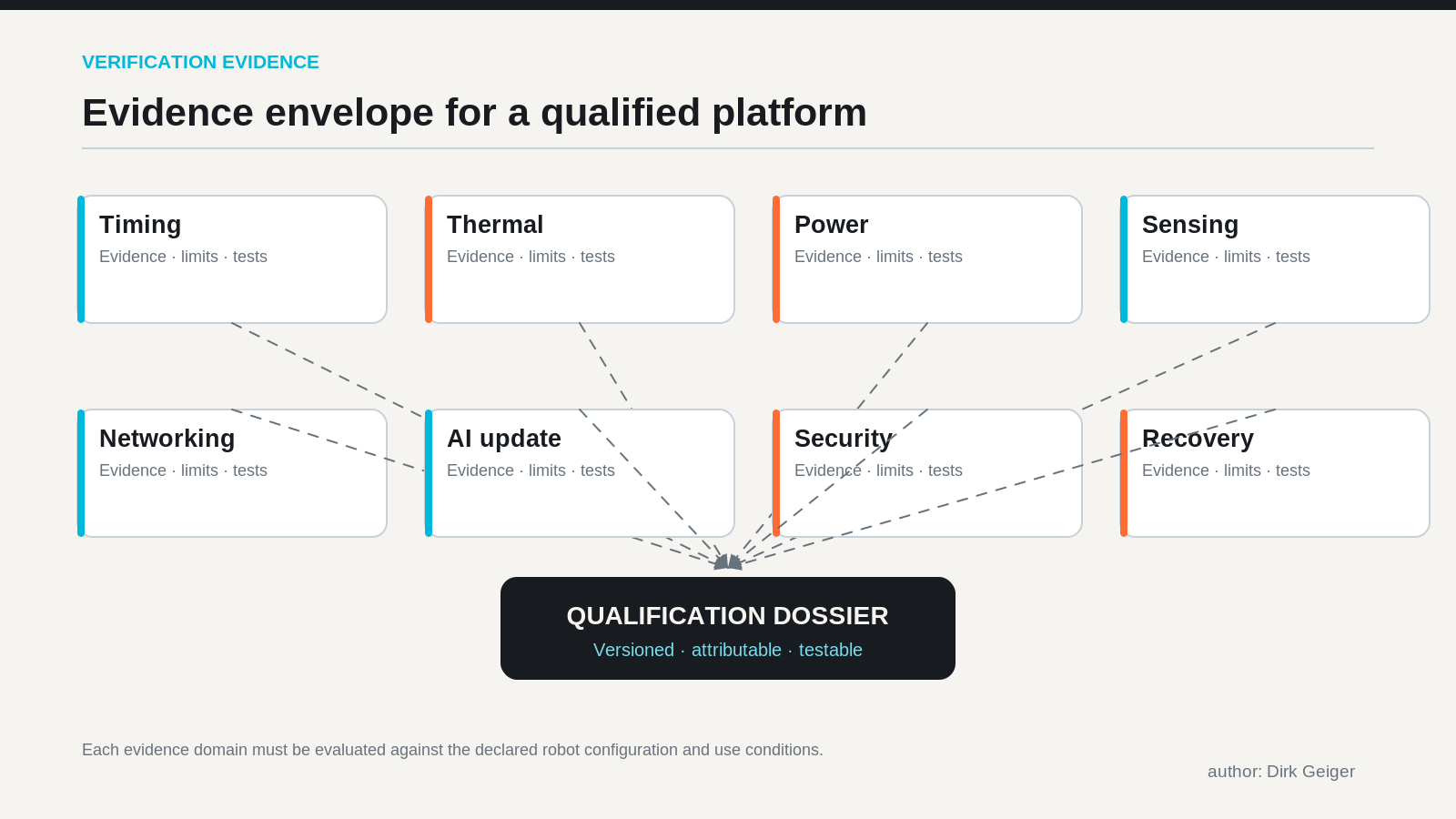
Qualification becomes credible when architectural promises yield repeatable observations. The accompanying evidence matrix identifies test classes that OEM engineers, integrators and site-safety teams can interrogate. Numerical limits must be established for the actual robot, load, task and site; no universal threshold can be responsibly inferred from public platform announcements.
| Challenge | Evidence and test | Acceptance question |
|---|---|---|
| Timing contention | End-to-end timestamps under maximum qualified workloads, deadline-miss injection | Are detection and response deadlines bounded? |
| Thermal saturation | Hot-environment duty cycles, throttling traces, enclosure temperature | Does reduced performance preserve required behavior? |
| Power disturbance | Rail droop, brownout and recovery tests during representative motion | Do controllers preserve or safely relinquish authority? |
| Sensor anomaly | Stale frames, occlusion, disagreement, timestamp corruption | Are uncertainty and invalid inputs handled safely? |
| Network failure | Loss, delay, duplication and partition injection | Do local controllers retain defined fallback behavior? |
| AI-model update | Version-linked scenario regression, edge cases, out-of-distribution tests | Is evidence sufficient for the changed function? |
| Cybersecurity incident | Unauthorized update attempts, credential revocation, recovery rehearsal | Can compromised authority be contained and restored? |
| Field recovery | Interrupted update, diagnostic extraction, rollback exercises | Can service restore a traceable approved baseline? |
A test result is useful only when its configuration, instruments, environment and pass criteria are preserved. A successful emergency response at one speed cannot establish performance for every payload and contact state. The same qualification record should show evidence provenance, observed deviations, remaining hazards and the authority that accepted them.
A mature evidence package also measures operational quantities: mean time to diagnose a fault, frequency of unplanned safety interventions, update success, fraction of fleet on approved baselines, service-part availability and recurring regression effort. Such records connect safety engineering with uptime and total cost of ownership. They are also harder to fabricate through a polished demonstration.
The eight-domain figure complements the detailed test matrix by grouping the evidence required for configuration approval.
The semiconductor system beyond the AI processor
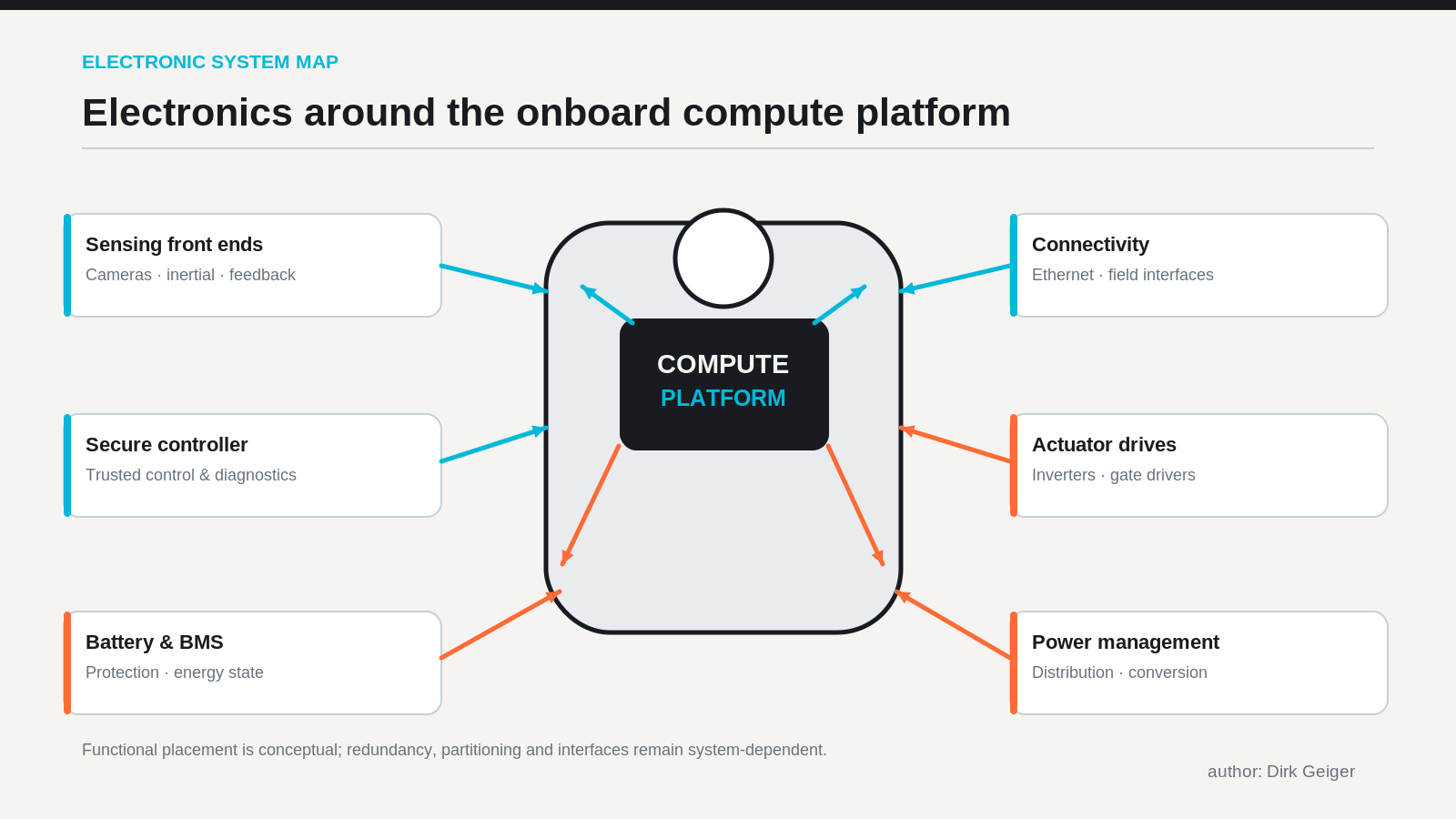
A decision to standardize main compute does not eliminate the rest of the robot’s electronics. It increases the importance of interfaces and the surrounding components because every physical input and output still crosses an engineering boundary. Power conversion must supply transient loads without destabilizing sensing or control. Voltage monitoring, isolation and protection determine whether a compute fault becomes a local event or a system-wide disturbance.
Motor drives and joint controllers carry high-frequency electrical and mechanical responsibility. Gate drivers, current measurement, position sensing, safety-oriented controllers and protection switches support the movement envelope defined by the machine design. A high-performance inference module cannot compensate for an actuator whose torque estimate is stale or whose power stage lacks adequate fault containment.
Network design matters for the same reason. A zonal Ethernet backbone can connect cameras, compute and distributed controllers, while time-sensitive networking mechanisms can support scheduled or prioritized traffic under characterized conditions. Other fieldbuses and direct links may remain appropriate at tightly constrained endpoints. The critical design variable is the end-to-end contract: bandwidth, maximum useful information age, clock synchronization, network fault behavior and physical connector durability.
Memory integrity, storage endurance, secure elements, identity provisioning and authenticated updates all become part of the qualification workload. A root of trust can prove code provenance and support secure lifecycle management. It does not prove that a neural policy is safe, and it cannot restore a robot whose mechanical limits have already been exceeded. Power, sensing, control, security and communication must be validated as one connected system.
For semiconductor suppliers, this creates an opportunity to provide reusable evidence-aware subsystems: characterized power trees, traceable sensor channels, secure update foundations, deterministic communication profiles and actuator reference designs. The strongest offering may be a documented interface and validation methodology as much as the silicon itself.
The electronics map identifies the distributed components whose power, timing, diagnostics and protection properties affect the platform-level assurance case.
Reference humanoids and manufacturing evidence are separate
NVIDIA’s October 21 announcement introduced Agile ONE SN from Agile Robots as a reference humanoid using Jetson Thor and Isaac GR00T, with Halos integration described as planned [S2]. This development should be kept distinct from Agility Robotics’ Digit 5 announcement. Agile Robots and Agility Robotics are different companies pursuing different programs; their similarly named announcements describe different architectures and commercialization paths.
Reuters reported that Agile Robots expected to produce approximately 1,000–2,000 smaller humanoids in 2027, with universities and research laboratories among the intended customers [S3]. That forecast indicates manufacturing ambition and the value of standardized development hardware. It is not evidence of completed deliveries, industrial task qualification or measured uptime. A research-oriented reference platform can accelerate experimentation while a production robot must demonstrate durable performance in specific environments.
The distinction sharpens the commercial test. Reference systems create compatible data, models, debugging tools and simulation assets. Production systems must survive installation, maintenance, component changes, unforeseen contact conditions and security events. The gap between these worlds is bridged by configuration control, explicit safety responsibilities and evidence collected during physical operation.
Agility’s September presentation of Digit 5 also emphasized cooperative operation near people and cited operational hours accumulated by earlier Digit deployments [S5]. Those experience claims are valuable context, although historical fleet hours do not establish the safety case of a newly configured generation. Existing industrial experience can inform test cases and operating limits; the new platform must still establish its own qualified boundaries.
What the customer should ask before approving deployment
A buyer evaluating a humanoid fleet needs an answer to a more demanding question than which processor is inside: Which complete robot configuration has been assessed for the intended work, and what happens when it changes? An OEM able to answer that question can make a credible claim about repeatable deployment.
Procurement and site-safety teams should request a configuration manifest covering hardware, firmware, runtime, AI models, network components and relevant calibrations. They should understand the safety function allocation, independent safeguards, intended operating modes, documented fault responses and limitations of any referenced certificates or assessments. They should also obtain evidence of application-level trials with the real payloads, floor conditions, working speeds and human interactions expected in service.
Operationally, the contract should define update approval authority, notice periods, rollback responsibility, diagnostic accessibility, incident reporting and support commitments for obsolete or vulnerable components. The OEM should provide a method to determine which fleet units run each approved configuration and explain the maintenance consequence of replacing a compute module or any dependent safety component.
Technical diligence should separate demonstrated performance from planned capability. A supplier can have a promising reference architecture and still lack sufficient public evidence of field reliability. Similarly, a lab safety result can be relevant without establishing the entire customer installation. Responsible buyers can encourage innovation while setting explicit evidence gates for expanded autonomy and deployment scale.
The qualification anchor is the new architectural prize
Onboard computing is turning into a strategic anchor because intelligence, runtime behavior, configuration identity and safety evidence increasingly intersect at its interfaces. Agility’s announced IGX Thor standardization demonstrates one OEM’s commitment to a common compute foundation. NVIDIA’s Isaac and Halos announcements show a broader attempt to integrate development, deployment and evaluation. Neither announcement, by itself, proves that the complete resulting robot is certified or that every future task will be safe.
The durable architectural advantage will belong to programs that make each component relationship explicit and each change assessable. A common compute baseline can improve engineering reuse, accelerate fault diagnosis and simplify fleet maintenance. Its value will diminish if timing assumptions remain implicit, independent safeguards are weak, or supplier concentration is unmanaged.
The decisive benchmark for the industrial humanoid era may therefore be neither raw inference throughput nor the elegance of a demonstration. It may be the speed and confidence with which a manufacturer can diagnose, repair, update and requalify a robot while protecting the people working beside it. That is the practical meaning of a qualification anchor.
Glossary
- Qualification baseline
- Version-controlled configuration of robot hardware, software, models and settings covered by an identified body of evidence.
- Deterministic execution
- Execution behavior for which relevant timing and ordering properties are bounded under stated operating conditions.
- Safety case
- Structured argument, supported by evidence, that specified safety requirements are met for defined operating conditions.
- Fault containment
- Measures preventing a component fault from propagating into unacceptable system behavior.
- Common-cause failure
- Multiple failures created by a common design weakness, dependency or environmental cause.
- End-to-end latency
- Elapsed time between physical sensing and the required resulting physical response.
- Root of trust
- Hardware or firmware foundation used to verify identities and authorize protected operations.
- Configuration provenance
- Traceable identity and history of versions, calibrations and changes defining a deployed system.
- Time-sensitive networking
- IEEE Ethernet mechanisms supporting time synchronization and managed communication schedules or traffic classes.
Abbreviations
- AI
- Artificial intelligence
- OEM
- Original equipment manufacturer
- IGX
- NVIDIA industrial-grade edge computing platform family
- TOPS
- Tera operations per second
- I/O
- Input/output
- TSN
- Time-sensitive networking
- BOM
- Bill of materials
Sources
- Agility Robotics Expands NVIDIA Collaboration as It Prepares Digit 5 for Commercial Scale · 2026-10-22
Agility confirms Digit 5 IGX Thor standardization, exclusive onboard compute, planned Halos integration and certification-related work.
https://www.agilityrobotics.com/content/agility-robotics-expands-nvidia-collaboration-as-it-prepares-digit-5-for-commercial-scale - NVIDIA Advances Isaac Platform for General-Purpose Robotics With New Reference Humanoid, Frameworks, Simulation Pipelines and Data · 2026-10-21
NVIDIA announces Isaac OS, reference humanoid development tools, planned safety integrations and connected training and validation workflows.
https://nvidianews.nvidia.com/news/nvidia-advances-isaac-platform-for-general-purpose-robotics-with-new-reference-humanoid-frameworks-simulation-pipelines-and-data/ - Germany’s Agile to make up to 2,000 humanoid robots with Nvidia, CEO says · 2026-10-21
Reuters reports Agile Robots management production intentions and standardized research humanoid features, distinguishing future targets from realized deliveries.
https://wifc.com/2026/10/21/germanys-agile-to-make-up-to-2000-humanoid-robots-with-nvidia-ceo-says/ - Agility and FORT Robotics Announce Strategic Partnership to Advance Humanoid Robot Safety · 2026-10-01
Companies describe pendant, on-robot communication and offboard bridge architecture to extend protection into surrounding industrial operations.
https://www.agilityrobotics.com/content/agility-and-fort-robotics-announce-strategic-partnership-to-advance-humanoid-robot-safety - Agility Unveils Digit 5 Humanoid Robot Built for Cooperatively Safe Work at Scale · 2026-09-15
Agility outlines Digit 5 deployment goals and cites experience from previous robot operations, without certifying new configurations.
https://www.agilityrobotics.com/content/agility-unveils-digit-5-humanoid-robot-built-for-cooperatively-safe-work-at-scale