
Magazine Article
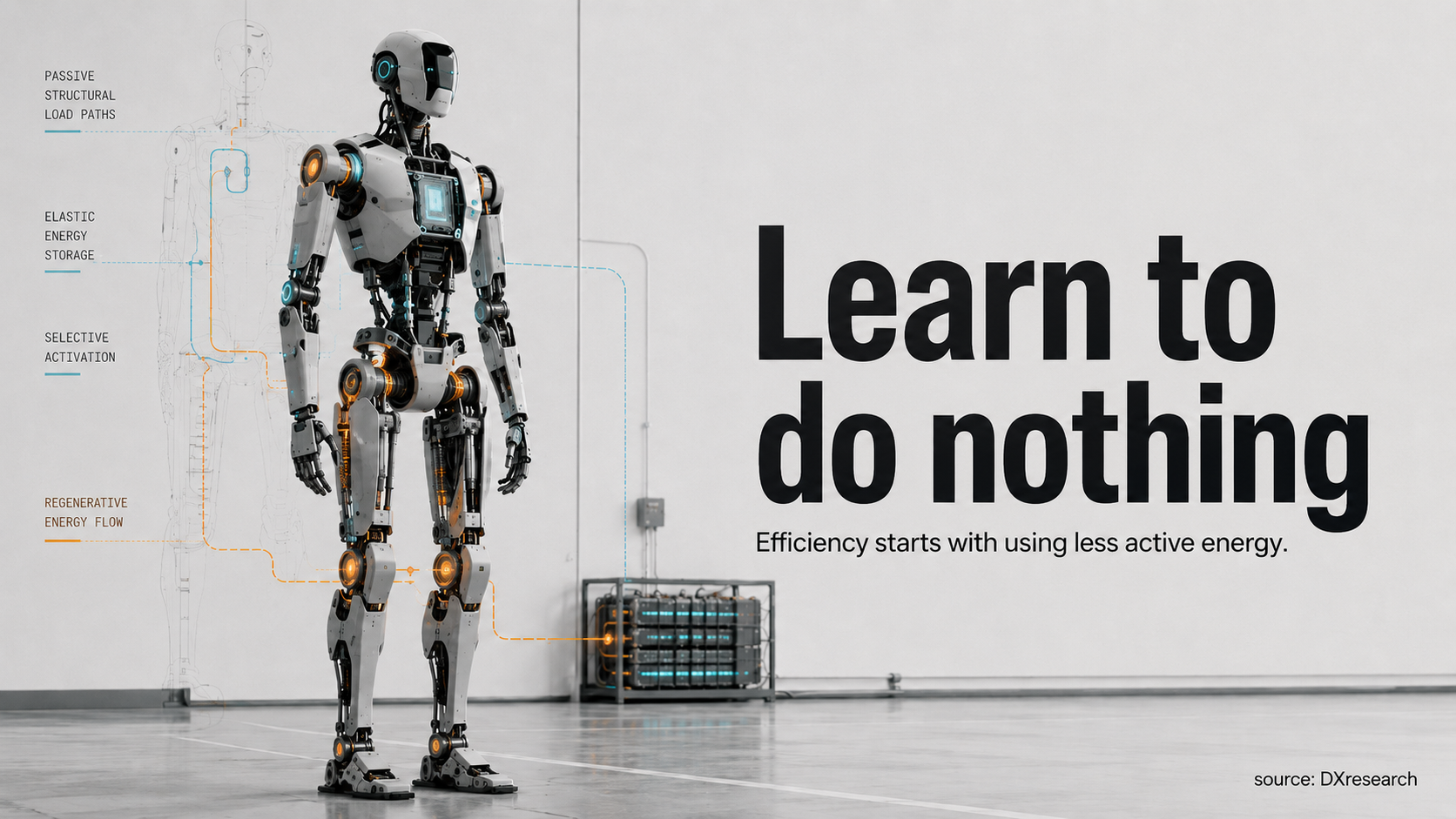
Learn to Do Nothing
Why the next leap in humanoid efficiency will come from using less active energy—not simply carrying a larger battery
Humanoid runtime is usually framed as a battery problem. It is increasingly an architecture problem. Measured standing power shows how much energy can disappear before useful work begins. The next efficiency gains will come from passive mechanics, selective wake states, energy-aware compute, better motion planning and regeneration.
The Standing Anomaly
The robot is not doing anything dramatic. It is simply standing there.
No box is being lifted. No stair is being climbed. The hands are empty, the floor is level, and the next command has not yet arrived. To a person watching from across the workcell, the machine appears almost idle. The electrical meter tells a different story.
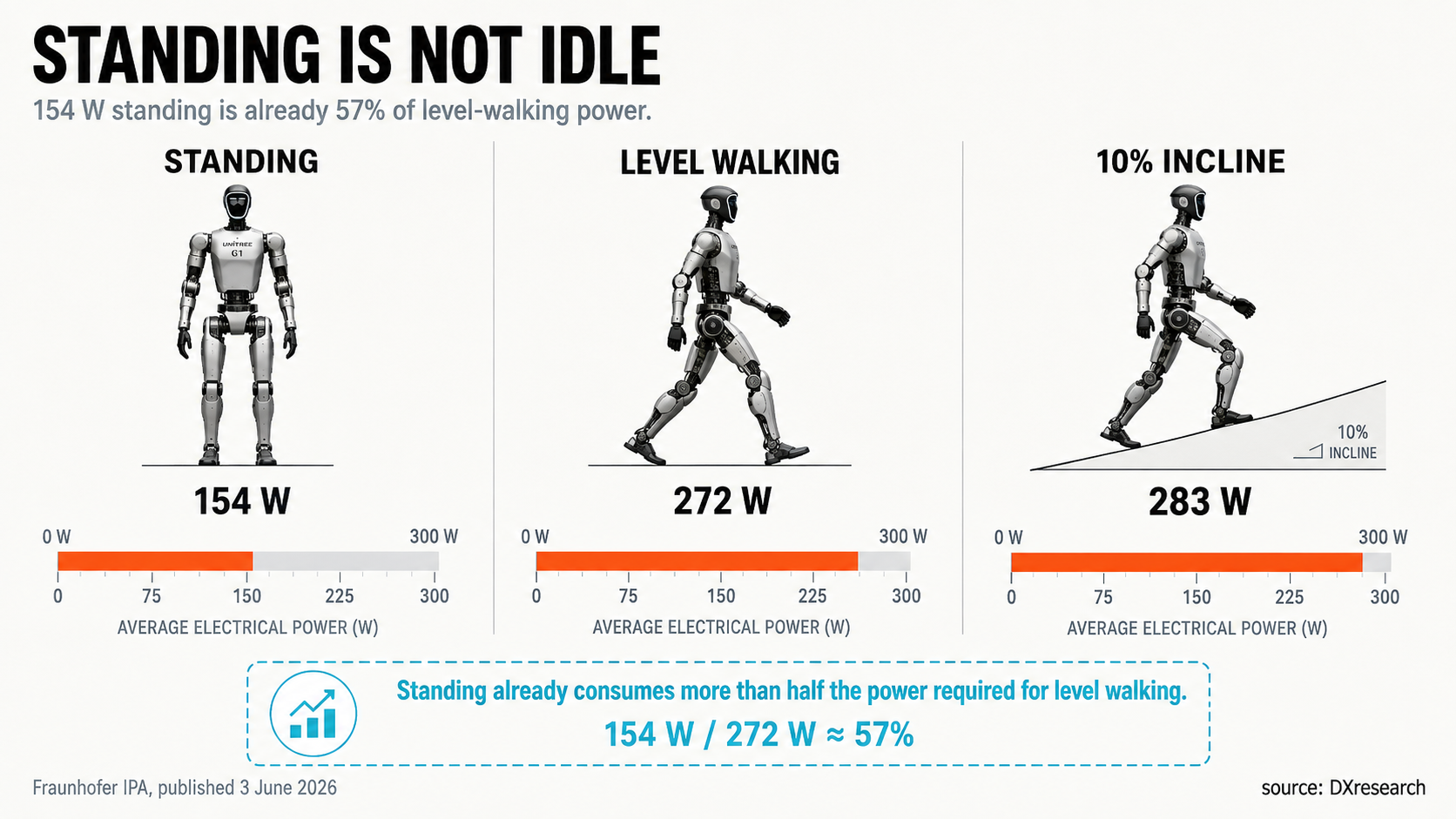
Fraunhofer IPA recently published standardized energy measurements for a Unitree G1 EDU-4. In its benchmark, the robot drew about 154 W while standing. Walking on level ground required about 272 W; a ten-percent incline raised the figure to roughly 283 W. Fraunhofer also reported about 239 W for its defined one-hour standard scenario. The values apply to the tested configuration and benchmark conditions, not to every G1 and certainly not to every humanoid. Even so, the comparison exposes a design question that is easy to miss: why does so much energy disappear before useful work has visibly begun?
Fraunhofer’s Simon Schmidt argues that users need to look beyond the polished surface of humanoid demonstrations because the market remains difficult to assess reliably. Energy measurements do exactly that. They replace the intuitive picture of “moving equals consuming, standing equals resting” with something less comfortable. Standing consumed more than half the measured power of level walking.
Humanoid energy discussions usually begin with the battery. A larger pack promises longer runtime. Better cells promise more watt-hours in the same volume. Faster charging promises shorter interruptions. All matter. But a larger reservoir does not explain whether the machine is spending its energy well.
A battery cannot distinguish productive energy from defensive energy. The watt used to turn a fastener and the watt used to keep a knee from drifting are identical at the terminals. The watt that runs perception during a complex manipulation and the watt that keeps a high-performance compute path awake while nothing changes come from the same finite store.
That makes runtime partly an electrochemistry problem and partly an activity problem. A humanoid is a stack of energy consumers: joints, motor drives, power conversion, sensing, communications, compute, thermal management and auxiliaries. Many of those components are individually efficient. Yet component efficiency does not guarantee robot efficiency. A highly efficient actuator producing unnecessary torque still wastes energy. A highly efficient processor running unnecessary workload still consumes power. A highly efficient sensor streaming redundant data is still awake.
The standing anomaly points to a more consequential design principle than another incremental gain in motor or converter efficiency: the cheapest watt-hour is the one the robot never has to draw.
The Human Paradox
The obvious comparison is the human body, and it begins with an apparent disadvantage. Human skeletal muscle is not an especially impressive energy converter if judged like an electric motor. Reported mechanical efficiency for positive muscular work is commonly in the low-to-mid twenties in percent, depending on contraction type, speed, muscle group and measurement method.
By that measure, biology should lose badly.
It does not.
Humans are economical at remaining upright, walking over ordinary terrain and switching between inactivity and action because muscles do not operate alone. Bones carry compression. Joint geometry routes load. Ligaments constrain motion. Tendons store and return elastic energy. Mass distribution reduces the cost of moving distal limbs. The nervous system recruits muscle selectively rather than demanding maximum stiffness everywhere at once. Reviews of human tendon behavior describe how elastic energy storage and return, particularly in the Achilles tendon, contributes to locomotor economy.
The distinction between force and work matters. A muscle can consume metabolic energy while producing force without external mechanical work. Electric actuation encounters the same trap. A shoulder joint holding an arm horizontally may draw current even though angular velocity is essentially zero. The motor is not performing useful mechanical work in the usual sense, but copper loss and inverter loss still become heat.
The useful lesson from biology is not anatomical imitation. It is architectural restraint.
Tad McGeer’s passive-dynamic walking experiments made that point with almost theatrical clarity. In 1990 he described two-legged mechanisms that could settle into a stable gait down a shallow slope, powered by gravity rather than continuous active control. Those machines were not industrial humanoids, and a factory floor is not a laboratory ramp. But the result demonstrated that geometry, inertia and gravity can perform part of the job that motors and controllers would otherwise have to provide.
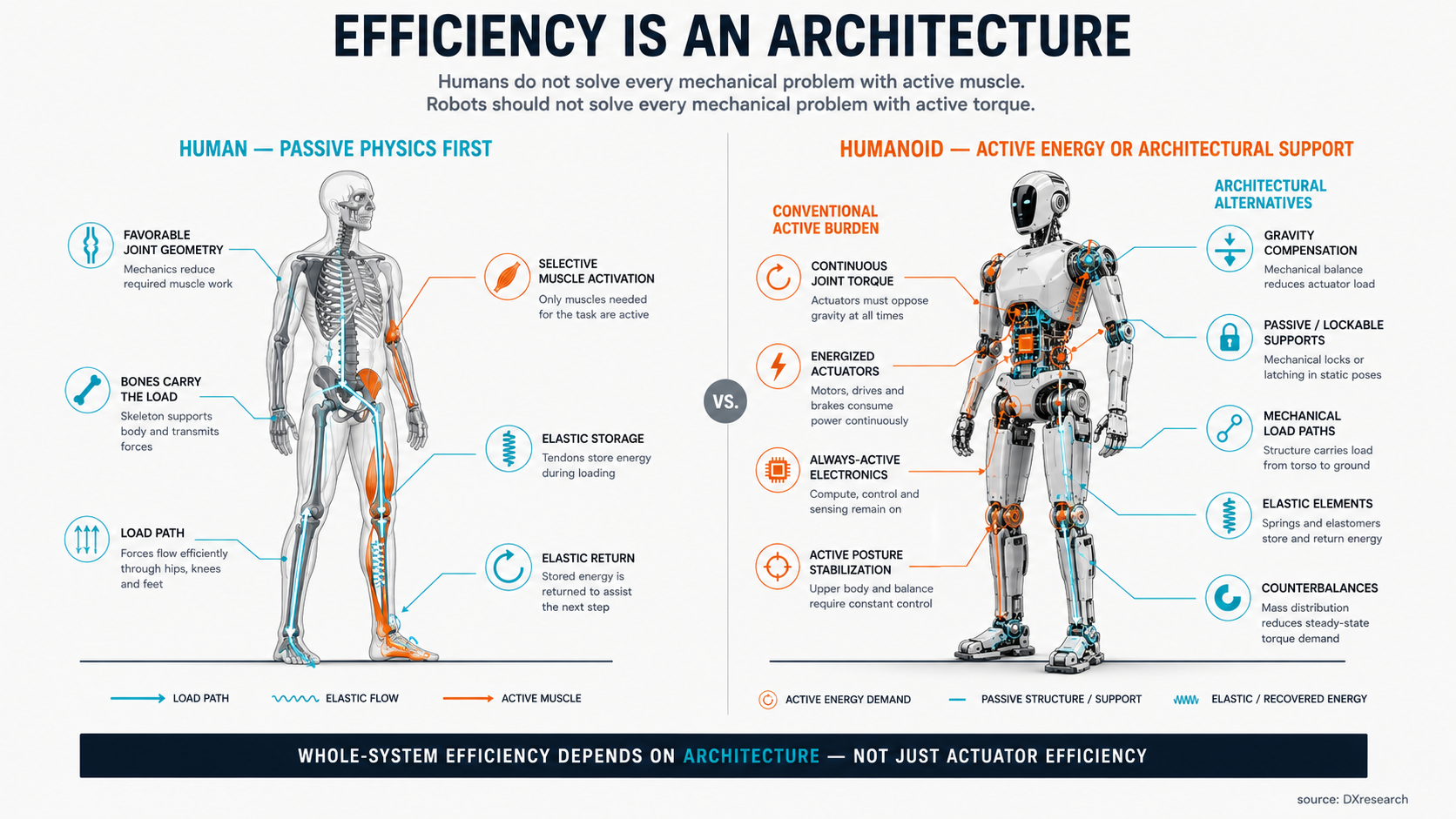
Modern humanoids need far more capability. They must reject disturbances, manipulate objects, change direction, interact with people, operate on imperfect floors and recover from uncertainty. That requires fast control and substantial actuation. The important question is not whether active control can be removed. It is whether every mechanical problem must be solved actively, all the time.
A body whose common postures depend on continuous torque makes an energy commitment before software begins. Gravity compensation, elastic elements, counterbalances, mechanically favorable poses, brakes, clutches or lockable mechanisms can create alternatives. Each brings trade-offs in weight, complexity, backdrivability, safety and serviceability. None is a universal answer. Their value lies in giving the controller a choice between spending energy and letting structure carry the load.
That choice is the human paradox translated into engineering terms: mediocre conversion efficiency can coexist with strong system economy when the architecture avoids asking the converter to work unnecessarily.
Where the Watts Go Before Work Begins
Imagine a humanoid assigned to a logistics workstation. For thirty seconds it walks. For twenty seconds it lifts and places containers. Then it waits for a pallet, a human operator or the next machine cycle. On a production dashboard the robot may be “working” throughout. Electrically, three very different states are being mixed together.
The first is mechanical activity: acceleration, deceleration, payload handling, balance correction and contact. The second is readiness: holding posture, preserving braking authority, keeping safety functions alive and maintaining thermal margins. The third is information processing: perception, localization, planning, inference, logging and communication.
Only some of those loads scale with visible motion.
This is why battery-runtime figures can be deceptive as an engineering KPI. Two robots with similar battery capacity may deliver very different useful work if one spends idle periods at near-active power while the other enters deterministic low-energy states. The difference does not require a breakthrough cell. It requires the system to treat inactivity as an operating condition worth engineering.
“Deterministic” is the critical word. A humanoid cannot simply switch off whatever seems unnecessary. Safety functions may need uninterrupted power. Joint brakes may require controlled sequencing. Some perception must remain available if a person can enter the workspace. Network nodes may have bounded wake-time requirements. Localization state may need to persist. A machine that saves energy by becoming unpredictable is not efficient; it is unavailable.
The more useful model is a robot-wide hierarchy of states. Full-active is only one. Task-active could energize only the joints and sensing needed for the current operation. Locomotion-ready could keep balance-critical actuation and perception prepared while hands and manipulation compute remain quiet. Manipulation-ready could do the opposite. Perception-watch could preserve environmental awareness with reduced compute and no unnecessary joint torque. Safe-hold could maintain safety, battery supervision and mechanically secure posture. Parked or service states could reduce the system further.
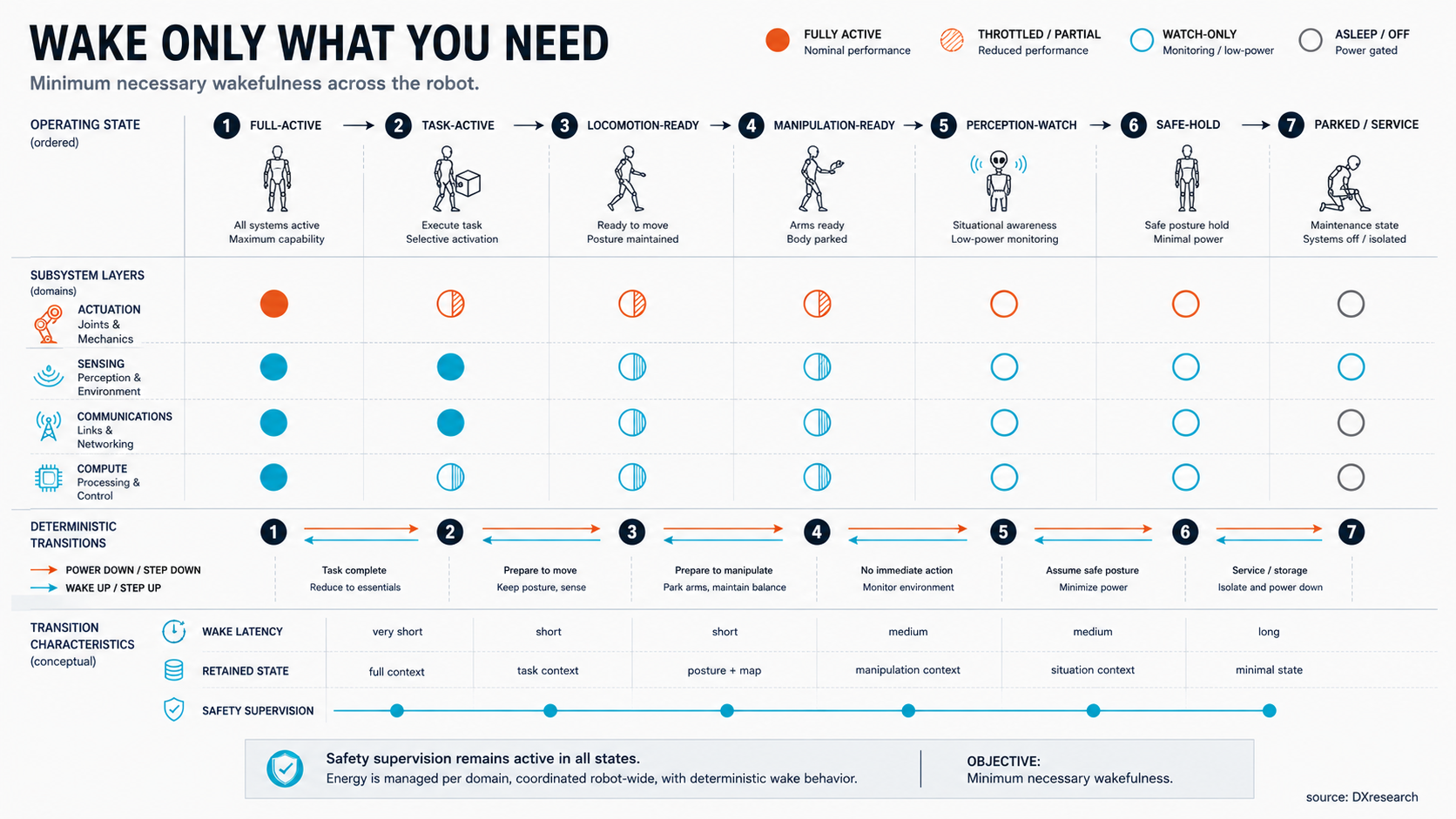
The state names matter less than the contract behind them. Each state needs defined wake sources, wake latency, retained context, safety coverage and failure behavior. If a camera sleeps, the controller must know how localization confidence changes. If a limb controller powers down, the mechanical state must remain safe. If compute is throttled, the reaction time must still satisfy the task.
The principle is simple: minimum necessary wakefulness.
That shifts energy analysis from component data sheets to mission behavior. Instead of asking only how efficient the knee drive is, ask how many minutes per hour it produces torque that contributes to the task. Instead of asking only for tera-operations per watt, ask how often the accelerator runs a high-complexity model when a simpler detector or event trigger would have been enough. Instead of treating the network as permanently awake infrastructure, ask which links need full bandwidth in each operating state.
The robot begins to look less like a collection of always-on subsystems and more like a coordinated organism with an energy budget.
Stop Paying to Stand Still
There is a particularly expensive kind of inactivity: producing torque without producing motion.
Humanoid joints often have to resist gravity continuously. A knee holds body weight. A shoulder supports an arm. A wrist maintains tool orientation. In each case mechanical output power can be near zero while electrical current remains significant. The current heats windings, semiconductors and conductors. Cooling then consumes additional power or adds mass. The robot is paying twice: first to generate force, then to remove the heat created while generating it.
The obvious response is “use a more efficient motor.” Sometimes that helps. But a motor cannot make a required holding torque disappear. If the mechanical architecture demands continuous torque, even excellent conversion efficiency leaves a persistent load.
That is why posture is an energy variable. A slightly different joint configuration can bring a load closer to the body, improve leverage and reduce required torque. A support surface can turn active holding into structural load transfer. A counterbalance can offset a predictable gravitational moment. A brake or latch can preserve position without continuous motor current where the safety concept allows it. Elastic elements can support recurring loads or recover energy between phases of motion.
None of these techniques is free. Brakes add parts and failure modes. Springs can complicate control. Counterbalances add mass. High gear ratios can reduce motor torque but increase friction and reflected inertia. Non-backdrivable mechanisms may save holding energy while making compliant interaction harder. The engineering decision is therefore not “active versus passive.” It is how much active authority the task needs, and when.
The answer can vary by joint. A leg joint that repeatedly exchanges energy during walking has different priorities from a wrist that must position a tool precisely. A shoulder expected to hold loads for long periods may justify gravity compensation that would be pointless in an ankle. Hands may benefit from mechanisms that retain grasp force mechanically rather than consuming current continuously.
This is where humanoid design becomes mission-specific. A demonstration robot optimized for agility may accept high continuous power to maximize responsiveness. A factory robot expected to stand beside a machine for hours has a different economic problem. Every watt of holding power returns as battery capacity, cooling burden, charging frequency or reduced shift availability.
The irony is that “doing nothing” can require more engineering than moving. Motion is visible and easy to celebrate. Efficient stillness depends on load paths, joint topology, passive support and state management that rarely appear in a demo video.
Yet the business case is unforgiving. A robot that spends a large part of its duty cycle waiting or holding should not behave electrically as if every second were a sprint.
Wake Only What You Need
Mechanical restraint solves only part of the problem. The rest of the robot is electronic, and electronics have their own version of holding torque: the always-on floor.
Cameras stream. Depth sensors scan. Network links exchange traffic. Processors remain clocked. AI accelerators wait for the next inference. Microcontrollers execute housekeeping. Memory retains state. Fans move air. Power converters consume quiescent current. Individually, many of these loads look modest. Across an entire machine and an eight- or ten-hour operating window, they become architectural.
The temptation is to search for one deep-sleep mode. Humanoids need something more granular because their responsibilities do not disappear together. A robot may stop walking but still need to watch. It may stop manipulating but remain ready to move out of the way. It may reduce perception bandwidth while preserving a safety channel. It may lower central compute performance while local controllers maintain hard real-time loops.
That creates a scheduling problem across physical and digital domains. If manipulation is not expected, fingers, wrist cameras and grasp-planning compute can potentially move to lower-power states. If the robot is parked, high-bandwidth mapping may be unnecessary while battery management, safety supervision and wake-capable communications remain alive. If a person approaches, perception can wake before actuation. If a task is assigned, compute can resume before the relevant joints are released.
The order matters. Energy states become a form of systems engineering rather than a collection of isolated sleep features.
A useful state machine therefore needs four properties. First, the transition must be bounded in time. Second, retained information must be defined: clocks, calibration, localization, safety state and communication context cannot be left to chance. Third, wake triggers must be explicit. Fourth, failure during wake-up must lead to a safe state rather than an undefined half-awake robot.
This approach also changes semiconductor and software architecture. Power domains need to be separable. Sensors need modes that match the task. Controllers need fast and deterministic resume behavior. Networks need wake-capable paths without forcing every endpoint to remain fully active. Software must understand that power availability is dynamic rather than assuming every resource exists continuously.
The idea is familiar from laptops, smartphones and vehicles, but humanoids couple it to gravity and safety. A sleeping processor is an inconvenience in a notebook. A sleeping joint controller can be a mechanical hazard if posture depends on it. The power-state hierarchy must therefore include the physics of the body.
When it works, the payoff is larger than standby savings. Selective activation reduces electrical load, thermal load and cooling demand. That can reduce battery size or extend runtime. Lower battery mass can reduce actuation demand. The system begins to compound small savings into architectural ones.
Efficiency stops being a race to make every component slightly better. It becomes a discipline of waking only what the task actually needs.
Move Less. Recover More.
The second half of “doing nothing” is avoiding motion that never needed to happen.
Robots can waste energy with perfectly executed trajectories. An arm may take a wide path because it is easy to plan. A torso may remain unnecessarily stiff. A gait may accelerate and decelerate mass more aggressively than the task requires. A hand may reposition repeatedly because perception and planning are not coordinated tightly enough. None of these behaviors looks like a component-efficiency problem. All appear on the battery meter.
Motion planning therefore belongs inside the energy architecture. If two trajectories satisfy the same task, the lower-energy one should have value beyond elegance. Slower acceleration may reduce peak current. Keeping loads close to the body may reduce joint torque. Coordinating whole-body motion can avoid one joint fighting another. Choosing a stable posture can reduce continuous current once the motion ends.
Then comes the energy that motion gives back.
When a joint decelerates a link, lowers a mass or absorbs part of a landing, the motor can operate as a generator if the drive supports bidirectional power flow. But “regenerative actuator” is not enough. Recovered energy is useful only if the rest of the electrical system can accept it at that instant.
A shared DC bus can let one joint consume energy released by another. Local capacitance can absorb short pulses. The battery may accept charge if state of charge, temperature and protection limits permit it. If no sink is available, the system must limit regeneration or dissipate the energy. Actual recovery therefore depends on timing, bus impedance, inverter capability, storage acceptance and control coordination.
This is why there is still no single public regeneration percentage that can sensibly describe humanoids as a class. A robot descending stairs has a different opportunity from one lifting boxes. A highly backdrivable transmission exposes different recoverable energy from a mechanism dominated by friction. A nearly full battery behaves differently from one at mid-state of charge. The mission profile decides the opportunity before the electronics decide how much can be captured.
Mechanical storage can sometimes be better than electrical recovery. A spring that stores and returns energy locally avoids conversion into electricity and back again. Passive dynamics can recycle kinetic and potential energy without asking the battery to participate. Regeneration should therefore be viewed as one layer in a hierarchy: avoid unnecessary motion first, reuse energy mechanically where practical, exchange it electrically across the body when useful, return it to storage when allowed, and dissipate only what cannot be used safely.
The most efficient joule is not merely the one recovered. It is the one that never had to make a round trip through the power system.
The Control Room Has an Energy Budget
Humanoid intelligence has an energy cost, and the cost is easy to hide because compute does not move visibly.
Modern robots combine perception, localization, planning, model inference, speech, safety monitoring, motor control, logging and communication. Some workloads need high performance continuously. Many do not. A control loop for a joint and a large model interpreting a scene occupy very different timing domains, yet architectures can make both depend on a central compute platform that remains broadly awake.
The energy question is not how to minimize compute at any price. It is how to deliver the required intelligence with the least active resource at each moment.
Hard real-time motor loops can remain local. Event detection can run on lower-power processors and wake larger accelerators only when needed. Cameras can reduce frame rate or resolution when the environment is static. Mapping can slow when localization confidence is high. A manipulation model can sleep while the robot is walking through a known corridor. High-bandwidth links can enter lower-power modes when traffic disappears, provided wake time and synchronization remain deterministic.
This creates another form of energy proportionality: computational effort should follow environmental complexity and task demand.
The difficulty is that performance states interact. Lowering camera rate may change tracking quality. Throttling compute may increase planning latency. Sleeping a network endpoint may delay a safety-relevant message if the architecture is poorly partitioned. The robot therefore needs an energy manager that understands dependencies rather than a set of independent power-saving switches.
That manager does not need to be a grand artificial intelligence. In many cases, deterministic rules are preferable. Task state, thermal headroom, battery state, wake latency and safety requirements can define which domains are permitted to sleep. Higher-level planning can then choose among those states as part of mission execution.
The interesting consequence is that energy becomes information. The robot needs to know not only how much charge remains, but why power is being consumed. A spike caused by an accelerating knee is different from one caused by compute. A rising baseline may indicate thermal-control activity, sensor load or a subsystem that failed to enter its expected low-power state. Energy telemetry can therefore become a diagnostic signal as well as a fuel gauge.
That matters operationally. A robot fleet managed only by state of charge discovers inefficiency late. A fleet that tracks energy by task and subsystem can detect drift, compare software versions, identify workloads that keep hardware awake and schedule charging based on expected missions rather than simple thresholds.
Once compute enters the energy budget explicitly, “intelligence per watt” stops being a chip benchmark. It becomes a robot-level question: how much sensing, inference and communication was required to complete the task safely and successfully?
The KPI That Matters: Watt-Hours per Useful Task
The battery percentage at the end of the shift is not the real score.
A robot can finish with plenty of charge because it accomplished little. Another can consume more energy because it moved more material, completed more assemblies or covered more productive distance. Runtime is necessary for planning, but it does not describe productivity.
The more useful metric couples energy to output: watt-hours per successful pick, watt-hours per kilogram moved, watt-hours per assembly cycle, watt-hours per meter of loaded transport, or watt-hours per productive operating hour. The exact denominator depends on the application. What matters is that the energy number carries a definition of useful work.
That also forces the mission profile into the discussion. A humanoid in logistics may alternate between walking, manipulation and waiting. A machine-tending robot may stand for long periods and perform short bursts of precise work. A service robot may spend more energy on perception and communication than on locomotion. There is no universal “humanoid efficiency” value independent of the job.
Fraunhofer IPA’s benchmark is important precisely because it begins to separate operating conditions instead of hiding them inside a single runtime claim. The next step for industry is to connect such measurements more tightly to application duty cycles and productive output. Without that link, a larger battery can still look like an efficiency improvement when it is merely more stored energy.
The economic consequences are direct. Lower active-energy demand can extend runtime, reduce charging interruptions and potentially reduce battery size. Lower losses reduce thermal burden. Lower cooling demand can reduce mass. Lower mass reduces actuation energy. Better state management can increase useful availability without changing cell chemistry at all.
That cascade changes the design priority. Instead of asking first how many kilowatt-hours the humanoid should carry, start with the job. Measure where the energy goes during that job. Identify which loads are productive, which are necessary overhead and which exist only because the architecture never learned to become quiet.
The hardest part may be cultural. Robotics celebrates action: faster walking, heavier lifts, more dexterous hands, larger models. Those capabilities are visible. Restraint is harder to demonstrate. A joint that does not need current, a sensor that sleeps, a processor that stays quiet, a trajectory that avoids unnecessary acceleration and a bus that reuses energy do not look spectacular.
They may be what makes the machine economical.
The next leap in humanoid efficiency is unlikely to come from one miraculous component. It will come from treating energy as a robot-wide control variable shared by mechanics, electronics and software. The system will need to know when to move, when to recover, when to watch, when to hold and when to shut almost everything down.
The most advanced humanoid may not be the one that is always ready to do more.
It may be the one that has learned exactly when to do nothing.
Glossary
- Regenerative operation
- Conversion of mechanical energy during deceleration or negative work back into electrical energy for immediate reuse or storage.
- Event-based vision
- Visual sensing that asynchronously reports local brightness changes rather than transmitting complete image frames at fixed intervals.
- Useful task
- A defined productive outcome used to normalize robot energy consumption, such as a completed transfer, manipulation cycle or inspection.
- Active energy
- Electrical energy consumed because a subsystem is powered, computing, sensing, communicating or generating torque rather than remaining in a low-energy state.
- Gravity compensation
- Mechanical or control techniques that offset gravitational loads so actuators need less continuous torque to hold a pose.
- Passive dynamics
- Use of a mechanism’s natural geometry, inertia, gravity and compliance to produce useful motion with reduced active control or actuation.
- Energy proportionality
- The design goal that subsystem energy demand should scale with the useful work or computational service required by the current task.
Abbreviations
- AI
- Artificial intelligence
- CPU
- Central processing unit
- GPU
- Graphics processing unit
- DC
- Direct current
- PHY
- Physical-layer transceiver
Sources
- Passive Dynamic Walking · 1990-04-01
Classic robotics paper demonstrates gravity-powered passive bipedal walking and argues natural dynamics can support efficient active locomotion.
https://journals.sagepub.com/doi/10.1177/027836499000900206 - Event-Based Vision: A Survey · 2022-01-01
Survey explains asynchronous event cameras and their low-power, low-latency characteristics alongside limitations and specialized processing requirements.
https://pubmed.ncbi.nlm.nih.gov/32750812/ - A Physiologist’s Perspective on Robotic Exoskeletons for Human Locomotion · 2007-09-01
Review connects animal locomotion biomechanics, muscle energetics and robotic exoskeleton design, emphasizing reduction of actuation power requirements.
https://pmc.ncbi.nlm.nih.gov/articles/PMC2185037/ - Humanoide Roboter: Standardisierte Analysen für anwendungsrelevante Kriterien · 2026-06-03
Fraunhofer IPA reports standardized Unitree G1 measurements for standing, walking, incline power and benchmark-specific operating time.
https://interaktiv.ipa.fraunhofer.de/embodied-ai/fraunhofer-ipa-entwickelt-standardisierte-analysen-fuer-anwendungsrelevante-kriterien-humanoider-roboter/ - Physiological factors associated with efficiency in high intensity exercise · 1996-11-01
Review discusses physiological determinants of muscular efficiency and reports mechanical efficiency ranges for intense dynamic exercise.
https://pubmed.ncbi.nlm.nih.gov/8923647/ - Human tendon behaviour and adaptation, in vivo · 2007-10-01
Review describes tendon elasticity, adaptation and evidence that elastic storage and return contribute to locomotor economy.
https://pubmed.ncbi.nlm.nih.gov/17855761/ - Passive Dynamic Walking · 1990-04-01
McGeer demonstrates passive biped walking down a shallow slope, showing how morphology and dynamics can reduce active control.
https://journals.sagepub.com/doi/10.1177/027836499000900206