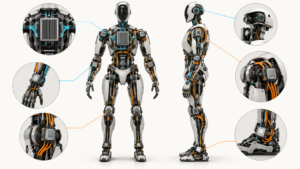
Zephyr or not?
Why Zephyr is emerging as a common embedded software layer for distributed robot control — and where it still falls short.
Humanoid robots need a common embedded platform beneath central AI compute. This revised analysis examines where Zephyr can standardize distributed controllers, where certified or minimal alternatives remain stronger, and which…
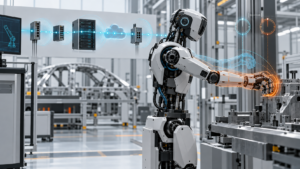
The Network Is Part of the Robot’s Dynamics
Resilient Physical AI must observe communication degradation before it becomes motion error
A robot does not experience a network as bandwidth. It experiences delayed evidence, stale commands and uncertain timing. Treating communication state as part of the controlled system creates a stronger…
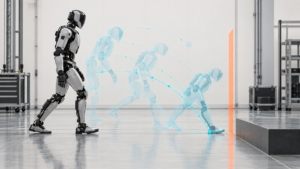
Think Ahead, Act Safely
Why humanoid robots need speculative intelligence without speculative execution
Humanoid robots cannot wait for perfect certainty before moving. They must predict plausible physical futures, compare them and commit only actions that remain within bounded control and safety constraints. A…

A Robot Does Not Have One Network
Physical AI spans four connectivity worlds, each with a different contract for latency, trust, authority and failure.
A humanoid may look like one machine, yet it participates in four distinct connectivity worlds: its own body, nearby robots, local infrastructure and remote services. Treating them as one network…
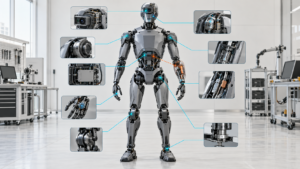
A Robot Is a Calibration Graph
Why Physical AI Must Preserve the Meaning of Every Measurement Across Manufacturing, Learning and Service
Humanoid intelligence depends on a web of geometric, dynamic, temporal and thermal calibration relationships. Managing that web as a traceable graph can expose drift, protect learning data, accelerate service and…
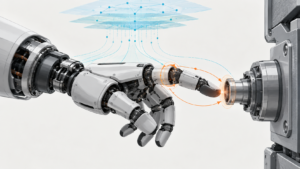
Intelligence Needs a Reflex
Why contact-rich Physical AI must separate semantic intent from bounded real-time correction
Contact turns a plausible robot plan into a time-critical physical negotiation. Three recent research directions point toward a split-timescale architecture: semantic policies propose actions, while local sensing, dynamics and control…
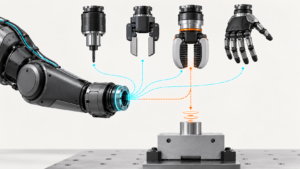
The Hand Is a Business Decision
Why reliable manipulation begins with the mission, not the number of fingers
Robot manipulation succeeds when mechanics, sensing, control and the task are designed as one system. Specialized tools and simple grippers usually win on payload, precision and uptime; adaptive and dexterous…

The Robot Acts. Responsibility Does Not.
Engineering accountable authority across deployment, updates, incidents and retirement
A robot’s action may emerge from software, integration choices, operating conditions and human decisions made by different organisations. Responsibility therefore cannot sit in one emergency-stop button or one job title.…
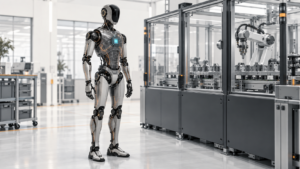
Always Ready?
Power states, wake-up architecture and the energy cost of always-on Physical AI
Humanoid robots need coordinated power states that reduce mission energy without compromising awareness, stability or safe recovery. A five-state architecture aligns motion, perception, compute, communication and safety with explicit readiness…
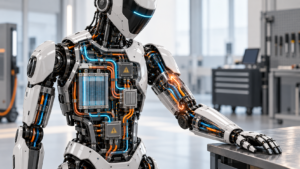
The Robot Must Know When Electricity Escapes
Why Insulation Integrity Becomes Runtime Intelligence in High-Power Humanoids
A humanoid can appear electrically healthy while insulation quietly deteriorates. As batteries, inverters, motors, chargers and moving harnesses share a touchable conductive body, insulation becomes a runtime system property. Continuous…

A Robot Can Reveal the Room Without Sharing the Image
Privacy begins at the representation boundary, where maps, geometry and task signals leave the machine
Keeping camera streams onboard does not make a robot private. Maps, object geometry and task references can still expose the spaces they describe. A defensible architecture must test every exported…
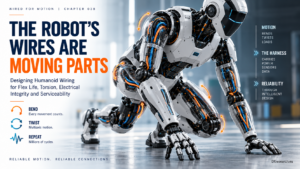
Wires Are Moving Parts
Designing Humanoid Wiring for Flex Life, Torsion, Electrical Integrity and Serviceability
Humanoid wiring moves with every joint, making flex life, torsion, routing, connectors, electrical integrity, diagnostics, and serviceability fundamental reliability requirements.
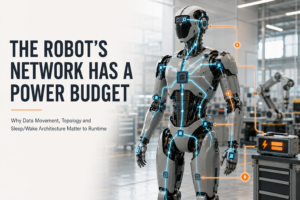
Network Power Budget
Why Data Movement, Link Topology and Sleep/Wake Architecture Matter to Humanoid Runtime
Humanoid communication consumes persistent energy; topology, bandwidth, active interfaces, and selective sleep states therefore belong inside the robot runtime budget.

Black Box: Physical AI Must Preserve the Evidence
Event data recording, evidence integrity and reconstructing what a robot actually did
Robots need protected event evidence linking decisions, commands and physical outcomes, enabling trustworthy reconstruction after failures without permanent workplace surveillance.
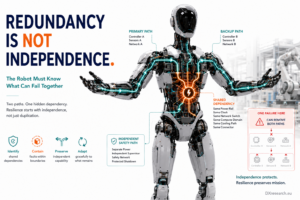
The Robot Must Know What Can Fail Together
Common-Cause Failures, Fault Containment and the Architecture of Meaningful Redundancy
Humanoid redundancy matters only when backup functions survive shared failures across power, timing, communication, compute, sensing, cooling, and supervision domains.
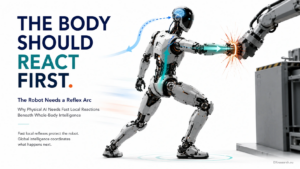
The Reflex Arc
Why Physical AI Needs Fast Local Reactions Beneath Whole-Body Intelligence
Fast local reflex loops let humanoids mitigate physical disturbances immediately while whole-body intelligence coordinates recovery, safety, balance and task continuity.

Know Your Power
Why State of Power Must Become a Real-Time Constraint for Humanoid Motion
A robot needs a real-time battery power envelope before motion, because remaining energy alone cannot guarantee the next maneuver safely.
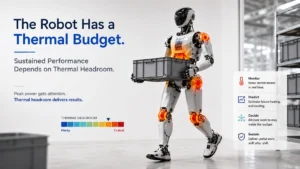
The Robot Has a Thermal Budget
Why Sustained Humanoid Performance Depends on Managing Heat as a Shared System Resource
Thermal headroom determines whether humanoid peak performance can become sustained useful work across actuators, compute, batteries and power electronics reliably.
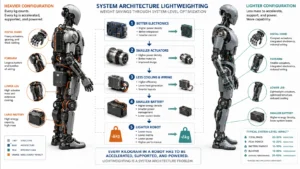
Every Kilogram Has to Move
Why Robot Mass Cascades Through Energy, Actuation, Materials and Semiconductor Architecture
Robot mass cascades through torque, energy, materials, cooling, wiring and batteries, making lightweighting a system architecture problem for scalable robotics.
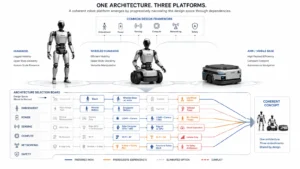
Morphological
From Morphological Boxes to Dependency-Aware Robot Platform Design
Dependency-aware morphological design progressively narrows robot architectures, exposing prerequisites and conflicts before detailed sizing locks expensive subsystem decisions into hardware.
No published books are available yet.