

White Paper
Robotics Scales Where Ecosystems Deliver
A global atlas of demand, engineering capability and the rules of deployment
Robotics scales where customer demand, engineering capability and dependable deployment ecosystems meet. This global atlas compares seven regions through missions, industrial adoption, research, suppliers, learning infrastructure and governance. It separates operating evidence from ambitions and shows how architecture, service and semiconductor choices shape commercially useful, reproducible capability.
1. Executive perspective: robotics scales through ecosystems
A commercially useful robot emerges when a demanding customer, a capable machine, dependable infrastructure and an accountable delivery organisation meet in the same place. National leadership in robotics therefore has several meanings. A country can manufacture excellent actuators, train influential models, operate large fleets or establish trusted deployment rules. These advantages reinforce one another, yet they belong to different parts of the value chain. Treating them as a single league table hides the decisions that customers and suppliers actually need to make.
The strongest opportunity is the intersection of a repeatable mission and an ecosystem able to support it throughout its operating life. Humanoid robotics adds a powerful possibility: machines that can use environments and tools designed for people. Its commercial promise depends on whether that compatibility compensates for the cost, energy consumption and control complexity of the body. Autonomous mobile robots, industrial manipulators and specialised inspection machines provide credible alternatives and valuable infrastructure for this emerging market.
The International Federation of Robotics reported approximately five million industrial robots operating worldwide in 2025 and more than 600,000 new installations during that year. These are industrial-robot statistics; they cannot establish a humanoid installed base. China accounted for 59% of installations. The United States, Japan, Korea and Germany followed among the largest national markets. [1]
For a customer entering robotics, geography should guide the search for complementary capabilities. China offers an especially substantial industrial demand base and visible humanoid product activity. Japan connects long-standing robot engineering with new Physical AI initiatives. Korea combines industrial automation products and humanoid research. Europe offers industrial application knowledge, research and explicit product-governance frameworks. North America provides documented early commercial humanoid applications and influential AI development. India links growing industrial adoption with cyber-physical research and emerging product platforms. South America presents opportunities anchored in manufacturing, infrastructure and resource industries, with Brazil and Chile providing concrete evidence.
Regional strengths guide the search for partners; the investment decision rests on named application owners, operating evidence and service capacity. Customer demand can be strong while a particular platform remains difficult to sustain. Conversely, a small deployment market can support a valuable specialised application. For semiconductor strategy, the starting point is the mission: translate its conditions into electrical functions and qualify their combined behaviour. Learning broadens the range of feasible tasks; sensing, control, power and protection make repeated execution possible. Figure 1 connects these dependencies to the customer’s accepted output.
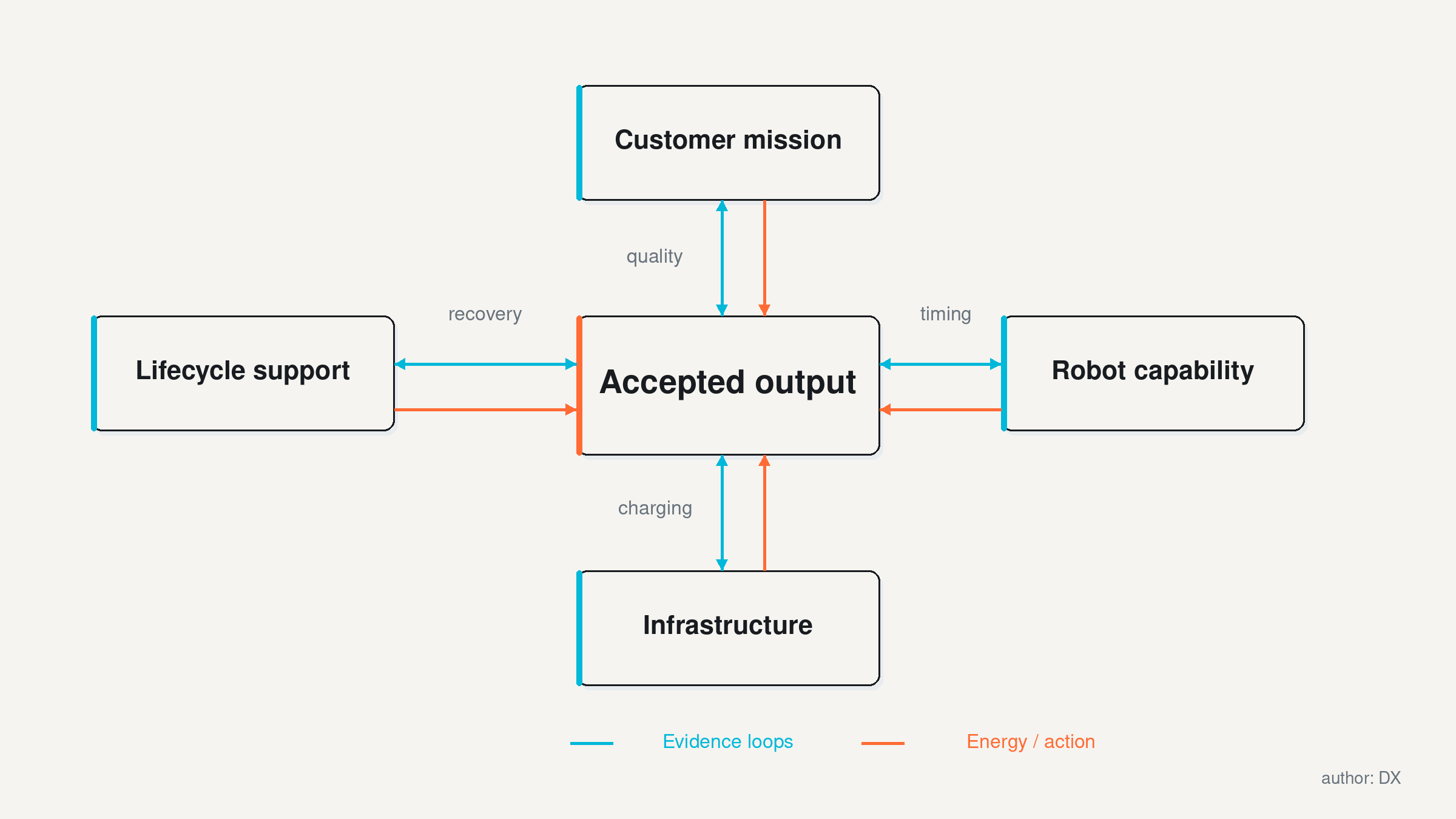
Figure 1. Accepted output depends on customer mission, robot capability, infrastructure and lifecycle support.
Capability leadership and deployment leadership can move at different speeds. A technically ambitious platform may require extensive support, while a narrower machine can deliver a stable service with a small team. The distinction changes investment priorities: research expands the feasible task space, and application engineering converts a selected portion of that space into dependable output. Strong partnerships connect both activities through operating evidence.
2. Read the evidence before reading the map
A robot shipment, an installation and a successful shift describe different events. Shipment demonstrates that a machine left a supplier. Installation establishes a location and some integration work. Productive operation requires accepted output under defined conditions. For emerging humanoids, the distance between these events can be commercially decisive. A buyer needs to know which one a public statement measures, who collected the evidence and what intervention was necessary.
A practical evidence ladder begins with a laboratory demonstration, progresses through a customer pilot and reaches contracted operation. It then asks whether the customer renewed, extended or reproduced the application. None of these steps proves universal autonomy. Each establishes a narrower proposition about a task, an environment and a support arrangement. Publicly available material often leaves staffing, uptime, failure frequency and economics undisclosed. Those omissions should remain visible in any investment or sourcing decision.
| Evidence category | What it establishes | What still needs checking |
|---|---|---|
| Research demonstration | Feasibility under reported conditions | Generalisation, endurance and safety outside the experiment |
| Customer pilot | Access to a real workflow and willingness to test | Intervention, acceptance criteria and repeatability |
| Commercial deployment | A reported operating application and commercial arrangement | Fleet size, renewal, service burden and customer economics |
| Announced capacity | A supplier's production ambition or nominal capability | Yield, orders, shipments and productive installations |
| Forecast or policy target | An expectation or intended future outcome | Assumptions, scope, funding and actual delivery |
Regional comparisons also require a consistent denominator. Industrial installations provide a useful indication of automation activity, but they exclude many service applications and cannot measure humanoid maturity. Robot density expresses industrial robots relative to manufacturing employment; a changing workforce can alter that ratio independently of new robot capability. Revenue comparisons depend on whether integration, software and service are included. Counting company announcements rewards communication volume as much as engineering accomplishment.
The installation figures refer to 2025 and share the IFR industrial-robot definition. Country totals support comparison of industrial adoption, with Brazil serving as one South American example. Comparable regional humanoid totals remain unavailable. Approximate figures retain the precision of their source. Procurement benefits from keeping these boundaries explicit: the scale of an established automation market indicates potential customer and service depth, while a new embodiment earns confidence through its own operational record.
An engagement evidence record links the source date, operating site, machine version, task, contractual status and known limitations. A supplier statement establishes the claim being offered; customer confirmation gives stronger support for actual adoption. Independent measurements become especially valuable when throughput, safety margins or lifecycle cost determine the decision. The central question is which claim the project depends on and which observation would establish it.
3. Demand begins with a difficult job
Demography supplies a structural reason to investigate robotics, while the job supplies the business case. UN DESA's 2024 population analysis places China, Germany and Japan among countries whose populations had already peaked, Brazil among those projected to peak during 2025–2054, and India, Canada and the United States among those likely to keep growing through 2054. These trajectories differ substantially. They also leave room for local labour shortages in growing populations and for plentiful workers in declining ones. [2]
The relevant unit of analysis is a shift, a location and a skill. A warehouse may struggle to retain people for repetitive handling. A production plant may need stable quality during night operations. An infrastructure operator may need access to hazardous spaces. A hospital may need logistics support while protecting patient dignity and privacy. These missions have different payloads, contamination constraints, human interactions and recovery procedures. A common robot body does not make their economics common.
Start by separating unmet work from work that is merely expensive. Unmet work can create delayed orders, idle equipment or deferred inspection. Its value may exceed the direct wage cost of the missing operator. Expensive work can still be hard to automate when it contains judgement, dexterous adaptation or frequent exceptions.
A credible baseline records both normal operations and the irregular events that consume attention. Otherwise, the robot receives an artificially simplified job while people inherit its difficult residue.
Form factor follows the task. Wheels are attractive on accessible floors because locomotion can be mechanically simpler. Legs become valuable where steps, uneven terrain or human access routes matter. A fixed manipulator can provide repeatability when the workpiece arrives in a predictable pose. A mobile manipulator joins transport and handling, at the cost of managing base position and interaction hazards. A humanoid can earn its complexity when a common body serves enough different human-oriented tasks to reduce adaptation costs.
For emerging systems, task selection should balance value against observability. Moving a rigid container between known interfaces gives clear completion criteria. Handling irregular, deformable objects introduces more uncertainty. Supporting vulnerable people introduces consequences that extend well beyond cycle time. Early engagement is easier to judge when the task has explicit boundaries, measurable output and a safe route for exceptions. Customers can expand those boundaries as the evidence improves.
Regional demand is best understood as a portfolio of missions. Demographic pressure, industrial structure and infrastructure conditions change the composition of that portfolio. They do not dictate a single winning machine. For technology suppliers, this creates an opportunity to serve several embodiments through shared electrical functions while respecting different requirements for duty cycle, exposure, safety and service.
4. A regional comparison grounded in applications
Each regional entry route connects a customer mission with capabilities that could help deliver it. Industrial adoption provides scale context; product portfolios, research institutions and customer applications reveal different forms of engineering access. Figure 2 condenses these routes into the next evidence needed for engagement. The equal weighting of its rows reflects a comparison of opportunities, with priority determined by the customer’s task and delivery constraints.
| Region | 2025 industrial adoption reference | Selected ecosystem anchors | Promising entry lens | Critical diligence question |
|---|---|---|---|---|
| Europe | Germany fewer than 25,000 installations; Italy about 7,800; France about 4,500; Spain about 4,300 [1] | ABB; BMW Leipzig pilot; ETH RobotX; IIT ergoCub [3–6] | Factory workflows, integration and assured deployment | Can a validated task be reproduced across plants? |
| Japan | 36,219 installations [1] | FANUC; AIST/CNRS JRL; METI Physical AI initiative [7–9] | Precision production, research transfer and industrial data | Can application knowledge accelerate learning and commissioning? |
| Republic of Korea | About 30,000 installations [1] | Doosan Robotics; KAIST humanoid and mobile robotics [10–11] | Manufacturing automation and mobile manipulation | Which application owner will sustain deployment evidence? |
| North America | US almost 38,500; Canada almost 4,000; Mexico fewer than 5,200 [1] | GXO/Agility commercial agreement; NVIDIA; Google DeepMind [12–14] | Logistics missions, learning software and fleet operations | How much autonomy survives real exception handling? |
| South America | Brazil almost 4,300; no regional total asserted [1] | SENAI CIMATEC; Codelco inspection; Brazil industrial policy [15–17] | Hazardous access, industrial modernisation and serviceable machines | Can the local support model withstand distance and operating conditions? |
| China | About 354,000 installations [1] | Unitree; UBTECH; embodied-AI innovation centres [18–20] | Hardware iteration, industrial trials and supply-chain development | Do product availability and demonstrated skills translate into durable customer output? |
| India | Almost 10,500 installations [1] | Addverb; IISc; NM-ICPS technology hubs [21–23] | Cost-sensitive automation, integration and specialised applications | Can productivity and quality justify the full deployment cost? |
Several consequences follow from this comparison. Large installation volumes can sustain an integration and service economy, yet emerging products must still prove application fit. A smaller market can offer a valuable test environment when its customers have distinctive operational problems. Research capability can support new mechanisms or learning methods, while commercialisation requires manufacturing, application engineering and customer access. Industrial policy can create resources and coordination; deployed output establishes whether those resources solved a problem.
The relationship between headquarters and capability also deserves care. A supplier can design in one country, manufacture in another and deploy through a third-country partner. A model developer can depend on globally sourced actuators and compute. An automotive group can test the same robot concept across continents. Classifying an entire system by the flag attached to its original equipment manufacturer, or OEM, loses these relationships. A useful atlas should follow the location of the capability being sought.
Selective depth makes regional breadth actionable. Comparing a small number of missions across locations reveals where requirements originate, who controls qualification, which components constrain performance and who owns the operating outcome. A long company catalogue with uneven evidence can conceal these relationships. A mission-led comparison exposes the missing partner or interface that determines whether the customer can deploy successfully.
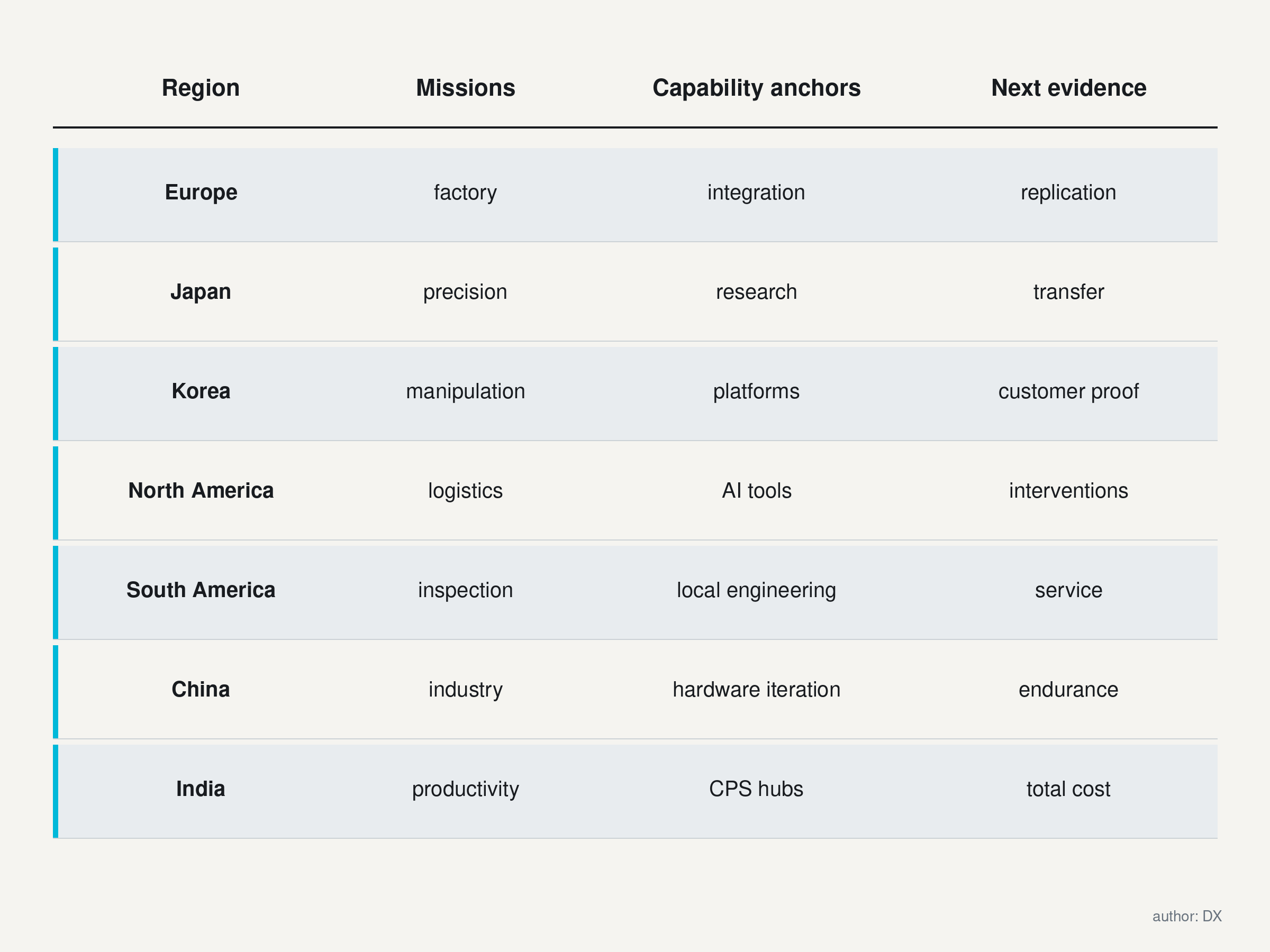
Figure 2. Regional entry routes connect missions, capability anchors and the next operating evidence.
5. Europe: application engineering and accountable deployment
Europe offers an instructive combination of industrial automation, university research and explicit product obligations. ABB's published portfolio covers industrial and collaborative robots, mobile robots, controllers, software and services. This demonstrates the breadth of an established automation proposition. ETH Zurich's RobotX provides a research and educational platform, while IIT's 2023 presentation of ergoCub connects humanoid development with an INAIL collaboration focused on workers' physical risk. These examples identify distinct capabilities, without establishing a collective European market share in humanoids. [3] [5] [6]
BMW's September 2026 account describes an AEON pilot at Leipzig, using a wheeled humanoid for production-related work, and relates it to earlier Figure activity in Spartanburg. The important distinction is the customer's use of the word pilot. The announcement establishes application access and an organisational effort to integrate Physical AI; it does not disclose a general European humanoid fleet, audited payback or unrestricted autonomous operation. [4]
The analytical opportunity lies in translating accumulated production knowledge into clear requirements. Plants already understand tolerances, takt time, maintenance windows, quality escape costs and safe access. A robotics project benefits when those requirements are made available early enough to shape the machine. Integration teams can also identify inexpensive changes to fixtures, packaging or information interfaces that make a demanding task more manageable. Preserving every feature of an existing workstation may be less valuable than preserving its useful output.
European customers should therefore consider two complementary engagement routes. One begins with a known production task and adds adaptive robotics where conventional automation struggles with variation. The other begins with a research capability and finds an application owner willing to define a controlled operating environment. Both need an explicit transfer mechanism: documentation, test methods, maintainable software and responsibility for failures. A university demonstration becomes commercially useful when another team can reproduce and support it.
Regional diversity matters. An application in a German automotive plant differs from one in a small manufacturer, a logistics building or a public-facing service. The European Union is also only part of geographical Europe. The UK, Switzerland and other markets require their own legal assessment. A common engineering platform can support several destinations, but market access should be resolved for each product and intended use.
For semiconductor suppliers, a productive European discussion begins with application constraints and lifecycle expectations. Compact drives, accurate feedback, protected power rails, secure updates and fault evidence can reduce the burden placed on integrators. Their commercial value becomes strongest when tied to an accepted system outcome, such as sustained manipulation accuracy or predictable recovery after a communications fault. Brand familiarity helps establish dialogue; qualification evidence earns the design decision.
6. Japan: precision engineering meets Physical AI
Japan's robotics contribution spans established products and long-running humanoid research. FANUC's current product catalogue includes industrial and collaborative robots across a broad payload range. The CNRS–AIST Joint Robotics Laboratory documents work on humanoid interaction, walking and manipulation. These provide credible anchors for manufacturing capability and research depth, while the maturity of any individual application still requires separate evidence. [7] [8]
METI's report of its July 2026 Physical AI outreach event describes FRONTia and a policy vision to deploy ten million robots domestically by fiscal 2040. The report connects industrial field data with future competitiveness. The ten-million figure is a government vision for robots broadly, with the scope and delivery pathway requiring examination. It should never be converted into a humanoid shipment forecast or a current order book. [9]
The strongest analytical case for Japan rests on the relationship between precision, process knowledge and learning. A robot policy trained on real industrial data can benefit from reliable labels about successful assembly, allowable contact and product quality. Producing those labels requires domain expertise. A demonstration dataset becomes more useful when it records why an operation was acceptable, which variation was tolerated and which failure required a different response. This is an opportunity for experienced manufacturers to contribute beyond hardware.
There is also a credible challenge to that proposition. Existing industrial systems can be closely coupled to proprietary controllers, interfaces and commissioning procedures. Valuable data may be difficult to reuse across embodiments or plants. A customer may hesitate to share failure records or process details.
Data abundance therefore does not automatically become a transferable learning advantage. Collaboration should specify ownership, access rights, annotation responsibilities and the boundary between common learning assets and customer-specific knowledge.
For a buyer, Japan is a useful location to investigate demanding production tasks, precision motion and research-to-industry transfer. For a supplier, the engagement should focus on reducing a measurable constraint: calibration effort, thermal drift, integration time, service complexity or inconsistent recovery. A component chosen for excellent nominal performance can disappoint when its maintenance procedure is difficult or its operating margin depends on ideal cooling. Application evidence should connect the component's specification to the actual duty cycle.
Ageing strengthens the long-term rationale for productivity, but care-related robots carry additional responsibilities. Assistance with goods movement can be assessed differently from physical support of a person. Public policy enthusiasm should be translated into carefully bounded use cases, user acceptance work and dependable escalation to human help. The useful outcome is sustained capability in a real setting, supported by engineering, data and organisational arrangements that survive beyond an initial demonstration.
7. Korea: industrial platforms and research continuity
The Republic of Korea combines a substantial industrial robot market with documented product and research capability. Doosan Robotics publishes collaborative robot families and describes configurations involving autonomous guided vehicles and autonomous mobile robots. KAIST's robotics material documents humanoid, mobile and human-interaction research, including the HUBO lineage. These anchors support investigation of industrial manipulation and whole-body engineering. They do not establish that every new Korean humanoid programme is commercially mature. [10] [11]
A useful engagement hypothesis is that established manipulation capability can accelerate mobile manipulation. The arm, force feedback and application software provide part of the solution. Mobility introduces changes in alignment, stability, communications and site interaction. When the same arm moves between workstations, the base becomes part of the accuracy chain. A task that was reliable on a rigid pedestal may need additional perception, calibration or mechanical support when performed from a mobile platform.
Humanoids extend this challenge further. A moving torso and articulated support structure change the relationship between joint commands and the tool. Whole-body control must preserve both task performance and stability. The electrical architecture needs timely measurements, bounded command delivery and observable faults. Research teams can contribute sophisticated control methods, while industrial suppliers can contribute maintainability, production discipline and customer access. A partnership becomes valuable when these responsibilities are explicit.
For customers, the first question should concern the operator's workflow. Can the machine recognise completion, hand over safely and recover from a changed part position? The second should concern the supplier's response when those conditions fail. A local integration partner may matter more than another increment of nominal arm speed. Training should include maintenance and exception handling, because the people working around the robot need confidence in its behaviour during unusual events.
Public support can affect access to research facilities, trials and finance. A project relying on Korean autonomous-manufacturing programmes needs confirmed eligibility, an accountable programme owner and current application terms. Announced support becomes commercially useful when it connects an application owner to test capacity and continuing engineering responsibility. Until those conditions are established, the business case depends on the customer’s requirements and resources. Funding can accelerate a sound deployment; continuing operation still requires customer value.
Semiconductor opportunities should be framed around the combination of compactness and predictable operation. Joint sensing, protected power, deterministic control and diagnostic coverage can support both collaborative arms and newer bodies. Common building blocks are commercially attractive when they shorten qualification across related products. The supplier still needs to demonstrate that reuse preserves the required performance under different mass, thermal and interaction conditions. Shared components create value through controlled commonality.
8. North America: early operations and influential learning tools
North America offers a concrete commercial reference in logistics. GXO's June 2024 announcement describes a multiyear robots-as-a-service agreement with Agility Robotics, following a proof-of-concept pilot. At the SPANX facility, Digit was to move totes from other automation onto conveyors, supported by Agility Arc. The customer's announcement establishes a defined use case and commercial arrangement. Public evidence still leaves questions about long-term utilisation, intervention rates and economics. [12]
This example matters because the humanoid participates in an existing workflow. Conveyors and mobile robots provide structured interfaces; a fleet platform coordinates work. A general body can therefore begin with a specific mission. The customer's challenge is to decide whether the adaptable machine solves an interface problem more economically than alternative equipment. Commercial operation creates an opportunity to learn from exceptions that a laboratory demonstration may never encounter.
NVIDIA's March 2025 GR00T N1 technical publication describes a model combining visual and language interpretation with action generation, supported by real, synthetic and broader pretraining data. Google DeepMind's March 2025 announcement identifies Gemini Robotics and an embodied-reasoning model tested with partners. These are dated examples of learning infrastructure, without implying that those releases remain the newest versions in October 2026 or that one organisation accounts for the whole field. [13] [14]
The regional opportunity is to connect software development with operational learning. A warehouse operator can expose the system to genuine variability, while a developer can improve perception and policies using structured feedback. The contract needs to determine what data can leave the site, how updates are accepted and who bears the cost of interrupted work. An apparently small software change can alter physical behaviour, so deployment discipline belongs within the commercial arrangement.
The United States, Canada and Mexico should remain distinct in application planning. A regional installation reference does not justify assuming common wages, service coverage, import conditions or workplace rules. Mexico's manufacturing customers may participate in cross-border production chains, while Canadian and US facilities may share software and equipment suppliers. The operating environment and legal obligations still belong to the specific site. Product qualification should follow that location.
For component suppliers, early commercial projects can generate valuable requirements about real workloads. The opportunity includes compute interfaces, power conversion, motor control, sensing and secure fleet maintenance. Procurement should seek evidence about sustained thermal operation and service replacement, because initial product excitement can mask a demanding support burden. A scalable robot business needs a repeatable method for commissioning the next site and diagnosing the next fault, alongside improved models.
9. South America: application value can precede humanoid scale
South America's robotics opportunity is visible in specialised work. Codelco reported in February 2025 that a robotic device inspected forty kilometres of a tailings channel at El Teniente during a maintenance programme. This is evidence of a defined inspection mission, with no implication that the device was a humanoid. SENAI CIMATEC publishes industrial automation and robotics services covering practical engineering and digital integration. Brazil's New Industry Brazil policy identifies digital industrial transformation and agroindustrial modernisation among its missions. [16] [15] [17]
These examples suggest an application-led route into robotics. Inspection value may arise from safer access, more consistent records or earlier detection of deterioration. Manufacturing value may arise from repeatability and process integration. Agricultural value may arise from timing, selective handling or working through seasonal constraints. Each requires a machine matched to the environment. Legs, wheels, rails, drones and fixed mechanisms should all remain candidates where their operating conditions permit.
Brazil’s industrial adoption gives one country reference within a diverse region. Argentina, Chile, Colombia and other markets have different industrial structures, infrastructure and purchasing conditions. Comparable public evidence about their current humanoid fleets remains incomplete. The stronger commercial starting point is a named operator with a difficult task, a measurable baseline and a support arrangement appropriate to the site. That approach can reveal valuable applications even where a broad market estimate remains uncertain.
Distance changes the economics of support. A robot that requires frequent expert attendance may be attractive near its developer and difficult to sustain at a remote site. Local technicians need understandable diagnostics, replacement modules and safe procedures. Connectivity may support remote assistance, but local recovery remains necessary when communications are unavailable. Environmental exposure, contamination and transport conditions should be built into qualification before a supplier promises availability.
A reasonable strategic position is to combine imported platform capability with local application engineering and research organisations. That arrangement can support adoption while building knowledge of local operating conditions. It should also preserve access to documentation, spare parts and data. Dependency becomes commercially damaging when the customer cannot maintain its equipment after a supplier changes priorities. Serviceability and ownership of operating knowledge are therefore central purchase criteria.
Humanoids may eventually serve tasks with human-oriented tools and access routes, yet the initial investment case should remain specific. A customer can gain meaningful value from a specialised inspection robot or a mobile handling system while humanoid capabilities mature. For electronics suppliers, robust sensing, protected power and low-burden maintenance are useful across these embodiments. The region's distinctive missions can generate demanding requirements that travel back into globally reusable designs.
10. China: industrial scale creates opportunity and scrutiny
China's industrial adoption scale makes it a central location for robotics engagement. Selected product evidence also shows different humanoid propositions. Unitree publishes the G1 platform and cautions about the power and complexity of humanoid machines. UBTECH's Walker S page presents an industrial humanoid with perception, manipulation and factory-integration features. These sources verify the products and the vendors' stated propositions; they do not independently establish fleet productivity or general autonomous competence. [18] [19]
The Chinese government portal's October 2024 account describes a Beijing embodied-AI innovation centre receiving national and local support and refers to humanoid development objectives for 2025 and 2027. These are policy ambitions and institutional announcements. Their historical dates should be preserved so that later developments can be evaluated against them. A target for an innovation system or reliable supply chain is a different proposition from confirmed customer demand. [20]
An attractive analytical hypothesis is that proximity among hardware producers, industrial customers and research teams can shorten iteration cycles. A joint supplier can refine a mechanism, an OEM can test the change and a customer can expose a new failure mode. The potential benefit comes from the quality of that feedback loop. Fast iteration can improve a design rapidly; it can also produce configuration drift when product revisions outrun documentation and qualification.
International customers should therefore investigate version control as carefully as nominal price. Which machine version generated the published evidence? Which firmware, actuator and battery configuration will be delivered? Are spare modules interchangeable, and how is recalibration handled? A compelling demonstration can lose relevance if the production machine changes materially. Evidence should remain linked to the configuration and operating boundary that produced it.
Cost competition raises useful questions about integration. A lower platform price can widen access to experimentation and education.
Installed cost also includes tooling, application development, safeguards, training and service. A customer paying less for the machine may still carry a large engineering burden. Comparison should allocate those costs consistently across bidders and consider the number of useful tasks achieved during the contract life.
For semiconductor suppliers, China's range of potential customers supports several engagement models. Some OEMs seek a complete subsystem; others design deeply into drives, control and power distribution. The practical response is to identify decision ownership and offer evidence at the right level. A reference circuit can support a fast prototype, while production qualification needs thermal, reliability and fault-response information. Long-term access should be earned through application value, predictable supply and engineering support, with trade and data conditions assessed for the actual cross-border transaction.
11. India: productivity, affordability and integration
India combines rising industrial robot adoption with visible cyber-physical research and emerging Physical AI products. IISc's department describes work spanning embedded systems, AI, robotics and data analytics. India's Department of Science and Technology documents the National Mission on Interdisciplinary Cyber-Physical Systems and twenty-five technology innovation hubs, including robotics and autonomous systems. Addverb's Physical AI site presents humanoid and other robotic platforms. These are concrete capability anchors; they do not establish a national humanoid installed base. [22] [23] [21]
India challenges a common demand assumption. A growing population can coexist with shortages of specific skills, inconsistent quality or physically difficult work. Automation can create value through throughput, safety and process capability even when direct wages are comparatively low. The customer must identify that value explicitly. A business case relying entirely on avoided labour cost may miss the stronger opportunity and may also encourage unrealistic assumptions about staffing reductions.
Affordability should be understood over the deployment life. A machine that requires a specialist team for commissioning and support may fail to reach smaller customers, regardless of its bill of materials. Preconfigured applications, transparent maintenance and understandable controls can reduce the expertise required on site. The resulting design may prioritise standard modules and clear operating boundaries over maximum feature breadth. That is a rational commercial choice when it increases the number of customers able to deploy successfully.
Research institutions and technology hubs can support this route by connecting prototypes to local application problems. The useful transfer includes test methods, software tools and people who can maintain the system. A project that remains dependent on its original doctoral researcher carries a fragile support model. Industrial partners should establish ownership of documentation and a path for training application engineers before promising replication.
For international suppliers, India can be both a customer market and an engineering partner. The engagement should distinguish local design ownership from imported platform integration. It should also test whether support capacity reaches the intended customer locations. A compelling project at a sophisticated factory does not establish readiness for every smaller site. Power quality, network access, process discipline and maintenance skills need direct observation.
Semiconductor positioning should connect integration and robustness to economic value. Accurate current sensing can support controllable motion; protective circuits can limit the consequences of electrical faults; diagnostic data can shorten troubleshooting. The opportunity is strongest when these functions reduce total deployment effort or improve accepted output. Policy programmes can assist technology development, but their original approvals and hub counts are historical or institutional facts. Current funding availability and market-access rules need a separate, application-specific check.
12. Follow the value chain across borders
Delivery responsibility extends from the customer’s acceptance criteria through the integrator, OEM and enabling subsystems. The customer defines the mission; the integrator connects it to the workflow; the OEM maintains the platform’s supported operating boundary. Mechanism, electronics and software suppliers contribute the functions within that boundary. Research develops and tests methods, while infrastructure and service sustain operation. Figure 3 maps these responsibilities across organisational and national borders.
These layers overlap, but they should remain visible during engagement. An OEM may sell a machine through an integrator who carries application liability and service obligations. A fleet platform may coordinate work without owning the robot's local protective response. A component supplier may provide diagnostics that the integrator never exposes to maintenance staff. The quality of the ecosystem depends partly on whether useful information reaches the person able to act on it.
Harmonic Drive's integrated actuator offering combines gearing, motor, feedback and drive functions, illustrating a subsystem proposition. Infineon's humanoid application material spans motor control, sensing, power distribution, connectivity and security, illustrating an electronics proposition. These published portfolios identify capabilities to investigate. They provide no evidence that a particular OEM uses a particular product, and they establish no automatic superiority over alternatives. [24] [25]
For a customer, subsystem boundaries affect service and bargaining power. An integrated actuator can simplify assembly and cabling while concentrating dependency on its supplier. A more discrete design can permit component substitution while increasing integration and calibration work. The better choice depends on engineering capacity, product volume, availability expectations and the cost of maintaining multiple variants. Procurement should evaluate these trade-offs through the intended operating life.
For a supplier, the route to value capture depends on where qualification decisions occur. A semiconductor selected by an actuator maker can enter many OEM platforms. A reference architecture adopted by an OEM can define several boards. A safety assessor may influence requirements even while purchasing no components. Engagement maps should therefore include technical decision makers and evidence gatekeepers alongside commercial accounts.
Cross-border partnerships can combine complementary strengths. A customer with demanding tasks, a research team with a useful method and a production supplier with service capability may create more value together than any could alone. The arrangement needs clear ownership of requirements, data, intellectual property and continuing support. Ecosystem breadth becomes an advantage when interfaces are dependable. Otherwise, the customer receives a collection of capable organisations and an unresolved integration problem.
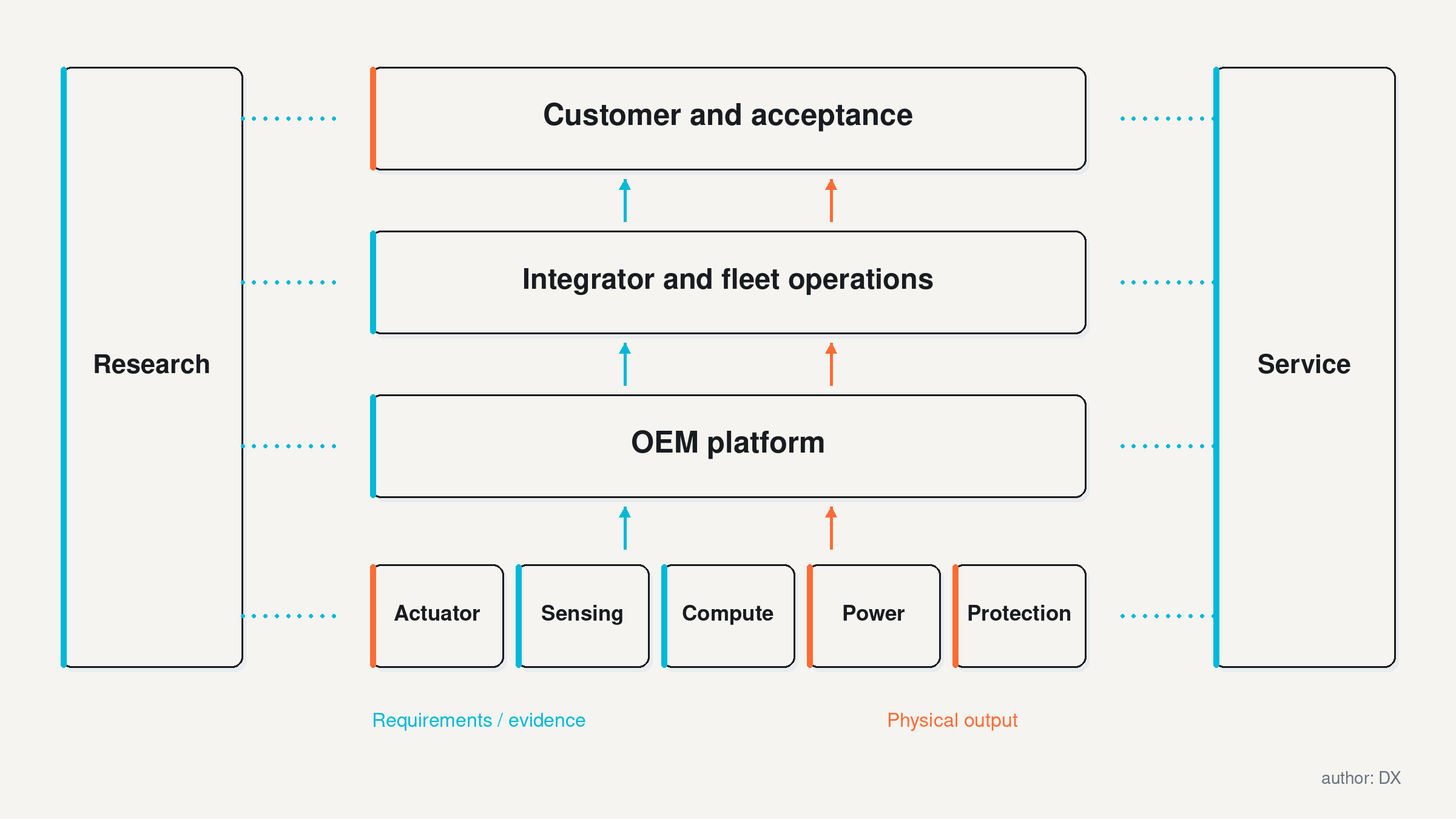
Figure 3. Delivery and qualification responsibility extend across the robotics value chain.
13. AI acceleration is a distributed engineering achievement
Learning makes some forms of variation easier to handle. Vision interprets objects and surroundings, language communicates goals, and action models translate observations into motion. Simulation expands experimentation; real demonstrations teach skills that are difficult to specify procedurally. NVIDIA’s and Google’s dated announcements illustrate this technical direction. Its commercial significance depends on the change in accepted output, adaptation effort and intervention frequency within a customer’s operating environment.
The improvement depends on several interacting contributions. Research provides architectures and learning methods. Compute suppliers provide training and inference capability. Robot makers provide controllable bodies and sensors. Simulation teams provide models of contact and dynamics. Customers provide tasks and operational feedback. Annotators and application engineers make data interpretable. Open tools and published experiments allow other teams to compare and improve methods. Assigning the entire acceleration to one company would obscure this dependency chain.
Simulation has a particular commercial role: it can reduce the cost of exploring dangerous or infrequent events. Its value depends on whether the relevant physical behaviour is represented. Friction, compliance, delay, backlash and sensor error can change the outcome of a contact task. A simulated success deserves stronger confidence when the assumptions are tested against hardware. Repeatedly training against an inaccurate model can create a polished policy with brittle real-world behaviour.
Likewise, a larger model is useful only when it fits the system's operational constraints. The robot must acquire timely observations, execute decisions and remain within safe limits. Inference competes with other workloads for memory bandwidth, power and cooling. A policy that performs well during a short demonstration may behave differently after prolonged operation or under communications congestion. Sustained workload tests should include the sensing, logging and supervisory functions used in production.
Data quality provides a further competitive axis. Successful demonstrations teach the normal task; failure and recovery records reveal its boundary. Time alignment among images, joint states, forces and commands helps identify causality. Maintenance records can explain gradual deterioration that otherwise appears as random policy failure. The electronics architecture therefore contributes to learning quality through accurate measurements and interpretable fault information. Physical AI depends on trustworthy physical evidence.
The strongest commercial claim is improved capability within a defined environment at an acceptable total cost. Customers should ask whether new learning methods reduce commissioning effort, expand the range of tolerated variation or lower intervention frequency. They should also compare simpler alternatives.
Some tasks benefit from a fixture, clearer packaging or better process information. AI is especially valuable when it handles variation that remains after sensible engineering improvements and does so with measurable reliability.
Two explanations can account for an apparent gain in autonomy. The policy may have become more capable, or the deployment may have become more structured through packaging, fixtures and task selection. Both improvements can create value. Separating their contribution matters when the next site has different conditions: transferable learning and carefully engineered interfaces require different replication work. A representative comparison holds the task boundary steady while measuring output and human assistance.
14. Charging, data and service complete the machine
Infrastructure determines how much of a robot's nominal capability becomes useful work. A battery-powered machine needs an energy plan covering operation, charging and safe handling. A connected fleet needs coverage, authentication and predictable access to its task systems. A maintainable deployment needs spare modules, trained staff and a method for restoring service after faults. These requirements exist in every region, but their practical cost depends on the site.
Charging is a workflow decision. A robot can charge during breaks, exchange batteries or rely on a schedule that reserves sufficient energy for its remaining tasks. Each approach changes facility layout, staffing and availability. A design that maximises battery capacity may become heavier and harder to manoeuvre. A design that charges frequently may need more infrastructure and scheduling discipline. Evaluation should measure useful work per operating cycle, including the time and labour required to restore energy.
Electrical qualification should follow the full energy path: battery, protection, distribution, conversion and loads. Transient demand can arise when several joints accelerate while compute remains active. Regeneration can return energy during braking or lowering. Faults can propagate across shared rails unless the architecture contains them. The appropriate protection and control depend on voltage, current, stored energy and mechanical consequences. A common regional product label supplies little guidance without those details.
Digital infrastructure also has physical consequences. Loss of a task server can interrupt work; loss of a remote-support connection can delay recovery; loss of local motion information can create an immediate hazard. These events should have different responses. Local controllers need defined behaviour when commands become stale or observations unreliable. Fleet orchestration can optimise work allocation, while the robot preserves the ability to respond safely within its immediate environment.
Customers should establish a data architecture before accumulating a large fleet. Useful records include task outcomes, interventions, energy, temperatures, software versions and component replacements. Access should be assigned by purpose. Maintenance personnel need actionable diagnostics; model developers may need selected sensor data; auditors may need configuration and event history. Collecting everything without clear use can increase cost and privacy exposure while making important events harder to find.
A regional rollout should begin with an infrastructure survey, followed by a representative operational test. Network coverage maps, charging plans and spare-parts lists are necessary inputs, yet real shifts reveal queues, blocked routes and human behaviour. These observations should feed back into both the machine and the facility. The ecosystem becomes scalable when each new site can be qualified using a repeatable process and when operating staff can recognise the limits of the system.
15. Rules follow intended use, hazards and jurisdiction
Intended use and foreseeable hazards determine the assurance route. Industrial manipulation, driverless transport, healthcare and public service can require different assessments. ISO’s public scope for ISO 10218-1:2025 covers industrial robot safety and excludes several uses and mobility-related hazards. ISO 3691-4:2023 addresses driverless industrial trucks and their systems. These scopes orient standards selection; a combined humanoid system requires assessment of its complete hazard set, as illustrated in Figure 4. [26] [27]
A mobile humanoid combines hazards that may span multiple frameworks: falls, contact, crushing, electrical energy, dropped loads and unexpected motion. Adding an industrial arm to a moving base creates an interaction problem beyond either subsystem in isolation. The design team should map each hazard to a responsible function and a verification method. Standards selection follows that analysis. A familiar standard number alone provides insufficient evidence that every relevant hazard has been addressed.
EU market access requires a dated classification assessment. Regulation (EU) 2023/1230 on machinery generally applies from 20 January 2027, with some provisions applying earlier. The July 2026 AI Omnibus extends the relevant Annex III high-risk AI obligations to 2 December 2027 and Annex I obligations to 2 August 2028. It also changes the machinery relationship toward a sectoral approach. The Commission’s implementation notice confirms the extended dates; the applicable duties for a robot still depend on its classification and conformity-assessment route. [28] [29] [32]
US OSHA's technical manual explains industrial robot hazards, risk assessment and responsibilities across manufacturers, integrators and operators. It is guidance material, with dated standards references, and should not be presented as a new standalone humanoid law. Brazil's official NR-12 material provides a machine-safety framework and links to applicable texts. A specific project needs the current binding provisions and an assessment of its actual operating conditions. [30] [31]
Market access in Japan, Korea, China, India, Canada, Mexico and individual South American jurisdictions depends on the specific product and site. Relevant obligations can include product safety, workplace protection, radio approval, privacy, sector-specific requirements and import conditions. Local assessment establishes the applicable instruments and responsible organisations. The deployment dossier then binds those obligations to the machine version, intended use and operating conditions. Innovation programmes can support development while manufacturers, integrators and operators retain their applicable responsibilities.
Security belongs in the same operational discussion. A compromised command, unauthorised update or corrupted sensor record can change physical behaviour. Secure startup, authenticated software, access control and recoverable updates support trustworthy operation, but their adequacy must be demonstrated at system level. Governance becomes manageable when evidence is produced alongside engineering decisions and maintained through updates, repairs and changes of application.
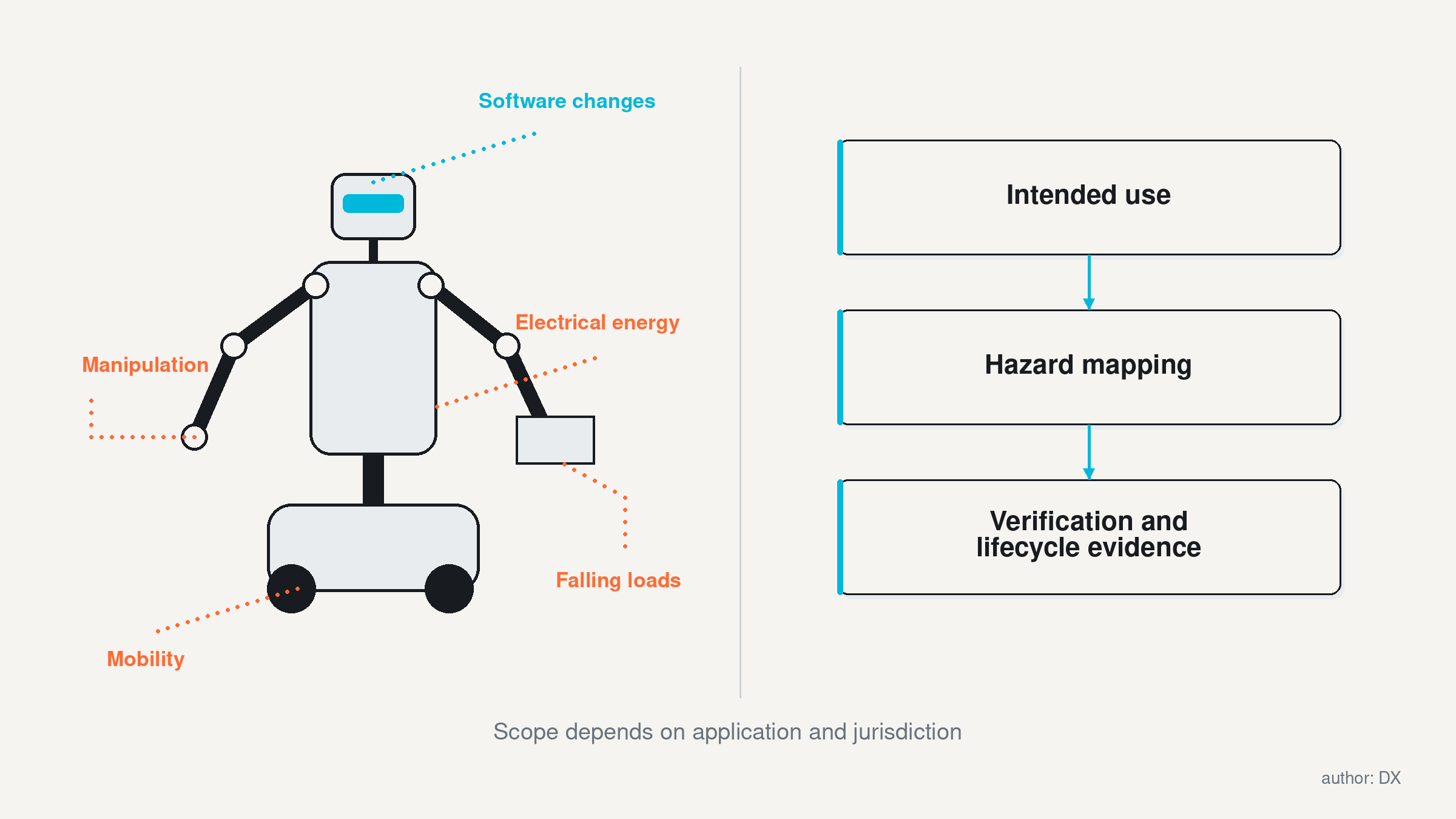
Figure 4. Intended use, interacting hazards and lifecycle evidence define the assurance route.
16. Economics depend on accepted output
A robot's economic unit should reflect what the customer buys. For handling, that may be correctly transferred containers. For inspection, it may be usable evidence from an asset. For production, it may be accepted parts. Robot-hours are an intermediate measure because time spent moving, waiting or recovering can produce very different value. The business case should include both useful output and the resources required to obtain it.
A practical lifecycle model includes acquisition or service fees, commissioning, facility changes, energy, consumables, maintenance, support, supervision and downtime. Benefits include increased output, improved quality, reduced hazardous exposure and avoided constraints on capacity. Some benefits are difficult to monetise consistently. They should remain explicit, with the decision maker choosing how to value them.
A headline payback calculation becomes misleading when important costs or benefits disappear into unexamined assumptions.
Consider an illustrative task with 4,000 scheduled hours per year. If availability is assumed to be 85% and productive utilisation during available time 70%, the result is 2,380 productive hours. These are hypothetical inputs, not an industry benchmark. Changing utilisation to 50% produces 1,700 hours even though hardware availability is unchanged. The example shows why workflow readiness, charging, waiting and exception handling can dominate economics. A cheaper machine may still deliver expensive useful work.
Labour accounting needs equal care. A robot can remove repetitive handling while creating monitoring, maintenance or exception tasks. Human attention may be shared across a fleet, but that sharing requires evidence about concurrent failures and travel time. Assuming that one supervisor can support an arbitrarily large fleet converts a future ambition into current economics. Trials should record interventions, their duration and the skill required, including work done remotely by the supplier.
Robots-as-a-service can redistribute financial risk and support responsibility. It can also make customers dependent on continuing connectivity, software access or a supplier's solvency. Contracts should specify accepted output, service levels, data rights, maintenance responsibility and exit arrangements. Ownership of the machine and control over the operating knowledge can diverge. A customer should understand both before committing a critical workflow.
Regional comparisons should use local operating costs and the same cost boundary. Imported hardware, installation travel and spare stock can alter the result. So can the value of avoided shutdowns or scarce skilled labour. The strongest diligence combines customer baseline data, a representative trial and sensitivity analysis. Investment becomes more defensible when it remains attractive under plausible changes in utilisation, intervention and service cost, with explicit triggers for revisiting the decision.
Intervention is both a cost and a diagnostic signal. A short, frequent reset may expose an interface problem that can be engineered out. A rare intervention requiring expert judgement may reveal a deeper capability limit. Recording only the total intervention count hides that difference. Classifying events by cause, duration and required skill allows the customer to test whether improvements reduce the support burden or merely move it to another team.
17. Semiconductor strategy follows the mission architecture
The most credible semiconductor opportunity connects an electrical function to a customer outcome. Motion depends on efficient switching, suitable drive control and useful feedback. Perception depends on sensors, signal integrity and calibration. Compute depends on stable rails, memory and interfaces. Connectivity depends on timing and fault handling. Protection depends on observable failures and reliable responses. These functions are shared across embodiments, while their required implementation changes with the task.
A humanoid joint may place demanding electronics inside a small enclosure close to heat and vibration. An autonomous mobile robot may provide more space while requiring long operating periods and substantial battery energy. A fixed industrial manipulator may use a different supply and thermal arrangement. Common functions support portfolio reuse; operating conditions govern qualification. Technology selection should compare efficiency, thermal margin, electromagnetic behaviour, cost, diagnostic capability and supply continuity together.
For example, reducing conduction or switching losses can lower temperature or permit a smaller enclosure. The customer benefit depends on whether that change improves duty cycle, weight, reliability or manufacturing cost. A faster converter can also introduce electromagnetic compatibility challenges. A more capable microcontroller can simplify control or integrate monitoring, while its software and safety support determine engineering effort. Specifications become commercially meaningful through these causal links.
Architecture discussions should cover the full chipset around a function. An actuator board includes power devices, gate driving, current and position measurement, control, communication and protection. A battery interface includes measurement, switching, diagnostics and charging coordination. A central compute interface includes conversion, sequencing, monitoring and fault containment. Supplying one excellent part does not establish that the combined board behaves reliably under all relevant conditions.
Regional customer engagement should identify the level at which decisions are made. A vertically integrated OEM may choose individual devices. A subsystem buyer may evaluate a complete actuator. An integrator may require validated interfaces and service information. Reference designs are useful when they reduce a real qualification burden and remain adaptable to the customer's constraints. Their value should be tested through commissioning time, thermal evidence and controlled fault behaviour.
Independent assessment can recognise Infineon's broad system proposition while evaluating alternatives fairly. The verified application material identifies relevant functional areas; production selection still needs device-level evidence and comparison. Suppliers gain a durable position when their support helps customers turn an emerging machine into dependable work. The guiding question is which electronics decision changes the operating outcome, and how that improvement can be demonstrated in the intended environment.
18. Build an engagement portfolio around evidence gates
An engagement portfolio earns its value through a small set of customer missions with clear decision gates. Meaningful output, an accountable application owner and observable results establish the basis for investment. Comparing plausible embodiments exposes the cost of flexibility and the value of adapting the workplace. Service, infrastructure and assurance then define the delivery capability required. Regional strengths guide partner selection within that concrete problem.
The first gate establishes need. Obtain baseline data on output, variation, hazards, staffing and downtime. The second establishes feasibility using a representative task and clear limits. The third establishes operating economics through sustained trials, including human interventions and support. The fourth establishes replication: another shift, another product variant or another site. The final gate concerns continuing service and controlled change. Passing one gate authorises the next investigation; it should not erase outstanding evidence requirements.
| Engagement gate | Required evidence | Decision consequence |
|---|---|---|
| Mission and baseline | Customer-owned problem, measurable output and current process data | Proceed only when value and responsibility are explicit |
| Bounded feasibility | Representative operation, documented conditions and safe exception route | Select the architecture and define remaining tests |
| Sustained operation | Output, intervention, energy, maintenance and downtime records | Approve a commercial scope supported by measured economics |
| Replication | Repeatable commissioning and comparable results under new conditions | Expand only within the demonstrated operating boundary |
| Lifecycle support | Update controls, spare supply, recovery procedures and exit arrangements | Maintain or revisit the commitment as evidence changes |
Technology suppliers face three distinct engagement conditions. Exploratory projects need flexible tools and rapid feedback. Production candidates need controlled configurations, representative workload tests and qualification support. Established deployments need supply continuity, maintainable software and predictable recovery. Commercial effort allocated to each stage can therefore differ. Early access is valuable when it reveals recurring requirements; a production commitment becomes stronger when those requirements are stable enough to support a reusable design.
Priority can be assessed through application value, decision access, technical fit, delivery capability and evidence quality. These dimensions should remain separate long enough to reveal trade-offs. A prestigious partner with weak application access may offer less near-term learning than a smaller organisation with a real customer and a measurable task. A promising OEM with limited service capacity may need an integration partner before its machine becomes deployable. Portfolio discussion should expose those dependencies.
A shared task dossier gives the customer and delivery partners a durable basis for decisions. It binds requirements to architecture, evidence, unresolved constraints and the next observation needed. Trials and significant configuration changes update the same record. Figure 5 shows how commitment can expand through these gates while findings return to earlier decisions. Across a portfolio, the dossiers reveal reusable capabilities, recurring constraints and partnerships able to reproduce customer outcomes.
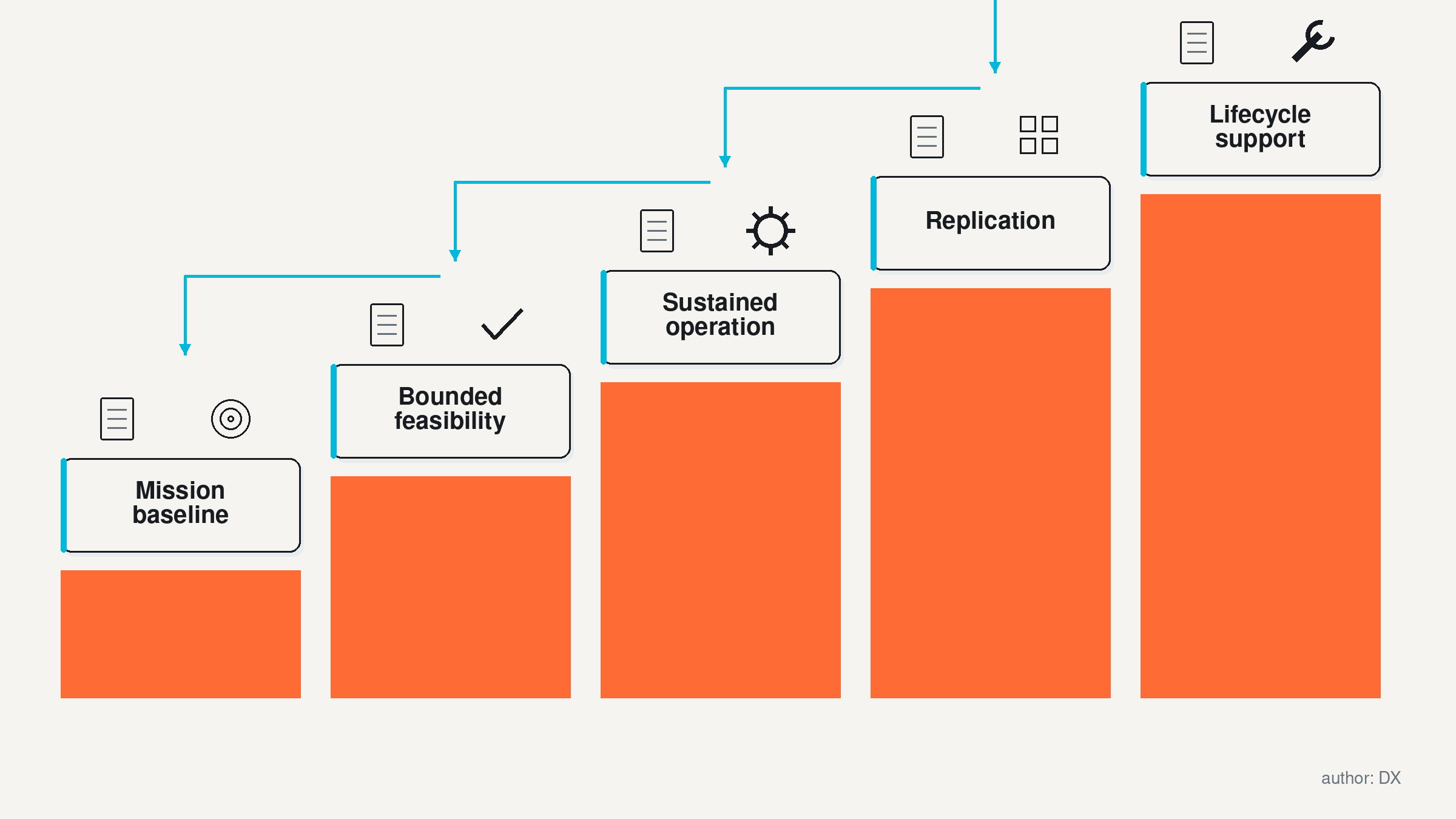
Figure 5. Commercial commitment expands through evidence gates, with feedback as conditions change.
19. The next advantage will be reproducible capability
Over the coming years, robotics could expand through improved learning, more capable bodies and easier deployment. The relative contribution of each remains uncertain. A model that handles more variation can reduce application programming. A better actuator can improve sustained manipulation. A simpler service procedure can keep a fleet productive. Commercial progress will depend on the combination, and different missions will reward different improvements.
A disciplined outlook should track evidence that would change the assessment. For humanoids, useful signals include repeat customers, replicated workflows, disclosed intervention trends and maintainable production configurations. For learning systems, useful signals include performance on unfamiliar conditions and the cost of adapting to a new task. For infrastructure, they include repeatable charging, network and service arrangements. For electronics, they include stable operation under representative loads and a demonstrated ability to contain faults.
There are credible paths to faster and slower adoption. Faster progress could come from common platforms, transferable task data and application packages that reduce commissioning. Slower progress could arise from persistent manipulation failures, support costs, safety constraints or customer reluctance to change workflows. The same ecosystem may accelerate one mission while struggling with another. A regional forecast should preserve that variation instead of assuming a uniform diffusion curve.
Several questions deserve direct investigation. How much work can be completed before a skilled person intervenes? Which failures recur across embodiments? How quickly can another site reproduce the result? Who owns the evidence needed to diagnose a problem? Which design choices improve useful output after accounting for energy, maintenance and assurance? These questions connect research ambition with purchasing decisions and make progress observable.
A global atlas is most useful when it directs attention to complementary capabilities. Europe, Japan, Korea, North America, South America, China and India each contain opportunities that extend beyond a simple national ranking. Customers can select demanding missions; research teams can develop and test methods; OEMs and subsystem suppliers can create maintainable platforms; infrastructure and service organisations can sustain them. The lasting advantage will belong to partnerships that reproduce useful capability, explain its limits and keep improving it under real operating conditions.
Reproducibility also changes bargaining power. A platform supported by transferable tests, clear interfaces and service documentation gives customers more confidence to expand. A deployment that depends on informal knowledge held by a few specialists remains vulnerable even when its demonstrations are impressive. The valuable operating knowledge includes the conditions for success, the warning signs of deterioration and the actions that restore useful work. Making that knowledge maintainable is a concrete route from promising technology to durable commercial capability.
Glossary
- Availability
- Share of scheduled time during which equipment is capable of performing its specified function.
- Reference design
- An example implementation intended to support adaptation and verification for a particular engineering function.
- Evidence gate
- A decision point requiring specified observations before increasing commitment.
- Lifecycle cost
- Combined acquisition, deployment, operation, maintenance and retirement costs over an agreed period.
- Qualification
- Evidence-based demonstration that a design meets specified application requirements.
- Deterministic control
- Control with defined timing and response behaviour under specified operating conditions.
- Fault containment
- Limiting the propagation and consequences of a fault across system boundaries.
- Fleet orchestration
- Software coordination of tasks, priorities, locations, charging, shared resources and availability across multiple robots.
- Whole-body control
- Coordinated control of a robot’s articulated body to achieve tasks while respecting constraints.
- Intervention
- Human action required to correct, assist, restart or complete a robot operation.
- Ecosystem
- Organisations, infrastructure and relationships that jointly develop, deliver and maintain a robotic application.
- Productive utilisation
- Share of available operating time that produces useful accepted output.
- Commissioning
- Work needed to configure, integrate, test and accept a system for its intended operation.
- Robot density
- Industrial robots relative to manufacturing employment, commonly expressed per ten thousand workers.
- Installed base
- Units installed or operational within a specified category, geography and date; the counting definition must be stated.
- Mobile manipulation
- Handling or manipulating objects using a robot that can move between locations.
- Embodiment
- The physical body, sensors, actuators and interfaces through which a robot acts.
- Humanoid
- A robot with a substantially human-oriented body arrangement; configurations may include legs or a wheeled base.
- Physical AI
- AI used to perceive, reason about and act within physical environments through embodied systems.
Abbreviations
- OEM
- Original equipment manufacturer
- AI
- Artificial intelligence
- NR-12
- Norma Regulamentadora No. 12, Brazil
- NM-ICPS
- National Mission on Interdisciplinary Cyber-Physical Systems
- INAIL
- Istituto Nazionale per l’Assicurazione contro gli Infortuni sul Lavoro
- KAIST
- Korea Advanced Institute of Science and Technology
- METI
- Ministry of Economy, Trade and Industry, Japan
- JRL
- Joint Robotics Laboratory
- CNRS
- Centre national de la recherche scientifique
- AIST
- National Institute of Advanced Industrial Science and Technology
- IISc
- Indian Institute of Science
- IIT
- Istituto Italiano di Tecnologia (in the European robotics examples)
- OSHA
- Occupational Safety and Health Administration
- ISO
- International Organization for Standardization
- UK
- United Kingdom
- US
- United States
- EU
- European Union
- IFR
- International Federation of Robotics
Sources
- UN DESA Policy Brief No. 167: Leveraging population trends for a more sustainable and inclusive future · 2024-11-14
Explains differing demographic transitions, population peaks and ageing, linking productivity, automation, skills and social policies to sustainable future development priorities.
https://desapublications.un.org/policy-briefs/un-desa-policy-brief-no-167-leveraging-population-trends-more-sustainable-and - National Mission on Interdisciplinary Cyber Physical Systems · Not available
Describes the national cyber physical mission and technology hubs, including robotics, connecting research translation, skills and entrepreneurship with application development.
https://dst.gov.in/national-mission-interdisciplinary-cyber-physical-systems-nm-icps - About RBCCPS · Not available
Describes cyber physical research spanning embedded systems, robotics, artificial intelligence and analytics, identifying an academic foundation for Indian engineering collaboration.
https://cps.iisc.ac.in/about-rbccps/ - Physical AI Robots That Move Industries Forward · Not available
Presents humanoid and other Physical AI platforms, identifying an Indian product development anchor while leaving commercial operating performance independently unverified.
https://addverb.ai/ - China pools efforts to fuel development of embodied AI robotics · 2024-10-11
Reports embodied AI innovation centre development and historical humanoid policy objectives, distinguishing institutional support and supply chain ambitions from deployments.
https://english.www.gov.cn/news/202410/11/content_WS67092284c6d0868f4e8ebb88.html - Walker S Industrial Humanoid Robot · Not available
Describes an industrial humanoid’s advertised perception, manipulation and factory integration capabilities, providing vendor claims that require customer validation before procurement.
https://www.ubtrobot.com/en/humanoid/products/walker-s - Humanoid robot G1 · Not available
Presents the G1 humanoid platform and manufacturer cautions, establishing product availability evidence without independently proving sustained industrial autonomy or economics.
https://www.unitree.com/g1/ - New Industry Brazil and the Ecological Transformation Plan · Not available
Describes Brazil’s industrial policy missions and intended financing, including agroindustrial modernisation and digital transformation, distinguishing policy objectives from realised outcomes.
https://www.gov.br/fazenda/pt-br/acesso-a-informacao/acoes-e-programas/transformacao-ecologica/novo-brasil-ecological-transformation-plan/featured-programs/new-industry-brazil-and-the-ecological-transformation-plan - Con dispositivo robótico, División El Teniente realiza inspección de 40 kilómetros de canaleta de relaves · 2025-02-12
Reports robotic inspection of forty kilometres of tailings channel, demonstrating a specialised operational mission within a Chilean mining maintenance programme.
https://codelco.com/con-dispositivo-robotico-division-el-teniente-realiza-inspeccion-de-40 - Automação Industrial e Robótica · Not available
Presents industrial automation and robotics services, including digital integration and process engineering, establishing a Brazilian applied technology and support anchor.
https://senaicimatec.com.br/servico/automacao-industrial-e-robotica/ - Gemini Robotics and Gemini Robotics-ER are two new Gemini models designed for robotics · 2025-03-12
Announces vision language action and embodied reasoning models, identifying partner testing and broader AI contributions to physical robot task capability.
https://blog.google/feed/gemini-robotics/ - Accelerate Generalist Humanoid Robot Development with NVIDIA Isaac GR00T N1 · 2025-03-18
Explains a humanoid foundation model architecture and training resources, connecting language, vision, action generation, simulation and demonstrations for robot development.
https://developer.nvidia.com/blog/accelerate-generalist-humanoid-robot-development-with-nvidia-isaac-gr00t-n1/ - KAIST Institute for Robotics · Not available
Introduces robotics research laboratories and the HUBO lineage, identifying expertise in humanoids, mobile systems, control and human interaction research activities.
https://kmatrix.kaist.ac.kr/kaist-institute-for-robotics/ - Five Million Robots now Operate in Factories Globally · 2026-09-24
Reports industrial robot stocks and installations for 2025, comparing major national markets while separating historical observations from future market forecasts.
https://ifr.org/ifr-press-releases/news/five-million-robots-now-operate-in-factories-globally - ABB Robotics · Not available
Describes industrial, collaborative and mobile robotics offerings, controllers, software, application solutions and services supporting manufacturing and logistics automation customer needs.
https://www.abb.com/global/en/areas/robotics - Leipzig debut: BMW Group introduces humanoid robots – a first in Germany · 2026-09-21
Describes a wheeled humanoid pilot at Leipzig and prior Spartanburg experience, providing customer evidence of bounded production applications and integration.
https://www.bmwgroup.com/en/news/general/2026/humanoid-robot-in-leipzig.html - Center for Robotics: RobotX · Not available
Presents a university robotics platform combining research, education and collaboration, identifying an institutional anchor for engineering talent and knowledge exchange.
https://robotx.ethz.ch/ - A new robot for the first 20 years of IIT · 2023-09-21
Reports the presentation of ergoCub and its collaboration with INAIL, connecting humanoid engineering with research into reducing workers physical risks.
https://opentalk.iit.it/en/a-new-robot-for-the-first-20-years-of-iit/ - ROBOT: Products · Not available
Lists industrial robot products and capabilities, including collaborative systems, establishing a primary reference for precision manufacturing automation offerings and applications.
https://www.fanuc.co.jp/en/product/robot/ - Humanoid Robotics: CNRS–AIST Joint Robotics Laboratory · Not available
Documents humanoid research on interaction, walking and manipulation, illustrating academic engineering contributions and the limits of laboratory capability transfer evidence.
https://unit.aist.go.jp/isri/isri-jrl/en/humanoid_lab.html - International Outreach Event on Japan’s Physical AI Policy Held · 2026-08-06
Reports Japan’s Physical AI policy outreach, FRONTia development and industrial data ambitions, including a future robot deployment vision requiring qualification.
https://geniac.meti.go.jp/english/geniac_magazine/external_01.html - Lineup: Products · Not available
Describes collaborative robot families, force sensing and mobile configurations, providing product evidence for industrial manipulation capabilities and potential integration pathways.
https://www.doosanrobotics.com/en/product-solutions/product - GXO signs industry-first multi-year agreement with Agility Robotics · 2024-06-27
Announces a commercial Digit deployment agreement after a pilot, describing tote handling, fleet orchestration and integration with existing warehouse automation.
https://gxo.com/cz/news_article/gxo-signs-industry-first-multi-year-agreement-with-agility-robotics/ - Integrated Actuators · Not available
Describes actuators combining gearing, motors, encoders and drives, illustrating subsystem integration choices and their implications for cabling and control interfaces.
https://www.harmonicdrive.net/products/integrated-actuators - Humanoid robots · Not available
Describes semiconductor functions across humanoid motion, sensing, power, connectivity and security, supporting system discussions without establishing specific customer design wins.
https://www.infineon.com/application/humanoid-robots - ISO 10218-1:2025: Robotics — Safety requirements — Part 1: Industrial robots · 2025-02
Defines the published scope of industrial robot safety requirements and exclusions, helping distinguish relevant hazards from unsupported universal humanoid certification.
https://www.iso.org/standard/73933.html - ISO 3691-4:2023: Driverless industrial trucks and their systems · 2023-06
Describes driverless industrial truck safety scope and verification, including mobile robots, while identifying revision activity requiring edition checks during procurement.
https://www.iso.org/standard/83545.html - Regulation (EU) 2023/1230 on machinery: consolidated text, 27 July 2026 · 2026-07-27
Provides consolidated machinery requirements, corrected application dates and amendments, supporting dated EU product governance assessment alongside the authoritative legislative instruments.
https://eur-lex.europa.eu/legal-content/EN/TXT/?uri=CELEX:02023R1230-20260727 - Regulation (EU) 2026/1744 · 2026-07-24
Amends AI and machinery governance, delaying specified high risk obligations and changing the machinery relationship, requiring application specific conformity assessment.
https://eur-lex.europa.eu/legal-content/EN/TXT/?uri=OJ:L_202601744 - OSHA Technical Manual: Section IV, Chapter 4 · Not available
Explains industrial robot hazards, risk assessment and stakeholder responsibilities, providing workplace guidance with dated references requiring current standard edition checks.
https://www.osha.gov/otm/section-4-safety-hazards/chapter-4 - Norma Regulamentadora No. 12 (NR-12) · Not available
Provides official background and links for Brazilian machinery safety requirements, supporting local assessment while distinguishing explanatory history from binding provisions.
https://www.gov.br/trabalho-e-emprego/pt-br/acesso-a-informacao/participacao-social/conselhos-e-orgaos-colegiados/comissao-tripartite-partitaria-permanente/normas-regulamentadora/normas-regulamentadoras-vigentes/norma-regulamentadora-no-12-nr-12 - AI Omnibus enters into force · 2026-07-27
Confirms AI Omnibus implementation dates, innovation support and administrative simplification, distinguishing high-risk obligations across Annex III and regulated product categories.
https://digital-strategy.ec.europa.eu/en/news/ai-omnibus-enters-force