
Listen to this chapter
Wired for Motion

Chapter 9

The Robot Must Know Its Own Strength

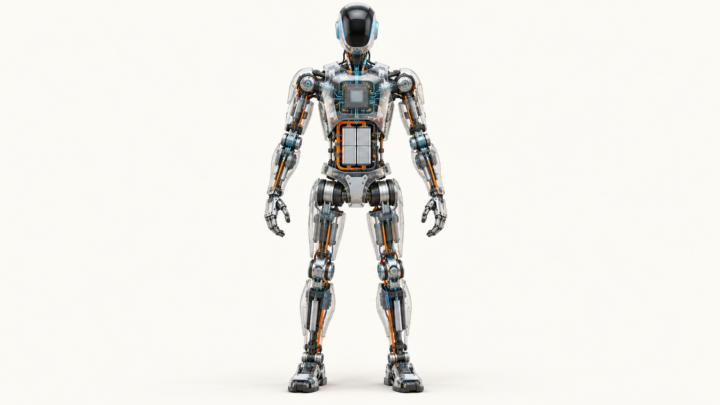
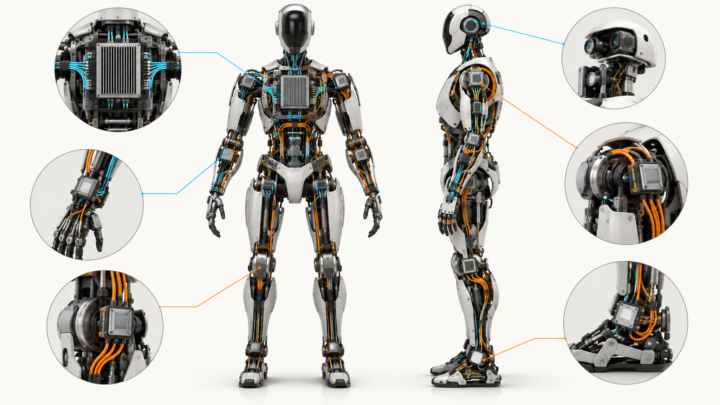
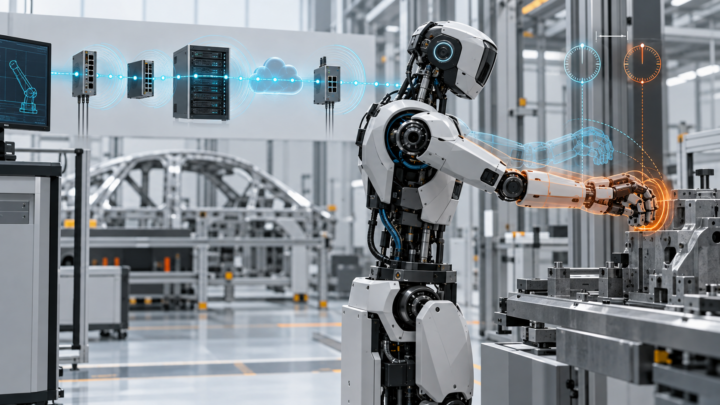
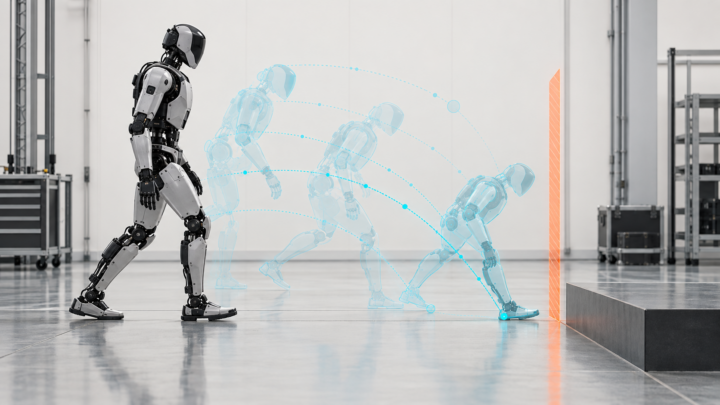
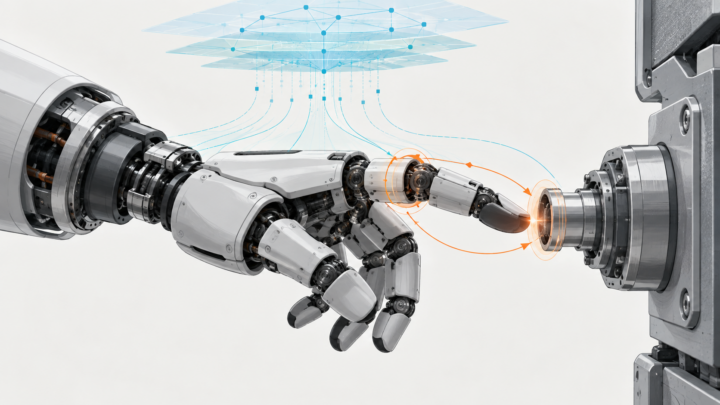
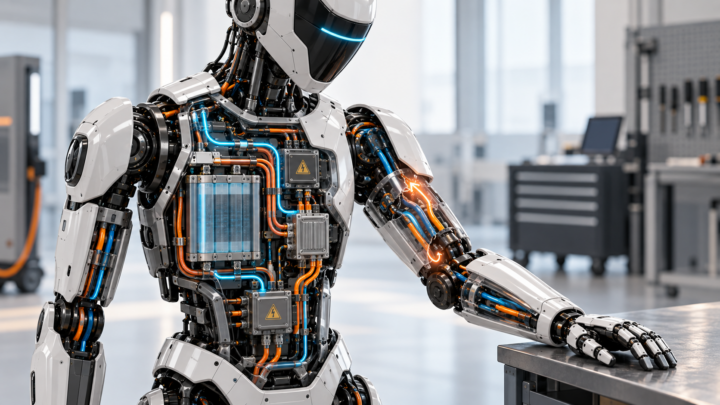
Technical actuator illustration linking motor current, joint torque, external contact and real-time control.
12 min readVersion 1.0
Humanoid robots cannot become dependable physical workers if they know position but not effort. A joint can reach the commanded angle while a gearbox is binding, a hand can reach the planned pose while crushing a fragile object, and a foot can arrive at the planned location while carrying a different ground reaction force than the balance controller expects. Physical intelligence therefore requires the robot to estimate not only where its body is, but how strongly it is interacting with the world.

This chapter argues that trustworthy joint torque and external torque awareness will become a system-defining layer of humanoid actuation. Current 2026 evidence shows several viable routes. 1X describes its new NEO hands as low-ratio, force-controlled and backdrivable, using joint effort and tactile information together [1]. Peer-reviewed research has demonstrated observer-based external-torque estimation in a 222:1 backdrivable actuator without a dedicated torque sensor, while FACTR 2 reports learned torque estimation on commodity robot arms and improved force-aware policy learning [2] [3].

The durable engineering conclusion is not that a single torque-sensing technology will win. Dedicated strain sensing, motor-current estimates, elastic deflection, inertial models, disturbance observers, wrist force-torque sensing and tactile skin each reveal a different part of interaction state. Robust humanoids will combine them selectively and preserve calibration, latency, confidence and diagnostic information. That turns force awareness into a semiconductor architecture spanning current sensing, magnetic position sensing, precision analog front ends, ADCs, real-time microcontrollers, memory, deterministic communication, functional safety and secure lifecycle data.

Position Is Not Effort

Traditional industrial robot control evolved around repeatable motion in structured cells. Position and velocity dominated because the environment was expected to stay out of the machine’s path. Humanoids invert this assumption. Their economic purpose is to grasp, carry, push, pull, insert, lean, recover and collaborate in environments built for people. Contact is no longer an exceptional disturbance. It is the work.

A robot can therefore be kinematically correct and physically wrong. The commanded joint angle can be reached while contact force exceeds the safe or useful range. A manipulation policy can visually align a plug with a socket yet fail because insertion force indicates misalignment. A balance controller can command the right ankle angle while the actual ground reaction differs because of surface compliance. The missing variable is effort.

NIST’s dexterous-grasping program reflects this broader measurement problem by developing metrics and tools for grasping, manipulation, contact safety and force control rather than treating dexterity as pose accuracy alone [4]. In learning systems, force information changes what a policy can infer about task progress. FACTR explicitly emphasizes force during contact-rich learning, while FACTR 2 estimates external torque from internal robot data and reports improved long-horizon policy progress without adding dedicated force hardware [5] [3].

Where Torque Actually Lives

Motor torque, joint torque and external torque are related but not interchangeable. The motor produces electromagnetic torque according to phase current, magnetic flux and the torque constant. Between motor and link sit bearings, gears, tendons, lubrication, structural elasticity, cable forces and brakes. Those elements consume, store or distort torque. External contact then acts on the link and propagates back through this chain.

Current measurement can therefore provide a fast estimate of motor-side effort while still being an imperfect measure of external force. Transmission friction changes with temperature and wear. Tendon routing can introduce configuration-dependent losses. Rotor and gearbox inertia consume torque during acceleration. The robot needs either a model of these effects or a measurement located closer to the link.

The useful architectural concept is torque transparency: how faithfully the actuator exposes link-side interaction through its sensing and mechanics. Backdrivability helps because external loads can propagate toward the motor instead of being absorbed by a high-friction transmission. Yet high ratio does not automatically mean poor force awareness. Borremans and colleagues demonstrated that a 222:1 backdrivable Wolfrom gearbox combined with a higher-order disturbance observer could estimate external torque and support impedance control on their testbed [2]. The result is specific to that actuator, but the engineering lesson is general: mechanics, sensors and estimation must be co-designed.

Five Paths to Force Awareness

Force-awareness signal chain from physical measurements through mixed-signal electronics, estimation, control, and system action.
Figure 1 — Force Awareness Is a Signal Chain. The useful output is a confidence-bearing physical-state estimate, not a single raw sensor value. Credit: DXresearch.eu.

Dedicated joint torque sensing

A dedicated joint torque sensor measures mechanical effort through strain, elastic deflection, magnetoelastic effects, optical deformation or related principles. The advantage is directness: sensing can be placed after the gearbox and thus reduce dependence on a friction model. The cost is mechanical volume, overload protection, stiffness trade-offs, calibration and precision analog electronics.

A strain-based design illustrates the semiconductor burden. The transducer can produce a small differential signal that requires stable excitation, low-noise amplification, high-resolution conversion, temperature compensation and stored calibration. The useful product is therefore not merely the sensor element. It is the full mixed-signal path that turns deformation into a bounded-latency torque estimate.

Motor-current-based estimation

Current-based torque estimation is attractive because phase current is already measured for motor control. Under field-oriented control (FOC), torque-producing current provides a high-bandwidth proxy for electromagnetic effort. Infineon’s current-sensing material emphasizes high-bandwidth compact magnetic measurement, while its humanoid application architecture places sensing and motor control among the core building blocks [6] [7].

The limitation is model dependence. Torque constant varies with temperature and motor state. Friction and transmission efficiency lie between motor and link. Rotor inertia consumes current during acceleration. Current sensing is therefore strongest when combined with position, velocity, temperature and a calibrated mechanical model rather than interpreted as a direct force measurement.

Observer-based estimation

A disturbance observer estimates forces that the commanded input and nominal model cannot explain. A momentum observer uses robot momentum dynamics for a related purpose. These methods reduce hardware count but shift difficulty into modeling, timing and uncertainty management. MOB-Net demonstrates this explicitly for humanoids by learning uncertainty compensation on top of momentum-based external-torque estimation using internal sensors [8].

The production requirement is confidence. An estimate distorted by friction, payload error or sensor bias should not be presented to the controller as equally trustworthy. Residual quality, estimator health and configuration identity should travel with the torque signal.

Wrist force-torque sensing

A six-axis force-torque sensor at the wrist measures endpoint wrench and is useful for insertion, polishing, assembly and hand guiding. It is more direct than motor-current estimation for end-effector contact, but it cannot localize contact on the forearm or torso and can be affected by bias, gravity compensation and mounting changes.

Tactile skin

Tactile sensing answers where contact occurs and how local pressure or shear is distributed. Joint-level effort sensing and skin are therefore complementary. The same joint torque can result from a hand carrying a box or a forearm colliding with a shelf; local contact sensing separates the cases. Chapter 008 treated robot skin as a distributed sensor network. Force-aware actuation is the internal counterpart: it connects surface contact to joint effort and motor electromechanics.

Comparison of five force and torque awareness methods and their semiconductor implications.
Figure 2 — Five Paths to Force and Torque Awareness. Different sensing paths trade directness, bandwidth, calibration, model dependence, packaging and cost. Credit: DXresearch.eu.

Torque Awareness Changes the Control Architecture

A force-aware robot can regulate physical behavior rather than only geometry. In direct torque control, joint effort becomes the commanded variable. In impedance control, the controller shapes the relationship between motion error and force so the robot behaves like a programmable spring-damper system. In admittance control, measured force is converted into commanded motion. These methods allow a humanoid to yield when pushed, maintain contact without crushing, or vary stiffness according to the task.

Force awareness also creates a natural hierarchy of reaction times. Joint-level microcontrollers can execute current limits, torque loops, disturbance checks and rapid derating with deterministic timing. A limb controller can fuse neighboring joint efforts, IMU data and contact state. Central AI can reason about why the contact occurred and what the task should do next. Foundation-model intelligence belongs above the hard protection loop, not inside every millisecond-scale reaction.

1X’s 2026 NEO hand illustrates this architecture at product level. The company describes low-ratio tendon drives, backdrivability, joint force control, proprioception and tactile sensing as one integrated physical-perception system [1]. Those performance claims remain vendor claims rather than independent benchmarks, but the system direction is significant: dexterity increasingly depends on transparent actuation and continuous effort feedback.

The Semiconductor Stack Behind Force-Aware Actuation

Current sensing becomes mechanical-state sensing

In a force-aware joint, the current sensor is not only an inverter-protection device. Its bandwidth, offset, linearity, phase delay and temperature drift influence the quality of the torque estimate. That creates different requirements from a protection-only measurement. A high-speed control path, a safety monitor and a diagnostic estimate may share the same physical current information while applying different filtering and thresholds.

Infineon’s robotics portfolio positions sensing, motor control, safety, connectivity and power as linked robot building blocks [9]. The strategic opportunity is to make current sensing part of a validated actuator signal chain rather than a standalone component choice.

Position sensing closes the transmission model

Motor position is essential for FOC, but force estimation becomes stronger when motor-side and link-side motion can be compared. Differential motion can expose gearbox torsion, backlash, compliance or abnormal friction. Magnetic sensing is attractive because it can fit compact joints without mechanical contact and can tolerate contamination. Timing between current and position measurements is as important as their standalone accuracy because estimator phase error can appear as false disturbance torque.

Precision analog returns to center stage

AI-centric robot discussions often emphasize central compute, but force sensing begins in analog physics. Strain bridges, magnetic sensors and load cells operate near high di/dt inverter switching, motor cables, radios and vibration. Excitation stability, common-mode rejection, anti-alias filtering, ADC performance, reference quality and PCB layout directly affect physical intelligence.

Microcontrollers become local physical-state estimators

The joint MCU executes FOC, current limiting, position and velocity loops, thermal monitoring, communications and diagnostics. Force awareness adds observer computation, friction compensation, plausibility checks and confidence handling. Infineon and NVIDIA’s 2026 robotics architecture emphasizes low latency, distributed motor control, sensing, safety and security, reinforcing the trend toward intelligent local actuator nodes [10].

This is the architectural meaning of the smart actuator: sensing, power electronics, motor control, physical-state estimation, diagnostics, safety and network participation converge into one bounded local subsystem.

Calibration Is a Lifecycle Function

Force awareness is sensitive to mechanical reality. Assembly preload, lubricant state, gear efficiency, bearing drag, cable routing, tendon tension, temperature, payload and structural aging all change the mapping from electrical measurements to physical effort. A joint calibrated correctly at end-of-line can drift after service or extended use.

Calibration drift is therefore not merely a sensor problem. Dedicated torque sensing, current-based estimation and model-based observers all have parameters that can change. Production robots need calibration records tied to physical module identity and software version. Local nonvolatile memory can retain coefficients, thermal compensation, manufacturing data and service history, while secure identity can prevent a replacement actuator from loading the wrong calibration.

Fleet data can then detect whether an estimator residual pattern correlates with gearbox lot, temperature, lubricant, task profile or firmware. Force awareness becomes an operational-health signal as well as a control variable.

Force Awareness Supports Safety, but Does Not Automatically Become a Safety Function

A sophisticated torque estimate can improve collision detection and controlled response, but functional safety requires known failure behavior, diagnostic coverage and verification of the complete protective path. If an estimator depends on a drifting current sensor or stale model, it can become confidently wrong.

ISO 10218-1:2025 defines industrial robot safety requirements and risk-reduction principles [11]. Humanoids operating outside traditional industrial cells will not map perfectly onto all assumptions in that standard, but the underlying engineering principle remains: force-limiting or collision-response claims require validated sensing, bounded reaction and explicit fault handling.

Infineon’s 2026 humanoid motor-control functional-safety application note further indicates that functional safety is becoming an explicit actuator-design concern in humanoids [12]. Redundancy does not necessarily mean duplicating every torque sensor. Sensor fusion can compare independent evidence such as current, link motion, IMU acceleration and tactile contact to detect implausible states. The design goal is credible disagreement detection, not simply more sensors.

The Economics Favor Selective Force Intelligence

Putting a premium six-axis force sensor in every joint would add cost, mass and mechanical complexity. Putting no force intelligence in the body would push too much uncertainty into software. The likely architecture is heterogeneous. High-consequence joints such as ankles, wrists or load-bearing shoulders may justify more direct sensing. Other joints may rely on calibrated current estimation and observers. Hands combine effort sensing with tactile skin.

Body region Force-awareness priority Likely architecture Semiconductor emphasis
Ankle / foot Very high Current + position + direct load/structural sensing + IMU fusion High-bandwidth current, position, AFE/ADC, MCU, timing
Knee / hip High Current + transmission model + optional joint torque sensor Current, angle, local compute, thermal diagnostics, safety
Shoulder / elbow High Current + observer + optional direct joint/wrist sensing Mixed-signal feedback, MCU/DSP, deterministic networking
Wrist Very high for assembly Six-axis F/T + current + tactile fusion Precision AFE, multichannel ADC, MCU, isolation
Hand / fingers Very high Backdrivable actuation + current/effort + tactile skin Compact current sensing, position, edge MCU, distributed interfaces

This selective architecture creates distributed semiconductor value. Force intelligence scales with the number of actuator nodes, adding current sensors, position sensors, precision analog, local controllers, memory and network interfaces around the body rather than concentrating value in one central AI processor.

Force Is Also a Learning Modality

Force data describes the physical consequence of action. Vision can show that a plug is near a socket; force reveals whether insertion aligned, jammed or bottomed out. Position can show that a drawer moved; effort reveals whether friction increased or an obstacle blocked it. This makes torque and contact data valuable for both classical control and robot learning.

FACTR and FACTR 2 provide early evidence of this shift by incorporating force information into contact-rich policy learning [5] [3]. The larger implication is that robot foundation models will increasingly consume proprioceptive effort and contact state alongside images and language.

That creates a new data-governance requirement: calibration provenance. A fleet cannot learn reliably if a nominal torque value represents different physical effort across robot revisions or temperatures. Hardware identity, calibration version, estimator version and confidence become part of machine-learning data quality. Semiconductor metadata therefore enters the learning pipeline.

Evidence Boundaries

Verified facts. Peer-reviewed and government sources establish approaches for external-torque estimation, force-aware robotic measurement and industrial-robot safety. The Frontiers Wolfrom-actuator study provides experimental evidence for observer-based torque estimation on its specific testbed; NIST maintains active dexterous-grasping and contact-performance measurement programs [2] [4].

Company claims. 1X and Infineon describe current architectures and technologies for force control, current sensing, humanoid motor control, safety and distributed robotics. These sources establish product direction and portfolio intent, not independent validation of every performance statement [1] [7].

Preprint evidence. FACTR, FACTR 2 and MOB-Net are relevant research results but should not be treated as independently replicated industrial performance benchmarks [3] [8].

Editorial interpretation. The chapter’s central thesis—that force and torque awareness will become a system-defining semiconductor layer in humanoids—is an engineering synthesis. The winning mix of direct sensors, electrical proxies and observers will vary by joint, task, cost, safety case and transmission.

Conclusion: Physical Intelligence Requires Effort Awareness

A humanoid that knows where its joints are but not how hard they are working remains partly blind to its own body. Physical work is defined by forces: gravity, payload, friction, grip, impact, support and human contact. Those forces cannot be managed reliably by position control and vision alone.

The practical architecture will be heterogeneous. Some joints justify direct torque sensing. Others infer effort from current, motion and models. Wrist sensors and tactile skin add endpoint and local contact evidence. The decisive capability is the ability to combine those sources with known latency, calibration, confidence and fault behavior.

That makes force awareness a semiconductor architecture. Current sensors observe electromagnetic effort. Position sensors close the mechanical model. Precision analog interfaces digitize strain and load. Microcontrollers estimate disturbances and execute compliant control. Memory preserves calibration. Safety mechanisms check plausibility. Networks distribute physical state. The robot that understands its own effort can manipulate more delicately, detect abnormal loads earlier, interact more safely and generate better physical-learning data. Before a humanoid can become broadly intelligent in the physical world, it must know its own strength.

Glossary

Admittance control

Control strategy converting measured external force into commanded motion according to a virtual dynamic model.

Backdrivability

Ability of an external load at the robot link to drive motion backward through the transmission toward the motor.

Calibration drift

Change in the mapping from sensor output or current to physical torque because of temperature, aging, stress, wear, or assembly variation.

Disturbance observer

Estimator that infers unmodeled or external forces from measured motion, commanded actuation, and a dynamic model.

External torque

Joint-space torque caused by environment, payload, human contact, collision, or another external interaction rather than commanded internal actuation.

Field-oriented control

Vector motor-control method regulating current components to produce controlled torque and flux in AC machines.

Force-torque sensor

Sensor measuring force and torque components, often along three translational and three rotational axes at a wrist or joint.

Functional safety

Part of overall safety that depends on systems correctly detecting faults and responding to hazardous conditions.

Impedance control

Control strategy shaping the dynamic relationship between robot motion and interaction force to produce programmed compliant behavior.

Joint torque

Rotational effort transmitted at a robot joint, generally expressed in newton-meters and produced by the actuator through its transmission.

Momentum observer

Model-based estimator using robot momentum dynamics to infer external generalized forces or torques without dedicated force sensors.

Sensor fusion

Combination of current, position, inertial, strain, force, tactile, and other measurements to estimate interaction state more robustly.

Smart actuator

Actuation subsystem combining power electronics, motor control, sensing, processing, communications and diagnostics to deliver controlled physical motion.

Torque constant

Motor parameter relating electromagnetic torque to current under defined conditions; uncertainty in it affects current-based torque estimation.

Torque transparency

Degree to which actuator-side measurements and control faithfully reflect link-side forces despite friction, inertia, elasticity, and transmission losses.

References

  1. AN1107-FuSa in a Nutshell: Humanoid and motor control aspects. Infineon introduces functional-safety challenges specific to humanoid motor control and outlines an approach for safer actuator electronics and control architectures development. Source
  2. Dexterous grasping. NIST develops metrics, test methods, and measurement tools for robotic grasping, manipulation, force control, contact safety, repeatability, and human-like dexterity. Source
  3. FACTR 2: Learning External Force Sensing for Commodity Robot Arms Improves Policy Learning. FACTR 2 learns external joint torque from free-motion data and reports better contact-rich policy learning without additional dedicated force sensing hardware. Source
  4. FACTR: Force-Attending Curriculum Training for Contact-Rich Policy Learning. FACTR explicitly integrates force information into contact-rich manipulation learning and reports improved generalization compared with policies trained without equivalent force emphasis. Source
  5. Humanoid robots application presentation. Infineon maps motor control, compute, zone control, battery management, charging, and sensing building blocks across contemporary humanoid robot system architectures. Source
  6. Infineon accelerates deployment of robots with improved sensing and control. Infineon and NVIDIA describe a common humanoid architecture emphasizing low latency, distributed motor control, sensing, functional safety, security, and embedded processing. Source
  7. ISO 10218-1:2025 — Robotics — Safety requirements — Part 1: Industrial robots. ISO 10218-1:2025 defines industrial robot safety requirements, inherently safe design principles, risk reduction measures, and information requirements before system integration. Source
  8. MOB-Net: Limb-modularized Uncertainty Torque Learning of Humanoids for Sensorless External Torque Estimation. MOB-Net combines momentum observation and learned uncertainty compensation to estimate humanoid external torque from internal sensors for collision handling and control. Source
  9. NEO’s Hands | An API to the Physical World. 1X describes backdrivable force-controlled tendon hands combining proprioception, tactile shear sensing, low gear ratios, embedded electronics, and reflexive physical interaction capabilities. Source
  10. Robotics. Infineon presents current, position, motor-control, power, sensing, safety, security, and connectivity semiconductor technologies as building blocks for modern robotic systems. Source
  11. Sense the current, control the power: Why coreless magnetic sensing is reshaping modern power design. Infineon reviews coreless magnetic current sensing for accurate high-bandwidth isolated power measurements, highlighting compact implementations relevant to torque-aware motor control systems. Source
  12. Torque-sensorless control of a high-ratio, backdrivable Wolfrom-gearbox for safe human-centered robotics. Peer-reviewed experiments demonstrate observer-based external torque estimation and impedance control in a high-ratio backdrivable actuator without dedicated torque sensing hardware. Source