Chapter 11
The Robot Must Feel Its Own Body

1. The Machine Inside the Machine
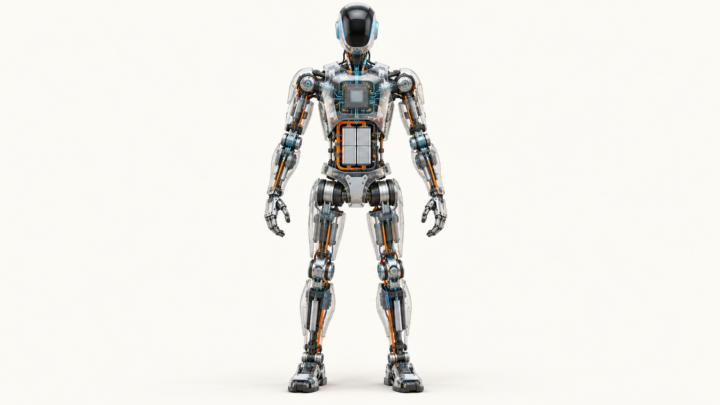
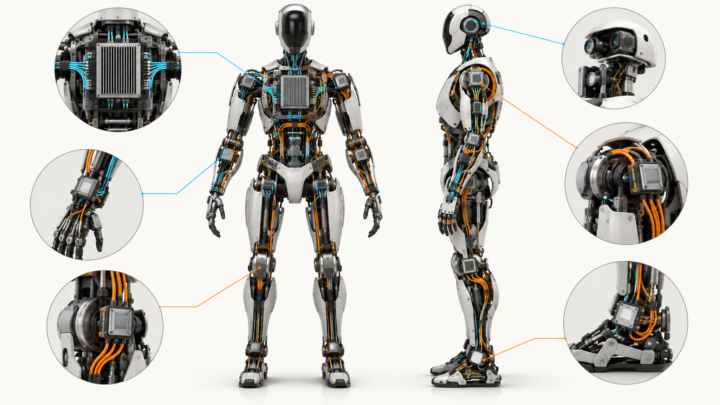
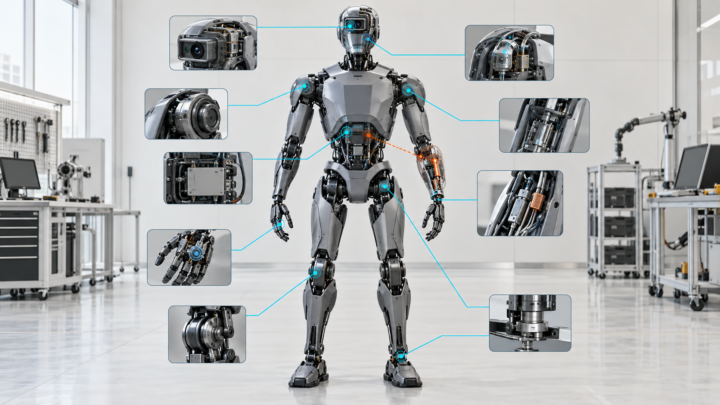
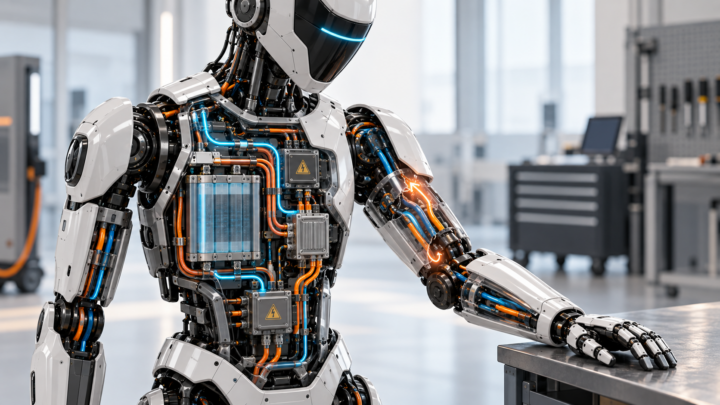
A humanoid may carry cameras, depth sensors, radar, microphones and tactile surfaces, yet none of these external channels answers the most immediate control question: what is my own body doing right now? In robotics, proprioception describes measurements and estimates of internal state. Joint angles and velocities, body acceleration and angular rate, contact state, actuator current, force, torque, temperature and power all contribute to an internal model of the moving machine [1].
For a humanoid, this internal model is not optional metadata. It closes the loop between commanded motion and physical motion. Balance control requires body orientation and velocity. Manipulation requires joint configuration and contact awareness. Collision response depends on detecting unexpected motion or load. Learning systems need reliable labels for what the body actually executed. Diagnostics need evidence that separates a software command error from a slipping foot, drifting sensor or damaged transmission.
The core thesis of this chapter is therefore simple: proprioception is a distributed electronic architecture, not a collection of sensors. The architecture must measure, time-align, validate, fuse and communicate internal physical state with bounded latency and known confidence. That makes semiconductor choices central to the robot’s ability to trust itself.

2. What Proprioception Must Estimate
2.1 Joint configuration is necessary but insufficient
Joint encoders provide the kinematic skeleton of the robot: where each controlled axis is relative to a reference. Absolute sensing is particularly valuable after power cycles because it can restore mechanical configuration without requiring uncertain search motions. Magnetic angle sensors are attractive where compact packaging, contamination robustness and high-speed operation matter; Infineon explicitly positions magnetoresistive angle sensing for robotics and motor-control applications [7].
However, encoder readings are not identical to true link pose. Gear compliance, backlash, structural flex, cable stretch, bearing play and assembly tolerances can separate motor-side angle from output-side motion. Complex multi-axis joints make that mapping harder. This is why advanced actuators increasingly combine multiple measurements instead of treating one encoder as ground truth.
2.2 The floating base changes everything
A fixed industrial arm can define its base as immovable. A humanoid cannot. Its pelvis and torso translate and rotate continuously, and during walking there may be no permanently fixed link. An Inertial Measurement Unit (IMU) therefore becomes a foundational proprioceptive source, measuring angular rate and linear acceleration. But inertial integration drifts, impacts create vibration, and low-cost sensors have bias and temperature sensitivity. State estimation must therefore combine inertial data with kinematics and contact constraints.
Recent work illustrates the direction. DogLegs fuses a body IMU, joint encoders and additional leg-mounted IMUs, using foot-contact constraints to improve body-state estimates across terrain [2]. Earlier multi-IMU odometry work similarly showed that extra leg IMUs can reduce drift and improve contact detection without relying entirely on external vision [3]. A 2025 learning-assisted approach further demonstrated that proprioceptive measurements alone can support competitive state estimation when fused with filtering and learned measurement models [4].
2.3 Contact is a measurement
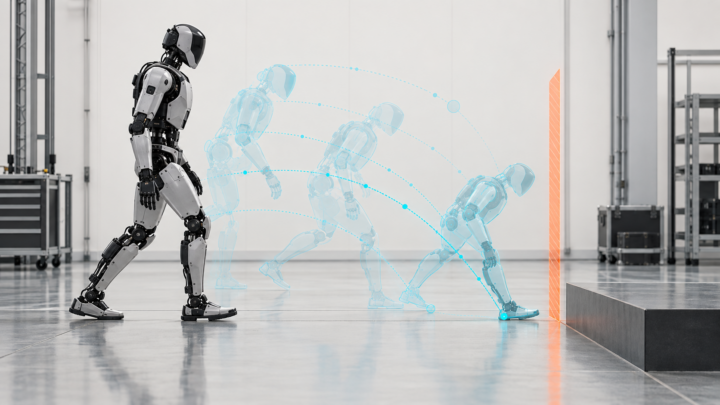
For legged robots, contact changes the observability of motion. A foot believed to be stationary provides a temporary reference; a slipping foot invalidates that assumption. Contact can be inferred from force sensors, foot pressure, actuator torque, kinematics, inertial signatures or combinations of these. Contact-aided estimation uses such constraints to reduce drift and improve state estimates.
Humanoid research already uses this combination. The RH5 platform, for example, integrates IMU, joint encoders, foot contact sensors and force-torque sensors for proprioceptive state estimation [6]. The Kinetics Observer goes further by tightly coupling encoders, IMU and force-torque sensing to estimate both robot kinematics and contact or perturbation forces [5].

3. From Sensors to a Trustworthy Body State
3.1 Sampling must be coherent
Sensor fusion assumes measurements describe a compatible instant in time. A joint angle sampled before an impact, an IMU sample during the impact and a contact bit sampled afterward can describe three physically different states. High-rate motion therefore turns timestamp quality, sampling latency and communication jitter into estimation errors. This chapter does not duplicate the book’s dedicated timing and synchronization topics; instead, it treats coherent acquisition as a requirement imposed by proprioception.
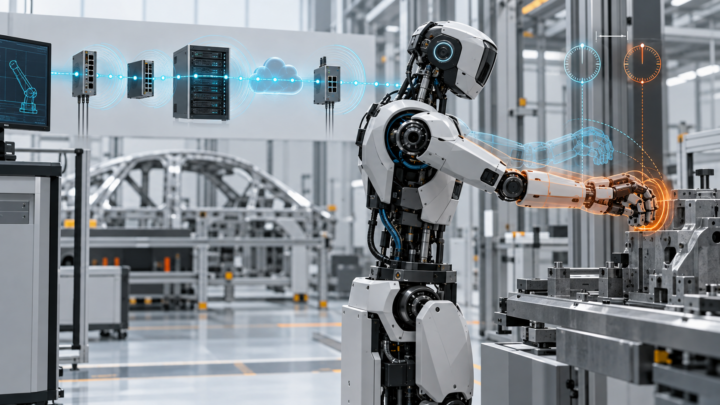
The practical implication is architectural. Sensing nodes should timestamp close to acquisition, preserve ordering, expose data age, and make latency observable. Local microcontrollers can preprocess raw measurements, perform sanity checks and maintain deterministic interfaces before data enters a higher-level estimator.
3.2 Redundancy should create confidence, not just duplication
Sensor redundancy is valuable only when disagreement is detectable. Two channels that fail from the same cause provide little protection. Better architectures combine diverse physical principles, locations and models: motor-side and joint-side position, body and leg IMUs, current-derived torque and dedicated force sensing, contact estimates and tactile evidence.
The estimator should propagate uncertainty rather than outputting a single number without qualification. Confidence can then influence control authority, safety margins and degraded-operation modes. A robot that detects its own uncertainty can slow down, widen support, reduce manipulation force or request recalibration instead of continuing with false precision.
3.3 Calibration becomes a lifecycle function
Proprioceptive accuracy changes over time. Magnet placement, mechanical alignment, gear wear, thermal expansion, sensor offsets and structural damage all alter the relationship between electrical measurements and physical state. Calibration data therefore belongs in the robot’s lifecycle architecture. It must be versioned, protected, associated with hardware identity and updated through controlled service procedures.
This creates a bridge to the book’s chapters on uptime, identity and cybersecurity without duplicating them. Proprioception contributes the evidence those lifecycle systems need: drift signatures, residual errors, sensor disagreement, impact history and changes in actuator behavior.
4. The Semiconductor Architecture
The semiconductor value chain behind proprioception spans more than the sensing element. A robust implementation contains several layers:
| Layer | Function | Semiconductor relevance | Design question |
|---|---|---|---|
| Sensing | Joint angle, body motion, load, current, temperature | Magnetic position sensors, IMUs, current sensors, analog front ends | Which physical quantities need direct measurement and which can be estimated? |
| Acquisition | Sample, condition, digitize and timestamp | ADCs, sensor interfaces, clocks, local MCU peripherals | Can measurement age and ordering be bounded? |
| Local intelligence | Calibration, filtering, plausibility and diagnostics | Real-time MCUs, local memory, hardware safety mechanisms | What should be validated before data leaves the joint? |
| Communication | Move state data through the body | CAN/Ethernet interfaces, transceivers, integrity mechanisms | How is deterministic delivery maintained under load and faults? |
| System estimation | Fuse measurements into body state and uncertainty | Real-time compute, memory and safety partitioning | How does confidence affect control and degraded operation? |

4.1 Position sensing moves toward the actuator
Angle sensing is already a direct semiconductor opportunity. Infineon’s magnetic angle portfolio includes Hall and magnetoresistive technologies and explicitly targets robotics, industrial automation and motor control [7]. Its 48 V dual-motor robotics reference design uses the TLI5012B magnetic angle sensor to provide position and speed feedback to a PSOC Control C3 field-oriented control loop [8]. This illustrates the broader trend toward tight integration of sensing and local control in the joint electronics.
Newer portfolio additions also show continued development in magnetic angle and current sensing for motor-control and robotics contexts [9]. The strategic point is not a specific device recommendation but the convergence of sensing, control and diagnostics at the actuator node.
4.2 IMUs become distributed, not singular
Traditional architectures place one central IMU in the torso. Multi-IMU research suggests a different direction: low-cost inertial sensors distributed across limbs can improve contact inference, detect slip, characterize link motion and add fault redundancy [2] [3]. If this pattern migrates into commercial humanoids, IMU content may scale with the number of critical links rather than remain one device per robot.
That creates new requirements for power, calibration, synchronization, communication bandwidth and diagnostic coverage. It also shifts value toward architectures that can manage a population of modest sensors as one coherent measurement system.
4.3 The estimator is a real-time safety dependency
Body-state estimation feeds balance and whole-body control; errors can therefore become physical hazards. The estimator must execute with predictable latency, detect stale or inconsistent inputs and expose validity. Hardware support for deterministic execution, memory protection, watchdogs and diagnostic monitoring becomes part of the proprioception chain even when the mathematical estimator itself is software.
5. Architecture Rules for Humanoid Designers
Five design rules follow from the evidence.
- Measure the state that matters at the location where errors originate. Motor-side sensing alone may not reveal output-link compliance or backlash.
- Treat time as measurement metadata. A precise sample with unknown age is not a precise state input.
- Design for disagreement. Redundant channels need diagnostics, diversity and explicit residual checks.
- Propagate confidence into behavior. Estimation uncertainty should change control limits and degraded-operation strategy.
- Make calibration traceable. Proprioceptive parameters should be tied to hardware identity, software version and service history.
6. Strategic Implications
Humanoid competition is often framed around AI models, compute performance or actuator torque density. Proprioception reveals a quieter differentiator: the quality of the robot’s internal truth. Better body-state awareness supports faster control without sacrificing stability, safer interaction without excessive conservatism, more informative learning data, and diagnostics that can distinguish sensor drift from mechanical degradation.
For semiconductor suppliers, this shifts the opportunity from selling isolated sensors toward enabling trusted measurement chains. Magnetic angle sensors, IMUs, current sensing, analog interfaces, real-time microcontrollers, deterministic communications, memory and safety mechanisms can be architected as a reusable body-state platform. The commercial advantage comes from reducing integration effort while improving observability and lifecycle evidence.
This is especially relevant as humanoids move from demonstrations toward fleets. A fleet cannot be calibrated by intuition. It needs comparable internal measurements, stable diagnostics and consistent confidence metrics across hundreds or thousands of machines.
7. Conclusion
A humanoid robot does not merely need to perceive the world. It must continuously perceive itself. Proprioception converts distributed electrical measurements into a coherent estimate of body configuration, motion, contact and load. Research on multi-IMU and contact-aided estimation shows why redundancy and fusion matter when external perception becomes unreliable. Product and reference-design evidence shows how position sensing and local motor control already converge at the actuator node.
The resulting architecture is semiconductor intensive: sensors measure the physical state; acquisition circuits preserve fidelity; microcontrollers calibrate and validate; networks transport time-aware data; real-time compute fuses it; diagnostics establish confidence. When these layers work together, the robot gains something more fundamental than another sensor modality: a trustworthy sense of its own body. For Physical AI, that internal truth is the foundation on which balance, dexterity, safety, learning and maintainability are built.
Glossary
- Body-state estimation
Continuous estimation of robot posture, velocity, orientation, contact state and related internal variables from multiple measurements.
- Contact-aided estimation
State estimation that uses known or inferred robot-environment contact constraints to reduce drift and improve observability.
- Physical AI
Artificial intelligence embodied in physical systems that perceive, decide, and act in the real world.
- Proprioception
Sensing and estimation of a robot’s own internal mechanical and dynamic state, including joint, body, contact and load information.
- Sensor redundancy
Use of overlapping measurements or modalities to detect faults, improve confidence and maintain usable state information under degradation.
References
- Angle sensors. Describes magnetic angle sensing technologies and robotics use for precise rotor position, motor control, torque and efficiency. Source
- DogLegs: Robust Proprioceptive State Estimation for Legged Robots Using Multiple Leg-Mounted IMUs. Fuses body and leg IMUs with joint encoders and contact constraints, improving proprioceptive state estimation across varied terrain. Source
- Experimental Investigations into Using Motion Capture State Feedback for Real-Time Control of a Humanoid Robot. Documents humanoid RH5 proprioceptive instrumentation including IMU, joint encoders, foot contacts and force-torque sensors for state estimation. Source
- Infineon extends XENSIV magnetic sensing portfolio. Details newer magnetic sensing devices including angle and current sensors relevant to motor control and robotics demonstrations. Source
- Learning-Assisted Multi-IMU Proprioceptive State Estimation for Quadruped Robots. Demonstrates proprioception-only state estimation using multi-IMU sensing, joint encoders, Kalman filtering and learned measurement assistance. Source
- Multi-IMU Proprioceptive Odometry for Legged Robots. Shows additional leg IMUs can reduce drift and improve contact inference with modest added hardware and computation. Source
- REF_48V_2X1KW_ASFOC dual-motor drive for robotics applications. Reference design uses a magnetic angle sensor and microcontroller for position and speed feedback within robotic field-oriented motor control. Source
- Sensors and Sensing — Proprioceptive Sensors. Defines proprioceptive sensing around joint, inertial, force, current, temperature and power measurements used to estimate a robot’s internal state. Source
- The Kinetics Observer: A Tightly Coupled Estimator for Legged Robots. Combines encoders, IMU and force-torque sensing in a tightly coupled estimator for kinematics, contacts and perturbation forces. Source