
Humanoid robots will not transform work simply because they can lift, carry, inspect, assemble, or operate for long hours. Their deeper impact will come from their physical presence beside people. Unlike software that changes a workflow invisibly, a humanoid robot is encountered in the same aisle, at the same workstation, during the same shift. It changes not only productivity, but also how workers understand competence, contribution, and professional identity.
Homo roboticus is therefore not a biological prediction. It is a sociological question: how can humans retain agency, dignity, and belonging while working with systems that may outperform them in narrowly defined physical and cognitive tasks?
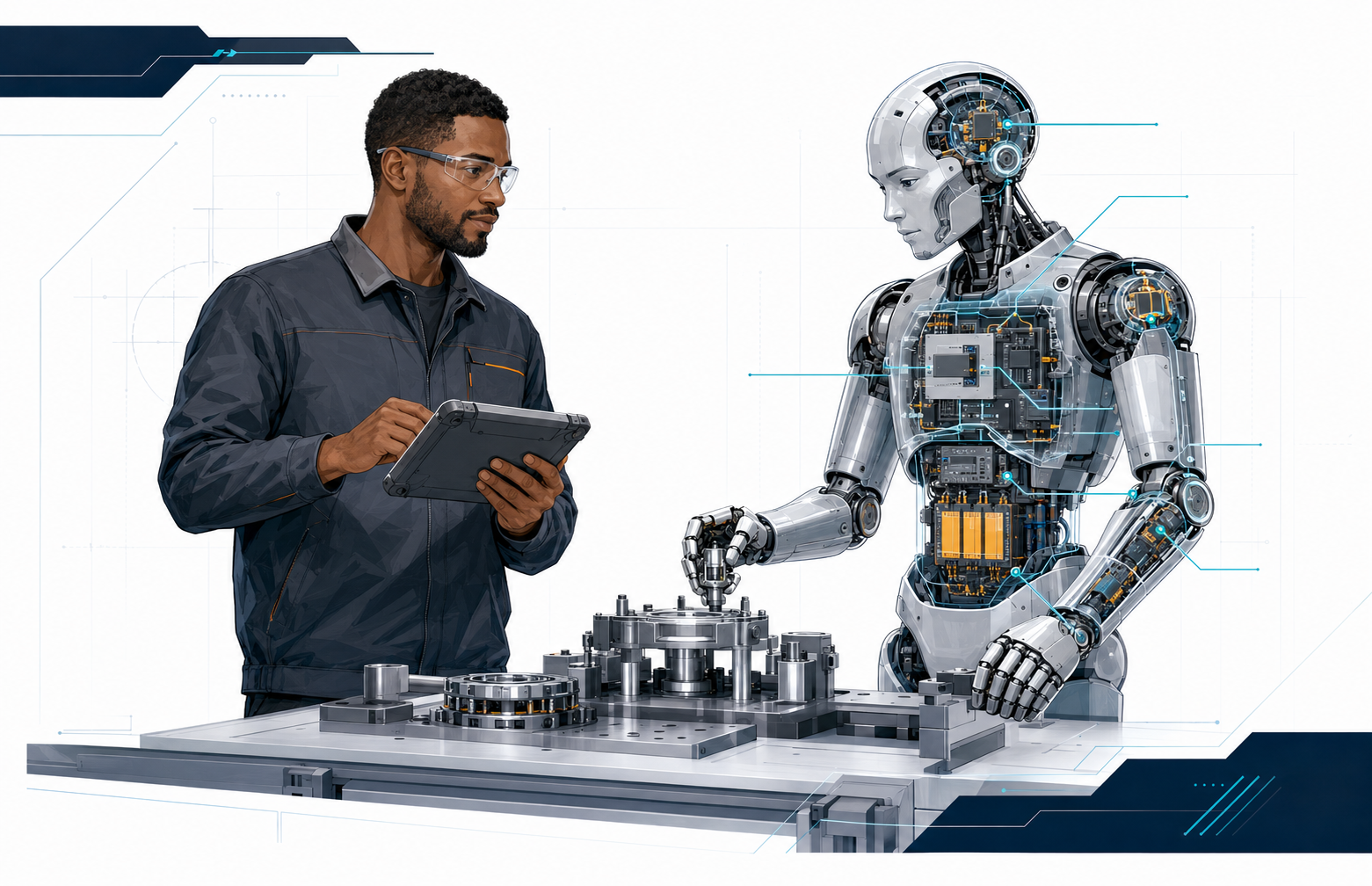
[Visual 01 – The Human, the Humanoid, and the Workstation]
The Moment Automation Becomes Personal
For most of industrial history, automation was visible but distant. A production line changed the rhythm of work; a machine tool changed the skill profile of a workshop; enterprise software changed the flow of information. Yet the worker could still see a clear boundary between the human realm and the automated realm.
Humanoid robotics reduces that boundary. A mobile, articulated machine can share the physical space of the worker. It can pick components from the same bin, move through the same warehouse, operate the same tools, and work through the same night shift. It may be faster, more repeatable, and more tireless in selected tasks. Crucially, it is not merely installed next to the work. It appears to participate in it.
This distinction matters. A worker does not experience an abstract productivity programme. They experience a specific machine performing a task that may previously have been a source of expertise, pride, or security. The resulting question is immediate: if the robot can do this, what remains uniquely mine?
Research on industrial robots already demonstrates why simple narratives are inadequate. Robot adoption can affect local employment and wages, particularly where automation substitutes for existing tasks. At the same time, automation can create new tasks, new occupations, and new demand when it strengthens industrial competitiveness. The outcome depends not only on the technology, but on how work is redesigned around it (Reference 01 – Robots and Jobs: Evidence from US Labor Markets).
The Risk Is Not the Robot. It Is Deskilling by Design.
The central danger is not that machines become more capable. Societies have repeatedly absorbed more capable machines. The danger is designing work so that the human becomes a peripheral supervisor of a process they no longer understand, cannot influence, and are held responsible for only when it fails.
That is the difference between augmentation and displacement. In an augmented workplace, the robot takes over exposure, repetition, heavy lifting, or unsafe conditions. The worker gains authority over exception handling, process quality, maintenance, learning, and improvement. In a displacement-oriented workplace, the robot captures the meaningful decisions while the worker is left with monitoring, resets, and performance pressure.
Evidence on human–robot interaction reinforces this distinction. Direct interaction with robots can be associated with higher work intensity, surveillance, reduced autonomy, and a weaker social environment. Yet case studies point to organisational and management choices—not the robot itself—as the decisive source of these effects (Reference 02 – Human–Robot Interaction: What Changes in the Workplace?).
A humanoid robot should therefore not be specified only through payload, speed, battery runtime, degrees of freedom, or AI capability. Its deployment also requires a social specification: Which decisions remain with the human? Which skills must expand? Who can stop, retrain, correct, or challenge the system? How is performance measured without turning people into the slowest component in a machine-defined process?
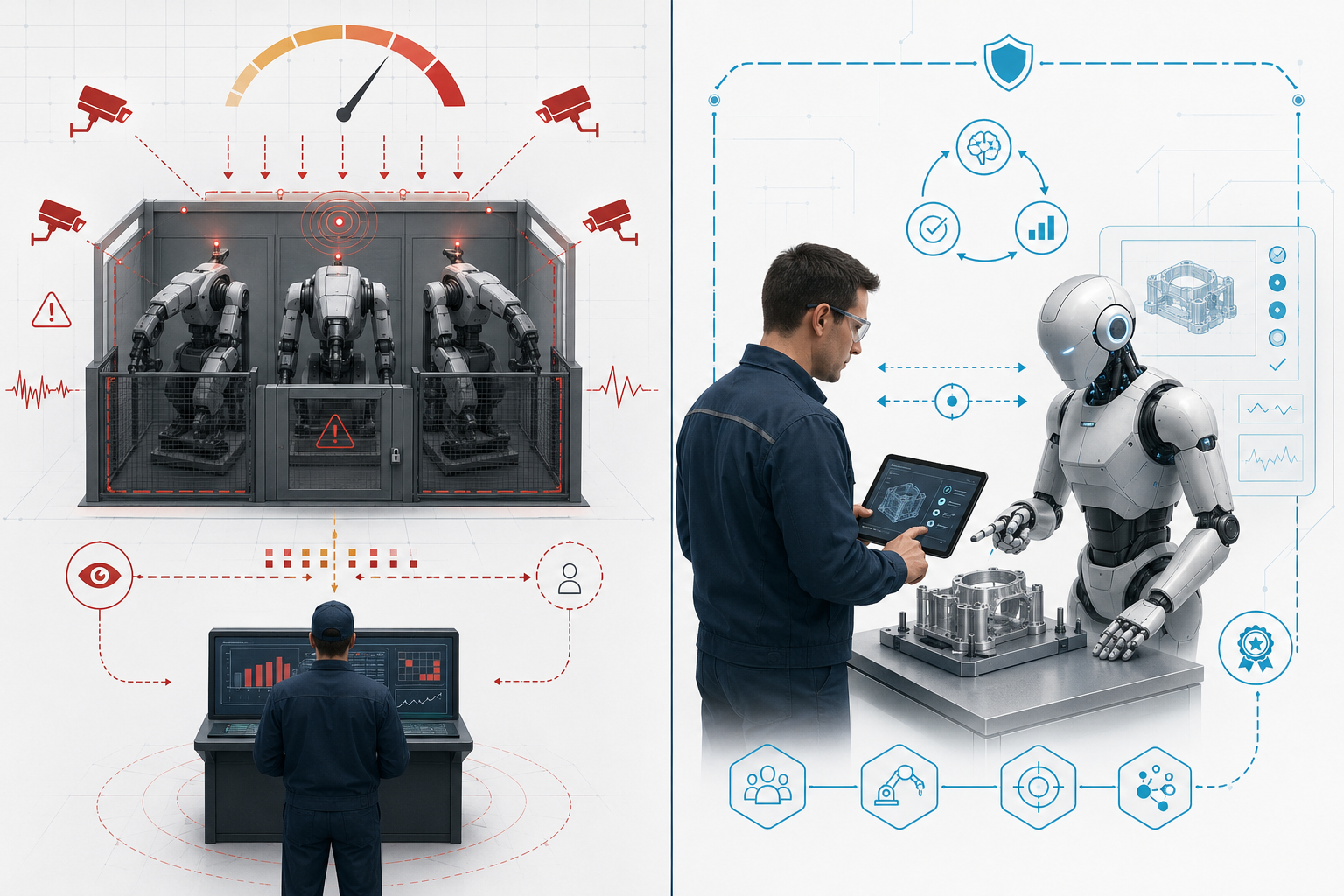
[Visual 02 – Two Futures of Human–Robot Collaboration]
The New Skilled Worker Is Not a Reduced Worker
There is a tempting but mistaken assumption that highly automated work requires less skill. In reality, it often requires different and broader skill. A production specialist working alongside a humanoid robot may need to interpret system states, recognise abnormal behaviour, validate an AI-supported action, recover a process safely, and feed practical experience back into the robot’s task model.
This is not a downgrade from craftsmanship. It is craftsmanship extended into a cyber-physical environment.
The human remains indispensable not because machines are incapable, but because industrial reality is full of variation. A part is damaged. A supplier changes packaging. A fixture drifts. A safety zone is temporarily obstructed. A customer request changes the sequence. The robot must either handle these situations safely or hand them over transparently. In both cases, human situational judgement becomes more—not less—valuable.
For semiconductor companies, this point has a practical consequence. The electronics inside a humanoid robot should support intelligible collaboration. Functional safety controllers, motor-control architectures, secure connectivity, sensor fusion, and diagnostic interfaces determine whether a worker encounters an understandable machine or an opaque one. Safety is not only the ability to stop motion. It is also the ability to explain state, detect uncertainty, preserve human authority, and enable a safe return to work.
| Design question | Poor human outcome | Better human outcome |
| Robot task allocation | Worker loses ownership of core tasks | Worker moves to quality, exceptions, improvement |
| System diagnostics | Black-box failures and waiting time | Clear fault context and guided recovery |
| Performance metrics | Human measured against robot speed | Team measured on quality, uptime, safety and learning |
| Training | One-off robot instruction | Continuing technical qualification and role progression |
| Safety design | Human treated as an obstacle | Human treated as an authorised collaborator |
Germany’s Underestimated Advantage
The next decade will bring an understandable focus on AI regulation, machinery safety, cybersecurity, and liability. All are essential. But the equally important challenge is the transition of people who work alongside these systems.
Germany possesses institutional tools that many technology narratives overlook: dual vocational education, certified skilled trades, works councils, collective bargaining, and co-determination. These are not obstacles to speed. Used intelligently, they are mechanisms for making change credible at the level where it is actually felt: the workplace.
The Bundesinstitut für Berufsbildung identifies AI and digital transformation as drivers of new requirements for trainees, skilled workers, and training personnel. The implication is clear: qualification cannot be an afterthought once a system is installed. It must be part of the system design and deployment plan from the beginning (Reference 03 – Artificial Intelligence in Vocational Education and Training).
Social dialogue serves a similar function. It brings operational knowledge into the design process early enough to improve the outcome. Workers often see the practical exceptions, safety risks, maintenance burdens, and training needs before they are visible in a business case. The International Labour Organization accordingly highlights social dialogue as a way to adapt AI to national, sectoral, and workplace realities rather than treating implementation as a universal software rollout (Reference 04 – Generative AI and Jobs: A 2025 Update).
This is especially relevant for humanoids. Their promise is flexibility: one platform, many tasks, changing environments. But flexibility without participation can become permanent uncertainty for workers. The role of social partnership is to convert that uncertainty into a negotiated pathway of learning, authority, and fair transition.
A Semiconductor Perspective: Designing for Agency
A robot’s semiconductor architecture influences the kind of workplace it creates. Reliable sensing can make motion predictable. Real-time control can keep actions smooth and safe around people. Secure identity and update mechanisms can ensure that only validated software changes behaviour. Distributed intelligence can reduce latency and preserve safe operation even when cloud services are unavailable.
These are engineering decisions, but they become social decisions at deployment.
The most valuable humanoid robot will not be the one that appears most human. It will be the one that makes human competence more effective. It will reduce fatigue without reducing status; automate routine without removing learning; and improve throughput without converting skilled people into passive attendants.
That is why homo roboticus should not be understood as a future in which humans become machine-like. It is a future in which work must become more deliberately human. The question is not whether the worker can compete with the robot on speed or endurance. In those narrow measures, the comparison is already misguided.
The real measure is whether the system gives people more capacity to exercise judgement, maintain quality, protect one another, and shape the work they perform. Germany’s industrial institutions can help answer that question—provided they are treated not as remnants of an earlier era, but as part of the operating system for Physical AI.
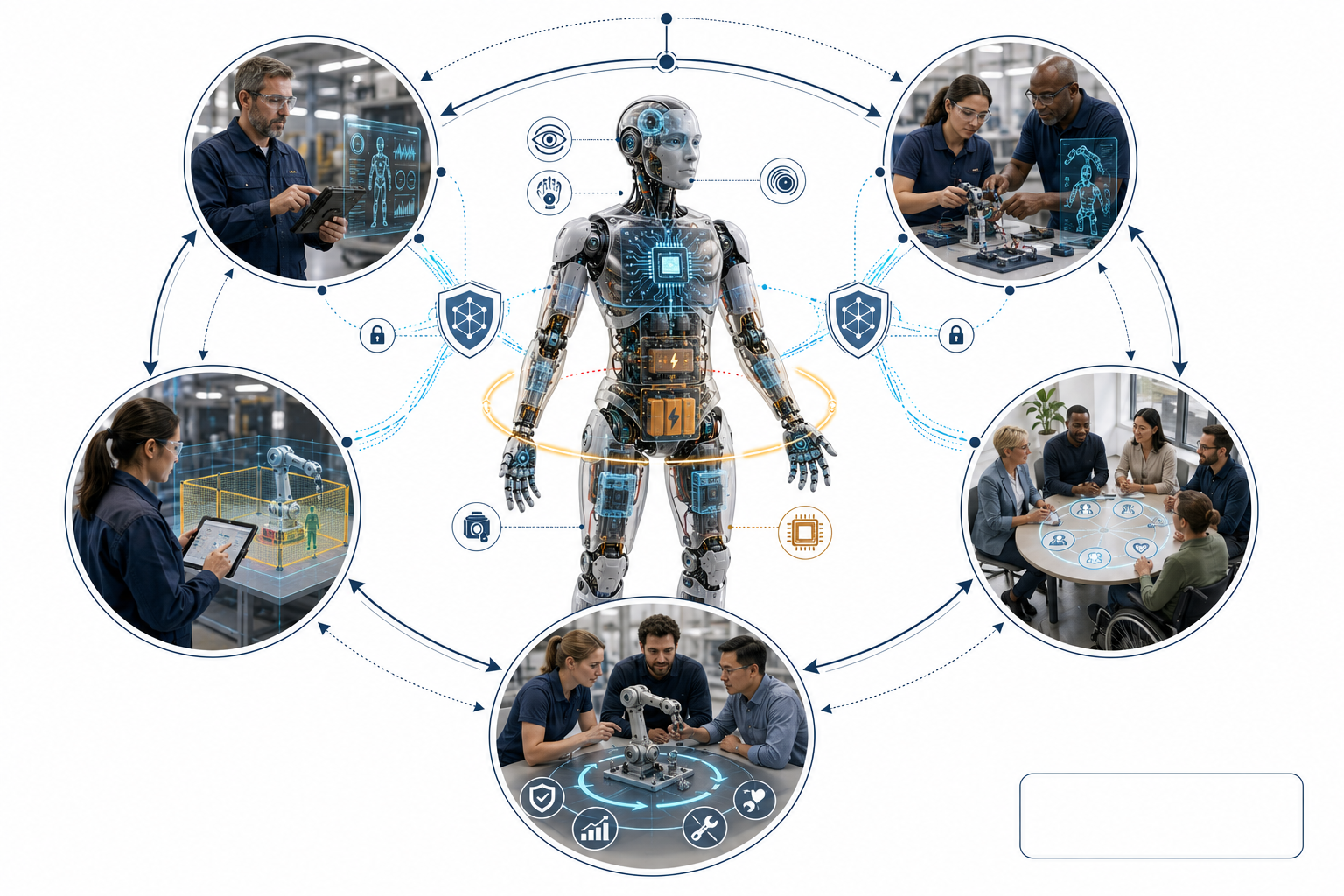
[Visual 03 – Social Architecture for Physical AI]
Verified Facts, Interpretation, and Assumption
Verified facts. Industrial robot adoption can produce uneven labour-market effects; human–robot interaction can raise psychosocial risks when work is poorly organised; vocational education and social dialogue are recognised mechanisms for shaping technological change.
Author interpretation. The physical presence of humanoid robots will make the question of professional identity more immediate than earlier forms of software-led automation.
Future assumption. By the 2030s, successful humanoid deployments in Europe will increasingly be assessed not only by task economics and uptime, but also by their measurable contribution to safer, more skilled, and more attractive work.
Glossary
Agency: A person’s practical ability to understand, influence, and act within their work environment.
Augmentation: Technology that expands a worker’s effectiveness rather than merely replacing their task.
Co-determination: Formal participation of employees and their representatives in workplace and corporate decision-making.
Deskilling: Reduction of meaningful knowledge, judgement, or autonomy in a job through work design.
Human–robot interaction (HRI): The technical and organisational relationship between people and robotic systems.
Physical AI: AI embodied in machines that sense, decide, and act in the physical world.
References
Reference 01 – Robots and Jobs: Evidence from US Labor Markets. 2020. Daron Acemoglu and Pascual Restrepo. Empirical analysis showing that industrial robots can reduce local employment and wages, while highlighting task displacement mechanisms. https://www.journals.uchicago.edu/doi/10.1086/705716
Reference 02 – Human–Robot Interaction: What Changes in the Workplace?. 2024. Eurofound. Examines workplace effects of human–robot interaction and identifies organisational design as central to worker outcomes. https://www.eurofound.europa.eu/en/publications/all/human-robot-interaction-what-changes-workplace
Reference 03 – Artificial Intelligence in Vocational Education and Training. 2025. Bundesinstitut für Berufsbildung. Describes how AI changes competence requirements for apprentices, skilled workers, and vocational training personnel. https://www.bibb.de/de/207534.php
Reference 04 – Generative AI and Jobs: A 2025 Update. 20 May 2025. International Labour Organization. Updates occupational exposure analysis and calls for proactive, inclusive strategies shaped through social dialogue. https://www.ilo.org/publications/generative-ai-and-jobs-2025-update
Reference 05 – Künstliche Intelligenz in der Arbeitswelt. 2026. Bundesanstalt für Arbeitsschutz und Arbeitsmedizin. Collects evidence on AI-enabled work design, occupational safety, and health-related opportunities and risks. https://www.baua.de/DE/Themen/Arbeitsgestaltung/Digitalisierung-KI/Kuenstliche-Intelligenz/_functions/BereichsPublikationssuche_Formular?pageNo=0


Leave a Reply