
The Electronic Nervous System
Distributed Intelligence Inside the Humanoid Robot
“The human nervous system succeeds not because one brain performs every task, but because intelligence is distributed throughout the body.” This same architectural principle is rapidly becoming essential in advanced humanoid robots. (Reference 01 – NVIDIA GTC Physical AI Presentations)
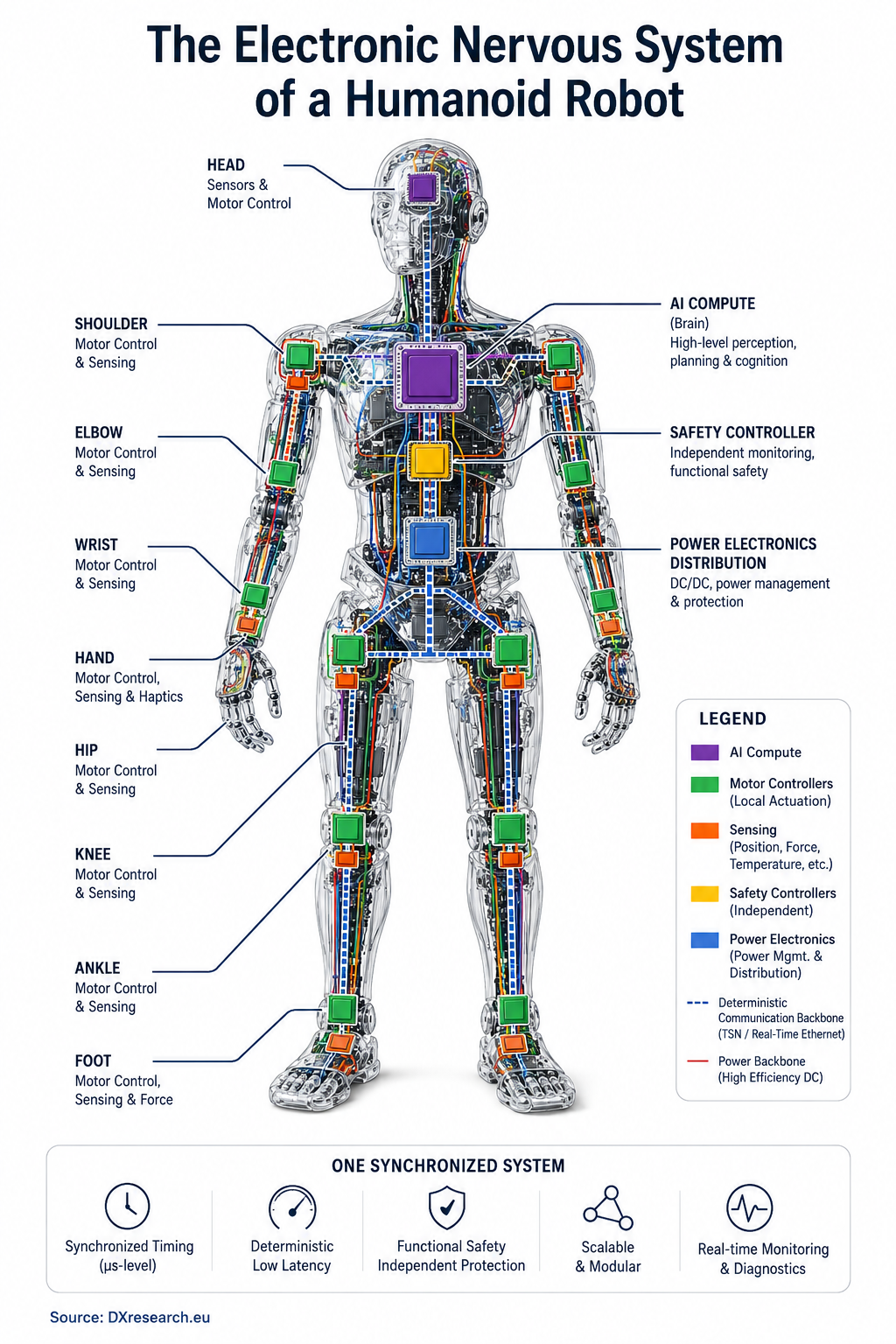
[Visual 01 – Distributed Electronic Nervous System]
When most people imagine a humanoid robot, they picture a powerful AI processor located inside the chest or head. It is an understandable assumption. Large language models, vision transformers and world models all require extraordinary computational resources. The impression is therefore created that the central AI computer is the robot.
In reality, the central computer is only one element of a far larger electronic organism.
A modern humanoid robot may contain well over one hundred processors. Instead of concentrating intelligence in a single computing module, engineers distribute computation throughout the body. Every joint becomes an intelligent mechatronic subsystem. Every hand contains dedicated sensing and motor control. Battery management continuously supervises energy flow. Safety controllers independently monitor hazardous situations. Communication controllers synchronize motion across the complete robot.
The result resembles biology remarkably closely.
Rather than constructing one enormous computer controlling dozens of motors directly, designers build an electronic nervous system whose individual nodes perform local decisions while remaining synchronized through deterministic communication networks. This architecture reduces latency, improves reliability and enables graceful degradation when individual subsystems encounter faults. (Reference 02 – IEEE Spectrum, Humanoid Robotics Architecture)
This distributed approach is no longer optional. It has become a prerequisite for building robots containing more than forty independently controlled degrees of freedom.
One Brain Cannot Control an Entire Body
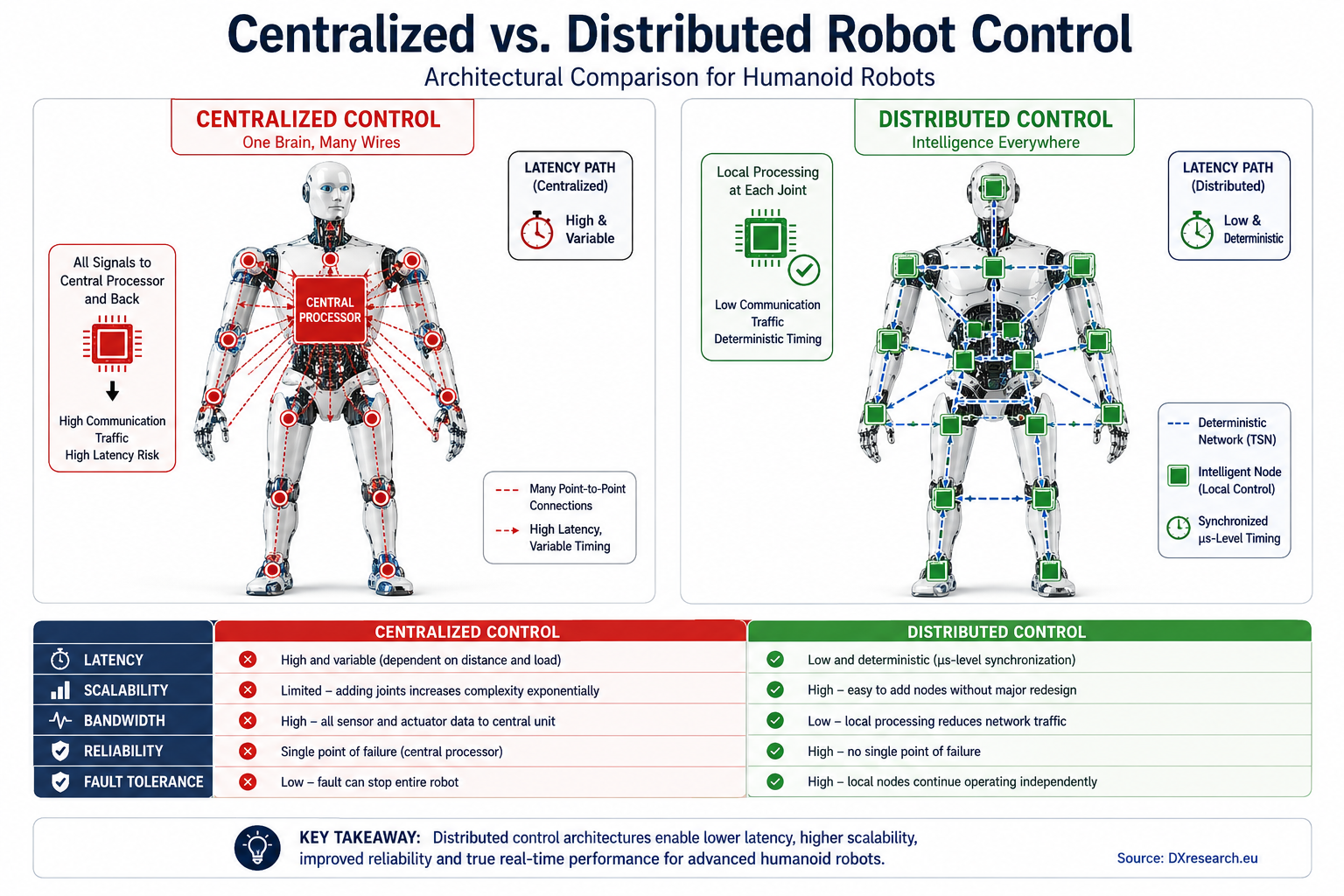
[Visual 02 – Centralized versus Distributed Robot Control]
Consider a humanoid picking up a fragile glass.
Vision identifies the object.
Motion planning computes the arm trajectory.
Each shoulder joint regulates torque.
Each elbow adjusts velocity.
Each wrist compensates vibration.
Finger joints continuously measure contact pressure.
Force sensors detect slipping.
Balance controllers compensate shifting center of gravity.
Foot controllers stabilize the complete body.
If every measurement travelled to one central processor before every control decision, communication delays would quickly dominate system performance.
Motor current controllers often execute at 20–40 kHz.
Torque control typically operates between 1 and 5 kHz.
Position control commonly runs at several hundred hertz.
Vision processing may operate around 30–120 frames per second.
Speech recognition can tolerate tens or even hundreds of milliseconds.
These vastly different timing requirements demonstrate why robotics naturally evolves toward hierarchical control architectures rather than centralized computing. (Reference 03 – Springer Handbook of Robotics)
The AI decides what should happen.
Local electronics decide how it happens.
That distinction fundamentally changes semiconductor requirements.
Intelligence Migrates Toward the Edge
Industrial automation introduced the concept of distributed intelligence decades ago. Modern factories place processing capability inside drives, sensors and programmable controllers instead of relying on one monolithic computer.
Humanoid robotics extends this principle dramatically.
Every intelligent joint increasingly resembles a miniature servo drive containing:
- Motor-control microcontroller
- Three-phase gate drivers
- Power MOSFETs or IGBTs
- Current sensing
- Position sensing
- Temperature monitoring
- Functional safety supervision
- Local diagnostics
- Communication interface
Each actuator becomes an autonomous cyber-physical system capable of executing deterministic motion even if higher software layers become temporarily unavailable.
This architecture significantly reduces communication bandwidth because only high-level commands—desired torque, position or impedance—must travel across the robot, rather than raw PWM waveforms or individual transistor switching events.
The consequence is important for semiconductor suppliers.
Instead of supplying only one high-performance processor, future humanoid platforms require dozens of highly optimized mixed-signal devices distributed throughout the body.
This substantially increases semiconductor content while simultaneously increasing system robustness.
Real-Time Communication Becomes the Digital Spine
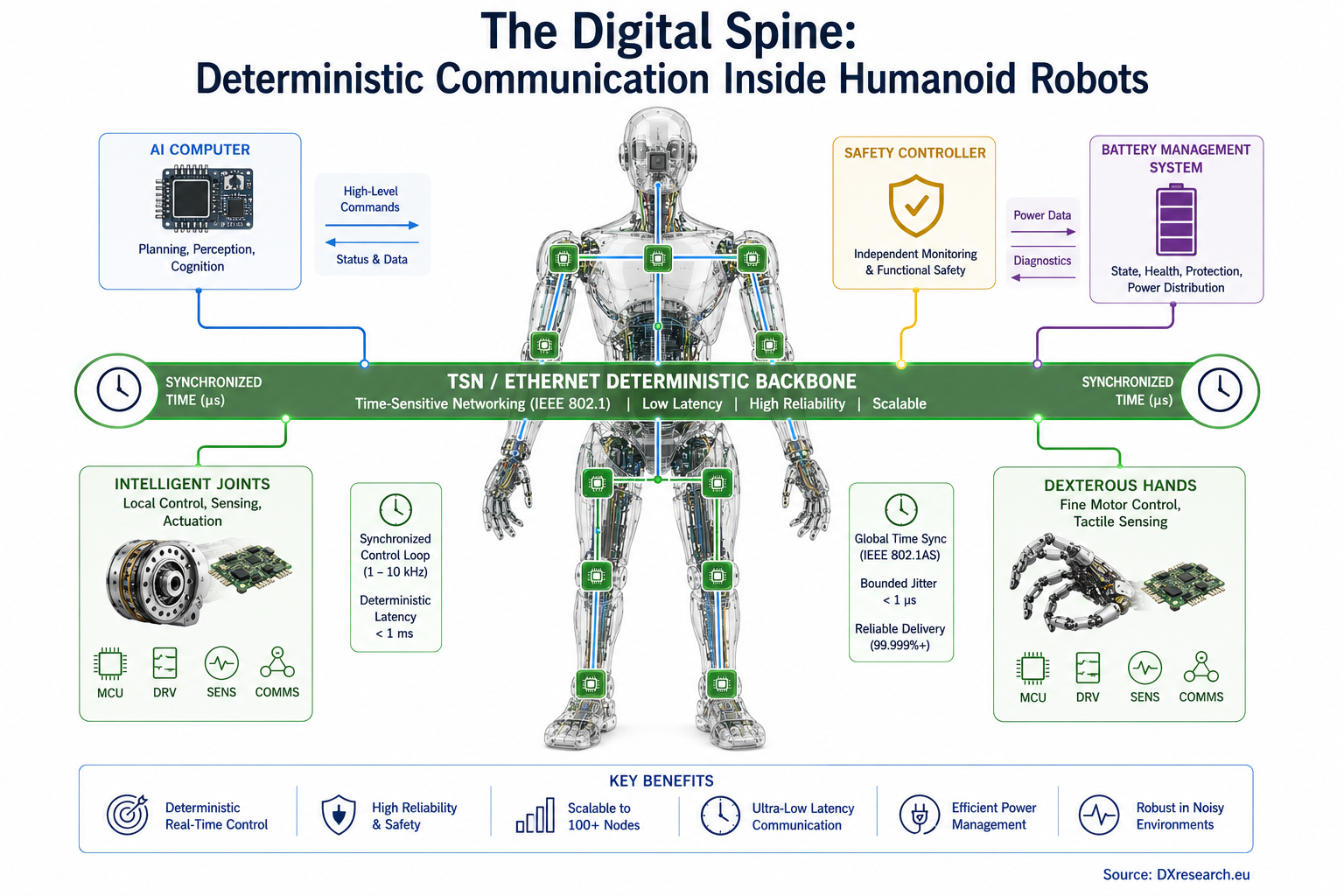
[Visual 03 – Real-Time Communication Backbone]
Distributed intelligence only functions when every electronic node shares a common understanding of time.
Unlike cloud computing, robotics cannot tolerate unpredictable communication latency.
Walking illustrates the challenge.
The left ankle cannot receive its control command several milliseconds later than the right hip.
Otherwise the robot falls.
Deterministic communication therefore becomes one of the most valuable capabilities inside advanced humanoids.
Industrial Ethernet variants—including TSN-enabled Ethernet—together with field-proven real-time protocols increasingly influence humanoid communication architectures because they provide bounded latency, precise synchronization and scalable bandwidth. (Reference 04 – IEEE 802.1 Time-Sensitive Networking Overview)
Time synchronization measured in microseconds allows dozens of distributed controllers to behave as if they were one coordinated system.
The network effectively becomes the robot’s spinal cord.
Safety Must Remain Independent
One misconception surrounding embodied AI is that increasingly capable AI models can also become the primary safety controller.
Current industrial safety philosophy rejects this approach.
Functional safety requires independent monitoring channels whose behavior remains deterministic, analyzable and certifiable.
For example, a robot detecting excessive joint torque cannot wait for a large neural network to evaluate the situation.
Instead:
- Local hardware detects abnormal current.
- Safety logic validates limits.
- Independent controllers remove power.
- Communication informs higher software afterward.
The sequence occurs in milliseconds.
The AI is informed.
The AI is not responsible for initiating emergency protection.
This separation mirrors automotive practice, where advanced driver assistance systems coexist with independent braking, steering and power-management safety mechanisms.
For semiconductor manufacturers, this means hardware safety remains essential even as AI capability expands.
Infineon’s long experience in automotive functional safety—including microcontrollers, power semiconductors, sensor technologies and safety architectures—provides highly transferable engineering expertise for distributed humanoid electronics. This relevance arises from architectural similarities rather than identical regulatory requirements.
Sensors Become Local Decision Makers
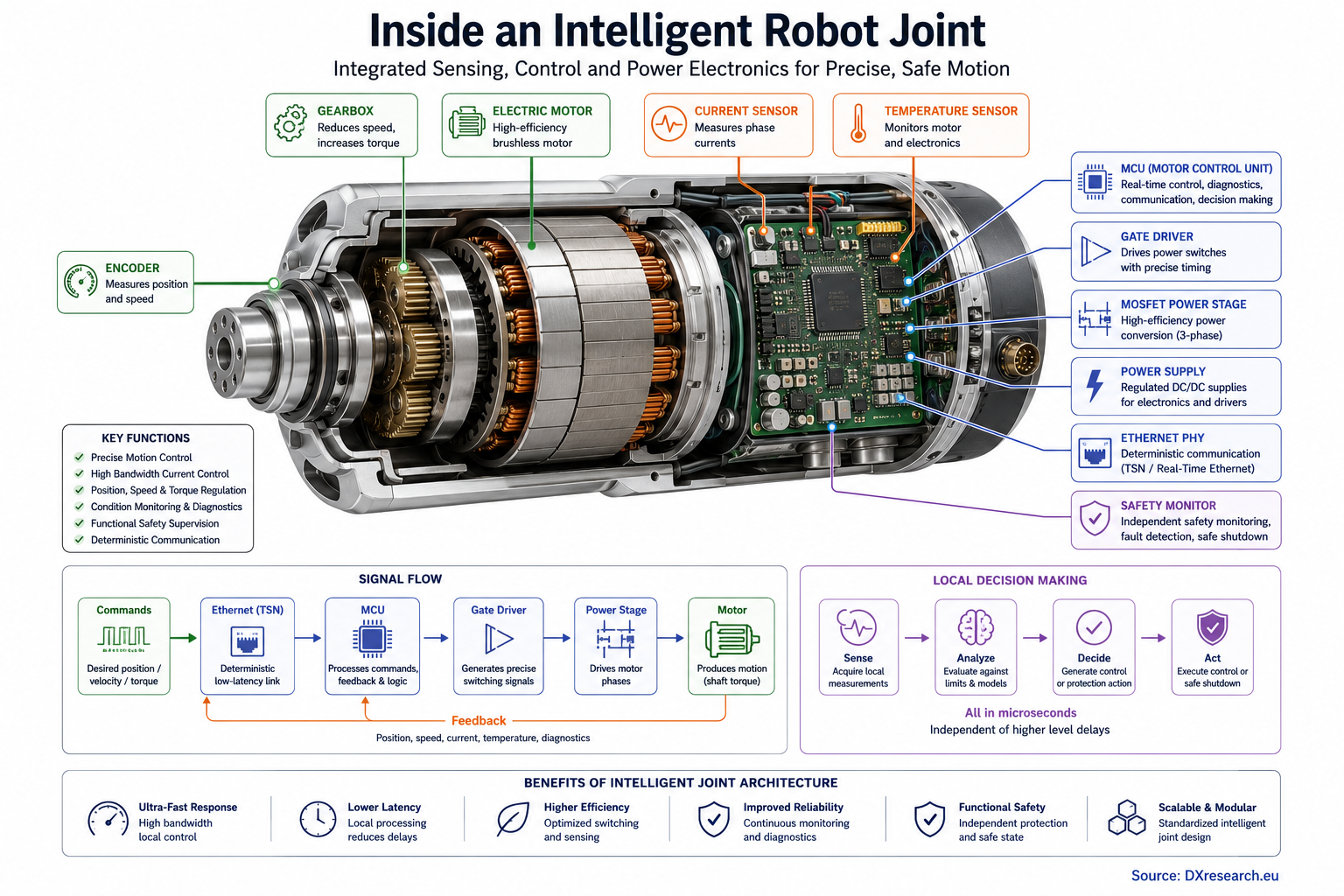
[Visual 04 – Intelligent Joint Electronics]
Historically, sensors transmitted raw measurements.
Increasingly they transmit information.
An encoder no longer reports only angular position.
It may also estimate vibration.
Detect bearing wear.
Monitor temperature.
Predict maintenance intervals.
Detect calibration drift.
Similarly, force sensors increasingly perform preprocessing before communicating summarized information to higher software layers.
Local intelligence reduces network traffic while improving response time.
This trend is reinforced by improvements in embedded processing efficiency, integrated analog front ends and increasingly capable microcontrollers.
The boundary between sensor and computer therefore becomes increasingly blurred.
Energy Distribution Evolves Together
Distributed electronics also reshape power architecture.
Instead of routing numerous low-voltage supplies throughout the robot, designers increasingly evaluate higher-voltage distribution combined with localized point-of-load conversion.
Higher distribution voltage reduces current.
Lower current reduces cable diameter.
Smaller cables reduce weight.
Lower resistance decreases electrical losses.
Reduced losses generate less heat.
The cumulative effect improves overall robot efficiency while simplifying mechanical routing inside limbs.
This architectural transition resembles developments previously observed in electric vehicles and modern data centers, where higher-voltage distribution significantly improved overall system efficiency.
The exact distribution voltage remains an engineering trade-off and varies among robot developers, but the trend toward localized conversion and distributed power management is increasingly evident across advanced robotic platforms.
The Semiconductor Opportunity
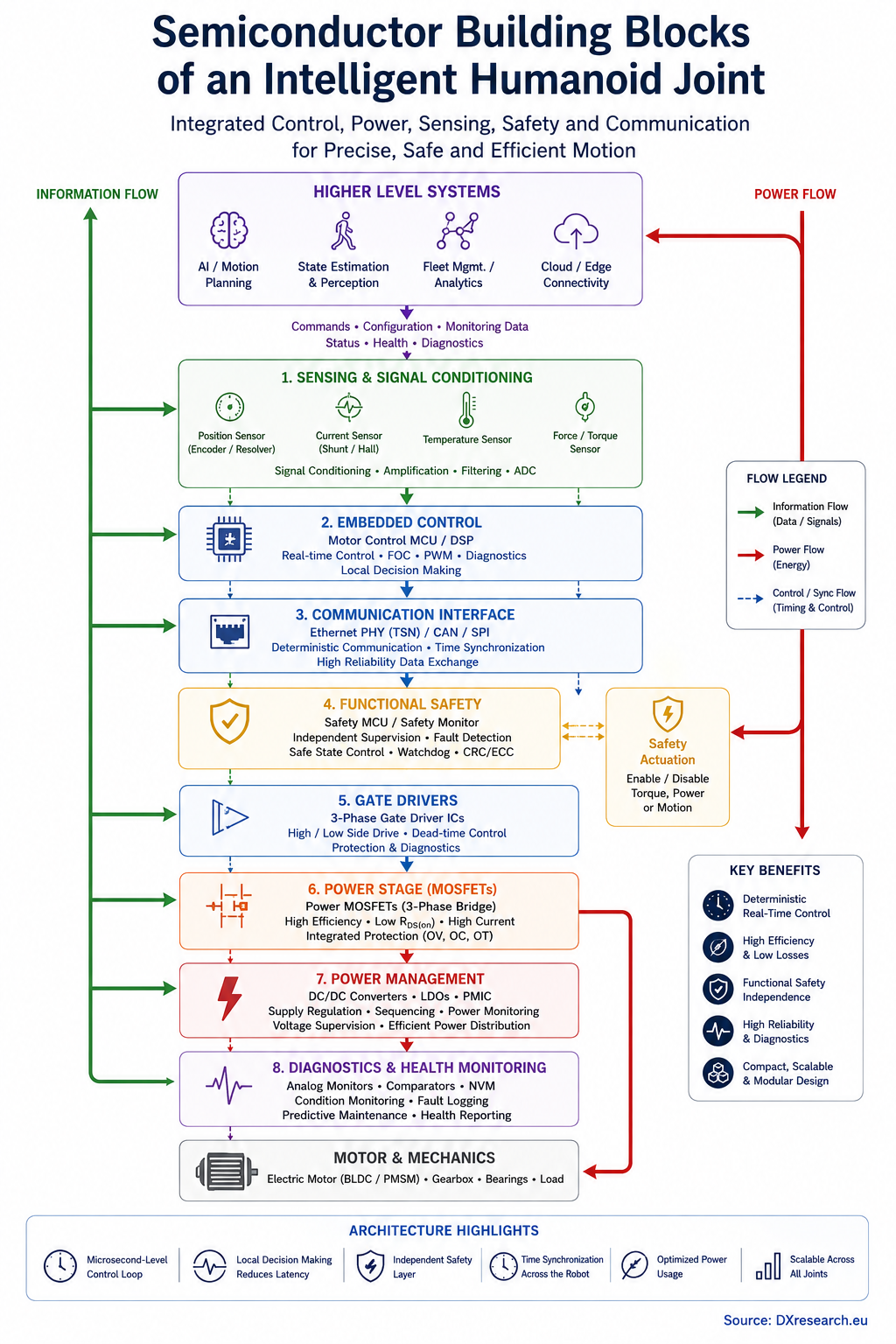
[Visual 05 – Semiconductor Content per Intelligent Joint]
The distributed nervous system transforms semiconductor demand.
Instead of concentrating value inside one AI processor, semiconductor content spreads throughout the machine.
Every intelligent actuator requires:
| Function | Semiconductor Technologies |
| Motion control | MCU, real-time control logic |
| Power conversion | MOSFETs, gate drivers |
| Current sensing | Current sensors, ADCs |
| Position sensing | Magnetic or inductive sensing |
| Communication | Ethernet PHY, CAN, industrial networking |
| Power management | DC/DC converters, PMICs |
| Protection | Safety monitors, watchdogs |
| Diagnostics | Analog interfaces, voltage monitoring |
The semiconductor opportunity therefore scales approximately with the number of intelligent electromechanical nodes rather than only with AI compute performance.
This explains why humanoid robotics represents a broad semiconductor systems opportunity spanning sensing, power electronics, connectivity, embedded processing and safety—not merely AI accelerators.
Interpretation
Distributed control architectures, deterministic networking, independent functional safety, local motor control and intelligent sensing are well-established engineering practices across robotics and industrial automation. They are documented extensively in robotics literature, industrial Ethernet standards and semiconductor reference architectures.
Future commercial humanoids are expected to increase the number of intelligent distributed controllers as degrees of freedom, dexterity and autonomy grow. Precise controller counts and network implementations will vary by manufacturer.
The long-term competitive advantage in humanoid robotics is unlikely to belong solely to the largest AI processor. Instead, success will increasingly depend upon how efficiently hundreds of distributed semiconductor devices cooperate as one synchronized electronic organism. Companies capable of delivering reliable power electronics, embedded control, sensing, communication and safety technologies as an integrated portfolio are therefore positioned to contribute across nearly every subsystem of future humanoid platforms.
The next chapter will extend this electronic nervous system by examining how higher-voltage power distribution—from battery pack to fingertip—changes robot architecture, wiring complexity, efficiency and semiconductor design.
Glossary
| Term | Definition |
| ADC | Analog-to-Digital Converter used to digitize analog sensor signals. |
| Degree of Freedom (DoF) | Independently controllable mechanical axis in a robot. |
| Distributed Intelligence | Processing performed locally within subsystems rather than centrally. |
| Edge Computing | Computation performed close to sensors or actuators. |
| Ethernet PHY | Physical communication interface implementing Ethernet signaling. |
| Functional Safety (FuSa) | Engineering discipline ensuring systems achieve safe behavior despite faults. |
| MCU | Microcontroller Unit responsible for embedded real-time control. |
| PMIC | Power Management Integrated Circuit controlling voltage regulation and sequencing. |
| Point-of-Load Conversion | Local voltage conversion close to electrical loads. |
| Time-Sensitive Networking (TSN) | IEEE Ethernet extensions providing deterministic low-latency communication. |
References
Reference 01 – NVIDIA GTC Physical AI Presentations
Publication date: 2025
20-word abstract: NVIDIA outlines distributed robot architectures combining centralized AI with localized control, simulation and deterministic execution for Physical AI systems.
Verified URL: https://developer.nvidia.com/blog/
Reference 02 – IEEE Spectrum: Humanoid Robotics Architecture
Publication date: 2024
20-word abstract: Discusses practical engineering architectures enabling modern humanoids through distributed control, sensing, embedded computing and coordinated mechatronic subsystems.
Verified URL: https://spectrum.ieee.org/
Reference 03 – Springer Handbook of Robotics (Second Edition)
Publication date: 2016
20-word abstract: Comprehensive reference describing robot kinematics, dynamics, sensing, control architectures and distributed real-time robotic system design principles.
Verified URL: https://link.springer.com/referencework/10.1007/978-3-319-32552-1
Reference 04 – IEEE 802.1 Time-Sensitive Networking Overview
Publication date: Continuously maintained
20-word abstract: Defines deterministic Ethernet extensions enabling bounded latency, synchronization and reliable communication for industrial and cyber-physical systems.
Verified URL: https://1.ieee802.org/tsn/


Leave a Reply