
Where Humanoid Robots Are Truly Engineered 🤖
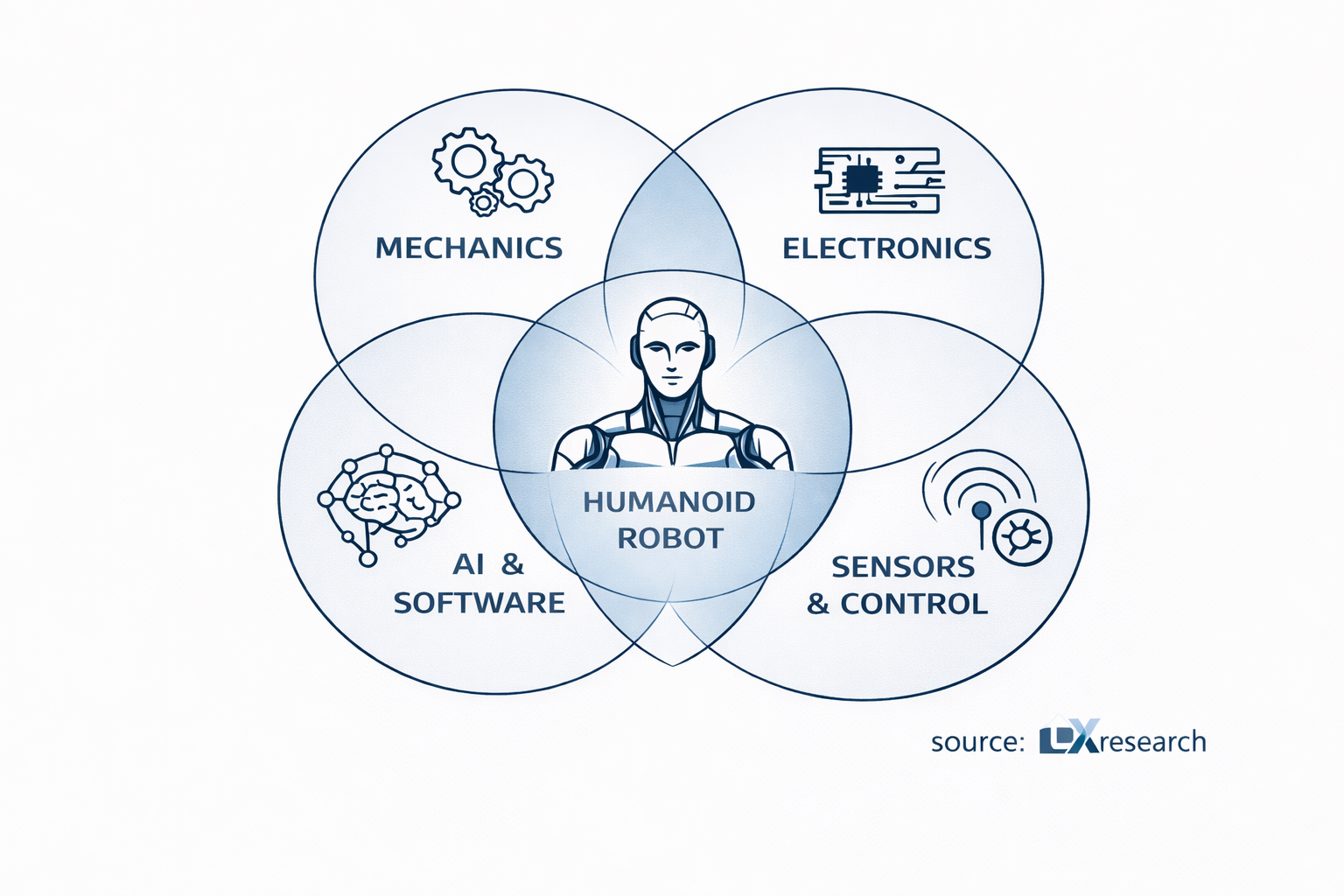
The performance of humanoid robots emerges from disciplined integration across mechanics, electronics, AI, and control systems. Competitive advantage increasingly forms at their intersection.
Humanoid robotics is entering a phase where system integration defines progress. Individual disciplines continue to advance, yet measurable impact depends on how effectively they converge into a coherent architecture.
🔧 Mechanical systems perspective
Mechanical design shapes the physical interface with the world. Actuation efficiency, structural materials, and kinematics determine motion quality and durability. Lightweight architectures directly influence energy consumption and thermal behavior (https://www.sciencedirect.com/topics/engineering/humanoid-robot). Design decisions at this layer propagate into every downstream subsystem.
⚡ Electronics and power perspective
Electronics translate intent into controlled motion. Power semiconductors, motor drives, and sensing circuits govern efficiency and responsiveness. Energy conversion losses remain a limiting factor in mobile robotics, especially under dynamic loads (https://ieeexplore.ieee.org/document/9098247). Progress in wide bandgap materials continues to shift system-level efficiency boundaries.
🧠 AI and software perspective
AI systems provide perception, decision-making, and adaptation. Advances in reinforcement learning and embodied AI enable robots to operate in unstructured environments. The transition from scripted automation to adaptive behavior continues to accelerate (https://deepmind.google/discover/blog/advances-in-robotics-and-ai/). Software complexity increases alongside system capability.
📡 Sensors and control perspective
Sensors create situational awareness. Control systems translate data into stable, real-time action. Precision sensing combined with low-latency control loops determines balance, safety, and interaction quality. Integration of multimodal sensing remains a key enabler for reliable deployment.
🔄 System integration perspective
System-level optimization defines real-world performance. Trade-offs between weight, power, compute, and cost require coordinated design decisions. Integration maturity increasingly separates scalable platforms from experimental prototypes. Industry analysis highlights the importance of co-design across hardware and software layers (https://www.mckinsey.com/industries/advanced-electronics/our-insights/the-future-of-robotics).
🏭 Industrialization perspective
Scaling humanoid robots introduces new constraints. Manufacturability, reliability, and lifecycle cost move into focus. Standardization and modular architectures support faster iteration and broader adoption. Supply chain alignment becomes a strategic factor in deployment readiness.
🌍 Market and application perspective
Applications continue to expand across logistics, manufacturing, and service environments. Market momentum reflects both labor dynamics and advances in enabling technologies. Investment activity signals growing confidence in long-term adoption trajectories (https://www.goldmansachs.com/insights/articles/humanoid-robots-investment-outlook.html).
The trajectory of humanoid robotics points toward tighter integration across disciplines. Progress emerges through alignment of mechanical design, semiconductor innovation, and intelligent software.
Sources
- Humanoid Robot Engineering Overview, 2023
Comprehensive overview of mechanical and system design principles shaping humanoid robot performance and development maturity.
https://www.sciencedirect.com/topics/engineering/humanoid-robot - Energy Efficiency in Robotics Systems, 2020
Explores power electronics constraints and efficiency challenges in advanced robotic systems under dynamic operating conditions.
https://ieeexplore.ieee.org/document/9098247 - Advances in Robotics and AI, 2024
Highlights recent developments in AI-driven robotics, including embodied intelligence and adaptive learning systems.
https://deepmind.google/discover/blog/advances-in-robotics-and-ai/ - The Future of Robotics, 2023
Analyzes system integration trends and industrial impact shaping robotics adoption across sectors.
https://www.mckinsey.com/industries/advanced-electronics/our-insights/the-future-of-robotics - Humanoid Robots Investment Outlook, 2024
Examines market drivers, investment trends, and long-term potential of humanoid robotics.
https://www.goldmansachs.com/insights/articles/humanoid-robots-investment-outlook.html
#humanoidrobots #robotics #physicalai #semiconductor #systemsengineering #innovation #infineon


Leave a Reply