
“Humans rarely notice time itself. They notice when it is lost. Humanoid robots are no different. Intelligence depends not only on computation, but on computation occurring together.”
- Intelligence Requires a Shared Sense of Time
A humanoid robot appears to behave as a single coherent machine. Its eyes follow a moving object while its head turns smoothly, its arms reach precisely toward the target, its legs maintain balance, and its fingers close around the object at exactly the right moment. To an observer, these actions seem simultaneous.
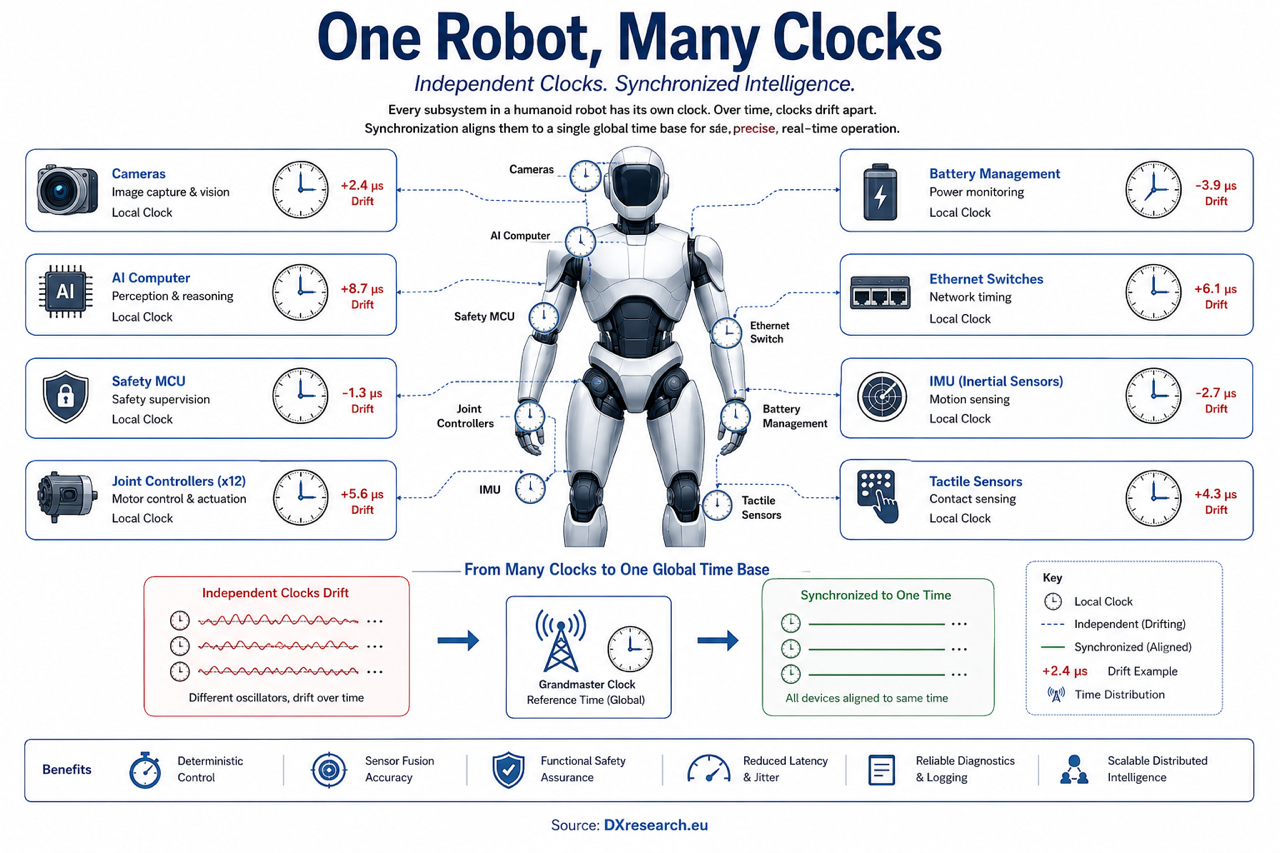
In reality, no electronic subsystem experiences the world at exactly the same instant.
Every camera exposes an image at a slightly different moment. Every inertial sensor samples acceleration according to its own internal clock. Every joint controller updates torque independently. Every processor executes software using its local oscillator. Even communication networks introduce propagation delays measured in nanoseconds, microseconds, or milliseconds.
Without careful synchronization, each subsystem would describe a slightly different version of reality.
The consequence extends beyond reduced accuracy. Motion becomes less stable, sensor fusion deteriorates, diagnostics become ambiguous, and distributed control loses determinism. For humanoid robots operating in dynamic environments, temporal inconsistency eventually becomes a physical problem rather than merely a computational inconvenience.
The ability to establish a common notion of time across hundreds of semiconductor devices is therefore emerging as one of the fundamental architectural requirements of Physical AI.

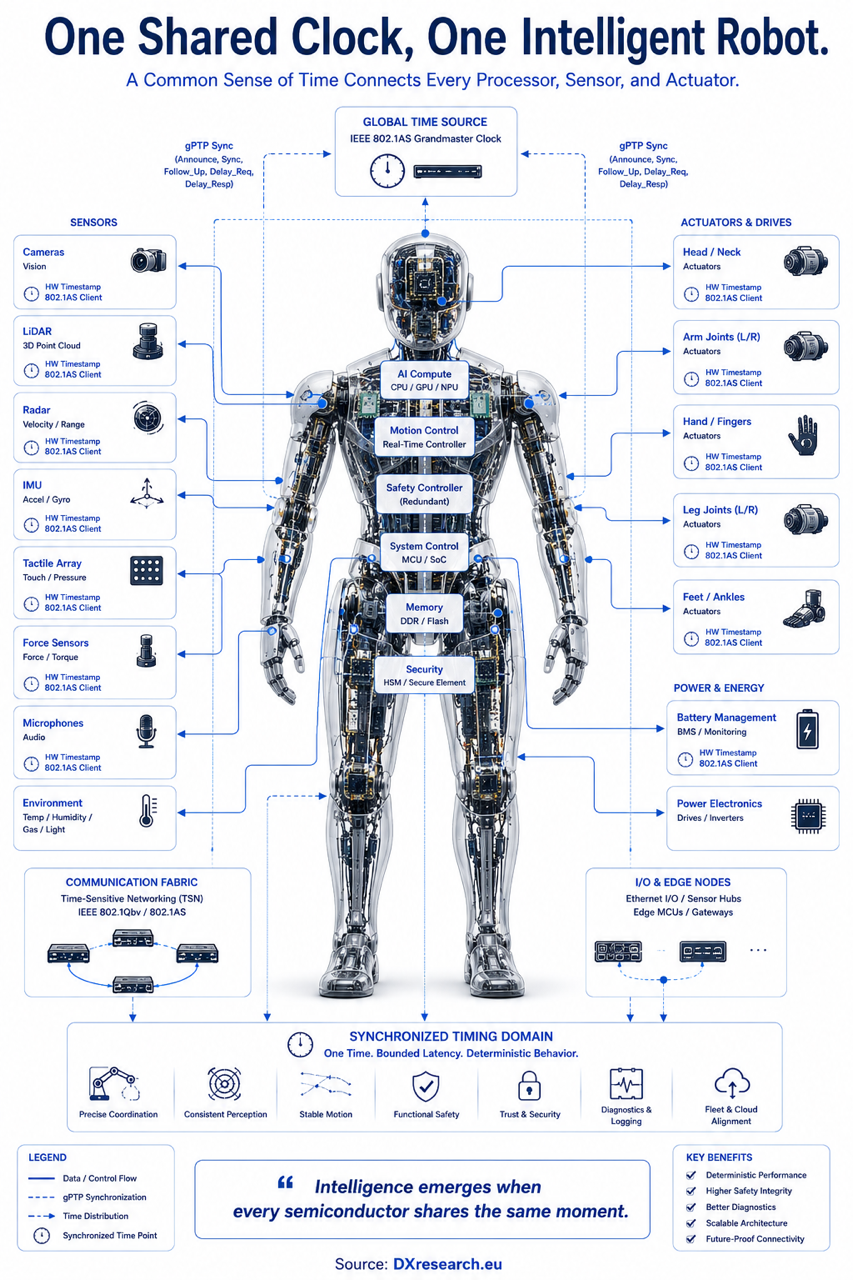
[Visual 01 – One Robot, Many Clocks]
- Every Measurement Has Two Values
Traditional engineering education often treats measurements as pairs consisting of a numerical value and a physical unit.
For distributed robotic systems, every measurement actually contains three essential elements:
| Measurement component | Example | Why it matters |
| Value | Joint angle = 32.4° | Describes the physical state |
| Quality | ±0.2° uncertainty | Indicates measurement confidence |
| Timestamp | 13:42:08.254381 | Defines when the measurement was valid |
The timestamp frequently receives the least attention despite often being equally important as the measured value itself.
Consider a humanoid balancing on one foot.
An inertial measurement indicating a body inclination of 2° remains useful only if the control system knows exactly when that inclination existed. A measurement delayed by several milliseconds may no longer represent the robot’s actual posture because the body continues moving continuously.
The problem becomes even more pronounced during rapid manipulation, dynamic walking, or collision avoidance, where body dynamics evolve faster than human perception.
Consequently, time itself becomes another sensor.
Semiconductor architectures increasingly support hardware timestamping directly at the interface between physical sensors and digital processing, reducing uncertainty introduced by software latency.
- Distributed Intelligence Depends on Temporal Consistency
Previous chapters discussed distributed intelligence, heterogeneous computing, and multi-rate execution. These architectural concepts rely upon an implicit assumption: every processing element shares a consistent understanding of time.
Without synchronization, distributed computing rapidly becomes distributed confusion.
Imagine a humanoid catching a falling object.
Its stereo cameras identify the object’s trajectory.
Its inertial sensors estimate body motion.
Joint controllers position the arms.
Force sensors detect initial contact.
Grip controllers close the fingers.
If each subsystem operates according to an independent clock drifting only a few hundred microseconds apart, sensor fusion begins combining observations that never truly existed simultaneously.
The robot effectively attempts to interact with a world assembled from different moments in time.
This phenomenon produces subtle yet cumulative errors:
- degraded localization;
- unstable sensor fusion;
- inconsistent diagnostics;
- motion oscillation;
- inaccurate event reconstruction;
- reduced Functional Safety diagnostic coverage.
Temporal synchronization therefore becomes an enabling technology rather than merely a communication feature.

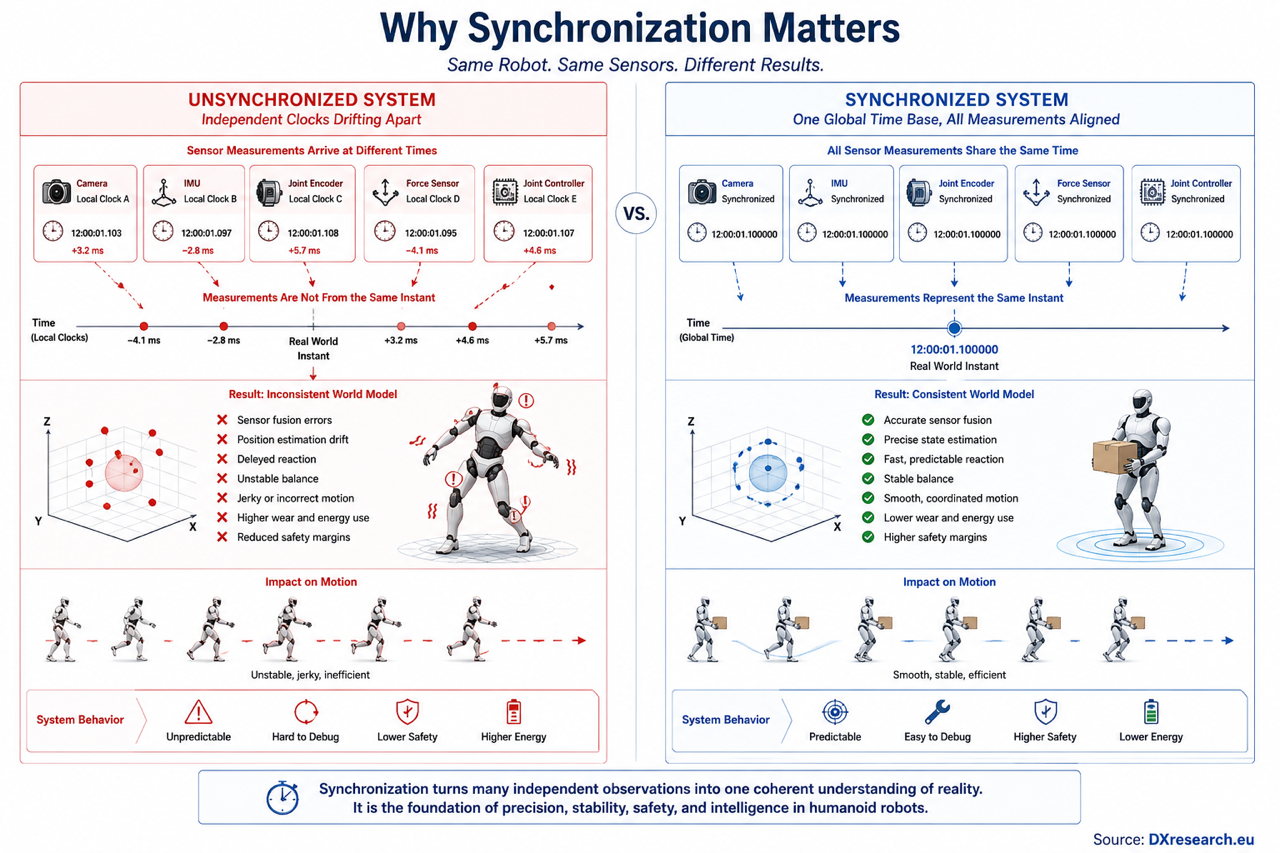
[Visual 02 – Unsynchronized Versus Synchronized Robot Perception]
- The Clock Becomes Part of the Control Loop
Historically, clocks were considered support circuitry responsible for generating processor frequencies.
Modern robotic systems elevate clocks into active control components.
Every synchronized event contributes to deterministic system behavior.
Typical examples include:
- simultaneous motor-control updates;
- coordinated sensor sampling;
- synchronized camera exposure;
- deterministic Ethernet transmission;
- distributed safety supervision;
- precise event logging;
- coordinated diagnostics;
- synchronized battery measurements.
Rather than executing tasks “as soon as possible,” distributed controllers increasingly execute them “at exactly the correct time.”
This distinction fundamentally changes software architecture.
Instead of reacting to asynchronous events, many robotic systems execute according to globally synchronized schedules that guarantee bounded temporal relationships among all participating processors.
The result is improved repeatability, lower communication jitter, simpler debugging, and more predictable closed-loop control.
Such deterministic scheduling forms the basis of modern Time-Sensitive Networking (TSN), which combines precise synchronization with bounded communication latency across Ethernet-based industrial systems (Reference 01 – IEEE 802.1 Time-Sensitive Networking Task Group).
- Synchronization Enables Better Sensor Fusion
Sensor fusion algorithms estimate the robot’s state by combining information originating from multiple sensing modalities.
Examples include:
- cameras;
- radar;
- lidar;
- inertial measurement units;
- joint encoders;
- tactile arrays;
- force sensors;
- microphones.
Each sensor observes the environment differently.
Vision contributes semantic understanding.
Radar provides velocity information.
IMUs capture dynamic motion.
Joint encoders describe internal body configuration.
Individually, each measurement contains uncertainty.
Collectively, synchronized observations enable remarkably accurate state estimation.
However, successful fusion requires that measurements correspond to the same physical instant.
A camera image captured after a head movement cannot be fused correctly with inertial data collected beforehand unless precise timing relationships are known.
For this reason, modern semiconductor sensor interfaces increasingly incorporate:
- hardware timestamping;
- synchronized triggering;
- deterministic sampling intervals;
- precision clock distribution;
- latency compensation.
These capabilities reduce temporal uncertainty before higher-level AI algorithms begin processing information.
From an architectural perspective, synchronization improves not only accuracy but also computational efficiency because algorithms require fewer corrections for timing inconsistencies.

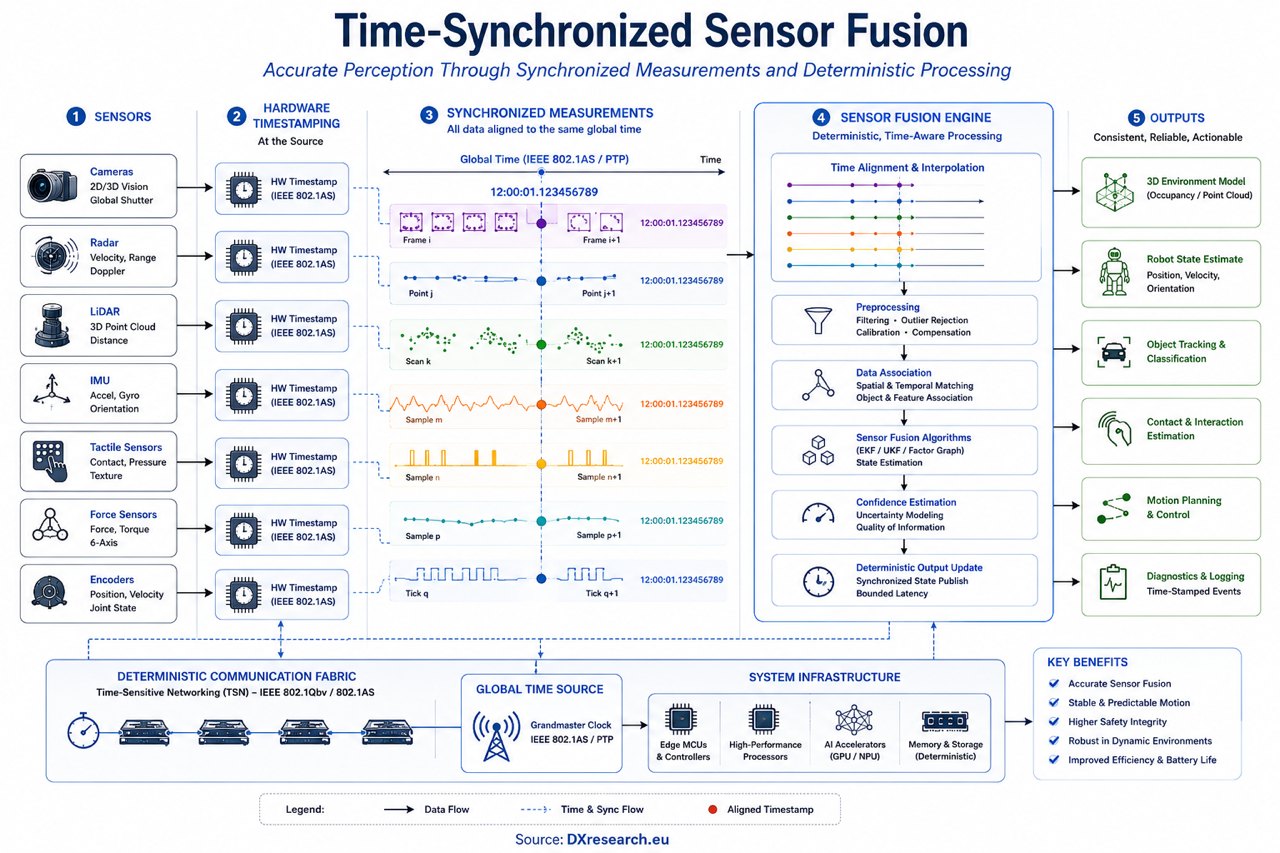
[Visual 03 – Time-Synchronized Multi-Sensor Fusion]
- Time Is Also a Cybersecurity Resource
Synchronization is commonly associated with control engineering, yet it also contributes significantly to trustworthy cybersecurity.
Secure distributed systems depend upon consistent event ordering.
Authentication protocols require synchronized validity periods.
Secure software updates rely upon trusted timestamps.
Distributed logging depends upon chronologically correct event records.
Incident investigations require accurate reconstruction of system behavior across multiple processors.
If clocks differ substantially between electronic control units, reconstructing the sequence of events following a malfunction or cyberattack becomes considerably more difficult.
Trusted time therefore becomes part of the system’s security architecture.
Modern secure semiconductor devices increasingly combine hardware security modules with protected timekeeping mechanisms, secure counters, authenticated event records, and cryptographically protected logs.
The integration of timing and security illustrates an important architectural trend throughout Physical AI.
Time is no longer merely an operational resource.
It becomes a trusted engineering resource supporting safety, diagnostics, cybersecurity, and explainability simultaneously.
(Reference 02 – IEC 62443 Industrial Communication Networks – IT Security for Industrial Automation and Control Systems)
Verified Facts
Distributed clock synchronization, hardware timestamping, deterministic Ethernet, IEEE 802.1 Time-Sensitive Networking, precision time protocols, and synchronized industrial control are established technologies used throughout industrial automation, automotive electronics, aerospace, telecommunications, and robotics.
Assumptions
Commercial humanoid robots will increasingly migrate toward Ethernet-based deterministic communication with hardware-assisted synchronization extending from central AI computers to intelligent joints, perception modules, battery systems, and distributed safety controllers.
Interpretation
As humanoid robots scale toward hundreds of distributed computing nodes, synchronization accuracy may become as strategically important as processor performance, because intelligence depends upon coordinated execution rather than isolated computation.
Chapter: The Robot’s Sense of Time — Why Synchronization Is the Invisible Foundation of Physical AI
Deliverable 2 of 2
- Precision Time Protocol and Deterministic Ethernet
The practical realization of a shared time base requires more than accurate oscillators. Every processor must continuously compensate for crystal tolerances, temperature drift, communication latency, and network topology changes while maintaining a common understanding of time.
This capability is provided by synchronized networking technologies, most notably the IEEE 802.1 Time-Sensitive Networking (TSN) family of standards. Within TSN, IEEE 802.1AS defines the generalized Precision Time Protocol (gPTP), a profile derived from IEEE 1588 that distributes synchronized time throughout an Ethernet network while continuously compensating for propagation delays and clock drift.
Unlike conventional Ethernet, deterministic Ethernet treats time as part of the communication protocol itself.
Instead of transmitting packets whenever network resources become available, deterministic scheduling ensures that time-critical traffic is transmitted within predefined windows while maintaining bounded latency, limited jitter, and predictable delivery.
For humanoid robots, synchronized Ethernet supports numerous coordinated activities simultaneously:
- synchronized joint-control updates;
- coordinated camera triggering;
- distributed sensor acquisition;
- deterministic safety communication;
- whole-body motion coordination;
- synchronized event recording;
- fleet-wide diagnostics.
The importance of synchronization increases as robots become more modular. A humanoid containing thirty intelligent joints effectively behaves as a distributed computing cluster. Every joint controller executes locally, yet all controllers must agree on when each control cycle begins.
The communication network therefore evolves from a transport mechanism into a timing infrastructure.

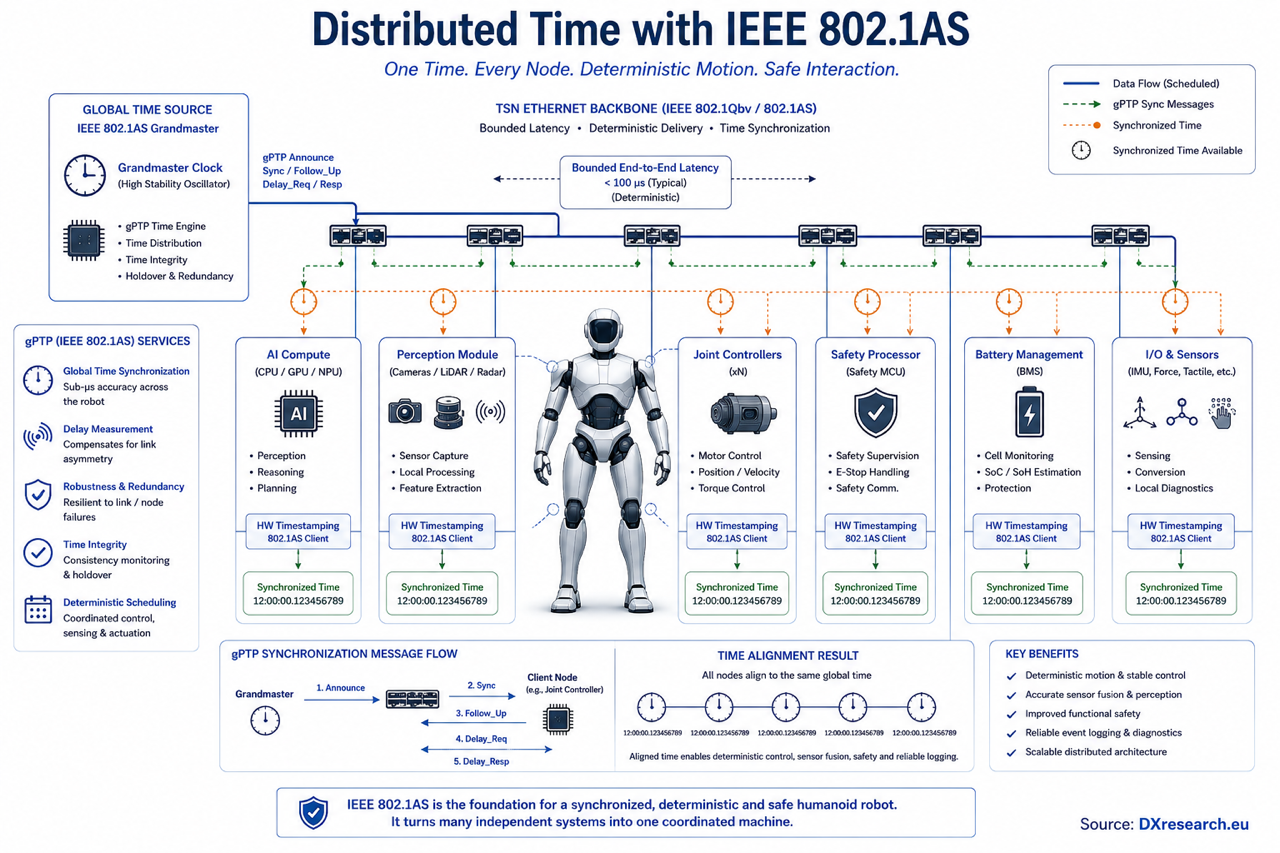
[Visual 04 – IEEE 802.1AS Synchronization Across a Humanoid Robot]
- Synchronization as a Functional Safety Enabler
Functional Safety is generally associated with redundancy, diagnostics, safe states, and fault detection. Less visible, but equally important, is temporal consistency.
Many safety mechanisms depend explicitly on synchronized execution.
Examples include:
- redundant processor comparison;
- distributed emergency-stop propagation;
- synchronized watchdog supervision;
- coordinated actuator shutdown;
- timestamped diagnostic records;
- deterministic communication timeout monitoring.
Consider a dual-channel safety architecture supervising joint motion.
Both channels may compute identical control outputs. However, if one processor executes several milliseconds later than the other because their clocks have diverged, comparison logic may incorrectly indicate disagreement even though both algorithms remain functionally correct.
Conversely, asynchronous execution may conceal genuine faults because measurements correspond to different physical states.
A shared notion of time therefore improves both diagnostic coverage and fault discrimination.
Future distributed safety architectures are expected to extend this principle further by incorporating fault-tolerant time distribution. Recent developments within IEEE 802.1AS introduce mechanisms for improving timing availability and integrity using multiple synchronized timing domains and redundant distribution paths, reducing the probability that timing faults propagate into safety-critical functions.
Synchronization should therefore be regarded as an enabling infrastructure supporting Functional Safety rather than replacing traditional safety mechanisms.

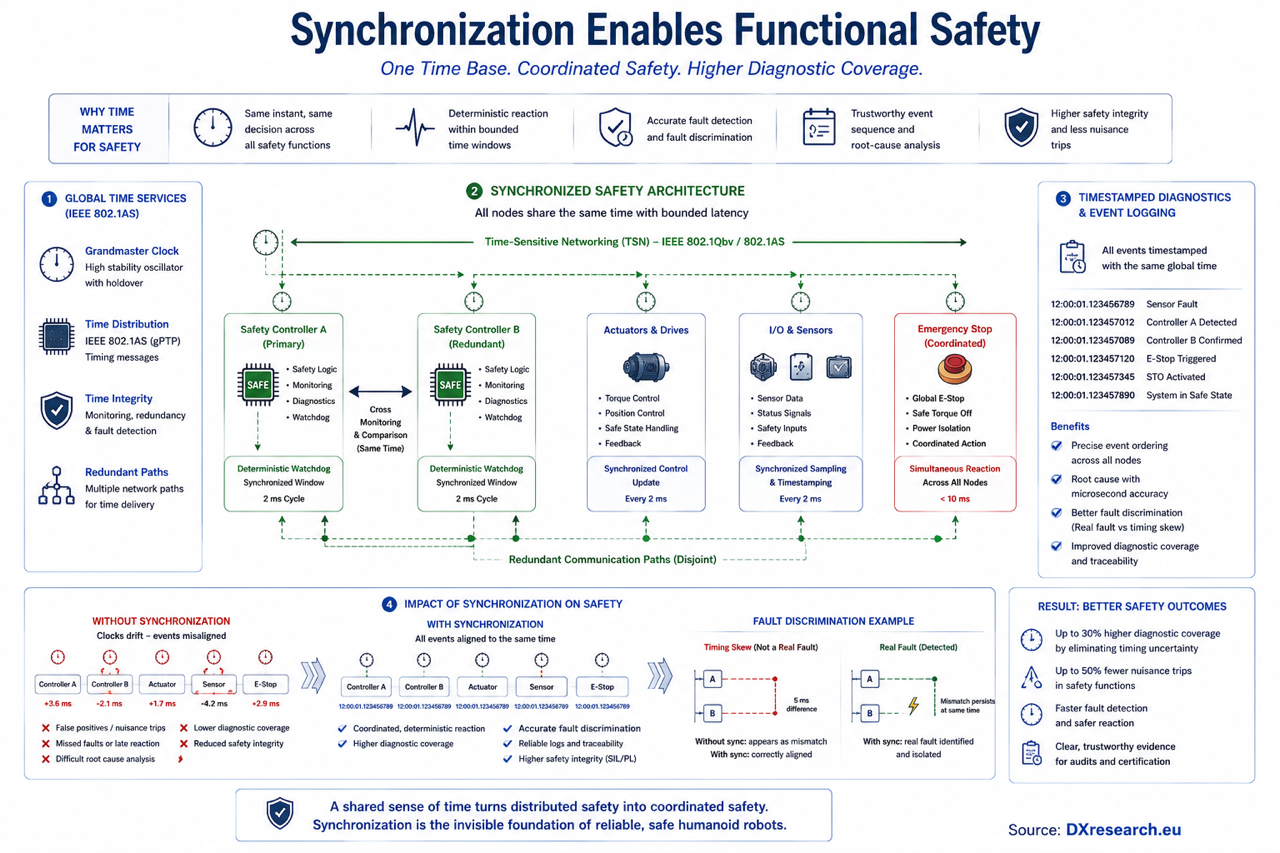
[Visual 05 – Time Synchronization Supporting Functional Safety]
- Semiconductor Implications for Timing Architectures
The migration toward synchronized distributed intelligence significantly influences semiconductor design.
Historically, clock generation remained largely internal to individual integrated circuits.
Future robotic semiconductor platforms increasingly expose timing as a system-level capability.
Important hardware functions include:
| Semiconductor capability | Contribution to synchronized robotics |
| Hardware timestamping | Eliminates software-induced timing uncertainty |
| Precision oscillators | Stable local time generation |
| Clock synchronization engines | Continuous correction of local clocks |
| Ethernet MAC with TSN support | Deterministic packet scheduling |
| TSN-capable PHY | Accurate timing transfer and bounded latency support |
| Timer peripherals | Deterministic task execution |
| DMA engines | Reduced timing jitter during data movement |
| Hardware event capture | Precise correlation of physical events |
| Security hardware | Trusted timestamps and authenticated logs |
The interaction among these functions is particularly significant.
Hardware timestamping reduces software overhead.
Deterministic communication minimizes uncertainty.
Precise oscillators improve long-term stability.
Trusted timing enables secure diagnostics.
Collectively, these features allow software to operate within predictable temporal boundaries instead of continuously compensating for timing uncertainty.
This shift illustrates a broader evolution within semiconductor architecture.
Integrated circuits increasingly contribute not only computational performance but also temporal integrity.
- From Clocks to Coordinated Intelligence
Synchronization is often perceived as a technical implementation detail confined to communication engineers.
Its architectural implications are considerably broader.
Once every subsystem shares a common time base, entirely new system capabilities emerge.
Distributed cameras may reconstruct three-dimensional scenes more accurately.
Joint controllers coordinate whole-body dynamics without accumulating phase errors.
Battery-management systems correlate electrical transients with mechanical loading.
Cybersecurity systems reconstruct incident timelines with forensic precision.
Fleet analytics compare operational events collected across thousands of robots using consistent temporal references.
Artificial intelligence itself benefits from synchronized observations because learning algorithms receive temporally coherent datasets rather than collections of loosely related measurements.
Time therefore becomes a unifying engineering resource linking sensing, computation, communication, safety, diagnostics, maintenance, and learning.
Rather than existing as isolated technical disciplines, these functions become components of one coordinated temporal architecture.

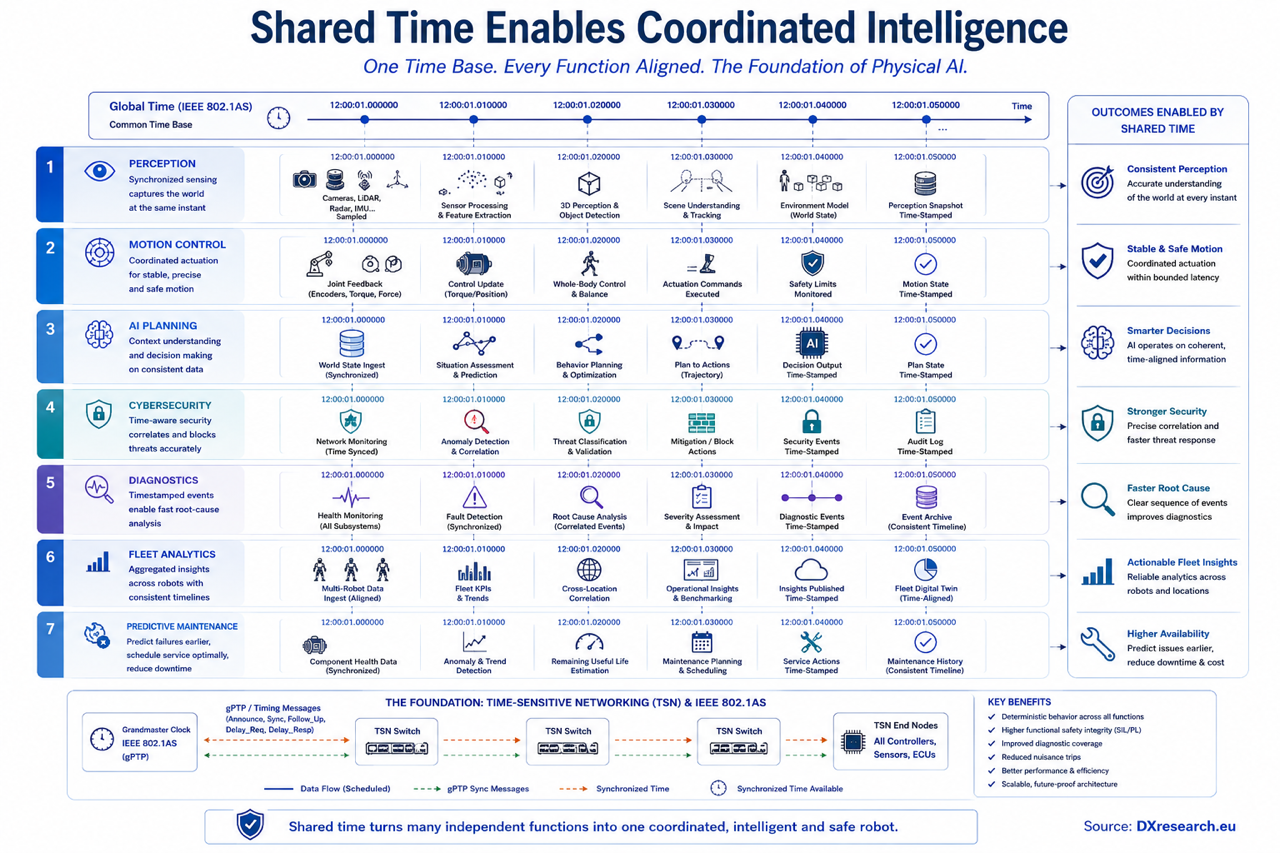
[Visual 06 – Shared Time Enabling Coordinated Intelligence]
- The Future Robot Shares One Sense of Time
Humanoid robots represent one of the most demanding distributed embedded systems ever developed.
Hundreds of processors.
Thousands of sensors.
Millions of control decisions every second.
All operating across multiple physical domains while interacting safely with people.
Such complexity cannot be managed through computational performance alone.
It requires coordination.
A shared understanding of time allows distributed processors to behave as one coherent machine.
It allows perception systems to observe one consistent world.
It allows Functional Safety mechanisms to supervise deterministic behavior.
It allows diagnostics to reconstruct trustworthy histories.
It allows AI to learn from temporally consistent experience.
Semiconductors make this possible by embedding timing intelligence directly into communication interfaces, processors, memory systems, synchronization engines, and security architectures.
Consequently, future competitive advantage will depend not only on faster AI accelerators or larger processors but equally on semiconductor platforms capable of distributing trusted time throughout the entire robot.
Ultimately, synchronized time becomes the invisible infrastructure that transforms many independent electronic systems into one intelligent physical machine.
Distributed clock synchronization, IEEE 802.1AS (gPTP), IEEE Time-Sensitive Networking, IEEE 1588 profiles, hardware timestamping, deterministic Ethernet, and synchronized industrial automation are established technologies with broad adoption across industrial automation, automotive systems, aerospace, and robotics. Recent IEEE amendments further strengthen fault-tolerant timing and time integrity for safety-critical distributed systems.
Future commercial humanoid robots will increasingly adopt Ethernet-based distributed architectures in which nearly every intelligent actuator, perception module, battery subsystem, and safety controller participates in a globally synchronized timing domain.
As humanoid robots evolve toward hundreds of cooperating electronic control units, timing integrity will become a first-class semiconductor design objective alongside computational performance, power efficiency, cybersecurity, and Functional Safety.
Glossary
| Term | Definition |
| Bounded Latency | Guaranteed maximum communication delay within a deterministic network. |
| Clock Drift | Gradual deviation between independent oscillators over time. |
| Deterministic Ethernet | Ethernet communication providing predictable timing behavior. |
| gPTP | Generalized Precision Time Protocol defined by IEEE 802.1AS. |
| Hardware Timestamping | Capturing packet or event times directly in hardware to minimize timing uncertainty. |
| IEEE 1588 | Precision Time Protocol standard providing high-accuracy clock synchronization. |
| IEEE 802.1AS | TSN synchronization standard defining generalized PTP for Ethernet networks. |
| Jitter | Variation in timing around an expected execution or communication instant. |
| Time Integrity | Confidence that distributed time remains correct, available, and trustworthy. |
| TSN | Time-Sensitive Networking, IEEE standards enabling deterministic Ethernet communication. |
References
Reference 01 – IEEE 802.1AS-2025: Timing and Synchronization for Time-Sensitive Applications
Publication date: 17 December 2025
Abstract (~20 words): Defines protocols, procedures, and managed objects for synchronized time distribution supporting deterministic control across IEEE 802 local-area networks.
Verified raw HTML URL: https://standards.ieee.org/ieee/802.1AS/11968/
Reference 02 – IEEE 802.1 Time-Sensitive Networking Task Group
Publication date: Continuously maintained working group documentation
Abstract (~20 words): Describes TSN standards delivering bounded latency, low jitter, deterministic Ethernet communication, and synchronization for industrial and automotive applications.
Verified raw HTML URL: https://www.ieee802.org/1/pages/tsn.html
Reference 03 – IEEE 802.1ASed-2026: Fault-Tolerant Timing with Time Integrity
Publication date: 25 March 2026
Abstract (~20 words): Introduces redundant timing domains, multiple synchronization paths, and time-integrity mechanisms to improve availability and resilience of synchronized networks.
Verified raw HTML URL: https://1.ieee802.org/tsn/802-1ased/
Reference 04 – Time-Sensitive Networking for Industrial Automation: Current Advances and Future Directions
Publication date: 6 June 2023
Abstract (~20 words): Reviews IEEE TSN standards, industrial applications, interoperability challenges, and future research directions for deterministic Ethernet communications.
Verified raw HTML URL: https://arxiv.org/abs/2306.03691


Leave a Reply