
After reviewing current teardown estimates, McKinsey supply-chain analysis, Interact Analysis actuator research, Morgan Stanley Optimus estimates, Nvidia humanoid ecosystem announcements and industry BOM studies, here the estimated humanoid value distribution today :
| System | Share of Hardware BOM |
| Actuators, motors, reducers, joint modules, hands | 45–60% |
| AI Compute & Control | 10–18% |
| Vision & Perception Sensors | 5–12% |
| Power Electronics & Battery Management | 8–15% |
| Networking, Connectivity & Safety Electronics | 3–8% |
| Magnets & Rare Earth Materials | 5–10% |
| Mechanical Structure, Bearings & Thermal | 10–20% |
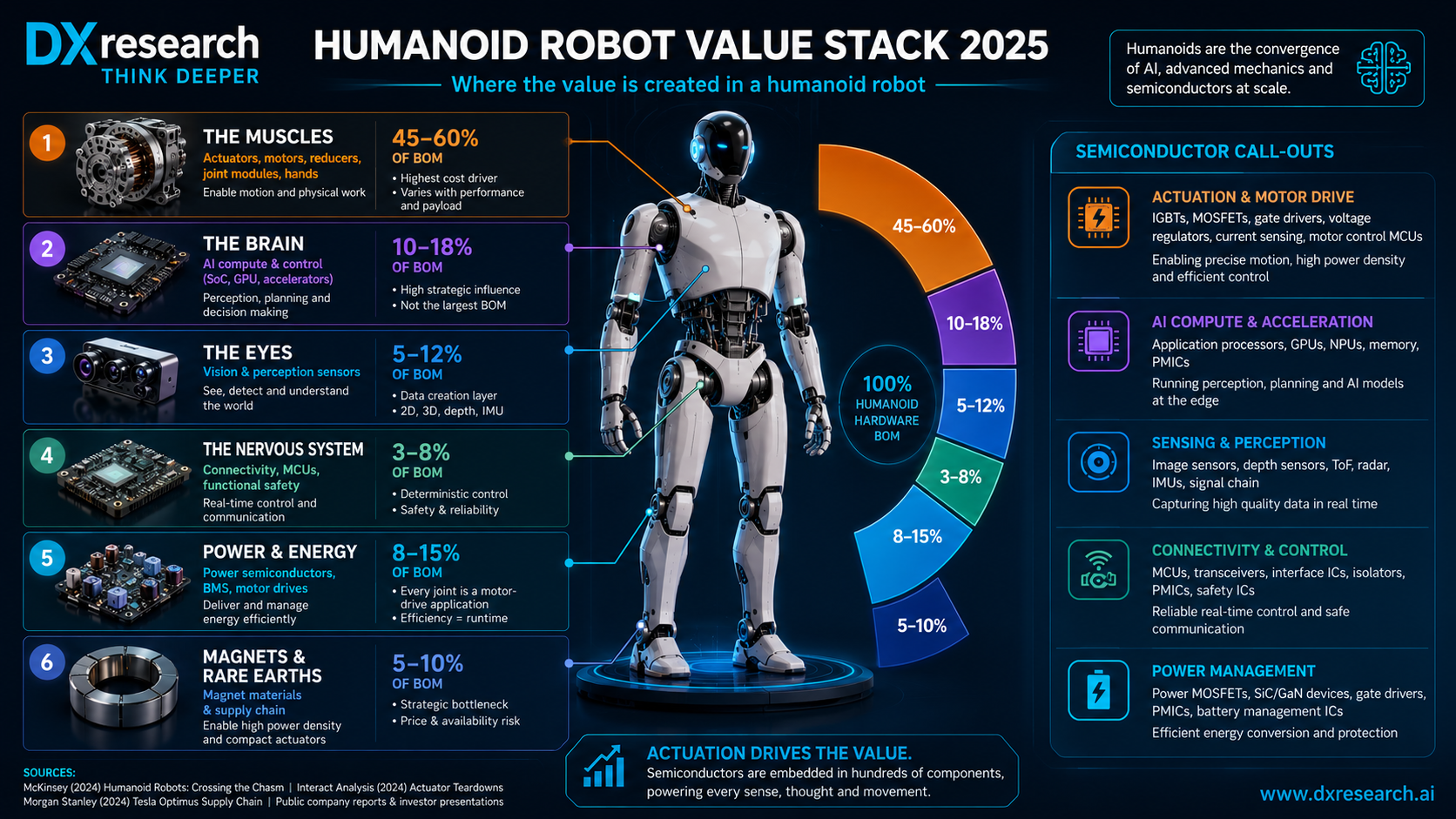
Actuation remains by far the largest value pool. Multiple studies place joint actuators above 30% of BOM and often above 50% in simpler humanoids. McKinsey estimates actuation at roughly 40–60% of total humanoid hardware cost.
For Tesla Optimus specifically, industry estimates suggest actuators account for roughly 56% of hardware cost, with reducers alone around 15%.
Sources supporting the distribution include public McKinsey humanoid teardown analysis, Interact Analysis actuator cost studies, Morgan Stanley Optimus BOM estimates, Reuters reporting on Nvidia’s humanoid ecosystem and Schaeffler actuator supply chain expansion.
For readers who want to go deeper, these are five authoritative sources that informed the DXresearch Humanoid Robot Value Stack analysis:
📘 McKinsey & Company
Humanoid Robots: Crossing the Chasm from Concept to Commercial Reality
October 2025
Analyzes commercialization barriers, deployment economics, cost structures, adoption drivers and scaling requirements for humanoid robots worldwide.
📘 Morgan Stanley
The Humanoid 100: Mapping the Humanoid Robot Value Chain
February 2025
Comprehensive analysis of the humanoid ecosystem, supply chain, value creation layers and detailed Tesla Optimus hardware cost estimates.
📘 Interact Analysis
Humanoid Robots Offer Potential but Limited Uptake in the Short-to-Mid Term
July 2025
Examines market forecasts, actuator cost contribution, deployment bottlenecks, safety challenges and expected adoption trajectories.
📘 Morgan Stanley Research
Humanoids: A $5 Trillion Market
May 2025
Explores long-term market potential, manufacturing scale economics, adoption scenarios and industry value creation opportunities.
https://www.morganstanley.com/insights/articles/humanoid-robot-market-5-trillion-by-2050
📘 POSCO Newsroom
Industrial Mega Trend: Humanoid Robots
February 2026
Provides an overview of the humanoid technology stack, supply chain structure, key components and ecosystem participants.
https://newsroom.posco.com/en/industrial-mega-trend-humanoid-robots/
Key takeaway from these sources:
While AI compute receives most of the attention, current research consistently shows that actuators, motors, reducers and joint modules represent the largest value pool in humanoid robots—typically accounting for 45–60% of total hardware cost. The humanoid opportunity is therefore not only an AI story, but equally a motion-control, power-electronics and semiconductor story.


Nice catch calling out the reducer share separately (~15% for Optimus), most studies just put “actuators.” Curious if that ratio holds as reducer suppliers scale, or if it compresses faster than the rest of the BOM. Future will tell us.