
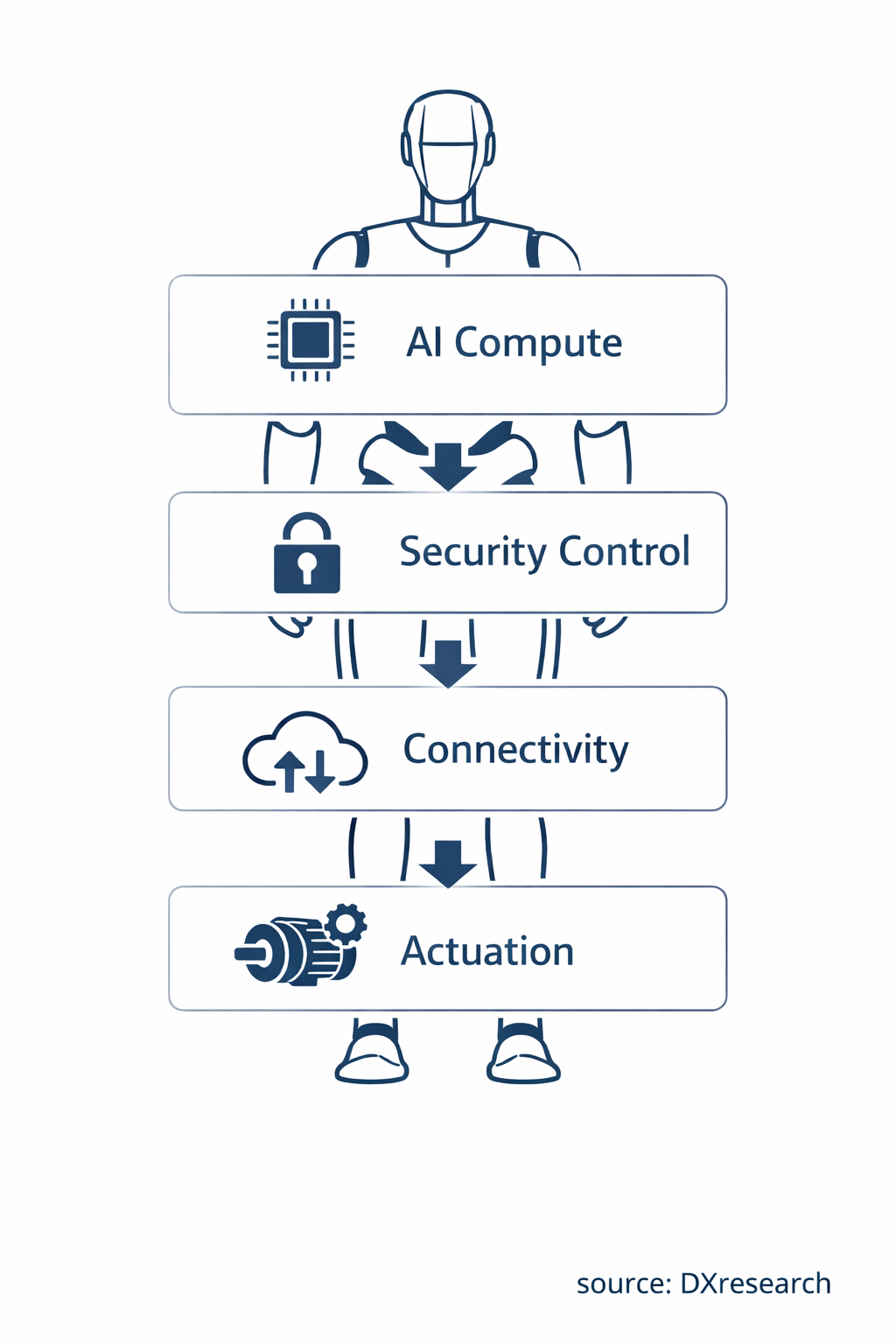
Software Defined Humanoids Scale Through Semiconductor Intelligence
Humanoid robots are evolving into software-defined platforms shaped by sensing, compute, and power efficiency. The real shift lies in system architecture, where semiconductors define scalability, safety, and lifecycle value across physical AI deployments.
🤖 Market Perspective
Humanoid robotics is entering a structured growth phase, supported by advances in AI, simulation, and hardware integration. Industry discussions increasingly position humanoids as adaptable systems designed for human environments, enabling deployment without major infrastructure changes (https://blogs.sw.siemens.com/podcasts/industry-forward/shift-towards-humanoid-robot/). Market projections highlight strong growth trajectories, with estimates pointing to multi-billion expansion over the next decade (https://www.marketsandmarkets.com/Market-Reports/humanoid-robot-market-99567653.html). Adoption remains gradual as cost, reliability, and energy constraints continue to shape investment decisions.
⚙️ Technology Perspective
The concept of software-defined robotics reflects a broader shift toward physical AI systems that integrate perception, reasoning, and action. These systems rely on continuous learning through simulation and real-world data. The World Economic Forum frames this as a transition toward adaptive, context-aware machines operating in dynamic environments (https://www.weforum.org/publications/physical-ai-powering-the-new-age-of-industrial-operations/). Platforms such as NVIDIA Isaac GR00T illustrate how AI models, simulation environments, and robotics stacks converge into unified development ecosystems (https://developer.nvidia.com/isaac/gr00t).
🔋 System Architecture Perspective
From a system standpoint, humanoids are complex distributed electronic systems. Performance depends on tight orchestration of sensing, compute, power, and actuation. Energy efficiency directly impacts uptime, while compute efficiency determines real-time responsiveness. McKinsey highlights runtime and cost as key gating factors for large-scale deployment, with battery life and system cost shaping business viability (https://www.mckinsey.com/industries/industrials/our-insights/humanoid-robots-crossing-the-chasm-from-concept-to-commercial-reality). Semiconductor innovation plays a central role in addressing these constraints through efficient power conversion, high-performance microcontrollers, and advanced sensing.
🧠 Semiconductor Perspective
The transition toward software-defined humanoids elevates semiconductors to a strategic layer. Sensors enable environmental awareness. Microcontrollers and processors support AI inference at the edge. Power semiconductors define energy efficiency and thermal behavior. Motor control solutions ensure precise and responsive movement. Functional safety architectures enable reliable human interaction. Connectivity solutions enable fleet-level learning and secure updates. This integrated view aligns with the requirements of scalable robotics platforms and highlights the importance of system-level semiconductor design.
🌍 Strategic Industry Perspective
Humanoids represent one pathway within a broader robotics evolution. Mobile manipulators, collaborative robots, and autonomous mobile robots continue to address structured and semi-structured environments effectively. Industry analyses indicate that different robot forms will coexist, each optimized for specific operational contexts (https://www.abiresearch.com/blog/expectations-for-modex-2026-robotics-and-automation). The common denominator across these platforms is the increasing role of software-defined capabilities supported by semiconductor innovation.
📊 Business Perspective
For decision makers, the evaluation framework is shifting toward lifecycle value. Key considerations include scalability, adaptability, safety, and total cost of ownership. Software-defined architectures enable continuous improvement through updates and data-driven optimization. This creates new value models based on performance over time rather than static capability at deployment.
🔐 Risk and Governance Perspective
As robots become more connected and software-driven, cybersecurity and functional safety gain importance. The integration of OTA updates, cloud connectivity, and AI models introduces new risk vectors. Governance frameworks and secure semiconductor architectures are essential to ensure safe and reliable operation across the lifecycle.
Key Takeaways
Software-defined humanoid robots reflect a broader transformation in robotics where intelligence, adaptability, and system integration define competitiveness. Semiconductors sit at the core of this transformation, enabling efficient, safe, and scalable platforms. The evolution toward physical AI systems will influence not only humanoids but the entire robotics landscape.
Sources
1. Siemens – The Major Shift Toward Humanoid Robots (2024)
Explores humanoids as software-defined systems operating in human environments, highlighting flexibility and integration trends across industrial applications.
2. World Economic Forum – Physical AI (2024)
Analyzes convergence of AI and robotics, emphasizing adaptive systems, real-world deployment challenges, and industrial transformation potential.
https://www.weforum.org/publications/physical-ai-powering-the-new-age-of-industrial-operations/
3. McKinsey – Humanoid Robots Crossing the Chasm (2024)
Details economic viability, energy constraints, and adoption barriers shaping commercialization of humanoid robotics platforms.
https://www.mckinsey.com/industries/industrials/our-insights/humanoid-robots-crossing-the-chasm-from-concept-to-commercial-reality
4. NVIDIA – Isaac GR00T Platform (2024)
Introduces foundation models and simulation frameworks enabling scalable development of general-purpose humanoid robots.
https://developer.nvidia.com/isaac/gr00t
5. MarketsandMarkets – Humanoid Robot Market Report (2025)
Provides growth projections and segmentation insights for humanoid robotics market expansion over the next decade.
https://www.marketsandmarkets.com/Market-Reports/humanoid-robot-market-99567653.html
6. ABI Research – Robotics Outlook (2026)
Highlights competitive landscape across robotics categories and the role of mobile manipulators and automation platforms.
https://www.abiresearch.com/blog/expectations-for-modex-2026-robotics-and-automation


Leave a Reply