RoboNews_2026.10.18_global_all
· Reporting window 11–17 October 2026 · Standard global edition
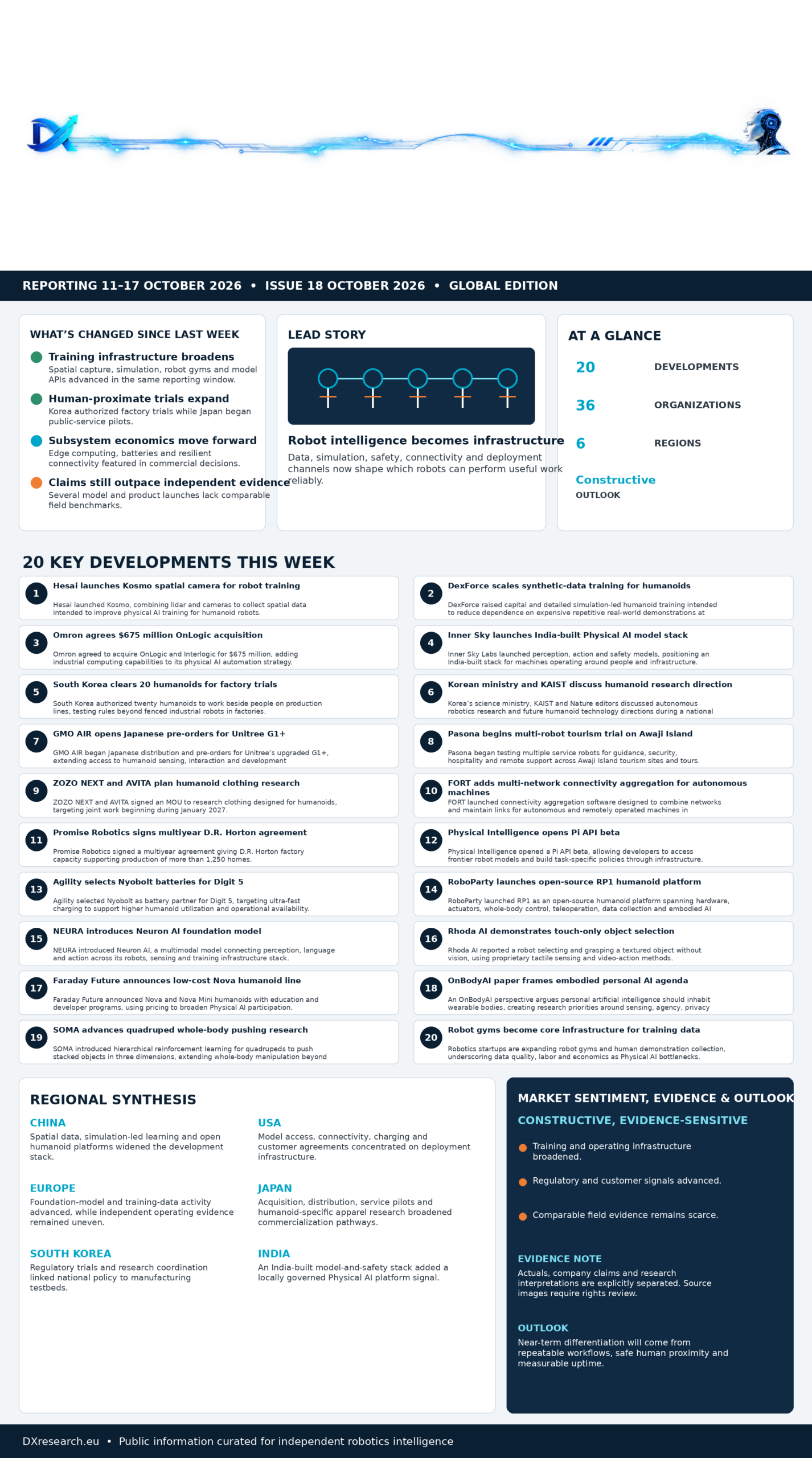
What’s Changed Since Last Week
- Training infrastructure broadens — Spatial capture, simulation, robot gyms and model APIs advanced in the same reporting window.
- Human-proximate trials expand — Korea authorized factory trials while Japan began public-service pilots.
- Subsystem economics move forward — Edge computing, batteries and resilient connectivity featured in commercial decisions.
- Claims still outpace independent evidence — Several model and product launches lack comparable field benchmarks.
Lead Story: Robot intelligence becomes infrastructure
Physical AI progress this week was less about one spectacular machine and more about the stack that lets robots learn, connect, charge, perceive and operate safely. Spatial capture and synthetic simulation widened training options; model APIs lowered software-access barriers; acquisition and partnership activity strengthened edge computing, connectivity and power availability. Korea’s factory sandbox and Japan’s service trials moved the discussion closer to workplaces shared with people.
The evidence remains uneven. Commercial agreements and regulatory approvals are reported actuals, while model capabilities, product performance and future research programs remain company claims or targets until independently validated. The strategic signal is nevertheless coherent: useful deployment increasingly depends on integrated infrastructure and controlled operating evidence, not isolated demonstrations. DXresearch therefore assesses sentiment as constructive but evidence-sensitive.
20 Key Developments
1. Hesai launches Kosmo spatial camera for robot training
Hesai launched Kosmo, combining lidar and cameras to collect spatial data intended to improve physical AI training for humanoid robots.
Reuters reported that Hesai unveiled Kosmo, a three-dimensional mapping camera combining lidar and conventional cameras. The company said it has agreements with Chinese robotics firms, while its broader actuator work is already used in Sharpa Robotics hands. DXresearch interpretation: spatial-data capture is becoming a distinct layer of the robotics stack, but claimed performance remains application-specific.
Evidence: reported actual; product launch. Source: Reuters
2. DexForce scales synthetic-data training for humanoids
DexForce raised capital and detailed simulation-led humanoid training intended to reduce dependence on expensive repetitive real-world demonstrations at scale globally.
Reuters described DexForce’s use of synthetic environments to train humanoid policies before transferring them to physical machines, alongside a recent Series B round. The company claims this approach is faster and cheaper than human demonstration collection. DXresearch interpretation: simulation is gaining strategic weight, but sim-to-real robustness remains the commercial test.
Evidence: reported actual and company claim; funding. Source: Reuters
3. Omron agrees $675 million OnLogic acquisition
Omron agreed to acquire OnLogic and Interlogic for $675 million, adding industrial computing capabilities to its physical AI automation strategy.
Omron said it will acquire U.S. industrial-PC specialist OnLogic and its parent company for $675 million. The stated aim is to strengthen physical-AI services within industrial automation. DXresearch interpretation: the deal highlights the rising value of rugged edge compute as robot intelligence moves closer to machines.
Evidence: reported actual; transaction announced. Source: Reuters
4. Inner Sky launches India-built Physical AI model stack
Inner Sky Labs launched perception, action and safety models, positioning an India-built stack for machines operating around people and infrastructure.
Inner Sky Labs announced perception, action-intelligence and independent safety models, including Kavach for pre-execution policy enforcement. The company says the stack is available to qualified partners and already runs across several environments. DXresearch interpretation: separating safety enforcement from generative action planning is architecturally consequential, though deployment claims need independent operating evidence.
Evidence: company claim; commercial availability claim. Source: Express Computer
5. South Korea clears 20 humanoids for factory trials
South Korea authorized twenty humanoids to work beside people on production lines, testing rules beyond fenced industrial robots in factories.
Seoul Economic Daily reported that South Korea granted a regulatory pathway for 20 humanoids to work near people in semiconductor, automotive, shipbuilding and logistics settings. This is an authorization for trials, not proof of scaled productivity. DXresearch interpretation: regulation is starting to adapt to mobile, human-proximate machines.
Evidence: reported actual; pilot authorization. Source: Seoul Economic Daily
6. Korean ministry and KAIST discuss humanoid research direction
Korea’s science ministry, KAIST and Nature editors discussed autonomous robotics research and future humanoid technology directions during a national conference.
South Korea’s Ministry of Science and ICT met KAIST and Nature representatives during a conference on autonomous robotics. The meeting itself is a policy-coordination signal rather than a technology milestone. DXresearch interpretation: Korea is connecting regulatory experimentation, manufacturing testbeds and research agenda-setting.
Evidence: reported actual; policy dialogue. Source: Digital Today
7. GMO AIR opens Japanese pre-orders for Unitree G1+
GMO AIR began Japanese distribution and pre-orders for Unitree’s upgraded G1+, extending access to humanoid sensing, interaction and development capabilities.
GMO AIR announced domestic handling and pre-orders for Unitree’s G1+ in Japan. The announcement expands platform access but does not establish shipment volume or deployed outcomes. DXresearch interpretation: distribution and integration channels are becoming important as cross-border humanoid platforms enter national markets.
Evidence: company announcement; pre-order. Source: GMO AI & Robotics Corporation
8. Pasona begins multi-robot tourism trial on Awaji Island
Pasona began testing multiple service robots for guidance, security, hospitality and remote support across Awaji Island tourism sites and tours.
Pasona announced an operational trial running from October 15 to November 1 across tourism venues and tours on Awaji Island. The program examines effectiveness and operating challenges across several service-robot roles. DXresearch interpretation: multi-robot field trials can expose workflow and business-model constraints that laboratory tests miss.
Evidence: company announcement; pilot. Source: Pasona Group
9. ZOZO NEXT and AVITA plan humanoid clothing research
ZOZO NEXT and AVITA signed an MOU to research clothing designed for humanoids, targeting joint work beginning during January 2027.
ZOZO NEXT and AVITA signed a memorandum to define research themes for humanoid-specific clothing, with joint work targeted for January 2027. This is a stated plan rather than completed research. DXresearch interpretation: apparel, coverings and appearance are emerging as practical interfaces for robots operating around people.
Evidence: company target; memorandum of understanding. Source: ZOZO
10. FORT adds multi-network connectivity aggregation for autonomous machines
FORT launched connectivity aggregation software designed to combine networks and maintain links for autonomous and remotely operated machines in deployment.
FORT Robotics announced software that aggregates available networks to improve link resilience for autonomous and remotely operated machines. The company positions the capability within its trust layer for Physical AI. DXresearch interpretation: dependable communications and controlled degradation are becoming part of the robot safety case.
Evidence: company announcement; product launch. Source: FORT Robotics
11. Promise Robotics signs multiyear D.R. Horton agreement
Promise Robotics signed a multiyear agreement giving D.R. Horton factory capacity supporting production of more than 1,250 homes.
Promise Robotics announced a multiyear agreement under which D.R. Horton will use its Factory-as-a-Service capacity for more than 1,250 homes. The volume is a company-stated commitment, not a completed output. DXresearch interpretation: outcome-linked commercial agreements are a stronger deployment signal than technology demonstrations.
Evidence: company announcement; customer agreement. Source: Promise Robotics
12. Physical Intelligence opens Pi API beta
Physical Intelligence opened a Pi API beta, allowing developers to access frontier robot models and build task-specific policies through infrastructure.
Physical Intelligence announced that its latest robotics models are available through a Pi API beta and invited developers to a waitlist. The beta broadens access to robot foundation models, but availability and performance remain company-controlled. DXresearch interpretation: model providers are moving toward platform economics and repeatable developer workflows.
Evidence: company announcement; beta. Source: Physical Intelligence
13. Agility selects Nyobolt batteries for Digit 5
Agility selected Nyobolt as battery partner for Digit 5, targeting ultra-fast charging to support higher humanoid utilization and operational availability.
Agility Robotics listed Nyobolt as its ultra-fast-charging battery partner for Digit 5. The announcement identifies a subsystem choice; operating gains still require field validation. DXresearch interpretation: charging time, thermal behavior and cycle life increasingly shape humanoid fleet economics.
Evidence: company announcement; technology partnership. Source: Agility Robotics
14. RoboParty launches open-source RP1 humanoid platform
RoboParty launched RP1 as an open-source humanoid platform spanning hardware, actuators, whole-body control, teleoperation, data collection and embodied AI workflows.
RoboParty launched RP1 with stated open access to hardware and software, plus workflows for control, teleoperation and data collection. The breadth is a company claim and the release roadmap requires review. DXresearch interpretation: open platforms can accelerate reproducibility if documentation and component availability match the promise.
Evidence: company announcement; product launch. Source: RoboParty
15. NEURA introduces Neuron AI foundation model
NEURA introduced Neuron AI, a multimodal model connecting perception, language and action across its robots, sensing and training infrastructure stack.
NEURA Robotics introduced Neuron AI and described a perception-language-action architecture combining sight, hearing, touch and action history. Independent benchmarks were not provided in the opened report. DXresearch interpretation: vertically integrated model-and-hardware stacks may shorten iteration loops while increasing dependence on proprietary evidence.
Evidence: company claim reported by media; model announcement. Source: Unite.AI
16. Rhoda AI demonstrates touch-only object selection
Rhoda AI reported a robot selecting and grasping a textured object without vision, using proprietary tactile sensing and video-action methods.
MEKAWIRE reported Rhoda AI’s demonstration in which a robot used touch to locate and remove a textured object while cameras were blocked. This is a controlled research demonstration, not a production deployment. DXresearch interpretation: tactile sensing is moving from component novelty toward policy input for manipulation.
Evidence: company research claim reported by media; prototype demonstration. Source: MEKAWIRE
17. Faraday Future announces low-cost Nova humanoid line
Faraday Future announced Nova and Nova Mini humanoids with education and developer programs, using pricing to broaden Physical AI participation.
Faraday Future and its robotics affiliate announced Nova and Nova Mini, plus curriculum and developer programs. Prices and positioning are company claims; availability, capability and support remain to be demonstrated. DXresearch interpretation: low-cost platforms could expand experimentation, but price alone does not establish useful autonomy.
Evidence: company claim reported by media; launch announcement. Source: Unite.AI
18. OnBodyAI paper frames embodied personal AI agenda
An OnBodyAI perspective argues personal artificial intelligence should inhabit wearable bodies, creating research priorities around sensing, agency, privacy and control.
Michael Beigl’s preprint develops ten propositions for AI systems that live on or near the body and answer to the user. It is a perspective paper, not experimental validation. DXresearch interpretation: the agenda expands Physical AI beyond standalone robots toward persistent, body-proximate systems with demanding privacy and control requirements.
Evidence: research interpretation; preprint. Source: arXiv
19. SOMA advances quadruped whole-body pushing research
SOMA introduced hierarchical reinforcement learning for quadrupeds to push stacked objects in three dimensions, extending whole-body manipulation beyond planar tasks.
The SOMA preprint presents hierarchical reinforcement learning for non-prehensile manipulation of stacked objects using a quadruped. The method adds explicit base-height control for three-dimensional pushing. DXresearch interpretation: locomotion platforms are increasingly being treated as whole-body manipulators, although peer review and broader hardware validation remain pending.
Evidence: research result; preprint. Source: arXiv
20. Robot gyms become core infrastructure for training data
Robotics startups are expanding robot gyms and human demonstration collection, underscoring data quality, labor and economics as Physical AI bottlenecks.
The Financial Times reported growing investment in robot gyms and egocentric data collection for Physical AI. The article also highlighted labor, quality and economic uncertainties. DXresearch interpretation: training infrastructure is industrializing, but higher data volume will not automatically translate into robust generalization.
Evidence: reported analysis; market signal. Source: Financial Times
Regional Synthesis
China
Spatial data, simulation-led learning and open humanoid platforms widened the development stack.
USA
Model access, connectivity, charging and customer agreements concentrated on deployment infrastructure.
Europe
Foundation-model and training-data activity advanced, while independent operating evidence remained uneven.
Japan
Acquisition, distribution, service pilots and humanoid-specific apparel research broadened commercialization pathways.
South Korea
Regulatory trials and research coordination linked national policy to manufacturing testbeds.
India
An India-built model-and-safety stack added a locally governed Physical AI platform signal.
Market Sentiment, Evidence and Outlook
Sentiment: Constructive, evidence-sensitive.
- Training and operating infrastructure broadened across multiple layers.
- Regulatory and customer signals moved selected applications closer to field use.
- Independent, comparable reliability evidence remains scarce.
Outlook: Near-term differentiation will come from repeatable workflows, safe human proximity and measurable uptime rather than headline capability alone.
Annual Global Humanoid Forecast, 2025–2040
Methodology: scenario rows combine the retained DXresearch baseline with public evidence on orders, deployments, production capacity, adoption friction and form-factor readiness. Values remain scenario estimates rather than reported actuals.
| Year | Scenario | Value | Unit |
|---|---|---|---|
| 2025 | Conservative | 18000 | annual units shipped |
| 2025 | Base | 30000 | annual units shipped |
| 2025 | Accelerated | 45000 | annual units shipped |
| 2026 | Conservative | 65000 | annual units shipped |
| 2026 | Base | 125000 | annual units shipped |
| 2026 | Accelerated | 180000 | annual units shipped |
| 2027 | Conservative | 115000 | annual units shipped |
| 2027 | Base | 240000 | annual units shipped |
| 2027 | Accelerated | 380000 | annual units shipped |
| 2028 | Conservative | 190000 | annual units shipped |
| 2028 | Base | 430000 | annual units shipped |
| 2028 | Accelerated | 750000 | annual units shipped |
| 2029 | Conservative | 300000 | annual units shipped |
| 2029 | Base | 720000 | annual units shipped |
| 2029 | Accelerated | 1350000 | annual units shipped |
| 2030 | Conservative | 460000 | annual units shipped |
| 2030 | Base | 1150000 | annual units shipped |
| 2030 | Accelerated | 2250000 | annual units shipped |
| 2031 | Conservative | 680000 | annual units shipped |
| 2031 | Base | 1750000 | annual units shipped |
| 2031 | Accelerated | 3500000 | annual units shipped |
| 2032 | Conservative | 950000 | annual units shipped |
| 2032 | Base | 2500000 | annual units shipped |
| 2032 | Accelerated | 5100000 | annual units shipped |
| 2033 | Conservative | 1300000 | annual units shipped |
| 2033 | Base | 3450000 | annual units shipped |
| 2033 | Accelerated | 7100000 | annual units shipped |
| 2034 | Conservative | 1700000 | annual units shipped |
| 2034 | Base | 4600000 | annual units shipped |
| 2034 | Accelerated | 9500000 | annual units shipped |
| 2035 | Conservative | 2150000 | annual units shipped |
| 2035 | Base | 5900000 | annual units shipped |
| 2035 | Accelerated | 12300000 | annual units shipped |
| 2036 | Conservative | 2650000 | annual units shipped |
| 2036 | Base | 7350000 | annual units shipped |
| 2036 | Accelerated | 15500000 | annual units shipped |
| 2037 | Conservative | 3200000 | annual units shipped |
| 2037 | Base | 8900000 | annual units shipped |
| 2037 | Accelerated | 19200000 | annual units shipped |
| 2038 | Conservative | 3800000 | annual units shipped |
| 2038 | Base | 10500000 | annual units shipped |
| 2038 | Accelerated | 23400000 | annual units shipped |
| 2039 | Conservative | 4500000 | annual units shipped |
| 2039 | Base | 12200000 | annual units shipped |
| 2039 | Accelerated | 28100000 | annual units shipped |
| 2040 | Conservative | 5200000 | annual units shipped |
| 2040 | Base | 14000000 | annual units shipped |
| 2040 | Accelerated | 33500000 | annual units shipped |
Weekly news infographic