
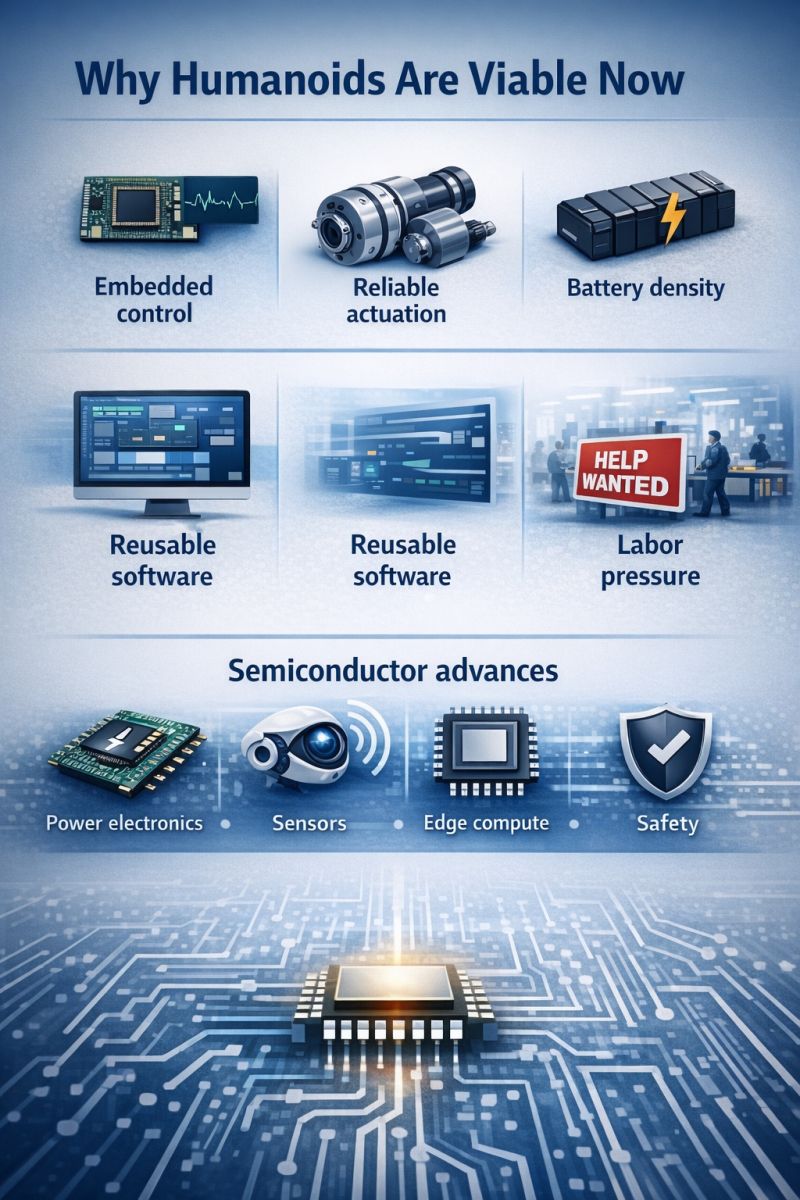
Humanoids are are emerging because several independent bottlenecks that blocked them for decades crossed minimum viability thresholds at roughly the same time.
1. Control stability under uncertainty became computable
Classical robotics failed at whole-body interaction not because of mechanics, but because real-time control under partial observability was intractable at acceptable cost and power. What changed is not “AI” as a concept, but the ability to run high-frequency perception, prediction, and control loops on compact, power-constrained hardware. Model predictive control plus learned policies became deployable at the edge, not just in labs.
Ten years ago, this required racks. Today it fits in a torso with tolerable thermals.
2. Actuation crossed the reliability–cost knee
Humanoids do not need perfect actuators. They need millions of reasonably cheap, reasonably precise, reasonably durable ones. That supply curve did not exist. Harmonic drives, integrated motor drives, compact power electronics, and field-replaceable joints are now “good enough” for pilot fleets. This is a manufacturing maturation, not a breakthrough.
3. Energy density reached an operational minimum
Batteries are still not great. They are just no longer disqualifying. A humanoid with one to two hours of useful work and fast swap capability can now exist without being absurd. Before, it could not. That matters more than lab-grade endurance.
4. Software reuse finally beats reinvention
ROS, simulation stacks, digital twins, and learned skill libraries reduced non-recurring engineering by an order of magnitude. Teams can now spend effort on integration instead of rebuilding the same locomotion and manipulation primitives. This compresses time to first deployment.
5. Labor substitution pressure moved from theory to accounting
For decades, labor shortage was discussed socially. Now it appears directly in factory uptime, warehouse throughput, and service availability metrics. CFOs see it as lost revenue, not a demographic chart. That changes willingness to fund ugly, imperfect machines.
Virtual AI is an enabler, not the trigger. Without physical control, safety, power, and reliability advances, better models would still be trapped behind the embodiment gap. Societal desire for automation is irrelevant. It has always existed.


Leave a Reply