
Functional Safety for Humanoid Robots: From Safe States to Situational Safety
“The greatest challenge in humanoid robotics is not teaching machines how to move. It is ensuring they always know how to move safely.”
Humanoid robots have captured the world’s imagination. Videos of robots performing backflips, climbing stairs, manipulating delicate objects, or collaborating with humans have become commonplace. Every few weeks, another manufacturer demonstrates a more capable machine, another foundation model promises increasingly general intelligence, and another factory announces pilot deployments of humanoids. The discussion surrounding this technological revolution almost always focuses on artificial intelligence, mechanical dexterity, battery technology, or computing performance. Yet one discipline quietly determines whether these remarkable demonstrations will ever become trusted products: Functional Safety.
Functional Safety has rarely attracted headlines. It is invisible when it works and painfully obvious when it fails. The automotive industry learned this lesson over decades. Modern aircraft, railway systems, industrial automation, and medical devices reached today’s extraordinary levels of reliability because engineers systematically analyzed hazards, anticipated failures, and designed systems capable of maintaining acceptable levels of risk under both normal and abnormal operating conditions. International standards such as IEC 61508, ISO 26262 and ISO 13849 did not emerge from theoretical discussions; they were developed through decades of engineering experience across safety-critical industries (Reference 01 – IEC 61508 Functional Safety Standard; Reference 02 – ISO 26262 Road Vehicles Functional Safety).
Humanoid robotics now stands at a similar inflection point. Early generations of robots primarily demonstrated technological feasibility. The next generation must demonstrate trustworthiness. Enterprises will not deploy thousands of humanoids because they can walk. They will deploy them because they can reliably perform useful work while operating safely around people, equipment, infrastructure and other robots. Safe operation is therefore not merely another engineering requirement. It becomes one of the central architectural challenges defining the commercial success of Physical AI.
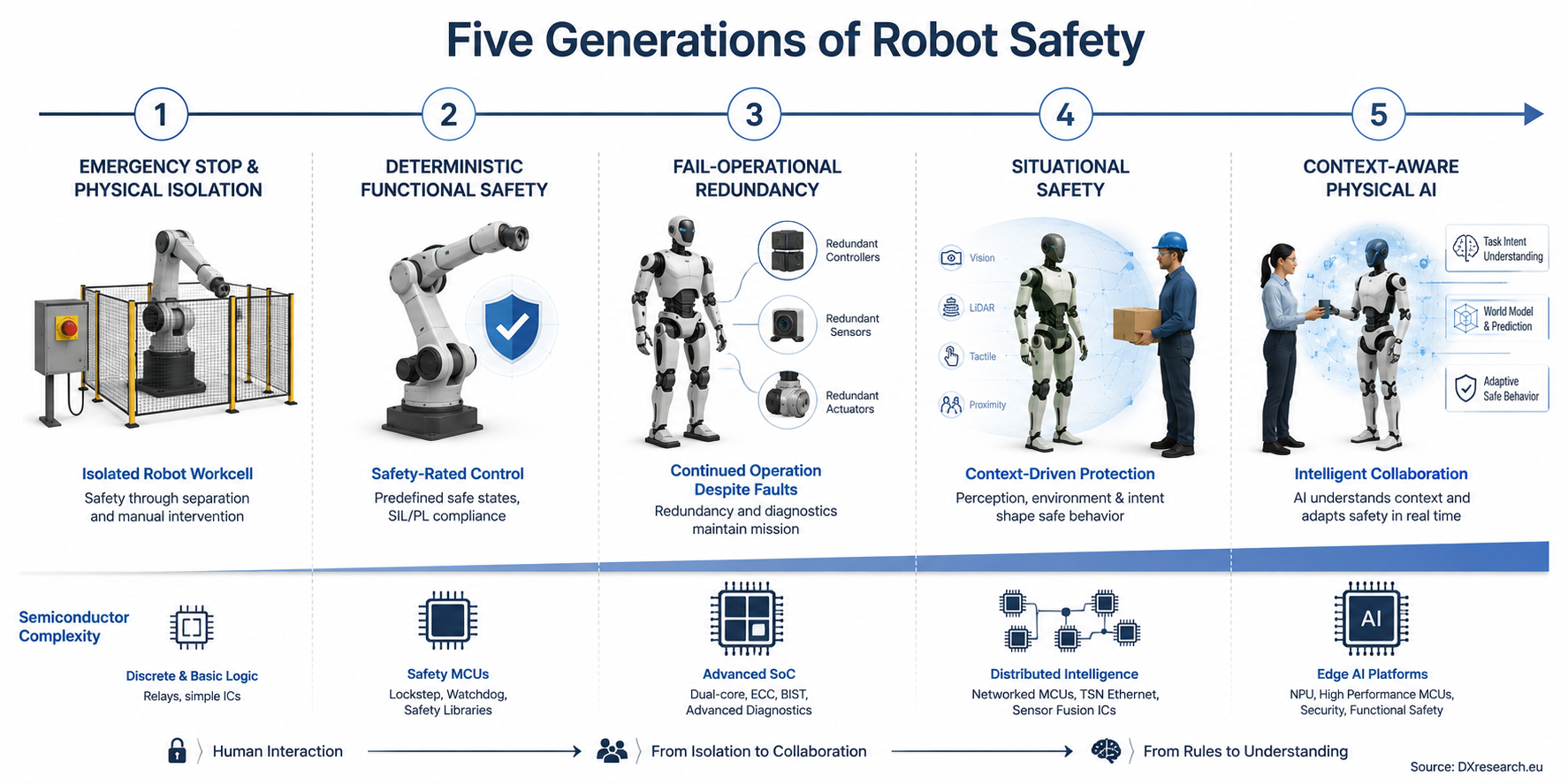
[Visual 01 – Evolution of Robot Safety: From Industrial Isolation to Physical AI]
The semiconductor industry occupies a unique position within this transformation. While robot manufacturers design complete systems, semiconductor companies increasingly determine which safety mechanisms become available at the system level. Modern microcontrollers integrate lockstep CPUs, error-correcting memories, hardware watchdogs, voltage monitors, clock supervision, communication diagnostics and increasingly sophisticated security functions. Intelligent gate drivers monitor power stages. Sensors incorporate self-diagnostics. Connectivity devices supervise network integrity. Memory devices protect against corruption. Security controllers establish trusted execution environments. None of these components individually makes a robot safe. Together, however, they provide the building blocks from which safe robotic architectures can be constructed (Reference 03 – Infineon Robotics Solutions; Reference 04 – Infineon Functional Safety Overview).
This distinction is important because Functional Safety has never been about certifying components in isolation. Safety always emerges from the interaction between components, software, mechanical systems, operating environments and human users. Semiconductors enable safety mechanisms, but system architects transform those mechanisms into complete safety concepts. As humanoid robots become increasingly autonomous, this architectural perspective becomes more important than ever.
The remarkable success of Functional Safety in automotive engineering naturally encourages engineers to transfer proven concepts into humanoid robotics. This transfer provides enormous value. Automotive electronics have accumulated decades of experience in fault analysis, diagnostics, redundancy management, software architecture and safety validation. Many semiconductor technologies now entering robotics were originally developed for electric vehicles, advanced driver assistance systems and steer-by-wire architectures. Automotive-qualified microcontrollers, power semiconductors, sensors and communication technologies already satisfy demanding reliability requirements under harsh environmental conditions. Leveraging these technologies dramatically accelerates the maturation of robotic platforms.
However, transferring technology does not necessarily imply transferring assumptions.
The environments encountered by autonomous vehicles remain highly dynamic, yet vehicles generally operate within relatively structured traffic systems. Steering systems always steer. Brake systems always brake. Electric propulsion systems always generate controlled torque. Even highly automated driving systems ultimately reduce complex decisions into relatively well-defined safety goals.
Humanoid robots represent something fundamentally different.
A humanoid may spend one moment assembling products inside a factory, the next assisting an elderly person, later carrying fragile equipment through a hospital, and eventually collaborating alongside another robot performing an entirely different task. Its physical configuration continuously changes. It may kneel, climb, crouch, balance, manipulate flexible objects, support human body weight, or intentionally make physical contact with people. Every activity introduces different hazards, different acceptable risks and different definitions of safe behavior.
This diversity fundamentally changes how engineers should think about Functional Safety.
Traditional safety engineering often revolves around identifying a predefined safe state. When hazardous conditions occur, the system transitions toward this state as rapidly and predictably as possible. In industrial machinery, stopping motion usually represents the preferred safe response. Automotive braking systems attempt controlled deceleration. Industrial robots frequently execute Safe Torque Off (STO), immediately removing motor torque to prevent unintended movement (Reference 05 – IEC 61800-5-2 Adjustable Speed Electrical Power Drive Systems – Functional Safety).
Such concepts remain highly valuable.
Yet humanoids increasingly encounter situations where simply stopping motion does not necessarily minimize risk.
Imagine a humanoid carrying a heavy battery module with a human coworker. Removing motor torque immediately may cause the shared load to fall. Consider a robot supporting a patient attempting to stand. Instantaneously disabling joint actuation may increase injury risk. A humanoid climbing stairs cannot safely enter a completely passive state without considering balance. A logistics robot transporting fragile medical equipment may need to maintain controlled posture while gradually reducing capability. Even an autonomous inspection robot operating offshore may require sufficient remaining functionality to reach a safe maintenance location before shutting down.
These examples illustrate an important observation.
There may no longer be one universally correct safe state.
Instead, safe behavior increasingly depends upon context.
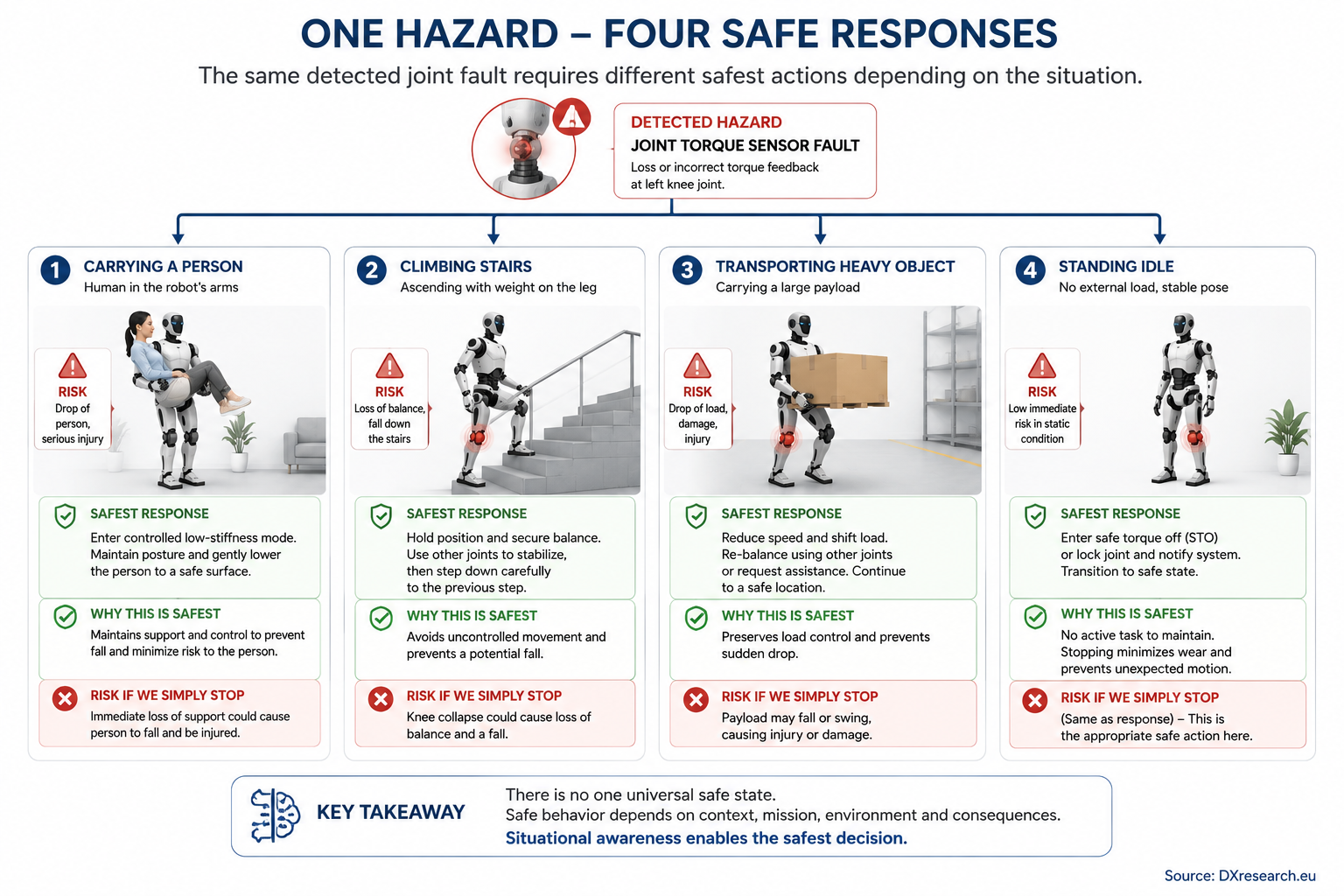
[Visual 02 – One Hazard, Multiple Context-Dependent Safe Responses]
This idea does not invalidate established Functional Safety principles. Rather, it expands them. Hazard analysis remains essential. Risk assessment remains essential. Diagnostic coverage remains essential. Hardware fault metrics remain essential. Verification, validation and systematic development remain essential. What changes is the architectural interpretation of how safe behavior should be achieved under increasingly complex operating conditions.
This distinction may appear subtle, yet it has profound implications for robot architecture.
Traditional Functional Safety often assumes deterministic control flows. Sensor inputs remain relatively predictable. Environmental conditions fall within well-characterized operating envelopes. Safety functions execute predefined logic according to thoroughly validated scenarios.
Humanoid robots challenge these assumptions because perception itself becomes part of the safety architecture.
Unlike conventional industrial automation, humanoids continuously observe and interpret their surroundings using cameras, radar, LiDAR, force sensors, tactile sensing, inertial measurement units, joint encoders, microphones and increasingly sophisticated multimodal AI models. These heterogeneous sensing modalities collectively construct an evolving understanding of the robot’s environment. Safety therefore depends not only upon reliable hardware but also upon maintaining sufficiently accurate situational awareness.
Consider a warehouse robot approaching a worker.
The safety decision extends far beyond obstacle detection. The robot may need to determine whether the person intends to cross its path, whether another worker approaches from behind, whether carried objects obstruct visibility, whether sufficient braking distance exists given the current payload, whether nearby robots influence available escape paths, and whether reducing speed, changing trajectory or temporarily stopping provides the safest overall outcome.
Safety thus becomes inseparable from perception.
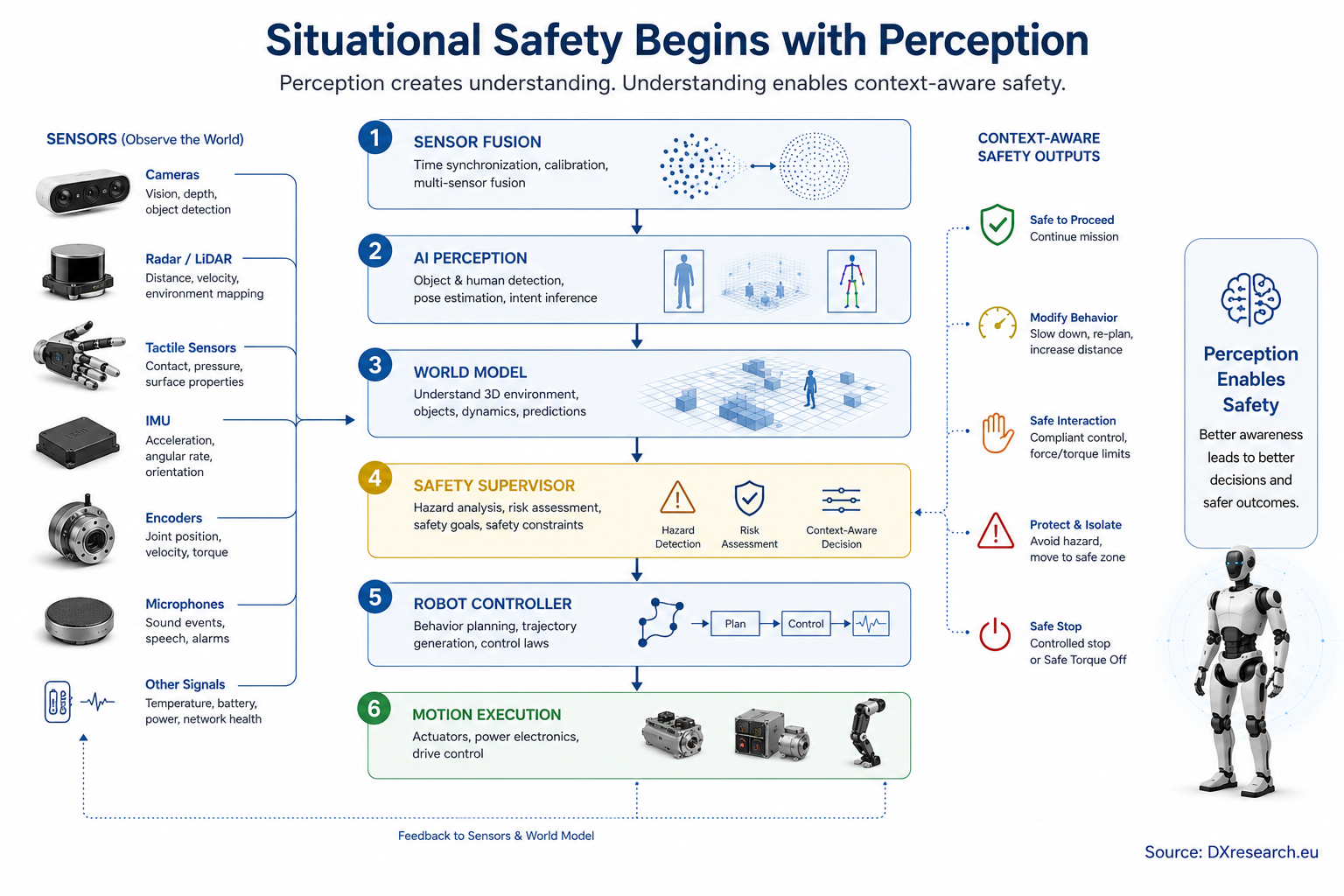
[Visual 03 – Situational Safety: Perception Driving Safe Behavior]
This observation introduces another architectural transition.
Historically, engineers frequently addressed increasing safety requirements through redundancy. Duplicate processors. Duplicate sensors. Duplicate communication channels. Duplicate power supplies. Triple Modular Redundancy (TMR) and lockstep execution dramatically improve fault tolerance in many applications. Aerospace, railway signalling and certain industrial systems continue to rely upon extensive redundancy because the consequences of failure justify the additional cost, weight and complexity.
Humanoid robots operate under different constraints.
Every additional processor increases thermal dissipation. Every duplicate sensor increases weight. Additional wiring reduces maintainability. Redundant batteries increase cost and charging time. More components require more diagnostics, additional software, larger mechanical structures and greater energy consumption.
The objective therefore cannot simply become “add redundancy.”
Instead, system architects must determine where redundancy creates meaningful safety improvement and where intelligent system behavior provides a better architectural solution.
This represents one of the defining engineering challenges of future humanoid robotics.
Instead of maximizing redundancy everywhere, engineers must optimize resilience.
Resilience encompasses much more than surviving hardware failures. It describes the ability of an entire robotic system to continue operating safely despite faults, degraded sensors, communication disturbances, unexpected environmental changes or partial subsystem failures. Some situations require complete shutdown. Others require graceful degradation. Still others may permit limited mission continuation under carefully constrained operating conditions.
The transition from redundancy toward resilience shifts engineering attention away from individual components and toward complete systems.
Consequently, Functional Safety increasingly becomes an exercise in systems engineering.
Rather than beginning with a single semiconductor device, architects must first understand the robot’s operational mission, interaction models, environmental assumptions, mechanical capabilities, software architecture, communication topology and human-machine interfaces. Only after establishing this comprehensive understanding can hazards be systematically decomposed into subsystem requirements, electronic architectures and ultimately semiconductor capabilities.
This decomposition process mirrors the hierarchical nature of modern robotics.
High-level safety goals influence behavioral requirements. Behavioral requirements determine perception requirements. Perception requirements define sensing architectures. Sensing architectures influence communication networks, compute platforms, power management, motor control, memory technologies and security functions. Finally, semiconductor products implement the required safety mechanisms supporting these architectural objectives.
The direction of engineering therefore increasingly flows from system understanding toward silicon implementation, rather than beginning with isolated electronic components.
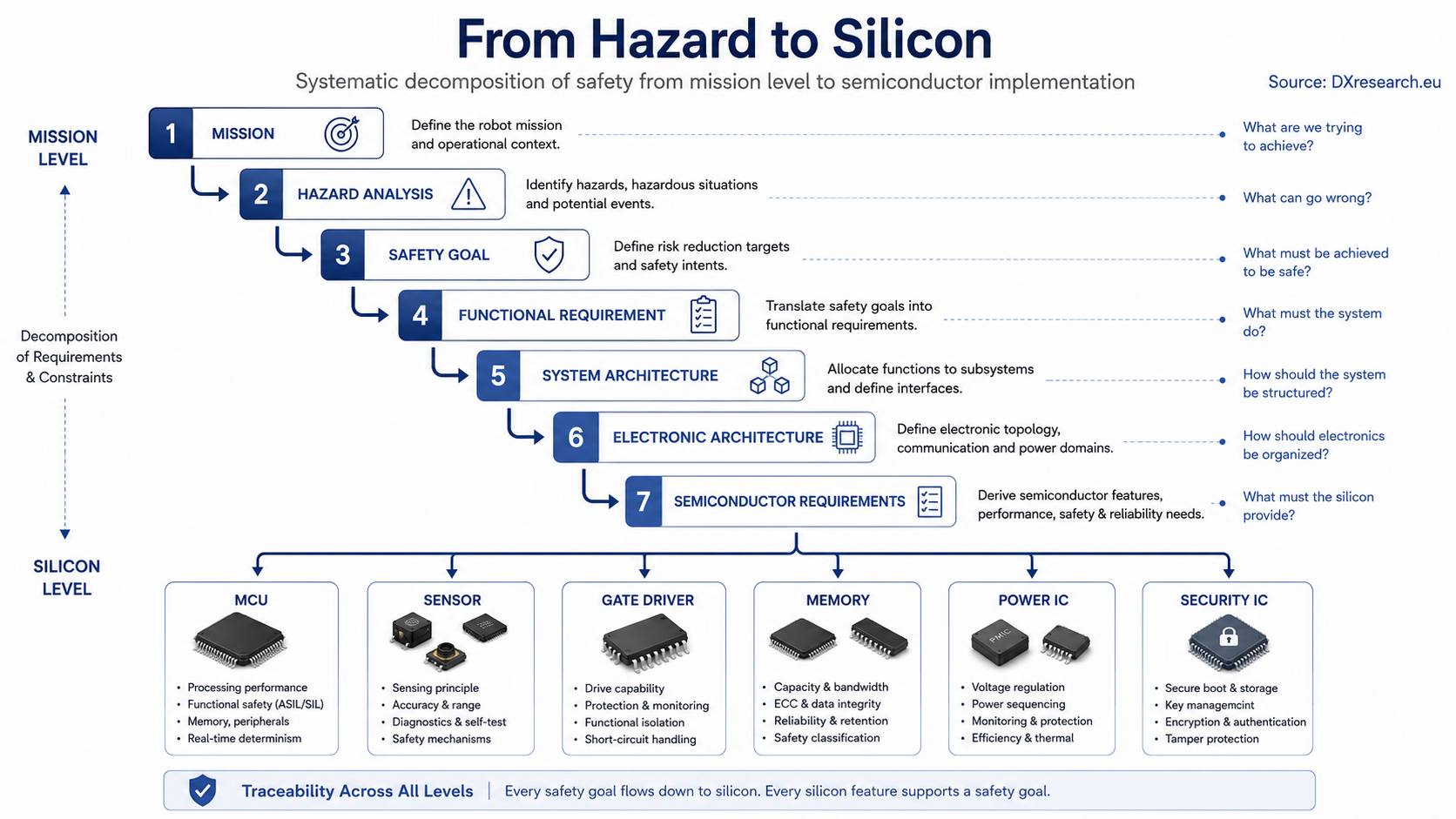
[Visual 04 – Decomposing Robot Safety: From Mission-Level Hazard to Semiconductor Requirement]
This perspective also explains why Functional Safety expertise is becoming increasingly interdisciplinary. Mechanical engineers, AI specialists, embedded software developers, cybersecurity experts, power electronics architects, communication specialists and semiconductor engineers can no longer optimize their respective domains independently. Safe humanoid robots emerge only when these disciplines converge around a shared architectural understanding of acceptable risk, dependable behavior and trustworthy operation.
The future of Functional Safety will therefore be shaped not only by better components but by better systems thinking.
From Situational Safety to Intelligent Safety Engineering: How AI, Distributed Electronics and Semiconductor Architectures Will Shape the Next Generation of Trustworthy Humanoid Robots
If Functional Safety is evolving from predefined safe states toward situational safety, then another question naturally follows: how can a robot determine what constitutes the safest behavior within an environment that changes continuously? The answer is unlikely to emerge from any single technology. Instead, it will result from the convergence of perception, distributed computing, deterministic communication, embedded intelligence, semiconductor innovation and classical systems engineering. Future humanoids will not simply execute predefined safety reactions. They will increasingly interpret situations, evaluate available options and execute the safest achievable behavior within the constraints imposed by physics, hardware capability and certification requirements. This does not imply replacing deterministic safety mechanisms with artificial intelligence. Rather, it means combining proven Functional Safety engineering with intelligent situational awareness, allowing robots to achieve levels of resilience that would otherwise require impractical amounts of hardware redundancy. This distinction is essential because Functional Safety remains grounded in determinism, traceability and verification, while intelligent algorithms provide additional context that can improve decision quality without becoming the safety mechanism itself (Reference 06 – ISO/TR 5469 Artificial Intelligence — Functional Safety and AI Systems).
This architectural evolution begins with a simple observation. Every humanoid robot continuously creates an internal representation of the world. Cameras reconstruct three-dimensional geometry. Force sensors estimate interaction loads. Joint encoders determine body posture. Inertial sensors estimate balance. Microphones detect acoustic events. Thermal sensors supervise electronics. Battery management systems evaluate available energy. Network controllers monitor communication latency. Motor controllers estimate torque and detect abnormal mechanical behavior. Cybersecurity modules verify software integrity. None of these subsystems alone determines whether a robot is safe. Safety emerges from their collective interpretation.
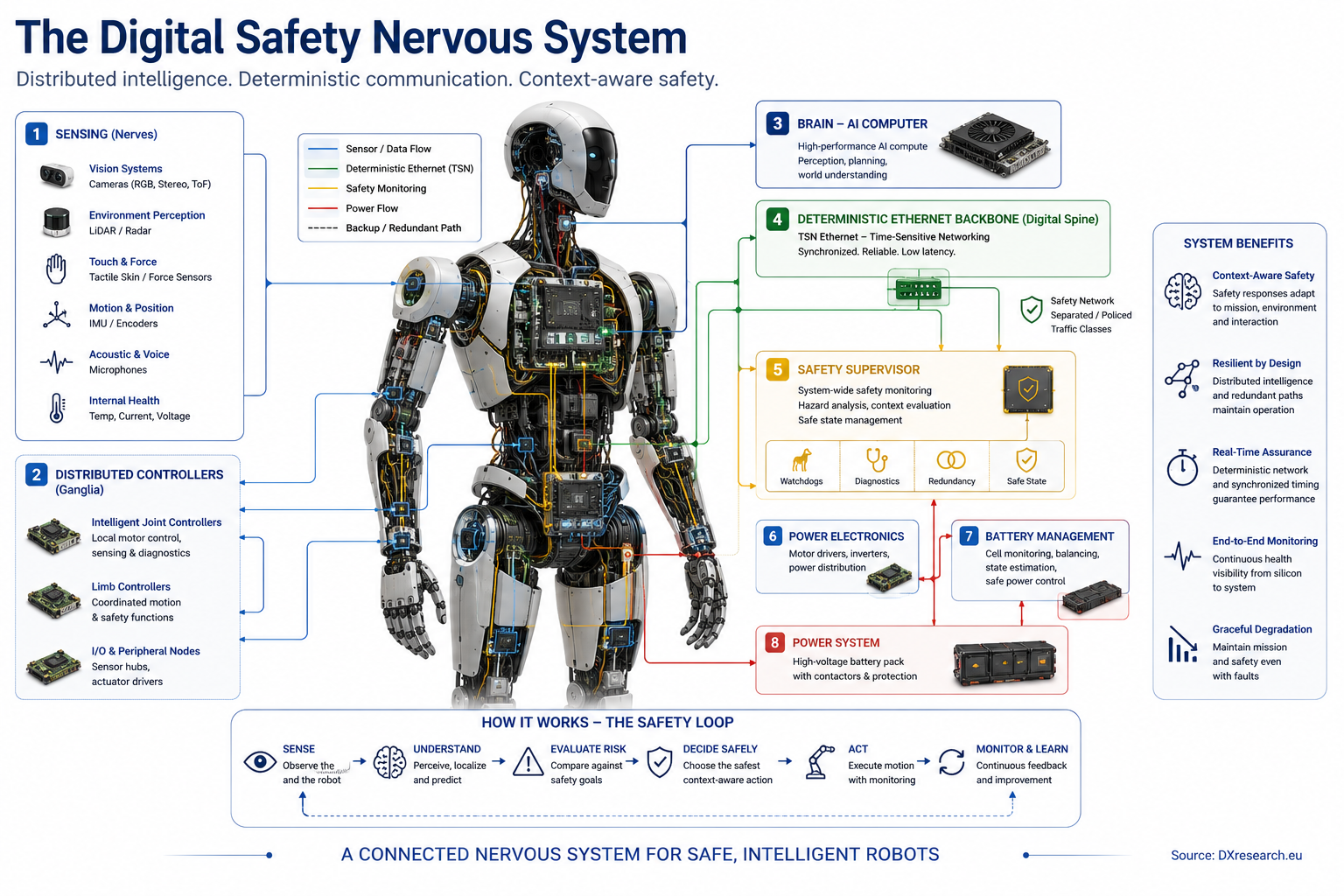
[Visual 05 – The Digital Safety Nervous System]
One useful analogy is the human nervous system. Human safety rarely depends upon a single sensory organ. Instead, vision, hearing, touch, balance and prior experience continuously interact within the brain to determine appropriate behavior. If vision becomes temporarily impaired, balance and touch often compensate. If one muscle becomes injured, others adapt. Humans constantly operate in degraded but safe modes without consciously recognizing the complexity involved. Humanoid robots will require similar architectural resilience, although implemented through deterministic engineering principles rather than biological evolution.
This analogy also reveals why centralized safety architectures eventually reach practical limits. Early generations of robots often concentrated perception, decision making and safety supervision inside one central controller. Such architectures simplify development but create increasing computational bottlenecks as robots become more capable. Hundreds of sensors continuously generate data streams requiring interpretation within milliseconds. High-bandwidth cameras alone may produce several gigabits per second of information. Motor controllers require deterministic torque updates every few hundred microseconds. Safety monitoring must execute independently of non-critical workloads. AI inference demands enormous computational resources while simultaneously sharing information with perception, localization and manipulation software. The result is a rapidly growing architectural challenge.
The solution increasingly points toward distributed intelligence.
Rather than treating every joint, sensor and actuator as passive peripherals, future humanoids will likely transform them into intelligent nodes capable of performing local monitoring, diagnostics and limited safety functions before communicating higher-level information through deterministic networks. Intelligent motor controllers can locally supervise overcurrent conditions, estimate motor temperature, detect encoder inconsistencies and execute predefined protective actions within microseconds. Smart sensors can continuously verify calibration, monitor signal integrity and communicate confidence metrics rather than raw measurements alone. Distributed battery management systems can independently supervise cell health while coordinating system-level energy optimization. Such architectures reduce communication latency, improve scalability and allow safety mechanisms to operate even if higher-level software becomes temporarily unavailable.
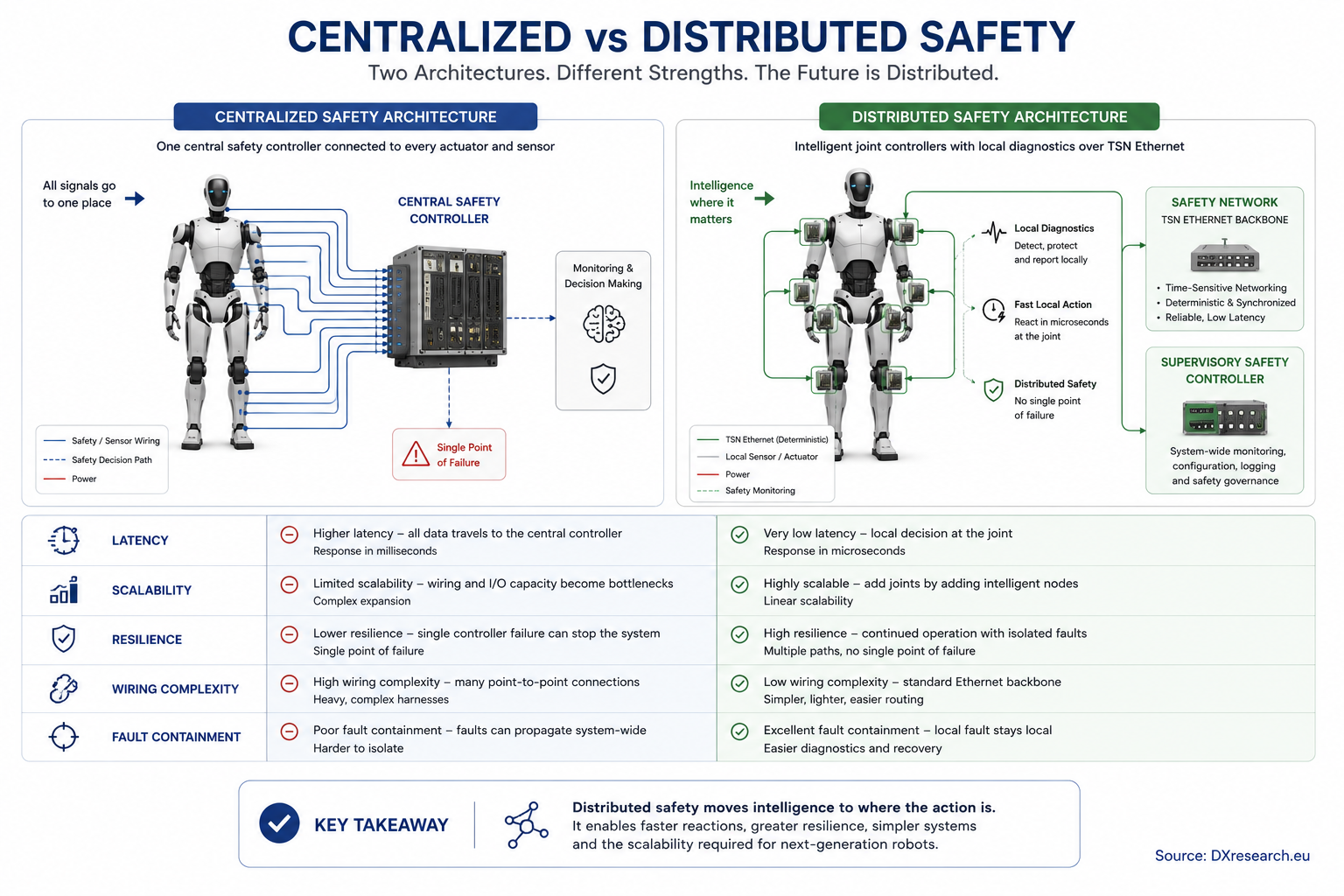
[Visual 06 – Centralized versus Distributed Safety Architecture]
Semiconductor technologies play a decisive role within this transformation. Safety-qualified microcontrollers increasingly integrate multiple processing domains, hardware security modules, lockstep execution, error-correcting memories, voltage supervision, clock monitoring, communication diagnostics and hardware accelerators supporting deterministic real-time execution. Intelligent gate drivers supervise power stages while monitoring short circuits, overtemperature events and gate integrity. Sensor technologies incorporate built-in self-test functions, redundant measurement principles and continuous diagnostics. Communication devices increasingly support deterministic Ethernet, Time-Sensitive Networking (TSN), Single Pair Ethernet (SPE) and advanced synchronization capabilities required for distributed robotic systems (Reference 07 – IEEE 802.1 Time-Sensitive Networking Overview).
The significance of these technologies extends beyond individual products. Each hardware capability becomes another architectural building block from which complete safety concepts can be constructed. A hardware watchdog is not valuable merely because it resets processors. Its value emerges from how system architects integrate it within larger diagnostic strategies. Error correction codes protect memories, but only when software properly interprets corrected and uncorrected faults. Secure boot establishes trusted execution, but only when combined with robust software lifecycle management. Functional Safety therefore becomes an exercise in architectural composition rather than component selection.
This perspective significantly changes how future semiconductor products should be defined.
Historically, semiconductor requirements frequently originated from individual applications. A motor controller required specific PWM channels. A communication controller required higher bandwidth. A sensor required improved accuracy. Increasingly, however, requirements will originate from complete robotic behaviors. Consider a robot required to continue supporting a human after losing one joint encoder. The resulting safety analysis propagates downward through multiple architectural layers. The robot must estimate body stability. The control system requires alternative state estimation. Communication networks must guarantee deterministic availability. Power electronics must continue supplying controlled torque. Microcontrollers require additional computational capacity. Sensors require redundancy or plausibility checking. Memory protection must maintain software integrity. Security mechanisms must ensure trustworthy software execution. What initially appears as one behavioral requirement ultimately decomposes into dozens of semiconductor capabilities distributed across the entire electronic architecture.
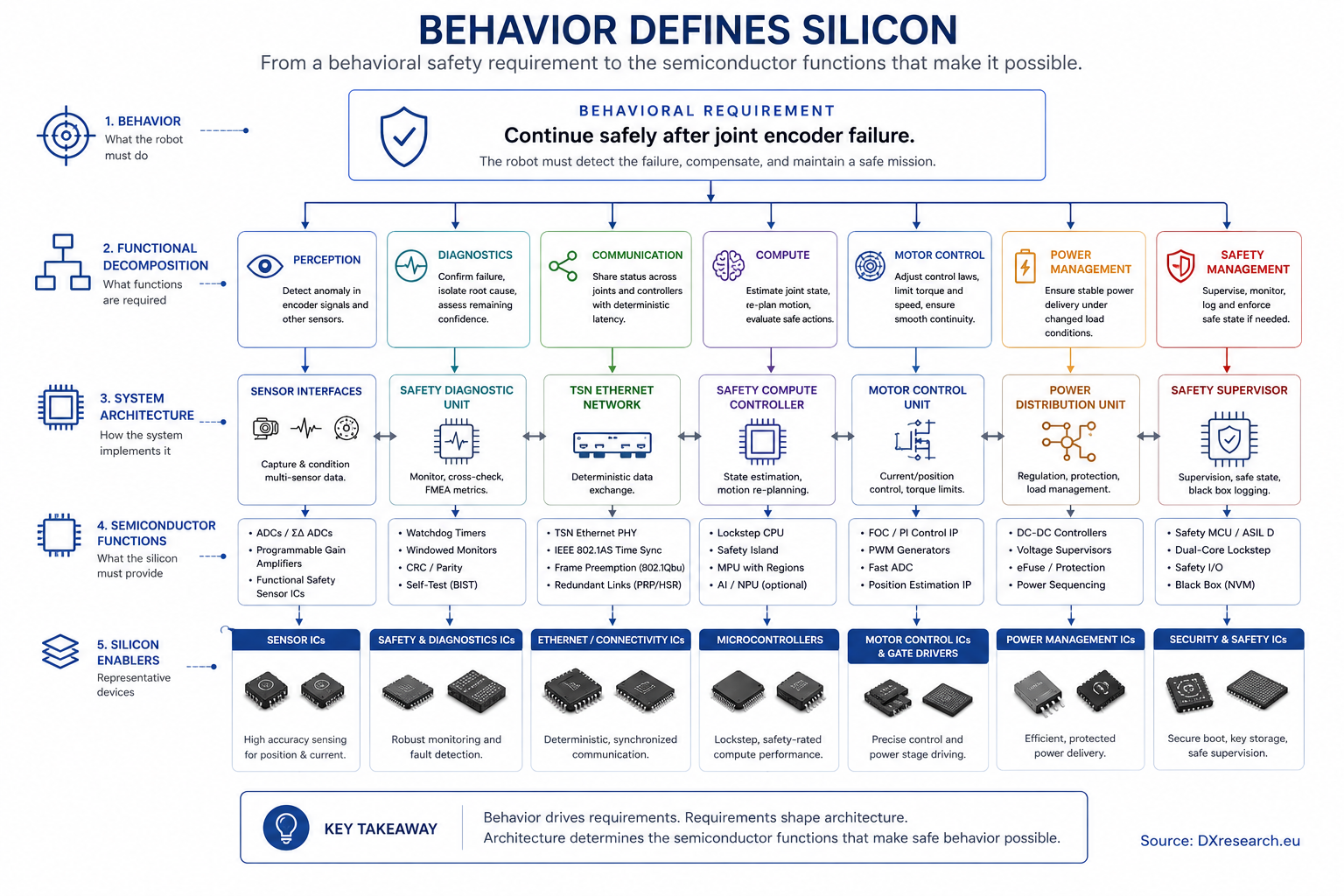
[Visual 07 – From Behavioral Requirement to Semiconductor Feature]
This decomposition process represents one of the most important future responsibilities of system architects working within semiconductor companies. Rather than designing individual integrated circuits in isolation, architects increasingly translate future robotic capabilities into semiconductor roadmaps spanning multiple product families. Such work requires understanding robotics, AI, communication networks, safety standards, power electronics, sensing technologies and software architectures simultaneously. The semiconductor industry therefore moves closer to becoming an architectural partner than a traditional component supplier.
Artificial intelligence may further strengthen this transition by transforming how engineers develop safety concepts themselves. Hazard Analysis and Risk Assessment (HARA), Failure Modes and Effects Analysis (FMEA), Fault Tree Analysis (FTA) and Failure Modes, Effects and Diagnostic Analysis (FMEDA) remain indispensable engineering methodologies. Yet the increasing complexity of humanoid robots makes manual analysis progressively more demanding. Hundreds of interacting subsystems generate enormous combinations of operating conditions, failure mechanisms and environmental influences. AI technologies may assist engineers by exploring design alternatives, identifying overlooked hazard combinations, proposing diagnostic strategies or automatically tracing safety requirements across increasingly complex architectures. Importantly, AI should be viewed as an engineering assistant supporting human experts rather than replacing certified engineering judgment.
Digital engineering environments may become equally transformative. High-fidelity digital twins already accelerate mechanical development and manufacturing optimization. Their future application within Functional Safety appears equally promising. Entire robotic systems may be subjected to millions of simulated fault conditions long before physical prototypes exist. Semiconductor failures, communication disturbances, degraded sensors, cyberattacks and environmental variations can be evaluated within virtual environments, allowing engineers to optimize safety concepts continuously throughout development. Such approaches complement physical validation while significantly reducing development cycles and improving architectural robustness.
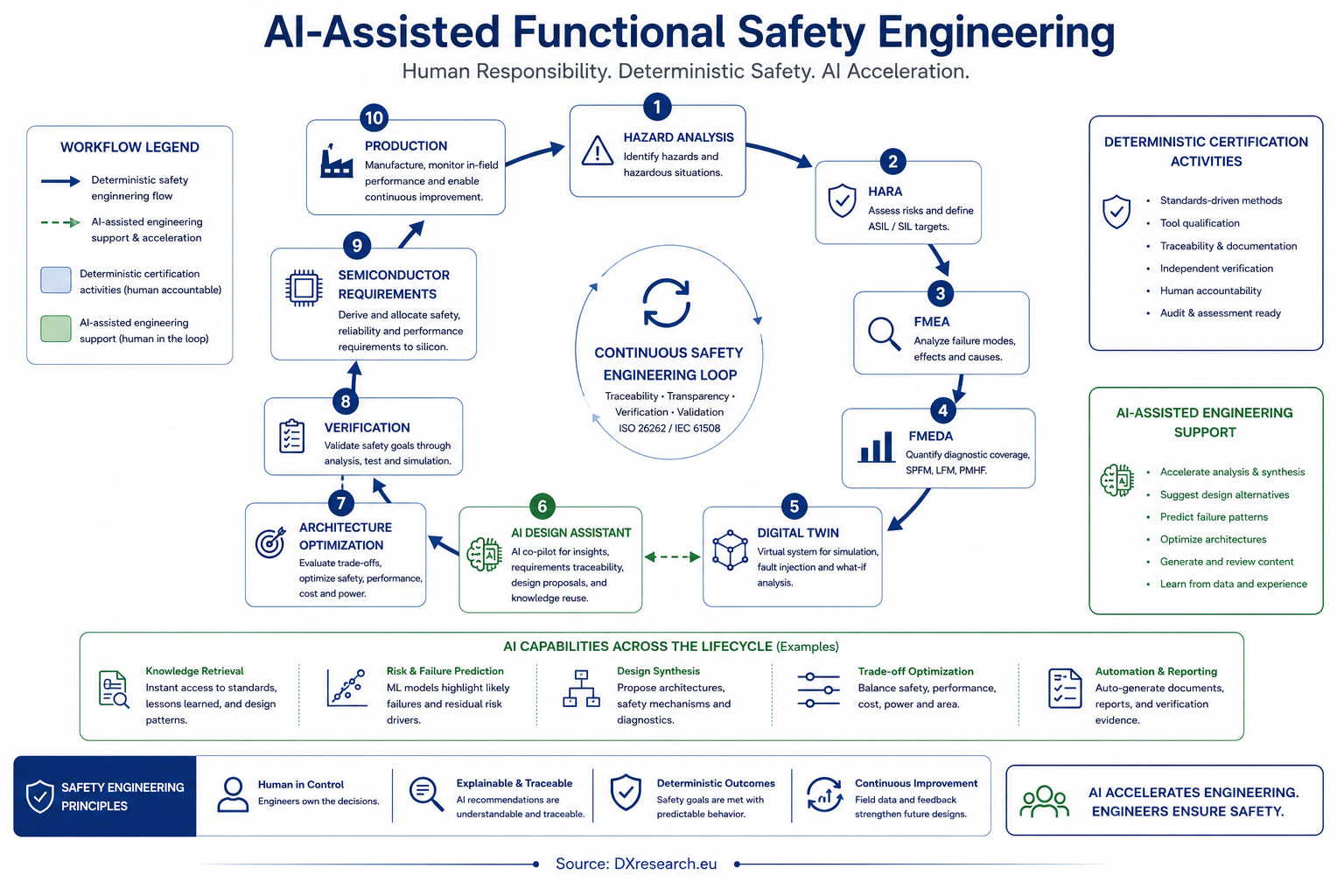
[Visual 08 – AI-Assisted Safety Engineering Workflow]
Cybersecurity introduces another dimension that can no longer remain separated from Functional Safety. Historically, accidental faults and malicious attacks were often considered independently. Autonomous humanoids increasingly erase this distinction. A compromised communication channel may produce unsafe behavior. Manipulated sensor information may invalidate safety assumptions. Unauthorized software updates may disable diagnostics. Consequently, trustworthy robots require Functional Safety and cybersecurity to evolve together rather than independently. International standards increasingly acknowledge this convergence, recognizing that dependable autonomous systems require coordinated treatment of both accidental failures and intentional threats (Reference 08 – ISO/SAE 21434 Road Vehicles Cybersecurity Engineering).
The convergence of AI, cybersecurity and Functional Safety further reinforces the importance of trustworthy semiconductor platforms. Hardware roots of trust, secure execution environments, cryptographic accelerators, physically unclonable functions, authenticated firmware updates and protected communication increasingly become foundational elements supporting safe robotic operation. Although these technologies originated primarily within automotive and security applications, their relevance to humanoid robotics continues to grow as robots become permanently connected members of larger digital ecosystems.
The semiconductor industry’s accumulated experience therefore represents an important accelerator rather than merely a source of individual products. Decades of automotive Functional Safety development have produced mature engineering processes, diagnostic methodologies, qualification procedures and safety documentation that can substantially reduce development risk for robotics manufacturers. Companies such as Infineon have invested extensively in safety-qualified microcontrollers, sensors, power semiconductors, memories, connectivity solutions and engineering support aligned with international Functional Safety standards. While humanoid robots introduce fundamentally new architectural questions, they also benefit enormously from engineering knowledge accumulated across electric mobility, industrial automation, energy infrastructure and transportation. The opportunity lies not in directly copying automotive architectures, but in thoughtfully adapting proven engineering principles to a new class of intelligent machines (Reference 09 – Infineon Robotics Solutions; Reference 10 – Infineon Functional Safety ISO 26262 Overview).
Perhaps the most significant transformation, however, concerns engineering culture itself. Functional Safety can no longer remain the responsibility of a specialized team entering projects after major architectural decisions have already been made. Instead, safety considerations increasingly influence every stage of system design, from mechanical layout and battery architecture to communication topology, AI software, semiconductor selection and cloud connectivity. Every engineering discipline contributes to trustworthy behavior because every engineering decision potentially affects system resilience. This broader perspective transforms Functional Safety from a compliance activity into a fundamental design philosophy.
Such a philosophy recognizes that future humanoid robots will never operate within perfectly predictable environments. They will continuously encounter uncertainty, ambiguity and unexpected interactions. Their safety therefore cannot depend solely upon predefined reactions stored within static decision tables. Instead, trustworthy robots will emerge through carefully engineered combinations of deterministic safety mechanisms, intelligent perception, distributed architectures, resilient communication, dependable semiconductors and rigorous systems engineering. The objective remains unchanged: protecting people and reducing risk to acceptable levels. The means of achieving this objective, however, continue to evolve alongside the remarkable capabilities of Physical AI.
Ultimately, the question facing the robotics industry is not whether Functional Safety remains relevant. Its relevance has never been greater. The real question is whether engineers are prepared to extend decades of proven safety engineering into architectures that perceive, reason, collaborate and adapt within an unpredictable physical world. Achieving this vision will require new standards, new semiconductor capabilities, new development methodologies and perhaps most importantly, a new generation of system architects capable of thinking simultaneously across electronics, software, mechanics, artificial intelligence and human interaction. Trustworthy humanoids will not emerge from any single breakthrough. They will emerge from the careful orchestration of thousands of engineering decisions, many of them invisible to end users, but all of them ultimately determining whether society chooses to trust robots as partners in everyday life.
Glossary of Abbreviations and Key Terms
AI (Artificial Intelligence): Computational methods enabling machines to perceive, reason, learn or make decisions from data.
ASIL (Automotive Safety Integrity Level): Risk classification defined by ISO 26262, ranging from ASIL A to ASIL D, with D representing the highest integrity requirements.
Context-Aware Safety: A safety approach where the appropriate protective action depends on the robot’s current task, environment and interaction rather than one predefined response.
Deterministic Communication: Communication with guaranteed timing and bounded latency, essential for distributed real-time control.
Digital Twin: A virtual representation of a physical system used for simulation, validation, optimization and lifecycle management.
Distributed Safety Architecture: A safety architecture where intelligent safety functions are executed across multiple electronic nodes rather than one centralized controller.
FMEDA (Failure Modes, Effects and Diagnostic Analysis): Engineering method used to determine failure modes, diagnostic coverage and hardware safety metrics.
FTA (Fault Tree Analysis): Top-down analytical technique for identifying combinations of failures leading to hazardous events.
Functional Safety (FuSa): Part of overall system safety that depends upon electrical, electronic or programmable systems operating correctly in response to inputs or failures.
Graceful Degradation: Maintaining reduced but safe functionality following faults rather than immediately shutting the system down.
HARA (Hazard Analysis and Risk Assessment): Structured process for identifying hazards and deriving safety goals.
Hardware Safety Mechanism: Circuit-level feature such as watchdogs, lockstep execution, ECC memory or voltage supervision used to detect or mitigate failures.
Human-Robot Collaboration (HRC): Safe physical interaction between humans and robots within shared workspaces.
Mission-Operational: Maintaining sufficient functionality to safely complete or terminate a mission following selected failures.
Physical AI: Artificial intelligence embodied within physical machines capable of sensing, reasoning and interacting with the real world.
PRO-SIL™: Infineon’s designation for products supporting Functional Safety integration according to relevant standards.
Resilience: The capability of a system to maintain safe operation despite faults, degraded conditions or unexpected events.
Safe State: A system condition that reduces risk to an acceptable level after detection of a hazardous fault.
Situational Safety: The architectural concept introduced in this chapter describing safety behavior that adapts according to mission, environment and current operating context.
TSN (Time-Sensitive Networking): IEEE Ethernet extensions enabling deterministic, synchronized communication across distributed systems.
References
Reference 01 – IEC 61508: Functional Safety of Electrical/Electronic/Programmable Electronic Safety-Related Systems
Publication: IEC 61508 Edition 2, 2010
Abstract (~20 words): Foundational international Functional Safety standard defining lifecycle processes, Safety Integrity Levels (SIL) and engineering practices for safety-related E/E/PE systems.
Verified URL: https://61508.org/knowledge/what-is-iec-61508/
Reference 02 – ISO 26262 – Functional Safety
Publication: Current Infineon overview (continuously maintained)
Abstract (~20 words): Explains ISO 26262 concepts, safety lifecycle support, PRO-SIL™ classifications and documentation supporting automotive Functional Safety integration.
Verified URL: https://www.infineon.com/quality/certifications-and-standards/functional-safety/functional-safety-iso26262
Reference 03 – Robotics | Infineon Technologies
Publication: Current robotics solution portal
Abstract (~20 words): Describes semiconductor building blocks for humanoids, industrial robots and mobile robots including power, sensing, compute, connectivity and safety.
Verified URL: https://www.infineon.com/applications/industrial/robotics
Reference 04 – Functional Safety | Infineon Technologies
Publication: Current Functional Safety overview
Abstract (~20 words): Overview of Infineon’s Functional Safety strategy, standards support, PRO-SIL™ program and safety-enabled semiconductor portfolio.
Verified URL: https://www.infineon.com/quality/certifications-and-standards/functional-safety
Reference 05 – AURIX™ TC3xx IEC61508 Applications
Publication Date: 28 September 2022 (updated 30 June 2026)
Abstract (~20 words): Explains reuse of ISO 26262 safety work products for IEC 61508 industrial applications including robotics and safety instrumented systems.
Verified URL: https://community.infineon.com/t5/Knowledge-Base-Articles/AURIX-MCU-TC3xx-IEC61508-applications/ta-p/373282
Reference 06 – ISO/IEC TR 5469:2024 Artificial Intelligence — Functional Safety and AI Systems
Publication Date: 8 January 2024
Abstract (~20 words): Technical report discussing AI inside safety functions, protecting AI-controlled equipment and using AI to develop safety-related systems.
Verified URL: https://webstore.iec.ch/en/publication/90977
Reference 07 – Time-Sensitive Networking for Robotics
Publication Date: 20 April 2018
Abstract (~20 words): Reviews deterministic Ethernet technologies for robotics and demonstrates how TSN enables unified real-time communication across robotic subsystems.
Verified URL: https://arxiv.org/abs/1804.07643
Reference 08 – Security Standards | Infineon Technologies
Publication: Current security standards overview
Abstract (~20 words): Summarizes cybersecurity standards including ISO/SAE 21434 and explains security-by-design approaches supporting safety-critical connected systems.
Verified URL: https://www.infineon.com/quality/security/security-standards
Reference 09 – AURIX™ Functional Safety in a Nutshell
Publication: Current AURIX documentation
Abstract (~20 words): Explains Functional Safety principles, standards hierarchy, safety levels and implementation concepts for AURIX microcontrollers.
Verified URL: https://documentation.infineon.com/aurixtc3xx/docs/owq1745576218449
Reference 10 – Automotive Functional Safety Presentation
Publication Date: 19 March 2024
Abstract (~20 words): Describes Infineon’s Functional Safety lifecycle support, documentation ecosystem, application engineering services and safety-oriented semiconductor development.
Verified URL: https://www.infineon.com/dgdl/Infineon-Automotive_Functional_Safety-Presentations-v01_00-EN.pdf?fileId=5546d4627572d8fd01757a183adf47c2


Leave a Reply