
For decades, Functional Safety has evolved around machines with well-defined operating modes and clearly defined safe states.
Humanoid robots challenge some of those assumptions.
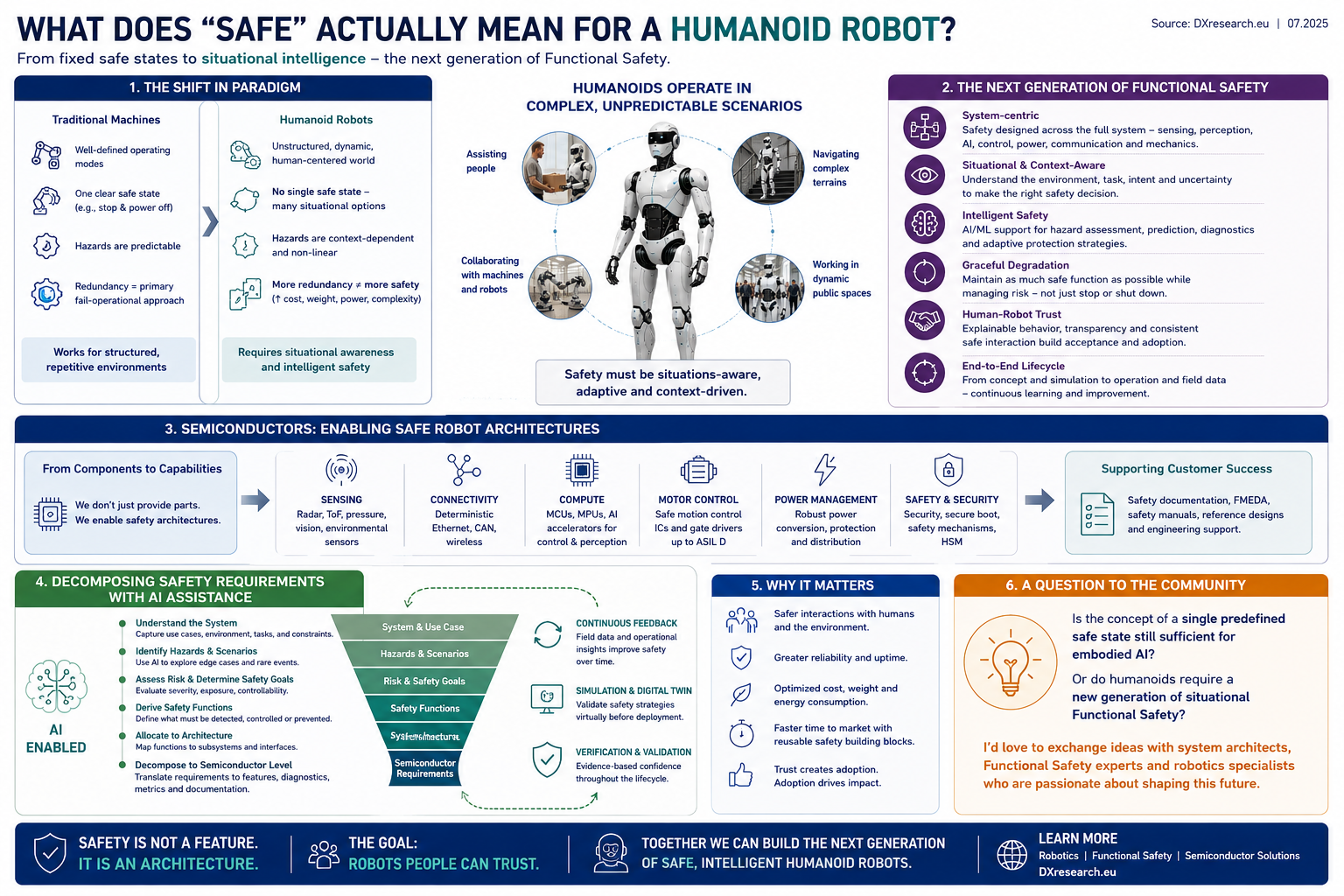
A robot assisting a worker, carrying a box, climbing stairs or collaborating with another robot may not have one obvious “safe state.” Simply stopping may create a new hazard. Blindly applying redundancy everywhere is unlikely to scale—it adds cost, weight, power consumption and complexity.
I believe the next generation of Functional Safety will become far more system-centric, situational and intelligent.
🧠 Safety architectures will need to understand context.
⚙️ AI may become part of hazard assessment, diagnostics and graceful degradation.
🔄 Safe operation may increasingly rely on coordinated sensing, perception, communication, motion control, power management and intelligent decision-making.
🔬 That also changes the role of semiconductors.
Instead of thinking about individual components, we need to understand the complete robotic architecture, derive future safety concepts, and translate them into the semiconductor technologies, safety mechanisms and documentation that enable our customers to build trustworthy robots.
This is one reason I enjoy working at Infineon. Decades of Functional Safety experience from automotive and industrial applications provide a strong foundation—but humanoid robotics gives us the opportunity to rethink how that expertise evolves for Physical AI.
I’m curious how others see this.
💬 Are we approaching Functional Safety for humanoids with yesterday’s mindset?
And are there system architects, Functional Safety experts or robotics specialists who are excited by these questions? I’d genuinely enjoy exchanging ideas with people who are thinking beyond today’s architectures.
Further reading:
https://www.infineon.com/applications/industrial/robotics
https://www.infineon.com/quality/certifications-and-standards/functional-safety/functional-safety-iso26262
https://documentation.infineon.com/aurixtc3xx/docs/usu1745575813611


Leave a Reply