
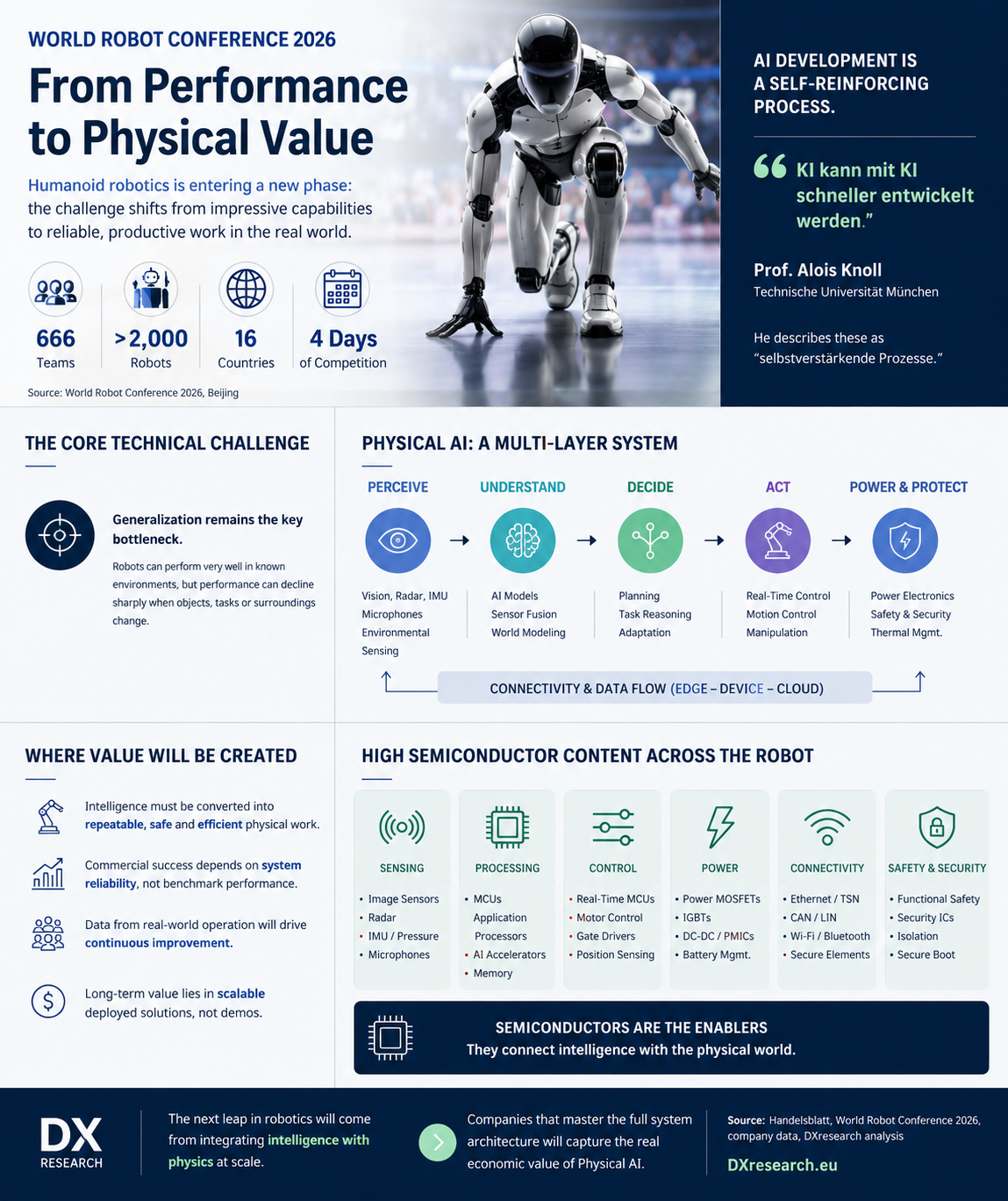
The World Robot Conference offers a useful view of where humanoid robotics is moving: from impressive capabilities toward the harder question of reliable deployment.
The Handelsblatt article highlights one of the core technical constraints clearly: generalization. Robots can perform strongly in known environments, but performance can fall quickly when objects, tasks or surroundings change. (https://www.handelsblatt.com/technik/ki/ki-chinas-humanoide-roboter-schlagen-saltos-aber-koennen-sie-auch-arbeiten/100244956.html)
Prof. Alois Knoll describes AI development as a self-reinforcing process: “KI kann mit KI schneller entwickelt werden.” That acceleration will matter across model development, simulation, control software and system optimization.
From a business perspective, the implication is broader than AI compute alone.
Humanoids will require a tightly integrated architecture spanning sensing, embedded intelligence, deterministic control, connectivity, safety, security and power electronics. Commercial value will come from converting intelligence into repeatable physical work.
The companies best positioned will be those that can make Physical AI robust, efficient and scalable in real operating environments.


Leave a Reply