
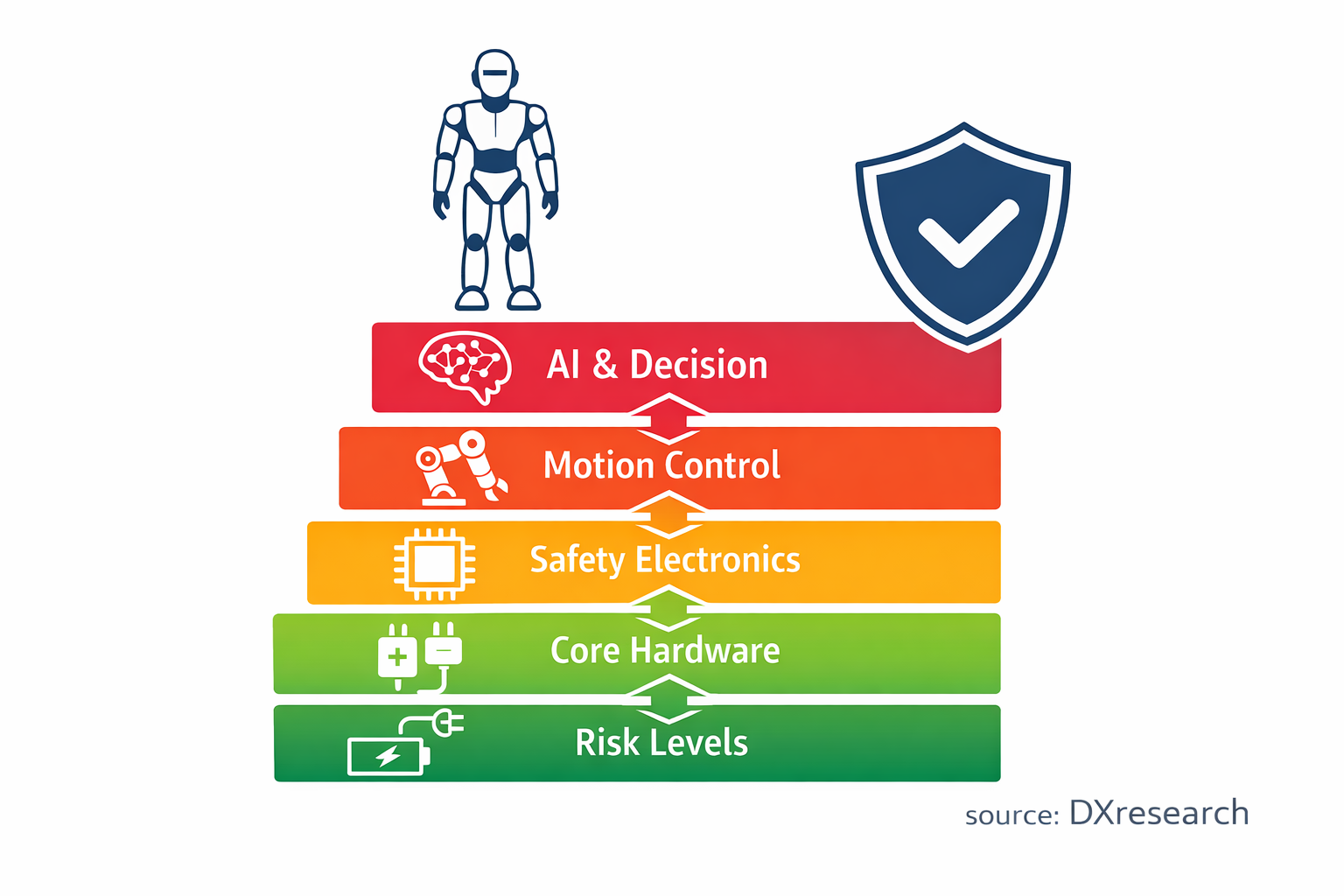
Functional safety in humanoid systems is converging across industries, pointing toward adaptive, AI-aware architectures as the emerging baseline for trust and scalability.
🤖 Executive perspective
Humanoid robotics is transitioning from prototype to deployment. Safety becomes a gating factor for scale, investment, and public acceptance. Established frameworks such as IEC 61508 provide foundational guidance for risk reduction and lifecycle processes (https://www.iec.ch/dyn/www/f?p=103:85:0::::FSP_LANG_ID:25). The current shift centers on integrating these principles into systems that combine mobility, manipulation, and cognition in one platform.
🚗 Automotive lens
Automotive safety introduced structured risk classification through ASIL, embedding severity, exposure, and controllability into system design (https://www.iso.org/standard/68383.html). This approach translates well into humanoids where human interaction is continuous and situational awareness defines acceptable behavior. The concept of controllability gains relevance when robots operate in shared human environments.
🏭 Industrial robotics lens
Industrial standards define safe operation through constrained environments, physical separation, and validated force limits (https://www.iso.org/standard/51330.html). Collaborative robotics extended this model toward human interaction. Humanoids expand the scope further, requiring safety concepts that remain effective in dynamic and unstructured environments.
🧠 AI and autonomy dimension
AI introduces probabilistic decision-making. Safety engineering traditionally relies on deterministic system behavior. Emerging work on trustworthy AI highlights robustness, explainability, and risk management as key pillars (https://www.iso.org/committee/6794475.html). These elements shape how future safety frameworks will handle uncertainty at runtime.
⚙️ System architecture perspective
Safety in humanoids evolves into a layered architecture
- Hardware integrity through redundancy and diagnostics
- Safe motion control with torque, speed, and position supervision
- System-level fault handling and state transitions
- AI monitoring and confidence evaluation
This layered approach aligns with existing standards while extending them into new domains.
📊 Standardization outlook
The emergence of a dedicated Robot Safety Integrity Level remains an open discussion. Industry momentum suggests evolution through harmonization of existing frameworks rather than the creation of a standalone classification. Regulatory initiatives such as the EU AI Act introduce risk-based obligations for high-risk AI systems, including robotics applications (https://artificialintelligenceact.eu/).
🔍 Implications for semiconductor strategy
Semiconductors increasingly define the safety envelope
- Microcontrollers with integrated safety mechanisms
- Power devices enabling controlled actuation
- Sensor fusion supporting reliable perception
- Hardware features supporting AI supervision
The opportunity lies in enabling system-level safety through integrated solutions that scale across applications.
📈 Conclusion
Humanoid robotics safety is entering a phase where cross-domain integration defines progress. Established standards remain relevant and are being extended to address AI-driven behavior and dynamic environments. The direction is clear: safety becomes adaptive, system-aware, and tightly coupled with intelligence.
Sources
- IEC 61508 Functional Safety Standard
2010
Defines lifecycle-based functional safety framework across industries, forming the basis for many domain-specific safety standards and methodologies.
https://www.iec.ch/dyn/www/f?p=103:85:0::::FSP_LANG_ID:25 - ISO 26262 Road Vehicles Functional Safety
2018
Introduces ASIL classification with risk parameters severity, exposure, and controllability, widely adopted in automotive system safety engineering.
https://www.iso.org/standard/68383.html - ISO 10218 Robots and Robotic Devices Safety
2011
Specifies safety requirements for industrial robots, including system integration, operation, and risk reduction in controlled environments.
https://www.iso.org/standard/51330.html - ISO/IEC JTC 1 SC 42 Artificial Intelligence Standards
Ongoing
Develops frameworks for trustworthy AI including governance, risk management, and system robustness across multiple industries and applications.
https://www.iso.org/committee/6794475.html - EU Artificial Intelligence Act
2024
Establishes regulatory framework for AI systems based on risk classification, including strict requirements for high-risk applications such as robotics.
https://artificialintelligenceact.eu/


Leave a Reply