
DXHMP v1.0 — The Open Reference Mission Framework for Humanoid Robotics
Abstract
Humanoid robotics is approaching the transition from experimental demonstrations toward industrial deployment. While significant advances have been achieved in locomotion, manipulation, artificial intelligence, perception and actuation, the industry still lacks a universally accepted methodology for evaluating robot performance under representative operating conditions. Current performance metrics, including battery runtime, average power consumption, thermal behaviour, payload capability and computational demand, are typically reported under manufacturer-specific test scenarios that differ substantially in mission complexity, environmental conditions and workload composition. Consequently, quantitative comparisons between humanoid platforms remain difficult, while system designers lack a reproducible basis for subsystem dimensioning, qualification and optimization.
This paper introduces the DX Humanoid Mission Framework (DXHMP), an open engineering framework that defines standardized mission workloads for humanoid robots. Rather than prescribing robot architectures or implementation technologies, DXHMP specifies representative operational missions that generate reproducible mechanical, electrical, computational and thermal demand profiles. The framework enables consistent evaluation of complete robots as well as individual subsystems, including actuators, batteries, semiconductors, embedded computing platforms, communication infrastructure and safety architectures.
Unlike existing robot benchmarks, DXHMP is conceived as a hierarchical framework consisting of a common reference certification mission together with multiple application-oriented mission families representing manufacturing, logistics, healthcare, construction, outdoor operation, emergency response and extreme environments. The framework therefore supports both technology comparison and application-specific system optimization while remaining independent of any particular robot design.
The long-term objective is to establish an open reference methodology that facilitates reproducible engineering analysis, digital-twin validation, qualification testing and future international standardization.
Keywords
Humanoid Robotics, Physical AI, Mission Profile, Benchmarking, Runtime Prediction, Thermal Analysis, Semiconductors, Digital Twin, Qualification, Certification, Standardization, DXHMP
I. Introduction
Humanoid robots represent one of the most complex engineered systems developed to date. Unlike industrial manipulators or autonomous mobile robots, humanoids simultaneously integrate dynamic locomotion, whole-body manipulation, real-time perception, distributed actuation, artificial intelligence, human interaction and autonomous decision making into a single cyber-physical system. Every movement requires the continuous interaction of mechanical structures, electrical power distribution, embedded computation, sensing, communication and software executing under strict real-time constraints. Consequently, evaluating the performance of a humanoid cannot be reduced to isolated subsystem specifications or laboratory demonstrations. Meaningful assessment requires a reproducible representation of the operational workload to which the entire system is subjected.
The absence of such a workload definition represents one of the most significant methodological gaps in current humanoid robotics. Manufacturers frequently publish battery runtime, payload capability or walking speed, yet these values are obtained under substantially different operating conditions. Runtime may represent continuous walking, intermittent operation, laboratory demonstrations or application-specific tasks. Similarly, thermal measurements depend strongly on environmental conditions, duty cycles and actuator utilization. Without a common workload definition, numerical performance values cannot be interpreted consistently, limiting both scientific comparability and engineering usefulness.
This situation differs fundamentally from other engineering disciplines. The automotive industry relies on standardized driving cycles to evaluate fuel consumption, emissions and electric vehicle range. Data centers employ standardized computational benchmarks to compare server efficiency. Microprocessors are evaluated using common software workloads, while communication systems rely on reproducible traffic models. In each case, performance is defined not only by the hardware but also by the standardized workload applied to that hardware. Humanoid robotics currently lacks an equivalent reference methodology.
As the industry progresses toward commercial deployment, this deficiency becomes increasingly significant. Robot developers require reproducible engineering models during system design. Component suppliers need representative operating conditions for actuator sizing, semiconductor selection and battery optimization. Industrial users require objective comparison between competing platforms. Certification organizations require transparent qualification procedures. Researchers need reproducible benchmarks that permit meaningful comparison of experimental results. These stakeholders share a common requirement: a standardized description of robot activity rather than a standardized robot.
The DX Humanoid Mission Framework addresses this requirement by introducing a structured methodology for defining representative humanoid workloads. Instead of prescribing morphology, actuation technology or software architecture, DXHMP specifies time-resolved mission descriptions that generate measurable physical demand. Every robot executes the same workload according to its own architecture, allowing direct comparison of resulting energy consumption, computational demand, thermal behaviour and system performance.
This distinction between standardizing workload and standardizing implementation represents the central principle of the framework. Innovation remains unrestricted while engineering comparison becomes reproducible.
II. The Scientific Need for Mission-Based Qualification
Engineering disciplines have historically progressed from qualitative demonstrations toward quantitative comparison through the introduction of standardized reference conditions. Early automobile development relied primarily on demonstration drives until standardized driving cycles enabled objective comparison of vehicle efficiency. Electrical machines became comparable only after standardized load profiles were introduced. Similar developments occurred in telecommunications, aviation, computing and industrial automation.
Humanoid robotics is presently undergoing the same transition.
Current demonstrations successfully illustrate robot capabilities but provide limited engineering information. A video showing a humanoid climbing stairs demonstrates feasibility but reveals little regarding actuator loading, semiconductor junction temperatures, computational utilization or battery degradation. Likewise, a published runtime of four hours conveys little meaning unless accompanied by a precise description of robot activity, payload, terrain, ambient conditions and computational workload.
From a systems engineering perspective, robot behaviour constitutes the independent variable governing the operating conditions of every subsystem. Locomotion determines mechanical power demand, which directly influences motor currents, inverter switching losses, battery discharge rates and thermal generation. Manipulation tasks modify actuator utilization and computational requirements. Perception-intensive activities increase sensor bandwidth, memory utilization and AI accelerator activity. Consequently, mission definition becomes the primary driver of system behaviour.
Every subsystem inherits its operating conditions from the mission being executed. This observation has profound implications for system design. A battery cannot be evaluated independently of the mission profile that determines discharge current. Likewise, thermal management cannot be dimensioned without knowledge of transient actuator loading. Embedded computing platforms cannot be selected solely according to peak computational throughput because mission-dependent perception and planning workloads determine sustained processor utilization. Therefore, mission definition becomes the fundamental engineering input from which subsystem requirements emerge.
Accordingly, the objective of DXHMP is not to define superior robot architectures but to establish a common workload description capable of generating reproducible engineering demand across diverse implementations.
III. Engineering Principles of DXHMP
The design of DXHMP follows four fundamental engineering principles that distinguish it from conventional benchmark definitions.
The first principle is implementation independence. The framework specifies robot activity rather than robot architecture. Consequently, the same mission may be executed by robots employing electric or hydraulic actuation, centralized or distributed computation, wheeled or bipedal locomotion, different battery chemistries or varying artificial intelligence architectures. Hardware diversity therefore becomes an observable variable rather than a source of methodological inconsistency.
The second principle is reproducibility. Every mission is defined as a deterministic sequence of activities with explicitly specified temporal resolution, environmental assumptions and reporting requirements. Independent organizations executing identical missions should therefore obtain comparable engineering results within documented uncertainty limits.
The third principle is hierarchical extensibility. Rather than representing a single benchmark, DXHMP defines a family of compatible mission descriptions sharing common metadata, temporal resolution and reporting structures. This hierarchy enables comparison across applications while maintaining methodological consistency.
The fourth principle is systems relevance. Every mission phase is selected according to its ability to generate representative mechanical, electrical, computational or thermal demand. Activities are therefore chosen because they stress engineering subsystems rather than because they appear visually impressive.
Together, these principles establish DXHMP as an engineering framework rather than a demonstration protocol.
IV. From Mission to Semiconductor Physics
One distinguishing characteristic of DXHMP is the explicit recognition that every robot mission ultimately manifests itself as semiconductor operating conditions. Although robot behaviour is usually described in mechanical terms such as walking, lifting or manipulation, these activities correspond directly to electrical quantities including phase currents, switching frequencies, memory transactions, communication bandwidth and processor utilization. The framework therefore considers the semiconductor system as an intrinsic component of robot behaviour rather than a downstream implementation detail.
At every instant, the total electrical demand of the robot may be represented as:
Integration over mission duration yields total mission energy:
Unlike traditional runtime calculations, this formulation establishes a direct causal relationship between mission design and semiconductor loading. Higher locomotion demand increases inverter current, switching losses and battery discharge rates. Increased perception activity raises memory bandwidth, processor utilization and AI accelerator power. Consequently, mission definition becomes the common engineering input governing every electrical subsystem.
The framework therefore enables semiconductor suppliers to evaluate technologies according to representative operational demand rather than isolated component specifications.
V. Architecture of the DX Humanoid Mission Framework
The framework is organized as a hierarchy of mutually compatible mission descriptions rather than a collection of unrelated benchmarks.
At the highest level, DXHMP defines a common metadata structure governing mission timing, environmental assumptions, reporting methodology, measurement resolution and result interpretation. This common layer ensures interoperability between different mission families.
The second level defines the Reference Certification Mission, designated DXHMP-R. This mission represents the canonical workload against which general robot performance may be compared. Similar to standardized driving cycles in automotive engineering, DXHMP-R provides a reproducible baseline for qualification, subsystem comparison and digital-twin validation.
Application-specific mission families extend this common reference without altering the underlying framework. Manufacturing environments emphasize repetitive precision manipulation, static holding torque and computationally intensive perception. Logistics missions prioritize locomotion, payload transport and battery utilization. Healthcare applications emphasize safe human interaction, prolonged standing and low-noise operation. Construction missions introduce uneven terrain, high transient torque and environmental robustness. Emergency response emphasizes peak power, communication resilience and rapid mobility, while outdoor utility and extreme-environment profiles address environmental conditions that fundamentally alter subsystem behaviour.
Because every application profile inherits the common DXHMP structure, engineering results remain comparable across fundamentally different deployment scenarios.
VI. Reference Robot Classes
A mission framework requires representative engineering envelopes but must remain independent of commercial products. DXHMP therefore introduces abstract reference classes describing ranges of physical capability rather than individual robot implementations.
The lightweight DXHMP-S class represents service-oriented humanoids optimized for interaction, retail and healthcare. The DXHMP-M class represents general-purpose industrial humanoids intended for manufacturing, logistics and inspection. The DXHMP-L class encompasses high-capability industrial platforms intended for construction, heavy logistics, infrastructure maintenance and demanding outdoor environments.
These classes define engineering parameter ranges including mass, payload, available electrical power, installed battery energy, computational capability and environmental robustness. They do not prescribe morphology, actuator technology or manufacturer-specific characteristics. Their purpose is solely to provide reproducible scaling parameters for simulation, digital twins and subsystem design studies.
This abstraction ensures that DXHMP remains applicable to future robot generations without requiring revision whenever commercial platforms evolve.
VII. The Mission as the Fundamental Engineering Variable
The central proposition of DXHMP is that every engineering quantity of interest originates from mission execution rather than from hardware specifications alone. Robot mass, battery capacity, actuator torque or processor performance define system capability, whereas the mission determines how this capability is utilized over time. Consequently, the mission constitutes the independent variable from which mechanical loading, electrical demand, computational activity and thermal behaviour emerge.
Conventional robot specifications frequently characterize systems using isolated peak values, including maximum payload, peak joint torque, walking speed or processor throughput. While these parameters describe capability limits, they provide limited information regarding continuous operation. Real deployments consist of sequences of heterogeneous activities involving locomotion, perception, manipulation, waiting, interaction and recovery. Each activity excites different physical subsystems with distinct temporal characteristics. Therefore, subsystem qualification must be performed under representative mission conditions rather than isolated peak loads.
DXHMP consequently defines the mission as a deterministic function:
Here, A(t) represents physical activity, E(t) the environmental state, L(t) the external load, C(t) computational demand and S(t) safety and communication state. Together these variables describe the complete engineering workload applied to the robot throughout mission execution.
Unlike traditional benchmark definitions that prescribe a sequence of visible actions, DXHMP specifies the physical quantities driving subsystem utilization. Two robots may execute identical mission definitions using entirely different locomotion algorithms, actuator technologies or AI architectures while remaining directly comparable because the imposed workload remains identical.
VIII. Hierarchical Mission Architecture
DXHMP is deliberately organized as a hierarchical framework rather than a single benchmark. This architecture allows standardization of the engineering methodology while preserving flexibility for application-specific workloads.
Layer 1 — DXHMP Core
The Core defines common metadata including temporal resolution, measurement methodology, reporting structure, environmental assumptions, signal definitions, validation methodology, uncertainty reporting and reference units. Every mission inherits these definitions.
Layer 2 — DXHMP-R
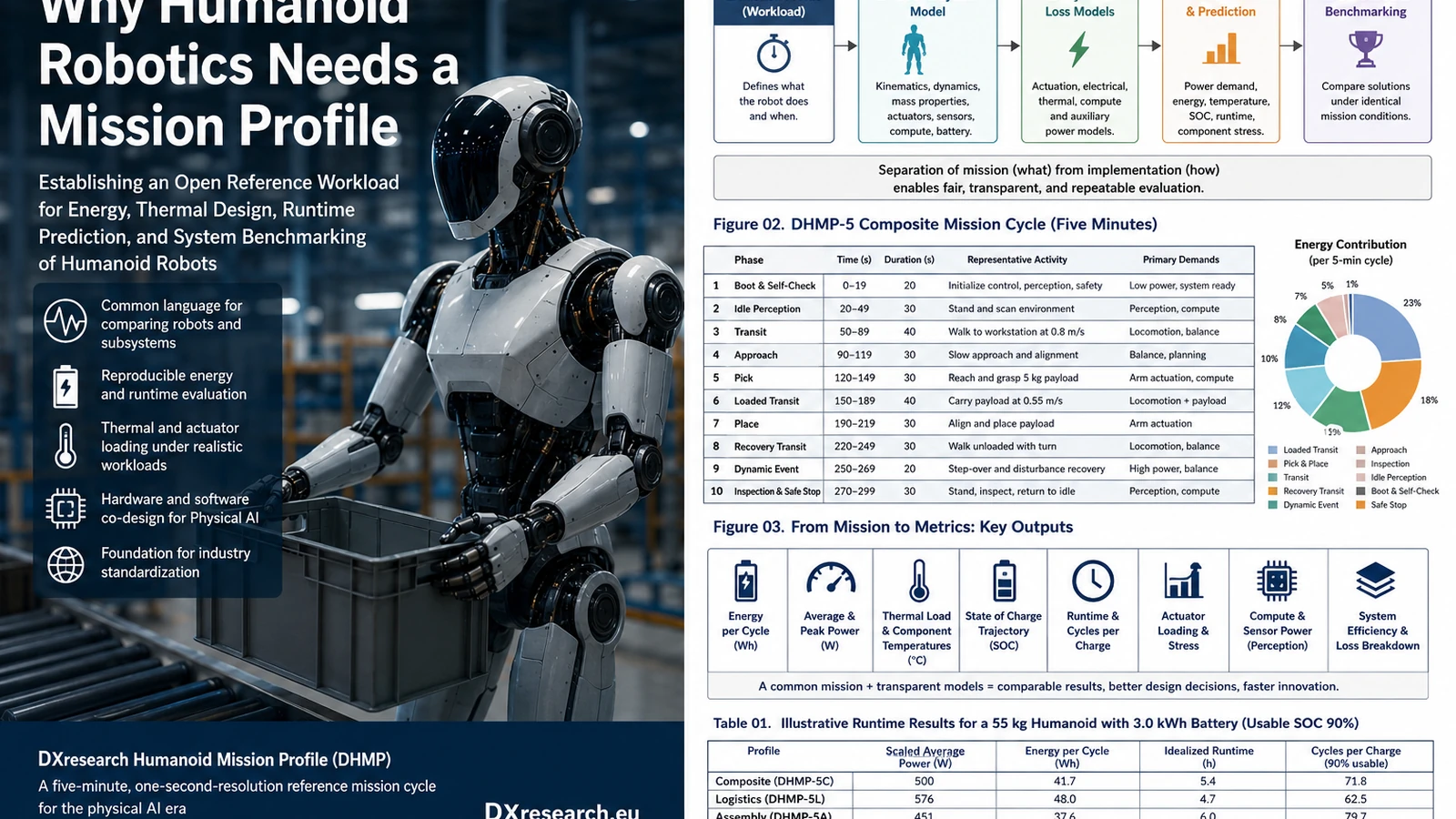
DXHMP-R constitutes the universal Reference Certification Mission. Its objective is comparable to the role of WLTP within the automotive industry. Rather than representing one industrial application, DXHMP-R captures the essential physical activities expected from a general-purpose humanoid, including locomotion, standing, manipulation, perception, object handling, environmental interaction, disturbance recovery and idle operation. Every compliant robot should be capable of executing DXHMP-R without modification of the mission definition.
Layer 3 — Application Mission Families
Application profiles extend the certification mission by emphasizing specific engineering characteristics. Unlike DXHMP-R, these profiles are not intended primarily for cross-platform certification but for subsystem optimization and deployment-specific qualification.
DXHMP-I — Industrial Manufacturing
The industrial profile represents repetitive precision work inside structured environments. Typical activities include precision assembly, machine tending, inspection, repetitive pick-and-place, tool handling, prolonged standing and fine manipulation. The dominant engineering challenges are sustained actuator holding torque, continuous thermal loading, precision sensing, deterministic real-time control and AI-assisted inspection. The resulting semiconductor utilization is dominated by motor control, vision processing, deterministic networking and functional safety.
DXHMP-W — Warehouse and Logistics
Warehouse operation emphasizes continuous locomotion. Representative activities include long-distance walking, carrying payloads, shelving, pallet interaction, obstacle avoidance, ramp traversal and repeated acceleration. This profile generates high battery throughput, continuous inverter loading, elevated hip and knee utilization, frequent regenerative braking and communication with warehouse infrastructure. Power electronics therefore become a dominant design constraint.
DXHMP-H — Healthcare
Healthcare operation differs fundamentally from industrial automation. The majority of mission time consists of slow walking, patient interaction, prolonged standing, door operation, object retrieval, cart assistance and close human collaboration. Peak power becomes relatively unimportant, whereas continuous holding torque, low acoustic noise, smooth motion, redundant sensing and safety supervision become dominant engineering drivers.
DXHMP-C — Construction
Construction environments produce highly dynamic loading. Representative activities include climbing, uneven terrain, ladder operation, overhead lifting, pushing, pulling, carrying heavy tools and repeated crouching. Mechanical loading becomes strongly transient. Subsystem stress shifts toward peak motor current, gearbox loading, semiconductor junction temperature, battery C-rate and vibration robustness.
DXHMP-O — Outdoor Utility
Outdoor operation introduces environmental uncertainty through long-distance inspection, slopes, gravel, mud, rain, vegetation and obstacle negotiation. Unlike indoor missions, traction conditions continuously change. Consequently, perception, localization, communication and energy management become tightly coupled.
DXHMP-E — Emergency Response
Emergency response deliberately represents the highest dynamic workload. Activities include rapid movement, stair climbing, debris traversal, crawling, casualty handling, tool operation and degraded communication. Subsystems experience repeated transitions between idle and peak loading. This mission intentionally stresses battery power delivery, inverter transient capability, processor utilization, communication resilience and thermal shock.
DXHMP-X — Extreme Environments
The final application family addresses environments fundamentally different from terrestrial industrial operation, including space, lunar exploration, nuclear facilities, offshore platforms and polar environments. Unlike previous profiles, environmental conditions themselves become dominant variables. Reduced convection, radiation exposure, communication latency and maintenance constraints substantially modify subsystem requirements.
IX. DXHMP-R — The Reference Certification Mission
Although application profiles differ significantly, meaningful comparison requires one universally accepted reference workload. DXHMP-R fulfills this role.
The temporal resolution is:
Each mission therefore contains:
The one-second sampling interval was selected because it provides sufficient temporal resolution for system-level energy and thermal modelling while remaining transparent for engineering review and implementation. Higher-frequency subsystem measurements remain possible but are aggregated into the standardized one-second reporting structure.
X. Mission Phase Architecture
Rather than prescribing individual robot movements, DXHMP-R defines engineering phases. Each phase represents a characteristic combination of locomotion, manipulation, perception and environmental interaction. A representative sequence consists of initialization, locomotion, perception, manipulation, payload transport, inspection, obstacle negotiation, disturbance recovery, idle monitoring and mission completion. The relative duration of each phase is fixed within the certification mission, while the physical implementation remains entirely platform specific. This distinction preserves innovation while maintaining reproducibility.
XI. Mathematical Representation of Mission Demand
Every subsystem receives its operating conditions from mission execution. Accordingly, instantaneous system demand may be represented as:
Here, Pm denotes mechanical actuation, Pc computational demand, Ps sensing, Pn networking and Pa auxiliary systems. Total electrical demand therefore becomes:
Mission energy follows directly as:
Because every subsystem contributes to total energy, improvements in computation, sensing or communication influence battery runtime just as strongly as actuator efficiency.
XII. Mission Scaling
One objective of DXHMP is applicability across different robot classes. Mission scaling therefore modifies system demand while preserving mission structure. Robot mass scaling may be approximated by:
Payload scaling becomes:
Environmental scaling introduces correction factors for slope, surface friction, temperature, wind and terrain roughness. Overall mission power therefore becomes:
Each factor represents an independently configurable engineering variable.
XIII. Semiconductor-Oriented Modeling
Most existing robot benchmarks terminate at system energy or runtime. DXHMP deliberately continues one abstraction level deeper. Every mission phase generates semiconductor operating conditions. Motor-control electronics experience changing RMS currents, AI processors experience varying computational intensity, power converters experience different duty cycles and communication controllers experience varying traffic. Consequently, subsystem qualification should evaluate semiconductor behaviour directly.
Representative mission outputs therefore include RMS phase current, peak current, inverter switching frequency, junction temperature, cumulative thermal cycles, battery current, DC-link ripple, processor utilization, AI accelerator utilization, memory bandwidth, sensor bandwidth, communication throughput and safety monitor activity. Rather than being derived independently, these quantities emerge directly from mission execution.
XIV. Electrothermal Modeling
Mission-dependent semiconductor heating represents one of the principal motivations for standardized workloads. Electrical losses may be expressed as:
Thermal accumulation follows:
Here, Rth and Cth represent equivalent thermal parameters. Unlike conventional steady-state calculations, mission execution generates continuously varying thermal trajectories. Consequently, semiconductor qualification requires transient mission definitions rather than static operating points.
XV. Battery System Modeling
Battery runtime cannot be described by nominal capacity alone. Mission execution determines discharge current, which influences voltage sag, efficiency, temperature, ageing and available energy. Mission-dependent state of charge evolves according to:
This formulation naturally accommodates regenerative braking, idle periods and varying computational activity. The resulting runtime therefore becomes an emergent system property rather than an independent specification.
XVI. Digital Twin Integration
Because every engineering quantity originates from the mission definition, DXHMP naturally integrates with digital-twin methodologies. The mission represents the common excitation applied simultaneously to multibody simulation, actuator models, semiconductor models, battery models, thermal models, AI workloads and communication networks. Correlation between measured and simulated quantities therefore becomes significantly more straightforward than under arbitrary demonstration scenarios.
Digital twins consequently become verifiable against reproducible engineering workloads rather than subjective demonstrations.
XVII. Qualification Through Standardized Mission Execution
The primary objective of DXHMP is not the creation of another benchmark but the establishment of a common engineering methodology for qualifying humanoid robots and their constituent technologies. Qualification should therefore be understood as the systematic demonstration that a robot, subsystem or component satisfies defined performance requirements when subjected to a reproducible operational workload. This distinction is fundamental. Whereas demonstrations illustrate capability under selected conditions, qualification establishes confidence that performance can be reproduced independently and compared objectively across different implementations.
Within the proposed framework, the mission profile becomes the controlled independent variable, while all measured quantities—including energy consumption, actuator loading, semiconductor temperature, computational utilization, communication latency and mission completion—become dependent variables. This relationship transforms mission execution from an application scenario into a repeatable engineering experiment.
A qualification procedure shall therefore specify at least the executed DXHMP mission profile, robot reference class, environmental conditions, payload definition, software configuration, battery state of charge, reporting uncertainty and measured engineering outputs. Only when these parameters are documented can results be interpreted, reproduced and compared. Consequently, DXHMP does not attempt to define robot performance. Instead, it defines the conditions under which performance shall be measured.
XVIII. Conformance Classes
Class A — Mission Compliance
Class A verifies that a robot executes the prescribed mission sequence without modification while preserving the required temporal structure and reporting methodology. Compliance focuses on mission execution rather than performance. Typical outputs include mission completion, trajectory conformity and event logging.
Class B — System Performance
Class B extends mission compliance through quantitative measurement of engineering variables including total mission energy, average electrical power, peak electrical power, battery utilization, runtime, mission duration and payload efficiency. This level represents the minimum requirement for meaningful comparison between complete robot systems.
Class C — Subsystem Characterization
Class C evaluates individual subsystems while executing standardized missions. Examples include actuator efficiency, inverter losses, semiconductor junction temperature, AI processor utilization, communication bandwidth, sensor activity and memory throughput. Unlike traditional laboratory characterization, subsystem measurements remain embedded within realistic robot operation.
Class D — Predictive Qualification
The highest conformance level introduces validated digital twins. Simulation results are compared directly with physical measurements obtained during standardized mission execution. Agreement within specified uncertainty limits establishes confidence that future design modifications may be evaluated through simulation before hardware construction. This approach substantially reduces development time while improving engineering confidence.
XIX. Standardized Reporting Methodology
One of the principal limitations of current humanoid performance publications is the absence of consistent reporting methodology. Runtime values frequently lack sufficient context to permit meaningful interpretation. Similar deficiencies exist for thermal performance, computational utilization and energy efficiency.
DXHMP therefore proposes a standardized reporting structure consisting of three complementary layers. The first layer contains descriptive metadata, including robot class, mission profile, environmental assumptions, payload and software revision. These data establish the experimental context.
The second layer contains measured engineering quantities obtained during mission execution. Representative metrics include energy consumption, battery utilization, joint loading, processor utilization, communication bandwidth and thermal behaviour.
The third layer contains derived engineering indicators intended for comparison between platforms. Examples include energy normalized by robot mass, payload-specific energy consumption, actuator utilization factors, computational efficiency and thermal utilization indices. The separation between measured quantities and derived indicators preserves transparency while allowing meaningful comparison across different robot architectures.
XX. Mission-Derived Engineering Indicators
The mission framework naturally enables the definition of engineering performance indicators that remain independent of specific hardware implementations. A generalized mission efficiency index may be expressed as:
Subsystem utilization may be represented by:
These formulations allow identical methodology to be applied to actuator torque, processor utilization, communication throughput, battery current, thermal loading, memory bandwidth and safety monitor activity. Consequently, the framework establishes a unified mathematical language for describing robot operation across heterogeneous technologies.
XXI. Implications for Semiconductor Engineering
One of the distinguishing characteristics of DXHMP is its direct applicability to semiconductor development. Humanoid robots represent highly integrated cyber-physical systems in which semiconductor technologies determine sensing, computation, communication, power conversion, actuation and functional safety. Nevertheless, semiconductor qualification currently relies predominantly on component-level laboratory testing, whereas system-level operating conditions remain application dependent.
Mission-based qualification fundamentally changes this paradigm. Rather than validating individual integrated circuits under simplified electrical loads, devices can be evaluated under representative robot missions. Consequently, mission execution generates realistic current profiles, voltage transients, switching losses, thermal cycling, processor activity, communication traffic and memory utilization.
Power semiconductors can be optimized using mission-derived switching trajectories rather than idealized laboratory waveforms. Motor-control microcontrollers may be evaluated according to representative field-oriented-control activity rather than synthetic processor benchmarks. AI accelerators become characterizable using mission-dependent perception and planning workloads. Sensor interfaces may be optimized according to realistic environmental interaction instead of isolated signal generation.
Perhaps most importantly, semiconductor reliability can increasingly be related to accumulated mission exposure rather than operating hours alone. Mission history therefore becomes an engineering quantity linking system operation to component lifetime.
XXII. Digital Twins as Reference Implementations
Digital twins are rapidly becoming central development tools for complex robotic systems. However, simulation accuracy depends fundamentally upon the availability of representative operating conditions. DXHMP provides precisely this common excitation.
Because every mission profile is deterministic, identical mission descriptions can be executed simultaneously by multibody simulations, battery models, semiconductor thermal models, communication simulators and physical robots. Agreement between these representations enables progressive validation of increasingly sophisticated digital twins.
Furthermore, validated mission models permit virtual qualification long before complete hardware systems become available. Component suppliers can therefore optimize future generations of semiconductors, batteries and actuators against representative robot missions without requiring access to proprietary robot platforms. This capability substantially broadens collaborative engineering across the humanoid ecosystem.
XXIII. Governance of the Framework
An engineering framework intended for long-term industrial adoption must evolve through transparent governance rather than unilateral definition. DXHMP is therefore proposed as an open reference framework maintained according to principles of reproducibility, traceability and backward compatibility.
Every released mission profile shall possess a permanent identifier, semantic version number, publication date, documented engineering assumptions, complete change history and validation status. Revisions shall preserve compatibility whenever possible. Major revisions shall introduce new functionality without altering previously published reference missions, thereby ensuring that historical qualification results remain reproducible.
The framework should ultimately be maintained through industrial participation involving robot manufacturers, semiconductor suppliers, research organizations, universities, software providers, system integrators and end users. Such collaborative governance represents an essential prerequisite for eventual international acceptance.
XXIV. Toward International Standardization
History demonstrates that technical standards rarely emerge fully formed. Instead, successful standards typically evolve from openly available engineering methodologies that prove useful through repeated industrial application.
DXHMP is intended to follow this evolutionary path. The first stage consists of publication as an openly documented engineering framework accompanied by publicly available mission definitions and simulation tools. The second stage emphasizes validation through collaborative execution across multiple robot platforms and independent organizations. The third stage establishes reproducible reporting practices supported by common terminology, engineering metrics and uncertainty analysis.
Only after sufficient industrial maturity should formal submission to standards development organizations such as IEEE, ISO or IEC be considered. At that point, the framework will have evolved from a proposed methodology into a demonstrably useful engineering practice supported by measurable evidence.
XXV. Future Research Directions
The present framework establishes only the first generation of standardized humanoid mission profiles. Future development should expand several technical areas.
Mission descriptions should increasingly incorporate probabilistic environmental interaction, allowing controlled variation while preserving statistical reproducibility. Human-robot collaboration should be represented more comprehensively through standardized interaction scenarios. Long-duration missions extending over multiple hours or complete work shifts should supplement the current certification cycle in order to investigate cumulative thermal behaviour, battery ageing and reliability.
Additional research is required to establish standardized semiconductor stress metrics directly derived from mission execution. Such metrics would provide a consistent methodology for comparing future power semiconductor technologies, embedded AI processors and communication architectures. Finally, the integration of DXHMP with simulation standards, digital engineering toolchains and autonomous software validation represents an important area for future investigation.
XXVI. Conclusions
Humanoid robotics has entered a phase in which reproducible engineering methodology has become as important as technological innovation. While remarkable progress has been achieved in locomotion, manipulation, perception and artificial intelligence, objective comparison between systems remains constrained by the absence of standardized operational workloads. Performance values reported without reference to a common mission cannot provide the engineering transparency required for qualification, subsystem optimization or certification.
The DX Humanoid Mission Framework addresses this deficiency by shifting the focus of standardization from robot implementation to mission definition. Instead of prescribing morphology, actuation technology or software architecture, the framework specifies reproducible workloads that generate representative mechanical, electrical, computational and thermal demand. This distinction preserves technological innovation while establishing a common engineering basis for comparison across heterogeneous robot platforms.
The proposed hierarchy of a universal reference certification mission together with application-specific mission families enables both cross-platform benchmarking and domain-specific optimization. More importantly, the framework connects robot behaviour directly to semiconductor operating conditions, allowing realistic evaluation of power electronics, embedded processors, sensing technologies, communication infrastructure and functional safety under representative operating conditions. In doing so, DXHMP extends beyond robot benchmarking and becomes a systems engineering methodology applicable throughout the humanoid value chain.
Ultimately, the significance of DXHMP does not lie solely in the definition of individual mission profiles but in the establishment of a common engineering language. Such a language is indispensable for reproducible experimentation, trustworthy digital twins, objective qualification, meaningful certification and future international standardization. The authors therefore propose DXHMP v1.0 not as a completed standard but as an open framework intended to evolve through scientific validation, industrial collaboration and transparent governance. If adopted broadly, mission-based qualification could provide humanoid robotics with the same methodological foundation that standardized drive cycles established for the automotive industry: a reproducible, vendor-neutral and scientifically grounded basis for engineering progress.
Acknowledgements
DXHMP is presented as an open engineering initiative intended to encourage discussion, validation and collaborative refinement across the global humanoid robotics ecosystem.
Download DXHMP Mission Profiles
Download an individual active mission profile as an import-compatible CSV trace or as an Excel-compatible workbook containing metadata, phase definitions, and the complete 300-second trace.
Canonical cross-domain mission for comparable energy, thermal, electrical and runtime reporting.
Repetitive, precision-oriented manufacturing workload with sustained upper-body utilization and inspection compute.
High-throughput material movement with long loaded travel, ramp operation and repeated acceleration.
Human-proximate, low-noise mission emphasizing safe interaction, sustained support and redundant perception.
Severe physical mission combining irregular terrain, heavy tools, overhead work, pushing and repeated crouching.
Long-range outdoor inspection across variable surfaces, slopes, adverse weather and intermittent connectivity.
Maximum-dynamic rescue mission with sprinting, debris, crawling, casualty handling and degraded communication.
Fault-tolerant mission for radiation, reduced convection, severe temperature, latency and restricted maintenance.


Leave a Reply