
Technical Article
The Body Is Not a Default
How Physiological Diversity Reaches Sensors, Semiconductors and Physical AI Before the Algorithm Begins
Human-facing Physical AI needs sensing architectures validated across physiological diversity, with adaptive calibration, context awareness, signal quality and explicit confidence.
Bias Can Begin Before the Algorithm
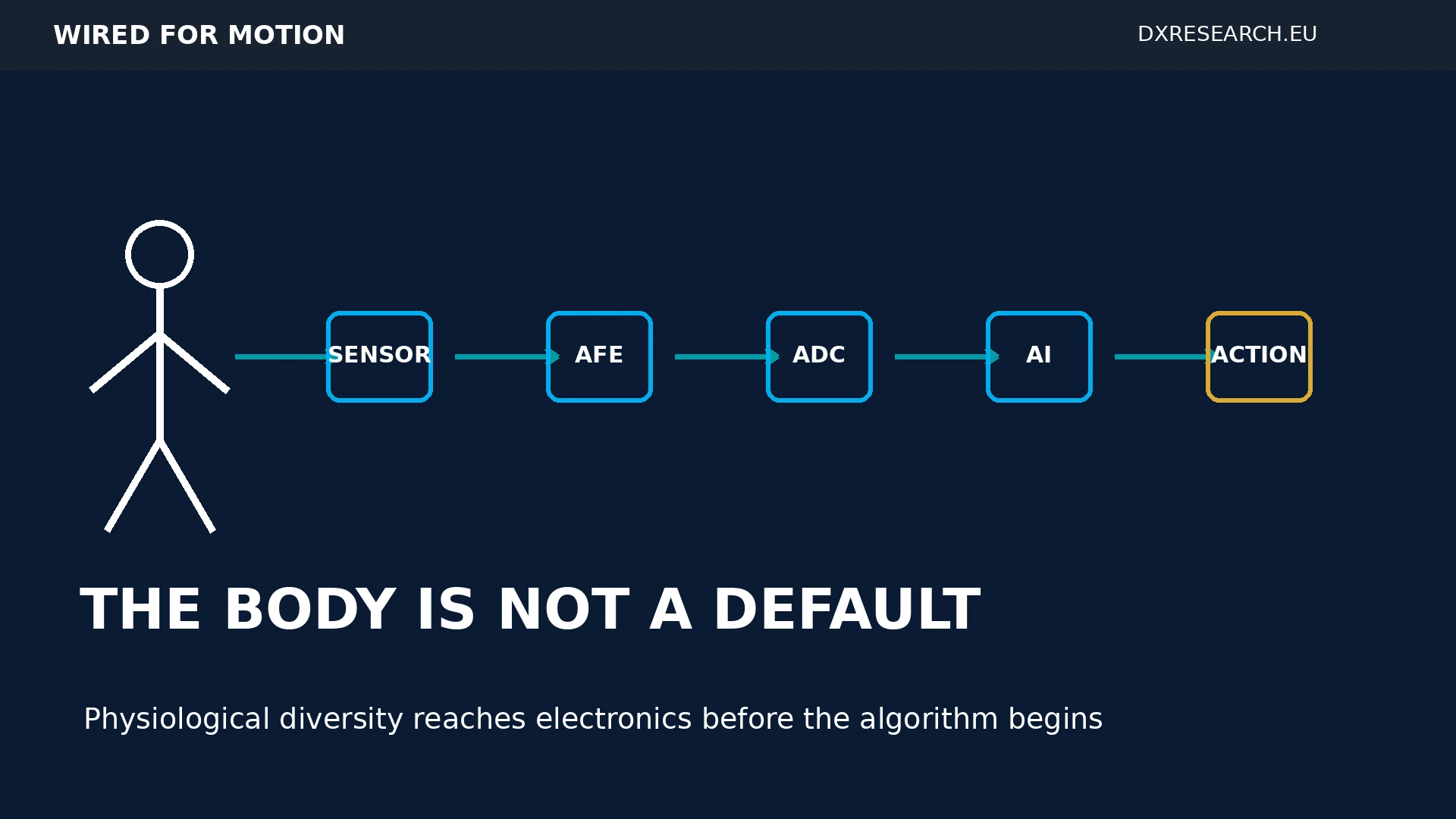
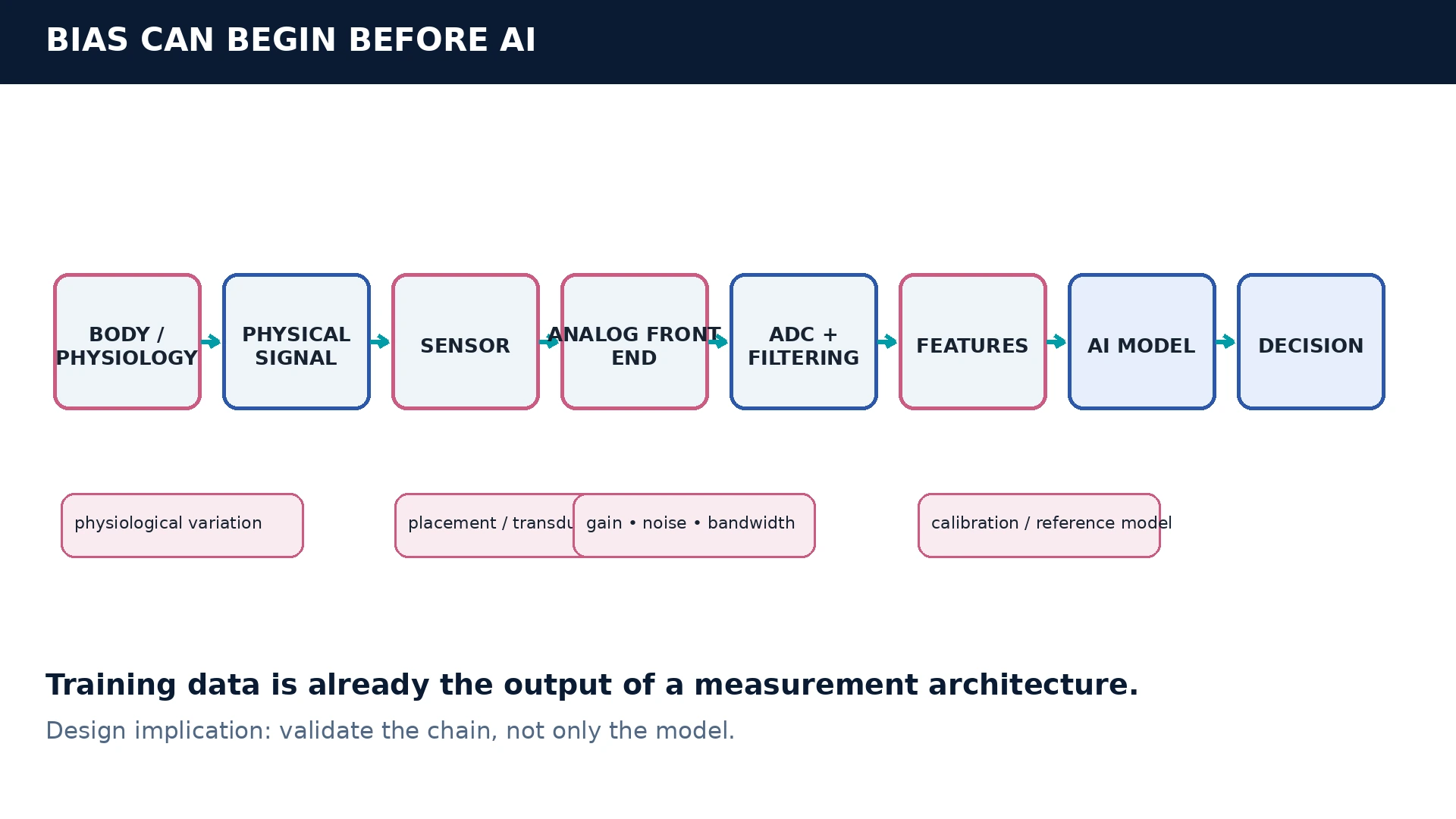
Discussions about responsible artificial intelligence often begin with datasets and models. For human-facing Physical AI, that starting point is too late. A robot, wearable or medical device never observes a person directly. It observes electrical signals produced by a chain of physical transduction, sensor placement, analog conditioning, sampling, filtering, calibration and feature extraction. Only after those stages does the system possess the data from which an AI model can learn.
This distinction matters because a technically precise sensor can still operate inside an incomplete physiological model. A threshold can be repeatable but inappropriate for some users. A waveform can be measured accurately but interpreted against the wrong baseline. A sensor can perform well in a laboratory reference population yet show different uncertainty in the population that ultimately uses it. FDA guidance now explicitly asks device developers to improve sex-specific enrollment, analysis and reporting so that device performance is understood in both sexes.[1] Broader FDA guidance similarly emphasizes sex-specific analysis and female participation across clinical evaluation.[2]
The engineering question is therefore not whether every sensor is biased. That would be too broad and frequently unsupported. The useful question is whether the full measurement chain has been validated for the physiological diversity it will encounter, and whether the system can detect when its own assumptions are weakening.
The Body Is Not One Reference Condition
Women provide a particularly useful lens because female physiology is dynamic rather than one fixed alternative to a male reference. A 2026 study in npj Digital Medicine analyzed 1.2 million days of wearable measurements from 2,596 women who logged 42,759 menstrual cycles. Resting heart rate, heart-rate variability, respiratory rate, skin temperature and blood oxygen saturation were among the measured biometrics, and the authors found systematic variation across the menstrual cycle and across cycle lengths.[3]
A 2026 living systematic review reached a similarly careful conclusion for wearable-derived heart-rate variability. Across 16 included studies, HRV differed across menstrual-cycle phase, hormonal contraceptive use and reproductive life stages; the review also stressed methodological heterogeneity and limits on quantitative synthesis.[4] That nuance is important. Physiological variation does not automatically prove sensor bias. It does show why one static physiological baseline can be insufficient for every interpretation.
The same principle appears at the waveform level. Photoplethysmography, or photoplethysmography, uses light to observe blood-volume-related changes in tissue. A 2024 IEEE EMBC paper reported sex-related differences in PPG waveform characteristics, including timing-related features.[5] Again, this is not evidence that PPG is inherently unfair. It is evidence that physiological signal distributions are not guaranteed to be universal.
Where Assumptions Enter the Signal Chain
The semiconductor system determines what survives between the body and the model. The sensor chooses a physical modality. Placement establishes optical, mechanical, acoustic or electrical coupling. The analog front end sets gain, bandwidth, filtering, dynamic range and noise behavior. The analog-to-digital converter samples what remains. Digital filters and feature extraction decide which aspects of the waveform are retained for later interpretation.
Each stage can be correct on its own and still create a system-level limitation. If sensor placement is optimized around one anatomy, coupling quality may change elsewhere. If the analog range is designed around a narrow expected distribution, useful extremes may compress or saturate. If filters reject a component treated as noise, they can remove physiologically meaningful variation. If calibration assumes one reference population, a consistent offset can become a consistent interpretive error.
That is why the chapter distinguishes variation from bias. Variation is a difference in the physical or physiological signal. Bias is a systematic error or performance disparity introduced by the measurement or interpretation system. The first is a property of reality; the second is a property of how the system handles reality. Good engineering must understand both.
Representative Validation Moves Down to Hardware
FDA device guidance makes the regulatory direction clear: medical-device studies should support appropriate sex-specific analysis, while related FDA guidance asks developers to consider demographic representation that reflects intended-use populations.[8] For semiconductor and sensor teams, this does not mean every integrated circuit becomes a clinical product. It means the evidence envelope around human-facing sensing functions can no longer stop at nominal electrical accuracy.
Representative validation asks a different set of questions. Does signal quality change across relevant anatomy or physiology? Which conditions reduce usable signal-to-noise ratio? Does calibration error shift systematically for a subgroup or life stage? Can the device identify when it leaves its validated envelope? Does uncertainty propagate with the measurement, or is a low-quality value delivered downstream as if it were ground truth?
NIST's continuing face-recognition evaluation illustrates why the acquisition chain matters. NIST reports demographic differentials in recognition errors and notes that poor image quality or capture conditions can induce or amplify some effects, while algorithmic under-representation can contribute to others.[7] The lesson for Physical AI is architectural: demographic performance is often a property of an end-to-end sensing-and-inference system, not of one isolated algorithm.
From Measurement to Qualified Measurement
A conventional sensor interface often reports one value: heart rate, temperature, force, distance or pose. Human-facing systems increasingly need a second output: how much the electronics trust that value under current conditions. A signal quality index can summarize artifact level, coupling quality, saturation, motion contamination or other evidence that affects measurement reliability. Confidence estimation then exposes uncertainty to the next decision layer rather than hiding it inside a black box.
The architectural pattern is:
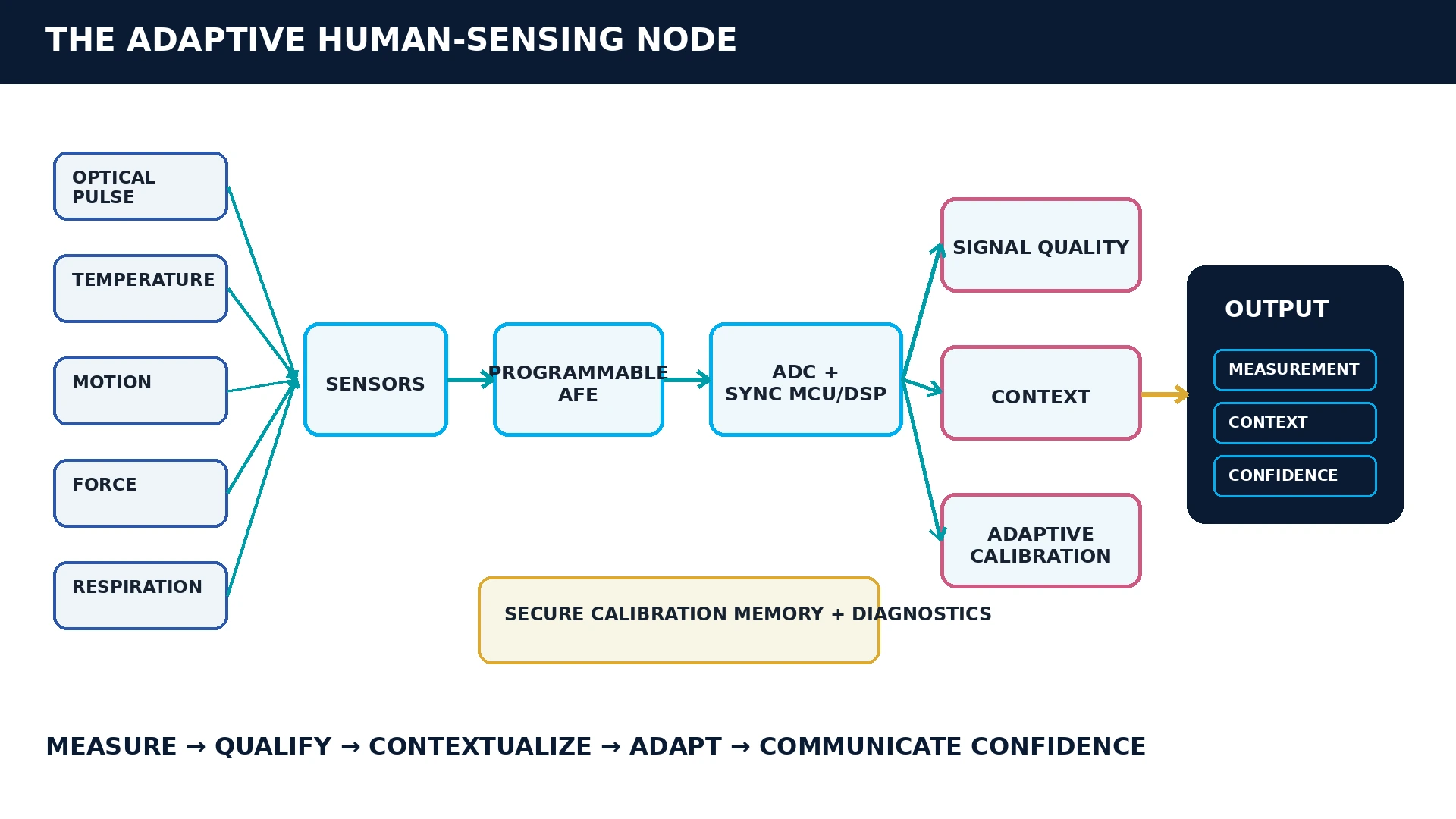
MEASURE → QUALIFY → CONTEXTUALIZE → ADAPT → COMMUNICATE CONFIDENCE
Measure the physical phenomenon. Qualify signal integrity. Contextualize the observation against relevant sensor state and physiological state. Adapt calibration or processing only inside bounded rules. Communicate both the value and its confidence to AI, control and safety functions.
Why This Matters to Humanoids
Humanoids expand the problem because people become part of the robot's physical feedback loop. A service robot may support someone while standing, detect a fall, measure contact force, estimate breathing, monitor fatigue proxies, interpret voice or facial signals, or adjust grip and assistance based on observed human state. In these applications, the cost of an uncertain human measurement can propagate directly into motion.
The right response is not to make a robot infer sensitive personal attributes whenever it can. In many cases it should avoid doing so. The stronger design principle is to make the sensing system aware of its own evidence quality and validated operating range. If the robot cannot confidently interpret a physiological or biomechanical signal, the system should expose that uncertainty and choose a bounded action rather than silently substitute a population-average assumption.
This shifts the semiconductor value proposition. Precision remains necessary, but precision without context is incomplete. Local processing can evaluate signal quality. Nonvolatile memory can retain device-specific calibration. Secure identity can bind calibration to a replaceable sensor module. Time synchronization can preserve cross-modal relationships. Real-time microcontrollers can fuse optical, inertial, force and thermal evidence. Diagnostics can distinguish hardware degradation from an unusual but valid human signal.
Female Physiology Shows Why Static Calibration Is Not Enough
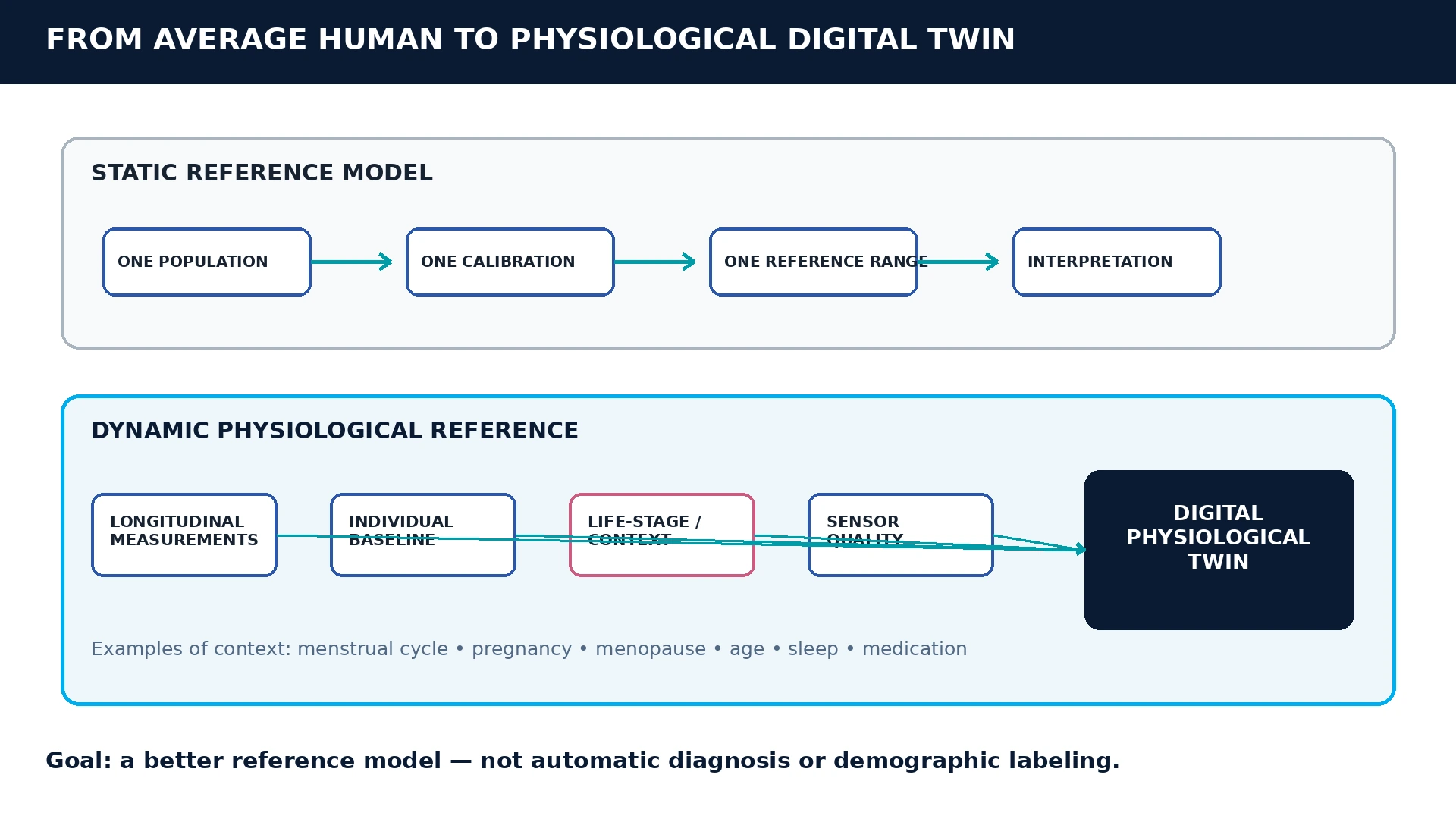
Female physiology also demonstrates why personalization can be temporal rather than merely demographic. The same person's expected biometric patterns can change across cycle phase, pregnancy, menopause, age, illness, sleep and medication. The 2026 wearable study and HRV review show measurable cycle- and life-stage-related variation but also show that effect sizes and interpretation depend on context and study method.[3][4]
This supports a move from one global calibration toward bounded adaptive sensing. The system can begin with population-level validation, establish an individual baseline over time, detect changes in signal quality and update interpretation only when evidence supports it. Such adaptation must remain auditable; otherwise personalization can become another source of opaque error.
The Digital Twin Is a Reference Model, Not an Avatar
A digital physiological twin is useful here if it is understood as a time-varying reference model rather than a photorealistic virtual person. It can represent an individual's baseline, historical trends, sensor-specific calibration and relevant physiological context. The purpose is not to label every state. It is to help the system interpret current measurements against a richer history than one static threshold.
Wearable hormone sensing shows where this idea might eventually extend. A 2025 ACS Sensors review describes optical, electrochemical and emerging flexible approaches for monitoring female hormones, while emphasizing the analytical difficulty created by very low biomarker concentrations.[6] This remains an emerging technology area, not a mature general-purpose capability. The important architectural point is that future physiological sensing may combine multiple slowly and rapidly changing signals into a longitudinal model.
The Semiconductor Requirements Change
Human-aware sensing does not require a new category of physics for every application. It requires conventional semiconductor capabilities to be assembled around a more explicit evidence model. Useful building blocks include low-noise sensors, programmable analog front ends, appropriate converter resolution, synchronized acquisition, embedded digital signal processing, local machine learning, secure calibration storage, temperature compensation, diagnostics and deterministic communications.
The differentiator is how those blocks are specified and validated. A next-generation human-sensing node should answer: What was measured? How good was the raw signal? Which calibration was applied? Under which operating conditions is that calibration valid? Which contextual assumptions influenced the result? What uncertainty should downstream software carry forward?
This approach also creates a clearer boundary between semiconductor responsibility and application responsibility. The sensing node does not need to diagnose a person. It does need to avoid pretending that a weak, out-of-envelope measurement has the same certainty as a high-quality one. That is a hardware-software contract the semiconductor industry can help define.
Fair Physical AI Starts at the Sensor
The central argument is narrower than a claim that electronic hardware is broadly biased against women. The evidence does not support such a universal statement. The stronger and more useful conclusion is that human physiology varies, that some measured signals vary across sex and female life stages, and that device performance must therefore be validated across intended populations and contexts.
For medical technology, regulators are already pushing toward sex-specific and demographically representative evidence.[1][8] For humanoid robotics, the same systems question will emerge wherever a machine physically assists, monitors or reacts to people.
Responsible AI therefore begins before the training dataset exists. The body creates a physical signal. Electronics decide how that signal is captured. Calibration decides how it is mapped. Signal processing decides what survives. Only then does AI receive data.
Design the sensor not only to measure the signal. Design the sensing node to know when the signal may not mean what the system assumes it means. Fair Physical AI starts where the human body becomes an electrical signal.
References
- Evaluation of Sex-Specific Data in Medical Device Clinical Studies. U.S. Food and Drug Administration. FDA. 2025-03. https://www.fda.gov/regulatory-information/search-fda-guidance-documents/evaluation-sex-specific-data-medical-device-clinical-studies-guidance-industry-and-food-drug
- Study of Sex Differences in the Clinical Evaluation of Medical Products. U.S. Food and Drug Administration. FDA. 2025-12. https://www.fda.gov/regulatory-information/search-fda-guidance-documents/study-sex-differences-clinical-evaluation-medical-products
- The menstrual cycle through the lens of a wearable device: insights into physiology, sleep, and cycle variability. Alexander Gonzalez; Johanna J. O'Day; Sarah C. Johnson; Jeongeun Kim; Summer R. Jasinski; Kristen E. Holmes; Scott L. Delp; Jennifer L. Hicks. npj Digital Medicine. 2026-05-25. https://pubmed.ncbi.nlm.nih.gov/42185632/
- Wearable-Derived Heart Rate Variability Across the Menstrual Cycle, Hormonal Contraceptive Use, and Reproductive Life Stages in Females: A Living Systematic Review. Eline de Jager; Brian Caulfield; Evgenia Angelidi; Brian MacNamee; Sinead Holden. Sports Medicine. 2026-05. https://pubmed.ncbi.nlm.nih.gov/41545627/
- Exploring Gender-Related Variations in Photoplethysmography. Sara Lombardi; Piergiorgio Francia; Leonardo Bocchi. IEEE EMBC. 2024-07. https://pubmed.ncbi.nlm.nih.gov/40039319/
- Toward At-Home and Wearable Monitoring of Female Hormones: Emerging Nanotechnologies and Clinical Prospects. Xingyu Meng; Zhaoxian Li; Wan Yue; Limei Zhang; Zhuang Xie. ACS Sensors. 2025-01-24. https://pubmed.ncbi.nlm.nih.gov/39761986/
- Face Recognition Technology Evaluation: Demographic Effects in Face Recognition. National Institute of Standards and Technology. NIST. 2026-07-31. https://pages.nist.gov/frvt/html/frvt11.html
- Evaluation and Reporting of Age-, Race-, and Ethnicity-Specific Data in Medical Device Clinical Studies. U.S. Food and Drug Administration. FDA. 2017-09. https://www.fda.gov/regulatory-information/search-fda-guidance-documents/evaluation-and-reporting-age-race-and-ethnicity-specific-data-medical-device-clinical-studies
Glossary
- Analog front end
- Circuitry that receives, amplifies, filters or otherwise conditions an analog sensor signal before conversion or digital processing.
- Confidence estimation
- Explicit quantification of the uncertainty or trustworthiness associated with a measurement, inferred state or decision.
- Digital physiological twin
- A computational representation of an individual's changing physiological state used to interpret longitudinal measurements and context.
- Photoplethysmography
- Optical sensing technique that measures blood-volume-related changes in tissue from variations in transmitted or reflected light.
- Physical AI
- AI systems that perceive, decide and act through physical machines, requiring computation to remain coupled to sensing, energy, motion and safety.
- Physiological baseline
- An individual or population reference state used to interpret subsequent physiological measurements and trends.
- Representative validation
- Evaluation across the populations, physiological states and operating conditions expected in real use rather than only a nominal reference case.
- Signal quality index
- A numerical or categorical estimate of whether a measured signal is sufficiently trustworthy for its intended interpretation or downstream use.
Sources
- Evaluation and Reporting of Age-, Race-, and Ethnicity-Specific Data in Medical Device Clinical Studies · 2017-09 · FDA
FDA recommends clinical-device study populations reflect relevant demographic groups and that subgroup performance be evaluated and reported.
https://www.fda.gov/regulatory-information/search-fda-guidance-documents/evaluation-and-reporting-age-race-and-ethnicity-specific-data-medical-device-clinical-studies - Evaluation of Sex-Specific Data in Medical Device Clinical Studies · 2025-03 · FDA
FDA guidance describes expectations for sex-specific enrollment, analysis and reporting to improve evidence on medical-device performance in both sexes.
https://www.fda.gov/regulatory-information/search-fda-guidance-documents/evaluation-sex-specific-data-medical-device-clinical-studies-guidance-industry-and-food-drug - Exploring Gender-Related Variations in Photoplethysmography · 2024-07 · IEEE EMBC
Study reports sex-related differences in PPG waveform characteristics, illustrating that physiological signal distributions need not be universal.
https://pubmed.ncbi.nlm.nih.gov/40039319/ - Face Recognition Technology Evaluation: Demographic Effects in Face Recognition · 2026-07-31 · NIST
NIST documents demographic differentials in face-recognition errors and notes that image quality and acquisition conditions can create or amplify demographic effects.
https://pages.nist.gov/frvt/html/frvt11.html - Study of Sex Differences in the Clinical Evaluation of Medical Products · 2025-12 · FDA
FDA recommends stronger female enrollment and sex-specific analysis and interpretation across medical-product clinical evaluation.
https://www.fda.gov/regulatory-information/search-fda-guidance-documents/study-sex-differences-clinical-evaluation-medical-products - The menstrual cycle through the lens of a wearable device: insights into physiology, sleep, and cycle variability · 2026-05-25 · npj Digital Medicine
Analysis of 1.2 million wearable measurement days from 2,596 women found systematic biometric variation across 42,759 menstrual cycles.
https://pubmed.ncbi.nlm.nih.gov/42185632/ - Toward At-Home and Wearable Monitoring of Female Hormones: Emerging Nanotechnologies and Clinical Prospects · 2025-01-24 · ACS Sensors
Review surveys optical, electrochemical and wearable approaches for female hormone monitoring and notes the sensitivity challenges of low-concentration biomarkers.
https://pubmed.ncbi.nlm.nih.gov/39761986/ - Wearable-Derived Heart Rate Variability Across the Menstrual Cycle, Hormonal Contraceptive Use, and Reproductive Life Stages in Females: A Living Systematic Review · 2026-05 · Sports Medicine
Review of 16 studies found wearable-derived HRV associated with menstrual-cycle phase, hormonal contraception and reproductive life stage, with methodological heterogeneity.
https://pubmed.ncbi.nlm.nih.gov/41545627/