

Technical Article
Network Power Budget
Why Data Movement, Link Topology and Sleep/Wake Architecture Matter to Humanoid Runtime
Humanoid communication consumes persistent energy; topology, bandwidth, active interfaces, and selective sleep states therefore belong inside the robot runtime budget.
Communication belongs in the energy model
The useful engineering question is not simply how many bits a robot sends. It is how much electronic infrastructure must remain powered so those bits can move when required. A network energy budget therefore has two broad components: baseline availability power and traffic-dependent power. Texas Instruments specifies its DP83TC811-Q1 100BASE-T1 PHY at less than 230 mW active power and provides Sleep, Standby, Disable and Wake-on-LAN functions. Texas Instruments DP83TC811-Q1 This is a manufacturer specification for one device, not a protocol-wide benchmark.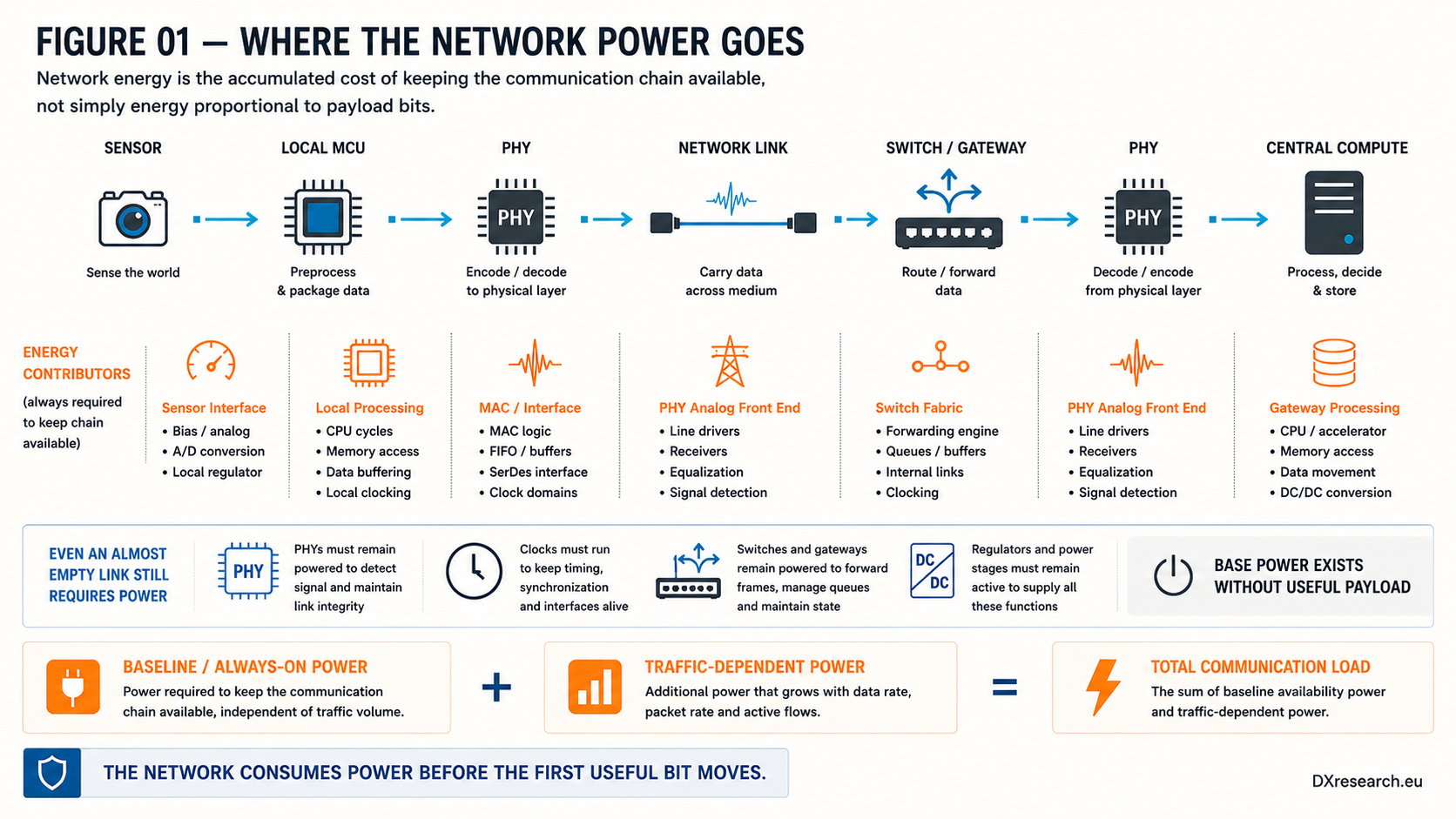
Topology changes what must stay awake
Two networks carrying the same application information can require different numbers of continuously active ports, forwarding stages and conversions. A switched star concentrates forwarding in a central switch; a line distributes forwarding through participating nodes; and a multidrop segment can reduce central switching. None is automatically the lowest-energy solution. 10BASE-T1S provides a useful example because multiple nodes can share a balanced-pair segment. IEEE 802.3da-2026 extends 10 Mb/s single-pair Ethernet multidrop operation and includes time-synchronization support and optional power delivery. IEEE 802.3da-2026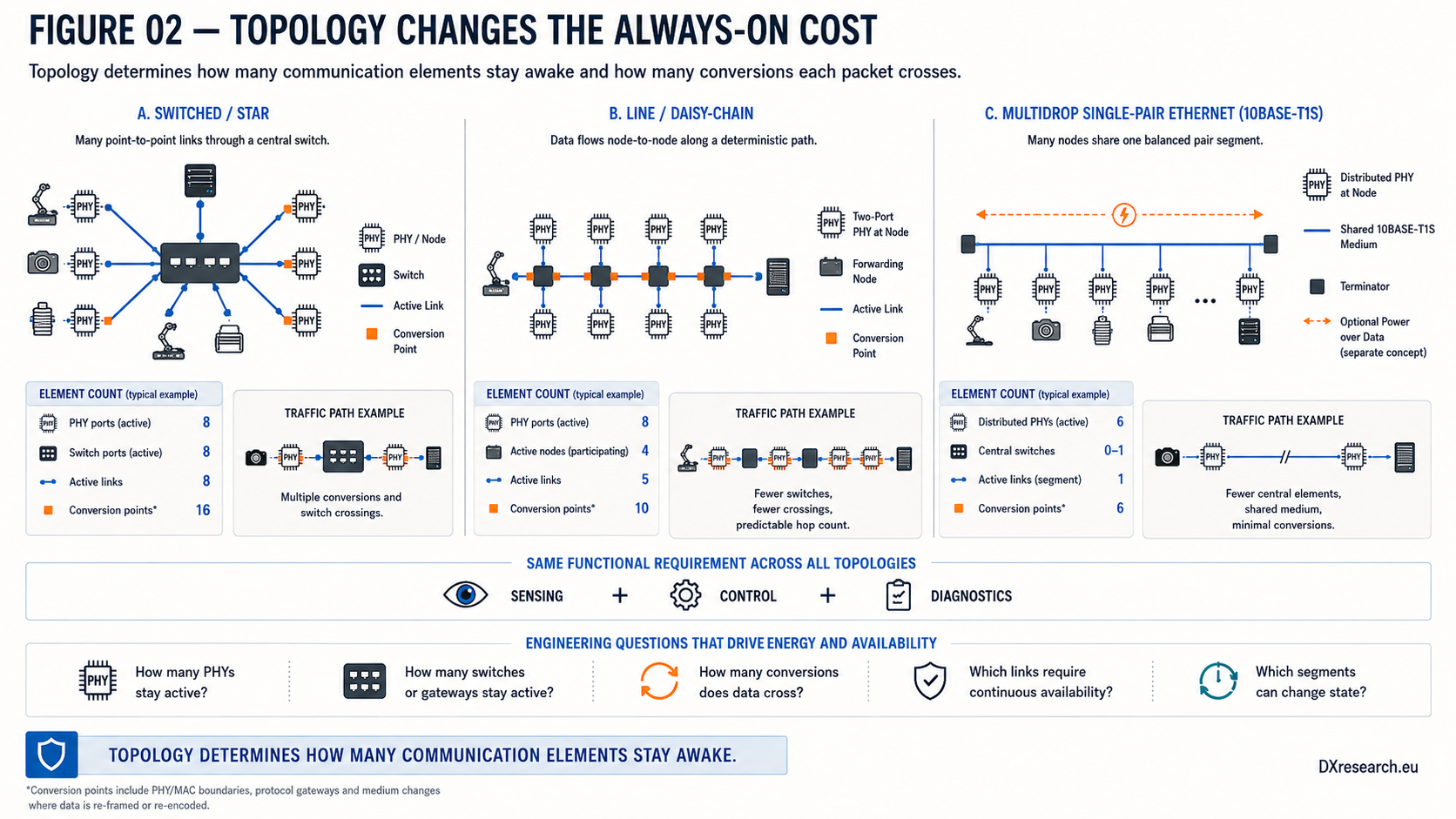
Determinism also has infrastructure
Time-Sensitive Networking addresses bounded latency, scheduling, synchronization and reliability. IEEE TSN Task Group IEEE 802.1AS-2025 defines transport of synchronized time and timing-source selection for time-sensitive applications. IEEE 802.1AS-2025 The energy consequence is an engineering interpretation rather than a standards claim: deterministic functions can require clocks, timestamping, forwarding resources and selected paths to remain available.Not every link needs the same power state
A robot can classify communication by criticality. Safety supervision, critical actuator control, essential state estimation and required synchronization may need continuous availability. High-bandwidth perception, nonessential sensors or diagnostics may use a communication power state that changes with mission context where wake latency and recovery behavior permit it.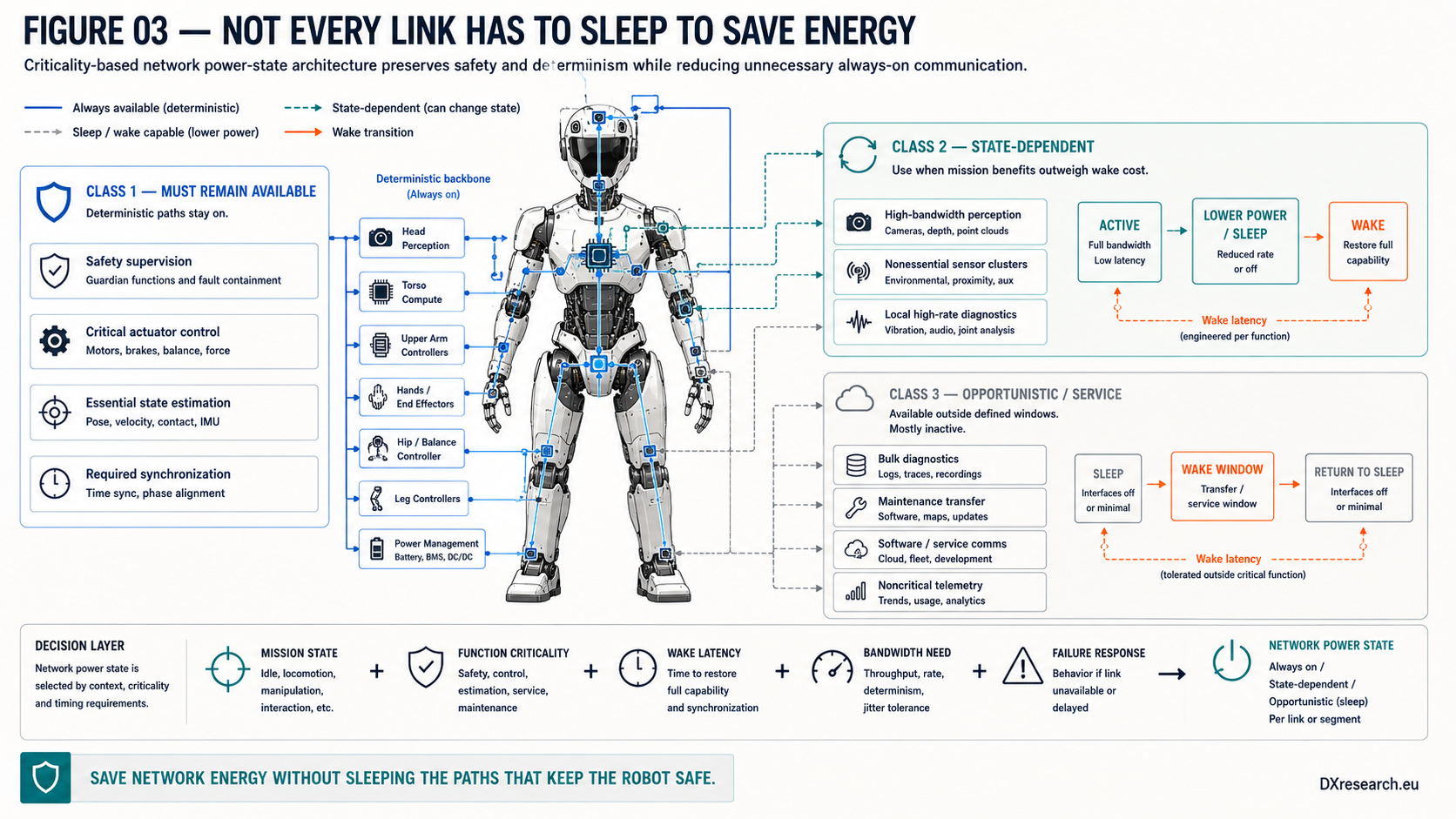
The hidden baseline matters over mission time
An always-on communication load can appear small beside locomotion power, yet mission energy is the integral of power over time. A modest baseline repeated across many interfaces and sustained for hours becomes part of battery sizing, thermal design and runtime.Design communication by criticality
Match bandwidth to workload. Minimize unnecessary forwarding and protocol conversions. Keep deterministic paths available where required. Use lower-power states only where wake latency and failure response have been engineered. Measure the complete network electronics rather than a single transceiver in isolation. Humanoid energy optimization will not be solved by motors and batteries alone. Data movement is implemented by physical silicon, clocks, analog front ends, memory and power conversion. Every bit has a power cost, but architecture decides how often—and through how many continuously powered elements—the robot pays it.Glossary
- 10BASE-T1S
- A 10 Mb/s single-pair Ethernet physical layer supporting short-reach multidrop or point-to-point operation.
- Always-on communication load
- Baseline power required to keep specified network functions operational independent of useful payload volume.
- Communication power state
- Defined operating condition of a communication interface or segment with associated availability, wake behavior and power consumption.
- Network energy budget
- Aggregate electrical energy attributable to communication interfaces and supporting network functions over a defined operating interval.
- Single-Pair Ethernet
- Ethernet physical-layer technologies using a single balanced pair of conductors for data communication.
- Time-Sensitive Networking
- IEEE 802.1 mechanisms supporting bounded latency, synchronization, traffic scheduling and reliability over Ethernet.
Sources
- DP83TC811-Q1 Low-Power 100BASE-T1 Automotive Ethernet PHY · Texas Instruments
Manufacturer specification lists under 230 mW active power plus Sleep, Standby, Disable and Wake-on-LAN power-management features for this PHY.
https://www.ti.com/product/DP83TC811-Q1 - IEEE 802.1 Time-Sensitive Networking Task Group · IEEE 802.1 Working Group
IEEE TSN standards provide deterministic Ethernet services using bounded latency, controlled delay variation, low loss, scheduling, synchronization and reliability mechanisms.
https://1.ieee802.org/tsn/ - IEEE 802.1AS-2025: Timing and Synchronization for Time-Sensitive Applications · 2025-12-17 · IEEE Standards Association
Defines synchronized-time transport, timing-source selection, timing impairments and synchronization behavior for time-sensitive applications across local-area networks.
https://standards.ieee.org/ieee/802.1AS/11968/ - IEEE 802.3da-2026: Enhanced 10 Mb/s Single-Pair Ethernet Multidrop Segments · 2026 · IEEE Standards Association
Enhances 10BASE-T1S multidrop operation with time-synchronization support and optional power delivery to multiple devices.
https://standards.ieee.org/ieee/802.3da/10282/