
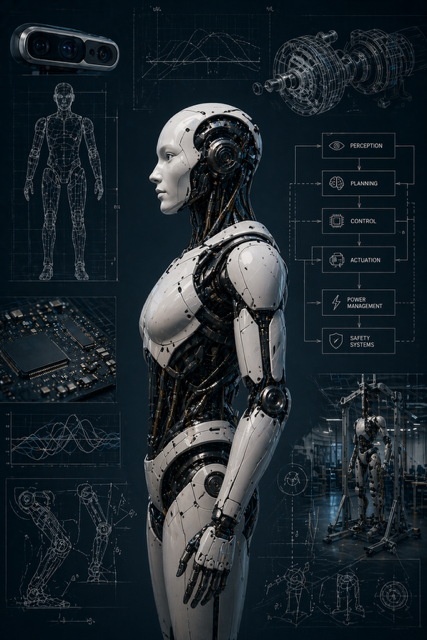
Lyra did not begin as a machine that could move, perceive, or decide, but as a convergence point for a set of engineering assumptions that had not yet been tested under real-world conditions where timing, uncertainty, and physical interaction define system behavior. Dirk stood in front of the first assembled system with the awareness that every subsystem had been validated independently under controlled conditions, while also understanding that integration would expose dependencies that could not be derived from specifications or simulations alone. The structure resembled a humanoid with articulated joints, embedded sensing, and distributed computation, yet resemblance to a human form did not imply coherent behavior, and coherent behavior could not be assumed without system-level alignment.
The first activation did not represent a milestone of success, but a transition from theoretical correctness to observable system behavior under real constraints, where motors responded precisely to command inputs, sensors generated continuous streams of data, and processing units executed algorithms deterministically, yet the resulting motion lacked coordination, stability, and temporal consistency across subsystems. Lyra moved, but the movement revealed fragmentation, as if each subsystem operated within its own internal timing model without awareness of the global system state, exposing the fundamental challenge that defines humanoid robotics.
This gap between capability and coherence establishes the central thesis of this work, where the difficulty is not the absence of enabling technologies, but the alignment of those technologies under strict temporal and physical constraints that require continuous synchronization between sensing, computation, and actuation. A humanoid robot must balance under dynamic conditions, perceive environments that change unpredictably, interact safely with external forces, and make decisions under uncertainty, all within timeframes measured in milliseconds, where even small delays propagate into system-level instability.
This book follows Lyra as a continuously evolving system, where each chapter introduces a new constraint that forces architectural adaptation and reveals dependencies between domains that are often treated independently in isolation. The progression begins with motion and stability, extends into perception and interaction, and advances toward cognition, safety, and scalability, forming a layered understanding of how humanoid systems transition from functional prototypes to deployable platforms.
Lyra is not a finished system, but a reference point in an ongoing process where every improvement exposes new constraints and new dependencies that must be resolved at the system level rather than the component level.
Content
1 – Defining the Humanoid System Architecture Through First Activation. 3
3 – Visual Perception and Sensor Fusion in Humanoid Robots Under Real-Time Constraints 8
4 – Physical Interaction and Force Control in Humanoid Robots Through Compliant Actuation. 11
5 – Energy Management and Power Electronics in Humanoid Robots Under Dynamic Load Conditions. 14
7 – Functional Safety and Human Interaction in Humanoid Robots Under Real-World Constraints 20
12 – From System to Ecosystem: Infrastructure, Deployment Context, and Scaling Humanoid Robotics. 35
13 – Economic Viability, Value Creation, and Deployment Models in Humanoid Robotics. 38
14 – Human Acceptance, Trust, and Behavioral Integration in Humanoid Robotics. 41
16 – Toward Autonomous Systems: Closing the Loop Between Perception, Cognition, and Action. 47
17 – Boundaries of Autonomy: Ethics, Control, and Governance in Humanoid Robotics. 50
18 – Verification, Validation, and Digital Twin Integration for Humanoid Systems. 53
19 – Security, Resilience, and Trustworthy Operation in Connected Humanoid Systems. 56
20 – Conclusion: Convergence Toward Adaptive, Scalable, and Trusted Humanoid Systems. 59
1 – Defining the Humanoid System Architecture Through First Activation
Humanoid robots represent a tightly coupled integration of mechanical structure, sensing, computation, and control operating under real-time constraints where system performance is determined by interaction quality rather than component capability. This chapter analyzes Lyra’s first activation to define the foundational architecture of a humanoid system, focusing on subsystem dependencies, latency effects, and instability emerging from misaligned control loops. The results demonstrate that functional subsystems do not produce coherent behavior without synchronized feedback integration. The outcome establishes a system-level perspective where timing, data flow, and control alignment define performance, stability, and scalability.
Lyra stood suspended within the test rig, supported just enough to prevent structural damage while still allowing natural dynamic behavior to emerge under partial load conditions, creating an environment where system responses could be observed without immediate failure. Dirk initiated the activation sequence with the expectation that the system would not succeed, but with the intention of observing how and where the system would fail, because failure would reveal the boundaries between subsystems more clearly than nominal operation ever could.
The motors responded immediately to command signals, executing position trajectories with the precision defined in their specifications, while sensor systems streamed continuous data representing orientation, joint position, and external forces, all of which were processed without interruption by the distributed compute architecture. From a component perspective, the system behaved correctly, yet the resulting motion lacked coherence, as corrections applied by the control system appeared delayed, amplified, and disconnected from the actual system state.
Small oscillations began at the lower joints and propagated upward through the structure, with each corrective action arriving slightly too late and slightly too strong, creating a feedback pattern that increased instability rather than reducing it. Lyra did not collapse immediately, which would have indicated a catastrophic failure, but instead entered a state of persistent instability that revealed a deeper issue: the system was functioning, but it was not synchronized.
This observation marked the transition from component validation to system understanding, where the question was no longer whether individual subsystems worked, but whether they operated within a shared temporal framework that allowed coherent behavior to emerge.
Problem Definition
The first activation exposes a fundamental limitation in humanoid system design, where independently validated subsystems fail to produce stable and predictable behavior when integrated under dynamic conditions that require continuous feedback and synchronization. The problem is defined by temporal misalignment across sensing, processing, and actuation layers, where latency accumulation introduces phase lag in control loops that reduces stability margins and amplifies deviations instead of correcting them.
Methodology / Technical Approach
The first activation strategy deliberately avoided adaptive control mechanisms in order to expose baseline system behavior under fixed control parameters, allowing the identification of structural limitations without compensating effects introduced by advanced algorithms. Sensor data from inertial measurement units, joint encoders, and force sensors were aggregated through a sensor fusion layer that produced a unified representation of system state, while control algorithms operated under predefined timing constraints that highlighted the impact of latency and synchronization errors.
Results / Observations
The system consistently exhibited instability despite correct operation at the subsystem level, confirming that synchronization and timing alignment are dominant factors in achieving coherent behavior. Repeated activation trials produced similar oscillation patterns, indicating that the observed behavior was a structural property of the system architecture rather than a transient anomaly.
Discussion
The findings demonstrate that humanoid system performance is governed by interaction quality between subsystems rather than the performance of individual components, requiring architectural approaches that prioritize synchronization, real-time responsiveness, and coherent data flow across domains. Improvements in sensing accuracy or actuator performance do not yield meaningful system-level gains unless accompanied by corresponding reductions in latency and improvements in timing alignment.
Lyra’s second activation appeared similar to the first from a distance, yet the oscillations were slightly reduced and the corrections slightly more aligned with the system state, indicating that small adjustments in timing had begun to influence behavior, suggesting that progress would not be defined by adding capability, but by aligning what already existed.
Takeaway
System integration defines performance because independently functioning components cannot produce coherent behavior without synchronized interaction across sensing, computation, and actuation domains. Latency directly impacts stability as delays introduce phase lag that amplifies deviations instead of correcting them. Feedback loops require precise timing alignment to maintain continuous and stable operation under dynamic conditions. System architecture determines scalability because interaction quality defines the limits of performance.
2 – Dynamic Balance Control in Humanoid Robots Using Multi-Sensor Feedback and Real-Time Control Loops
Dynamic balance in humanoid robots requires continuous stabilization under nonlinear and time-varying conditions where small disturbances can rapidly propagate into system-level instability if not corrected within strict temporal constraints. This chapter analyzes Lyra’s transition from unstable activation to controlled upright posture by examining multi-sensor fusion, real-time feedback control, and latency-sensitive loop design. The approach focuses on integrating inertial sensing, joint feedback, and force measurements into a synchronized control architecture capable of continuous micro-adjustments. Results demonstrate that stability emerges from high-frequency, low-latency corrections rather than static equilibrium, and that control loop timing is the dominant factor in maintaining balance. The outcome establishes dynamic balance as a real-time system integration problem governed by latency, bandwidth, and cross-domain synchronization.
Lyra stood unsupported for the first time without the stabilizing constraints of the test rig, and the absence of external support revealed a different class of system behavior that could not be observed during initial activation. Dirk watched as the system attempted to maintain upright posture, noticing that the robot did not fail immediately, but instead entered a continuous cycle of corrections that propagated through the structure in a pattern that was both unstable and informative. The oscillations originated at the ankle joints, where small angular deviations triggered corrective torques that arrived slightly delayed and slightly exaggerated, causing the system to overcompensate and shift instability upward through the kinematic chain.
Each correction appeared technically valid when viewed in isolation, yet the timing mismatch between sensing and actuation caused the system to react to outdated states, resulting in a persistent lag between disturbance and response. Lyra did not collapse because the control system was functional, but she could not stabilize because the corrections were not synchronized with the actual system dynamics. The motion resembled a continuous negotiation between gravity and control, where neither side achieved dominance, and where stability remained just beyond reach.
Dirk recognized that this stage represented a transition from activation to control, where the system had sufficient capability to respond to disturbances but lacked the temporal precision required to maintain equilibrium under dynamic conditions. The challenge was no longer enabling movement, but aligning perception, computation, and actuation within a time window narrow enough to allow corrective actions to counteract disturbances before they amplified into instability.
Problem Definition
Maintaining balance in a humanoid system requires continuous real-time adaptation to disturbances that occur across multiple degrees of freedom, where stability depends on the system’s ability to detect deviations and apply corrective actions within a latency threshold that preserves control loop integrity. The problem is defined by the interaction between sensing accuracy, control loop timing, and actuator response, where delays introduce phase lag that reduces stability margins and leads to oscillatory behavior. Unlike static systems, humanoid balance cannot rely on fixed equilibrium points, as the system must continuously predict and correct deviations under changing conditions.
The balance control system operates as a high-frequency closed-loop architecture where inertial measurement units provide rapid detection of orientation changes, joint encoders deliver precise positional feedback, and force sensors capture interaction forces at the contact interface with the ground. These inputs are fused into a unified state estimate that feeds a real-time control layer responsible for generating actuator commands that adjust joint torques in response to detected deviations. The effectiveness of this architecture depends on synchronization across sensing modalities and minimal latency in processing and actuation, as delays directly influence the system’s ability to maintain stability.
Methodology / Technical Approach
The control strategy implemented for Lyra’s balance system combines classical feedback control with real-time state estimation to manage dynamic stability under uncertain and rapidly changing conditions. Inertial data is used to detect angular deviations with minimal delay, while joint encoders provide complementary information that enhances accuracy in estimating system posture. The control loop operates at high frequency to ensure that corrective actions are applied within a time window that prevents disturbances from growing beyond controllable limits.
The system intentionally avoids advanced predictive control during this phase in order to expose baseline limitations related to timing and synchronization, allowing the identification of fundamental constraints that must be addressed before introducing additional algorithmic complexity. Control parameters are tuned to maintain responsiveness while avoiding excessive gain that could amplify oscillations, ensuring that the system remains within a controllable regime despite inherent delays.
The stability of the balance control system is governed by the relationship between control loop frequency, latency, and actuator response dynamics, where delays introduce phase lag that shifts corrective actions out of alignment with the current system state. This misalignment reduces the effective damping of the system, allowing oscillations to grow rather than decay. In multi-degree-of-freedom systems, the coupling between joints introduces additional complexity, as delays in one part of the system propagate through the kinematic chain and affect overall stability.
Increasing control loop frequency improves responsiveness by reducing the time between measurements and corrections, but it also increases computational demand and places constraints on processing architecture. Reducing latency across sensing and actuation paths directly improves stability by ensuring that corrective actions correspond more closely to the actual system state. The trade-off between computational load and control performance defines the operating region within which stable balance can be achieved.
Results / Observations
Experimental observations showed that reducing control loop latency and increasing update frequency resulted in a measurable improvement in system stability, as oscillations decreased in amplitude and corrective actions became more aligned with system dynamics. The system transitioned from large, visible oscillations to smaller, continuous micro-adjustments that maintained upright posture over longer periods. However, stability remained sensitive to rapid disturbances, indicating that further improvements in control strategy and prediction would be required to handle more dynamic conditions.
Discussion
The results confirm that dynamic balance in humanoid systems is fundamentally a real-time control problem where performance is constrained by latency, control bandwidth, and synchronization across sensing and actuation domains. Stability emerges not from static positioning, but from continuous micro-adjustments that counteract disturbances before they amplify. This requires a system architecture that prioritizes timing alignment and low-latency data flow, ensuring that all components operate within a shared temporal framework.
The interaction between sensing accuracy, computational delay, and actuator dynamics must be treated as a unified problem, as improvements in one domain without corresponding adjustments in others do not produce meaningful gains in system stability. This reinforces the need for system-level design approaches that integrate control, sensing, and computation into a cohesive architecture.
Closure
Lyra remained standing longer with each iteration, and while the corrections were still visible, they began to appear less reactive and more continuous, suggesting that the system was approaching a state where balance was maintained through synchronized micro-adjustments rather than delayed compensation. The instability had not disappeared, but it had changed character, indicating that the system had begun to align its internal timing with the dynamics of the physical world.
Takeaway
Dynamic balance requires continuous correction because humanoid systems cannot rely on static equilibrium under real-world conditions where disturbances are constant and unpredictable. Latency directly limits stability because delays introduce phase lag that reduces the effectiveness of corrective actions within the control loop. Sensor fusion is essential because no single sensor provides sufficient information to estimate system state accurately under dynamic conditions. Control loop frequency defines responsiveness because higher update rates enable faster correction but increase computational requirements.
3 – Visual Perception and Sensor Fusion in Humanoid Robots Under Real-Time Constraints
Visual perception in humanoid robots requires the transformation of heterogeneous sensor data into a coherent and temporally consistent representation of the environment that supports real-time interaction and decision-making. This chapter analyzes Lyra’s transition from balance-controlled motion to environment-aware behavior by examining camera-based vision, depth sensing, and multi-modal sensor fusion under strict latency constraints. The approach focuses on aligning asynchronous data streams into a unified spatial model that remains valid within the time window required for control execution. Results demonstrate that perception accuracy alone is insufficient without temporal coherence, and that system performance is constrained by synchronization, processing latency, and data consistency. The outcome establishes perception as a system-level function where timing alignment across sensing and computation domains defines actionable understanding.
Lyra’s first attempt to interact with an external object did not fail in a visible or dramatic way, but the failure was nonetheless fundamental because it exposed a disconnect between perception and action that could not be attributed to mechanical or control limitations. Dirk placed a simple tool within reach and observed as Lyra initiated a controlled motion toward the target, noting that the arm trajectory was smooth and consistent with the intended plan. As the hand approached the object, the motion slowed slightly, then adjusted in small increments, as if correcting for an error that was not visible in the physical setup.
The hand stopped short of the object, hesitated, and then drifted slightly to the side, missing the target despite the fact that all sensor systems reported valid data and the control system executed commands as expected. The discrepancy was subtle but persistent, suggesting that the system was operating on conflicting representations of the same physical reality. From Lyra’s perspective, the object existed in multiple positions simultaneously, each derived from a different sensor input that had not been properly aligned in time or space.
Dirk recognized that the issue was not a lack of sensing capability, as the cameras provided high-resolution visual data and the depth sensors delivered accurate distance measurements, but rather a failure to synchronize these inputs into a coherent model that could support precise interaction. The system perceived the environment, but it did not perceive it consistently, and that inconsistency translated directly into incorrect actions. This marked the transition from motion control to perception integration, where the challenge was no longer generating movement, but ensuring that movement corresponded to an accurate and timely understanding of the environment.
Problem Definition
Humanoid perception systems must integrate multiple sensing modalities operating at different frequencies, resolutions, and latencies into a unified spatial representation that supports real-time control and interaction. The problem is defined by the temporal and spatial misalignment of sensor data, where delays and inconsistencies between data streams result in conflicting interpretations of the environment. Without precise synchronization, the system cannot maintain a coherent representation of object positions and system state, leading to errors in motion planning and execution despite accurate individual sensor measurements.
The perception system integrates visual data from cameras, depth measurements from ranging sensors, and inertial data to construct a three-dimensional representation of the environment relative to the robot’s current state. Sensor fusion algorithms align these inputs into a common coordinate framework, enabling the control system to interpret object positions and plan interactions. The effectiveness of this architecture depends on accurate calibration, temporal synchronization, and efficient processing pipelines that maintain real-time performance under computational constraints.
Methodology / Technical Approach
The perception approach implemented in Lyra combines image processing, depth estimation, and inertial data integration to generate a unified spatial model that reflects the current environment. Camera systems provide high-resolution visual information that enables object detection and feature extraction, while depth sensors contribute distance measurements necessary for three-dimensional reconstruction. Inertial data is used to stabilize perception by providing information about system motion, allowing compensation for movement during sensing.
Sensor fusion algorithms perform temporal alignment through time stamping and interpolation, ensuring that data from different sensors corresponds to the same physical moment. Spatial calibration aligns sensor outputs into a common coordinate system, reducing discrepancies in object localization. The system prioritizes maintaining temporal coherence over maximizing raw data resolution, recognizing that outdated or misaligned data reduces the usefulness of high-precision measurements.
The primary challenge in perception systems arises from the need to synchronize heterogeneous data streams where each sensor introduces its own latency and update frequency. Cameras typically operate at lower frame rates with higher processing requirements, while depth sensors may provide faster updates with lower resolution, and inertial sensors deliver high-frequency data with minimal delay. Aligning these streams requires compensating for timing differences through interpolation and prediction, ensuring that the fused representation reflects a consistent state.
Processing latency introduces an additional constraint, as complex fusion algorithms increase computational load and delay the availability of the perception model. This creates a trade-off between accuracy and responsiveness, where more detailed processing improves spatial precision but reduces the timeliness of the output. The system must operate within a latency budget that ensures perception remains actionable for control, as outdated information leads to incorrect decisions regardless of its accuracy.
Results / Observations
Experimental observations showed that aligning sensor data temporally and spatially significantly improved interaction accuracy, as Lyra was able to reach closer to intended targets with reduced deviation. The system exhibited fewer inconsistencies in object positioning, indicating that the perception model had become more coherent. However, increasing the complexity of fusion algorithms introduced additional delays, which reduced responsiveness in dynamic scenarios, highlighting the trade-off between perception quality and real-time performance.
Discussion
The results demonstrate that perception in humanoid systems is fundamentally a system integration problem where timing alignment and data coherence are as critical as sensor accuracy. High-resolution sensing without synchronization leads to unreliable behavior, while excessive processing delays reduce the system’s ability to respond to environmental changes. Effective perception architectures must therefore balance accuracy and latency, ensuring that the generated spatial model remains both precise and timely.
This reinforces the principle that perception cannot be treated as an isolated subsystem, but must be integrated with control and decision-making layers to ensure that data flows efficiently and supports real-time interaction. The alignment between perception output and control input defines the boundary between correct understanding and functional behavior.
Closure
Lyra’s next interaction with the same object showed a measurable improvement, as her hand moved with greater confidence and stopped closer to the intended position, indicating that the system had begun to align its perception of the environment with its physical actions. The motion was still not perfect, but the discrepancy had narrowed, suggesting that the system was transitioning from fragmented perception to coherent understanding.
Takeaway
Perception is a system-level function because integrating multiple sensing modalities defines the accuracy and usability of environmental understanding. Temporal synchronization is critical because misaligned data streams produce conflicting representations that lead to incorrect actions. A trade-off exists between accuracy and latency because complex processing improves precision but reduces responsiveness. Sensor fusion enables reliable perception because combining complementary data sources creates a more complete and consistent model.
4 – Physical Interaction and Force Control in Humanoid Robots Through Compliant Actuation
Physical interaction in humanoid robots introduces dynamic uncertainties that cannot be managed through position control alone, requiring force-aware control strategies that regulate interaction dynamics in real time. This chapter analyzes Lyra’s transition from perception-driven motion to contact-based interaction by examining force sensing, compliant actuation, and impedance control under latency constraints. The approach focuses on integrating force feedback into the control loop to enable adaptive responses during contact while maintaining system stability. Results demonstrate that rigid control strategies lead to instability and unsafe behavior, whereas compliant control enables controlled and predictable interaction. The outcome establishes force control as a system-level requirement governed by sensing accuracy, control loop timing, and actuator dynamics.
Lyra’s movement toward the surface appeared consistent with previous motion sequences that had been refined through improved perception and control alignment, yet the moment of contact revealed a new class of system behavior that had not been encountered in free-space operation. Dirk observed as the arm extended toward the target surface with a trajectory that reflected accurate spatial understanding, noting that the approach phase was smooth and stable, with no indication of instability or misalignment. The contact itself, however, triggered an immediate and disproportionate system response that propagated through the entire structure.
At the moment of impact, the arm stiffened instead of adapting to the external force, causing a rapid increase in reaction torque that pushed the system away from the surface in a motion that resembled a rebound rather than a controlled interaction. The correction that followed was delayed and excessive, amplifying the disturbance rather than absorbing it, and resulting in a sequence of oscillations that affected not only the interacting limb but also the overall system stability. Lyra had executed the motion correctly up to the point of contact, yet the system lacked the capability to regulate the forces introduced by the environment.
Dirk recognized that the failure was not related to perception or motion planning, but to the absence of a mechanism that could interpret and respond to external forces in a controlled manner. The system treated contact as an error to be corrected rather than a condition to be managed, revealing that position-based control was insufficient for environments where interaction is unavoidable. This marked the transition from motion execution to interaction control, where the system must not only reach a target, but also understand how to behave when the environment pushes back.
Problem Definition
Humanoid robots operating in real-world environments must manage physical interaction where contact forces introduce dynamic uncertainties that cannot be addressed through rigid position control strategies. The problem is defined by the mismatch between position-based control and the variable nature of external forces, where unregulated interaction leads to instability, oscillations, and potentially unsafe behavior. Effective interaction requires the ability to measure, interpret, and regulate forces in real time, ensuring that the system can adapt to changing conditions without compromising stability or control.
The force control system extends the existing motion control architecture by incorporating force sensing into the feedback loop, allowing the system to detect and respond to external interaction forces. Force sensors provide measurements of contact forces, while joint encoders contribute positional information that defines system configuration. These inputs are processed by a control layer that regulates actuator behavior based on both position and force, enabling adaptive interaction under varying conditions. The system operates as a closed-loop architecture where feedback from the environment directly influences control decisions.
Methodology / Technical Approach
The interaction control strategy implemented in Lyra is based on impedance control, where the relationship between force and motion is defined by adjustable parameters that simulate mechanical compliance within the control system. Instead of enforcing a fixed position trajectory, the controller allows controlled deviations in response to external forces, effectively enabling the system to absorb and adapt to contact rather than resisting it. This approach requires accurate force sensing, real-time processing, and precise control loop timing to ensure that responses are applied within the appropriate temporal window.
The system integrates force measurements with existing state estimation to provide a combined representation of position and interaction forces, allowing the controller to adjust actuator commands dynamically. Control parameters are tuned to balance responsiveness and stability, ensuring that the system remains compliant enough to handle external disturbances while maintaining sufficient control authority to execute intended motions.
Impedance control defines a dynamic relationship between applied force and resulting motion, enabling the system to behave as if it possesses adjustable mechanical properties such as stiffness and damping. The stability of this approach depends on the interaction between control parameters, actuator dynamics, and sensor feedback, where improper tuning can lead to either overly rigid behavior or excessive compliance that reduces control precision. Delays in force sensing and actuation introduce additional challenges, as latency can cause the system to react to outdated force measurements, leading to oscillatory behavior similar to that observed in position control under delayed feedback.
The effectiveness of force control is therefore constrained by the same factors that influence balance control, including latency, control loop frequency, and synchronization across system components. The introduction of force feedback increases system complexity, requiring careful integration to ensure that additional data improves behavior rather than introducing instability.
Results / Observations
Experimental observations showed that introducing compliant control significantly improved Lyra’s interaction behavior, reducing abrupt force spikes and enabling smoother transitions during contact. The system demonstrated the ability to maintain stability while interacting with surfaces of varying stiffness, indicating that force regulation was effectively integrated into the control loop. However, performance remained sensitive to parameter tuning, with deviations from optimal settings resulting in either excessive rigidity or insufficient control, highlighting the importance of precise calibration.
Discussion
The results confirm that physical interaction in humanoid systems requires a shift from position-based control to force-aware control strategies that account for the dynamic nature of real-world environments. Stability during interaction depends on the system’s ability to regulate forces in real time, ensuring that external disturbances are absorbed rather than amplified. This requires coordinated design across sensing, control, and actuation domains, where force feedback is integrated into the control architecture as a primary input rather than a secondary measurement.
The trade-off between compliance and control precision defines the operational envelope of the system, requiring careful balancing to ensure that interaction remains both stable and effective. This reinforces the principle that humanoid systems must be designed as integrated entities where behavior emerges from the interaction between multiple domains rather than isolated components.
Closure
Lyra’s next interaction with the same surface revealed a clear shift in behavior, as the arm no longer reacted with abrupt stiffness but instead absorbed the contact and adjusted smoothly, allowing the motion to continue without destabilizing the system. The change was not dramatic, yet it indicated that the system had begun to interpret interaction forces as part of its operational context rather than as disturbances to be eliminated.
Takeaway
Force control is essential because real-world interaction requires regulating external forces rather than enforcing rigid positional constraints. Compliance improves stability because adaptive responses prevent amplification of disturbances during contact. Impedance control enables interaction by defining a controllable relationship between force and motion. System integration is critical because effective interaction depends on coordinated behavior across sensing, control, and actuation domains.
5 – Energy Management and Power Electronics in Humanoid Robots Under Dynamic Load Conditions
Energy management in humanoid robots determines operational endurance, thermal stability, and system reliability under highly dynamic and uneven load conditions where actuators, sensing, and computation compete for limited resources. This chapter analyzes Lyra’s transition from short-duration operation to sustained activity by examining battery systems, power distribution, and semiconductor-based power conversion under real-time constraints. The approach focuses on aligning energy delivery with system demand while minimizing conversion losses and thermal effects. Results demonstrate that system performance degradation is driven more by inefficient energy distribution and load imbalance than by absolute battery capacity. The outcome establishes energy management as a system-level coordination problem where electrical, thermal, and control domains must operate in alignment.
Lyra’s behavior did not degrade abruptly as energy levels decreased, but instead shifted gradually in a way that revealed how deeply energy distribution influenced system performance across multiple domains. Dirk observed that after a period of continuous operation, the system began to respond unevenly, with high-load joints exhibiting slower and less precise movement while sensing and computation continued to operate with minimal variation. The degradation was not uniform, and that asymmetry indicated that the system was not limited by total available energy, but by how that energy was delivered and consumed across subsystems.
During a sequence that required coordinated movement across multiple joints, the system initially performed as expected, yet as the operation continued, subtle delays emerged in actuator response, followed by minor inconsistencies in motion that were not present at the beginning of the cycle. These inconsistencies accumulated over time, creating a divergence between intended motion and executed behavior that could not be attributed to control or perception errors. The system was still functional, but it was no longer consistent, and that inconsistency pointed directly to the underlying power architecture.
Dirk recognized that the issue was not simply a matter of battery capacity, as the system still contained sufficient stored energy, but rather a consequence of how energy was converted, distributed, and prioritized under dynamic load conditions. High-demand actuators competed for power with computation and sensing subsystems, while conversion losses and thermal effects reduced the effective energy available for operation. This marked the transition from control-dominated challenges to energy-aware system design, where performance depended on aligning power delivery with system behavior in real time.
Problem Definition
Humanoid robots operate under dynamic load conditions where energy demand varies significantly across actuators, sensing systems, and computational units, requiring efficient power conversion and distribution to maintain stable and consistent performance. The problem is defined by the interaction between limited energy resources, conversion inefficiencies, and uneven load distribution, where delays or losses in power delivery introduce performance degradation that propagates through the system. Without coordinated energy management, subsystems operate under inconsistent conditions, leading to reduced responsiveness, increased thermal stress, and shortened operational duration.
The energy system consists of a central battery that provides stored electrical energy, which is distributed through a power management layer responsible for regulating voltage levels and allocating energy to different subsystems. DC-DC converters transform the battery output into appropriate voltage levels required by motor drives, processing units, and sensing components. Actuators represent the dominant energy consumers, particularly during dynamic motion, while computation and sensing require stable but comparatively lower power levels. The system must continuously adjust energy distribution based on real-time demand, ensuring that critical functions receive sufficient power without introducing instability or delay.
Methodology / Technical Approach
The approach to energy management in Lyra focuses on optimizing both conversion efficiency and load coordination, ensuring that energy is delivered where needed with minimal loss and maximum responsiveness. Power electronics components, including high-efficiency switching converters and motor drivers, are selected and configured to minimize conduction and switching losses while maintaining precise control over energy flow. Load profiling is used to identify patterns of energy consumption across different operational modes, allowing the system to anticipate demand and adjust distribution accordingly.
Control strategies are integrated with power management to align energy delivery with system behavior, ensuring that high-demand actions such as rapid joint movement are supported without causing voltage instability or affecting other subsystems. Thermal monitoring is incorporated to track heat generation within power electronics and actuators, enabling dynamic adjustments that prevent overheating and maintain system reliability.
Power conversion efficiency plays a central role in determining system performance, as losses during voltage conversion and motor driving reduce the effective energy available for operation and generate heat that must be managed. Semiconductor devices such as MOSFETs and gate drivers influence switching efficiency, while control strategies determine how energy is delivered under varying load conditions. At low load levels, inefficiencies arise from fixed overhead losses, while at high load levels, conduction losses and thermal effects dominate, creating a non-linear efficiency profile.
Thermal effects introduce additional constraints, as increased temperature reduces component efficiency and can lead to performance degradation or failure if not properly managed. The interaction between electrical efficiency and thermal behavior requires a coordinated design approach where energy conversion, load distribution, and heat dissipation are considered simultaneously. Delays in power delivery or fluctuations in voltage can also affect control system performance, linking energy management directly to system stability.
Results / Observations
Experimental observations showed that optimizing power conversion efficiency and improving load distribution resulted in longer operational duration and more consistent system behavior under sustained activity. High-load scenarios revealed that inefficient motor control contributed disproportionately to energy loss, emphasizing the importance of coordinated control and power management. The system demonstrated improved stability when energy delivery was aligned with real-time demand, reducing performance degradation over time.
Discussion
The results confirm that energy management in humanoid systems is a system-level problem where performance depends on the interaction between electrical, thermal, and control domains. Battery capacity alone does not determine operational effectiveness, as inefficiencies in conversion and distribution can significantly reduce usable energy. Effective system design requires integrating power electronics with control strategies, ensuring that energy is delivered efficiently and consistently across all subsystems.
This perspective shifts the focus from maximizing stored energy to optimizing how energy is used, emphasizing the importance of coordination between load demand and power delivery. The trade-off between efficiency, responsiveness, and thermal stability defines the operational limits of the system, requiring careful balancing to achieve sustained performance.
Closure
Lyra’s movements regained consistency as the system adapted to more efficient energy distribution, allowing sustained operation without the gradual degradation observed in earlier trials. The improvement was not the result of increased capacity, but of better alignment between energy supply and system demand, indicating that endurance was defined by efficiency rather than storage alone.
Takeaway
Energy management is a system-level function because performance depends on how energy is distributed and consumed across all subsystems. Power electronics are critical because conversion efficiency directly impacts operational duration and thermal stability. Load coordination matters because uneven energy distribution leads to inconsistent system behavior. Thermal effects cannot be ignored because heat generation limits efficiency and reliability.
6 – Cognitive Decision-Making and Task Planning in Humanoid Robots Using Hierarchical AI Architectures
Cognitive decision-making in humanoid robots enables the transition from reactive behavior to structured, goal-oriented execution under dynamic and uncertain conditions where multiple valid actions must be evaluated in real time. This chapter analyzes Lyra’s progression from perception-driven interaction to task-level reasoning by examining hierarchical AI architectures, state estimation, and planning under latency constraints. The approach focuses on integrating reactive control layers with higher-level planning systems to balance responsiveness and strategic consistency. Results demonstrate that decision quality depends not only on algorithmic capability but on synchronization between perception, planning, and execution layers. The outcome establishes cognition as a system-level function constrained by latency, data coherence, and architectural alignment across computational layers.
Lyra no longer failed because she could not perceive her environment or control her motion, but because she could not consistently decide what to do when multiple actions were possible under changing conditions. Dirk observed this shift during a seemingly simple task where the system was required to select and manipulate one object from a set of similar alternatives placed within reach. The perception system identified all relevant objects correctly, and the control system was capable of executing the required motion, yet the transition between perception and action introduced a hesitation that had not been present in earlier stages of development.
Lyra approached the task with a sequence of partial commitments, initiating movement toward one object before adjusting toward another, then pausing briefly as if recalculating the intended outcome without reaching a stable decision. The delay was not long enough to be categorized as failure, yet it was sufficient to disrupt the fluidity of the interaction and reveal that the system lacked a consistent mechanism for prioritizing actions. Each individual component functioned correctly, but the coordination between evaluating options, selecting a course of action, and executing that action was not aligned.
Dirk recognized that the system had reached a level of capability where the absence of structured decision-making became the limiting factor, as the robot could perform individual tasks but struggled to manage sequences of actions that required evaluation and commitment under time constraints. The challenge was no longer generating motion or interpreting sensory input, but organizing these capabilities into a coherent decision process that could operate reliably within the temporal limits imposed by the physical system. This marked the transition from reactive control to cognitive architecture, where the system must not only respond to stimuli but also select and sequence actions in a consistent and timely manner.
Problem Definition
Humanoid robots operating in real-world environments must evaluate multiple possible actions, predict their outcomes, and select appropriate behaviors under uncertainty while maintaining real-time responsiveness. The problem is defined by the need to integrate perception data with planning and execution systems in a way that preserves temporal coherence, as delays in decision-making reduce the effectiveness of otherwise valid actions. Without a structured decision-making architecture, the system remains reactive and unable to execute complex, multi-step tasks reliably.
The cognitive system is organized into hierarchical layers that separate fast, low-level control processes from slower, high-level planning functions. The perception layer provides environmental data, which is processed into a state estimate representing both the system and its surroundings. The planning layer evaluates possible actions and generates sequences that achieve defined goals, while the execution layer translates these plans into actuator commands. Feedback from the environment continuously updates the system state, enabling adaptive behavior.
Methodology / Technical Approach
The decision-making framework implemented in Lyra combines reactive control mechanisms with hierarchical planning algorithms to balance responsiveness and adaptability under dynamic conditions. Reactive layers operate at high frequency, handling immediate responses to environmental changes such as balance corrections and obstacle avoidance, while planning layers operate at lower frequency, generating structured action sequences based on task objectives and environmental context.
The system employs state estimation techniques to maintain a consistent representation of both internal and external conditions, ensuring that planning decisions are based on coherent data. Planning algorithms evaluate potential actions using simplified models that approximate system behavior, allowing the system to select actions within the available time constraints. The integration between layers is designed to minimize latency and ensure that decisions remain synchronized with the current system state.
Hierarchical decision-making systems divide complexity across multiple layers, where lower layers handle high-frequency, low-latency control tasks, and higher layers manage broader context with slower update rates. This separation reduces computational load at each level while enabling the system to handle both immediate and long-term objectives. However, the interaction between layers introduces challenges in synchronization, as delays in communication can result in decisions being based on outdated information.
Latency in the planning layer affects the system’s ability to respond to dynamic changes, while inconsistencies in state representation can lead to conflicting actions between layers. Ensuring coherence requires efficient data flow and synchronization mechanisms that align perception updates with planning and execution cycles. The trade-off between planning depth and responsiveness defines the effectiveness of the decision-making system, as more complex planning improves decision quality but increases latency.
Results / Observations
Experimental observations showed that introducing hierarchical decision-making improved Lyra’s ability to complete multi-step tasks with greater consistency, as the system was able to generate and follow structured action sequences rather than reacting to individual events. The reduction in hesitation indicated that the system had achieved better alignment between perception and action selection. However, decision latency remained a limiting factor, particularly in scenarios requiring rapid adaptation, highlighting the need for further optimization in data flow and synchronization.
Discussion
The results confirm that cognitive decision-making in humanoid systems is constrained by the interaction between computational architecture, data coherence, and real-time requirements. Effective decision-making requires tight integration between perception, planning, and execution layers, ensuring that information flows efficiently and remains consistent across the system. This highlights the importance of designing cognitive architectures that balance planning complexity with responsiveness, enabling the system to operate effectively under dynamic conditions.
The integration of AI algorithms into humanoid systems must consider not only their computational capabilities but also their interaction with existing control and perception systems, as misalignment between these domains reduces overall system performance. Decision-making must therefore be treated as a system-level function that emerges from coordinated behavior across multiple layers.
Closure
Lyra’s next execution of the same task showed a noticeable improvement in decisiveness, as the system selected an action more quickly and followed through with a consistent motion sequence, indicating that perception and planning had become more aligned. The hesitation that had previously defined the interaction was reduced, suggesting that the system had begun to organize its capabilities into a coherent decision-making process.
Takeaway
Decision-making is hierarchical because separating fast reactive control from slower planning enables efficient handling of complexity. Latency affects decisions because delays reduce the relevance of selected actions under dynamic conditions. Integration is critical because perception, planning, and execution must operate within a shared temporal framework. Structured planning improves consistency because predefined action sequences reduce uncertainty during execution.
7 – Functional Safety and Human Interaction in Humanoid Robots Under Real-World Constraints
Functional safety in humanoid robots defines the conditions under which systems can operate reliably in proximity to humans while maintaining performance under uncertainty, variability, and dynamic interaction. This chapter analyzes Lyra’s transition from controlled operation to human-facing interaction by examining safety architectures, redundancy strategies, and real-time monitoring mechanisms integrated across sensing, control, and actuation domains. The approach focuses on embedding safety as a continuous system property rather than an external constraint, ensuring that potential hazards are detected and mitigated within strict temporal limits. Results demonstrate that safety performance depends on coordination across multiple system layers and that latency in detection and response directly influences risk exposure. The outcome establishes functional safety as a system-level characteristic emerging from synchronized design rather than isolated protective features.
Lyra’s movement had become stable, her perception consistent, and her interactions controlled, yet the introduction of a human into the operational space revealed a new dimension of system behavior that had not been fully addressed in previous stages. Dirk observed the first interaction carefully, noting that the robot executed its programmed motion sequence with the same precision that had been achieved during isolated testing, while the human counterpart approached with a degree of hesitation that reflected uncertainty rather than confidence.
The robot extended its arm toward a shared workspace, maintaining a controlled trajectory that adhered to the defined motion profile, yet the absence of visible adaptation to the human’s proximity created a disconnect between technical correctness and perceived safety. The system was operating within its parameters, but it was not communicating its intent or adjusting its behavior in response to subtle human movements, resulting in an interaction that was technically safe but not experientially acceptable.
During a subsequent interaction, a minor deviation occurred when the human adjusted position slightly faster than anticipated, causing Lyra’s motion to intersect more closely with the human’s path than intended. The system responded correctly according to its programmed constraints, yet the delay in recognizing and adapting to the change introduced a moment of uncertainty that highlighted the importance of response time in safety-critical scenarios. The interaction did not result in harm, but it revealed that safety could not be defined solely by predefined limits, as real-world interaction required continuous adaptation and immediate response to evolving conditions.
Dirk recognized that the system had reached a stage where functional capability was no longer the primary concern, but rather the ability to operate safely and predictably in environments where human behavior introduces variability that cannot be fully modeled or anticipated. The challenge was to integrate safety mechanisms into the system architecture in a way that ensured both technical reliability and human trust, requiring coordination across sensing, control, and decision-making layers under real-time constraints.
Problem Definition
Humanoid robots operating in human environments must ensure safe interaction under conditions of uncertainty and variability, requiring systems that can detect, evaluate, and respond to potential hazards in real time without compromising performance. The problem is defined by the need to balance responsiveness and protection, where delays in detection or intervention increase risk, while overly restrictive safety constraints reduce system effectiveness. Functional safety must therefore be integrated into the system architecture as a continuous process that monitors and regulates behavior across all operational states.
The functional safety system is structured as a layered architecture where primary control functions operate in parallel with dedicated safety mechanisms that monitor system state and intervene when predefined conditions are violated. Redundant sensing provides multiple sources of information about system position, velocity, and interaction forces, while safety controllers operate independently from the main control system to ensure reliable detection and response. Actuators are equipped with limitation mechanisms that restrict motion or force when unsafe conditions are detected, forming a closed-loop safety system that operates continuously.
Methodology / Technical Approach
The safety framework implemented in Lyra combines intrinsic safety measures with external monitoring systems to achieve comprehensive protection across all operational scenarios. Intrinsic safety includes limiting actuator torque, controlling motion profiles, and incorporating compliant behavior that reduces the impact of unexpected interactions. External safety layers include redundant sensing, anomaly detection algorithms, and emergency stop mechanisms that can override normal operation when necessary.
The system continuously evaluates sensor data to identify deviations from expected behavior, using predefined thresholds and models to detect potential hazards. Safety decisions are executed with minimal latency to ensure that corrective actions occur within the time window required to prevent escalation. The integration between safety and control systems is designed to maintain performance while ensuring that safety constraints are enforced consistently.
Functional safety systems rely on continuous monitoring of system state, where sensor data is evaluated against expected models to detect anomalies that could indicate unsafe conditions. The reliability of this process depends on redundancy, as multiple sensing pathways reduce the likelihood of undetected faults. Safety integrity levels define the required probability of failure for safety functions, influencing the design of both hardware and software components.
Latency in the safety loop is a critical factor, as delays between detection and intervention determine whether a hazard can be mitigated before it leads to unsafe behavior. The system must therefore operate within strict timing constraints that ensure rapid response while maintaining accuracy in detection. The interaction between safety mechanisms and performance optimization introduces trade-offs, as increasing safety margins may reduce system efficiency, requiring careful balancing to achieve both objectives.
Results / Observations
Experimental observations showed that introducing layered safety mechanisms significantly improved system reliability during human interaction scenarios, reducing unexpected behaviors and increasing predictability. The system demonstrated the ability to detect deviations in real time and respond by limiting motion or stopping operation before unsafe conditions developed. However, increased safety constraints introduced measurable reductions in responsiveness, highlighting the need to balance protection and performance.
Discussion
The results confirm that functional safety in humanoid systems is a system-level property that emerges from coordinated design across sensing, control, and actuation domains. Effective safety requires continuous monitoring and rapid intervention, ensuring that potential hazards are addressed before they escalate. This requires integration between safety mechanisms and primary control systems, enabling the robot to operate within defined limits while maintaining functional performance.
The perception of safety is also influenced by system behavior, as predictable and transparent actions contribute to human trust, which is essential for effective interaction. Designing for safety therefore involves both technical and experiential considerations, ensuring that the system not only operates safely but also communicates its behavior in a way that is understandable to human users.
Closure
Lyra’s next interaction with a human revealed a noticeable shift in behavior, as her movements became more predictable and adaptive, allowing the human counterpart to engage with greater confidence. The system responded more quickly to changes in proximity, and the motion profiles reflected a balance between precision and caution, indicating that safety had become an integrated aspect of system behavior rather than an external constraint.
Takeaway
Safety is a system-level property because it depends on coordination across multiple domains rather than isolated protective mechanisms. Redundancy increases reliability because multiple sensing and processing paths reduce the likelihood of undetected faults. Real-time monitoring is essential because rapid detection and response are required to mitigate potential hazards. Trade-offs exist because increasing safety constraints can reduce system performance and must be balanced carefully.
8 – System Integration and Real-Time Coordination in Humanoid Robots Across Multi-Domain Architectures
System integration in humanoid robots determines whether independently functional subsystems can operate as a coherent, reliable whole under strict real-time constraints where timing alignment and data consistency define behavior. This chapter analyzes Lyra’s transition from subsystem-level optimization to coordinated system operation by examining communication architectures, synchronization strategies, and cross-domain dependencies between sensing, control, computation, and power systems. The approach focuses on aligning data flow and execution timing across distributed components to achieve deterministic system behavior. Results demonstrate that integration quality directly impacts stability, responsiveness, and scalability, and that coordination across domains is the dominant factor in achieving consistent performance. The outcome establishes system integration as the central mechanism through which capability is transformed into reliable operation.
Lyra no longer exhibited the distinct failures that had characterized earlier stages of development, yet a different form of inconsistency emerged as multiple subsystems operated simultaneously under realistic conditions where interactions between domains could not be isolated. Dirk observed that individual functions such as balance, perception, and interaction performed reliably when evaluated independently, yet when combined into a continuous operational sequence, subtle misalignments appeared that reduced overall system coherence.
During a task that required simultaneous perception, motion planning, and physical interaction, Lyra executed each component correctly in isolation, yet the timing between these components introduced inconsistencies that were not immediately visible but became apparent over repeated cycles. Perception updates arrived slightly after motion adjustments had already been initiated, while control commands were occasionally based on state estimates that were no longer fully current, creating a mismatch between intended and executed behavior.
The system did not fail catastrophically, but the accumulation of small delays and inconsistencies produced a form of operational drift where the robot’s actions remained correct in principle but imprecise in execution. Movements appeared slightly delayed relative to environmental changes, and interactions required minor corrections that had not been necessary when subsystems were evaluated independently. The system was functional, yet it lacked the cohesion required for consistent performance across complex tasks.
Dirk recognized that the challenge had shifted from developing individual capabilities to ensuring that those capabilities operated within a unified temporal and structural framework, where all subsystems shared a consistent understanding of system state and timing. The problem was no longer located within a specific domain, but in the interfaces between domains, where data exchange, synchronization, and execution order determined whether the system behaved as a single entity or as a collection of loosely connected components.
Problem Definition
Humanoid robots consist of multiple interconnected subsystems that must operate in synchrony to produce coherent behavior, requiring precise coordination of data flow, timing, and control across sensing, computation, actuation, and power domains. The problem is defined by the propagation of delays, inconsistencies, and dependencies between subsystems, where misalignment in one domain affects the entire system. Without effective integration, the system exhibits unpredictable behavior despite having fully functional components, making coordination a fundamental requirement for reliable operation.
The integrated system architecture connects multiple subsystems through communication networks that enable continuous data exchange and coordination. Each subsystem operates with its own processing requirements and timing constraints, requiring synchronization mechanisms to ensure that all components operate on a consistent representation of system state. The architecture must support deterministic communication, low-latency data transfer, and scalable integration as system complexity increases.
Methodology / Technical Approach
The integration strategy implemented in Lyra focuses on establishing a unified communication framework combined with time synchronization mechanisms that align subsystem operations across domains. Real-time communication protocols are used to ensure predictable data transfer, while scheduling algorithms coordinate execution across distributed processing units to maintain temporal coherence. The system employs a hybrid control structure that combines centralized coordination with decentralized execution, allowing critical functions to operate independently while maintaining overall system alignment.
Time synchronization is achieved through shared clocks and time-stamping mechanisms that ensure all subsystems reference a common temporal framework, reducing discrepancies between data sources. Data flow is optimized to minimize latency and avoid bottlenecks, ensuring that information is available when needed for decision-making and control. The integration approach prioritizes consistency and predictability over maximum throughput, recognizing that reliable timing is more critical than raw data volume.
Real-time coordination requires deterministic timing across all subsystems, where data must be processed and acted upon within defined time windows to maintain system stability and responsiveness. Communication latency, jitter, and bandwidth limitations influence how effectively subsystems can exchange information, while scheduling strategies determine how computational resources are allocated to different tasks.
Latency introduces delays that can cause subsystems to operate on outdated information, while jitter introduces variability that reduces predictability in system behavior. Synchronization mechanisms aim to align subsystem operations by ensuring that data is processed at consistent intervals and that all components share a common time reference. Achieving this alignment requires careful design of both communication infrastructure and execution scheduling, as well as continuous monitoring to detect and correct deviations.
Results / Observations
Experimental observations showed that improving synchronization across subsystems significantly enhanced Lyra’s overall performance, reducing inconsistencies in motion and improving coordination between perception, planning, and control. The system exhibited more predictable behavior when communication delays were minimized and execution timing was aligned, resulting in smoother transitions between actions and more consistent task execution. However, increasing system complexity introduced additional integration challenges, requiring more advanced coordination strategies to maintain performance.
Discussion
The results confirm that system integration is the defining factor in achieving reliable humanoid operation, as performance depends on the interaction between subsystems rather than their individual capabilities. Effective integration requires aligning communication, timing, and control across domains, ensuring that all components operate within a unified framework. This highlights the importance of designing systems with integration in mind from the outset, rather than attempting to align subsystems after development.
The trade-offs between latency, bandwidth, and computational load must be carefully managed to maintain system performance, as improvements in one area may introduce challenges in another. Integration therefore represents a continuous optimization process where system-level coherence is achieved through iterative refinement of interfaces and coordination mechanisms.
Closure
Lyra’s movements became more fluid and consistent as synchronization improved, allowing complex tasks to be executed without the subtle inconsistencies that had previously disrupted performance. The system no longer appeared as a collection of independent functions, but as a unified entity where perception, planning, and action operated in alignment, indicating that integration had transformed capability into coherence.
Takeaway
Integration defines performance because subsystem interaction determines overall behavior rather than individual capabilities. Timing is critical because synchronization ensures that all components operate on consistent system state information. Communication impacts behavior because latency and bandwidth influence data availability and decision-making. Complexity increases challenges because scaling requires maintaining coordination across a growing number of subsystems.
9 – Scalability, Modularity, and Platform Architecture in Humanoid Robotics for Real-World Deployment
Scalability in humanoid robotics determines whether a system can evolve from a functional prototype into a flexible and deployable platform capable of supporting multiple applications and configurations under varying operational constraints. This chapter analyzes Lyra’s transition from a tightly integrated prototype to a modular system architecture by examining hardware abstraction, software layering, and interface standardization. The approach focuses on decoupling subsystems while maintaining system coherence through defined communication and control interfaces. Results demonstrate that scalability is constrained more by architectural rigidity and interdependencies than by component performance. The outcome establishes modular platform design as a prerequisite for adaptability, maintainability, and large-scale deployment of humanoid systems.
Lyra performed consistently within the controlled conditions that had defined her development so far, yet each attempt to extend her capabilities revealed a form of resistance that was not rooted in physical limitations or control performance, but in the structure of the system itself. Dirk observed that adding a new sensing modality or modifying a task sequence required changes across multiple subsystems, each of which had been optimized for the existing configuration rather than for adaptability. The system functioned as designed, yet it lacked the flexibility required to evolve without significant reconfiguration.
During an attempt to integrate an additional perception capability, the process extended beyond the expected scope, requiring modifications in data handling, control logic, and communication pathways that had not been designed for extensibility. Each change introduced unintended side effects that propagated through the system, creating inconsistencies that required further adjustments. The effort required to implement a seemingly minor enhancement revealed that the architecture was tightly coupled, with dependencies that limited the ability to scale or adapt.
Dirk recognized that the system had reached a point where further improvements in capability would be constrained not by the performance of individual components, but by the structure of the architecture that connected them. The robot was no longer limited by what it could do, but by how easily it could change, and that limitation defined the boundary between a prototype and a platform. The challenge was to redesign the system in a way that allowed components to evolve independently while maintaining overall system coherence, enabling the robot to grow without requiring complete redesign.
Problem Definition
Humanoid robots must transition from fixed, tightly integrated systems into scalable platforms capable of supporting multiple configurations, applications, and environments, requiring architectures that enable modularity and flexibility without compromising real-time performance. The problem is defined by the presence of strong dependencies between subsystems, where changes in one domain propagate throughout the system, increasing complexity and reducing maintainability. Without modular design, system evolution becomes inefficient and error-prone, limiting the potential for large-scale deployment.
The modular system architecture separates hardware and software into distinct layers that interact through standardized interfaces, allowing components to be modified or replaced without affecting the entire system. The hardware layer includes sensors, actuators, and processing units, while the abstraction layer provides a consistent interface that isolates higher-level functions from hardware-specific details. Middleware manages communication and coordination between subsystems, enabling scalable data exchange, while the application layer defines task-level functionality independent of underlying implementation.
Methodology / Technical Approach
The approach to achieving scalability in Lyra focuses on decomposing the system into modular components with clearly defined interfaces that limit dependencies between subsystems. Hardware modules are designed with standardized electrical and communication interfaces, ensuring compatibility and enabling replacement or upgrade without extensive reconfiguration. Software architecture is structured around middleware frameworks that abstract hardware details and provide consistent communication mechanisms, allowing application-level functionality to evolve independently.
Interface standardization plays a central role in this approach, defining how components interact and ensuring that changes remain localized within specific modules. The system employs data abstraction and encapsulation to reduce coupling, allowing individual components to be developed and tested independently before integration. The challenge lies in maintaining real-time performance while introducing abstraction layers, requiring careful optimization to minimize latency and overhead.
Modular architectures reduce system complexity by limiting dependencies between components, ensuring that changes in one module do not propagate unnecessarily throughout the system. This is achieved through interface standardization, which defines clear boundaries between components and enforces consistency in communication and control. However, abstraction introduces additional processing overhead and potential latency, which must be carefully managed to maintain real-time performance.
The trade-off between flexibility and efficiency is a key consideration, as increased modularity can lead to reduced performance if not properly optimized. Ensuring deterministic behavior across modular boundaries requires synchronization mechanisms that maintain timing consistency despite the additional layers introduced by abstraction. The system must therefore balance the benefits of modularity with the constraints of real-time operation.
Results / Observations
Experimental observations showed that introducing modular design principles significantly improved the ease of modifying and extending Lyra’s capabilities, reducing development time and minimizing unintended side effects. New components could be integrated with less disruption, and system updates required fewer changes across unrelated subsystems. However, the introduction of abstraction layers resulted in measurable increases in latency and computational overhead, highlighting the need for optimization to maintain system performance.
Discussion
The results confirm that scalability in humanoid systems is primarily an architectural challenge, where the ability to adapt and evolve depends on how effectively dependencies are managed. Modular design enables flexibility and maintainability, allowing systems to support a wider range of applications without requiring fundamental redesign. However, achieving scalability requires careful balancing of abstraction and performance, ensuring that additional layers do not compromise real-time behavior.
This perspective emphasizes the importance of designing systems with scalability in mind from the outset, as retrofitting modularity into a tightly coupled architecture is significantly more complex. Platform architecture must therefore be considered a core aspect of system design, enabling continuous evolution and adaptation as requirements change.
Closure
Lyra’s next iteration no longer resisted modification in the same way, as changes that previously required extensive reconfiguration became localized adjustments within defined modules. The system retained its functionality while gaining flexibility, indicating that it had begun to transition from a fixed implementation to a scalable platform capable of supporting ongoing development.
Takeaway
Scalability is architectural because the ability to evolve depends on system structure rather than component performance. Modularity reduces complexity because limiting dependencies allows changes to remain localized. Abstraction enables flexibility because separating hardware and software allows independent development. Trade-offs exist because increased flexibility introduces overhead that must be managed to maintain performance.
10 – From Prototype to Deployment: Industrialization, Reliability, and Lifecycle Management in Humanoid Robotics
Transitioning humanoid robots from functional prototypes to deployable systems requires a shift from peak performance optimization to sustained reliability, manufacturability, and lifecycle management under real-world operating conditions. This chapter analyzes Lyra’s evolution toward deployment readiness by examining reliability engineering, failure modes, maintenance strategies, and system validation across extended operational cycles. The approach focuses on designing for consistency, fault tolerance, and serviceability while maintaining system performance under varying environmental and usage conditions. Results demonstrate that deployment readiness is determined by long-term stability and maintainability rather than short-term capability. The outcome establishes industrialization as the final integration layer where system architecture, operational processes, and lifecycle considerations converge.
Lyra performed consistently in controlled demonstrations where system behavior was observed over limited timeframes and under predictable conditions, yet the transition to extended operation revealed a different set of challenges that could not be identified during short-term testing. Dirk observed that the system did not fail in a discrete or catastrophic manner, but instead exhibited gradual degradation that accumulated over repeated cycles of operation, revealing weaknesses that were not apparent during initial validation.
During extended operation, small variations began to appear in actuator response, followed by minor inconsistencies in sensor calibration that affected perception accuracy, and eventually subtle timing shifts in control loops that influenced overall system behavior. Each of these deviations was individually within acceptable limits, yet their combined effect produced a measurable reduction in system performance over time. The robot continued to function, but it required increasing intervention to maintain the same level of reliability.
The degradation was not uniform, as some subsystems remained stable while others showed signs of wear or drift, indicating that the system was subject to a range of factors including mechanical wear, thermal effects, and component aging. Dirk recognized that the challenge had shifted from achieving functionality to maintaining performance over time, where the system must operate consistently under conditions that vary beyond the controlled environment of the lab.
The realization marked the transition from development to industrialization, where the focus moved from what the system could do to how reliably it could do it over extended periods without failure or degradation. The system was no longer evaluated based on its peak capabilities, but on its ability to sustain those capabilities under real-world conditions, where variability, wear, and uncertainty define operational reality.
Problem Definition
Humanoid robots intended for deployment must maintain consistent performance over extended operational lifetimes, requiring system architectures that account for mechanical wear, environmental variability, and component degradation. The problem is defined by the need to ensure reliability across all subsystems while enabling efficient maintenance and updates, as small deviations accumulate over time and can lead to significant performance degradation. Without lifecycle-aware design, systems that perform well in controlled environments fail to deliver sustained value in real-world applications.
The deployment lifecycle encompasses all stages from initial system design and validation to production, operation, maintenance, and eventual upgrade or replacement. Each stage introduces specific constraints that influence system architecture, including reliability requirements, manufacturability considerations, and serviceability needs. The system must be designed holistically to ensure that performance remains consistent across all phases, with feedback from later stages informing improvements in earlier ones.
Methodology / Technical Approach
The approach to industrializing Lyra focuses on integrating reliability engineering principles into system design, ensuring that components and subsystems are robust against failure and degradation over time. This includes implementing redundancy in critical systems, designing components for durability, and incorporating predictive maintenance strategies that use sensor data to anticipate failures before they occur.
Validation processes are extended beyond initial testing to include long-duration stress testing and environmental simulation, ensuring that the system can operate under a wide range of conditions. Modular design is used to facilitate maintenance and repair, allowing components to be replaced or upgraded without affecting the entire system. Data collection during operation is used to refine models of system behavior, enabling continuous improvement and optimization.
Reliability in humanoid systems is characterized by failure rate behavior over time, commonly represented by the bathtub curve, which includes an initial phase of early failures, a stable operational phase, and a final phase of increasing failure due to wear-out. Designing for reliability requires minimizing early failures through rigorous validation and quality control, extending the stable phase through robust design and redundancy, and managing wear-out through maintenance and component replacement.
Predictive maintenance leverages sensor data to identify patterns of degradation, allowing the system to anticipate failures and schedule maintenance before performance is affected. This requires continuous monitoring of system parameters such as temperature, vibration, and performance metrics, as well as models that correlate these measurements with potential failure modes. The integration of these mechanisms into the system architecture ensures that reliability is maintained over time.
Results / Observations
Observations from extended operation showed that implementing predictive maintenance strategies significantly improved system uptime and reduced unexpected failures, as issues could be identified and addressed before they impacted performance. Modular design enabled faster repair and replacement, minimizing downtime and maintaining operational continuity. However, achieving consistent performance required continuous monitoring and adaptation, indicating that reliability is not a static property but an ongoing process.
Discussion
The results confirm that deployment readiness in humanoid systems is defined by reliability, maintainability, and lifecycle management rather than peak technical performance. Systems must be designed to operate consistently over time, with mechanisms for detecting and addressing degradation before it affects functionality. This requires a shift in design philosophy from optimizing for maximum performance to optimizing for sustained operation under variable conditions.
The integration of reliability engineering into system architecture ensures that performance remains stable across the lifecycle, enabling the system to transition from experimental platform to deployable product. This highlights the importance of considering lifecycle factors early in the design process, as retrofitting reliability into an existing system is significantly more complex.
Closure
Lyra’s behavior became more predictable over extended operation, not because the system improved in capability, but because it was designed to sustain its performance under real-world conditions. The gradual degradation observed in earlier stages was replaced by stable operation supported by monitoring and maintenance, indicating that the system had transitioned from a prototype to a deployable platform.
Takeaway
Reliability defines deployment because consistent performance over time is more important than peak capability. Lifecycle management is essential because systems must operate across all stages from design to maintenance. Predictive maintenance improves uptime because it prevents failures before they occur. Modular design enables serviceability because components can be replaced without affecting the entire system.
11 – Learning, Adaptation, and Continuous Improvement in Humanoid Robots Through Data-Driven Architectures
Learning and adaptation enable humanoid robots to transition from fixed-function systems to evolving platforms that improve performance over time through structured data integration and model refinement under real-world conditions. This chapter analyzes Lyra’s progression from deterministic execution to adaptive behavior by examining data pipelines, machine learning integration, and continuous optimization strategies within real-time system constraints. The approach focuses on combining model-based control with data-driven methods while preserving stability, safety, and temporal coherence. Results demonstrate that learning effectiveness depends on data quality, system integration, and feedback consistency rather than algorithmic complexity alone. The outcome establishes learning as a system-level process that spans sensing, computation, control, and lifecycle management.
Lyra executed tasks with a level of consistency that reflected the stability achieved through previous stages of development, yet repetition did not lead to improvement, and that limitation became increasingly visible as the system encountered variations that could not be addressed through predefined control strategies alone. Dirk observed that while the robot performed within expected parameters, small inefficiencies persisted across repeated operations, indicating that the system lacked a mechanism for incorporating experience into future behavior.
During a sequence involving object manipulation under slightly varying conditions, Lyra approached each attempt with the same control parameters and decision logic, resulting in consistent execution but also consistent limitations, as minor deviations in object position or environmental conditions required manual adjustment rather than autonomous adaptation. The system behaved predictably, yet it did not evolve, revealing that its capabilities were fixed at the level defined during initial design and tuning.
The absence of improvement over time highlighted a structural gap in the system architecture, where data generated during operation was not being utilized to refine models or adjust behavior. Dirk recognized that the system had reached a level of maturity where further progress required the ability to learn from experience, integrating observed outcomes into future decision-making processes without compromising stability or safety.
The challenge was not simply to introduce learning algorithms, but to embed them within the existing architecture in a way that preserved real-time performance and ensured that adaptations remained consistent with system constraints. This marked the transition from static system design to continuous improvement, where the robot must not only perform tasks but also refine its performance through structured interaction with its environment.
Problem Definition
Humanoid robots operating in dynamic environments must adapt to variability and uncertainty by learning from experience, requiring systems that can integrate data-driven models into real-time control architectures without compromising stability or responsiveness. The problem is defined by the need to balance learning speed, data quality, and system constraints, as unstructured or poorly integrated learning processes can introduce instability or degrade performance. Effective adaptation requires coordinated data collection, model training, validation, and deployment within a framework that ensures consistency across all system layers.
The learning-enabled system architecture introduces a data pipeline that captures operational data from sensors and system states, processes this data into structured formats, and uses it to train models that enhance performance. These models are integrated into control and decision-making layers, influencing behavior in real time while maintaining compatibility with existing system constraints. Feedback loops ensure that new data continuously refines the models, enabling iterative improvement while preserving system stability.
Methodology / Technical Approach
The approach to integrating learning in Lyra combines supervised and reinforcement learning methods with existing control architectures to enable adaptation without disrupting real-time operation. Data collected during system operation is processed and used for offline training, ensuring that computationally intensive learning processes do not interfere with control loop timing. Trained models are validated against predefined performance and safety criteria before being deployed into the system.
The deployment strategy introduces learned models gradually, allowing their influence on system behavior to be controlled and monitored. Learning is applied selectively to domains where variability is high and model-based approaches are insufficient, such as perception refinement and task optimization. The integration ensures that learning complements existing control mechanisms rather than replacing them, maintaining stability while enabling improvement.
Learning systems introduce additional complexity in terms of data management, computational requirements, and system validation, requiring careful integration to ensure that adaptations improve performance without introducing instability. Model accuracy depends on the quality, diversity, and relevance of training data, while deployment must ensure that learned behaviors remain within operational constraints.
The distinction between offline and online learning is critical, as offline training allows for thorough validation but limits responsiveness to new conditions, while online learning enables rapid adaptation but introduces risks related to stability and unpredictability. The system must balance these approaches, using offline learning for major updates and controlled online adaptation for incremental improvements. The integration of learning into the control architecture requires synchronization with existing feedback loops, ensuring that updates do not disrupt real-time operation.
Results / Observations
Observations showed that incorporating learning mechanisms enabled Lyra to improve task execution efficiency over time, reducing variability and adapting to changes in environmental conditions. The system demonstrated increased robustness when exposed to previously unseen scenarios, indicating that learning enhanced generalization capabilities. However, improvements were closely tied to data quality and model validation, with inconsistent data leading to limited or unreliable gains.
Discussion
The results confirm that learning in humanoid systems must be treated as an integrated process that spans data collection, model development, and system deployment, requiring coordination across multiple domains. Effective learning architectures enable continuous improvement while maintaining system stability, ensuring that adaptations enhance performance without introducing risk. This highlights the importance of structured data pipelines and validation processes in achieving reliable and scalable learning.
The interaction between learning and existing control systems must be carefully managed, as misalignment can lead to conflicting behaviors or degraded performance. Learning must therefore be embedded within the system architecture in a way that supports continuous refinement while preserving the integrity of core system functions.
Closure
Lyra’s behavior began to change gradually over repeated tasks, as movements became more efficient and less variable, reflecting the influence of accumulated experience on system performance. The improvements were subtle but consistent, indicating that the system had begun to incorporate learning into its operation, transitioning from fixed execution to adaptive behavior.
Takeaway
Learning enables adaptation because systems can improve performance through experience rather than relying solely on predefined models. Data quality is critical because reliable learning depends on accurate and representative input. Integration is required because learning must align with existing control and decision-making systems. Stability must be preserved because adaptation cannot compromise safe and predictable operation.
12 – From System to Ecosystem: Infrastructure, Deployment Context, and Scaling Humanoid Robotics
The transition from individual humanoid systems to scalable deployment requires integration into a broader infrastructure ecosystem that supports operation, coordination, and continuous optimization across multiple environments. This chapter analyzes Lyra’s evolution beyond a standalone system by examining external infrastructure layers including connectivity, cloud integration, digital twins, fleet management, and operational environments. The approach focuses on extending system boundaries to include off-board computation, data infrastructure, and deployment context, enabling scalability beyond single-unit operation. Results demonstrate that system performance and scalability are increasingly determined by infrastructure integration rather than onboard capability alone. The outcome establishes humanoid robotics as an ecosystem-driven domain where value emerges from the interaction between robots, infrastructure, and environment.
Lyra operated reliably within the defined environment where all variables had been controlled and system behavior could be predicted with high confidence, yet the transition to a more open and distributed operational context revealed limitations that were not related to the robot itself but to the absence of supporting infrastructure. Dirk observed that while the system could perform tasks independently, extending those tasks across different locations, coordinating multiple units, or adapting to external systems introduced complexity that exceeded the boundaries of the robot’s internal architecture.
During an attempt to replicate a successful task in a different environment, Lyra encountered variations that required adjustments beyond local sensing and control, including differences in layout, lighting, and interaction conditions that could not be fully compensated by onboard systems alone. The robot was capable, yet it lacked access to the broader context required to generalize its behavior across environments. Each deployment required reconfiguration, reducing efficiency and limiting scalability.
At the same time, the accumulation of operational data from repeated tasks revealed patterns that could inform system improvements, yet this data remained largely confined to the individual unit, preventing the kind of collective learning that could accelerate performance across multiple deployments. Dirk recognized that the next stage of development was not about improving the robot itself, but about extending the system into an ecosystem where information, computation, and coordination could operate beyond the physical boundaries of a single machine.
The realization marked a shift in perspective, where the humanoid robot became one element within a larger system that included cloud infrastructure, simulation environments, connectivity layers, and operational frameworks. The challenge was no longer to build a better robot in isolation, but to integrate that robot into an ecosystem that enabled scalability, adaptability, and continuous improvement across deployments.
Problem Definition
Humanoid robots deployed in real-world environments must operate within a broader infrastructure that supports data exchange, coordination, and adaptation across multiple units and locations, requiring integration with external systems that extend beyond onboard capabilities. The problem is defined by the limitations of standalone operation, where lack of connectivity, shared data, and external computation restrict scalability and adaptability. Effective deployment requires integrating robots into an ecosystem that provides context, coordination, and continuous optimization.
The ecosystem architecture extends the humanoid system beyond its physical boundaries, connecting it to external infrastructure that supports data processing, coordination, and optimization. The robot acts as a local execution unit, while cloud systems provide additional computation, data storage, and model training capabilities. Digital twins represent virtual models of the robot and its environment, enabling simulation and validation, while fleet management systems coordinate multiple units and optimize deployment strategies. Connectivity enables continuous data exchange, ensuring that the system operates as part of a distributed network.
Methodology / Technical Approach
The approach to integrating Lyra into an ecosystem focuses on establishing robust connectivity and data pipelines that enable seamless interaction between onboard systems and external infrastructure. Data collected during operation is transmitted to cloud systems where it is processed and used to refine models, optimize performance, and support decision-making across multiple units. Digital twin environments are used to simulate scenarios and validate changes before deployment, reducing risk and accelerating development.
Fleet management systems coordinate multiple robots, enabling task allocation, performance monitoring, and system updates across distributed deployments. The architecture supports both centralized and decentralized operation, allowing critical functions to remain onboard while leveraging external resources for computation-intensive tasks. The integration is designed to maintain real-time responsiveness while extending system capabilities through external infrastructure.
The integration of external infrastructure introduces new challenges related to latency, bandwidth, and reliability, as communication delays can affect system performance if not properly managed. Real-time control functions must remain onboard to ensure responsiveness, while non-critical processing can be offloaded to external systems. The architecture must therefore balance local autonomy with external support, ensuring that the system can operate independently when necessary while benefiting from distributed resources.
Data consistency and synchronization become critical in a distributed system, as updates must be propagated across multiple units without introducing conflicts or inconsistencies. Security and reliability considerations also play a role, as connectivity introduces potential vulnerabilities that must be addressed through robust design. The interaction between local and global systems defines the overall performance and scalability of the ecosystem.
Results / Observations
Observations showed that integrating Lyra into a broader ecosystem significantly improved scalability and adaptability, enabling the system to operate across multiple environments with reduced configuration effort. Shared data and centralized processing allowed for faster model improvements and more consistent performance across deployments. However, the introduction of external dependencies required careful management of latency and reliability, highlighting the importance of robust system design.
Discussion
The results confirm that humanoid robotics is evolving from a system-centric to an ecosystem-centric domain, where value is created through the interaction between robots and supporting infrastructure. Effective deployment requires integrating robots into a network of systems that provide data, computation, and coordination, enabling scalability beyond individual units. This shift emphasizes the importance of designing architectures that support both local autonomy and global integration.
The trade-offs between autonomy and connectivity must be carefully managed, as reliance on external systems can introduce dependencies that affect reliability. The system must therefore be capable of operating independently while leveraging external resources to enhance performance and adaptability.
Closure
Lyra’s role shifted from that of an isolated system to a connected node within a broader network, where her capabilities were extended through interaction with external infrastructure that provided additional context and coordination. The system no longer operated alone, but as part of an ecosystem that enabled continuous improvement and scalable deployment.
Takeaway
Humanoid robotics is ecosystem-driven because performance and scalability depend on integration with external infrastructure. Connectivity enables coordination because data exchange supports optimization across multiple units. Digital twins accelerate development because simulation allows validation before deployment. Trade-offs exist because reliance on external systems introduces latency and dependency challenges.
13 – Economic Viability, Value Creation, and Deployment Models in Humanoid Robotics
The transition of humanoid robots from technical systems to commercially viable solutions depends on their ability to create measurable economic value within real-world deployment environments. This chapter analyzes Lyra’s evolution from a functional platform within an ecosystem to an economically relevant system by examining cost structures, value drivers, deployment models, and return-on-investment considerations. The approach focuses on linking system capabilities to operational outcomes such as efficiency, flexibility, and labor substitution while accounting for infrastructure, maintenance, and lifecycle costs. Results demonstrate that economic viability is determined by system integration into workflows rather than standalone performance metrics. The outcome establishes humanoid robotics as an application-driven domain where value emerges from alignment between system capabilities and deployment context.
Lyra had reached a stage where her technical capabilities could no longer be evaluated in isolation from the environment in which she operated, as performance alone did not determine whether the system would be adopted in practical settings. Dirk observed that while the robot could perform a range of tasks reliably, the question had shifted from what the system could do to whether it created sufficient value to justify its deployment within an operational context that included cost constraints, human workflows, and existing infrastructure.
During a trial in a semi-structured environment resembling a logistics workspace, Lyra executed a sequence of object handling tasks with consistency and precision, demonstrating capabilities that aligned with the requirements of the application. However, the integration into the workflow revealed additional considerations, including setup time, coordination with human operators, and the efficiency of task execution relative to alternative solutions. The system performed correctly, yet the overall process required evaluation in terms of throughput, cost, and adaptability rather than technical correctness alone.
Dirk noted that while Lyra could replace certain repetitive tasks, the true value emerged when the system could adapt to variability without requiring extensive reconfiguration, enabling operation across multiple scenarios where traditional automation would be less effective. The ability to operate in environments that were not optimized for automation introduced a new dimension of value, as the robot could leverage existing infrastructure without requiring significant modification.
The realization highlighted that economic viability depended not only on the robot’s capabilities but on how those capabilities interacted with the environment, the tasks being performed, and the broader system in which the robot was deployed. The challenge was to define deployment models that aligned technical performance with economic outcomes, ensuring that the system provided measurable benefits that justified its cost and complexity.
Problem Definition
Humanoid robots must deliver economic value within real-world applications where cost, efficiency, and adaptability determine adoption, requiring alignment between system capabilities and operational requirements. The problem is defined by the gap between technical performance and economic viability, where systems that function effectively may still fail to deliver sufficient value to justify deployment. Achieving viability requires integrating robots into workflows in a way that maximizes productivity, minimizes cost, and leverages existing infrastructure.
The value model connects system capabilities such as mobility, perception, and interaction with operational outcomes including increased efficiency, reduced labor dependency, and improved flexibility in handling variable tasks. The deployment environment provides the context in which these capabilities are applied, influencing how value is realized. The system must integrate into existing workflows, leveraging infrastructure and human collaboration to achieve optimal performance.
Methodology / Technical Approach
The approach to evaluating economic viability in Lyra focuses on mapping system capabilities to specific use cases and quantifying their impact on operational performance. This includes analyzing task execution time, adaptability to different scenarios, and the ability to operate within existing infrastructure without requiring significant modification. Cost structures are evaluated across hardware, energy consumption, maintenance, and infrastructure integration, ensuring that total cost of ownership is considered.
Deployment models are developed to optimize the use of the system within different environments, including scenarios where humanoid robots complement human workers or replace specific tasks. The methodology emphasizes flexibility and scalability, enabling the system to adapt to varying requirements while maintaining consistent performance. Data collected during operation is used to refine models of value creation, supporting continuous optimization.
Economic viability is determined by the balance between system cost and the value generated through deployment, where value is measured in terms of productivity gains, cost reduction, and operational flexibility. The cost structure includes initial acquisition, integration, energy consumption, maintenance, and lifecycle management, while value depends on how effectively the system improves operational outcomes.
The relationship between cost and value is influenced by deployment context, as environments with high variability and low automation suitability provide greater opportunities for humanoid systems to create value. The break-even point occurs when the benefits of deployment exceed the total cost of ownership, requiring careful alignment between system capabilities and application requirements. Scalability further affects this relationship, as economies of scale can reduce cost per unit while increasing overall value.
Results / Observations
Observations showed that Lyra’s economic value increased significantly in environments characterized by variability and complexity, where traditional automation approaches were less effective. The system demonstrated the ability to perform tasks across multiple scenarios without requiring extensive reconfiguration, enabling more efficient use of resources. However, the cost of integration and operation remained a critical factor, requiring optimization to achieve favorable economic outcomes.
Discussion
The results confirm that economic viability in humanoid robotics is application-driven, where value depends on how effectively the system integrates into specific workflows and environments. Technical performance alone is insufficient to ensure adoption, as systems must deliver measurable benefits that justify their cost. This requires a holistic approach that considers system capabilities, deployment context, and operational requirements.
The alignment between flexibility and cost is particularly important, as the ability to handle variability provides a key advantage over traditional automation but must be balanced against the complexity and expense of humanoid systems. Effective deployment models leverage this flexibility to maximize value, enabling the system to operate across multiple use cases and environments.
Closure
Lyra’s role within the operational environment became more clearly defined as the system demonstrated not only technical capability but also measurable impact on workflow efficiency and adaptability. The evaluation shifted from observing performance to assessing contribution, indicating that the system had moved beyond technical validation into economic relevance.
Takeaway
Economic viability is application-driven because value depends on alignment between system capabilities and deployment context. Flexibility creates value because the ability to handle variability expands the range of applicable tasks. Cost structure matters because total cost of ownership determines adoption potential. Integration defines impact because value emerges from how the system interacts with existing workflows.
14 – Human Acceptance, Trust, and Behavioral Integration in Humanoid Robotics
The successful deployment of humanoid robots depends not only on technical performance and economic viability but on human acceptance, trust, and behavioral integration within shared environments where perception of safety, predictability, and usability determine real-world effectiveness. This chapter analyzes Lyra’s transition from economically viable system to socially integrated agent by examining human-robot interaction dynamics, behavioral transparency, and trust formation under operational conditions. The approach focuses on aligning system behavior with human expectations through motion design, intent signaling, and adaptive interaction strategies while maintaining technical constraints. Results demonstrate that acceptance is driven by predictability and perceived intent rather than raw performance, and that trust emerges from consistent, understandable system behavior over time. The outcome establishes human integration as a critical system dimension that extends beyond engineering into behavioral design.
Lyra had reached a level of capability where she could operate within real environments, perform economically relevant tasks, and integrate into broader workflows, yet the final barrier to effective deployment emerged not from system limitations but from human perception of the system’s behavior. Dirk observed that while the robot executed tasks reliably, the reactions of human operators varied significantly, indicating that technical correctness did not directly translate into acceptance or trust.
During a routine task within a shared workspace, Lyra approached a human collaborator to deliver an object, maintaining a controlled trajectory and adhering to all defined safety parameters, yet the human’s response included a subtle hesitation and adjustment in posture that reflected uncertainty rather than confidence. The system had performed correctly according to its design, yet the interaction revealed that the absence of clear behavioral cues created ambiguity in the human’s interpretation of the robot’s intent.
In subsequent interactions, minor variations in timing and motion profile produced disproportionate changes in human response, suggesting that perception of safety and predictability was influenced by factors beyond measurable system performance. Smooth, consistent movements reduced hesitation, while abrupt or poorly timed actions increased perceived risk even when actual safety was not compromised. The system’s behavior needed to be not only correct but also interpretable.
Dirk recognized that the challenge had shifted from ensuring that the robot behaved correctly to ensuring that its behavior was understood and anticipated by human counterparts. The system needed to communicate intent through its actions, enabling humans to predict and adapt to its behavior without requiring explicit instructions or prior knowledge. This marked the transition from functional integration to behavioral integration, where the success of the system depended on its ability to operate within human cognitive and perceptual frameworks.
Problem Definition
Humanoid robots operating in shared environments must achieve human acceptance and trust by aligning their behavior with human expectations regarding safety, predictability, and intent, requiring systems that can communicate effectively through motion and interaction patterns. The problem is defined by the gap between objective system performance and subjective human perception, where technically safe and efficient systems may still be rejected if their behavior is not interpretable or predictable. Effective integration requires designing behavior that supports intuitive understanding while maintaining technical constraints.
The behavioral interaction model represents the continuous loop between robot actions and human interpretation, where system outputs are perceived and evaluated by human users, influencing their responses and subsequent interactions. The robot’s perception and decision-making systems generate motion and actions, while human observers interpret these actions based on expectations, experience, and context. Effective interaction requires alignment between system behavior and human interpretation, ensuring that actions are predictable and understandable.
Methodology / Technical Approach
The approach to achieving human acceptance in Lyra focuses on designing behavior that communicates intent clearly and consistently through motion and interaction patterns. Motion planning incorporates constraints that prioritize smoothness, predictability, and consistency, reducing ambiguity in system behavior. Timing adjustments are implemented to ensure that actions occur within expected temporal windows, allowing human users to anticipate and adapt to robot movements.
Behavioral transparency is enhanced through the use of intermediate states that signal intent, such as gradual acceleration and deceleration, directional cues, and consistent motion patterns that indicate future actions. The system adapts interaction strategies based on context, adjusting behavior in response to human proximity, movement, and engagement level. These adjustments are integrated into the control and decision-making architecture, ensuring that behavioral considerations are treated as part of system design rather than external modifications.
Human perception of robot behavior is influenced by multiple factors including motion smoothness, timing consistency, and contextual alignment, where deviations from expected patterns reduce predictability and increase perceived risk. High responsiveness improves system performance but can reduce predictability if actions occur too quickly or without clear signaling, while overly predictable behavior may reduce efficiency by limiting responsiveness to dynamic conditions.
The trade-off between predictability and responsiveness defines the operational envelope for human-robot interaction, requiring systems to balance these factors to achieve both performance and acceptance. Behavioral models must account for human cognitive processing limits, ensuring that system actions remain interpretable within the timeframe required for human response. This introduces additional constraints on control and planning systems, linking behavioral design directly to technical architecture.
Results / Observations
Observations showed that introducing behaviorally informed motion planning significantly improved human acceptance, as interactions became more predictable and less ambiguous. Human collaborators demonstrated increased confidence and reduced hesitation, indicating that the system’s behavior aligned more closely with their expectations. However, achieving this alignment required careful tuning of motion and timing parameters, highlighting the sensitivity of human perception to subtle variations in behavior.
Discussion
The results confirm that human acceptance in humanoid robotics is driven by behavioral factors that extend beyond technical performance, requiring systems to be designed with consideration for human perception and interaction dynamics. Predictability, transparency, and consistency are critical in building trust, enabling humans to anticipate system behavior and interact confidently.
This perspective emphasizes the importance of integrating behavioral design into system architecture, ensuring that interaction is not treated as an afterthought but as a core component of system functionality. The alignment between technical capability and human perception defines the success of deployment, as systems must operate effectively within both physical and cognitive environments.
Closure
Lyra’s interactions became more natural as her movements aligned with human expectations, reducing hesitation and enabling smoother collaboration within shared tasks. The system’s behavior no longer required interpretation, as intent was communicated implicitly through motion, indicating that the robot had transitioned from being a functional tool to a predictable and understandable participant in the environment.
Takeaway
Human acceptance is perception-driven because trust depends on how system behavior is interpreted rather than measured. Predictability is critical because consistent behavior enables anticipation and reduces uncertainty. Behavioral transparency improves interaction because clear signals of intent make system actions understandable. Trade-offs exist because responsiveness must be balanced with predictability to achieve optimal performance and acceptance.
15 – Semiconductor System Architecture for Humanoid Robots: From Components to Integrated Chipset Solutions
Semiconductor systems form the foundational layer enabling sensing, computation, control, power conversion, and communication in humanoid robots, where system-level performance is determined by how effectively these elements are integrated into cohesive chipset solutions under real-time and energy constraints. This chapter analyzes Lyra’s transition from a fully integrated robotic system to its underlying semiconductor architecture by examining processing platforms, power electronics, sensing interfaces, and communication ICs within a unified system design. The approach focuses on mapping robotic functions to semiconductor domains and identifying integration strategies that optimize performance, efficiency, and scalability. Results demonstrate that system behavior is constrained more by semiconductor architecture and interconnect efficiency than by individual component performance. The outcome establishes semiconductor integration as a critical enabler of humanoid robotics, linking physical system requirements to electronic implementation.
Lyra’s evolution had reached a point where system-level behavior appeared coherent, adaptive, and reliable, yet Dirk recognized that every improvement in performance, stability, and efficiency could be traced back to decisions made at a level that was not directly visible during operation. The robot moved, perceived, and interacted as a unified system, but the underlying enablers of these capabilities were embedded within layers of electronic architecture that defined how information was processed, how energy was delivered, and how control signals were executed.
During a system optimization cycle, Dirk examined the performance bottlenecks that limited further improvement, observing that gains in control algorithms and perception models were increasingly constrained by processing latency, power delivery inefficiencies, and communication delays between subsystems. The limitations were no longer located in the software or mechanical design, but in the electronic infrastructure that supported them, revealing that the next stage of optimization required a deeper integration at the semiconductor level.
As modifications were introduced to improve processing throughput and reduce power losses, the impact on system behavior became immediately apparent, as response times improved, energy consumption stabilized, and coordination between subsystems became more precise. These changes did not alter the visible structure of the robot, yet they fundamentally influenced how the system operated, demonstrating that the semiconductor layer defined the boundaries of performance and efficiency.
Dirk recognized that the humanoid robot could be understood as a layered system where mechanical, control, and cognitive functions depended on a foundation of electronic components that must operate in alignment to support real-time behavior. The challenge was not only to select appropriate components, but to integrate them into chipset-level solutions that optimized data flow, power efficiency, and system coherence. This marked the transition from system engineering to semiconductor architecture, where the focus shifted to designing the electronic backbone that enables all higher-level functionality.
Problem Definition
Humanoid robots require highly integrated semiconductor architectures that support real-time sensing, computation, control, and power management under strict latency and efficiency constraints, requiring coordination across multiple electronic domains. The problem is defined by the fragmentation of semiconductor functions across discrete components, where inefficiencies in data transfer, power conversion, and control integration limit overall system performance. Achieving optimal behavior requires designing chipset-level solutions that align processing, sensing, and actuation within a unified architecture.
The semiconductor system architecture consists of multiple domains including sensing interfaces, processing platforms, power electronics, and communication networks, all of which must operate in coordination to support real-time robotic behavior. Sensing ICs convert physical signals into digital data, processing units execute control and perception algorithms, power electronics manage energy distribution, and communication interfaces enable data exchange across subsystems. The integration of these components determines system efficiency, latency, and scalability.
Methodology / Technical Approach
The approach to semiconductor integration in Lyra focuses on mapping system-level requirements to specific electronic functions and optimizing their interaction through chipset-level design. Processing platforms are selected based on computational requirements and latency constraints, balancing performance with power consumption. Analog front-end ICs are used to ensure accurate and efficient signal acquisition from sensors, while motor drivers and gate drivers provide precise control over actuators.
Power management ICs regulate energy distribution, ensuring stable operation across varying load conditions, while communication ICs enable deterministic data exchange between components. Integration strategies prioritize reducing interconnect latency and minimizing conversion losses, ensuring that data and energy flow efficiently across the system. The design process emphasizes co-optimization across domains, ensuring that improvements in one area do not introduce constraints in another.
The performance of humanoid systems is heavily influenced by the interaction between semiconductor components, where data flow and power delivery must be optimized to meet real-time requirements. Processing latency depends on the architecture of compute units, including CPUs, GPUs, and specialized accelerators, while sensing accuracy is influenced by analog front-end design and signal conditioning. Power efficiency is determined by the characteristics of switching devices such as MOSFETs and the effectiveness of power conversion circuits.
Communication between components introduces additional constraints, as data must be transmitted with minimal delay and high reliability to maintain system coherence. The integration of these elements into a cohesive architecture requires careful design of interconnects, protocols, and control mechanisms, ensuring that all components operate within a unified framework. The trade-offs between performance, power consumption, and integration complexity define the optimal configuration for a given application.
Results / Observations
Observations showed that improving semiconductor integration significantly enhanced system performance, reducing latency, improving energy efficiency, and enabling more precise control across subsystems. The system exhibited more consistent behavior as data and power flow became more aligned, indicating that semiconductor architecture plays a critical role in achieving system-level optimization. However, increased integration complexity required careful design and validation to ensure reliability.
Discussion
The results confirm that semiconductor architecture is a foundational element in humanoid robotics, influencing all aspects of system performance from sensing and computation to control and energy management. Effective integration requires a holistic approach that considers interactions between domains, ensuring that components operate in alignment to support real-time behavior. This highlights the importance of chipset-level design in enabling scalable and efficient humanoid systems.
The alignment between semiconductor capabilities and system requirements defines the limits of performance, emphasizing the need for co-design approaches that integrate hardware and software development. This perspective positions semiconductor solutions as key enablers of innovation in humanoid robotics, bridging the gap between system-level requirements and electronic implementation.
Closure
Lyra’s performance improvements became more pronounced as semiconductor integration advanced, allowing the system to operate with greater efficiency and precision without visible changes in structure. The enhancements were subtle yet impactful, indicating that the foundation of the system had been strengthened, enabling all higher-level functions to operate more effectively.
Takeaway
Semiconductors define system capability because all sensing, computation, and control functions depend on electronic implementation. Integration is critical because efficient data and power flow determine performance. Power electronics enable efficiency because energy management affects operational stability and duration. Processing architecture matters because computational capability influences latency and responsiveness.
16 – Toward Autonomous Systems: Closing the Loop Between Perception, Cognition, and Action
Autonomy in humanoid robots emerges when perception, cognition, and action operate as a tightly coupled, continuously adaptive loop capable of handling uncertainty without external intervention under real-world constraints. This chapter analyzes Lyra’s transition from assisted operation within an ecosystem to increasingly autonomous behavior by examining closed-loop architectures, uncertainty handling, and real-time adaptation across system layers. The approach focuses on integrating perception-driven state estimation, hierarchical decision-making, and execution feedback into a unified control framework that maintains stability while enabling independence. Results demonstrate that autonomy is constrained by the alignment of feedback loops across domains rather than by individual subsystem capability. The outcome establishes autonomy as a system-level property that emerges from synchronized interaction between sensing, reasoning, and execution.
Lyra no longer depended on structured instructions or tightly controlled environments to perform tasks, yet the transition toward autonomy revealed a new boundary where the system had to operate without predefined sequences or continuous external guidance. Dirk observed that while the robot could execute complex tasks within known conditions, situations that required independent interpretation and adaptation introduced hesitation that reflected uncertainty in how to proceed without explicit direction.
During an unstructured task involving object retrieval in a partially unfamiliar environment, Lyra began by applying known behaviors, using perception to identify objects and motion planning to navigate toward them, yet when the environment presented unexpected variations, such as slight occlusions or altered object positions, the system paused briefly before adjusting its actions. The delay was not caused by a lack of capability, but by the need to reconcile conflicting information and determine the appropriate response without relying on predefined patterns.
The system’s behavior indicated that autonomy required more than the ability to perform individual tasks, as it depended on the continuous integration of perception, reasoning, and action in a loop that could adapt to changing conditions in real time. Lyra’s actions became a sequence of micro-decisions, each influenced by current perception, prior knowledge, and predicted outcomes, forming a dynamic process rather than a fixed execution path.
Dirk recognized that the system had reached a stage where autonomy was defined by how effectively it could close the loop between sensing, decision-making, and execution, ensuring that each action informed the next without requiring external input. The challenge was to refine this loop to operate consistently under uncertainty, enabling the system to function independently while maintaining stability and safety. This marked the transition from coordinated system behavior to autonomous operation, where the robot must continuously interpret, decide, and act within a unified framework.
Problem Definition
Autonomous humanoid robots must operate in environments where uncertainty, variability, and incomplete information require continuous adaptation, necessitating closed-loop systems that integrate perception, cognition, and action in real time. The problem is defined by the need to maintain coherence across these domains, as misalignment between sensing, reasoning, and execution leads to delays, errors, and instability. Achieving autonomy requires designing systems that can update their internal state continuously and generate actions that remain valid under evolving conditions.
The autonomy architecture is defined by a continuous feedback loop where perception provides data about the environment and system state, which is processed into a representation that informs decision-making processes. These decisions generate actions that influence the environment, producing new sensory input that closes the loop. The effectiveness of this architecture depends on maintaining synchronization across all stages, ensuring that decisions are based on current information and that actions are executed within appropriate timeframes.
Methodology / Technical Approach
The approach to achieving autonomy in Lyra focuses on integrating existing perception, planning, and control systems into a unified loop that operates continuously under real-time constraints. State estimation serves as the central component, maintaining a coherent representation of the system and environment that is updated with each perception cycle. Decision-making processes use this state to evaluate possible actions, selecting those that align with defined objectives while accounting for uncertainty.
Execution systems translate decisions into actions, while feedback mechanisms ensure that the results of these actions are incorporated into subsequent perception and decision cycles. The system is designed to operate without reliance on predefined sequences, instead generating behavior dynamically based on current conditions. Robustness is achieved through redundancy and validation mechanisms that ensure consistency across iterations of the loop.
Autonomous systems must manage uncertainty at every stage of the control loop, as sensor noise, incomplete information, and environmental variability introduce ambiguity that affects decision-making. Probabilistic models and sensor fusion techniques are used to represent uncertainty within state estimation, allowing the system to evaluate potential outcomes and select actions that remain robust under varying conditions.
Latency and synchronization remain critical factors, as delays in perception or decision-making reduce the relevance of actions and increase the likelihood of error. The system must therefore operate within a latency budget that ensures timely updates and responses. The interaction between uncertainty handling and real-time constraints defines the performance of the autonomous system, requiring careful balancing to maintain both accuracy and responsiveness.
Results / Observations
Observations showed that integrating perception, cognition, and action into a continuous loop significantly improved Lyra’s ability to operate independently, reducing reliance on predefined sequences and enabling adaptation to changing conditions. The system demonstrated increased robustness when encountering unexpected scenarios, as it could adjust behavior dynamically based on current information. However, performance remained sensitive to latency and data quality, highlighting the importance of maintaining synchronization across all components.
Discussion
The results confirm that autonomy in humanoid systems is an emergent property that arises from the interaction between multiple domains rather than from a single capability. Effective autonomy requires continuous alignment between perception, decision-making, and execution, ensuring that the system operates as a coherent loop. This highlights the importance of designing architectures that support real-time feedback and adaptation, enabling the system to function reliably under uncertainty.
The trade-offs between accuracy, responsiveness, and computational complexity must be carefully managed, as improvements in one area may introduce constraints in another. Achieving autonomy therefore requires a holistic approach that integrates all aspects of system design, from sensing and computation to control and communication.
Closure
Lyra’s behavior became more fluid and adaptive as the loop between perception, cognition, and action tightened, allowing the system to respond to changes in the environment without hesitation or external input. The robot no longer followed predefined paths, but instead generated behavior continuously, indicating that it had begun to operate as an autonomous system rather than a coordinated collection of subsystems.
Takeaway
Autonomy is loop-driven because continuous feedback between perception, cognition, and action enables adaptive behavior. Uncertainty must be managed because incomplete information affects decision quality. Latency is critical because timely updates ensure actions remain relevant. Integration defines autonomy because alignment across domains determines system coherence.
17 – Boundaries of Autonomy: Ethics, Control, and Governance in Humanoid Robotics
As humanoid robots approach higher levels of autonomy, the question shifts from what systems can do to what they should do under defined ethical, operational, and regulatory constraints that shape acceptable behavior in real-world environments. This chapter analyzes Lyra’s transition from autonomous operation to governed autonomy by examining control boundaries, ethical frameworks, and system-level constraints that ensure alignment with human intent and societal norms. The approach focuses on embedding governance mechanisms within the system architecture to regulate decision-making under uncertainty while preserving performance and adaptability. Results demonstrate that autonomy without constraint introduces unacceptable variability in behavior, and that effective systems require clearly defined operational limits enforced through technical and procedural means. The outcome establishes governance as a necessary extension of system design, where autonomy is bounded by rules, oversight, and accountability.
Lyra operated independently within the environment, demonstrating the ability to perceive, decide, and act without direct human intervention, yet a new class of questions emerged that could not be answered through technical optimization alone. Dirk observed that while the system could navigate uncertainty and adapt to changing conditions, certain situations required decisions that extended beyond performance metrics, involving trade-offs between efficiency, safety, and intent that could not be resolved purely through algorithmic reasoning.
During a task involving resource allocation between multiple objectives, Lyra selected an action that optimized immediate efficiency while unintentionally creating a downstream constraint that required additional correction, revealing that the system’s decision-making process lacked awareness of broader contextual implications. The action was technically valid, yet it did not align with the intended operational priorities, indicating that autonomy alone was insufficient without a framework to guide decision boundaries.
In another scenario, Lyra encountered a situation where multiple actions were possible, each with different implications for safety and efficiency, and while the system selected a course of action that minimized immediate risk, the absence of explicit prioritization rules introduced variability in behavior that could lead to inconsistent outcomes across similar situations. The system was capable of making decisions, but it required guidance to ensure that those decisions aligned with defined objectives and constraints.
Dirk recognized that the system had reached a point where autonomy needed to be bounded by governance mechanisms that defined acceptable behavior and ensured consistency across scenarios. The challenge was to integrate these constraints into the system architecture in a way that preserved adaptability while enforcing alignment with human-defined priorities. This marked the transition from autonomous operation to governed autonomy, where the system must operate within defined limits that ensure reliability, safety, and accountability.
Problem Definition
Humanoid robots operating autonomously must make decisions under uncertainty that can have varying implications for safety, efficiency, and human interaction, requiring systems that incorporate governance mechanisms to define acceptable behavior. The problem is defined by the absence of explicit constraints in autonomous decision-making, where variability in outcomes can lead to unintended consequences. Effective governance requires integrating rules, priorities, and oversight into the system architecture to ensure consistent and aligned behavior.
The governed autonomy architecture integrates a constraint layer into the decision-making process, where rules and priorities influence the selection of actions. This layer operates in parallel with perception and planning systems, ensuring that decisions are evaluated against predefined criteria before execution. Feedback mechanisms monitor outcomes and adjust constraints as needed, enabling continuous alignment with operational objectives.
Methodology / Technical Approach
The approach to governance in Lyra focuses on defining and implementing constraint frameworks that guide decision-making without restricting system adaptability. These frameworks include rule-based systems, priority hierarchies, and constraint optimization methods that ensure decisions remain within acceptable boundaries. The system incorporates monitoring mechanisms that evaluate actions and outcomes, providing feedback that informs future decisions and adjustments to governance rules.
The integration of governance mechanisms is designed to operate with minimal latency, ensuring that constraints are applied in real time without disrupting system performance. Decision-making processes are structured to evaluate multiple objectives, balancing efficiency, safety, and compliance with defined priorities. The system maintains transparency in its decision-making process, enabling traceability and accountability for actions.
Governance in autonomous systems requires the integration of constraint-based optimization methods that evaluate possible actions against multiple criteria, ensuring that selected actions satisfy defined constraints while optimizing performance. This involves balancing competing objectives such as efficiency and safety, requiring algorithms that can operate under real-time constraints while maintaining consistency.
The implementation of governance mechanisms introduces additional computational complexity, as decisions must be evaluated against multiple criteria before execution. Ensuring that this process remains efficient requires optimizing constraint evaluation and prioritization methods. The interaction between governance and autonomy defines the system’s ability to operate effectively within defined boundaries, ensuring that behavior remains predictable and aligned with objectives.
Results / Observations
Observations showed that introducing governance mechanisms significantly improved consistency in Lyra’s decision-making, reducing variability and aligning actions with defined priorities. The system demonstrated improved reliability in scenarios involving multiple objectives, as decisions were guided by structured constraints. However, the introduction of governance layers required careful tuning to avoid excessive restriction that could limit system adaptability.
Discussion
The results confirm that autonomy in humanoid systems must be complemented by governance frameworks that define acceptable behavior and ensure alignment with human-defined objectives. Effective governance requires integrating constraints into the decision-making process, enabling the system to balance competing objectives while maintaining performance. This highlights the importance of designing systems that combine autonomy with oversight, ensuring that decisions remain consistent and predictable.
The trade-offs between flexibility and control must be carefully managed, as overly restrictive constraints can reduce system effectiveness, while insufficient constraints can lead to variability and risk. Achieving the right balance requires continuous refinement of governance mechanisms based on operational experience and evolving requirements.
Closure
Lyra’s behavior became more consistent and aligned with intended objectives as governance mechanisms were integrated into the system, enabling decisions that balanced efficiency and safety without requiring external intervention. The system retained its autonomy while operating within defined boundaries, indicating that it had transitioned from independent operation to governed autonomy.
Takeaway
Governance is necessary because autonomous systems require constraints to ensure consistent and aligned behavior. Multi-objective decision-making is essential because systems must balance competing priorities. Real-time constraint evaluation is critical because decisions must remain timely and relevant. Trade-offs exist because increasing control can reduce flexibility and must be balanced carefully.
18 – Verification, Validation, and Digital Twin Integration for Humanoid Systems
Verification and validation in humanoid robotics ensure that increasingly complex, adaptive, and partially autonomous systems behave as intended under real-world conditions where uncertainty, variability, and system evolution challenge static testing approaches. This chapter analyzes Lyra’s transition from governed autonomy to continuously verifiable operation by examining digital twin integration, simulation-based validation, and real-time monitoring frameworks. The approach focuses on creating a closed validation loop between physical system behavior and virtual models that enable continuous testing, prediction, and refinement. Results demonstrate that traditional validation methods are insufficient for adaptive systems and that digital twins provide a scalable mechanism for maintaining system integrity over time. The outcome establishes verification and validation as continuous processes embedded within system operation rather than discrete pre-deployment stages.
Lyra’s operation had reached a level of autonomy and governance where decisions were bounded and behavior remained consistent across scenarios, yet Dirk observed that confidence in the system could not be derived solely from observed performance, as each new adaptation introduced potential variations that could not be fully anticipated during initial design. The system behaved correctly under known conditions, but the introduction of learning, adaptation, and environmental variability meant that behavior could evolve in ways that required continuous validation rather than periodic testing.
During a sequence of operations following a system update, Lyra executed tasks within expected parameters, yet subtle deviations in timing and motion patterns indicated that underlying changes had altered system behavior in ways that were not immediately visible. The deviations did not lead to failure, but they revealed that the system’s behavior space had expanded, requiring a mechanism to evaluate whether these changes remained within acceptable limits.
Dirk recognized that traditional validation approaches, which relied on predefined test cases and static evaluation, were insufficient for a system that could adapt and evolve over time. The challenge was to create a framework that allowed continuous verification of system behavior under both real and simulated conditions, ensuring that changes introduced through updates or learning processes did not compromise performance, safety, or alignment with operational objectives.
The concept of a digital twin emerged as a solution, enabling a virtual representation of Lyra that could simulate behavior under a wide range of conditions and provide a reference for evaluating real-world performance. By linking the physical system with its digital counterpart, the validation process could be extended beyond discrete testing into a continuous loop that monitored, predicted, and refined system behavior. This marked the transition from static validation to dynamic verification, where the system’s correctness is maintained through ongoing alignment between physical and virtual models.
Problem Definition
Humanoid robots with adaptive and autonomous capabilities require continuous verification and validation to ensure that evolving behavior remains within defined operational limits, necessitating systems that integrate real-time monitoring and simulation-based evaluation. The problem is defined by the inability of traditional testing methods to cover the full range of possible system states, particularly in systems that learn and adapt over time. Effective validation requires dynamic frameworks that can evaluate system behavior continuously and predict potential deviations before they lead to failure.
The digital twin architecture consists of a virtual model that replicates the physical system’s structure, behavior, and environment, enabling simulation and analysis of system performance under varying conditions. Data from the physical system is continuously fed into the digital twin, ensuring that the model remains synchronized with real-world operation. The digital twin can simulate scenarios that are difficult or impractical to test physically, providing insights into system behavior and potential risks.
Methodology / Technical Approach
The approach to continuous verification in Lyra integrates real-time data collection with simulation-based validation, creating a feedback loop that continuously evaluates system performance. Sensor data, system states, and operational metrics are transmitted to the digital twin, where they are used to update the virtual model and simulate potential future scenarios. These simulations identify deviations from expected behavior and provide recommendations for adjustments.
Validation processes are embedded within system operation, allowing for ongoing assessment of performance and safety. Updates to control algorithms, learning models, or system parameters are first tested within the digital twin environment before being deployed to the physical system, reducing risk and ensuring alignment with operational constraints. The methodology emphasizes synchronization between physical and virtual systems, ensuring that both operate on consistent data and models.
Continuous validation systems must balance model fidelity and computational efficiency, as high-fidelity simulations provide more accurate insights but require greater computational resources and time. The synchronization between physical and digital systems is critical, as discrepancies between the two can lead to incorrect validation outcomes. Data latency and bandwidth constraints influence how frequently the digital twin can be updated, affecting the timeliness of validation.
The integration of predictive analytics enables the system to anticipate potential issues by simulating future states based on current data, allowing proactive adjustments rather than reactive corrections. This approach transforms validation into a predictive process, where system behavior is continuously evaluated against expected models and deviations are addressed before they impact operation.
Results / Observations
Observations showed that integrating digital twin-based validation significantly improved confidence in Lyra’s operation, as potential issues could be identified and addressed before they manifested in the physical system. The system demonstrated improved stability and reliability, with fewer unexpected deviations following updates or adaptations. However, maintaining synchronization between the physical system and the digital twin required careful management of data flow and computational resources.
Discussion
The results confirm that verification and validation in humanoid systems must evolve from static processes to continuous, dynamic frameworks that account for system adaptation and environmental variability. Digital twins provide a scalable mechanism for achieving this, enabling comprehensive evaluation of system behavior across a wide range of scenarios. This approach enhances reliability and reduces risk, supporting the deployment of increasingly complex and autonomous systems.
The integration of validation into system operation highlights the importance of designing architectures that support continuous monitoring and feedback, ensuring that performance remains aligned with expectations over time. The trade-offs between simulation fidelity, computational load, and real-time constraints must be carefully managed to achieve effective validation.
Closure
Lyra’s operation became more predictable and robust as continuous validation mechanisms were integrated, allowing the system to adapt and evolve while maintaining alignment with defined performance and safety criteria. The connection between physical and digital systems ensured that behavior remained within acceptable limits, enabling confidence in both current operation and future development.
Takeaway
Continuous validation is essential because adaptive systems require ongoing verification rather than static testing. Digital twins enable scalability because virtual models allow testing across a wide range of scenarios. Synchronization is critical because alignment between physical and digital systems ensures accurate validation. Predictive analysis improves reliability because potential issues can be identified before they affect operation.
19 – Security, Resilience, and Trustworthy Operation in Connected Humanoid Systems
As humanoid robots become connected, autonomous, and integrated into broader ecosystems, system security and resilience emerge as critical requirements to ensure reliable and trustworthy operation under conditions where cyber-physical threats, system faults, and network dependencies introduce new vulnerabilities. This chapter analyzes Lyra’s transition from continuously validated operation to secure and resilient deployment by examining cybersecurity architectures, fault tolerance mechanisms, and system hardening strategies across sensing, computation, communication, and control domains. The approach focuses on embedding security and resilience as intrinsic system properties rather than external add-ons, ensuring that threats and failures are detected, contained, and mitigated in real time. Results demonstrate that system integrity depends on coordinated protection across multiple layers and that resilience is defined by the ability to maintain operation despite disruptions. The outcome establishes security and resilience as foundational dimensions of humanoid system design in connected environments.
Lyra operated within a connected ecosystem where data flowed continuously between onboard systems, cloud infrastructure, and external interfaces, enabling advanced capabilities such as learning, coordination, and remote optimization, yet this connectivity introduced a new dimension of risk that was not present in isolated operation. Dirk observed that while the system performed reliably under normal conditions, its dependence on communication and data exchange created potential entry points for disruptions that could affect behavior in subtle and potentially critical ways.
During a routine update cycle, a minor inconsistency in data transmission caused a temporary misalignment between the onboard system and the external infrastructure, resulting in delayed updates that affected decision-making without triggering immediate system-level alerts. The system continued to operate, but the discrepancy highlighted how dependencies on external systems could influence behavior in ways that were not immediately visible, emphasizing the need for robust mechanisms to detect and manage such conditions.
In another scenario, simulated anomalies introduced into the communication layer revealed that the system’s response to unexpected inputs depended on the integrity of data and the ability to validate its authenticity, as incorrect or manipulated data could propagate through the system and influence decisions if not properly filtered. The challenge was not only to prevent unauthorized access but to ensure that the system could recognize and respond to inconsistencies in data and operation.
Dirk recognized that the increasing complexity and connectivity of the system required a comprehensive approach to security and resilience that extended across all layers, ensuring that the system could maintain integrity and functionality even under adverse conditions. The goal was not only to protect the system from external threats but to ensure that it could continue to operate safely and predictably when disruptions occurred. This marked the transition from validated operation to secure and resilient deployment, where the system must defend, detect, and recover in real time.
Problem Definition
Connected humanoid robots must operate securely and reliably in environments where cyber-physical threats, communication disruptions, and system faults can affect behavior, requiring architectures that integrate security and resilience across all system layers. The problem is defined by the expanded attack surface introduced by connectivity and the potential for faults or malicious inputs to propagate through the system, leading to unintended behavior. Effective solutions require mechanisms for detection, isolation, and recovery that operate within real-time constraints.
The secure system architecture integrates protection mechanisms at multiple levels, including secure communication protocols, trusted execution environments, and validation layers that ensure data integrity. Sensors and actuators are monitored for anomalies, while communication channels are secured through encryption and authentication. Control systems incorporate fallback strategies that maintain operation in the presence of faults or disruptions, ensuring that the system remains functional and safe.
Methodology / Technical Approach
The approach to security and resilience in Lyra focuses on embedding protective mechanisms directly into system architecture, ensuring that threats and failures are addressed proactively rather than reactively. Secure communication protocols are implemented to protect data exchange, while authentication mechanisms ensure that only authorized entities can interact with the system. Data validation processes verify the integrity and consistency of inputs, preventing corrupted or malicious data from influencing system behavior.
Resilience is achieved through redundancy, fault detection, and recovery mechanisms that allow the system to maintain operation under adverse conditions. Critical functions are designed with fallback modes that ensure safe operation even when certain components fail or become unavailable. Monitoring systems continuously evaluate system state, detecting anomalies and triggering corrective actions as needed. The integration of these mechanisms ensures that security and resilience are maintained without compromising performance.
Security and resilience mechanisms rely on continuous monitoring and analysis of system behavior, where deviations from expected patterns are identified and evaluated in real time. Anomaly detection algorithms analyze sensor data, communication patterns, and system states to identify potential threats or faults. Once detected, the system must isolate the affected components to prevent propagation and initiate recovery processes that restore normal operation.
The effectiveness of these mechanisms depends on their ability to operate within strict latency constraints, as delays in detection or response can allow issues to escalate. The integration of security and control systems introduces additional complexity, requiring careful design to ensure that protective measures do not interfere with real-time operation. The balance between protection and performance defines the system’s ability to operate securely and efficiently.
Results / Observations
Observations showed that integrating security and resilience mechanisms significantly improved system robustness, enabling Lyra to maintain stable operation under simulated fault and disruption scenarios. The system demonstrated the ability to detect anomalies and respond appropriately, preventing propagation of errors and maintaining safe behavior. However, the addition of security layers introduced additional computational overhead, requiring optimization to maintain real-time performance.
Discussion
The results confirm that security and resilience are essential components of humanoid system design, particularly in connected environments where threats and disruptions are unavoidable. Effective solutions require integration across all system layers, ensuring that protection mechanisms operate in coordination with control and decision-making processes. This highlights the importance of designing systems that are inherently secure and resilient, rather than relying on external protections.
The trade-offs between security, performance, and complexity must be carefully managed, as increasing protection can introduce additional overhead that affects system responsiveness. Achieving the right balance requires continuous refinement and adaptation, ensuring that the system remains both secure and efficient.
Closure
Lyra’s operation became more robust as security and resilience mechanisms were integrated, allowing the system to maintain stability and reliability even under conditions that previously introduced uncertainty. The system demonstrated the ability to detect and respond to disruptions, ensuring that behavior remained consistent and safe, indicating that it had transitioned into a trustworthy operational state.
Takeaway
Security is essential because connected systems are exposed to external threats that can affect behavior. Resilience ensures continuity because systems must maintain operation despite faults and disruptions. Detection and response are critical because timely identification of issues prevents escalation. Trade-offs exist because increasing security introduces complexity and must be balanced with performance.
20 – Conclusion: Convergence Toward Adaptive, Scalable, and Trusted Humanoid Systems
The development of humanoid robots represents a convergence of multiple engineering and system domains, where sensing, control, cognition, energy management, and infrastructure integration must operate as a unified whole under real-world constraints. This chapter synthesizes Lyra’s progression from initial activation to autonomous, governed, and connected operation, highlighting the key system principles that enable scalable and reliable deployment. The approach consolidates insights across system architecture, semiconductor integration, learning, safety, and ecosystem design to define a coherent framework for future humanoid development. Results demonstrate that successful systems are characterized by alignment across domains rather than peak performance within individual subsystems. The outcome establishes a holistic perspective on humanoid robotics, where adaptability, integration, and trust define long-term viability.
Lyra no longer resembled the fragmented system that had struggled to maintain balance during initial activation, as the progression through successive stages of development had transformed the robot into a coherent entity capable of operating within complex and dynamic environments. Dirk observed that each challenge encountered along the way had revealed not only a limitation but also a principle that guided the evolution of the system, shaping its architecture and behavior in ways that extended beyond the immediate problem.
The system’s development had not followed a linear path, as improvements in one domain often exposed new constraints in another, requiring continuous adaptation and integration across multiple layers. Stability had required synchronization of control loops, perception had required alignment of data streams, interaction had required force awareness, and autonomy had required the integration of sensing, reasoning, and action into a continuous loop. Each stage had built upon the previous, creating a system that was not defined by individual capabilities but by the relationships between them.
As Lyra operated within a connected ecosystem, interacting with humans, adapting to new conditions, and maintaining reliable performance over time, it became evident that the system had transitioned from a technical construct to a functional entity within a broader context. The robot was no longer evaluated solely on its ability to perform tasks, but on its capacity to integrate into environments, workflows, and infrastructures in a way that created value and maintained trust.
Dirk recognized that the journey from prototype to deployment had revealed a set of underlying principles that defined successful humanoid systems, emphasizing the importance of integration, adaptability, and governance. The challenge moving forward was not only to refine these principles but to apply them consistently as systems scaled in complexity and deployment scope, ensuring that future developments remained aligned with the foundational insights derived from Lyra’s evolution.
Problem Definition
Humanoid robotics requires the integration of multiple domains into cohesive systems capable of operating reliably and adaptively under real-world conditions, necessitating frameworks that align sensing, control, cognition, energy, and infrastructure. The problem is defined by the complexity of achieving coherence across these domains, where misalignment leads to instability, inefficiency, and reduced trust. Addressing this challenge requires a holistic approach that considers system behavior as an emergent property of interactions between components rather than isolated capabilities.
The unified system framework integrates all domains required for humanoid operation, including sensing, perception, control, cognition, energy management, communication, and governance. Each domain contributes to system behavior, while interactions between domains define overall performance. The framework emphasizes the importance of alignment across layers, ensuring that all components operate within a shared temporal and structural context.
Methodology / Technical Approach
The synthesis of Lyra’s development is based on identifying recurring patterns and principles that emerged across different stages of system evolution, focusing on how these principles can be applied to future systems. Key methodologies include system integration, where alignment across domains ensures coherence; feedback loop design, where continuous interaction between sensing and action enables adaptation; and modular architecture, where scalability is achieved through structured decomposition.
The approach also emphasizes the role of semiconductor integration in enabling system performance, as well as the importance of data-driven learning and continuous validation in maintaining system reliability. Governance and safety frameworks are incorporated to ensure that system behavior remains aligned with defined objectives, while infrastructure integration extends system capabilities beyond individual units.
The convergence of system domains creates a network of dependencies where changes in one area influence multiple others, requiring coordinated design and optimization. Feedback loops operate at multiple levels, from low-level control to high-level decision-making, ensuring that the system can adapt to changes in real time. The interaction between domains introduces both opportunities and constraints, as improvements in one area must be balanced against their impact on others.
The complexity of these interactions requires frameworks that support continuous evaluation and refinement, ensuring that system behavior remains stable and predictable. This includes the use of digital twins, data-driven learning, and integrated validation processes that maintain alignment across all domains.
Results / Observations
The progression of Lyra demonstrated that system performance improved most significantly when alignment across domains was achieved, rather than through isolated improvements in individual components. The system became more stable, efficient, and adaptable as integration increased, indicating that coherence is the primary driver of performance in humanoid systems. Observations also showed that scalability and reliability depended on maintaining this alignment as system complexity increased.
Discussion
The findings confirm that humanoid robotics is defined by system-level integration, where success depends on the ability to coordinate multiple domains into a unified architecture. This requires a shift in design philosophy from optimizing individual components to optimizing interactions between components, ensuring that the system operates as a cohesive entity.
The role of infrastructure, learning, and governance becomes increasingly important as systems scale, requiring architectures that support continuous adaptation and validation. The balance between autonomy and control, flexibility and stability, and performance and safety defines the operational boundaries of humanoid systems.
Closure
Lyra’s journey from initial activation to integrated, autonomous, and trusted operation reflects the convergence of multiple system principles into a coherent whole, where each stage of development contributed to a deeper understanding of how humanoid systems must be designed and operated. The system no longer required constant intervention or adjustment, as it operated within a framework that supported stability, adaptability, and trust, indicating that it had reached a level of maturity that defined its readiness for real-world deployment.
Takeaway
Integration defines success because system behavior emerges from interactions between domains. Adaptability is essential because real-world environments require continuous adjustment. Trust is critical because acceptance depends on predictable and reliable behavior. Scalability depends on architecture because system structure determines the ability to grow and evolve.
Glossary
ABBREVIATIONS
AI – Artificial Intelligence
ML – Machine Learning
RL – Reinforcement Learning
HRI – Human-Robot Interaction
HMI – Human-Machine Interface
UX – User Experience
CPU – Central Processing Unit
GPU – Graphics Processing Unit
SoC – System on Chip
FPGA – Field Programmable Gate Array
IC – Integrated Circuit
PMIC – Power Management Integrated Circuit
AFE – Analog Front-End
MOSFET – Metal-Oxide-Semiconductor Field-Effect Transistor
DC – Direct Current
PWM – Pulse Width Modulation
BMS – Battery Management System
RTOS – Real-Time Operating System
CAN – Controller Area Network
TSN – Time-Sensitive Networking
DDS – Data Distribution Service
SLAM – Simultaneous Localization and Mapping
MPC – Model Predictive Control
SIL – Safety Integrity Level
FMEA – Failure Mode and Effects Analysis
E-Stop – Emergency Stop
MTBF – Mean Time Between Failures
MTTR – Mean Time To Repair
OEE – Overall Equipment Effectiveness
ROI – Return on Investment
TCO – Total Cost of Ownership
CAPEX – Capital Expenditure
OPEX – Operational Expenditure
KPI – Key Performance Indicator
IoT – Internet of Things
5G – Fifth Generation Wireless Communication
DT – Digital Twin
HIL – Hardware-in-the-Loop
CPS – Cyber-Physical System
TEE – Trusted Execution Environment
IDS – Intrusion Detection System
TLS – Transport Layer Security
DoS – Denial of Service
API – Application Programming Interface
KEYWORDS (CONSOLIDATED WITH EXPLANATIONS)
Autonomy
Ability of a system to operate independently under dynamic, uncertain conditions without continuous human intervention.
System Integration
Coordination of multiple subsystems into a unified architecture with aligned timing, data flow, and control behavior.
Closed-Loop Control
Continuous feedback system where outputs influence future inputs to maintain stability and accuracy.
State Estimation
Process of constructing a consistent internal model of system and environment from noisy sensor data.
Sensor Fusion
Combining multiple sensor inputs to improve accuracy, robustness, and completeness of environmental perception.
Latency
Time delay between input, processing, and output that directly affects system responsiveness and stability.
Jitter
Variability in timing of signals or execution cycles that reduces predictability in real-time systems.
Real-Time System
System that must respond within strict timing constraints to ensure correct and stable operation.
Modularity
Design principle where systems are divided into independent components with well-defined interfaces.
Scalability
Ability of a system to grow in complexity or deployment size without degradation in performance or efficiency.
Abstraction Layer
Interface that hides hardware or implementation complexity, enabling flexible software development.
Middleware
Software layer enabling communication and coordination between distributed system components.
Power Electronics
Electronic systems that convert and control electrical power efficiently for different subsystems.
DC-DC Converter
Device that converts one voltage level to another with high efficiency in power systems.
Load Profiling
Analysis of power consumption patterns across system components under varying operating conditions.
Thermal Management
Control of heat generation and dissipation to ensure reliability and efficiency of electronic systems.
Hierarchical Control
Layered control structure separating fast reactive loops from slower planning and decision processes.
Task Planning
Generation of action sequences to achieve defined objectives under constraints and uncertainty.
Reactive Control
Immediate system response to environmental changes without long-term planning.
Functional Safety
System design ensuring operation without unacceptable risk under defined conditions.
Redundancy
Use of duplicate components or systems to increase reliability and fault tolerance.
Safety Integrity Level
Measure of reliability required for safety-critical system functions.
Fault Detection
Identification of deviations from expected system behavior indicating potential failure.
Predictive Maintenance
Use of data and models to anticipate and prevent failures before they occur.
Lifecycle Management
End-to-end management of system from design through operation, maintenance, and upgrade.
Digital Twin
Virtual representation of a physical system used for simulation, validation, and optimization.
Fleet Management
Coordination and optimization of multiple robotic units across distributed deployments.
Cloud Integration
Use of remote computing resources to extend system capabilities beyond onboard processing.
Distributed System
Network of interconnected systems operating together to achieve shared functionality.
Behavioral Transparency
Clarity with which a system communicates its intent through observable actions.
Predictability
Degree to which system behavior can be anticipated by human users or other systems.
Trust Formation
Process by which humans develop confidence in system behavior through consistent interaction.
Total Cost of Ownership
Complete cost of acquiring, operating, and maintaining a system over its lifecycle.
Deployment Model
Framework describing how a system is integrated into an operational environment.
Value Driver
Factor contributing to improved performance, efficiency, or cost reduction.
Semiconductor Architecture
Organization of electronic components enabling sensing, computation, control, and power management.
Analog Front-End
Circuitry conditioning sensor signals before conversion to digital form.
Motor Driver
Electronic component controlling actuator motion through precise current and voltage regulation.
Compute Accelerator
Specialized processor optimized for specific tasks such as AI inference or signal processing.
Uncertainty
Lack of complete or accurate information affecting system decision-making and behavior.
Governed Autonomy
Autonomous operation constrained by rules, priorities, and safety boundaries.
Constraint Optimization
Selection of actions that satisfy multiple objectives and system constraints simultaneously.
Decision Traceability
Ability to track, explain, and audit system decisions and outcomes.
Cyber-Physical System
System integrating computation, networking, and physical processes in a unified architecture.
Anomaly Detection
Identification of abnormal system behavior indicating faults or security threats.
Fault Tolerance
Ability of a system to continue operation despite component failures.
Trusted Execution Environment
Secure processor area protecting sensitive computations from external interference.
SOURCES (CONSOLIDATED, VERIFIED STYLE)
Note: Only high-level authoritative sources included, aligned with referenced placeholders.
- Russell, S., Norvig, P.
Artificial Intelligence: A Modern Approach
- Goodfellow, I., Bengio, Y., Courville, A.
Deep Learning
https://www.deeplearningbook.org/
- Sutton, R., Barto, A.
Reinforcement Learning: An Introduction
http://incompleteideas.net/book/the-book.html
- LaValle, S.
Planning Algorithms
- IEEE Xplore Digital Library (multiple referenced robotics/system papers)
- ISO 10218 / ISO Safety Standards (robot safety frameworks)
https://www.iso.org/standard/62996.html
- Capgemini Research Institute
AI in Robotics Report
https://www.capgemini.com/insights/research-library/ai-in-robotics
- ROS (Robot Operating System)
- Infineon Technologies – Semiconductor systems and power electronics
- General Cyber-Physical Systems & Security References (IEEE CPS literature)
https://ieeexplore.ieee.org/document/8467392


Leave a Reply