
A practitioner’s view from physical AI
Working at Infineon Technologies and focusing on physical AI, I see humanoid robotics moving into a more defined market phase. The past weeks brought a shift in signals. Discussions are becoming more grounded. Execution is gaining weight. Early production announcements, ecosystem partnerships, and policy discussions now shape the narrative.
This moment feels less like a breakthrough event and more like a structural transition. The industry is building foundations that will define scale over the next decade.
🌍 A globally fragmented value chain
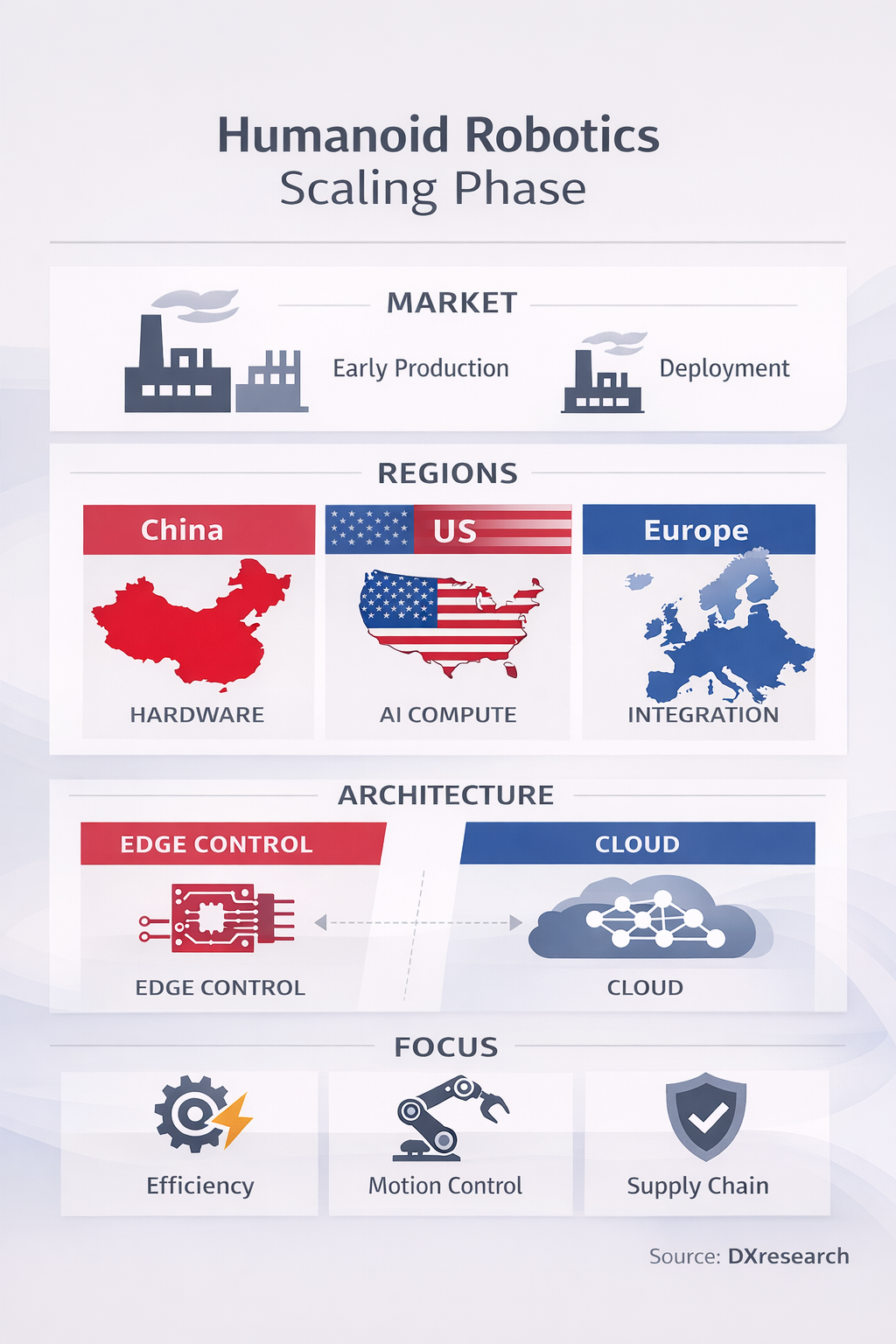
The humanoid robotics stack is evolving across regions with distinct strengths.
China continues to expand its role in hardware, components, and manufacturing scale. Reports suggest strong dependence of Western systems on Chinese subsystems and supply chains (https://www.wsj.com/tech/under-the-skin-of-americas-humanoid-robots-chinese-technology-27dd4fdf).
The United States is advancing AI models and compute infrastructure. Recent initiatives around large scale AI chip projects highlight the link between robotics and data center economics (https://www.reuters.com/business/autos-transportation/intel-join-musks-terafab-mega-ai-chip-project-2026-04-07/).
Europe is building strength in industrial integration. Trade fairs and ecosystem collaborations show a clear focus on embedding humanoids into real workflows (https://emag.directindustry.com/2026/04/02/humanoid-robots-hype-or-the-future-of-automation-insights-from-logimat-2026/).
This distribution creates interdependence. It also creates strategic exposure. Companies increasingly evaluate how much of the stack they control versus source externally.
🏭 OEMs move toward execution
Recent OEM activity indicates progress toward early commercialization.
Companies such as Boston Dynamics are advancing deployment readiness. Others, including Tesla, continue to expand ambitions around humanoid platforms. In parallel, Chinese companies such as UBTECH Robotics are accelerating iteration cycles and production volumes.
Shipment data points are beginning to emerge. For example, reported multi thousand unit shipments over short periods suggest a shift in manufacturing capability (https://www.forbes.com/sites/johnkoetsier/2026/03/30/agibot-shipped-a-staggering-5000-humanoid-robots-in-the-last-3-months/).
This evolution signals a transition. The discussion is increasingly about throughput, reliability, and deployment economics.
⚙️ The semiconductor layer gains strategic relevance
From a semiconductor perspective, humanoid robotics is becoming a system level challenge.
AI compute demand continues to grow. At the same time, edge processing requirements are becoming more stringent. Real time control, deterministic latency, and energy efficiency are central design constraints.
Partnerships between AI infrastructure players reinforce this direction. Collaboration between chip companies and robotics platforms highlights the integration of robotics into broader AI ecosystems (https://www.reuters.com/business/autos-transportation/intel-join-musks-terafab-mega-ai-chip-project-2026-04-07/).
This leads to a dual architecture.
Cloud based systems handle training, coordination, and continuous improvement. Edge systems execute motion control, perception, and safety functions.
For semiconductor companies, this creates multiple entry points. Power electronics, sensing, connectivity, and control architectures all become critical elements of system performance.
🧠 Technology convergence toward hybrid intelligence
A consistent architectural pattern is emerging across platforms.
Humanoid systems increasingly rely on hybrid intelligence. High level reasoning is supported by cloud infrastructure. Low latency execution remains local.
This approach aligns with practical constraints. Network latency, reliability, and safety requirements limit full reliance on remote compute. At the same time, continuous learning benefits from centralized data and models.
Research and early demonstrations show progress in linking language models with robotic control loops. These systems translate high level instructions into motion sequences in near real time.
The implication is clear. Integration complexity increases. Synchronization between cloud and edge becomes a core capability.
💼 Talent and ecosystem formation
Another visible trend is the increasing competition for talent in embodied AI.
Companies are investing heavily in recruiting across robotics, machine learning, and control systems. Compensation packages and cross industry hiring reflect the strategic importance of these capabilities (https://www.businessinsider.com/chinese-robotics-startup-tesla-rival-18-million-salary-chief-scientist-2026-4).
At the same time, partnerships are evolving. Collaboration now spans hardware, AI, and infrastructure providers.
This suggests that humanoid robotics will be shaped by ecosystems rather than isolated players. Coordination across the stack becomes a differentiating factor.
📊 Implications for industry positioning
Several implications emerge from current developments.
Supply chains are becoming a strategic lever. Companies seek resilience and flexibility in sourcing critical components.
System integration capabilities are gaining importance. The ability to combine hardware, software, and AI into reliable solutions defines deployment success.
Semiconductor architectures are evolving toward tighter integration. Solutions that combine sensing, power, and compute enable higher efficiency and performance.
From my perspective, this creates a clear opportunity space for companies working on physical AI infrastructure. The focus shifts toward enabling systems that operate reliably in real environments.
🔭 Looking ahead
The next phase of humanoid robotics will likely be shaped by three dynamics.
First, scaling production while maintaining quality and safety.
Second, integrating humanoids into real world workflows across industries.
Third, aligning AI capabilities with physical system constraints.
These dynamics require coordination across disciplines and regions.
The trajectory is becoming clearer. Humanoid robotics is progressing toward a structured market with defined roles, dependencies, and competitive positions.
Sources
- Under the Skin of America’s Humanoid Robots
07 Apr 2026
Analysis of supply chain dependencies showing strong reliance on Chinese components in US humanoid systems and broader geopolitical implications
https://www.wsj.com/tech/under-the-skin-of-americas-humanoid-robots-chinese-technology-27dd4fdf - Intel to Join Musk AI Chip Project
07 Apr 2026
Covers collaboration on large scale AI chips linking robotics demand with data center infrastructure and future compute requirements
https://www.reuters.com/business/autos-transportation/intel-join-musks-terafab-mega-ai-chip-project-2026-04-07/ - Agibot Ships 5000 Humanoid Robots
30 Mar 2026
Highlights rapid scaling of humanoid production volumes indicating early manufacturing capability and commercialization momentum
https://www.forbes.com/sites/johnkoetsier/2026/03/30/agibot-shipped-a-staggering-5000-humanoid-robots-in-the-last-3-months/ - Humanoid Robots at LogiMAT 2026
02 Apr 2026
Industry perspective on humanoids in logistics and industrial environments with focus on deployment readiness and use cases
https://emag.directindustry.com/2026/04/02/humanoid-robots-hype-or-the-future-of-automation-insights-from-logimat-2026/ - UBTECH Talent Investment
07 Apr 2026
Reports on high compensation packages to attract embodied AI talent, reflecting competitive pressure in robotics hiring markets
https://www.businessinsider.com/chinese-robotics-startup-tesla-rival-18-million-salary-chief-scientist-2026-4
#HumanoidRobotics #PhysicalAI #Semiconductors #Robotics #Automation #AI #Industry40


Leave a Reply