Technical Article
Commit Before Act
Why Vision-Language-Action Needs an Explicit Contract with Real-Time Control
Humanoid intelligence becomes dependable when probabilistic AI proposals become bounded, time-valid, confidence-aware commitments executed and verified by deterministic physical-control architectures.
Inference Is Not the Control Loop
VLA models make robotics more adaptable by relating visual context, language and action representations. NVIDIA’s Isaac GR00T N1.7 tutorial reports an optimized end-to-end inference latency of 39.9 ms on Jetson AGX Thor under its stated benchmark configuration [R1]. Isaac GR00T N1 and TensorRT optimization provide the related model and deployment context [R2] [R3]. That is a meaningful systems result. It does not mean that every motor command may be delegated to a generative model at that cadence.
A humanoid has several time domains. Motor-current regulation, position loops, contact response, protective supervision and communication recovery require bounded behaviour at rates and failure modes that differ from inference. The AI domain is probabilistic: its confidence, data distribution and execution time can vary. The physical-control domain must remain explicit about timing, limits, authority and evidence. Treating these domains as identical creates an unsafe gap between a useful demonstration and a deployable machine.
The Action Contract
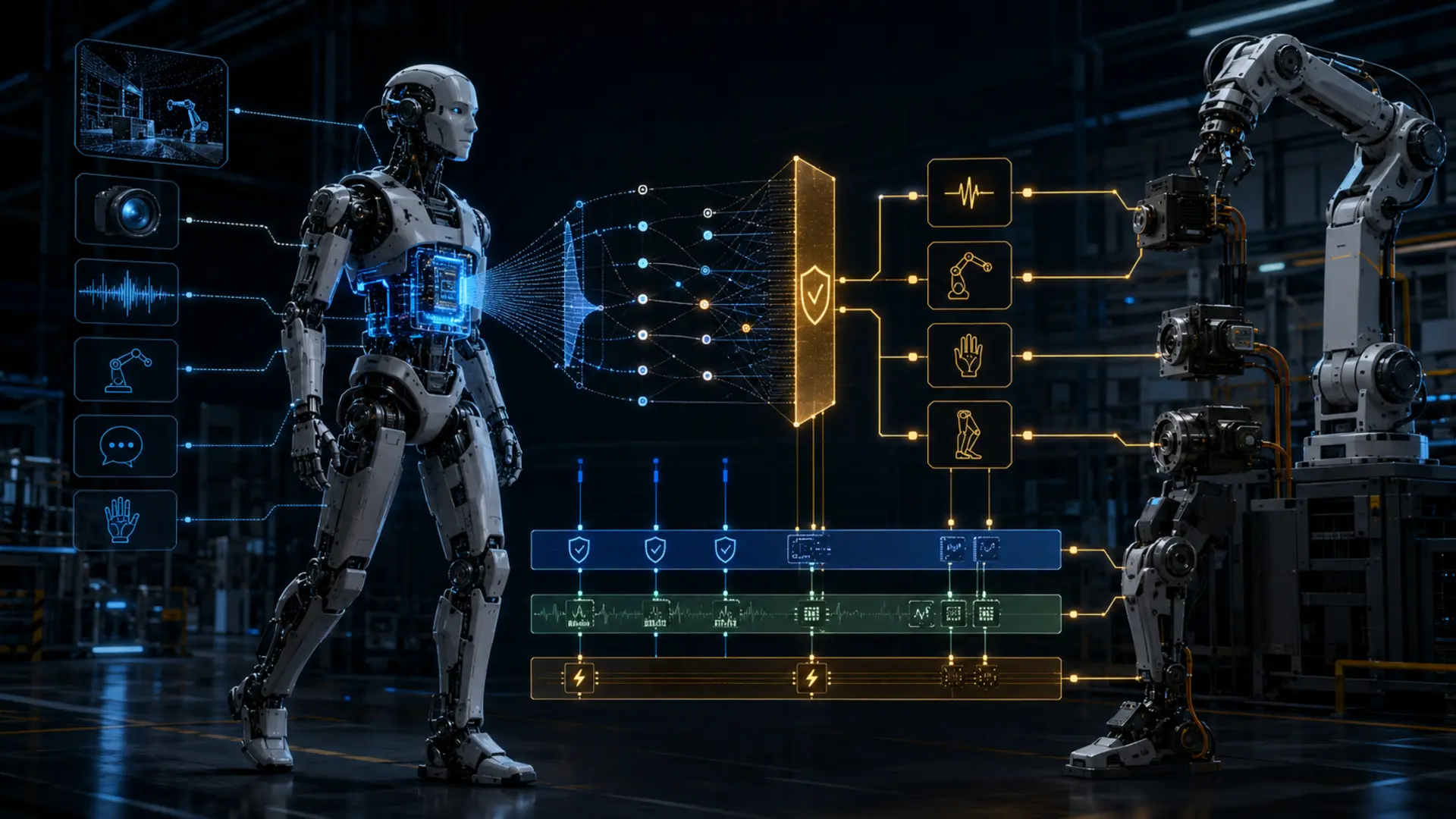
An action contract is not a raw stream of joint targets. It is a machine-readable commitment describing an intended task or motion primitive together with its validity interval, confidence, required observations, allowed workspace, speed and force envelope, stop condition, and fallback behaviour. The contract can be rejected, clipped, delayed, re-planned or superseded without confusing the ownership of safety-critical control.
This separates three decisions. The VLA system proposes an action from context. A supervisory layer checks whether the proposal is still valid and permitted. The deterministic controller closes the physical loops, while an independent safety path can restrict energy, brake or initiate a verified minimum-risk response. The robot is therefore not made less intelligent; it becomes more trustworthy because every layer has a clear promise to keep. This separation is consistent with the safety lifecycle and risk-reduction principles expressed in ISO 10218-1 and IEC 61508 [R4] [R5].
What the contract must contain
| Contract field | Why it matters physically | Semiconductor implication |
|---|---|---|
| Validity time and freshness | Prevents a stale perception result from driving a changing scene. | Timestamping, synchronized clocks, watchdogs and deterministic communication. |
| Confidence and observability | Allows conservative behaviour when the model lacks evidence. | Sensor health monitoring, local diagnostics and compute supervision. |
| Motion and energy envelope | Limits speed, torque, contact force and reachable space. | Safety-capable motor control, current sensing, gate drivers and protected power switching. |
| Fallback and verification | Defines what happens when execution diverges or timing is lost. | Independent MCU paths, nonvolatile evidence, safety I/O and secure communications. |
The Semiconductor Architecture of a Promise
The action contract turns semiconductor functions into system commitments. Edge compute provides the inference result, but power integrity determines whether it arrives predictably under dynamic load. Sensors and time bases establish whether the result remains relevant. Microcontrollers and real-time networks distribute a bounded command, as reflected in established control interfaces such as ros2_control [R6]. Gate drivers, power devices, current sensing and position sensing translate it into controlled torque. Functional-safety mechanisms monitor the path independently. Secure identity and authenticated updates establish which software is allowed to make proposals.
For Infineon, the opportunity is therefore wider than supplying one component beside an AI accelerator. It is to help create the dependable physical layer beneath it: robust power delivery, safe motor-control nodes, sensing, connectivity, cybersecurity and diagnostic evidence [R7]. Those functions make advanced AI useful in a robot that must work near people, equipment and changing environments.
Design Rule: Intelligence May Propose; Control Must Commit
The next generation of humanoids will not win through central compute alone. They will win when perception, language and learned policies can influence motion without weakening the guarantees that motion requires. Teams should define action contracts early, test their latency and failure semantics under realistic workload, and measure how confidence, power integrity, sensing health and safe fallback change the resulting behaviour. The decisive benchmark is not only how quickly an AI model produces an answer. It is whether the robot can commit that answer into the physical world with bounded risk, repeatable behaviour and verifiable evidence.
References
- [R1] NVIDIA, “Deploy GR00T N1.7 on Jetson AGX Thor,” Jetson AI Lab, accessed 2026-08-09.
- [R2] NVIDIA, “Isaac GR00T N1,” technical documentation, 2025.
- [R3] NVIDIA, “TensorRT Model Optimizer: Quantization,” documentation, accessed 2026-08-09.
- [R4] ISO 10218-1:2025, Robots and robotic devices — Safety requirements for industrial robots.
- [R5] IEC 61508-1:2010, Functional safety of electrical/electronic/programmable electronic safety-related systems.
- [R6] Open Robotics, “ros2_control,” documentation, accessed 2026-08-09.
- [R7] Infineon Technologies, “Humanoid Robotics,” application portfolio, accessed 2026-08-09.
Glossary
- Action contract
- A bounded, time-valid and confidence-aware instruction that translates AI intent into permissible physical execution.
- Minimum-risk condition
- A verified state that reduces harm when normal operation cannot continue.
- Vision-language-action model
- A model that relates visual observations and language instructions to candidate robot actions.
Sources
- Deploy GR00T N1.7 on Jetson AGX Thor · 2026 · NVIDIA
https://www.jetson-ai-lab.com/tutorials/groot_n17_on_thor/ - Humanoid Robotics · 2026 · Infineon Technologies
https://www.infineon.com/cms/en/applications/robotics/humanoid-robots/ - IEC 61508-1:2010 · 2010 · IEC
https://webstore.iec.ch/en/publication/5515 - Isaac GR00T N1 · 2025 · NVIDIA
https://developer.nvidia.com/isaac/gr00t - ISO 10218-1:2025 · 2025 · ISO
https://www.iso.org/standard/85639.html - ros2_control documentation · 2026 · Open Robotics
https://control.ros.org/ - TensorRT Model Optimizer · 2026 · NVIDIA
https://docs.nvidia.com/deeplearning/tensorrt/model-optimizer/