Technical Article
Balance Is Momentum Management
Whole-Body Dynamics, Disturbance Recovery and the Semiconductor Control Loop
Humanoid balance depends on managing whole-body momentum through sensing, contact forces, coordinated limbs and fast control before disturbances become falls.
Balance Is Not a Static Pose
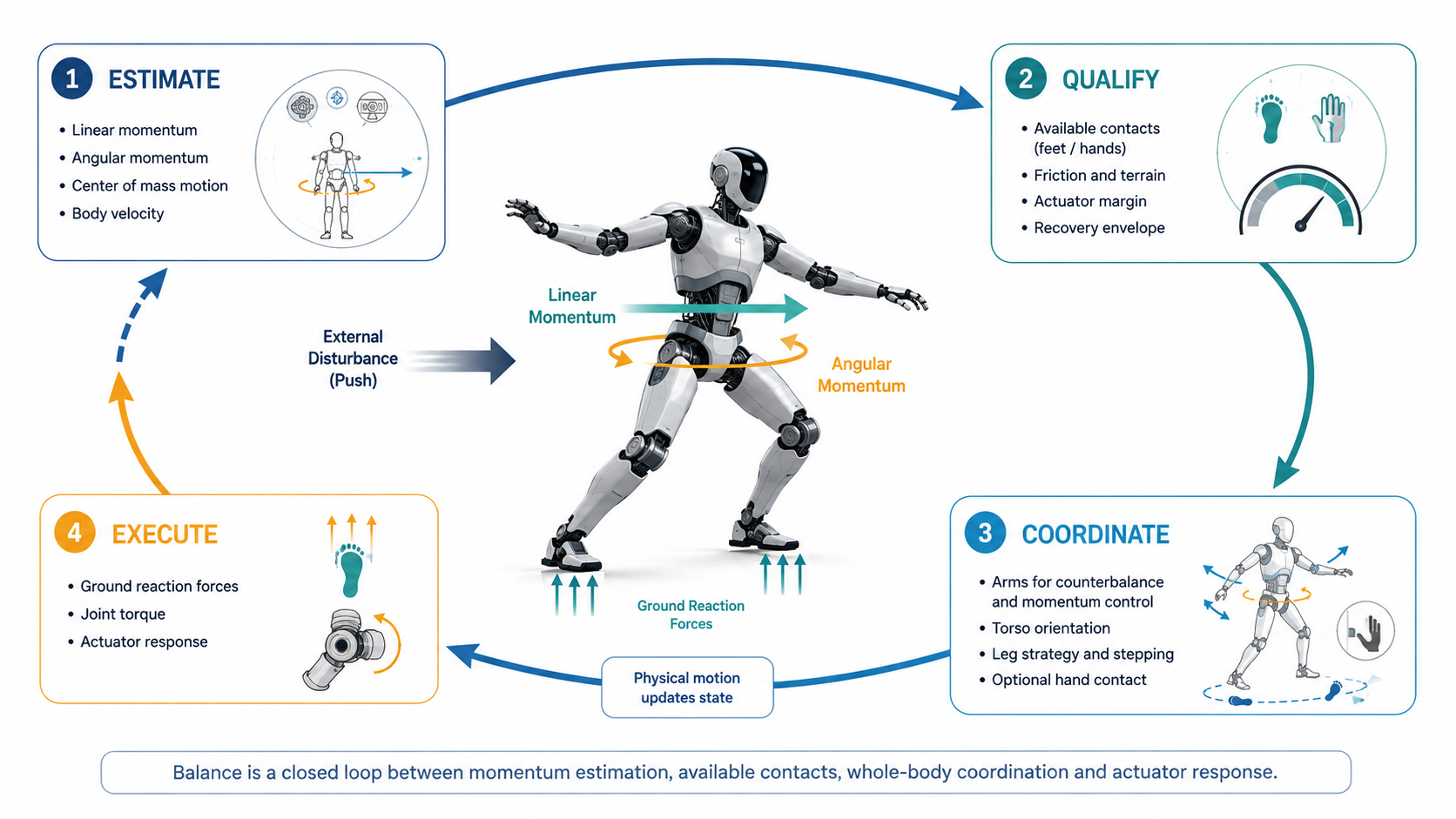
A standing humanoid can look stable while already moving toward failure. Center-of-mass position alone does not reveal how quickly the body is translating, rotating or accumulating motion that the feet and actuators may no longer be able to arrest. Centroidal momentum provides a compact description of whole-body dynamic motion. Recent humanoid planning work explicitly couples centroidal momentum dynamics with joint-level whole-body control because locomotion is strongly coupled, underactuated and exposed to disturbances. [1] The practical question is therefore not only where the robot is, but whether its present motion can still be redirected with the contacts, actuator authority and time that remain.
Every Limb Participates in Balance
Moving an arm changes angular momentum. Humanoid research increasingly uses that coupling deliberately rather than treating upper-body motion as decoration. Lee, Jeon and Kim use centroidal-angular-momentum observations to train coordinated arm behavior that reduces whole-body angular momentum and improves balance under locomotion and perturbations. [3] Other whole-body controllers similarly use upper-body motion to compensate angular momentum generated by lower-body walking. [5] Arms, torso and legs therefore become shared dynamic resources whenever the robot walks, reaches, carries or recovers from a disturbance.
Contacts Are Where Momentum Leaves the Robot
Internal joint motion can redistribute momentum, but sustained changes in total momentum require external forces. The ground reaction force at a foot changes linear momentum, while its moment arm and contact torque change angular momentum. This makes balance inseparable from contact estimation. The controller needs to know which contacts are trustworthy, how much friction they can support and how quickly force can change. Force-torque sensing, motor-current inference, tactile sensing and inertial measurements contribute to the same physical question: which external forces are actually available now?
Recovery Has a Finite Envelope
A disturbance does not instantly create a fall. It moves the robot through increasingly constrained recovery options. Small momentum errors may be corrected at the ankles. Larger disturbances recruit hips and arms. Still larger disturbances require a step or a new hand contact. The capture region expresses where a feasible new contact can help redirect the current motion. ICRA 2026 work on unified humanoid fall safety integrates fall prevention, impact mitigation and recovery rather than treating them as unrelated modes. [4] Momentum management therefore determines whether upright recovery remains dynamically feasible before a minimum-risk stop or controlled descent becomes necessary.
Observers Make Disturbances Visible
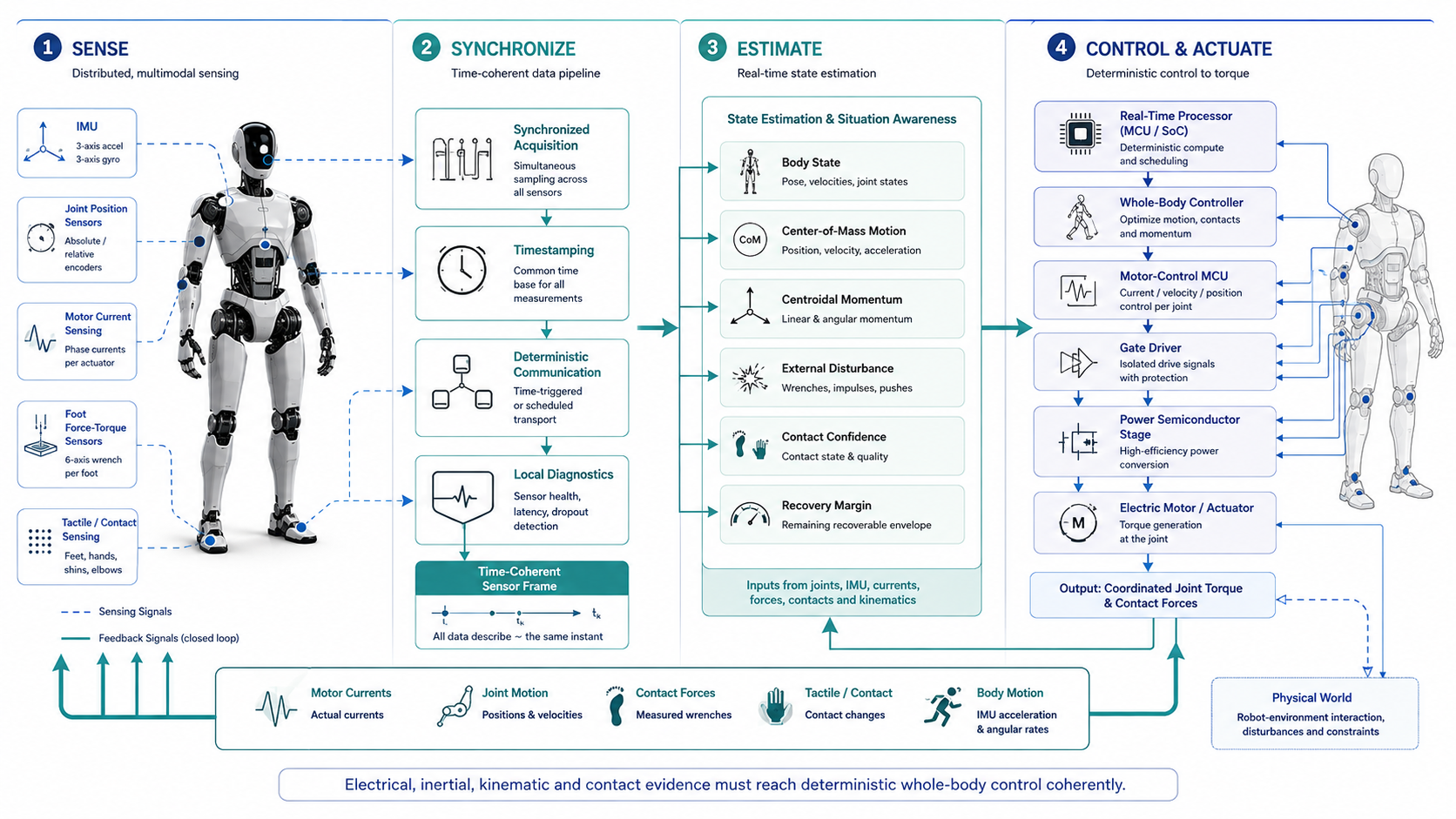
A robot rarely knows the external disturbance in advance. Someone pushes the torso, a carried object shifts, a foot lands earlier than expected or a cable catches. A disturbance observer estimates missing force or torque from the difference between predicted and measured motion. Momentum-based observer research demonstrates disturbance estimation integrated with whole-body control for bipedal robots. [2] MOB-Net takes a complementary approach, combining momentum observation with learned model-uncertainty compensation to estimate external joint torque from internal sensing. [9] Existing actuator and body-state signals can therefore become higher-level physical intelligence when timing, calibration and models are sufficiently accurate.
Several Time Scales Must Cooperate
Momentum management spans prediction and reflex. A planner may reason hundreds of milliseconds or seconds ahead about footsteps and task motion. Whole-body control resolves feasible forces and joint torques much faster. Joint current loops execute faster still. Control-barrier-function whole-body research shows how dynamic stability, force-torque feedback and collision constraints can be integrated into a control framework. [6] NVIDIA's SONIC work demonstrates the parallel rise of learned whole-body motion policies at scale. [7] Whether the motion reference is model-based or learned, physical execution still requires synchronized, bounded actuator effort and coherent state information across the control hierarchy.
The Semiconductor Architecture
Momentum-aware control depends on inertial sensing for body motion, joint position for kinematics, motor-current measurement for actuator effort, force-torque and tactile sensing for contacts, synchronized acquisition for coherent state estimation, deterministic communication and real-time controllers for coordinated response. Infineon's humanoid architecture spans power switching, gate driving, real-time control, current sensing, position feedback and diagnostics. [8] Momentum management gives those components a whole-body context. Current sensing contributes to effort and disturbance estimation. Position sensing contributes to the centroidal model. Deterministic communication preserves the temporal relationship between measurements distributed across the robot.
Payload Awareness and Momentum Are Complementary
Payload awareness asks what the robot is carrying and how that changes mass, center of gravity, inertia and actuator margin. Momentum management asks what the combined robot-load system is doing dynamically. Payload awareness improves the physical model; momentum awareness evaluates the resulting motion. The same object can create very different momentum-management requirements depending on posture, speed and contact state. This distinction also separates momentum management from proprioception, which measures internal body state, force awareness, which estimates physical interaction, and safe stopping, which governs the transition toward a minimum-risk condition.
Design Rules
Estimate motion, not posture alone. Treat arms and torso as dynamic resources rather than passengers. Qualify contacts continuously instead of assuming that nominal contact means usable support. Expose the recovery envelope to both motion control and safety logic. Fuse model-based observers with direct electrical, inertial and mechanical sensing. Preserve timing across measurements distributed through the body. Keep deterministic torque, contact and protection limits underneath learned motion policies. A robot should know not only that it is moving, but whether the physical options that remain can still redirect that motion safely.
Conclusion
Humanoid balance is better understood as continuous momentum management than as static center-of-mass placement. Walking creates momentum. Reaching redistributes it. Payloads change it. Disturbances inject it. Contacts and actuators must redirect it before recoverable motion becomes unavoidable falling. That makes momentum a system variable linking sensing, estimation, communication, control, power electronics and safety. The semiconductor opportunity is not a dedicated momentum chip. It is a coherent distributed control fabric whose sensors are synchronized, whose actuator effort is observable, whose communication is deterministic and whose real-time controllers can coordinate the whole body quickly enough to preserve physical options.
References
- Cun et al., Decentralized Repetitive Learning for Whole-Body Planning and Control of Humanoid Robots With Centroidal Momentum Dynamics, 2026-04. https://doi.org/10.1109/TASE.2026.3679544
- Heng et al., A Robust Disturbance Rejection Whole-Body Control Framework for Bipedal Robots Using a Momentum-Based Observer, 2025-03-19. https://pmc.ncbi.nlm.nih.gov/articles/PMC11940329/
- Lee, Jeon and Kim, Learning Humanoid Arm Motion via Centroidal Momentum Regularized Multi-Agent Reinforcement Learning, 2025-07-05. https://arxiv.org/abs/2507.04140
- Xu et al., Unified Humanoid Fall-Safety Policy from A Few Demonstrations, 2026-06. https://web.eecs.umich.edu/~stellayu/publication/2026firmICRA.html
- Frontiers in Neurorobotics authors, Walking control of humanoid robots based on improved footstep planner and whole-body coordination controller, 2025. https://www.frontiersin.org/journals/neurorobotics/articles/10.3389/fnbot.2025.1538979/full
- Chen et al., Control Barrier Function-based Whole-body Control Framework for Humanoid Robots, 2025. https://scholars.lib.ntu.edu.tw/entities/publication/cadc7718-234c-4e39-b074-f84cf7c197a9
- NVIDIA Research, SONIC: Supersizing Motion Tracking for Natural Humanoid Whole-Body Control, 2026-07. https://research.nvidia.com/labs/dair/publication/sonic2026/
- Infineon Technologies, Humanoid robots, 2026. https://www.infineon.com/applications/industrial/robotics/humanoid-robots
- Lim et al., MOB-Net: Limb-modularized Uncertainty Torque Learning of Humanoids for Sensorless External Torque Estimation, 2024-02-17. https://arxiv.org/abs/2402.11221
Glossary
- Angular momentum
- Measure of rotational motion determined by mass distribution and velocity.
- Capture region
- Feasible contact locations from which a robot can redirect its current momentum and recover balance.
- Centroidal momentum
- Combined linear and angular momentum of a robot expressed about its center of mass.
- Disturbance observer
- Estimator inferring unmodeled external forces or torques from measured behavior and a dynamic model.
- Ground reaction force
- Force exerted by a supporting surface on the robot at a contact.
Sources
- A Robust Disturbance Rejection Whole-Body Control Framework for Bipedal Robots Using a Momentum-Based Observer · 2025-03-19 · Heng et al.
https://pmc.ncbi.nlm.nih.gov/articles/PMC11940329/ - Control Barrier Function-based Whole-body Control Framework for Humanoid Robots · 2025 · Chen et al.
https://scholars.lib.ntu.edu.tw/entities/publication/cadc7718-234c-4e39-b074-f84cf7c197a9 - Decentralized Repetitive Learning for Whole-Body Planning and Control of Humanoid Robots With Centroidal Momentum Dynamics · 2026-04 · Cun et al.
https://doi.org/10.1109/TASE.2026.3679544 - Humanoid robots · 2026 · Infineon Technologies AG
Maps humanoid requirements across motor control, sensing, power, communication, memory, functional safety and hardware-based security.
https://www.infineon.com/applications/industrial/robotics/humanoid-robots - Learning Humanoid Arm Motion via Centroidal Momentum Regularized Multi-Agent Reinforcement Learning · 2025-07-05 · Lee, Jeon and Kim
https://arxiv.org/abs/2507.04140 - MOB-Net: Limb-modularized Uncertainty Torque Learning of Humanoids for Sensorless External Torque Estimation · 2024-02-17 · Lim et al.
https://arxiv.org/abs/2402.11221 - SONIC: Supersizing Motion Tracking for Natural Humanoid Whole-Body Control · 2026-07 · NVIDIA Research
https://research.nvidia.com/labs/dair/publication/sonic2026/ - Unified Humanoid Fall-Safety Policy from A Few Demonstrations · 2026-06 · Xu et al.
https://web.eecs.umich.edu/~stellayu/publication/2026firmICRA.html - Walking control of humanoid robots based on improved footstep planner and whole-body coordination controller · 2025 · Frontiers in Neurorobotics authors
https://www.frontiersin.org/journals/neurorobotics/articles/10.3389/fnbot.2025.1538979/full