
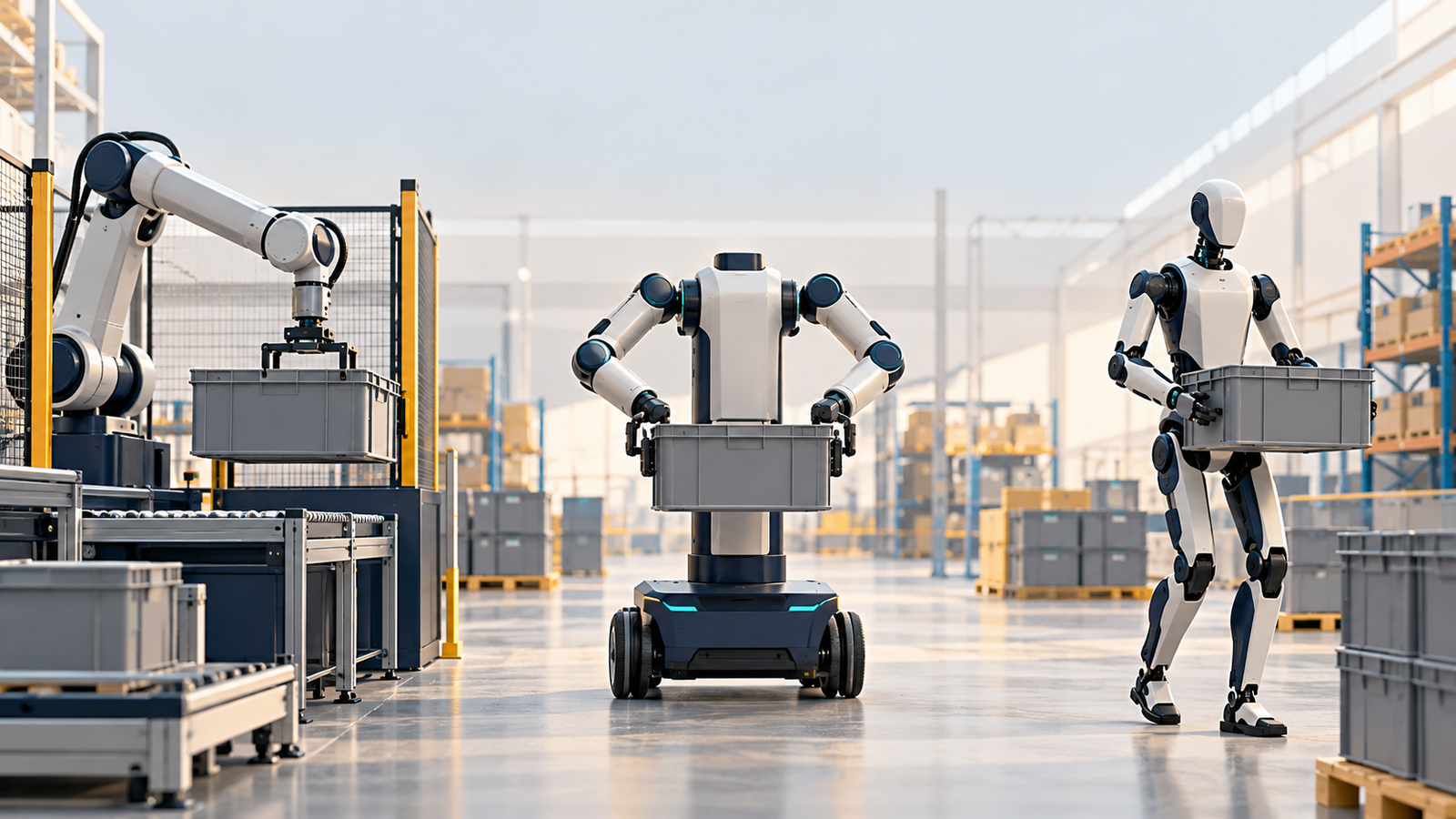
Magazine Article
Humanoids in Logistics: Make the Robot Earn Its Shape
Where legs, wheels, hands and grippers create value—and where conventional automation still makes more sense
Second draft in the current DX author voice; retains source evidence, illustrative economics and market scenarios, and supplied approved visual attachments.
A night shift raises a daytime question
Humanoids will earn their place in logistics by closing costly handling gaps. A robot reaching towards a supermarket shelf makes that possibility tangible. The practical question is what this job requires that existing automation cannot economically provide.
The Danish føtex trial provides a good place to investigate. Euronews reported on 11 October 2026 that HIVE Robots was training Unitree machines to replenish shelves, with people guiding their movements and independent operation an ambition for early 2027. The robots were still slower than staff. That distinction matters: the demonstration establishes access to a real task, while the productive business model remains under development. [src-01]
HIVE describes an hourly service that includes robots, software, maintenance and remote operators. Its launch programme includes a dedicated teleoperator; store staff select replenishment tasks and prepare the equipment. This is a plausible way to learn inside an actual shop, but the public offer does not disclose a competitive cost per correctly shelved item. [src-02]
Which movements demand human-like reach, and which become easier after a modest change to packaging or layout? The successful machine may combine two arms with wheels, or legs with simple grippers. Every capability needs to earn its place.
The opportunity lives between existing machines
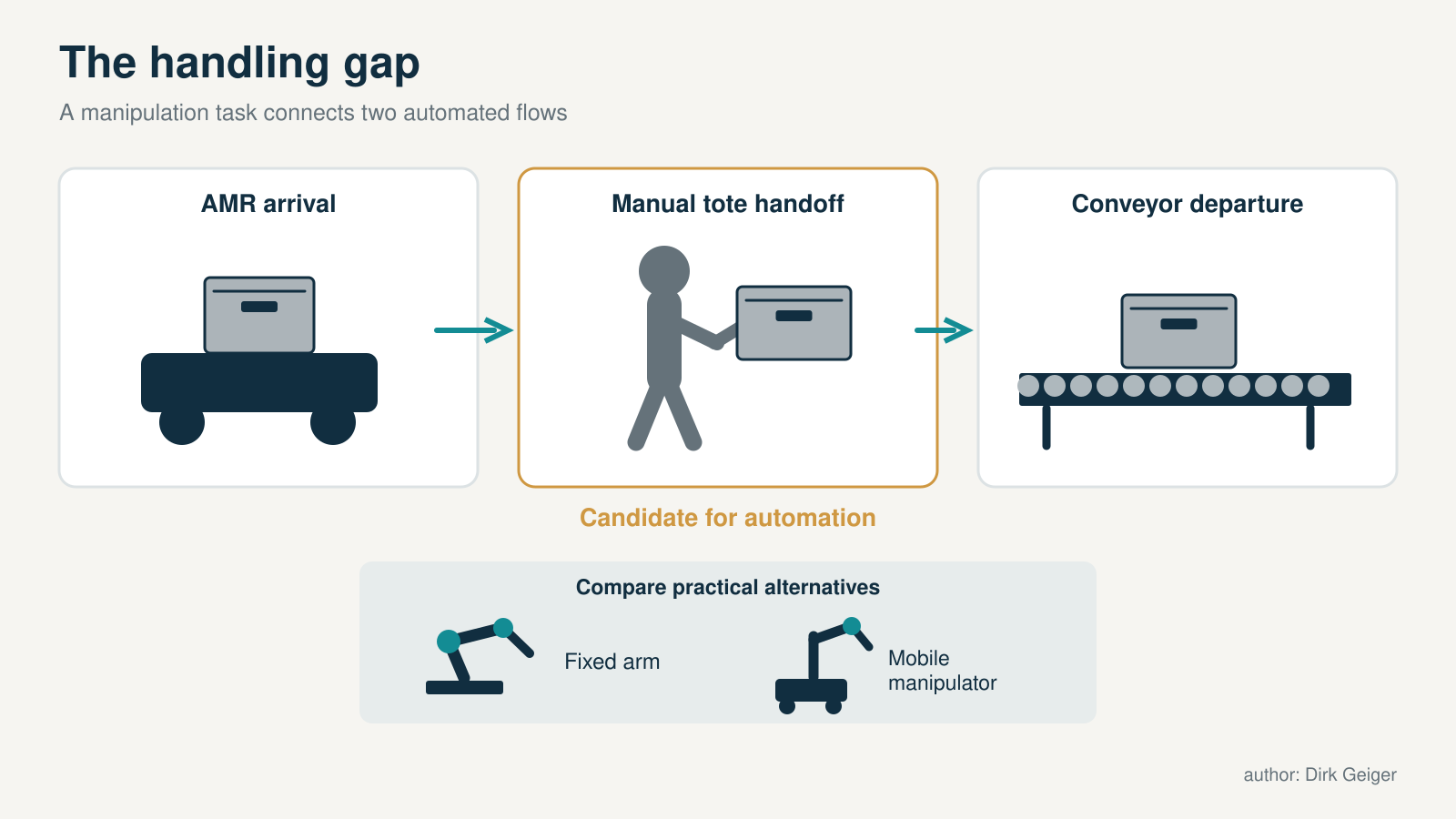
In a typical automated warehouse, mobile robots deliver containers and conveyors carry orders away. People still transfer totes, replenish packaging and clear obstructions. Figure 1 shows the opening for mobile manipulation at these handoffs.
A robot that reaches an existing rack and places a container on an existing conveyor can complete a missing process step. Mobility lets it serve several locations. Existing buildings, changing contracts and limited space can make a complete rebuild unattractive.
An extra conveyor, lift table, fixed arm or redesigned tote may solve the same problem with fewer moving parts. Compare installation disruption, future changes and operating burden alongside equipment cost.
Redeployment could be valuable for contract logistics operators facing uncertain customer commitments. Moving the machine still requires mapping, training, integration and acceptance; physical portability alone provides limited flexibility.
Useful utilisation requires a workable schedule. Two tasks that peak simultaneously cannot both fill the same robot’s shift. Travel, changeovers and conflicting priorities reduce capacity; complementary workloads can keep a slower machine productively occupied.
A hundred thousand totes are evidence—with a denominator missing
GXO and Agility Robotics announced a commercial Robot-as-a-Service agreement in June 2024. At the SPANX operation in Flowery Branch, Digit transfers totes between mobile robots and conveyors. Agility later reported that Digit had moved more than 100,000 totes there. This is meaningful evidence of repeated work in an operating logistics environment. [src-03] [src-04]
A September 2026 Agility announcement adds useful detail. The company reports more than 65,000 operational hours across customer sites and approximately 98% on-task accuracy at the GXO tote application. These are manufacturer-reported figures. The release does not supply the definitions and operating breakdown needed to calculate independently comparable cost per successful transfer. [src-05]
On-task accuracy and scheduled-shift availability measure different things. Charging, waiting and assistance can consume hours even when most attempted tasks succeed. Recovery time and labour belong in the denominator.
The same release describes more than $300 million in multi-year Digit 5 orders, subject to contractual milestones, with early access expected in the first half of 2027 and general availability by year end. That strengthens evidence of customer intent while leaving delivery, acceptance and realised revenue ahead. [src-05]
The next decisive disclosure would combine successful transfers, scheduled hours, assistance and installed cost for the same operation, enabling comparison with a fixed transfer cell or wheeled manipulator.
Deployment is a spectrum, and the labels matter
Several other projects illustrate commercial interest without establishing an identical level of maturity. Mercado Libre and Agility announced a commercial agreement in December 2025, starting at San Antonio, Texas, with possible expansion into Latin American operations. The initial location matters: this announcement should not be counted as an already established Latin American fleet. [src-06]
Amazon's October 2023 publication describes testing Digit for empty-tote recycling at a research facility. A newer Agility release includes Amazon among operational customer sites, but does not quantify an Amazon production fleet. Taken together, these sources support continuing engagement, with scale still undisclosed. [src-07] [src-05]
GXO's June 2024 Apptronik announcement concerns an early proof of concept, beginning with laboratory evaluation of Apollo before potential distribution-centre deployment. Its September 2024 Reflex announcement describes a pilot in an omnichannel operation for a Fortune 100 retailer, covering tasks such as tote transfer and picking. Neither older release alone establishes today's fleet size. [src-08] [src-09]
In China, UBTECH describes Walker handling work at BYD in coordination with mobile automation, and three weeks of training at a Zeekr warehouse loading station. These examples connect humanoids to factory logistics, although the supplier page leaves sustained throughput and customer economics unspecified. [src-10]
| Evidence category | What it establishes | Next question |
|---|---|---|
| Demonstration or training | A task has been attempted in a relevant setting | How much assistance was required? |
| Live pilot | The workflow is being tested operationally | Can it sustain representative shifts? |
| Commercial deployment | A customer is paying for a defined service or system | Does the customer's complete business case work? |
| Conditional order | Future demand depends on agreed milestones | What triggers delivery and acceptance? |
| Repeat rollout | The customer is extending a proven application | How repeatable are integration and economics? |
The existing automation industry has a strong answer
DHL provides a useful reality check. In May 2025 it announced an agreement framework for more than 1,000 additional Boston Dynamics Stretch robots and reported unloading rates up to 700 cases per hour. Stretch is a purpose-built handling system, not a humanoid. Its published performance is an application-specific benchmark, not a direct comparison with tote handling. [src-11]
Retail also has an earlier example. FamilyMart and Telexistence announced a 300-store rollout of TX SCARA in August 2022, focused on replenishing refrigerated bottles and cans from the back-storage area. The announcement concerns a specialised task and planned deployment; it does not establish the current installed fleet. Nevertheless, it shows that shelf replenishment can support an automation strategy with a tightly constrained operating environment. [src-12]
Specialists exploit regular packaging, repeatable working zones and predictable movements. These conditions simplify perception, gripping and recovery. In stable, high-volume processes, fewer degrees of freedom can be an advantage.
Humanoids have a stronger opening at dispersed stations, across changing tasks and where short investment horizons discourage infrastructure. That boundary will move: dedicated automation also benefits from better vision, learning and grippers.
A humanoid pilot may reveal that changing a container or adding a short conveyor solves the problem cheaply. That remains a successful automation decision.
Legs have to solve a problem that wheels cannot solve economically
Locomotion, reaching, carrying and manipulation deserve separate evaluation. Buildings designed for people often accommodate carts and pallet trucks too. Human scale alone establishes little need for walking.
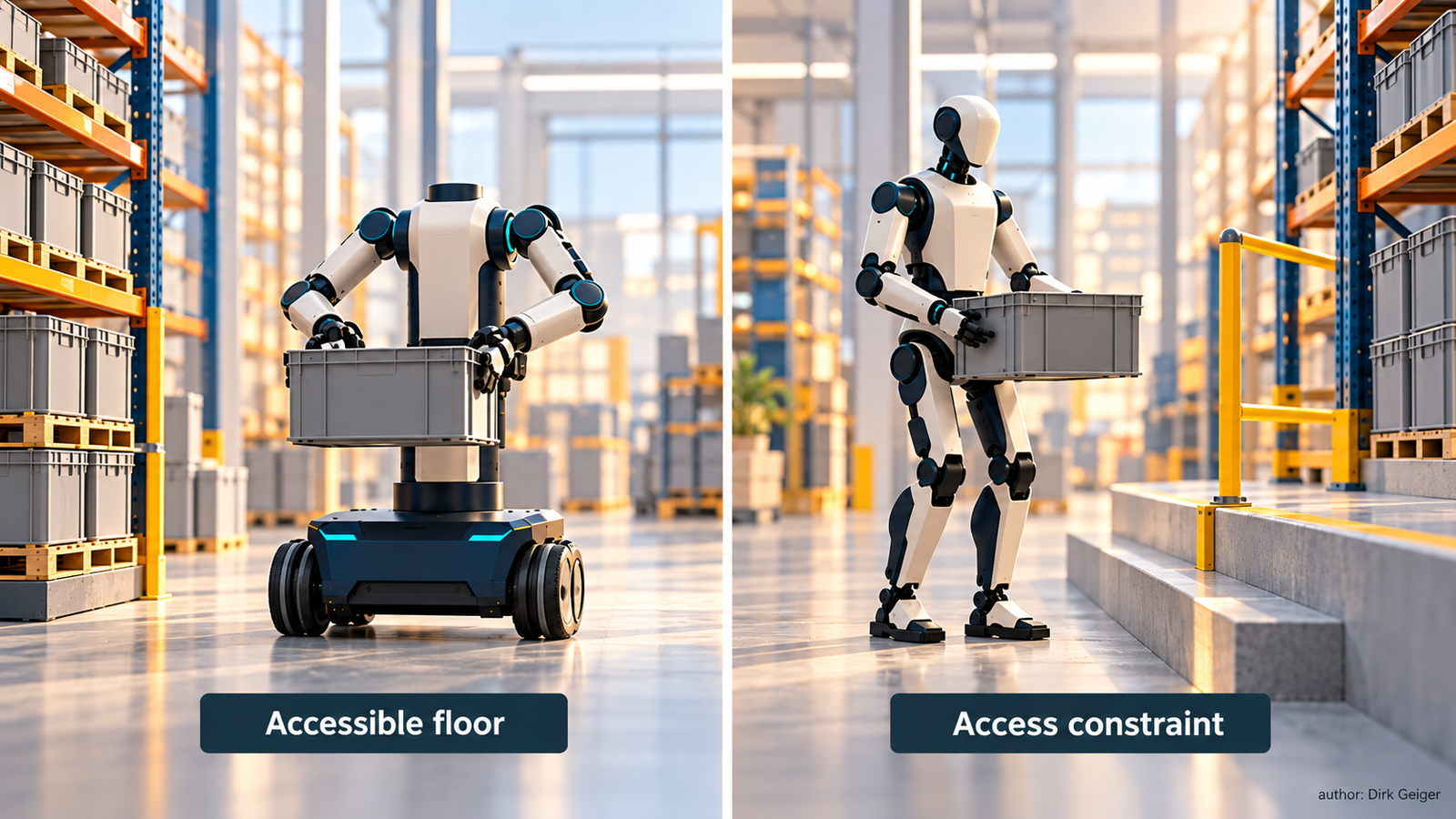
On smooth floors, wheels avoid continuous bipedal balancing and can provide a stable manipulation base. A lifting torso extends reach. Payload, footprint and route conditions determine the advantage; steps, gaps and obstacles constrain wheels.
Reflex explicitly describes its platform as a wheeled humanoid and combines supervised operation with learning from repeated work. That approach treats useful reach and manipulation as separable from legged locomotion. Its GXO pilot gives the architecture a relevant operational setting, while public claims about immediate readiness still require site-specific acceptance. [src-13] [src-09]
Legs become attractive where necessary routes contain steps or constrained workstations require unusual body positions. Compare loaded walking with a ramp, lift or altered workstation. Stair-climbing demonstrations establish little about safe, sustained load carrying.
Figure 2 frames the choice around access. The strongest bipedal case combines frequent, valuable work with obstacles that are expensive to remove.
Measure the working envelope while turning, reaching and recovering with the intended load. A wheeled base needs repositioning room; a biped may need a stabilising step. Both must leave sufficient space for passing workers.
A warehouse hand may need only two fingers
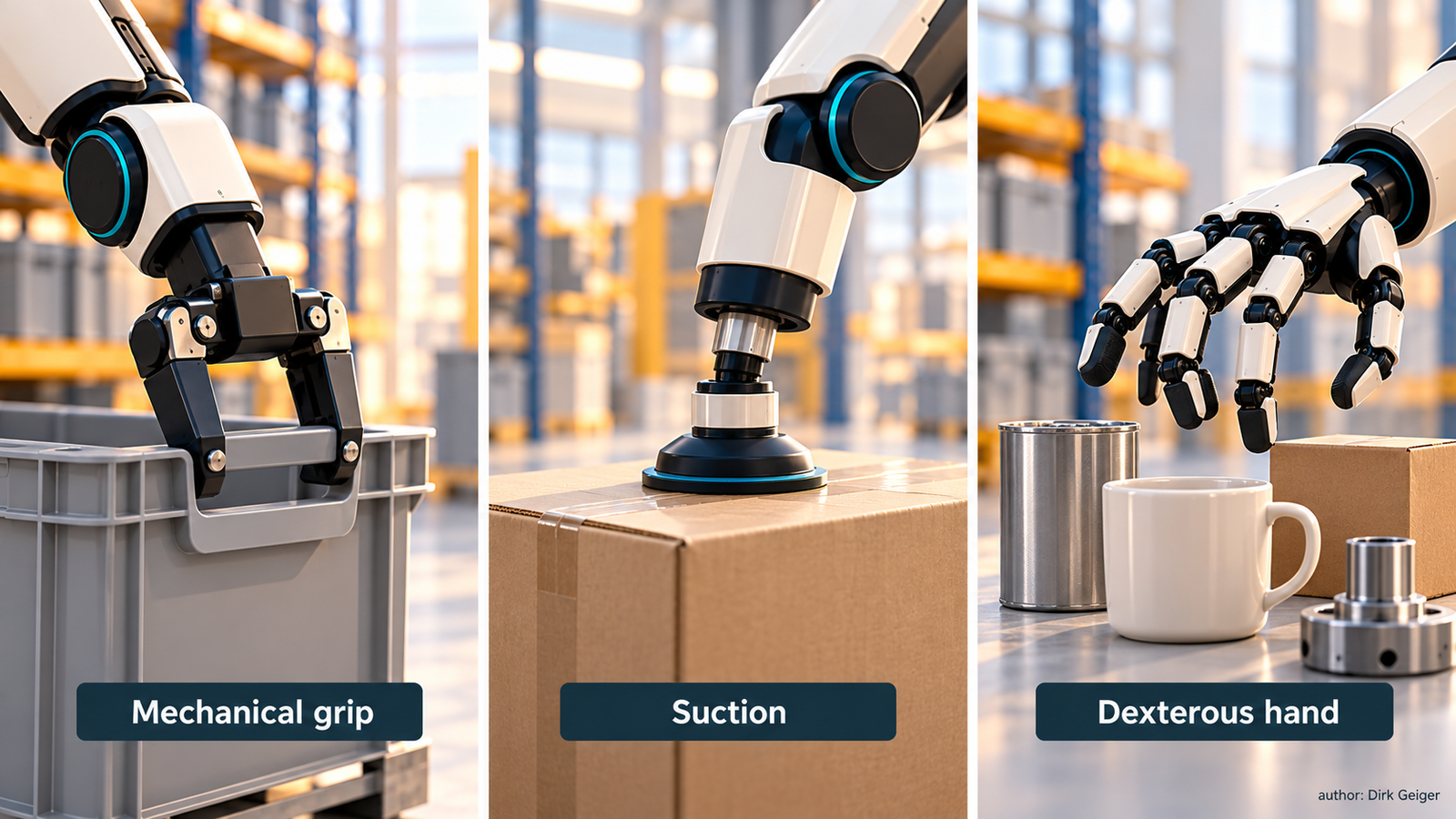
A tote may need a mechanical grip; a suitable carton may accept suction; fragile produce may require compliant contact. Figure 3 contrasts these task-specific tools with a dexterous hand.
Agility makes this argument explicitly in its tooling strategy. It describes interchangeable end effectors that draw on established industrial tools, supporting bulk handling and specialised tasks. The approach retains the option of more dexterous hands later. Its Digit 5 announcement also specifies swappable grippers. [src-14] [src-05]
Dexterous hands earn their cost through valuable changes of grasp, manipulation within the hand or access to objects simpler tools cannot handle reliably. Each extra capability still requires training and validation against the customer’s workload.
Simple tools also have limits. Suction depends on surface quality and leakage; fingers struggle with some slippery or irregular packages. Tool changing adds docking, cleaning and verification time.
Start with object dimensions, mass, surface, fragility and presentation. Select the simplest reliable tool set that covers the valuable workload.
Weight coverage by task frequency and economic importance. Ninety supported products can represent most of the work or almost none. Small changes to packaging and presentation may improve coverage faster than increasingly elaborate manipulation.
Six opportunities, with different machines likely to win
Tote handoffs offer a comparatively narrow starting point. Containers and placement locations can be constrained, while a mobile manipulator closes the gap between existing systems. GXO's Digit application demonstrates the relevance of this task. The decision turns on whether mobility and reuse justify the cost over a fixed transfer solution. [src-03]
Factory line feeding and kitting could reward a machine that serves several workstations and follows changing production needs. Long travel should generally remain a transport problem; the manipulator adds value at pickup, presentation and placement. UBTECH's supplier-reported applications illustrate the intended collaboration with existing mobile automation. [src-10]
Supermarket replenishment has attractive labour content and a difficult object world. A successful process must include case opening, stock identification, shelf placement and packaging disposal, or explicitly leave those steps with staff. Early products should be selected for reliable handling. The economics will suffer if employees spend substantial time preparing every item for the robot.
Mixed-item fulfilment and returns potentially need more dexterity, but they also face strong competition from dedicated picking systems. Returns add uncertain packaging, condition assessment and identification. That makes them interesting learning environments and challenging first applications for a promise of unattended productivity.
Trailer unloading and palletising involve strenuous work, yet dedicated machines already target these tasks. A humanoid could appeal where one unit also performs other valuable duties or access constraints favour its geometry. It must still be compared with the specialist under the same load and flow conditions.
Transport and stock scanning usually provide a weak standalone case for an elaborate body. An autonomous mobile robot (AMR), automated guided vehicle (AGV) or scanning platform may cover the requirement. Combining scanning with replenishment can add value, provided it does not compromise the primary task.
Calculate a shift, including the person behind the robot
Robot purchase price is an incomplete basis for comparison. A useful first calculation multiplies scheduled hours by productive availability and successful task productivity relative to a person. That yields equivalent human work hours. The value depends on whether those hours avoid hiring, overtime or agency labour, or create an explicitly measured service benefit.
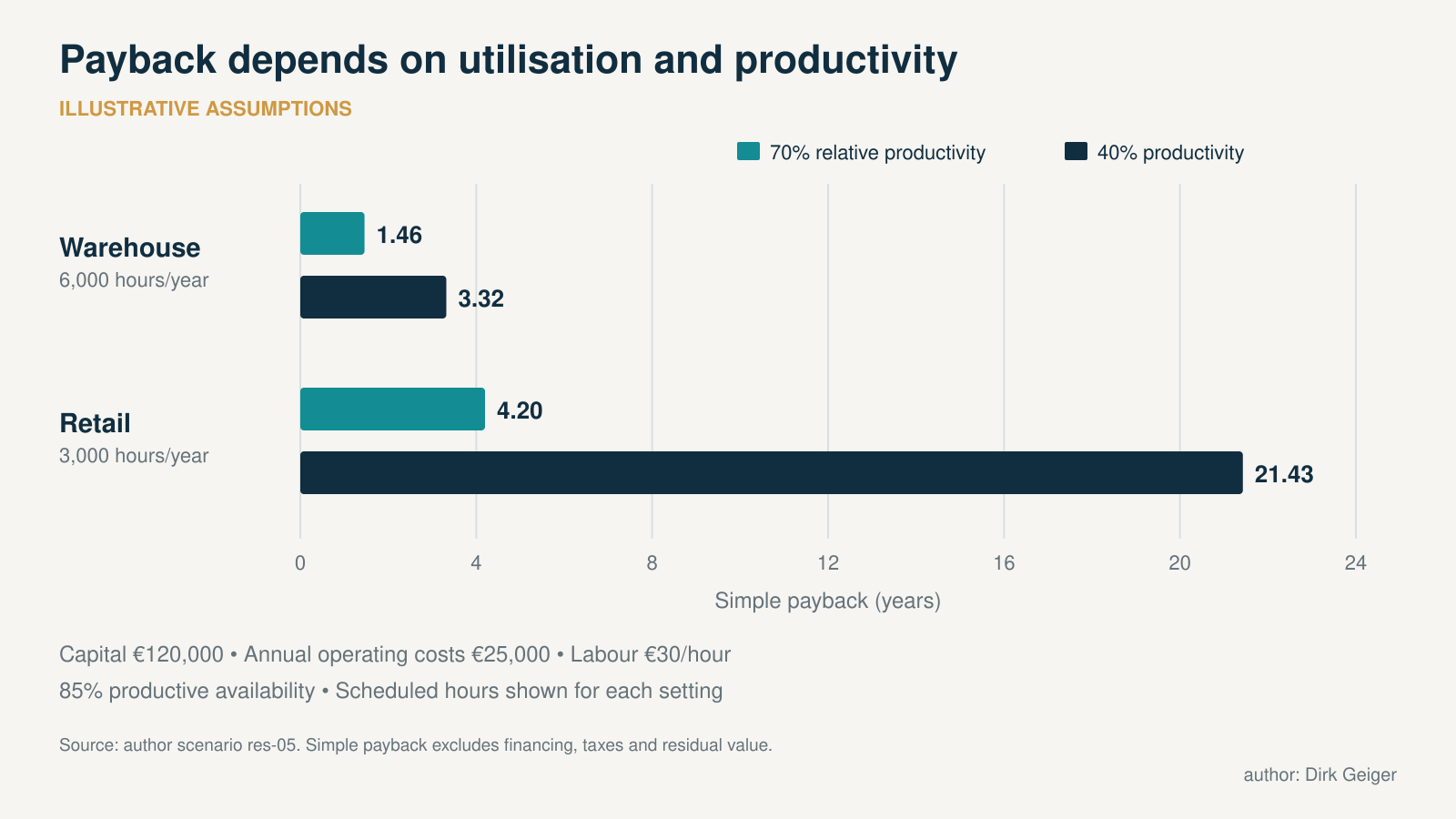
Consider an illustrative investment of €120,000 and annual operating costs of €25,000, including maintenance, energy, software and an assumed allocation of human assistance. These are analytical assumptions, not quotations. With 6,000 scheduled hours, 85% productive availability and 70% relative productivity, the robot delivers 3,570 equivalent human hours. At €30 per hour, that represents €107,100 of annual labour-equivalent value.
After operating costs, €82,100 remains before capital recovery, implying roughly 1.5 years of simple payback. Restrict the same machine to 3,000 overnight hours and the equivalent contribution falls to €28,550, extending payback to about 4.2 years. Reduce relative productivity to 40%, and those paybacks become about 3.3 years and 21 years respectively.
Figure 4 exposes the sensitivity to utilisation and speed. These simple-payback calculations exclude financing, taxes and residual value. A second useful shift or lower installed cost could materially improve the retail case.
Assistance deserves its own line. At an assumed €30 per operator hour, continuous one-to-one support for 3,000 hours costs €90,000. A genuinely achievable one-to-ten ratio allocates €9,000 per robot before overhead. That lower figure requires manageable interventions, including the awkward moments when several robots need help simultaneously. Any actual assistance cost must replace its assumed allocation in the €25,000 operating budget; adding it twice would distort the comparison.
Robot-as-a-Service (RaaS) can move capital risk to a provider, but it does not remove the underlying economics. The contract should define successful work, included assistance, availability, exclusions and remedies. Customers need predictable output; suppliers need enough margin to maintain it.
The market could be substantial; the forecast needs humility
The International Federation of Robotics reports 117,500 transportation and logistics robots sold in 2025, illustrating an established appetite for automation. It separately reports around 7,000 full-size humanoids for commercial and professional applications and identifies teleoperation, cost and business-case barriers. The categories and scope differ; the figures should not be added or treated as a clean humanoid market-share calculation. [src-15]
A transparent scenario is more useful than multiplying all warehouse workers by a robot price. Suppose, purely for planning, that the global candidate pool comprises 100,000 warehouses, 50,000 separate factory-logistics sites and 200,000 larger retail stores. These inputs are assumptions, not a verified facility census. At 10% adoption by 2031, with eight, six and two robots per adopting site respectively, the installed fleet would reach 150,000.
Assuming annual shipments equal 30% of that installed fleet, combining growth and replacement, gives 45,000 units in 2031. An assumed blended hardware price of $50,000 implies $2.25 billion in annual hardware revenue. This scenario includes bipedal and wheeled humanoids, excludes ordinary transport robots and fixed arms, and allocates each site to one segment to avoid double counting.
A conservative scenario of 40,000 installed units and 12,000 annual shipments at $65,000 gives about $0.8 billion. An upside scenario of 400,000 installed units and 120,000 shipments at $40,000 gives $4.8 billion. These are illustrative sensitivities, without assigned probabilities or independently validated site eligibility.
The broad range reflects the unresolved questions: repeatable task economics, operator dependence, deployment effort and service capacity. Recurring software and maintenance create additional business opportunities, but RaaS receipts already recover hardware cost and cannot simply be added to equipment revenue. Regional models must also use local labour costs, operating practices and support networks. A European overnight staffing case will not automatically transfer to a Chinese factory or a US fulfilment centre.
Reliable operation will decide which designs scale
The enabling technology extends well beyond the AI model. Joint control must repeat movements under changing loads. Sensors must identify position, contact and force. Power conversion and battery monitoring must support the intended duty cycle. Independent safety functions must constrain motion when people or faults interrupt the plan. Secure communications and controlled updates matter when a fleet is remotely supported.
These requirements link electronics to economics: sensing can reduce interventions, efficient drives and charging can increase useful hours, and diagnostics can shorten repairs. Their commercial value appears in the complete machine’s reliable output.
Serviceability matters equally. A quickly replaceable gripper may deliver more annual work than a sophisticated hand awaiting spare parts. Both walking and wheeled machines need credible recovery from depleted batteries, blocked aisles and unstable loads.
Safety is application-specific. A promotional statement about working near people does not establish unrestricted suitability for a busy shop. Payload, speed, stopping behaviour, gripping hazards and the local operating environment require assessment. Retail night work reduces customer interaction and creates a more controlled starting point, while staff access and recovery procedures still matter.
Reusable actuation, sensing, power, safety and connectivity subsystems can serve both humanoids and mobile manipulators. Customers also need a supplier who restores service on a Tuesday night and keeps it running through peak season.
Ask the robot to earn its shape
A serious pilot starts with baseline throughput, quality, labour and variability. Include awkward products and interrupted shifts. Compare the present process, a modest process improvement and the most plausible automated alternative.
Agree acceptance measures before the demonstration: correct tasks per scheduled hour, assistance per hundred tasks, damage, charging, repairs and redeployment cost. Peak-period performance matters alongside the average.
Count the work people retain: preparing goods, supplying containers, clearing exceptions and supervising remote operation. Learning from a pilot has value even when the initial economic target proves elusive.
A second site tests scalability. Repeating extensive manual training and custom engineering points to local feasibility. Reusing a common configuration with limited adaptation supports a repeatable business. Integration partners, spare parts and service capacity will shape which suppliers can expand.
Adaptable handling could extend automation into places it has remained incomplete. Useful designs may retain human reach while simplifying the rest: wheels where floors permit them, grippers where objects allow them, and software that broadens the workload.
The supermarket night shift is worth watching because it exposes these choices in a familiar setting. The real achievement will be a repeatable morning result: the right products in the right places, at an acceptable total cost, with staff able to trust the process. That is the evidence that will turn an intriguing robot into a useful colleague.
The evidence still needed
Public deployment evidence remains uneven. Supplier-reported performance needs customer operating data, and the initiating Nordisch report could not be directly checked. Independent comparisons of sustained output, assistance and total cost would sharpen the commercial boundary between humanoids and established automation.
Glossary
- Humanoid
- Robot with a broadly human-like body arrangement; this article includes bipedal and wheeled variants and distinguishes ordinary mobile manipulators.
- Mobile manipulator
- A robot combining a mobile base with one or more mechanisms for handling objects.
- End effector
- Tool attached to a robot arm, such as a gripper, suction device or dexterous hand.
- Teleoperator
- A person who remotely controls or assists a robot.
- Productive availability
- Share of scheduled time during which the robot performs productive tasks, accounting for charging, downtime and work availability.
- Relative productivity
- Rate of successfully completed work relative to a person performing the same task during productive operation.
- Simple payback
- Initial investment divided by annual net contribution, excluding financing, taxes and residual value.
Abbreviations
- AI
- Artificial intelligence
- AMR
- Autonomous mobile robot
- AGV
- Automated guided vehicle
- RaaS
- Robot-as-a-Service
- ROI
- Return on investment
Sources
- Denmark tests humanoid robots in supermarkets · 2026-10-11
Reports Danish supermarket trials using Unitree robots, current human guidance, slower performance, replenishment workloads, and ambitions for future autonomous operation.
https://www.euronews.com/video/2026/10/11/denmark-tests-humanoid-robots-in-supermarkets-to-help-to-ease-staff-workload-at-night - HIVE Retail · Not available
Describes hourly retail robotics services combining humanoid hardware, remote operators, software, maintenance, staff preparation, and a structured launch partner programme.
https://hiverobots.dk/retail - GXO Signs Industry-First Multi-Year Agreement with Agility Robotics · 2024-06-27
Confirms commercial deployment through a service agreement, integrating Digit with existing mobile robots and conveyors for repetitive warehouse tote transfers.
https://www.agilityrobotics.com/content/gxo-signs-industry-first-multi-year-agreement-with-agility-robotics - Digit Moves Over 100,000 Totes in Commercial Deployment · 2025-11-20
Reports cumulative tote handling at GXO and additional stacking tasks, while omitting detailed operating hours, intervention rates, and customer economics.
https://www.agilityrobotics.com/content/digit-moves-over-100k-totes - Agility Unveils Digit 5 Humanoid Robot Built for Cooperatively Safe Work at Scale · 2026-09-15
Announces Digit upgrades, operating metrics, conditional customer orders, interchangeable grippers, and expected availability, with performance and commercial statements requiring qualification.
https://www.agilityrobotics.com/content/agility-unveils-digit-5-humanoid-robot-built-for-cooperatively-safe-work-at-scale - Mercado Libre and Agility Robotics Announce Commercial Agreement · 2025-12-10
Announces Digit deployment beginning in Texas, with potential Latin American expansion and objectives addressing repetitive work, staffing gaps, and ergonomics.
https://www.agilityrobotics.com/content/mercado-libre-and-agility-robotics-announce-commercial-agreement - Amazon announces new fulfillment center robots, Sequoia and Digit · 2023-10-18
Describes Amazon robotics developments and planned Digit testing for empty tote recycling, distinguishing experimental humanoid applications from broader automation deployments.
https://www.aboutamazon.com/news/operations/amazon-introduces-new-robotics-solutions - GXO advances humanoid strategy, announces multi-phase R&D initiative with Apptronik · 2024-06-20
Announces laboratory evaluation of Apollo for logistics tasks before potential distribution centre deployment, establishing research activity rather than scaled operations.
https://investors.gxo.com/news-releases/news-release-details/gxo-advances-humanoid-strategy-announces-multi-phase-rd - GXO partners with Reflex Robotics to deploy new warehouse automation · 2024-09-18
Describes a live warehouse pilot covering tote transfers and picking, using demonstrations to develop autonomy within a robotics service model.
https://gxo.com/news_article/gxo-partners-with-reflex-robotics-to-deploy-new-warehouse-automation/ - UBTECH Humanoid Robot Industrial Application Solution · Not available
Summarises humanoid factory applications, including BYD material handling and Zeekr warehouse training, alongside integration with mobile robots and manufacturing systems.
https://www.ubtrobot.com/en/humanoid/solutions/industry - DHL Group signs MOU with Boston Dynamics · 2025-05-13
Announces intended expansion of Stretch deployments and reports unloading performance, providing a relevant dedicated automation benchmark rather than humanoid demand.
https://group.dhl.com/en/media-relations/press-releases/2025/dhl-group-signs-mou-with-boston-dynamics-and-accelerates-cross-business-automation-strategy.html - Telexistence to Begin Installing AI Robot TX SCARA in 300 FamilyMart Stores · 2022-08-10
Announces planned installation of specialised refrigerated beverage replenishment robots across FamilyMart stores, demonstrating a constrained automation approach to retail stocking.
https://tx-inc.com/en/blog/2022/08/10/11737/ - Reflex Robotics: built for industry · Not available
Describes a wheeled humanoid platform combining industrial hardware, supervised recovery, and learning, with manufacturer claims about workflow compatibility and readiness.
https://www.reflexrobotics.com/ - The Right Tool for the Job · Not available
Explains interchangeable tooling for humanoids, supporting specialised handling and task flexibility while retaining future options for more dexterous robotic hands.
https://www.agilityrobotics.com/content/the-right-tool-for-the-job - Global Sales of Professional Service Robots Surge 24% · 2026-09-30
Reports logistics robot sales and humanoid volumes, while identifying teleoperation, maintenance, training, safety, and economic barriers to broader commercial adoption.
https://ifr.org/ifr-press-releases/news/global-sales-of-professional-service-robots-surge-24-percent - Regal-Revolution: Supermarktkette testet humanoide Roboter – nachts · 2026-10-12
Search metadata describes humanoid supermarket replenishment trials; direct article access failed, so underlying claims were checked against other accessible reporting.
https://www.nordisch.info/natur-forschung/revolution-im-regal-supermarktkette-testet-humanoide-roboter-nachts/