

Technical Article
World Models Are Becoming Silicon Roadmap Instruments
How spatial workloads can reveal durable compute requirements before semiconductor designs harden
World models could expose semiconductor requirements before product roadmaps harden. AMD’s proposed World Labs acquisition provides a test case for measured model–hardware collaboration. Separating training, generation, simulation, planning and embedded inference reveals distinct constraints. A reproducible workload observatory can test whether those signals improve architectural decisions and customer outcomes.
1. The roadmap value is earlier evidence
World models could give semiconductor teams an earlier view of the workloads their next products must support. Their value as roadmap instruments will depend on whether measured behavior changes architectural decisions: memory capacity, data movement, numerical formats, software execution and power budgets. Access to model researchers creates that opportunity. A useful roadmap still requires repeatable experiments and evidence that survives changes in model design.
AMD’s proposed acquisition of World Labs makes this opportunity unusually explicit. Its 28 September announcement connects emerging model expertise with future hardware, software and systems, and describes the agreement as a way to improve understanding of evolving AI workloads. Lisa Su states that next-generation compute requires “a deep understanding of how models are evolving”. That is a research rationale with a concrete architectural consequence: workload discovery can move upstream of product definition. [1]
The proposed test is straightforward. Build one set of architecture priorities from established language-model workloads and another from the same evidence plus representative spatial and physical workloads. Compare which constraints each process identifies, which decisions change, and whether those changes improve subsequently observed application performance. A world-model observatory earns its place when it predicts important bottlenecks that the baseline misses, at an acceptable engineering cost.
This is a demanding standard. Impressive generated environments can attract attention while revealing little about deployable robot systems. Conversely, an unglamorous trace showing repeated movement of persistent state may be more valuable to a memory architect than a visually striking demonstration. Commercial usefulness emerges when observations connect to a customer’s operating conditions and a product decision.
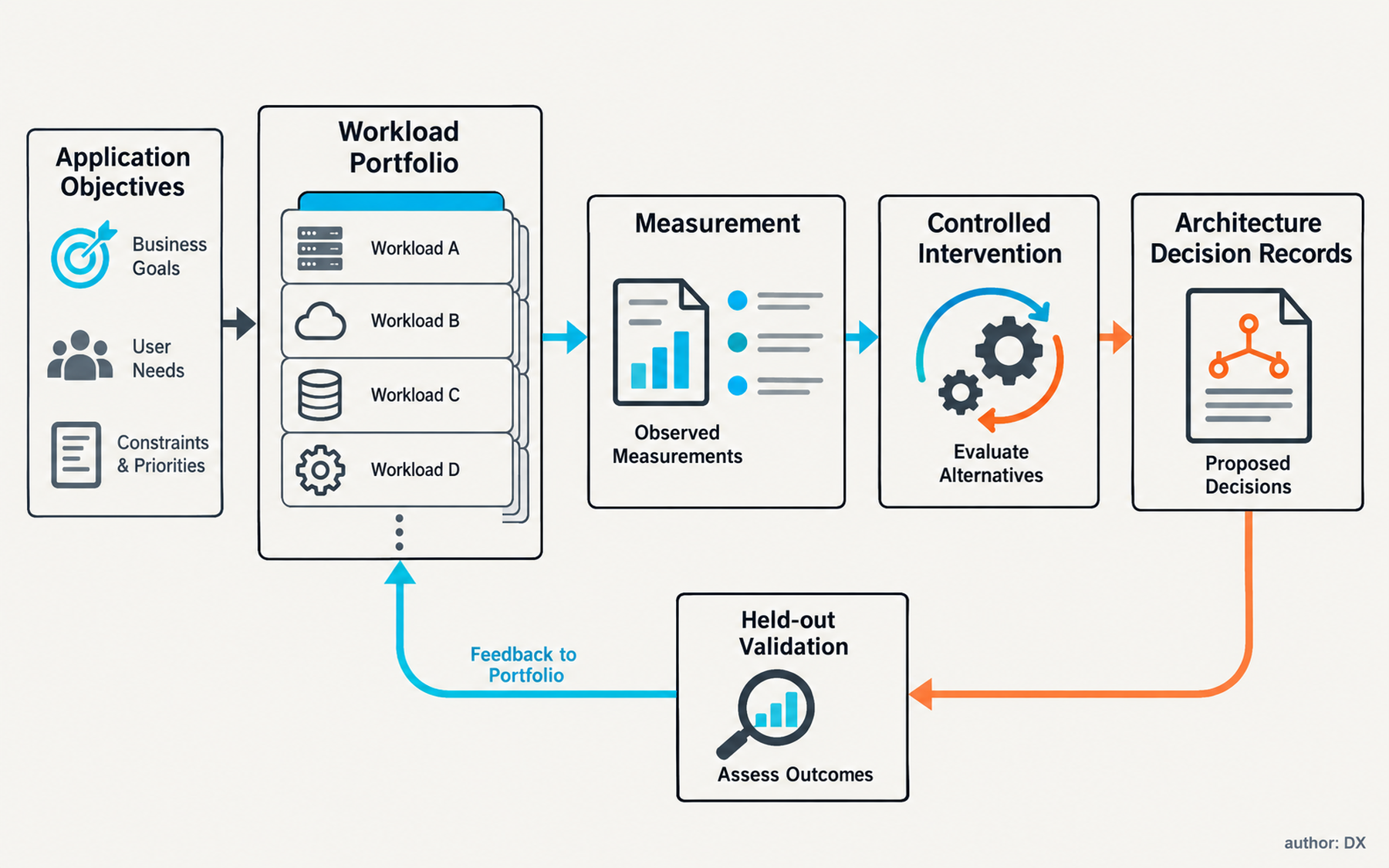
Figure 1. The evidence chain runs from application objectives through measured execution and controlled interventions to an architecture decision. Held-out validation closes the loop by testing whether the proposed response remains useful outside the workloads that motivated it.
2. Agreement, ambition and demonstrated capability
The transaction remains a proposed combination. AMD announced a definitive agreement, with closing expected by the end of 2026 subject to regulatory approvals and customary conditions. World Labs independently confirms the agreement and expected closing window. Corporate integration, research access and future products therefore occupy different evidence categories. No conclusion about shipping silicon follows automatically from the signature. [2]
World Labs reports that its technical partnership with AMD began in the previous year with model training and inference optimization on AMD GPUs. This matters because the relationship already involved execution behavior, giving the roadmap hypothesis a plausible starting point. Public announcements provide no corresponding traces, measured optimization results or disclosed architecture changes. The benefits remain objectives against which later evidence can be assessed.
There is also robotics work to examine. In July, World Labs published company-reported real-to-sim-to-real demonstrations and comparisons between simulated policy performance and physical trials. Its cube-handover evaluation describes 2,000 simulated trials and 100 physical trials per checkpoint. These observations support investigation of simulation as an evaluation tool; their generality requires broader replication, diverse tasks and transparent failure accounting. They establish neither production reliability nor safety qualification. [4]
The strongest interpretation of the combination is improved coordination between model research and systems engineering. The strongest counterargument is that internal access may deliver talent and software optimization without identifying durable hardware requirements. Both explanations fit the announcements. Evidence that distinguishes them would include reproducible workload characterization, documented changes to design priorities and later validation on independently selected applications.
3. Five workloads need separate contracts
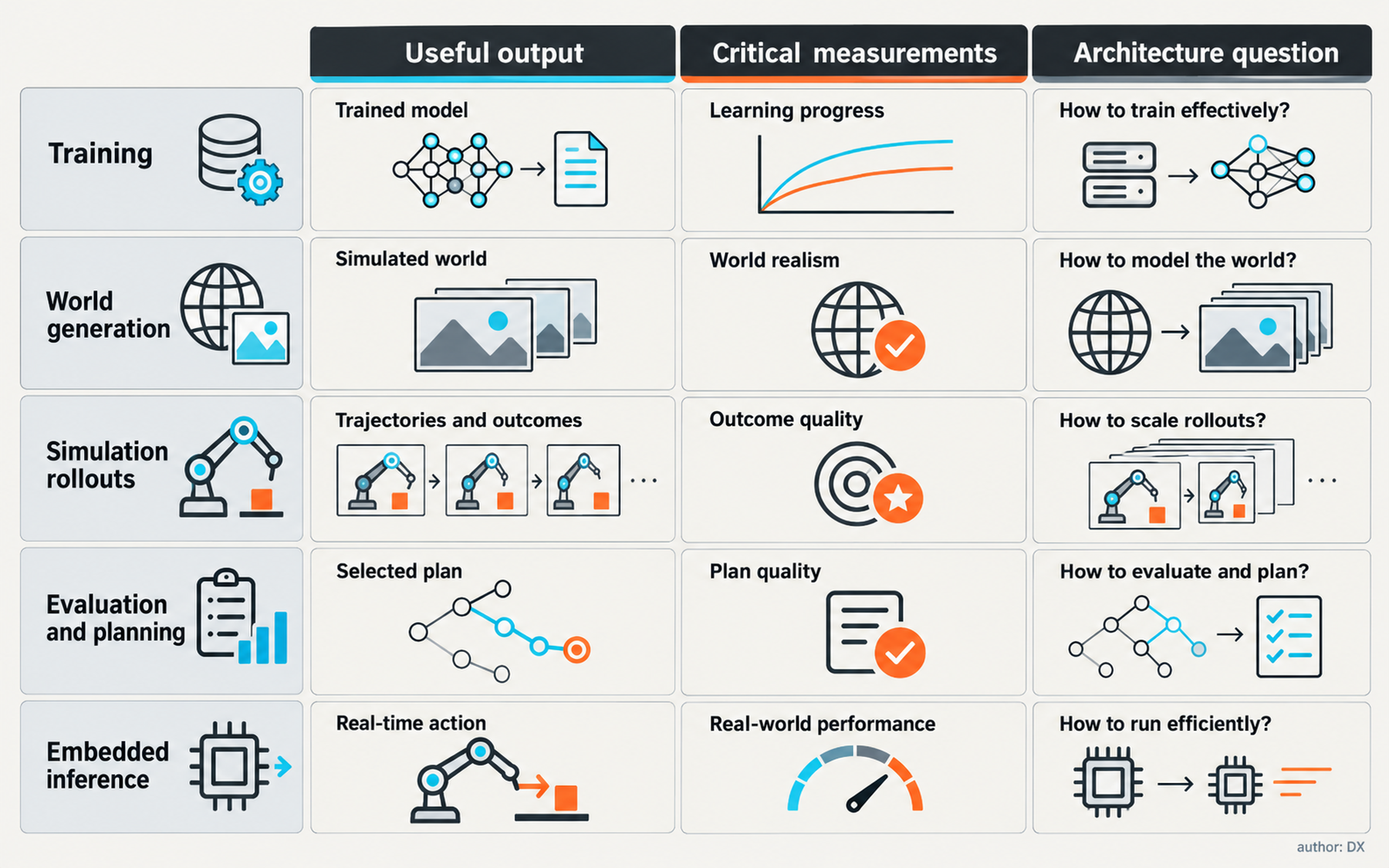
The term world model spans several distinct functions. World Labs’ functional taxonomy separates renderers, simulators and planners, an important distinction when visual plausibility, physical consistency and action selection are evaluated. Semiconductor planning needs a further separation between how models are built, how they create environments and how they execute inside operational systems. [3]
| Workload | Useful output | Measurements | Architecture question |
|---|---|---|---|
| Training and adaptation | Model at agreed validation quality | Time, memory, communication, energy to quality | Compute and distributed memory balance |
| World generation | Usable environment or observation sequence | Generation latency, representation size, validity | Decoder execution and geometry data handling |
| Simulation rollouts | State transitions and sensor observations | Valid transitions per second, fidelity, transfer cost | Physics, rendering and policy coordination |
| Policy evaluation and planning | Comparable policy outcomes or candidate actions | Coverage, ranking agreement, decision latency | Branching, state reuse and scheduling |
| Embedded inference | Timely perception or action proposal | Tail latency, deadline misses, task quality, energy | Bounded memory, thermal behavior and interfaces |
Training seeks useful model quality over an extended run. World generation may produce a persistent scene, a video sequence or a representation consumed by other software. Simulation advances states under chosen actions and must preserve the properties relevant to an experiment. Policy evaluation compares behavior across conditions; planning selects actions, sometimes using imagined futures. Embedded inference operates within an actual robot’s timing, power and communication constraints.
These boundaries describe workloads, not exclusive model families. One model can support several functions, while a deployment can combine learned predictions with conventional physics and control. DreamerV3 offers a research example of learning behavior through imagined trajectories. NVIDIA’s Cosmos platform combines components for world-model development and adaptation. Their distinct purposes justify collecting multiple workload families before treating any single architecture as representative. [5] [6]
Figure 2. Five workload contracts make the benchmark boundaries visible. Training progress, generation quality, valid simulation outcomes and timely robot inference require separate acceptance criteria; their measurements become comparable only through a defined customer objective.
4. Representation determines the memory problem
A spatial system can retain image features, latent states, geometry, object attributes and observation history simultaneously. The important quantity is the working set required by a particular operation, including temporary buffers and duplicated representations. Parameter count provides only part of that picture. A compact model may still execute with a large scene state or expensive intermediate tensors.
Consider a hypothetical manipulation evaluation. The environment holds geometry and material parameters; cameras generate observations; a policy extracts features; several candidate actions generate future states. Keeping shared geometry resident while branching only dynamic state could reduce traffic. Copying the complete scene for every candidate would create a different memory demand. Both approaches may implement the same functional experiment, so the observatory must record representation layout and reuse behavior alongside throughput.
Temporal persistence adds another dimension. Recomputing features can save retained memory while increasing execution work and energy. Retaining them can improve responsiveness while introducing consistency and eviction problems. The right balance depends on scene change, observation rate, horizon and available capacity. Bytes moved per accepted transition or decision, cache behavior and peak live allocation reveal how those choices behave as the scene and prediction horizon change.
Geometry introduces irregularity when object counts, visibility, contacts or active regions vary. A trace should distinguish dense tensor execution from sparse indexing, traversal, sampling and bookkeeping. If poor performance comes from an avoidable software allocation pattern, a compiler or runtime change may address it. If several implementations repeatedly expose the same capacity or locality limit, the evidence for an architectural response becomes stronger.
This distinction protects capital. Memory changes affect packaging, cost and product segmentation. A workload-driven proposal should state which customer task benefits, how the improvement behaves under smaller and larger scenes, and what happens when software changes. A feature whose value disappears after routine operator fusion deserves a different commitment from a persistent state-management constraint.
5. Compute, precision and interconnect must follow useful work
Peak arithmetic performance describes a resource, while useful throughput describes an application outcome. For training, the comparison needs a common quality target and a reproducible data regime. For generation, output validity and consistency must accompany speed. For rollouts, faster transitions count only while the experiment preserves task-relevant dynamics. Without these conditions, a benchmark can reward doing less useful work.
Numerical formats require component-specific tests. Reduced precision may accelerate learned layers while changing accumulated state error, contact predictions or policy ranking. A hybrid pipeline can use different formats for feature extraction, latent dynamics and physical state updates. Conversion overhead and changes in behavior belong in the same evaluation. Recovery from difficult states is especially revealing because small errors can have disproportionately large consequences.
Interconnect pressure arises when training shards exchange information, when simulation workers communicate with policy services, and when scene or observation data crosses processor boundaries. These transfers have different message sizes and synchronization needs. Aggregate bandwidth can conceal latency-sensitive exchanges or idle periods caused by uneven work distribution. Instrument endpoints and queueing so that time spent moving data is separated from time spent waiting for another stage.
Storage and preparation belong in the same accounting. Video decoding, data curation, scene loading and checkpoint handling can dominate elapsed time in a poorly balanced workflow. An accelerator improvement has limited customer value if the surrounding system cannot feed it. Cold-start and steady-state behavior can differ substantially as caches warm and scene assets are reused.
An illustrative comparison would hold task quality constant and test operator fusion, precision changes and data placement before introducing a hypothetical hardware feature. Report the incremental effect of each intervention. This ordering helps a design team identify whether the durable requirement concerns arithmetic, memory, communication or software maturity. The result may justify a simpler silicon change than an initial model-level profile suggests.
6. Simulation throughput needs a credibility boundary
Simulation offers parallel experimentation, controlled variation and access to internal state. Its architectural appeal is substantial: many environments can generate experience or screen policies without allocating a physical robot to each trial. The original World Models research explored compressed environmental representations and learning within generated environments. That research lineage establishes a useful computational approach; each operational application still needs its own transfer evidence. [7]
For a warehouse grasping task, visually accurate packaging may improve perception testing while inaccurate friction changes the outcome of contact. For a navigation task, geometry and occlusion may matter more than fine surface appearance. The simulation contract must specify which properties affect the decision being made. Spending compute on irrelevant detail can make a benchmark expensive without increasing confidence.
World Labs’ July results connect simulated evaluation with physical policy comparisons. A semiconductor observatory could use such an approach as one benchmark component, provided independent tasks and controlled replication accompany it. Company-reported success motivates experiments; broader operating claims require evidence spanning task diversity, intervention frequency and environmental change.
A practical metric is the cost of a valid evaluation outcome. Rejected scenes, failed reconstructions and simulator instability consume resources alongside successful runs. Agreement with physical policy rankings and detection of known failure regions reveal whether that expenditure supports useful decisions. High transition throughput with weak ranking agreement may be useful for exploration, yet unsuitable for choosing a deployment candidate.
The credibility boundary also constrains charts. Generation speed, simulator steps and robot task completion belong on different axes. A dashboard can connect them through an explicit workflow, but combining them into a universal performance score hides the trade-offs engineers need to inspect. Uncertainty in the environment model should remain visible when allocating compute or drawing architecture conclusions.
7. Embedded inference is a distinct operating envelope
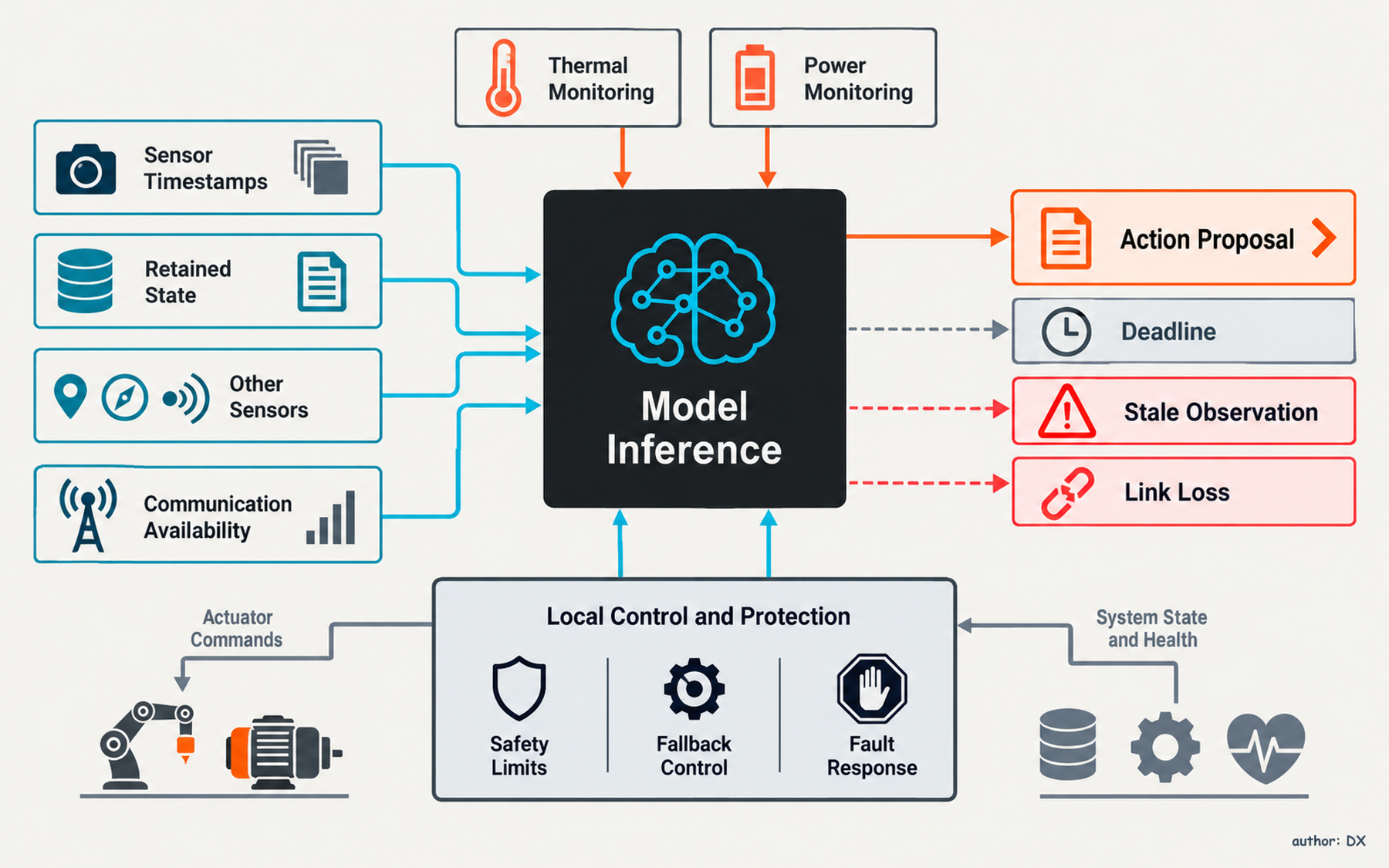
A robot may use a world model for perception, planning or task prediction while local control and protection execute through other components. The compute requirement follows the chosen responsibility. A model producing occasional action proposals has a different timing contract from a service on a continuously updated control path. The observatory should capture observation age, execution time, output validity and the behavior of the system when a result arrives late.
Tail latency matters because the operational system experiences individual delays. The relevant distribution includes concurrent sensor input, communication and background activity, with deadline misses and worst observed cases retained. A selected percentile is useful evidence within the tested conditions; it provides no universal timing guarantee. Bounds require their own engineering method and assumptions.
Power measurements should cover the complete compute subsystem and its operating states. Short laboratory runs can miss sustained thermal behavior. Energy per accepted decision, sustained task performance and idle consumption need a documented ambient condition. Transitions between active and reduced-power states can also affect availability. A low-energy result that depends on frequent missed opportunities has limited operational value.
Cloud assistance creates a partitioning problem. Uploading observations, retaining state locally and requesting remote planning trade communication demand against device capacity and responsiveness. Link degradation and loss expose whether the local system can maintain an appropriate response when remote information becomes unavailable. These experiments can expose needs for memory, network interfaces and local processing without implying that the learned model implements protection functions.
For semiconductor suppliers beyond the main accelerator, workload measurements can reveal sensor synchronization, interface traffic, power conversion and monitoring requirements. The relevance to embedded controllers and connectivity follows measured responsibilities and system integration. It would be premature to translate every frontier-model advance into additional semiconductor content per robot. Integration could also reduce component count or move demand toward different device classes.
Figure 3. The embedded operating envelope links inference to observation age, retained state, communication and thermal constraints. Local control and protection remain distinct responsibilities. The topology illustrates a system partition; it specifies no safety qualification or fixed timing guarantee.
8. Build a workload observatory with decision records
An observatory should produce an auditable chain from application objective to trace, intervention and architectural implication. A manageable portfolio could combine spatial reconstruction, video or latent world prediction, a learned-dynamics agent, a conventional simulation pipeline and an embedded policy path. An established language-model baseline preserves the comparison needed to test the roadmap hypothesis.
Each workload benefits from a frozen reference configuration alongside a version that follows current development. The frozen track detects platform regressions and allows historical comparison. The moving track captures advances in models and software. Checkpoint, dataset, seed, scene asset, runtime, compiler, precision and test-condition records make a result reproducible. A permitted surrogate can support external comparison where original assets cannot be distributed, provided the preserved behaviors are documented.
Instrumentation should connect stage-level execution with end-to-end quality. Live memory, traffic, operator time, synchronization stalls and energy become meaningful alongside task outcomes and run-to-run variation. Controlled interventions can distinguish a measured correlation from its proposed cause. A correlation between scene size and runtime deserves investigation before it becomes a memory specification.
Quarterly architecture decision records would give those measurements a route into product planning. Each record should identify the constraint, supporting workloads, proposed response, cost, confidence and conditions that would reverse the recommendation. Hardware teams need alternatives: a runtime change, a larger memory configuration, an interconnect modification or a dedicated operation may solve overlapping problems at different risks.
Independent replication provides a safeguard against internal enthusiasm. A systems team can reproduce selected findings with another implementation while a customer-facing team challenges application relevance. A frontier-model team contributes early signals, while platform engineering tests robustness and product planning tests commercial importance. The observatory creates value through those disagreements when the evidence resolves them.
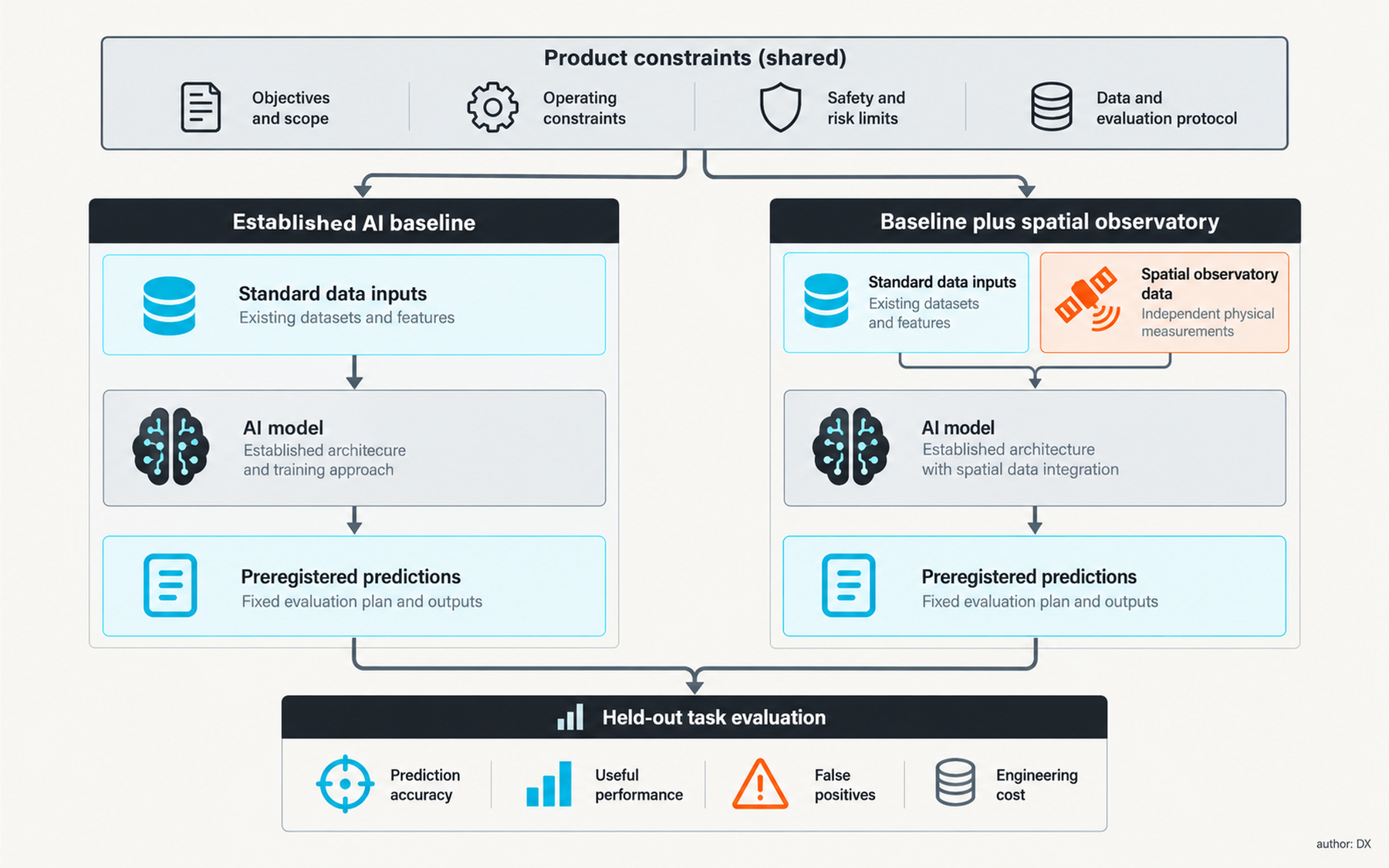
Figure 4. Two planning lanes receive shared product constraints and produce predictions before held-out evaluation. Prediction accuracy, useful performance, false positives and engineering cost provide the comparison. The method could demonstrate an observatory’s value even when the resulting recommendation is a software change.
9. Test the roadmap hypothesis before committing
A credible evaluation begins with two comparable planning processes. Both receive the same product constraints, customer objectives and established AI evidence. One also receives the spatial-workload observatory. Each records priorities before new evaluation tasks are revealed. This prevents hindsight from turning any later bottleneck into an apparent prediction.
Workloads held out from different model families and tasks expose whether predicted constraints match observed limitations. Architectural interventions can then be assessed for useful performance under realistic resource budgets. False positives matter too: features prioritized by the observatory may provide little benefit. Architecture exploration has an opportunity cost, and a more elaborate process must justify its additional engineering effort.
Useful outcomes include better bottleneck prediction, stronger improvements at fixed quality and power, and fewer revisions when a new application appears. Numerical acceptance thresholds should be agreed before testing, based on product economics and measurement uncertainty. Public evidence has yet to establish whether acquiring a world-model company improves these outcomes.
The hypothesis would weaken if requirements converge with the language-model baseline, if software changes erase most differences, or if model-specific features fail on held-out tasks. It would strengthen if independent model families repeatedly expose the same constraints and interventions predictably relieve them. Mixed results may justify changes to memory configurations or software investment while leaving the core accelerator architecture intact.
Commercial weighting needs similar discipline. Training infrastructure, simulation services and embedded robot compute serve different buyers, volumes and margins. A demanding experiment can reveal a real limitation while representing a small market. Workload prevalence and customer willingness to accept cost, power or integration changes determine whether technical importance warrants a product priority.
10. Openness makes the architectural signal stronger
Ownership can shorten communication between researchers and hardware teams, yet it can also concentrate attention on a proprietary model family. An open observatory should retain externally developed workloads, document substitutions and distinguish public evidence from confidential measurements. Diverse implementations help reveal which constraints belong to the application and which belong to one software stack.
Reproducible traces can expose architectural behavior without disclosing every training asset or future product decision. The useful public record includes workload definitions, input dimensions, operating conditions, measurement methods and quality criteria. Trace sharing still needs explicit permission: environments may contain sensitive facilities, proprietary objects or identifiable observations. Anonymized summaries should preserve the execution features needed for comparison.
Long-cycle decisions require a view across several model generations. Responses that remain useful as representations, operators and deployment patterns evolve offer greater resilience. Capacity headroom, efficient data movement and adaptable software can serve multiple plausible futures. Dedicated features need stronger evidence of durable demand and a clear account of their area, power and validation costs.
AMD and World Labs have articulated an ambition to bring model research closer to compute infrastructure. The next meaningful evidence would be a documented workload portfolio, measured constraints and reproducible interventions that influence engineering priorities. For robotics customers, the ultimate test is improved development throughput or operational performance at credible cost and reliability. For semiconductor teams, the immediate task is to instrument emerging workloads well enough that a roadmap can learn before its commitments become expensive.
Glossary
- World model
- A learned representation used to predict or generate observations, environmental states or consequences of actions.
- Workload observatory
- A repeatable measurement process connecting representative applications, execution traces and architectural decisions.
- Working set
- The data and intermediate state actively needed during an operation.
- Tail latency
- The high-delay portion of an execution-time distribution under defined test conditions.
- Sim-to-real transfer
- Application of behavior developed or evaluated in simulation to a physical system.
- Held-out workload
- A workload excluded from planning evidence and later used to test predictive validity.
- Architecture decision record
- A documented engineering choice including evidence, alternatives, costs and reversal conditions.
- Numerical precision
- The representational accuracy available to stored values and arithmetic operations.
Abbreviations
- AI
- Artificial intelligence
- AMD
- Advanced Micro Devices
- GPU
- Graphics processing unit
Sources
- AMD to Acquire World Labs to Advance the Future of AI Compute · 2026-09-28
AMD announces a definitive acquisition agreement, connecting model research with future compute roadmaps, while specifying transaction value and closing conditions.
https://ir.amd.com/news-events/press-releases/detail/1299/amd-to-acquire-world-labs-to-advance-the-future-of-ai-compute - World Labs is Joining AMD · 2026-09-28
World Labs describes its proposed AMD combination, prior GPU optimization partnership, research leadership arrangements, open ecosystem ambitions and closing conditions.
https://www.worldlabs.ai/blog/amd-announcement - A Functional Taxonomy of World Models · 2026-06-03
World Labs distinguishes rendering, simulation and planning, examining their functional contracts, emerging convergence, representation choices and unresolved physical fidelity challenges.
https://www.worldlabs.ai/blog/taxonomy-of-world-models - Building Worlds That Train Robots · 2026-07-28
World Labs presents reported robot simulation transfer demonstrations and policy evaluation comparisons, describing task alignment, variation and remaining deployment challenges.
https://www.worldlabs.ai/blog/real-to-sim-to-real - Mastering Diverse Domains through World Models · 2023-01-10
DreamerV3 learns environment dynamics and improves behavior through imagined trajectories, reporting broad task coverage with shared configuration and robustness techniques.
https://arxiv.org/abs/2301.04104 - Cosmos World Foundation Model Platform for Physical AI · 2025-01-07
NVIDIA introduces a world foundation model platform spanning video curation, pretrained models, posttraining examples and tokenizers for Physical AI development.
https://arxiv.org/abs/2501.03575 - World Models · 2018-03-27
Ha and Schmidhuber investigate compressed spatial temporal representations, compact policies and learning within generated environments, establishing an influential modeling approach.
https://arxiv.org/abs/1803.10122