
White Paper
The Physical AI Supply Chain
Where value, concentration and qualification will decide the speed of the robot economy
Physical AI depends on a supply chain that extends from critical minerals to fleet services. This paper maps that chain, identifies the most consequential concentration and qualification risks, and proposes a resilience agenda for robot makers, component suppliers, integrators and industrial users preparing for scaled deployment.
Executive Summary
Physical AI turns artificial intelligence into physical work. Its supply chain therefore carries two inheritances at once: the digital concentration of advanced compute and software, and the industrial complexity of motors, batteries, sensors, precision mechanics and safety engineering. A humanoid, autonomous mobile robot or intelligent machine may be presented as one product, yet its ability to scale depends on a network that starts with mined materials and ends with field service, spare parts, software support and trusted operational data.
The most visible bottleneck will rarely be the only important one. A high-performance actuator can be constrained by rare-earth magnets, precision gearsets, bearings, winding capacity, calibration equipment, power semiconductors or a supplier's willingness to reserve capacity for uncertain volumes. A compute module can be available while the safety architecture, real-time control integration or cybersecurity assurance remains immature. A battery cell can be plentiful while pack qualification, burst-power performance and service procedures hold back deployment.
Current evidence points to four conclusions:
- Actuation concentrates cost and supply risk. McKinsey estimates actuators at 40–60 percent of a humanoid bill of materials and identifies precision reducers, roller screws, force sensing and permanent magnets among likely choke points [1].
- Regional concentration is structural. China combines strong positions in rare-earth processing, magnets, batteries, motors, power electronics and high-volume electromechanical manufacturing. The European Commission states that all rare earths used for permanent magnets in the EU are refined in China [3].
- Qualification can become scarcer than components. Robotics-grade performance depends on calibration, traceability, reliability evidence, safety engineering and stable interfaces. These capabilities take time to create and cannot be secured through spot purchasing.
- Resilience requires architectural choices. Dual sourcing helps only when parts, software and validation evidence can be exchanged without redesigning the robot. Modular interfaces, qualified alternates, lifecycle data and controlled software provenance turn procurement options into operational resilience.
The central recommendation is to manage the Physical AI supply chain as a portfolio of performance-critical, concentration-critical and qualification-critical dependencies. Companies should map these dependencies below the Tier-1 level, design substitutability into architectures, reserve scarce qualification capacity, and build regional ecosystems around subsystems where performance and supply leverage intersect. The winners will secure more than parts. They will secure repeatable, verifiable and serviceable capability.
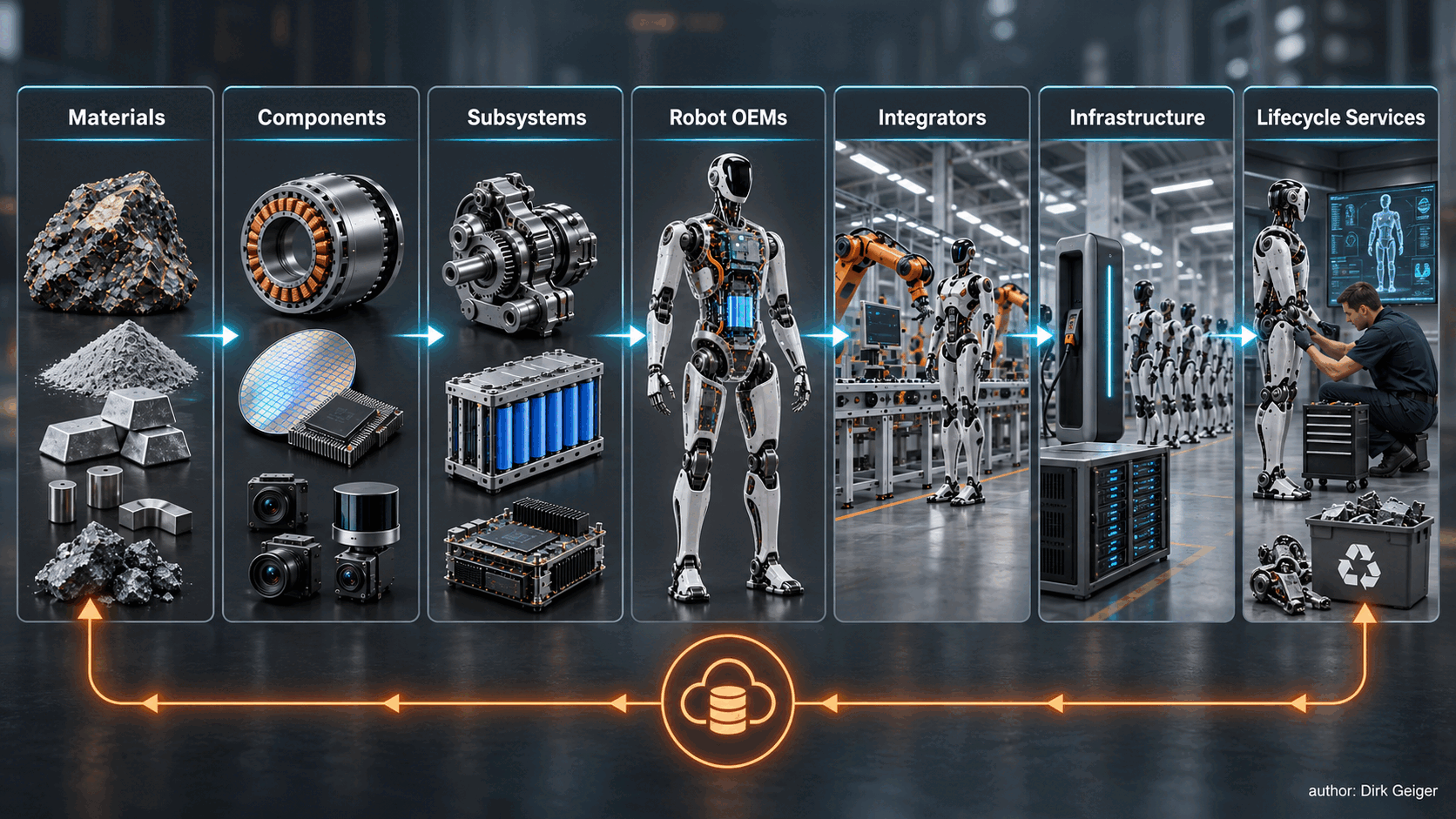
Figure 1 maps the complete value chain. It connects upstream material flow and downstream capability delivery with the field-data loop that supports maintenance, redesign and supplier learning.
A Supply Chain for Machines That Perceive, Decide and Act
The Physical AI value chain can be understood as seven connected layers. Each layer has different economics, lead times and failure modes, yet every deployed robot depends on all seven.
| Layer | Representative content | Primary scaling question |
|---|---|---|
| Materials | Rare earths, copper, aluminium, steel, silicon, lithium, graphite and engineered polymers | Can supply be refined, processed and certified at predictable cost? |
| Components | Magnets, semiconductors, cells, sensors, bearings, connectors, motors and precision screws | Is qualified capacity available beyond one supplier or region? |
| Subsystems | Actuators, battery packs, compute platforms, sensor suites, hands, communication and safety modules | Are interfaces stable enough for reuse, substitution and volume production? |
| Robot OEMs | Mechanical architecture, embedded control, autonomy stack, system integration and product assurance | Which capabilities define the product, and which should become supplier platforms? |
| Integrators | Application engineering, tooling, workflow design, safety validation and site acceptance | Can a technically capable robot deliver reliable work in a real process? |
| Infrastructure | Charging, networking, edge or cloud services, fleet orchestration, identity and data platforms | Can fleets operate securely and continuously across customer environments? |
| Lifecycle services | Maintenance, spares, remanufacturing, updates, calibration, training and recycling | Can availability and economic value be sustained over years? |
This layered view prevents a common planning error: treating the robot bill of materials as the complete supply chain. A bill of materials captures what is installed at build time. It does not capture tooling, calibration, firmware maintenance, safety evidence, commissioning, charging logistics, spare-part availability or the operational data needed to improve performance. These downstream capabilities determine whether a prototype becomes a production asset.
The layers also move at different speeds. Semiconductor products may have multiyear design and qualification cycles. Robot mechanical designs can change several times within one year. Mining and refining projects may require far longer. Software models can be updated weekly, while safety-relevant behavior demands controlled releases and regression evidence. Supply-chain strategy must therefore reconcile clocks that were never designed to run together.
Physical AI also blurs the conventional boundary between supplier and operator. Fleet data can shape component specifications. Maintenance findings influence control limits. A new model can change compute load, thermal behavior, energy consumption and achievable duty cycle. The supply chain becomes a closed learning loop in which field evidence travels upstream and revised capabilities travel downstream.
Where Scaling Pressure Accumulates
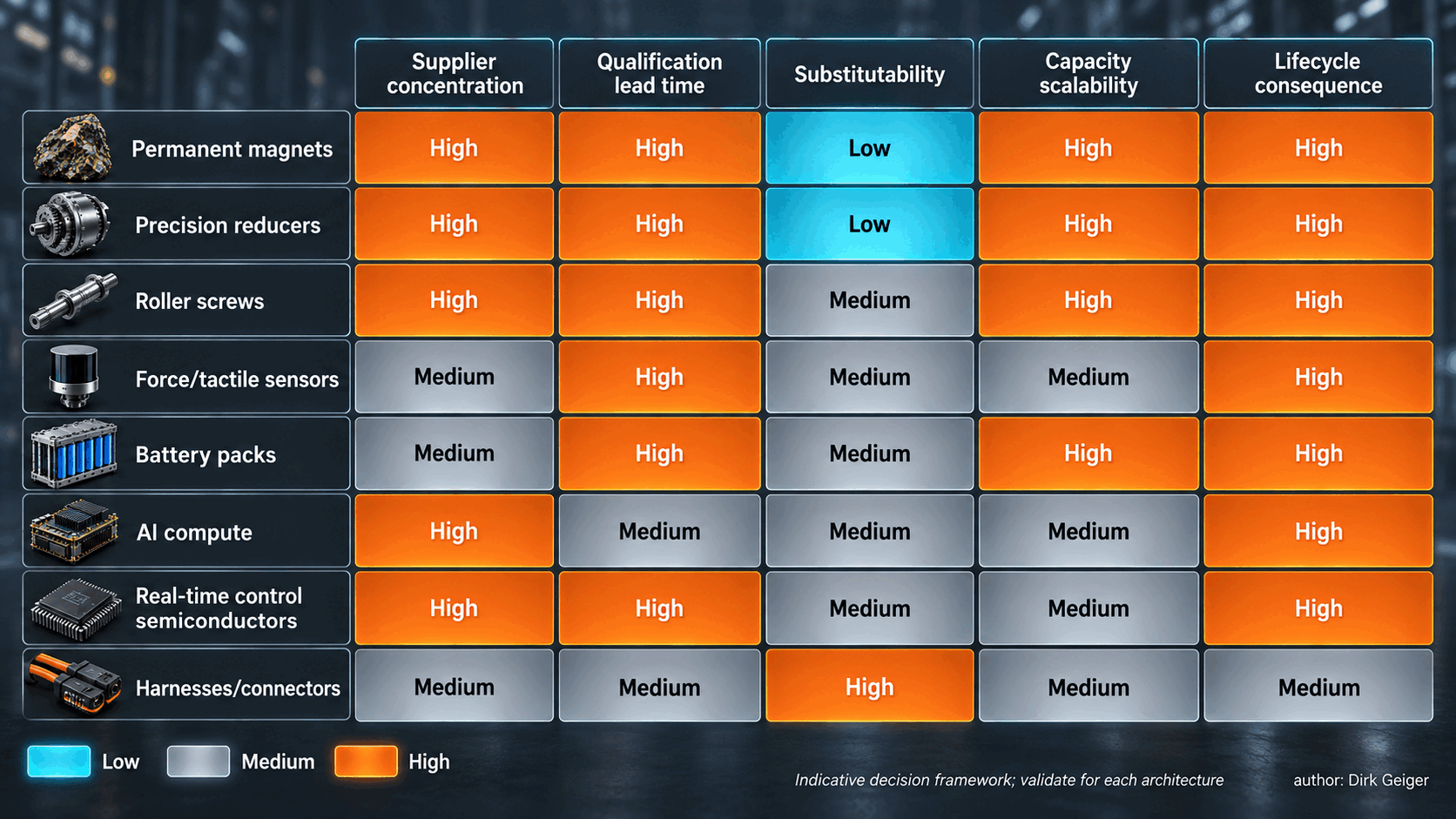
Supply risk grows when five conditions overlap: high value contribution, limited supplier depth, demanding tolerances, long qualification cycles and weak substitutability. This combination explains why the smallest part is not always the smallest risk.
Actuation: the dominant mechanical-electrical stack
Actuators translate electrical energy and control commands into useful force. In humanoids, dozens of axes must deliver torque density, precision, backdrivability, low mass and thermal stability. McKinsey places actuators at 40–60 percent of the humanoid bill of materials and estimates the gearbox alone at 30–50 percent of actuator cost [1]. These estimates vary by architecture, payload and vertical integration, yet they correctly identify actuation as the first place to look for economic and supply leverage.
Rare-earth permanent magnets support compact, efficient motors, especially where distal mass matters. The International Energy Agency identifies price volatility, bottlenecks and geopolitical concentration as central critical-mineral security issues [2]. The European Commission reports that 100 percent of the rare earths used for permanent magnets in the EU are refined in China [3]. USGS data provides a broader evidence base for production, reserves, trade exposure and critical-mineral dependence [4]. The strategic exposure sits in separation, refining, alloying and magnet production as much as in mining.
Precision mechanics create a different constraint. Strain-wave reducers, cycloidal drives, roller screws, cross-roller bearings and compact linear guides demand tightly controlled materials, machining, heat treatment, assembly and metrology. Capacity can exist in a generic category while robotics-grade capacity remains scarce. A supplier able to produce industrial bearings is not automatically qualified to deliver a lightweight joint bearing with the required stiffness, life, traceability and acoustic behavior.
Tactile and force sensing add calibration intensity. Each sensor may require compensation for temperature, hysteresis, creep, assembly stress and cross-axis sensitivity. Scaling production therefore means scaling calibration fixtures, reference standards, automation, data handling and acceptance criteria. Manufacturing equipment and calibration know-how become part of the product.
Energy: plentiful cells, demanding robot packs
Battery cells benefit from the enormous industrial base created for electric vehicles and consumer electronics. This adjacency lowers cell scarcity relative to specialist robotics components. A robot pack still faces a distinctive operating profile: high transient power, frequent partial cycles, compact packaging, fall or impact exposure, human proximity and pressure for rapid charging or battery exchange. Pack architecture, battery-management electronics, thermal design, connectors, isolation and service procedures can therefore become the binding constraint.
The implication is practical. Cell multisourcing does not create pack substitutability unless electrical behavior, mechanical dimensions, firmware parameters and validation evidence are managed as a platform. Battery resilience begins with an interface and qualification strategy, then extends to cells.
Semiconductors and compute: capacity plus architectural dependence
Physical AI needs heterogeneous compute. High-performance processors execute perception and learned models; microcontrollers manage deterministic control, sensing, power conversion, communication and safety-related supervision. Power semiconductors switch energy in motor drives and converters. Memories, timing devices, security hardware and analogue front ends complete the electronic nervous system.
Semiconductor exposure is distributed across process nodes and device classes. Leading-edge AI compute attracts attention, while mature-node microcontrollers, analogue components, sensors and power devices can also interrupt production. The Semiconductor Industry Association projects significant regional capacity changes through 2032, including expansion of advanced logic manufacturing in the United States [6]. Capacity investment improves resilience slowly because factories, process qualification, packaging and customer redesign take years.
A second risk comes from platform dependence. If perception software, toolchains, model formats and acceleration libraries are deeply tied to one compute ecosystem, a nominal alternative may require extensive redevelopment. Software portability, long-term support and verified update mechanisms belong in the sourcing decision.
Figure 2 provides an architecture-specific screening tool. Its qualitative ratings focus attention on the combination of concentration, qualification time, substitutability, scalability and lifecycle consequence; every program should validate the cells against its own design and supplier evidence.
Connectivity and electromechanical detail
Harnesses, connectors, flex circuits and network components often appear late in executive discussions. In moving robots, they experience repeated bending, vibration, contamination and service handling. A connector with a low unit cost can immobilize a high-value robot. The same applies to cooling fans, seals, encoders and cable assemblies. Risk assessment should use downtime consequence and replacement difficulty, not purchase value alone.
The hidden long-lead items
Long lead time is frequently associated with scarce materials or factory queues. Physical AI adds three less visible forms. The first is engineering lead time: the interval required to translate a promising component into a validated robot subsystem. The second is tooling lead time: fixtures, winding equipment, end-of-line testers, calibration rigs and software environments that are specific to a design. The third is learning lead time: the production cycles needed to discover yield loss, field wear and interactions that laboratory tests missed.
These lead times explain why a supplier's announced capacity can differ from usable capacity. A line may produce thousands of units while only a fraction meet the torque ripple, backlash, sensor accuracy or acoustic limits of a particular robot. Yield is therefore a strategic variable. Early supplier engagement should examine process capability, test coverage and the path to improve yield alongside nameplate output.
Workforce capacity belongs on the same map. Precision assembly, motor design, functional safety, embedded security, calibration and robot commissioning depend on specialist experience. New factories can be financed faster than teams can absorb complex processes. Regional resilience programs that fund equipment without developing skills risk creating nominal capacity with slow qualification and low initial yield.
Regional Strengths, Dependencies and Exposure
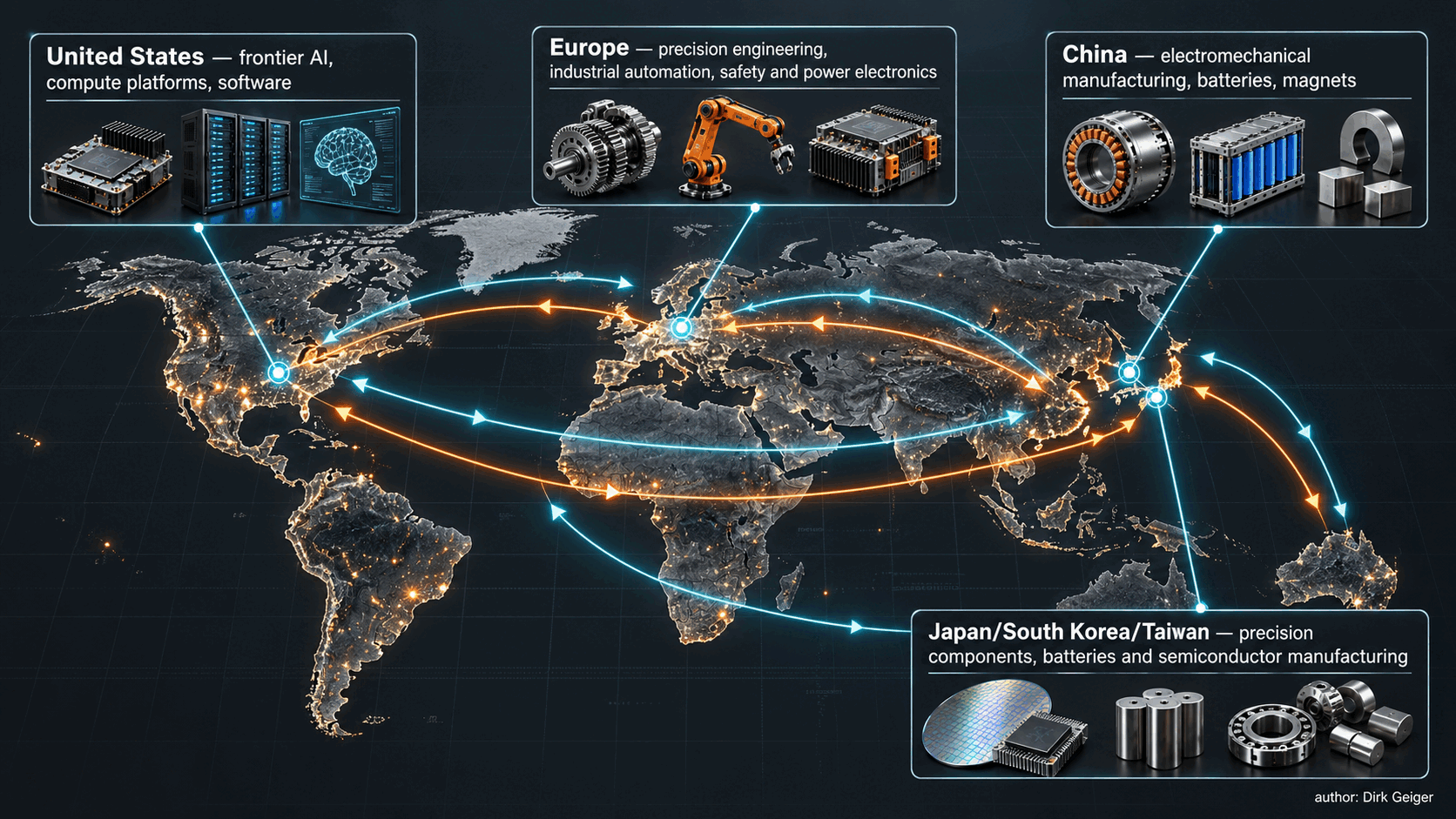
Physical AI is emerging inside three broad industrial ecosystems. China combines robotics policy, a vast domestic manufacturing base, battery and electric-vehicle scale, dense supplier clusters and strong positions in rare-earth processing and magnets. McKinsey cites China’s 295,000 industrial-robot installations in 2024 and an installed base of about 2.03 million units, reinforcing the depth of its automation ecosystem [1]. That depth supports faster iteration because motors, machining, electronics, batteries and suppliers can often be found within established industrial clusters.
The United States leads in frontier AI, compute platforms, software ecosystems, venture capital and several advanced technology domains. Its vulnerabilities include offshore manufacturing dependencies across parts of electronics and electromechanics. Public and private semiconductor investment is expanding domestic capacity, although new fabs do not remove dependencies in materials, equipment, packaging, substrates or global customers.
Europe brings precision engineering, industrial automation, automotive electronics, functional safety, power semiconductors and demanding manufacturing customers. It also carries significant dependencies in critical materials, batteries, electronics manufacturing and parts of digital infrastructure. The Critical Raw Materials Act establishes 2030 benchmarks of 10 percent EU extraction, 40 percent processing and 25 percent recycling for strategic raw materials, while seeking to limit dependence on any single third country to 65 percent at a relevant processing stage [3]. These targets show the scale of the policy response and the distance still to travel.
Japan and South Korea hold important positions in precision components, motors, reducers, batteries, materials, sensors and electronics. Taiwan remains central to semiconductor foundry capacity and the broader electronics manufacturing network. Southeast Asia, India and Mexico are attracting additional electronics, battery and industrial production, creating diversification options that still depend on globally sourced equipment and materials.
The likely outcome is a network of partially regionalized supply chains connected by selected global dependencies. Complete regional self-sufficiency would be costly and technically unrealistic. Robustness comes from knowing which dependencies are acceptable, which need redundancy, and which require strategic control.
Regionalization also changes the unit of comparison. A component sourced locally can still contain imported magnets, wafers, substrates, chemicals or machine tools. Country-of-final-assembly is therefore a weak proxy for resilience. A more useful map follows critical process steps and ownership of qualification evidence. It asks where a failure can be recovered, where an alternate can be approved, and whether technical data can move legally and securely across the network.
Trade controls and licensing deserve scenario treatment because their effect can be selective. Restrictions may apply to a material grade, destination, performance threshold, end use, software capability or manufacturing tool. This can split a previously common design into regional variants. Variant management then adds inventory, engineering and certification cost. Platform teams should identify which design decisions preserve the widest lawful sourcing space and which capabilities justify deliberate regional differentiation.
Figure 3 shows regional capability as an interdependent network. The connecting paths matter as much as the callouts: every major ecosystem combines distinctive strengths with imported materials, manufacturing stages, equipment, software or qualification dependencies.
Qualification Is a Capacity Constraint
A robot component has at least three identities: a part number, a production process and an evidence package. The evidence package may include material traceability, process controls, calibration records, reliability testing, change notification, cybersecurity documentation and safety analysis. Two physically similar parts are not operational substitutes when their evidence differs materially.
Industrial robot safety illustrates the point. ISO 10218-1:2025 defines safety requirements for industrial robots, while integration responsibilities are addressed by ISO 10218-2 [7]. Many mobile, service and humanoid applications extend beyond the scope of industrial-robot standards and require additional risk analysis. Standards provide a baseline; each application still needs a defensible safety concept, validated limits and controlled integration.
Qualification pressure appears in four forms:
- Design qualification demonstrates that a component or subsystem meets electrical, mechanical, thermal and functional requirements.
- Production qualification demonstrates that the manufacturing process can repeatedly deliver within those limits.
- Application qualification demonstrates that the integrated robot performs safely and reliably in its intended environment.
- Change qualification controls the consequences of supplier, process, material, firmware or model changes over time.
These activities consume test benches, environmental chambers, metrology, reference equipment, engineering time and representative field cycles. During rapid market growth, the scarce resource may be the ability to prove that new capacity is equivalent to existing capacity. Long-lead equipment for precision machining, calibration or semiconductor fabrication compounds the problem.
Cybersecurity expands the evidence requirement into the digital supply chain. NIST SP 800-161 Rev. 1 highlights risks including malicious functionality, counterfeit products and vulnerabilities created by poor manufacturing or development practices, and recommends supply-chain risk management across organizational levels [5]. For Physical AI, this means managing device identity, software bills of materials, secure boot, update authority, model provenance, vulnerability response and supplier access. A compromised update pipeline can affect an entire fleet faster than a defective mechanical batch.
Procurement metrics should therefore include qualification lead time, evidence completeness, change-control maturity and recovery time. Unit price remains important; it is an incomplete representation of supply risk.
A mature qualification strategy uses families instead of isolated approvals. Common test methods, parameter limits and evidence templates allow several component variants to be assessed against the same system contract. This approach creates a controlled substitution path and reduces repeated work. It also helps separate characteristics that truly determine safety or performance from preferences inherited from an early prototype.
Change control deserves equal attention after release. Semiconductor dies migrate, firmware libraries are updated, magnets change coating suppliers, battery cells evolve and manufacturing sites are transferred. Each change may be reasonable in isolation. The system effect can appear through timing, thermal behavior, electromagnetic compatibility, calibration or lifetime. Supplier agreements should define notification thresholds, retained samples, traceability, regression obligations and the period for which the previous configuration remains available.
Evidence must travel with the product throughout its life. Serial identity, calibration provenance, software version, manufacturing deviations and repair history support safe maintenance and faster root-cause analysis. They also enable condition-based remanufacturing. In this sense, traceability is both an assurance mechanism and an economic asset.
The Downstream Chain: Integration, Infrastructure and Lifecycle Services
The commercial unit of Physical AI is useful work delivered over time. This shifts value downstream toward integrators, infrastructure providers and lifecycle services.
Integrators connect robot capability with a job. They design tooling, work cells, traffic rules, human interaction, safety measures and escalation paths. Their knowledge frequently determines whether a pilot reaches stable production. Integration capacity may become a bottleneck when many robot models enter the market with different interfaces and immature application tooling.
Infrastructure includes charging, battery exchange, wireless and wired networks, edge compute, fleet orchestration, identity management, time synchronization and operational data systems. Every robot adds physical and digital interfaces to the customer environment. Standardized APIs help, although service-level behavior matters more than connectivity alone: task dispatch must remain coherent through network loss, charging must fit production schedules, and fleet software must preserve accountability for decisions and updates.
Lifecycle services close the economic loop. Wear occurs in gearsets, bearings, cables, seals and batteries. Calibration drifts. Software vulnerabilities emerge. Models change. Customers need diagnostic tools, spare parts, repair instructions, trained technicians and predictable turnaround. A low purchase price can become expensive when mean time to repair is long or replacement modules are unavailable.
Circularity can strengthen resilience. Remanufacturing actuators, recovering magnets and battery materials, and designing modules for disassembly can reduce exposure to primary materials and shorten service cycles. The economic case improves when component identity, usage history and condition data remain available. Circular supply is therefore linked to digital traceability and product architecture.
A Decision Framework for Supply-Chain Resilience
A practical resilience framework begins with the robot’s required functions and works upstream. Each dependency is assessed across six dimensions:
| Dimension | Decision question | Useful measure |
|---|---|---|
| Performance criticality | How strongly does the item determine payload, precision, safety, energy or uptime? | Loss of capability under substitution or failure |
| Concentration | How many independent qualified sources, regions and process routes exist? | Qualified supplier and site count; regional share |
| Lead time | How quickly can supply, tooling and qualification capacity recover? | Time to replace capacity, including validation |
| Substitutability | Can an alternate be introduced without major mechanical, electrical or software redesign? | Engineering effort and requalification time |
| Evidence maturity | Are traceability, reliability, safety and cybersecurity artifacts complete? | Evidence coverage and change-control performance |
| Lifecycle consequence | What happens to deployed fleets if supply or support stops? | Fleet downtime, spare exposure and recovery cost |
The resulting priorities should distinguish three actions. Protect dependencies that are concentrated and difficult to substitute through inventory, capacity agreements and supplier development. Redesign dependencies where architecture creates unnecessary lock-in. Partner where joint road maps and shared qualification offer more leverage than transactional sourcing. Figure 4 turns this logic into a repeatable decision gate.
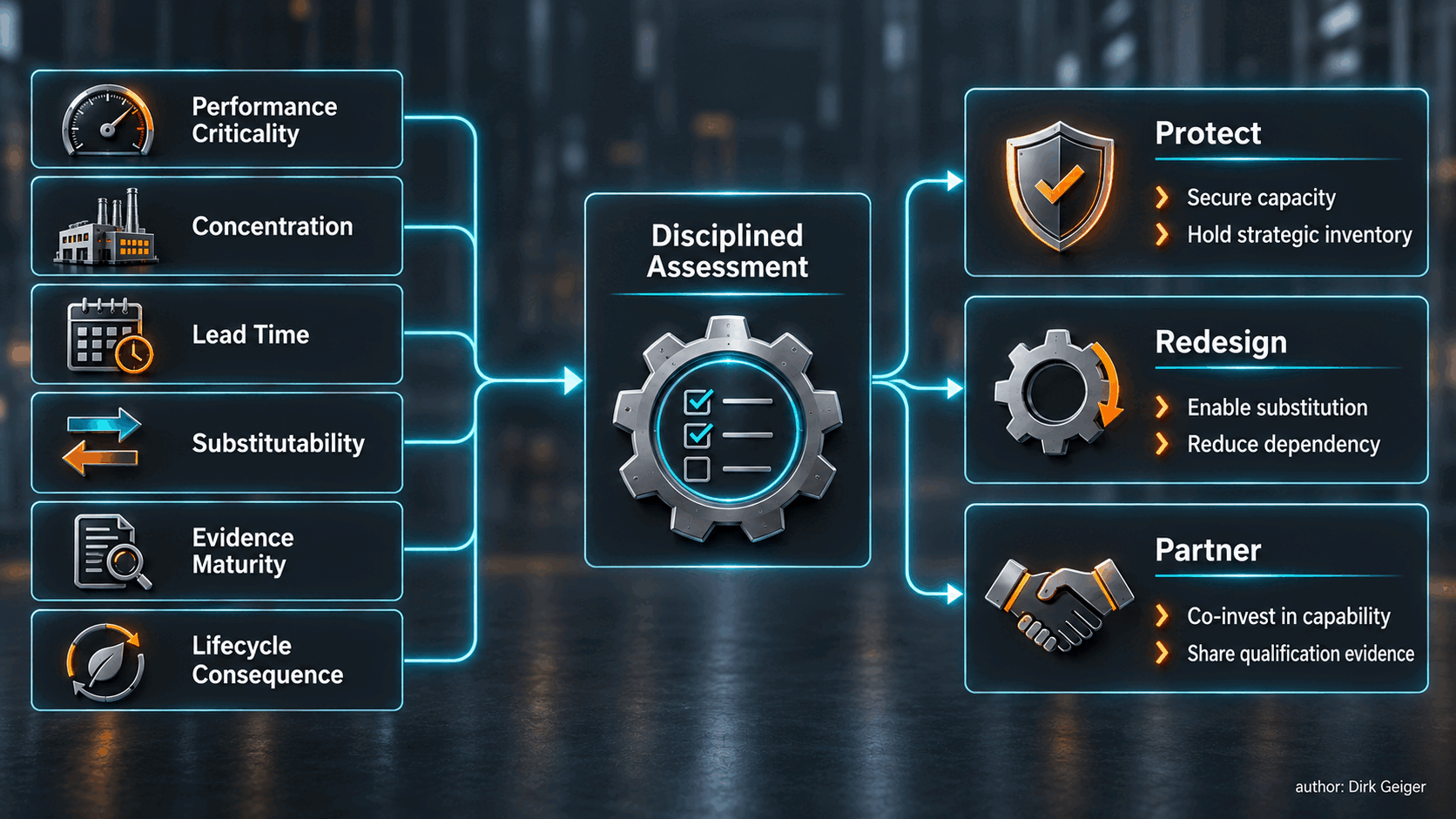
Stress tests make the framework operational. Scenarios should include loss of a magnet source, a six-month semiconductor allocation, a failed gearbox supplier, a revoked software component, export licensing delays, a regional logistics interruption and a field-quality event. The goal is to identify the first capability that fails, the time available to respond and the evidence required to approve an alternate.
Inventory can bridge short disruptions; it cannot solve structural dependency. Dual sourcing can reduce risk; it can also create two sources dependent on the same upstream refinery, wafer fab, tooling supplier or software stack. Visibility below Tier 1 is essential for identifying common-mode exposure.
Resilience targets should be tied to mission consequence. A development fleet can tolerate manual recovery and short component life. A factory fleet operating beside people may require rapid safe degradation, predictable spare coverage and auditable software support. A response plan should state the maximum tolerable outage, minimum retained capability and authority for approving temporary configurations. These operational contracts turn a broad ambition into engineering requirements.
Commercial mechanisms can reinforce the architecture. Capacity reservations protect high-criticality items. Joint yield programs expand usable output. Escrow or controlled access arrangements can protect essential firmware and service data. Last-time-buy rules and lifetime notifications give operators time to qualify replacements. Strategic inventory remains appropriate where disruption impact is immediate and substitution time is long, especially when the material is stable and carrying cost is modest relative to fleet downtime.
The framework should be reviewed at architecture milestones and after significant field events. A dependency that appears acceptable at pilot scale can become critical at volume, while a formerly scarce component may mature into a competitive market. Supply-chain risk is dynamic because technology, policy, volumes and supplier incentives change together.
Strategic Priorities
For robot OEMs
- Freeze interfaces before freezing suppliers. Define electrical, mechanical, thermal, communication, diagnostic and safety contracts that permit controlled substitution.
- Map critical dependencies at least two tiers upstream for magnets, precision motion, semiconductors, batteries, sensors and specialized manufacturing equipment.
- Treat calibration data, firmware, toolchains and safety evidence as supply-chain assets under configuration control.
- Build serviceability into joints, battery modules, sensor assemblies and compute platforms. A replaceable module protects fleet availability and creates remanufacturing options.
- Use volume scenarios with explicit confidence ranges when negotiating capacity. Suppliers can invest against credible ramps and shared milestones.
For component and semiconductor suppliers
- Move from catalogue parts toward application-ready platforms where integration risk is high: actuator electronics, safety-capable control, secure connectivity, battery protection and calibrated sensing.
- Provide reference architectures, diagnostics, lifecycle models and qualification evidence alongside hardware.
- Design product families that cover several robot classes and voltage or performance tiers. Commonality improves scale economics before any single OEM reaches mass volume.
- Reserve engineering capacity for codevelopment. Early design influence can create durable platform positions as architectures converge.
For integrators and industrial users
- Specify outcomes, duty cycles, environments and recovery requirements before selecting a robot.
- Evaluate supplier viability, spare-part strategy, cybersecurity response and software support with the same rigor as task performance.
- Capture structured field data on faults, intervention, energy, wear and task success. This evidence improves procurement and accelerates supplier learning.
For policy makers and ecosystem builders
- Support processing, magnet production, precision manufacturing, semiconductor capacity, recycling and test infrastructure as connected value chains.
- Fund shared qualification facilities and workforce development in metrology, functional safety, cybersecurity, power electronics and robotics integration.
- Promote interoperable interfaces and credible standards while preserving room for architectural innovation.
Conclusion
Physical AI will scale through a complete industrial system. Materials must become qualified components; components must become reliable subsystems; subsystems must become safe machines; machines must become productive fleets. Every transition adds interfaces, evidence and organizations.
The decisive bottlenecks will form where performance ambition meets concentrated supply and slow qualification. Actuators, permanent magnets, precision motion, force and tactile sensing, compute ecosystems and assurance capabilities deserve early attention. Regional strengths will shape different paths, with China advantaged in manufacturing depth, the United States in frontier compute and software, Europe in high-assurance industrial engineering, and Asia more broadly in critical electronics and precision supply.
Resilience is an architectural property before it becomes a purchasing result. Companies that create substitutable interfaces, visible dependencies, disciplined evidence and serviceable products will convert global specialization into an advantage. Those that discover their supply chain only when volumes rise will find that the longest lead item may be the capability to qualify a second choice.
Glossary
- Physical AI supply chain
- The materials, components, subsystems, software, integration, infrastructure and lifecycle services required to deliver intelligent physical work.
- Actuator
- An integrated system that converts electrical energy and control commands into controlled mechanical movement or force.
- Bill of materials
- The structured list and cost of parts and assemblies required to build a product.
- Qualification
- Evidence-based confirmation that a design, process or integrated system meets defined requirements under specified conditions.
- Substitutability
- The ability to introduce an alternative component or service without disproportionate redesign, revalidation or loss of capability.
- Common-mode exposure
- A shared upstream dependency capable of disrupting several nominally independent suppliers or systems at the same time.
- Lifecycle services
- Maintenance, repair, calibration, updates, spares, remanufacturing and end-of-life activities supporting deployed products.
- Heterogeneous compute
- Architecture combining processor types selected for AI, general computation, deterministic control and protection responsibilities.
Abbreviations
- AI
- Artificial intelligence
- BOM
- Bill of materials
- EU
- European Union
- OEM
- Original equipment manufacturer
- USGS
- United States Geological Survey
- IEA
- International Energy Agency
- NIST
- National Institute of Standards and Technology
Sources
- Turning humanoid supply chain constraints into billion-dollar wins · 2026-04-17
Maps humanoid component costs, bottlenecks, regional concentration and the transition from vertical integration toward supplier platforms.
https://www.mckinsey.com/industries/industrials/our-insights/turning-humanoid-supply-chain-constraints-into-billion-dollar-wins - Global Critical Minerals Outlook 2025 · 2025-05-21
Assesses critical-mineral markets, investment, geographic concentration, diversification policy, refining, recycling and long-term supply-demand security.
https://www.iea.org/reports/global-critical-minerals-outlook-2025 - European Critical Raw Materials Act · 2024-05-23
Defines EU resilience measures and 2030 benchmarks for extraction, processing, recycling and single-country dependency.
https://commission.europa.eu/topics/competitiveness/green-deal-industrial-plan/european-critical-raw-materials-act_en - Mineral Commodity Summaries 2026 · 2026-02-06
Provides official production, reserves, trade, price and import-reliance data across more than ninety mineral commodities.
https://www.usgs.gov/publications/mineral-commodity-summaries-2026 - Cybersecurity Supply Chain Risk Management Practices for Systems and Organizations · 2022-05-05
Guides organizations in identifying, assessing and mitigating cybersecurity risks across technology supply chains and acquisition activities.
https://csrc.nist.gov/pubs/sp/800/161/r1/final - Emerging Resilience in the Semiconductor Supply Chain · 2024-05-08
Projects regional semiconductor manufacturing capacity and capital investment changes through 2032 under major industrial-policy programs.
https://www.semiconductors.org/emerging-resilience-in-the-semiconductor-supply-chain/ - ISO 10218-1:2025 Robotics — Safety requirements — Part 1: Industrial robots · 2025-02-01
Defines safety requirements for industrial robots and clarifies the relationship between robot design and system integration.
https://www.iso.org/standard/73933.html