

Technical Article
The Network Is Part of the Robot’s Dynamics
Resilient Physical AI must observe communication degradation before it becomes motion error
A robot does not experience a network as bandwidth. It experiences delayed evidence, stale commands and uncertain timing. Treating communication state as part of the controlled system creates a stronger contract: keep critical loops local, expose uncertainty, degrade deliberately and validate physical outcomes under held-out impairments.
A correct command can arrive wrong
The manipulator receives the right command. The trajectory was valid when calculated, the target pose was reachable and the force limit was appropriate. Yet the packet arrives after the object has shifted and after the operator has begun to correct. Nothing in the command is corrupt. Its meaning has expired.
That is the uncomfortable boundary in networked Physical AI. Communication does not merely carry observations and instructions beside the control system. Delay, jitter, loss, reordering, handover and clock error change what the controller knows about the plant and when that knowledge remains actionable. Once a remote observation enters a feedback path, the channel affects the effective dynamics.
This does not mean that Ethernet, Wi-Fi or cellular radio literally becomes a mechanical component. It means that a controller using networked information must represent the information's age, delivery uncertainty and synchronization quality as state. A robot that cannot distinguish a fresh measurement from a plausible but stale one is not fully observing its operating condition.
The design thesis is testable: under matched delay, loss, interference and handover conditions, a controller that observes and predicts communication state should preserve accepted task performance with fewer transmissions and fewer unsafe or aborted transitions than one treating the network as fixed transport. If held-out tests show no material improvement, the added model, compute and validation burden is unjustified.
Transport metrics are not control guarantees
More bandwidth can reduce congestion, but it cannot make an old measurement current. A low average latency can conceal a tail of late packets precisely where a contact transition, foot placement or force correction becomes sensitive. Packet delivery can be excellent while two clocks disagree enough to corrupt sensor fusion. Encryption can protect integrity while adding processing and queuing variability. A successful handover can still interrupt the time window in which a remote command was safe to execute.
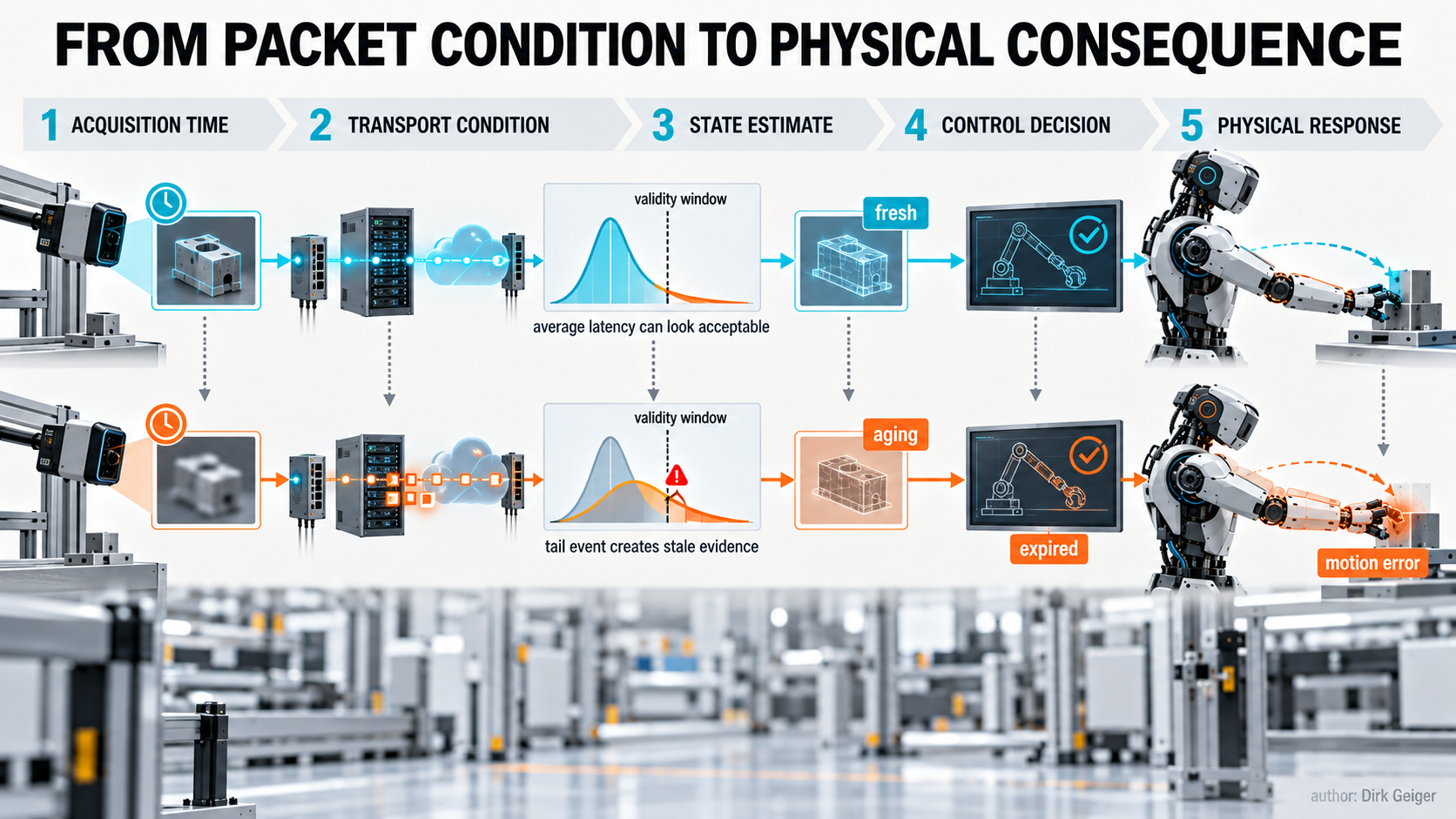
The relevant unit is therefore not the packet. It is the physical consequence. The engineering chain runs from acquisition timestamp through transport, estimation, decision, actuation and observed response. At every step, uncertainty accumulates. The controller needs to know not only a value but also when it was sampled, which configuration produced it, how uncertain its delivery is and whether the current world still satisfies the assumptions behind it.
Figure 1 follows that chain. The dangerous event is not necessarily a dropped packet; it may be a delivered packet whose data age has crossed the validity window. An average can remain reassuring while one tail event turns fresh evidence into an expired premise. Control acceptance therefore has to evaluate temporal validity at the point of use, where the physical consequence can still be contained.
Time-Sensitive Networking provides important tools on standardized Ethernet, including timing and synchronization, traffic scheduling, resource allocation and mechanisms for bounded delivery. The IEEE 802.1 work also includes frame replication and elimination for reliability and security-related standards [S3]. These capabilities can make a wired domain far more predictable. They do not certify an application, guarantee a wireless extension or decide whether a delayed torque request remains safe. Network determinism is an input to system assurance, not a substitute for it.
Fresh evidence, narrow conclusions
Two preprints submitted on 4 September 2026 sharpen the boundary from different directions. Madushanka, Samarakoon and Bennis propose coupled predictive representations of robot dynamics and wireless-channel evolution. Their framework uses visual observations alongside raw and structured radio-frequency representations to forecast robot and channel states, schedule uplink communication and react when latent predictions diverge. Evaluation takes place in a synchronized Gazebo–ROS–Sionna simulation environment under propagation and perception perturbations [S1]. The result is evidence for a research direction, not proof of deployment performance.
HaptiNet addresses geographically distributed physical interaction. Its authors report haptic terminals, force feedback and an imitation-learning delay compensator across laboratory, cross-city and clinical settings. The preprint describes evaluation with 284 healthy participants and 111 patients with neurological impairments, including three intercity links totaling about 4,000 kilometres [S2]. This is unusually concrete evidence that compensation can help sustain task-level haptic interaction over distance. It does not establish the safety or performance of industrial humanoid control, whose hazards, dynamics and acceptance criteria are different.
Older networked-control work supplies a useful counterweight to novelty. Yu and Chen model nonlinear networked systems with time-varying sampling and potentially large transmission delays, then examine dynamic event-triggered control to reduce unnecessary communication while maintaining formal stability properties under stated assumptions [S4]. It reinforces a durable lesson: communication scheduling and control performance can be co-designed, but guarantees belong to a defined model and operating envelope.
Together, these sources support a disciplined interpretation. Communication-aware control is not a promise that learning can erase distance. It is an architecture in which channel evidence, prediction error and information age can change how much physical authority is granted.
The communication-aware control contract
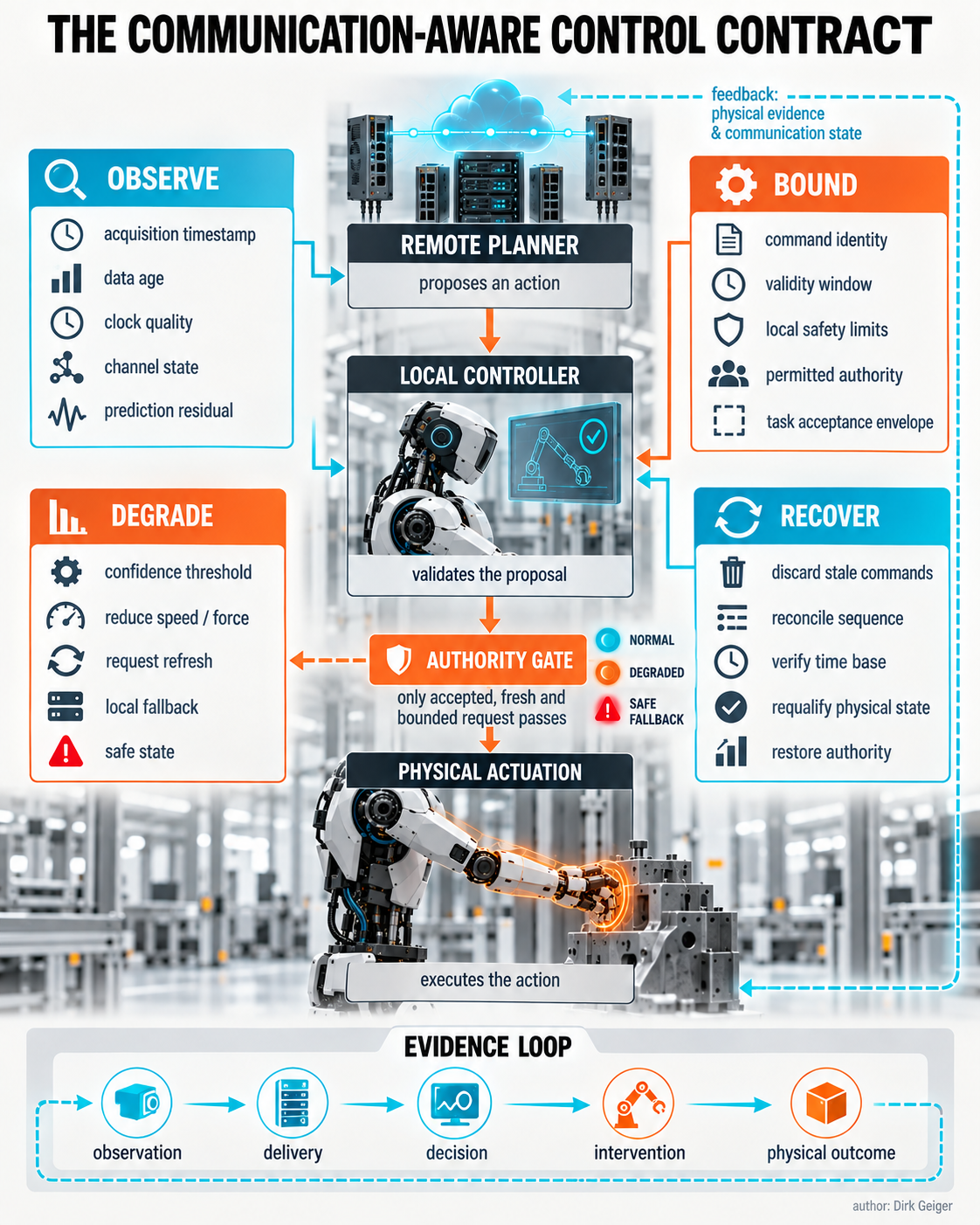
A useful contract begins with observable quantities. Each control-relevant message should carry an acquisition timestamp, sequence identity, source identity and configuration context. The receiving function should derive data age rather than infer freshness from arrival. Clock offset and synchronization quality must themselves be monitored. For wireless paths, relevant observations may include link state, retransmissions, queue depth, channel-quality indicators, handover state and prediction residuals. None is universally causal; the selected signals must be shown to arrive early enough to support a safe decision.
Observation alone is insufficient without bounded authority. A remote planner, operator or model may propose a trajectory, target or force envelope. A local controller decides whether the request is still admissible against current joint state, contacts, obstacles, energy and safety limits. Commands need validity windows and sequence semantics. When their evidence expires, the robot must not improvise that validity back into existence.
Prediction adds another obligation: explicit uncertainty. A predictor should expose confidence or a calibrated error measure, not only its best estimate. The control policy then needs thresholds with defined consequences: continue normally, reduce speed, request a refresh, switch to a local policy, hold a stable condition, retreat or stop. A learned world model that cannot declare its knowledge limit becomes a new hidden channel.
Recovery closes the loop. Restoration after a link returns is not merely reconnecting sockets. The robot must reconcile sequence state, time bases, configuration identity and physical state. Buffered commands may need to be discarded. Operator intent may need reconfirmation. Control authority should return only after the local and remote sides agree on a coherent present.
The same contract needs a declared timing and energy budget. Every protection, serialization, queue, scheduler, radio transmission, inference and clock-recovery step consumes time; every always-on observer and predictor consumes energy. The budget should distinguish typical behavior from the tail conditions used for acceptance. It should also identify which component owns each margin. Otherwise a security update, a new perception model or an apparently harmless buffering change can silently consume the control reserve.
The contract is bilateral. The communications domain exposes measured service and uncertainty. The control domain exposes the freshness, integrity and continuity it actually needs. Neither side should reduce the conversation to one number. A ten-millisecond delay bound has different meaning for a one-hertz supervisory update, a balance estimator and a force loop. Likewise, a controller cannot demand zero loss without defining what retransmission delay would do to the physical task. The interface becomes useful when each requirement is tied to a consequence and a fallback.
Figure 2 condenses the contract into four operating duties: observe, bound, degrade and recover. Their order is causal rather than administrative. Missing timestamps prevent reliable age estimation; unbounded requests turn stale intent into actuator authority; undefined degradation leaves timeout behavior to accident; unreconciled recovery can replay a past into the present.
What stays local and what may travel
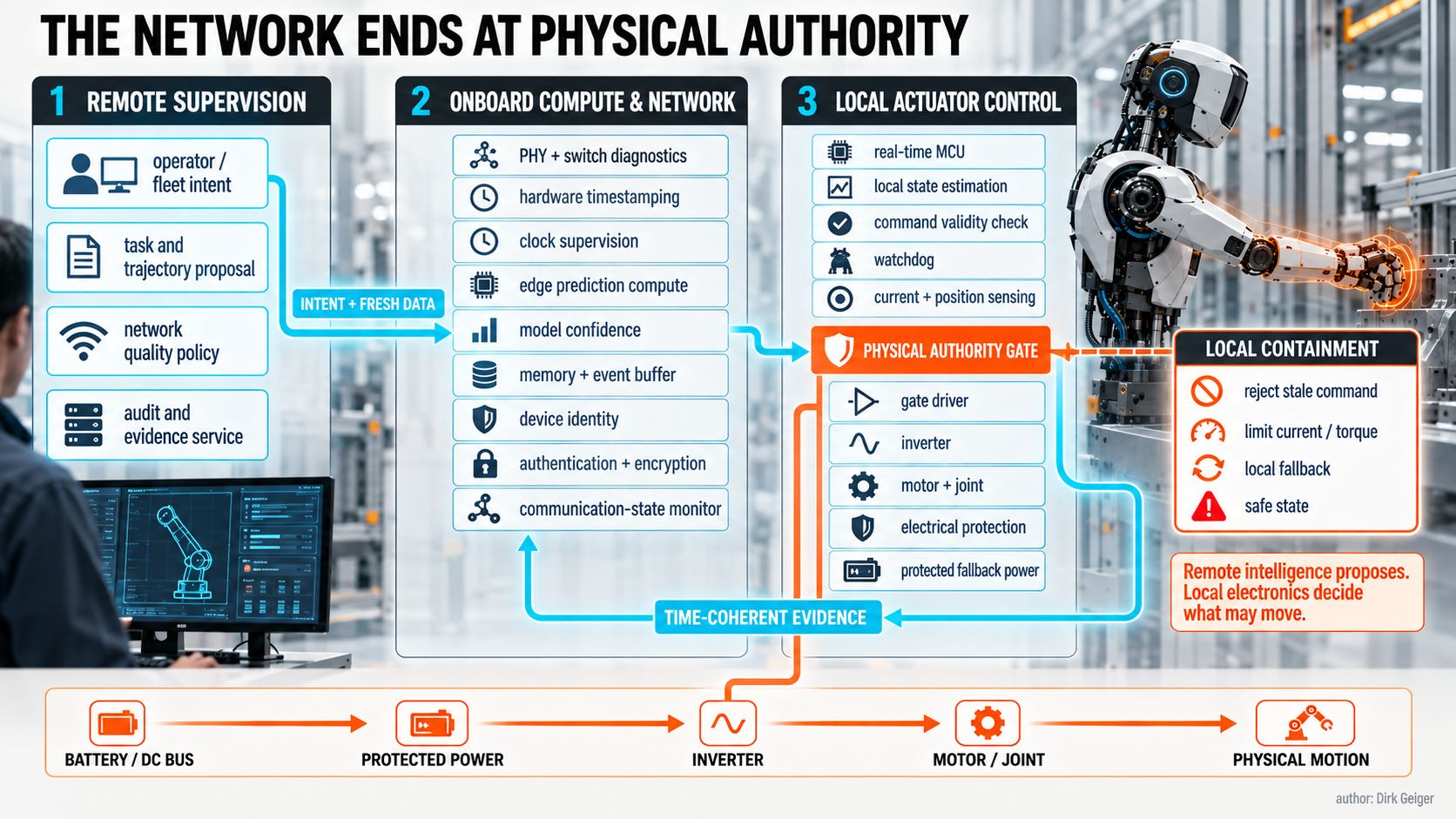
The decisive architectural question is not wired versus wireless. It is which consequence can tolerate which uncertainty. Current regulation, commutation, fast torque control and immediate electrical protection normally belong close to the actuator. Balance stabilization, collision reaction and contact-force containment also demand local or onboard paths when loss of communication could rapidly create a hazard. Their timing must not depend on a remote service whose failure assumptions the robot cannot contain.
Slower functions have more freedom. Semantic goals, route updates, fleet priorities, model downloads, supervisory optimization and human guidance may cross less deterministic networks when the robot can continue safely without immediate refresh. Remote teleoperation sits between these categories. It can carry intent or haptic interaction, but local constraints must bound what an aged command can cause.
Prediction changes this boundary without abolishing it. A local model can bridge short observation gaps or correct unexecuted motion within delegated limits. Event-triggered communication can send information when state deviation or uncertainty makes an update valuable rather than streaming every high-dimensional observation. That may reduce airtime and communication energy. It may also increase local compute, memory traffic and model-maintenance cost. The balance must be measured at system level.
Wired deterministic domains and wireless links therefore play different roles. A synchronized onboard Ethernet backbone can provide controlled timing among compute, sensors and controllers. Wireless provides mobility and reach but introduces propagation, interference and handover conditions that are harder to bound. Remote wide-area links add longer and more variable paths plus organizational dependencies. One control contract can describe all three, but it should not pretend their evidence quality is equivalent.
Degradation must be an engineered state
Most network failures are not clean disconnections. Quality decays: latency tails widen, retransmissions increase, clocks wander, a handover begins, interference changes abruptly or prediction residuals rise. Waiting for a timeout can be waiting for the physical error.
A degradation state machine should combine communication evidence with task context. A late image during stationary inspection is not equivalent to a late force estimate during contact. The same packet loss may be tolerable for a warehouse route update and unacceptable for bilateral haptic interaction. Thresholds therefore belong to a task-specific acceptance envelope, not to a universal latency number.
Transitions need guards, permitted actions and exit criteria. In a caution state the robot may reduce speed and shrink force limits. In local fallback it may finish a bounded motion using onboard sensing, then hold. A protective transition may remove actuator authority while preserving the communications, logging and supervision domains required for diagnosis. Recovery should require stable evidence over time, not one optimistic packet.
The evidence record is part of the contract. Acquisition times, delivery distributions, losses, synchronization quality, channel observations, predictor confidence, safety interventions, accepted commands and physical outcomes should share a coherent timeline. Without that record, an unsafe transition can later look like a controller defect, a radio disturbance or an operator mistake depending on which log is opened first.
Security events belong in the same state machine. Failed authentication, certificate expiry, replay detection or an unexpected device identity can remove trust even while link quality remains excellent. The safest reaction is not always an immediate power cut: a dynamically balanced robot may first need a locally controlled stabilization action. Cybersecurity therefore constrains authority, while functional behavior determines the physically safe route to containment.
Supervision should remain deliberately boring. A health monitor needs simple, inspectable rules for stale data, broken synchronization, abnormal queues, predictor disagreement and repeated fallback. Complex prediction may improve performance, but the decision to withdraw authority should not depend exclusively on the same model whose validity is in doubt. That separation turns uncertainty into a managed operating condition instead of a debate between subsystems during an incident.
The semiconductor consequence
Communication-aware control turns abstract resilience into concrete electronics requirements. Physical-layer devices and switches need timestamping and diagnostic observability, not just nominal throughput. Timing functions need stable clocks, hardware capture and cross-domain synchronization monitoring. Local microcontrollers must close deterministic loops, supervise stale data and retain safe behavior when the high-level compute or link disappears.
Edge processors may host state prediction, compression and event-selection models, but their accelerators and memory paths must be assessed for worst-case response and power. Secure elements or hardware security functions bind device identity, keys and trusted startup to the control path. Authentication and encryption latency must be included in measurements rather than subtracted as networking overhead. Power-management devices must preserve the minimum domains needed for safe fallback, evidence retention and controlled recovery.
The architecture also needs fault containment. A common software stack that predicts both robot and channel state may create elegant efficiency and an elegant common-mode failure. Independent local limits, watchdogs and electrical protection should remain capable of rejecting unsafe authority. Diversity is not automatically required everywhere, but independence claims must survive shared clocks, shared power, shared firmware and shared network management.
Figure 3 makes the authority boundary explicit. Cyan information paths may cross remote supervision, onboard compute and network domains. Orange energy and torque paths terminate in locally gated electronics. The return evidence path is equally important: the remote system must learn what the robot accepted, modified or rejected, not merely what was transmitted.
Test the boundary, not the brochure
A meaningful comparison starts with one robot, one task and two control strategies. The baseline treats the channel as fixed transport. The candidate observes communication state, predicts it where justified and changes transmission or control behavior within defined authority. Both face identical held-out impairment traces: delay distributions, burst loss, interference, clock disturbance, congestion and handovers not used to tune the candidate.
The scorecard must join network and physical measures. Record task success, tracking error, contact-force error, stability margin, unsafe or aborted transitions, human interventions and recovery time. Alongside them record latency distributions rather than averages, packet and byte counts, retransmissions, synchronization error, local compute load, communication energy and total electrical energy. Fewer transmissions are not a win if inference power rises more, recovery becomes fragile or physical performance deteriorates.
Acceptance should be scenario based. One scenario may introduce congestion while the robot transports an object. Another may force a wireless handover during human-guided manipulation. A third can disturb clock synchronization while two sensor streams are fused. Each needs a success envelope and a prohibited outcome. Repeating impairment traces across both strategies makes the comparison fair; reserving additional traces for final evaluation tests whether the communication model learned a general relationship or memorized the laboratory.
Test benign conditions too. A sophisticated strategy that improves impairment cases but reduces nominal performance or creates difficult commissioning may not deserve deployment. Then test epistemic failure: unseen interference, shifted visual conditions, a broken channel predictor and misleading confidence. The controller must become more conservative when its predictive premise weakens.
The most valuable outcome may be a boundary map rather than a winning algorithm. It should show which loops remain local, which remote information improves performance, which impairments trigger degradation and which evidence is sufficient for recovery. Bandwidth will still matter. So will deterministic networking, wireless quality and edge compute. But none can be specified independently of the motion they influence.
A networked robot is resilient when it knows not merely that communication exists, but what that communication can still be trusted to mean.
Glossary
- Acquisition timestamp
- The time at which a physical quantity was sampled rather than received by software.
- Bounded authority
- An architecture in which remote or high-level functions propose actions while local functions enforce physical and safety limits.
- Data age
- Elapsed time between acquisition of information and the instant at which a receiving function evaluates or uses it.
- Deterministic networking
- Communication engineered so selected traffic has bounded or otherwise controlled delay, jitter and delivery behavior.
- Event-triggered communication
- Transmission initiated by a meaningful state change or uncertainty condition rather than a fixed continuous schedule.
- Handover
- Transfer of an active communication session between access points, cells or network attachment paths.
- Jitter
- Variation in packet or task timing relative to its intended schedule.
- Prediction residual
- Difference between an observed state and the state forecast by a predictive model.
- Safe fallback
- A predefined locally executable behavior that limits physical consequence when required information or authority becomes unreliable.
- Synchronization quality
- Measured confidence that distributed clocks share a sufficiently accurate time basis for the intended function.
Abbreviations
- AI
- Artificial Intelligence
- JEPA
- Joint Embedding Predictive Architecture
- PHY
- Physical layer
- RF
- Radio frequency
- ROS
- Robot Operating System
- TSN
- Time-Sensitive Networking
Sources
- Coupled Control and Wireless World Models for Resilient Remote Robotic Control · 2026-09-04
Preprint couples robot and wireless predictive representations to schedule communication and adapt under simulated propagation and perception changes.
https://arxiv.org/abs/2609.04851 - HaptiNet: Networked Haptic Robots Enable Physical Co-presence in Geographically-Unconstrained Rehabilitation · 2026-09-04
Preprint reports delay-compensated force-feedback interaction across laboratory, intercity and clinical rehabilitation settings with healthy participants and patients.
https://arxiv.org/abs/2609.04799 - Time-Sensitive Networking (TSN) Task Group · undated; accessed 2026-09-11
Official IEEE 802.1 page identifies current TSN standards and projects spanning timing, reliability, resource allocation, traffic shaping and wireless enhancements.
https://1.ieee802.org/tsn/ - Periodic event-triggered networked control systems subject to large transmission delays · 2021-06-30
Research models nonlinear networked control with time-varying delays and proposes dynamic event triggering to reduce unnecessary transmissions under stated assumptions.
https://arxiv.org/abs/2106.15806