
Technical Article
Think Ahead, Act Safely
Why humanoid robots need speculative intelligence without speculative execution
Humanoid robots cannot wait for perfect certainty before moving. They must predict plausible physical futures, compare them and commit only actions that remain within bounded control and safety constraints. A layered architecture separates probabilistic reasoning from deterministic execution and continuous sensor verification, allowing intelligence to think broadly without granting it unrestricted physical authority.
The robot cannot wait for certainty
A humanoid robot does not have the luxury of waiting until the physical world becomes unambiguous. By the time a camera has exposed an image, perception has interpreted it, a planner has selected an action, a controller has converted that action into joint commands and the motors have produced force, the world has already moved on. A person has shifted weight. A box has begun to slip. A foot has made imperfect contact. A door has continued to swing. The machine is always acting on information that is becoming old.
This is one of the defining differences between artificial intelligence that produces information and artificial intelligence that produces motion. A language model can take another fraction of a second to reconsider a sentence. A humanoid balancing on one leg cannot. Physical intelligence is therefore not only a matter of recognizing the present. It must estimate what happens next early enough for action to remain useful.
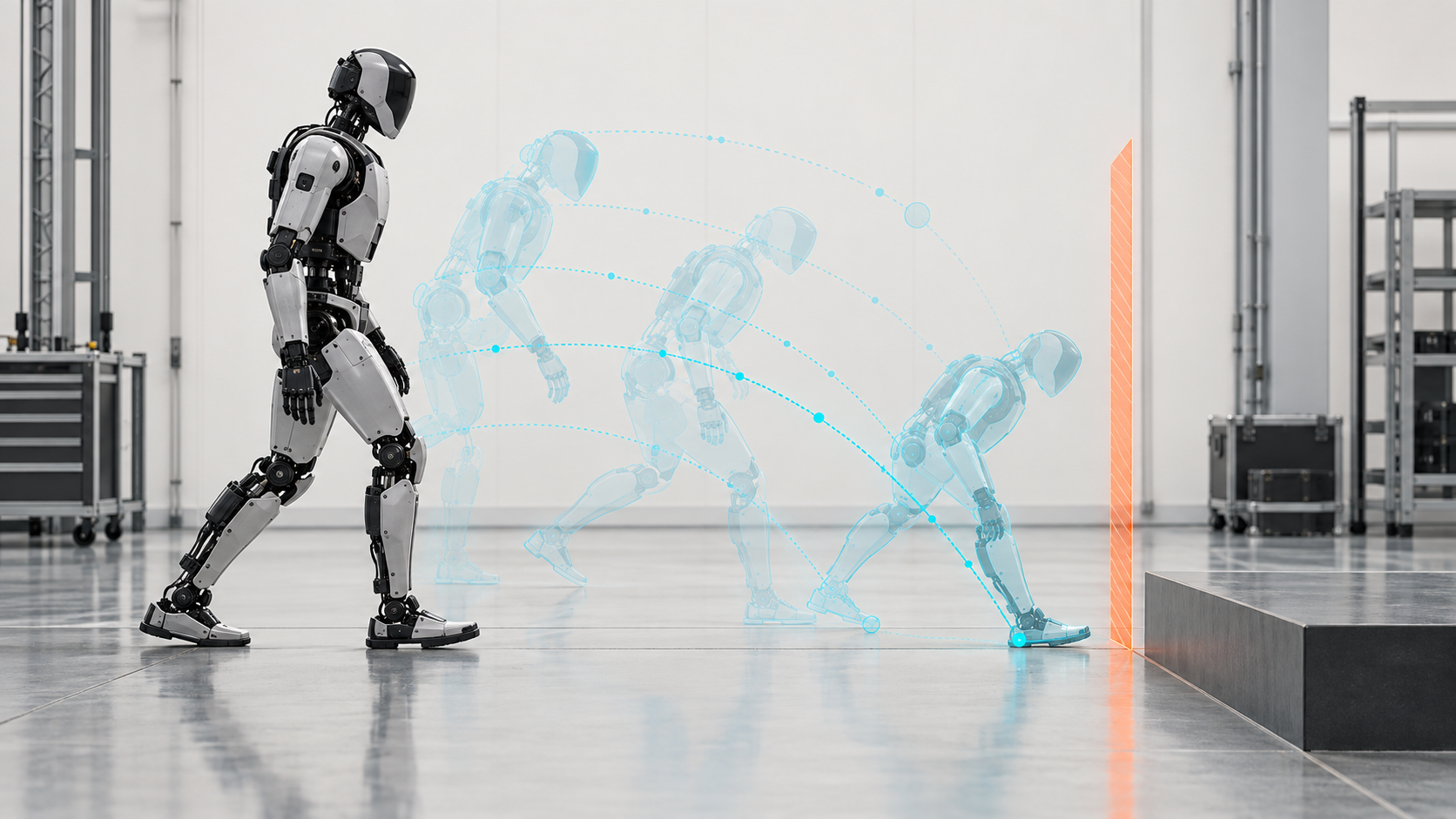
The next generation of humanoid intelligence will behave like a continuously running prediction machine. It will not merely ask what is happening. It will estimate what may happen 10 milliseconds from now, 100 milliseconds from now, one second from now and after the next task step. The answers will not always agree. They do not need to. Their value lies in keeping plausible futures available soon enough to prepare for them.
I call this speculative physical intelligence. The phrase is an editorial framing, not the name of a standardized academic discipline. Robotics already provides many of its mechanisms: state estimation, trajectory optimization, model predictive control, learned dynamics, world models, motion policies and reflex loops. Viewed together, however, they reveal an architectural principle. A capable humanoid may need to speculate broadly about the future while remaining extremely conservative about what it physically executes.
The governing principle is simple: think speculatively, act conservatively.
The design target is not maximum prediction. It is sufficient prediction with bounded authority. A mature humanoid should know when a compact local model is enough, when a richer world model is justified, when uncertainty requires slower motion and when the correct response is to enter a defined safe state. Speculation becomes a controlled resource rather than an unrestricted privilege. Compute, sensing, bandwidth and energy can then be allocated according to the consequence of being wrong at each horizon.
That distinction matters because errors change character once intelligence has a body. A speculative recommendation can be ignored. A speculative motor command can move tens of kilograms of machinery into a person, destabilize the robot, damage a workpiece or turn uncertain contact into a high-force collision. Freedom to predict must therefore be separated from authority to act.
Prediction is already inside the control loop
Acting on prediction is not foreign to robotics. It is embedded in established control techniques for dynamic machines. Model predictive control repeatedly forecasts how a system may evolve over a finite horizon, optimizes control inputs under constraints, applies only the immediate portion of the solution and solves the problem again as new state information arrives.
That receding-horizon structure is attractive for humanoids because balance is not static. Walking is a sequence of deliberately managed instabilities. Contact conditions and support geometry change. Momentum must be redirected. Disturbances arrive from terrain, payloads and interaction. A controller that anticipates those developments has more options than one that waits for every deviation to become an error.
Romualdi and colleagues demonstrated an online nonlinear centroidal MPC that computes desired contact forces, torques and contact locations while allowing step adjustment. On iCub, the controller changed contact location online and resisted a documented external push rather than replaying a fixed walking pattern.[1] A later hierarchical reduced-order MPC framework for Unitree G1 separated planning and stabilization rates: a high-level step planner operated at 40 Hz while a mid-level controller operated at 500 Hz in the reported implementation.[2] The exact rates belong to that research platform, not to a universal humanoid requirement. The architecture is the more durable lesson: different physical decisions deserve different models, horizons and deadlines.
The same logic reaches loco-manipulation. A humanoid pushing a cart or carrying an object cannot treat walking and manipulation as independent problems because forces at the hands alter whole-body balance. Work on the HECTOR platform used force-and-moment-based MPC with a simplified rigid-body model that accounts for humanoid and object dynamics, demonstrating dynamic loco-manipulation and payload transport on hardware.[3] The future of the body and the future of the object are coupled.
These systems are not “speculating” in the conversational sense. They solve constrained optimization problems around explicit models. Structurally, though, they establish the central point: useful physical action often depends on evaluating a future state before that state exists.
From one prediction to many possible futures
Traditional predictive control usually begins with a model compact enough to optimize in real time. Physical AI expands the problem. The robot may face uncertain object geometry, incomplete visual information, changing friction, ambiguous human intent and tasks expressed in language rather than precise trajectories. There may be no single clean model and no single useful horizon.
World models become relevant at this boundary. In robotics, a world model is an internal representation that captures enough of the environment and its dynamics to support prediction, planning or reasoning. A recent survey of robotic manipulation frames world models around precisely these capabilities while also noting that the term, its scope and its required architecture remain unsettled.[4] That caution is useful. “World model” should describe a testable function, not serve as a decorative label for any large model attached to a robot.
Consider a service humanoid carrying a tray through a crowded workspace. One person approaches from the left. Another turns away. A trolley blocks the direct route. The robot cannot know exactly what each person will do, yet it can maintain candidate futures: continue, slow down, shift right, stop, change tray posture or wait. Each action produces a different predicted state for the body, payload and nearby people.
Research is beginning to join semantic reasoning and future prediction more explicitly. Vision-Language Model Predictive Control generates candidate action sequences from a goal image or language instruction, predicts future frames or trajectories conditioned on those candidates and selects among them through a cost function.[5] More recent work has explored structured future representations intended to reduce redundant dense prediction and connect foresight more directly to kinematic progress.[6] These are research results, not safety architectures, but they clarify the direction: imagined futures can become an intermediate representation between perception and action.
This creates a useful distinction between reactive intelligence and counterfactual intelligence. Reactive intelligence maps a perceived state to an action. Counterfactual intelligence asks what could happen under several candidate actions before choosing one. The second is computationally more demanding, but it fits the ambiguity of physical work more naturally.
A humanoid in an unstructured environment will rarely enjoy perfect certainty. The objective is not to eliminate uncertainty before acting. It is to represent uncertainty, compare plausible futures and select an action whose consequences remain acceptable across a sufficient part of that uncertainty.
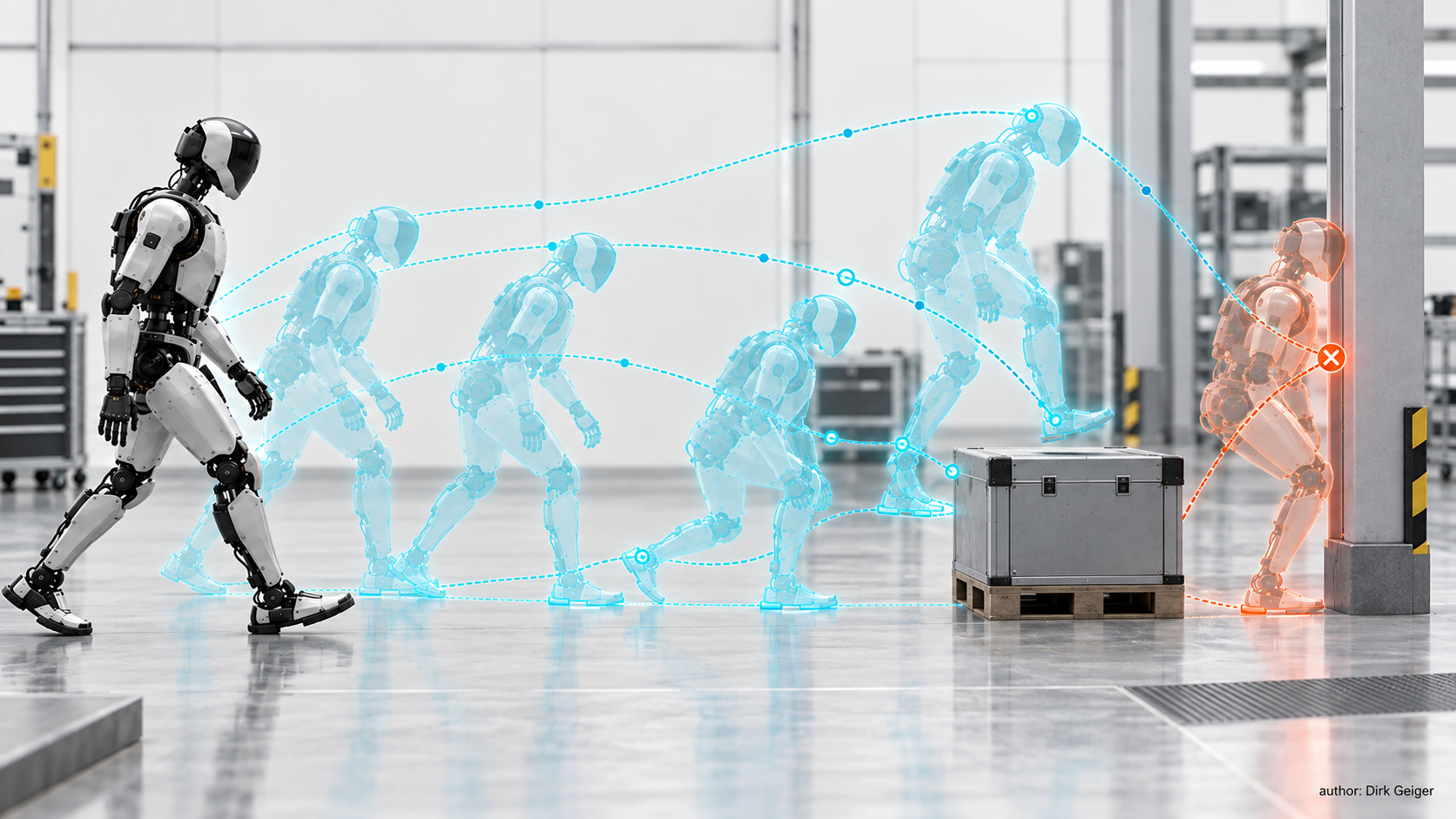
Many futures, one physical action
The ability to generate many futures is useful only if the architecture prevents them from becoming uncontrolled physical experiments. A generative model may propose a grasp. A world model may forecast a result. A planner may rank trajectories. None of those operations should automatically confer authority over the motors.
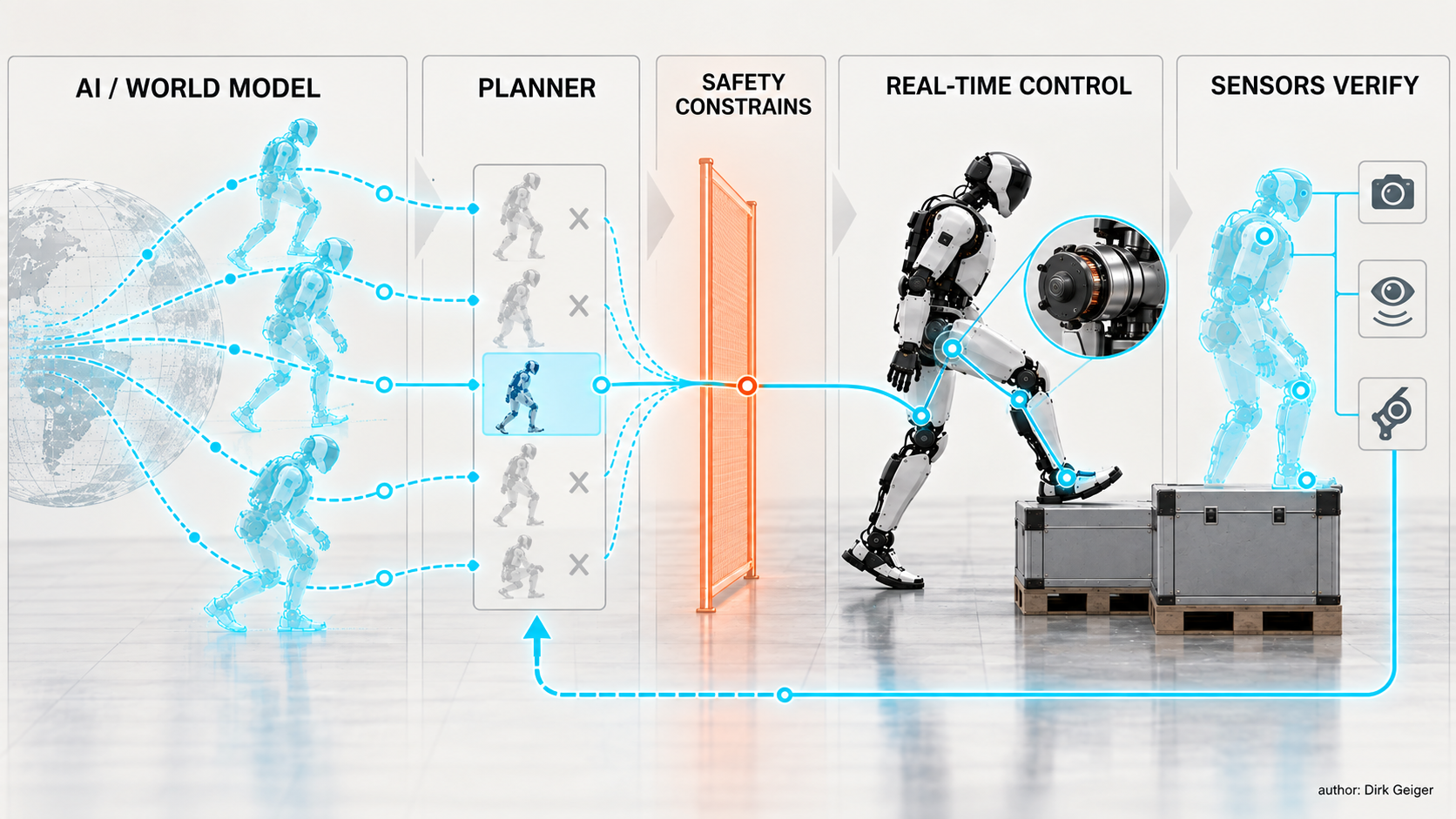
A robust architecture behaves like a narrowing funnel. Perception and world modelling create hypotheses. Planning reduces them to candidate actions. Constraint checking removes trajectories that violate kinematic, dynamic, workspace, collision or task limits. A safety layer imposes boundaries that do not depend on the planner’s confidence. Real-time control then executes a bounded command while local sensing verifies that the physical system behaves as expected.
Confidence must become an engineering signal. AI models often express uncertainty incompletely, while control systems need explicit margins. A useful architecture translates confidence into an operating envelope. Strong evidence may support normal speed and broader trajectory choice. Weak evidence may shorten the prediction horizon, reduce speed, increase clearance, request another observation or transfer authority to a simpler fallback. The practical question is not whether the AI is “right” in the abstract. It is how much physical authority the available evidence justifies.
Predictions may also disagree across layers. A semantic model may infer that a person intends to hand over an object while force sensing shows that it is still firmly held. The interpretation remains useful, but measured contact must govern the immediate response. A planner may forecast a stable step while an inertial sensor detects an unexpected angular-rate excursion. The measured physical state should dominate the actuator command. Prediction is valuable because it can be revised; execution must survive that revision.
The architecture is not AI sees, AI decides, motors move. It is closer to AI and world model propose, planner evaluates, safety constrains, real-time control executes, sensors verify. Probabilistic intelligence and deterministic control solve different problems. A model is valuable because it can handle ambiguity. A containment mechanism is valuable because it reduces ambiguity where electrical energy becomes force.
Humanoids span several time domains. Task reasoning may look seconds ahead. Whole-body planning works over shorter horizons. Balance and contact control run faster. Motor-current regulation and protection act faster still. Passing every decision through one central AI model would create latency, availability and assurance problems. A hierarchy lets reasoning become broader as the horizon expands while local loops become more deterministic as they approach the actuator.
The interface between those layers should be treated as an action contract rather than a raw stream of desired motion. Such a contract can express the intended task, permitted region, velocity or force envelope, validity time, confidence assumptions and conditions that invalidate the request. The planner is then free to explore many possibilities, but the controller receives a bounded proposition with an expiry condition. If the underlying observation becomes stale or the measured state leaves the declared envelope, the contract no longer authorizes continued execution.
This separation also reduces the temptation to disguise uncertainty as precision. A high-level model may know that a hand should move toward a handle without knowing the exact contact geometry. It can delegate a constrained approach while local sensing and control resolve the final millimetres. Conversely, a local controller should not extend its authority into semantic decisions simply because it has the fastest loop. Each layer remains powerful inside a deliberately limited domain.
The boundary that makes speculation safe
Safety makes the argument sharper. ISO 10218-1:2025 addresses safety requirements for industrial robots, including inherently safe design and risk reduction.[7] ISO/TS 15066:2016 supplements the ISO 10218 framework for collaborative industrial robot systems and their work environments.[8] Their scopes must not be stretched: ISO 10218-1 explicitly excludes service robots and consumer products, while ISO/TS 15066 does not apply to non-industrial robots. The latter nevertheless notes that its safety principles may be useful elsewhere in robotics. For a humanoid outside those scopes, the standards are relevant engineering references, not automatic claims of conformity.
The humanoid safety problem is unusually difficult because mobility, reach, changing contact and general-purpose decision making coexist in one machine. It can reposition its base and centre of mass, alter leverage, carry tools and interact with people. The same motion may be benign in one configuration and hazardous in another.
Speculative intelligence therefore needs confidence without making safety dependent on confidence. If a world model predicts an open path, independent sensing should still detect an unexpected obstacle. If a planner predicts a stable grasp, local force and torque sensing should still detect slip. If a locomotion policy expects firm ground, the machine still needs bounded responses when contact differs from expectation.
Three containment layers follow. Semantic containment translates goals and interpretations into explicit robot states, task constraints or motion objectives. Dynamic containment tests candidate motion against joint, torque, stability, collision, workspace or reachable-state limits. Electrical containment supervises current, voltage, temperature, position, speed and faults in the actuation path through mechanisms that remain effective even when higher-level intelligence is wrong.
The closer a decision gets to physical energy, the less speculative its authority should become.
Prediction changes the electronics architecture
Once prediction becomes continuous and multi-horizon, the consequences reach directly into electronics architecture.
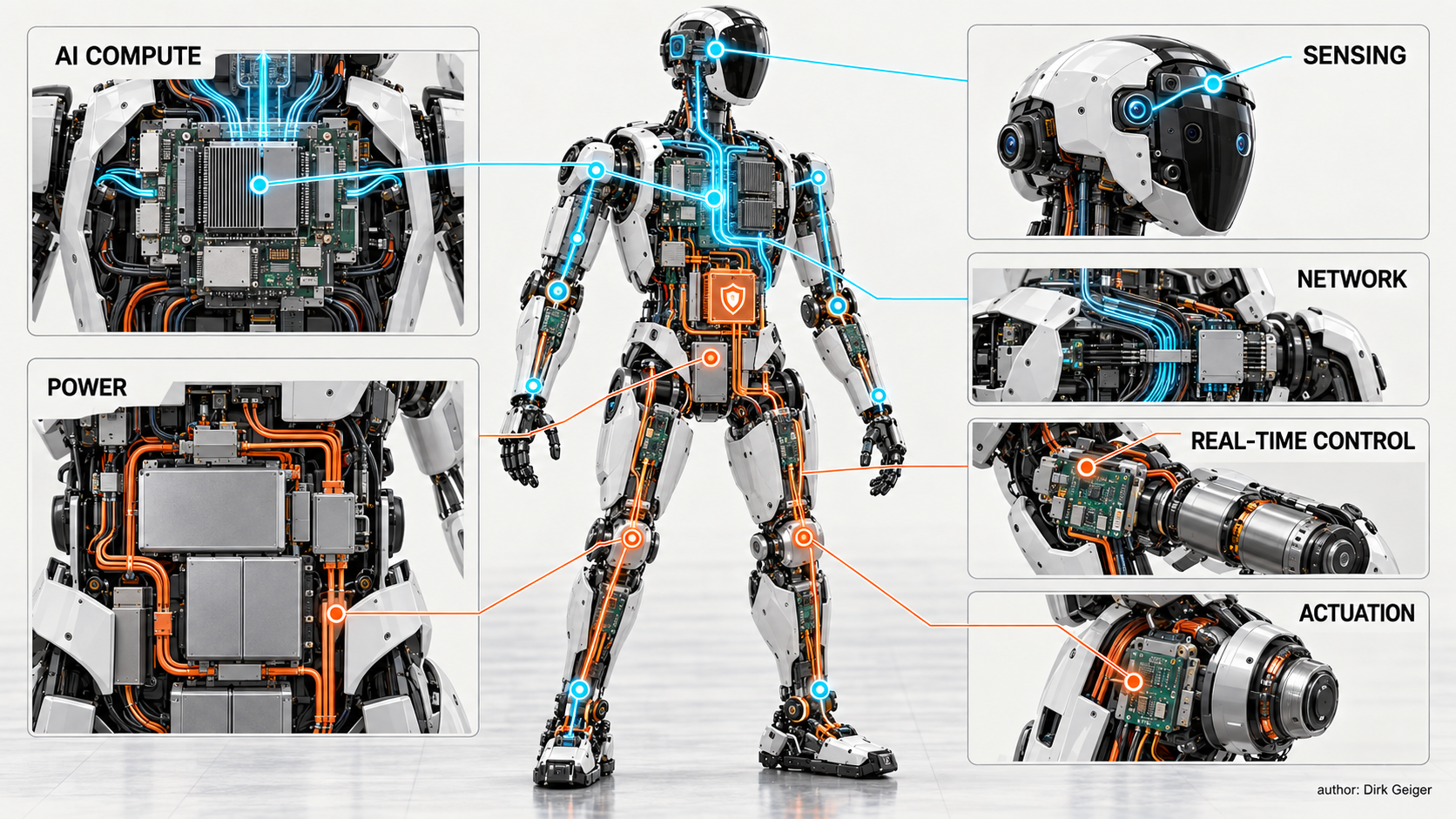
First comes compute. A robot that estimates the present already needs perception, state estimation and control. A robot that evaluates several futures must also approximate the consequences of candidate actions while those answers remain relevant. Depending on implementation, this may combine CPU optimization, GPU inference, AI acceleration, numerical solvers and deterministic microcontroller resources.
Second comes memory and data movement. Candidate futures are not free. Vision features, maps, latent states, trajectories, contact hypotheses and model parameters move between processing elements. The bottleneck may be memory bandwidth and locality rather than arithmetic. In a battery-powered machine, data movement also contributes to heat and energy demand.
Third comes real-time partitioning. The application processor running a world model is not automatically the right device to close a motor loop. Humanoids need heterogeneous compute: powerful processors for perception and AI; deterministic microcontrollers for supervision and control; motor-control electronics near the inverter; and independent protection capable of enforcing limits when the central computer is delayed, unavailable or mistaken.
Fourth comes networking. Distributed cameras, inertial sensors, force sensors, hands, joints and power modules contribute to the robot’s estimate of the future. Prediction quality depends on values, acquisition time, transport delay and validity. Time synchronization, bounded latency, freshness and fault detection are therefore part of intelligence quality, not merely network quality.
Fifth comes sensing. Prediction matters only when prediction error can be observed. Encoders, inertial measurement, current sensing, force and torque sensors, tactile arrays, radar and cameras form the verification layer that decides whether an anticipated future is still credible.
Finally comes power. Additional prediction costs energy. Larger models, faster memory and more sensing increase electrical load. The relevant question is whether the added computation reduces total mission energy, peak effort, collisions, unnecessary acceleration, failed grasps or recovery motion enough to justify its cost. That answer is workload- and architecture-dependent and should be measured rather than assumed.
These requirements argue against treating the robot as a central computer surrounded by passive peripherals. The torso processor may own the broadest models, yet joints and limbs still need local timing, diagnostics and protective authority. Sensor nodes need trustworthy acquisition timing. Network endpoints need to expose delay and loss rather than silently presenting old data as current data. Power domains need controlled startup, shutdown and fault isolation so that a failed high-performance processor does not automatically remove every path to a bounded stop.
The architecture must also carry state across boundaries cleanly. A trajectory is incomplete without its coordinate frame and validity interval. A contact estimate is incomplete without confidence and timestamp. A torque request is incomplete without the operating limits under which it was calculated. These details are easy to dismiss as middleware, but they determine whether a prediction remains physically meaningful when it reaches another processor. A plausible model connected through weak timing semantics can be less trustworthy than a simpler model operating on coherent data.
More compute can still mean less wasted energy
Compute and motion live on different energy scales and have different physical consequences. The best humanoid is not necessarily the one that minimizes compute power. It is the one that minimizes the energy and risk required to complete useful work.
A purely reactive machine may save prediction power while wasting energy correcting avoidable motion. Poor foot placement can demand a recovery step. Late obstacle recognition turns smooth deceleration into abrupt braking. A weak grasp estimate can lead to a dropped part and repetition of the task. An incorrect payload estimate can increase torque peaks and thermal stress.
Prediction can therefore support energy management. Early disturbance awareness distributes corrective action across more joints and more time. Anticipated contact allows stiffness and posture to be adjusted before impact. Forecasting a task sequence allows power, communication and compute domains to prepare before they become urgent.
None of this makes prediction automatically efficient. Always-on high-performance compute can consume meaningful battery capacity, and richer generative models may be inappropriate for short-horizon control. Prediction depth should match decision horizon and consequence. Milliseconds ahead, compact dynamic models and local estimators may dominate. Hundreds of milliseconds ahead, whole-body prediction and contact planning become relevant. Seconds ahead, semantic world models may add value. Minutes ahead, mission planning can incorporate battery state, thermal margin and resource availability.
Speculative physical intelligence is therefore not one algorithm. It is a scheduling and partitioning problem across models, processors, sensors, networks and power states. The robot has to decide how much future is worth computing.
A practical architecture for speculative physical intelligence
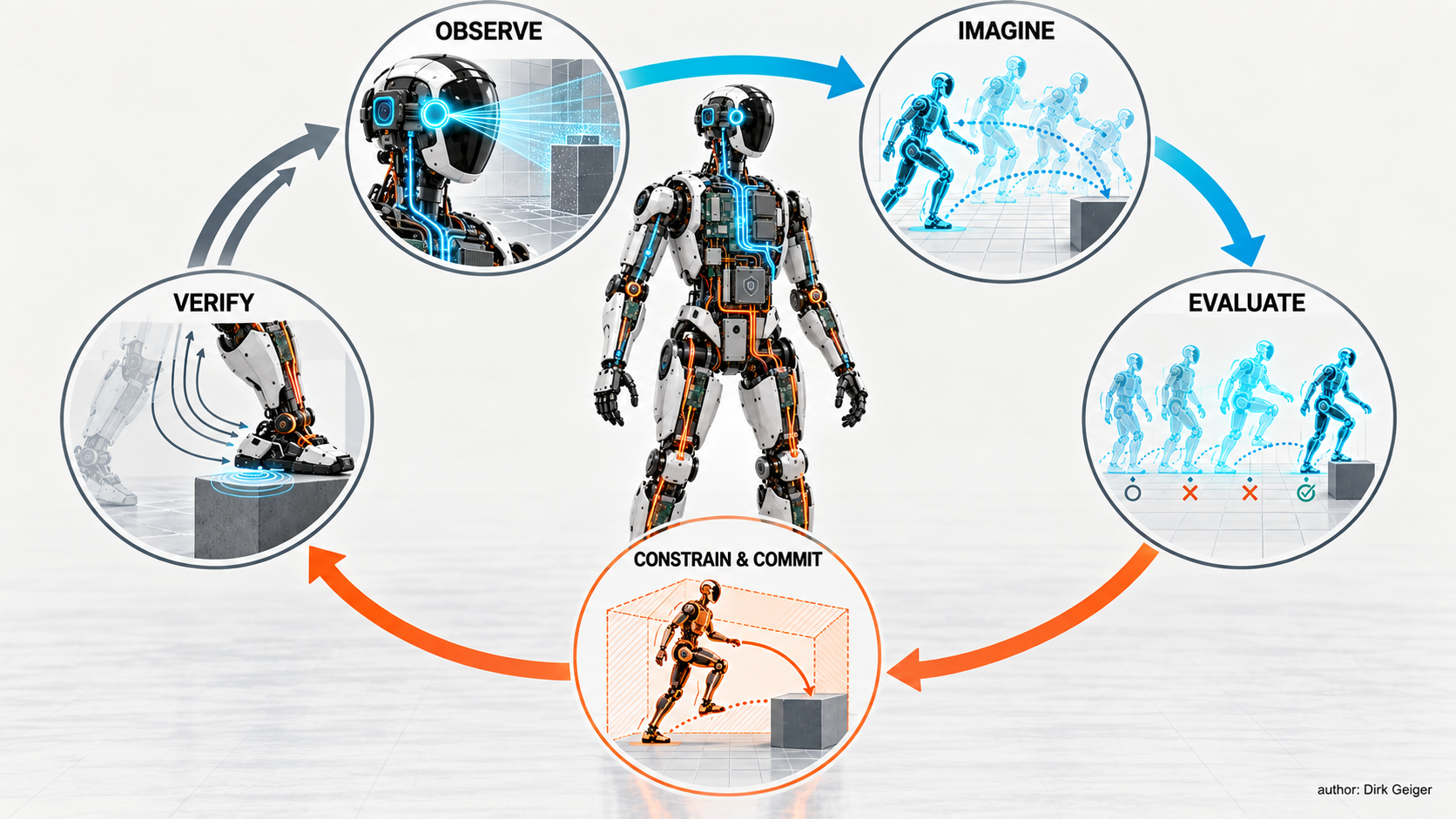
A practical architecture can be organized around five coupled functions.
Observe. Sensors establish the best available estimate of the robot and its environment. That estimate includes proprioception, contact state, electrical state and external perception, together with acquisition time and quality.
Imagine. Models project plausible future states. Short horizons may rely on explicit dynamics and estimators. Longer horizons may use learned dynamics, world models or generative representations. Multiple futures can coexist without any of them becoming a command.
Evaluate. Candidate futures are scored against task objectives, feasibility, energy, timing, collision risk and uncertainty. Planning converts possibility into a smaller set of admissible actions.
Constrain and commit. Independent limits determine what the machine may actually do. Real-time control converts the selected action into bounded actuator commands. Only here does a predicted future become physical energy.
Verify. Sensors compare expected and actual state. Deviations update the model, invalidate hypotheses, reduce authority or trigger protective behavior. The loop begins again immediately.
The decisive property is not prediction alone but prediction coupled to falsification. A world model that cannot be challenged by physical evidence is imagination without discipline. A controller that cannot benefit from prediction may be robust but unnecessarily reactive. Physical intelligence emerges when both cooperate without confusing their responsibilities.
This division of labour maps naturally onto semiconductor functions. High-performance processors and AI accelerators support imagination and evaluation. Microcontrollers and real-time processors support deterministic state machines and control. Sensor interfaces create observability. Connectivity devices move time-coherent information. Power semiconductors turn bounded commands into mechanical work. Monitoring and protection keep energy inside the permitted envelope.
The electronics do not merely execute AI. They define how AI is allowed to become physics.
Think speculatively. Act conservatively.
This architecture changes how humanoids should be commissioned. Traditional validation often begins with known tasks, defined trajectories and bounded operating spaces. A speculative system needs another class of tests: not only whether the preferred action succeeds, but whether the robot responds correctly when its preferred prediction is wrong. A person stops instead of continuing. A box is heavier than estimated. A floor contact is softer than expected. A network update arrives late. A camera is occluded. The system should reveal which layer noticed the disagreement, which hypothesis was invalidated and how authority changed.
Good test cases therefore inject disagreement deliberately. They vary observation age, friction, payload, timing and occlusion while keeping the expected containment response explicit. The result is not merely a task success score. It is evidence about detection latency, remaining margin, the path by which authority was reduced and the state reached after containment. A robot that stops safely but cannot explain which guard triggered may still be difficult to diagnose, maintain or improve.
Prediction error becomes an observable systems metric. Engineers can track how often futures are rejected, how late rejection occurs, which evidence provides the decisive contradiction and how much physical margin remains when correction begins. A robot that frequently recovers may still have a poor architecture if it recognizes prediction failure only after large forces or aggressive corrective motion develop. Earlier falsification is generally more valuable than dramatic recovery.
The same principle applies to software updates and learned policies. Updating perception, a world model or a planner changes the distribution of proposed actions even when low-level control remains untouched. A layered architecture allows those proposals to be checked against invariant execution constraints. Upper layers can evolve quickly; lower layers preserve the physical contract. System-level validation remains essential, but the boundary makes the relationship between fast-moving AI capability and slower-moving assurance more manageable.
That boundary is strategically important for manufacturers. Humanoid platforms will probably evolve through software more rapidly than through mechanics. New models, skills and task representations will arrive continuously. If every increase in model capability requires redesigning the safety and actuation stack, development becomes difficult to scale. Treating speculative capability as a proposal layer allows intelligence to advance without granting every new model unrestricted access to torque.
Observability matters as much as raw AI performance. A robot should record what it believed, which futures it considered, why one path was chosen, what constraints were active and where measured reality diverged from expectation. Such traces support debugging, fleet learning and incident analysis. In a machine that constantly predicts, rejected futures may be almost as informative as the executed one.
That record does not require preserving every internal tensor indefinitely. It requires a deliberate evidence design: time-coherent state estimates, selected candidate summaries, active constraints, command provenance, relevant sensor residuals and the reason for any veto or fallback. Retention can be matched to operational need and privacy obligations. The important point is architectural: evidence should be produced while the decision is made, not reconstructed later from unrelated logs.
A mature humanoid architecture may resemble a disciplined competition between futures rather than a single chain of commands. Models propose. Sensors challenge. Constraints veto. The actuator command is the small residue that survives. Intelligence grows in the space of alternatives; safety grows in the discipline of selection.
The next phase of Physical AI will not be won by the robot that generates the most elaborate internal story. It will be won by systems that turn uncertain predictions into useful physical action without surrendering control of the consequences.
“Perception, decision and action” is too sequential for a machine operating continuously in the physical world. Observation, imagination, evaluation, constrained commitment and verification better reflect the loop. Every observation reshapes the futures. Every action creates new evidence.
Humanoids make the architecture unavoidable because they are mobile, dynamically demanding, contact-rich and intended for environments designed around people. Generality expands the situations they may encounter faster than engineers can enumerate them. The intelligence layer must be comfortable with uncertainty. The execution layer must not be.
A humanoid can maintain several hypotheses about what a person may do next. It can evaluate foot placements, grasps and payload motions. That is where speculation belongs. At physical commitment, it needs explicit constraints, appropriate deterministic timing, independent supervision, measured state and rapid rejection of predictions that no longer match reality.
Physical AI is often presented as the moment artificial intelligence acquires a body. The more consequential change may be the reverse: once intelligence has a body, physics imposes a new architecture on intelligence. The robot of the future will think ahead constantly. It should never confuse thinking ahead with permission to act.
Think speculatively. Act conservatively.
Glossary
- Speculative physical intelligence
- Editorial framing for a robot's ability to generate and evaluate multiple possible future physical states before committing an action.
- Model predictive control
- Control method that repeatedly predicts system evolution over a finite horizon, optimizes inputs under constraints and applies the immediate control action.
- World model
- An internal representation of environmental state and dynamics used to support prediction, planning or reasoning.
- Counterfactual intelligence
- The ability to compare predicted outcomes under alternative candidate actions before selecting one.
- Bounded physical authority
- Architecture in which high-level intelligence proposes actions while real-time functions enforce physical and safety limits.
- Semantic containment
- Translation of AI goals or interpretations into explicit task states, objectives and permissible action descriptions before execution.
- Dynamic containment
- Enforcement of kinematic, stability, collision, force, speed and reachable-state constraints on candidate motion.
- Electrical containment
- Independent supervision that limits current, voltage, temperature, speed or faults in the actuation path.
- Data freshness
- The degree to which sensor or state information remains temporally valid for a decision or control action.
- Heterogeneous compute
- Architecture combining different processor types selected for AI, general computation, deterministic control and protection responsibilities.
- Local loop closure
- Execution of fast sensor-feedback or motor-control loops close to the actuator rather than through central compute.
- Prediction falsification
- Use of measured physical evidence to reject, revise or constrain a predicted future that no longer matches reality.
Abbreviations
- AI
- Artificial Intelligence
- MPC
- Model Predictive Control
- VLM
- Vision-Language Model
- VLMPC
- Vision-Language Model Predictive Control
- CPU
- Central Processing Unit
- GPU
- Graphics Processing Unit
- MCU
- Microcontroller Unit
- IMU
- Inertial Measurement Unit
- ISO
- International Organization for Standardization
- VLA
- Vision-Language-Action
Sources
- ISO/TS 15066:2016 — Robots and robotic devices — Collaborative robots · 2016-02-04
ISO/TS 15066 supplements industrial robot safety requirements for collaborative systems and provides principles relevant to human-robot interaction risk reduction engineering.
https://www.iso.org/standard/62996.html - World Model for Robot Learning: A Comprehensive Survey · 2026-04-30
Survey positions predictive world models as infrastructure for robot planning, simulation, evaluation, policy learning, data generation, and embodied decision making.
https://arxiv.org/abs/2605.00080 - A survey of world models for physical AI with uncertainty representation and control · 2026-09-03
Physical AI survey connects predictive world models with uncertainty, partial observability, planning, control, and safe action in embodied intelligent systems.
https://link.springer.com/article/10.1007/s44163-026-02122-1 - Online Non-linear Centroidal MPC for Humanoid Robot Locomotion with Step Adjustment · 2022-03-09
Online nonlinear centroidal MPC computes contact forces and locations, enabling step adjustment and demonstrated push recovery on the iCub humanoid.
https://arxiv.org/abs/2203.04489 - Hierarchical Reduced-Order Model Predictive Control for Robust Locomotion on Humanoid Robots · 2025-09-05
Hierarchical reduced-order MPC separates step planning and stabilization rates and reports hardware experiments on the Unitree G1 humanoid robot.
https://arxiv.org/abs/2509.04722 - Dynamic Loco-manipulation on HECTOR: Humanoid for Enhanced ConTrol and Open-source Research · 2023-12-19
Force-and-moment MPC combines humanoid and object dynamics for dynamic walking, disturbance rejection and loco-manipulation with payload transport on hardware.
https://arxiv.org/abs/2312.11868 - A Step Toward World Models: A Survey on Robotic Manipulation · 2025-10-31
Survey examines robotic world models across perception, prediction and control while noting unresolved definitions, architectures, capabilities and evaluation challenges.
https://arxiv.org/abs/2511.02097 - Vision-Language Model Predictive Control for Manipulation Planning and Trajectory Generation · 2025-04-07
VLMPC generates candidate action sequences, predicts future frames or trajectories and selects actions using vision-language-conditioned costs for robotic manipulation.
https://arxiv.org/abs/2504.05225 - Beyond Dense Futures: World Models as Structured Planners for Robotic Manipulation · 2026-03-13
Structured future frames use kinematic cues to connect predictive world models with physically meaningful manipulation milestones and lower-level execution.
https://arxiv.org/abs/2603.12553 - ISO 10218-1:2025 — Robotics — Safety requirements — Part 1: Industrial robots · 2025-02-05
Official standard page defines industrial-robot safety scope, inherently safe design principles, risk reduction and explicit exclusions including service robots.
https://www.iso.org/standard/73933.html - ISO/TS 15066:2016 — Robots and robotic devices — Collaborative robots · 2016-02-04
Official specification page covers collaborative industrial robot systems and notes its safety principles may still inform other robotics fields.
https://www.iso.org/standard/62996.html