
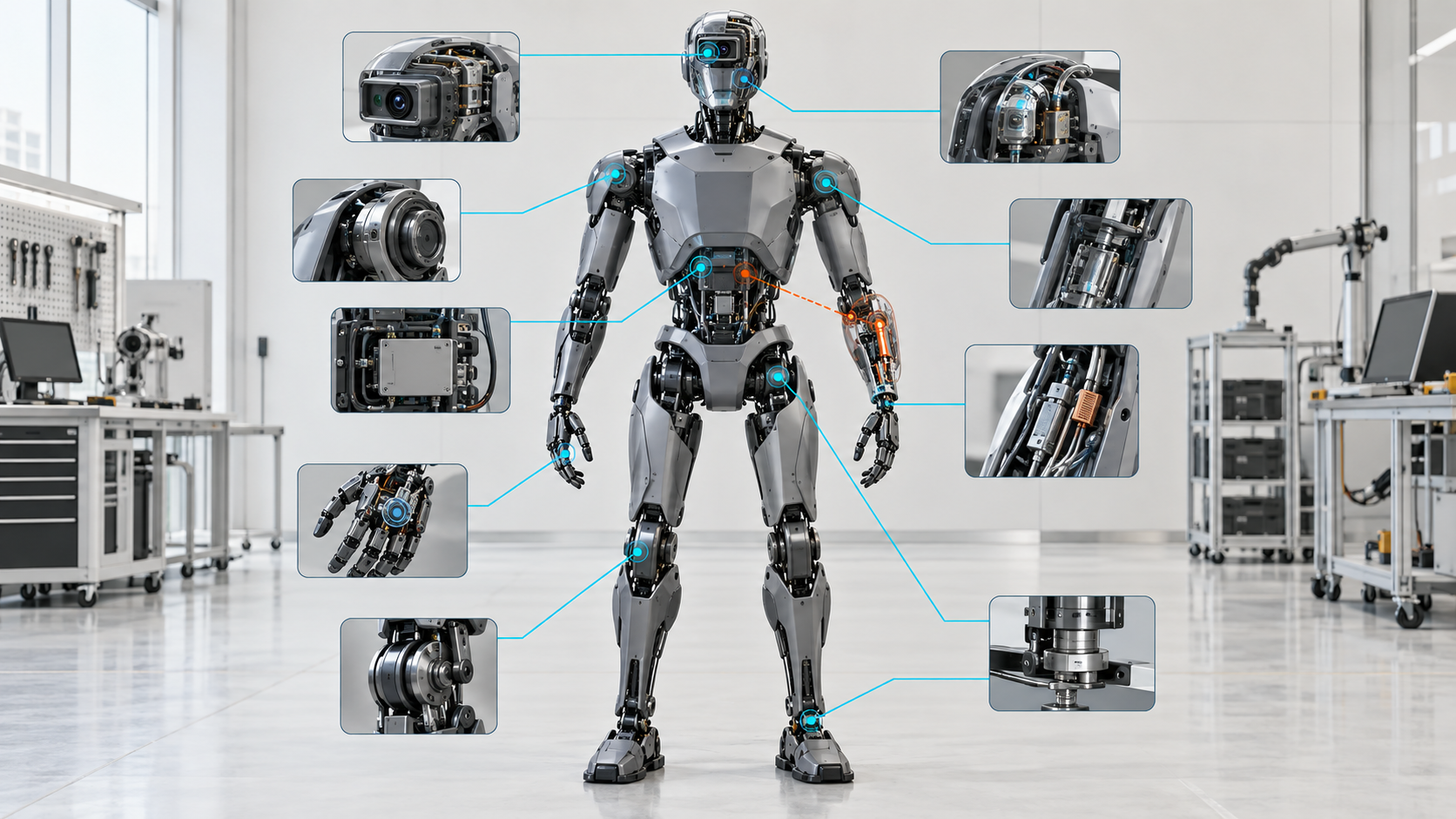
Technical Article
A Robot Is a Calibration Graph
Why Physical AI Must Preserve the Meaning of Every Measurement Across Manufacturing, Learning and Service
Humanoid intelligence depends on a web of geometric, dynamic, temporal and thermal calibration relationships. Managing that web as a traceable graph can expose drift, protect learning data, accelerate service and prevent physically inconsistent robot configurations from remaining hidden inside apparently healthy electronics.
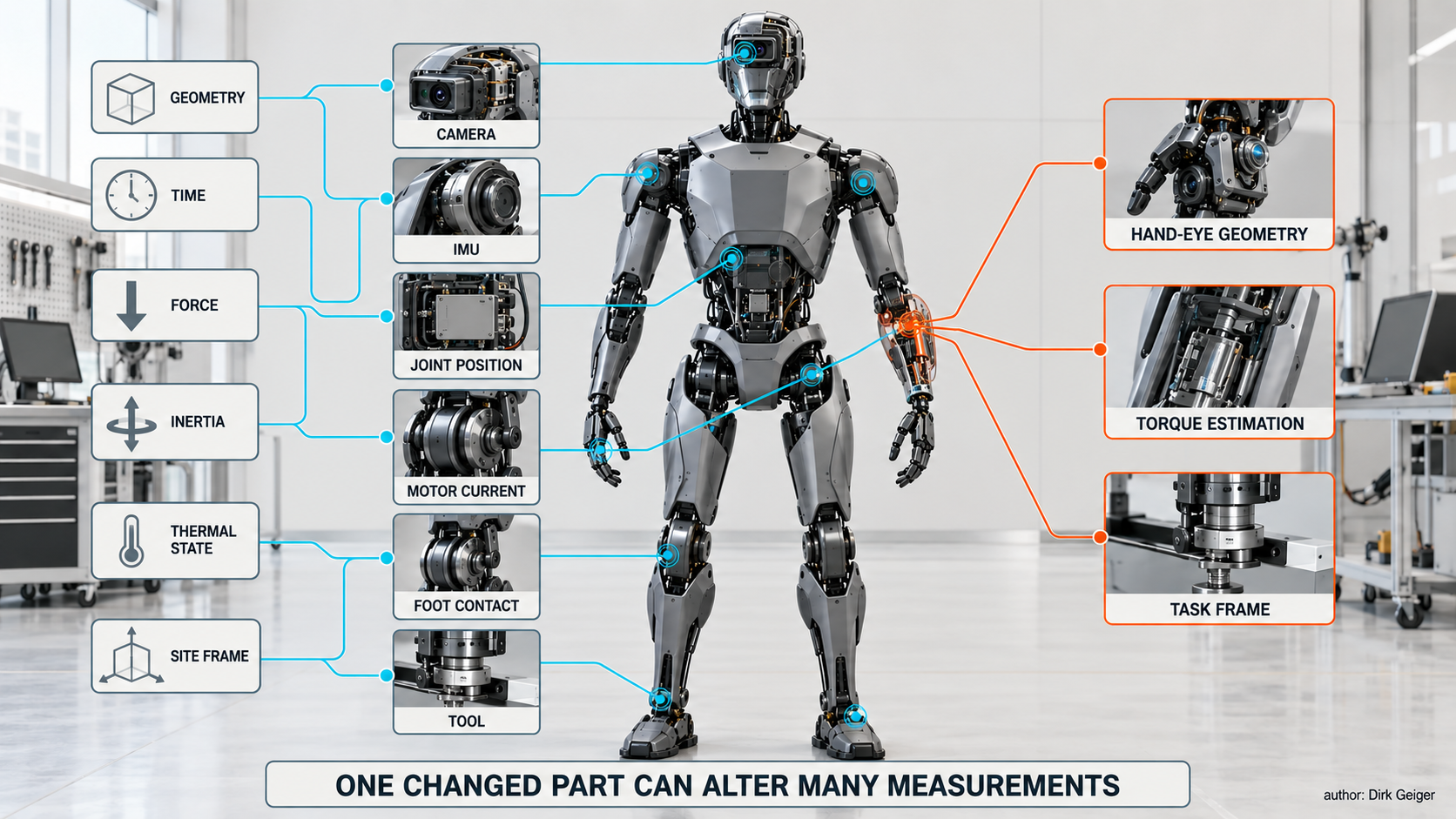
Calibration reaches across the complete physical stack
Geometry is only the first layer
Kinematic calibration identifies how joint offsets, link dimensions, axis alignment and compliance differ from the nominal mechanical model. A humanoid adds branched chains, changing contacts and a floating base. The left hand, right hand, head, pelvis and feet must agree through a common body model although no base is permanently bolted to a surveyed foundation.
Research on the TALOS humanoid demonstrates a practical whole-body method using embedded force sensors and a single plane. The authors selected 31 informative postures and reported a 2.3-fold reduction in average root-mean-square cross-validation error relative to the manufacturer model [src-talos-calibration-2025]. These are attributed experimental results, not a general performance promise. Their broader value is methodological: a humanoid can use its own sensing and contact capabilities to make calibration more observable and less dependent on extensive external metrology.
Dynamics determine what force and motion mean
Geometry alone cannot explain a robot that accelerates limbs, carries loads or makes contact. Controllers depend on inertial parameters, friction, joint compliance, transmission efficiency, motor torque constants and current-sensor behavior. These relationships change with payload, temperature, assembly tolerance, lubrication, cable routing and wear. A torque estimate derived from current can remain numerically stable while becoming physically biased as winding resistance or transmission friction changes.
PRIME treats physically consistent state estimation for legged and humanoid robots as a joint inference problem involving kinematics, actuator commands, contact forces and inertial parameters. Its authors evaluated the approach on quadrupeds and a Unitree G1 humanoid and described force- and contact-annotated trajectories as useful inputs for downstream learning [src-prime-2026]. This is research evidence rather than a certified deployment architecture. It nevertheless makes the dependency clear: calibration quality influences real-time estimation and the data used to train future behavior.
Time is a calibration dimension
Two sensors can be individually accurate and collectively misleading if their observations refer to different physical instants. Camera exposure, inertial sampling, encoder acquisition, network transport and compute pipelines add delay and jitter. The calibration graph therefore needs temporal offsets and uncertainty as well as spatial transforms. A fixed delay may be compensated. A variable or unobserved delay becomes uncertainty that should limit confidence in fusion and control.
This matters during fast contact. Vision may describe where a hand was while the force sensor reports what it is doing now. If the estimator assumes simultaneity, it may attribute disagreement to geometry, contact or policy behavior. Calibration and synchronization remain distinct disciplines, but the robot must preserve their relationship.
Coordinate conventions create a similarly quiet class of failure. A transform may be numerically valid yet interpreted with reversed direction, different axis order or a frame attached to the wrong mechanical feature. Units can fail in the same way: degrees and radians, millimeters and meters, motor-side and joint-side quantities can pass through software interfaces without triggering a communication error. A graph makes conventions part of the interface contract. The edge says not only that one value depends on another, but also how it is transformed, which version defined that transformation and which residual can challenge it.
Energy and thermal state change the model
Battery voltage, power-stage temperature, winding temperature and current-sensor offset influence the relationship between commands and delivered torque. Mechanical dimensions and sensor offsets also move with temperature. A calibration value without its valid operating envelope is incomplete. Some parameters can use temperature-dependent models; others need conservative bounds or a revalidation trigger. The aim is not perfect compensation. It is to prevent a changing physical relationship from being treated as immutable truth.
Robot learning inherits every measurement error
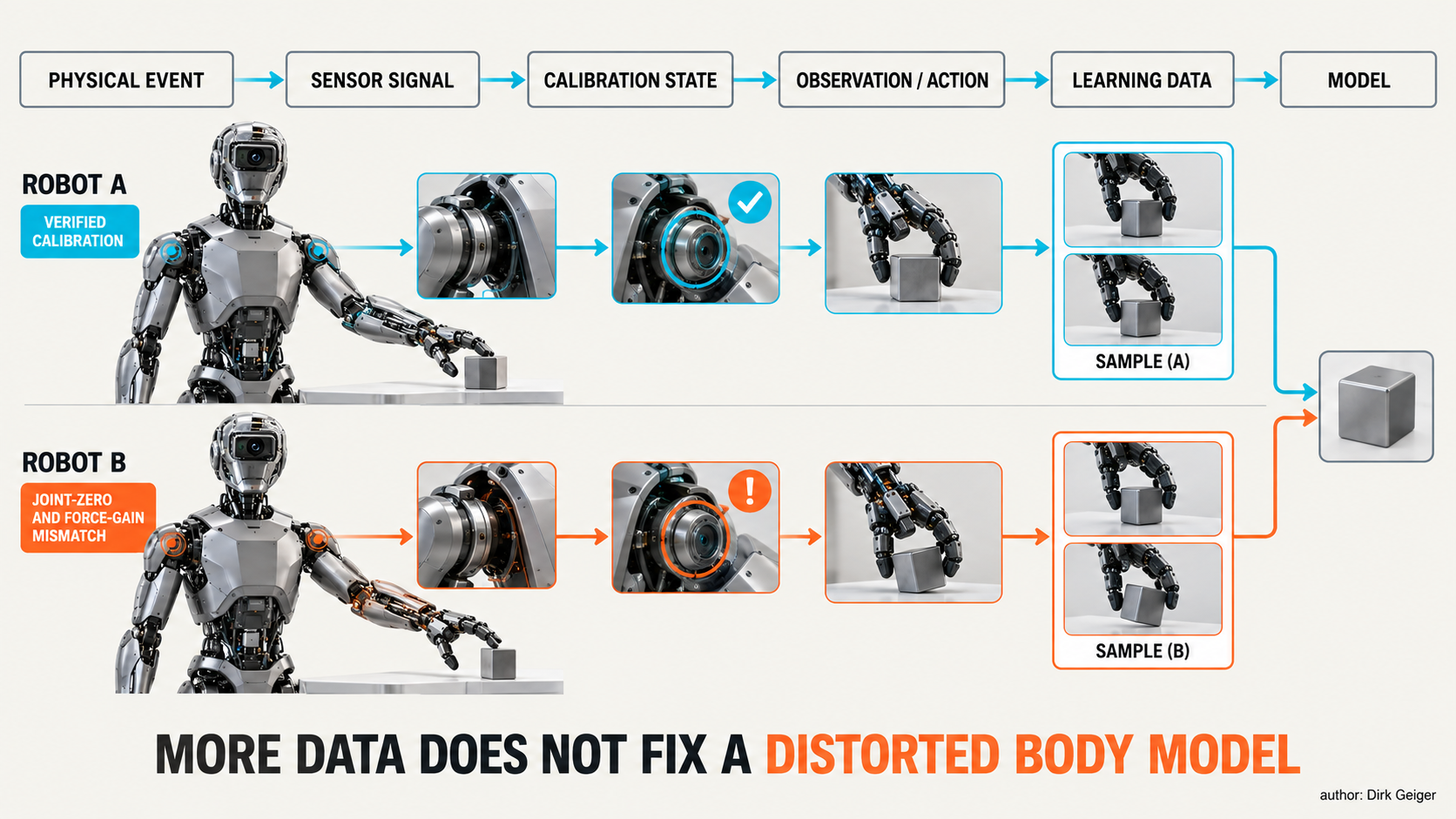
Embodied AI is trained on observations, actions and outcomes. Calibration defines the semantics of all three. If a camera-to-base transform is wrong, an object-pose label is wrong. If a joint zero is biased, the recorded action does not match the physical posture. If force gain drifts, demonstrations from different robots no longer describe equivalent contact. A dataset can be large, diverse and carefully curated yet still encode a distorted body.
This becomes a fleet problem. Data from one robot may be pooled with data from another under the assumption that common model names and software versions imply common physical meaning. Manufacturing tolerance makes that assumption unsafe. Calibration state should travel with the data: robot and hardware configuration, active parameter set, uncertainty, last verification and subsequent invalidating events. This is not provenance for auditors alone. It determines whether two samples are comparable.
Simulation-to-real transfer has the same dependency. A simulator contains geometry, inertial properties, actuator limits, latency and contact assumptions. System identification and domain randomization can reduce sensitivity to mismatch, but they do not remove the need to know the deployed robot. A model trained across a distribution needs evidence that the physical machine remains inside it. When drift pushes the robot outside, confidence should fall or capability should be constrained rather than allowing silent extrapolation.
Calibration can itself become an object of learning. Self-observation, self-touch, controlled contact and routine task data can produce residuals that reveal inconsistency. The robot may infer candidate corrections, but learned recalibration should not silently rewrite safety-relevant parameters. A credible lifecycle separates detection, estimation, authorization and activation. Statistical evidence can propose that a transform or torque constant changed; an independent policy decides whether the proposal is accepted, bounded, tested or escalated to service.
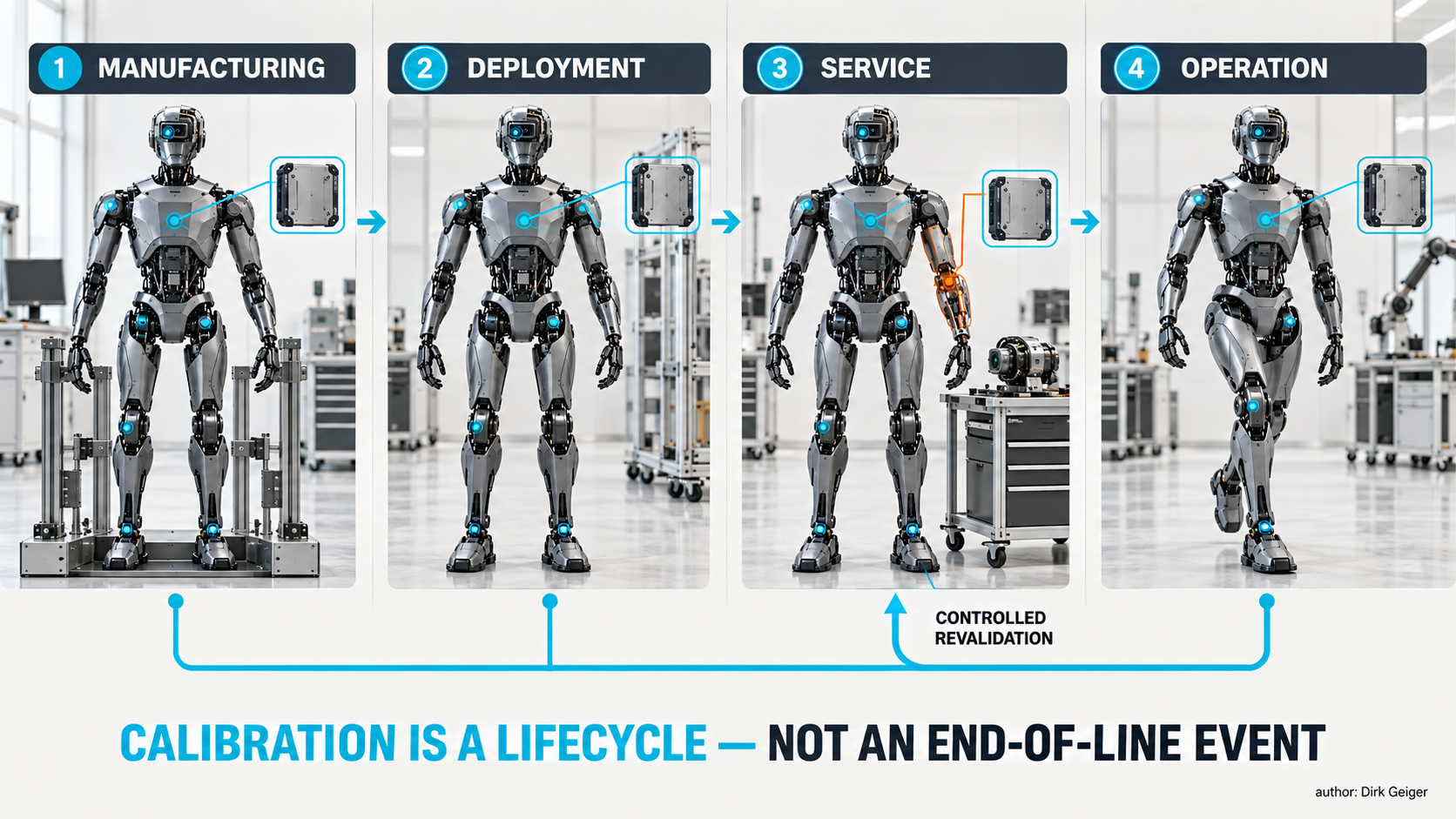
Calibration is a lifecycle, not an end-of-line station
Manufacturing establishes the first trusted body model
Production calibration should bind measurements to the actual assembly. The relevant identity is not only the robot serial number. It includes replaceable joint modules, sensors, gearboxes, batteries, tools and compute units whose properties influence the model. End-of-line procedures can establish geometric relationships, sensor offsets, actuator parameters and baseline residuals. The result becomes the initial trusted calibration graph.
Manufacturing economics favor short tests, inexpensive fixtures and high first-pass yield. Measurement quality favors informative poses, controlled conditions and redundant observations. The engineering challenge is to select movements and contacts that make important parameters observable without turning every unit into a laboratory project. Production adds fixture capability, cycle time, uncertainty, traceability and failure routing to the research problem.
Deployment connects body and site
A robot arriving at a site inherits new relationships: floor geometry, workcell coordinates, charging infrastructure, tools, payloads, localization landmarks and human operating zones. Commissioning should extend the factory graph with deployment-specific frames and verify interfaces between robot and environment. NIST’s work on robot performance emphasizes application-driven metrics and the behavior of integrated systems, not only isolated components [src-nist-robot-metrics].
ISO 10218-1:2025 addresses industrial robots, while ISO 10218-2:2025 addresses robot applications and cells [src-iso-10218-1-2025] [src-iso-10218-2-2025]. Scope still matters: neither should be presented as a universal humanoid certification route. Their separation between a robot and its integrated application nevertheless exposes a calibration boundary. A machine can leave the factory with a valid internal model and still be incorrectly related to its deployed environment.
Service creates a new configuration
Replacing a module is not complete when communication returns. The replacement carries its own calibration, manufacturing tolerances and firmware. The robot must determine which relationships remain valid, which can be inherited, which require local tests and which demand a controlled fixture. A wrist replacement may invalidate hand-eye geometry, payload estimation and force bias. A foot replacement may affect contact geometry, pressure distribution and locomotion state estimation.
A service tool should compute the affected subgraph instead of issuing a generic recalibrate command. This shortens downtime and avoids unnecessary motion while preventing hidden dependencies from escaping. It also improves warranty evidence by distinguishing a sensor failure, assembly shift, incorrect module, missed procedure and environment outside the validated range.
Operation supplies continuous evidence
Routine motion produces natural consistency checks. With a stationary foot in contact, inertial and joint estimates should agree within expected bounds. When both hands touch a known fixture, independent kinematic chains close a loop. During slow unloaded joint motion, current, speed and gravity compensation should form a plausible pattern. These checks do not always identify one parameter error, but they reveal when the model no longer explains the body.
The response depends on observability and consequence. A weak residual may be logged for trending. Repeated cross-sensor disagreement may trigger a bounded self-test. A confirmed error in a safety-relevant path may restrict force, speed or reachable space until revalidation. One uncertain residual should never be converted into a precise but unjustified diagnosis.
Not every parameter deserves the same treatment
A scalable architecture needs calibration classes: device-local production values, robot-assembly values, site relationships and adaptive estimates. These classes differ in ownership, update authority, evidence, valid lifetime and consequence of error. Safety relevance comes from the functions that consume each parameter. The same camera transform may support a convenience function in one mode and human detection in another.
The graph therefore needs edges to functions and capability envelopes, not only links between files. When confidence falls, the system can identify what remains supported. A wrist-camera error may block autonomous grasping while supervised transport remains available; an uncertain pelvis-to-foot relationship may affect the entire locomotion domain. Evidence source must also remain visible: factory metrology, embedded self-contact, fleet statistics and online estimation are not interchangeable.
A calibration graph needs assurance, not just storage
A useful record contains a value, unit, coordinate convention, uncertainty or validity bound, method, time, responsible process, hardware identity, software context and dependencies. It also retains the state in which measurement occurred: temperature, payload, fixture, support condition and relevant power state. Without context, a value can be precise and still be wrong for the current robot.
Versioning matters because calibration and software evolve together. A controller may change coordinate convention, filtering, compensation model or parameter interpretation. The graph should declare compatibility between the parameter schema and consuming software. Activation should be atomic where inconsistent combinations can influence motion. Rollback should restore a coherent set rather than one isolated file.
Cybersecurity enters because calibration data can modify physical behavior. Changing a joint zero, force gain, payload model or camera transform may alter motion without replacing executable code. NIST SP 800-193 discusses protecting, detecting changes to and recovering platform firmware and critical data [src-nist-sp800-193]. A humanoid calibration architecture can apply the same broad pattern: authenticate authorized changes, protect critical records, detect unexpected modification and retain a recoverable known-good state. This is an architectural analogy, not a claim that the publication is a humanoid calibration standard.
Integrity alone is insufficient. A correctly signed calibration generated with the wrong fixture or robot identity is still wrong. Assurance also needs procedural and physical evidence: authorized method, matching target identities, valid conditions, accepted residuals and bounded verification. Cryptography protects the evidence chain; metrology gives the evidence meaning.
Engineering changes should declare calibration impact. A sensor revision may preserve the electrical interface while changing offset statistics, latency or temperature behavior. A gearbox may meet dimensional drawings while changing friction. Software may preserve a field while changing timestamp semantics. Each change should identify graph nodes and edges that are preserved, invalidated or uncertain.
Ownership has to be explicit as well. A sensor supplier can characterize device-local behavior; the robot manufacturer owns assembly geometry and the interpretation of modules in the body; the integrator owns site frames and tools; the operator controls service events and deployment conditions. Adaptive estimators may propose updates, but they do not automatically inherit authority from any of these actors. Separating evidence generation from approval keeps a plausible estimate from becoming an untraceable production value.
Uncertainty should remain structured rather than compressed into a single confidence score. A geometric transform can have directional covariance. A torque estimate may be reliable in one temperature and speed range but weak near reversal because friction dominates. Timing uncertainty may be bounded on one network path and variable on another. Consumers need the part of this evidence relevant to their function. Whole-body control, manipulation, safety supervision and learning pipelines can legitimately apply different acceptance rules to the same calibrated quantity.
Recovery is part of assurance. Calibration activation may fail through lost power, interrupted service or corrupted memory. Critical parameter sets need transaction behavior: prepare the candidate, verify integrity and identity, activate coherently, retain a known-good set and record the result. Distributed controllers require system-level commit logic so that a mixture of old and new relationships never receives full motion authority.
The semiconductor foundation determines what can be known
Calibration quality begins at the sensing interface. Position, current, inertial, optical, pressure and temperature sensors each bring offset, scale, noise, drift, nonlinearity and environmental sensitivity. Product specifications are only one layer. Magnet geometry, PCB placement, mechanics, power integrity, electromagnetic compatibility and signal processing determine the installed result.
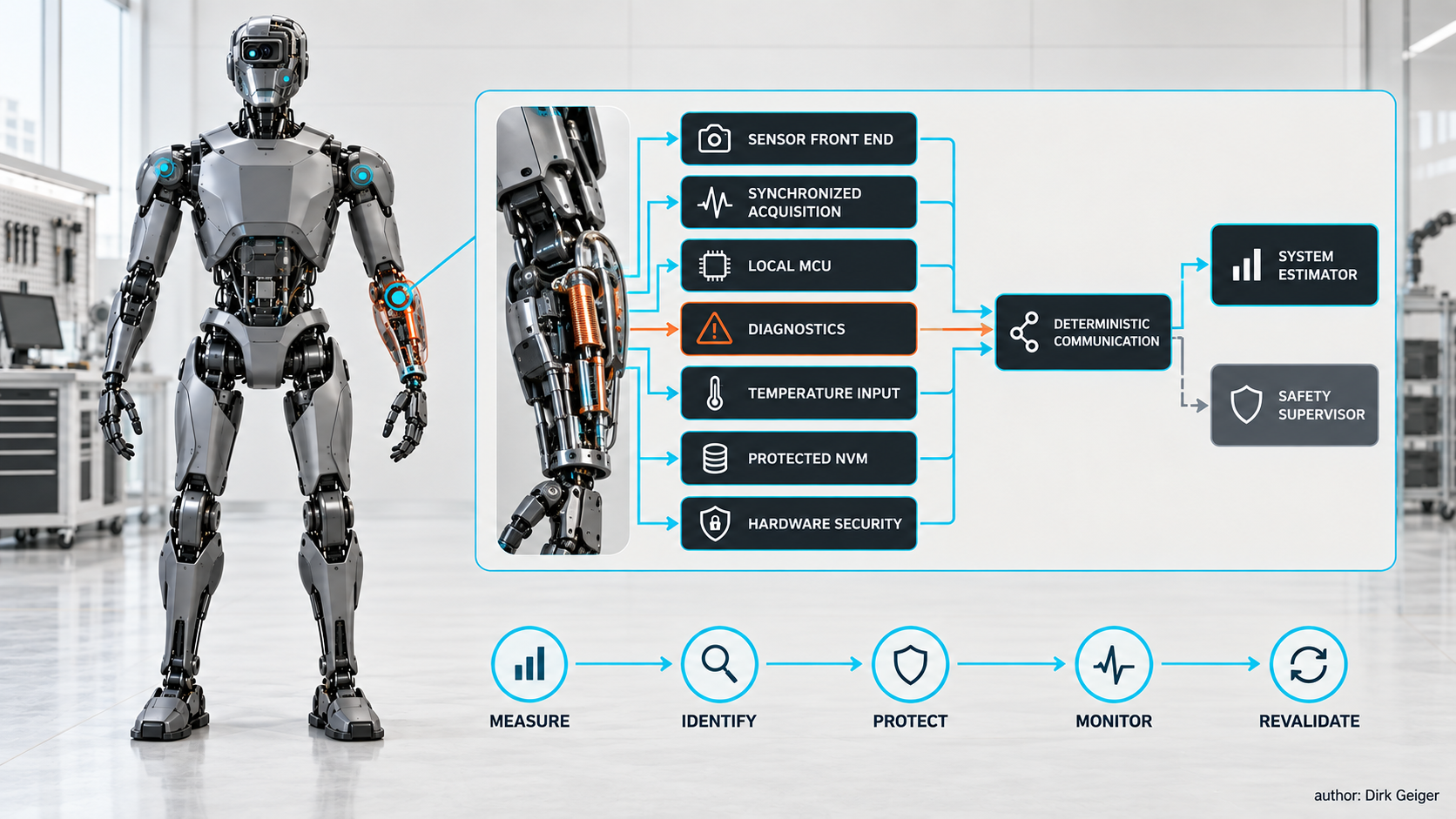
Local microcontrollers can apply compensation, timestamp samples, execute plausibility checks and preserve device-level calibration. Safety-oriented controllers can compare redundant or diverse channels and enforce bounds when evidence becomes inconsistent. Hardware security functions can protect device identity and authorize calibration changes. Nonvolatile memory stores parameters and event history, while error detection and power-fail handling guard against corruption. Deterministic communication preserves timing relationships and makes the age of evidence visible.
Temperature deserves special treatment because it connects electrical and mechanical calibration. Motor resistance, magnetic behavior, sensor offsets, battery characteristics and structural dimensions vary with thermal state. A distributed thermal picture lets the controller select a compensation model or widen uncertainty. One ambient temperature attached to the complete robot is rarely enough.
Diagnostics can expose degradation before task performance visibly fails. Signal amplitude, supply margin, communication errors, self-test results, current-offset trends and memory-integrity events help explain why a residual changed. The value lies in correlation. Joint-angle disagreement accompanied by sensor diagnostic faults suggests a different response from the same disagreement after mechanical service.
The strategic opportunity is a reference architecture connecting sensing, synchronized acquisition, local diagnostics, protected parameter storage, deterministic communication and lifecycle tooling. A semiconductor supplier cannot guarantee robot accuracy or safety. It can make measurements identifiable, time-aligned, diagnosed, protectable and maintainable across product life.
That architecture benefits from locality. Raw sensor behavior is most visible near the analogue interface, where saturation, supply disturbance, signal amplitude and temperature can be observed before abstraction removes context. A local MCU can bind a sample to device identity, acquisition time and active compensation state. The system estimator can then consume a measurement with provenance instead of receiving a number stripped of the conditions that gave it meaning.
Locality does not mean isolation. Robot-level consistency checks require communication across limbs and sensing modalities. The joint node can detect that its encoder signal is plausible; it cannot alone know that the hand and camera disagree about the same contact. The architecture therefore divides responsibility: local electronics preserve measurement quality and diagnostics, deterministic networking transports time and identity, and the system layer tests whether independent evidence agrees with the shared body model.
Test the graph by breaking its assumptions
A calibration architecture should be validated with controlled faults and lifecycle events. Inject a joint-zero offset, exchange module identities, delay one sensor stream, apply an incorrect camera transform, change current gain, heat a joint, loosen a mounting interface, replace a limb and interrupt parameter activation. The goal is not merely to make a diagnostic bit change. The system should localize affected relationships, constrain capability appropriately and return to service through a defined process.
Useful fleet measures include calibration escapes per service action, residual-detection coverage, false-alarm rate, time to isolate an affected subgraph, share of learning data with complete calibration provenance, robot-to-robot task variation and post-repair recommissioning time. Safety-relevant tests add a physical outcome: while confidence is degraded, does the robot remain within declared speed, force, workspace and energy limits?
Detection and correction must remain distinct. A method may reliably detect inconsistency without identifying the responsible parameter. Automatic correction deserves credit only when observability and validation support it. Otherwise, the correct result is graceful degradation and a precise service request. This prevents a sophisticated estimator from becoming an unreviewed mechanism that rewrites the body model.
Reference artifacts make results comparable. A surveyed plane, instrumented fixture, known mass, fiducial target, force gauge or repeatable locomotion course supplies an external constraint. Embedded self-tests provide internal evidence. The strongest validation combines independent references with redundant onboard observations because common errors can make internal channels agree while all remain wrong.
A mission-based calibration test
A compact validation mission can cross several domains without pretending to replace detailed metrology. The robot identifies installed modules and parameter versions, observes a surveyed target, touches a known plane with both hands, transfers a known mass, executes slow joint trajectories, loads and unloads each foot, and traverses a repeatable short path. The sequence creates closed kinematic chains, force constraints, inertial excitation, current signatures, contact events and site-frame observations.
The analysis asks whether one coherent parameter set explains the complete mission within declared uncertainty. If only a camera residual grows, the affected subgraph differs from a case in which vision, contact and inertial evidence all disagree after pelvis replacement. Each motion is selected because it distinguishes plausible causes, not because it merely looks representative.
Authority should be released progressively. Calibration begins with low-energy observations and advances toward motion only when prerequisite evidence passes. Failure at an early stage blocks higher-energy tests. Results remain bound to exact hardware, software, temperature and fixture context. Recommissioning becomes a controlled engineering transaction rather than an informal judgment that the robot appears to move normally.
Calibration debt becomes fleet cost
Poor calibration first appears as engineering friction: manual tuning, inconsistent demonstrations and unexplained residuals. At fleet scale it becomes an economic system. Tasks need larger margins, cycle time falls, grasp failures rise, models require robot-specific tuning, service visits last longer and useful data fragments into incompatible subsets. Teams may compensate in software for mechanical or sensing variation without recording the dependency, creating calibration debt with every release.
A graph-based architecture does not make calibration free. It adds identity, metadata, storage, fixtures, test time and governance. Its return comes from reducing uncertainty where uncertainty is expensive: end-of-line diagnosis, site integration, module replacement, fleet learning and safety validation. The business case should be measured through avoided variation and service effort, not the number of parameters stored.
There are valid counterpoints. Some applications tolerate large errors. Learning can adapt to variation. Conservative control can hide imperfect models. External perception can correct local drift. A complete metrological chain for every low-cost sensor would be uneconomic. The relevant dependencies are those that influence task success, safety evidence or fleet learning; their validation effort should remain proportionate to consequence.
Physical AI needs a measurable body
Humanoid intelligence is grounded in the relationship between digital state and physical reality. Calibration defines that relationship. When dependencies are fragmented, a robot can remain operational while its internal description quietly diverges from its body. The result may resemble poor perception, unstable control, weak learning, excessive wear or random fleet variation although the real failure is one broken measurement relationship.
Treating the robot as a calibration graph changes the workflow. Manufacturing establishes an identified baseline. Deployment extends the graph into the site. Service updates affected relationships and proves the new configuration. Operation watches residuals and preserves evidence. Learning data carries the context that gives observations and actions meaning. Security protects parameter state, while safety supervision limits capability when evidence becomes weak.
The semiconductor contribution is systemic. Sensors, microcontrollers, timing, diagnostics, secure identity, protected memory and communication determine whether the body can be measured, compared and trusted over time. The robot does not need perfect self-knowledge. It needs to know which parts of its physical model remain valid, which have changed and what it is still allowed to do.
Glossary
- Observability
- The extent to which an internal parameter or state can be inferred uniquely from available inputs and measurements.
- Parameter schema
- The defined structure, units, conventions and interpretation used by software to consume calibration data.
- Repeatability
- The closeness with which a robot returns to the same measured result under repeated conditions, distinct from closeness to the true result.
- Self-calibration
- Calibration using the robot’s own sensors, motion and environmental contacts to estimate or verify model parameters.
- System identification
- Estimation of model parameters from observed inputs and physical responses.
- Trusted calibration state
- An identified calibration configuration whose origin, compatibility and required validation evidence satisfy the active release policy.
- Validity envelope
- The environmental, thermal, mechanical and operational conditions within which a calibration value or compensation model is considered applicable.
- Calibration graph
- A versioned network of measurement parameters, coordinate relationships, validity conditions and dependencies defining how a robot interprets its body and environment.
- Calibration provenance
- Evidence describing how, when, under which conditions and for which identified hardware a calibration value was produced and authorized.
- Cross-sensor residual
- The difference between observations or predictions from independent sensing paths after transformation into a comparable physical representation.
- Dynamic parameter
- A model value such as inertia, friction, compliance or torque constant relating commanded and measured motion or force.
- Extrinsic calibration
- The estimated position and orientation of one sensor or coordinate frame relative to another.
- Intrinsic calibration
- Parameters describing internal sensor measurement behavior, such as focal properties, offset, scale or distortion.
- Kinematic calibration
- Identification of geometric robot-model parameters such as joint offsets, link dimensions and axis alignment from measured poses or constraints.
- Configuration identity
- An attributable description of hardware, software, models, parameters, calibration and dependencies defining a deployed robot state.
- Deterministic recommissioning
- A controlled restart process verifying identity, configuration, hardware health, safety state and readiness before operational release.
Abbreviations
- HSM
- hardware security module
- ISO
- International Organization for Standardization
- AI
- Artificial Intelligence
- IMU
- Inertial Measurement Unit
- MCU
- Microcontroller Unit
- NIST
- National Institute of Standards and Technology
- RMS
- Root Mean Square
- NVM
- Nonvolatile Memory
- PRIME
- Physically-consistent Robotic Inertial and Motion Estimation
Sources
- ISO 18646-2:2024 — Robotics — Performance criteria and related test methods for service robots — Part 2: Navigation · 2024-01
ISO specifies navigation performance measures including pose accuracy, repeatability, obstacle avoidance, path deviation, narrow passage and mapping accuracy.
https://www.iso.org/standard/82643.html - Measurement Science for Robotics and Autonomous Systems Program · n.d.; accessed 2026-09-10
NIST develops application-driven metrics, information models, datasets and test methods for integrated robotic performance, safety and manufacturing adoption.
https://www.nist.gov/programs-projects/measurement-science-robotics-and-autonomous-systems-program - Humanoid Robot Whole-body Geometric Calibration with Embedded Sensors and a Single Plane · 2025-07-22
Researchers report automated TALOS whole-body calibration using embedded force sensing, optimized contact postures and one planar reference surface.
https://arxiv.org/abs/2507.16369 - NIST SP 800-193 — Platform Firmware Resiliency Guidelines · 2018-05-04
NIST describes protecting platform firmware and critical data, detecting unauthorized changes and recovering platform state securely after compromise.
https://csrc.nist.gov/pubs/sp/800/193/final - Angle sensors · n.d.; accessed 2026-09-10
Infineon presents magnetic angle-sensing technologies, interfaces and product families used for position measurement and motor-control applications.
https://www.infineon.com/products/sensor/magnetic-position-sensors/angle-sensors - ISO 9283:1998 — Manipulating industrial robots — Performance criteria and related test methods · 1998-04
ISO defines performance criteria and test methods used to assess manipulating industrial robots under specified operating and test conditions.
https://www.iso.org/standard/22244.html - ISO 10218-1:2025 — Robotics — Safety requirements — Part 1: Industrial robots · 2025
Part one specifies requirements for industrial robots while retaining defined scope boundaries relevant to interpretation and system integration.
https://www.iso.org/standard/73933.html - PRIME: Physically-consistent Robotic Inertial and Motion Estimation for Legged and Humanoid Robots · 2026-05-17
PRIME jointly refines motion, contact forces and inertial parameters to produce physically consistent trajectories for legged and humanoid robots.
https://arxiv.org/abs/2605.17681 - Humanoid Robot Whole-body Geometric Calibration with Embedded Sensors and a Single Plane · 2025-07-22
TALOS experiments use embedded force sensing, one plane and selected postures to identify a more accurate whole-body kinematic model.
https://arxiv.org/abs/2507.16369 - Robot Systems — Performance Metrics and Test Methods
NIST develops application-driven measurements, test methods and artifacts for evaluating robot components, capabilities and integrated system performance.
https://www.nist.gov/programs-projects/robot-systems - ISO 10218-2:2025 — Robotics — Safety requirements — Part 2: Industrial robot applications and robot cells · 2025
Part two addresses safety requirements for industrial robot applications and cells, including integration beyond the individual robot product.
https://www.iso.org/standard/73934.html - NIST SP 800-193 — Platform Firmware Resiliency Guidelines · 2018-05
NIST describes mechanisms to protect platform firmware and critical data, detect unauthorized changes and recover a known-good state.
https://csrc.nist.gov/pubs/sp/800/193/final