
Technical Article
Physical AI Is Becoming a Three-System Market
Diverging Regional Strategies and the Rise of System Enablement
China, the United States and Europe are building distinct Physical AI markets, making system enablement the emerging route to scale.
Executive Summary
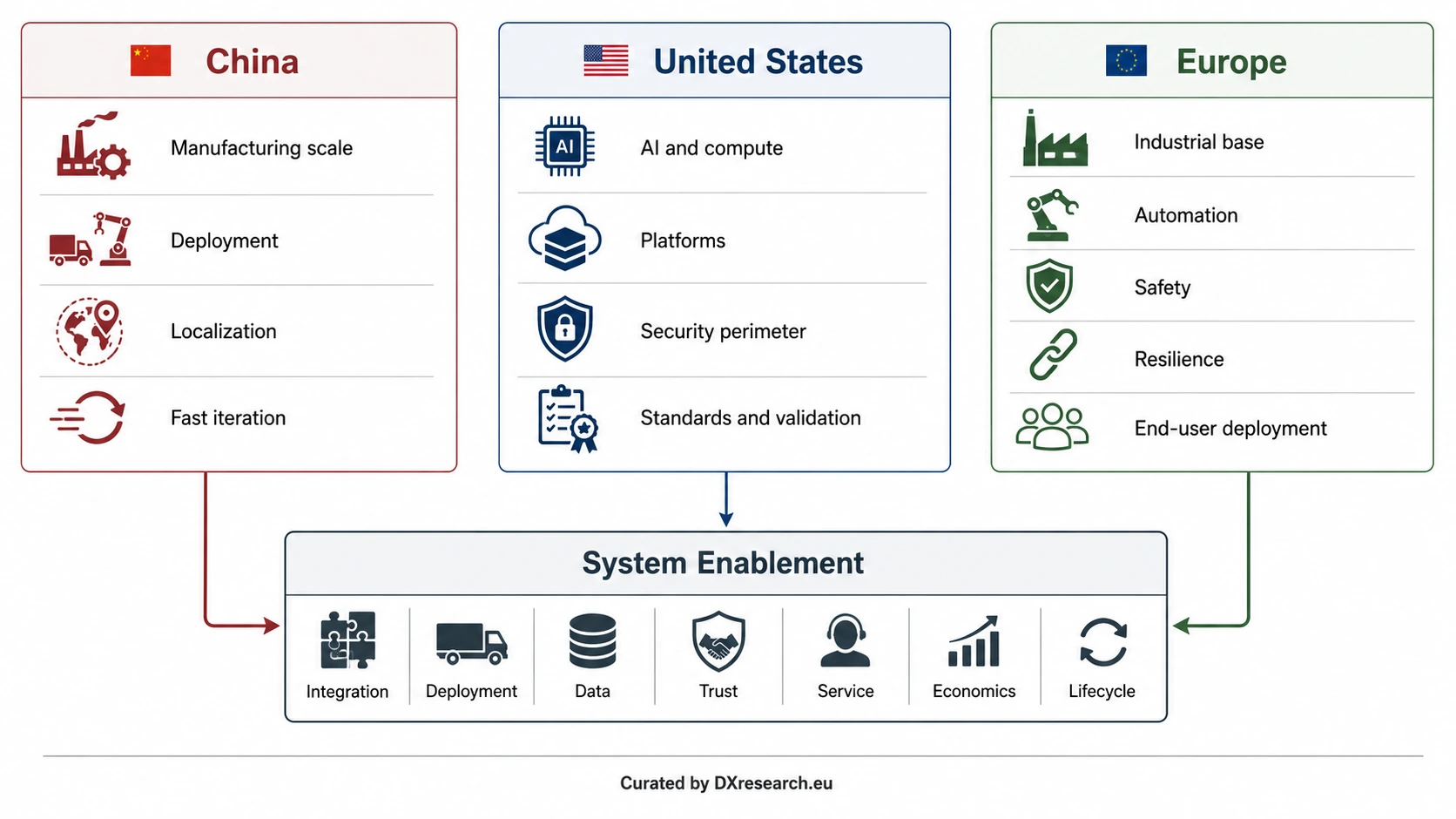
Physical AI is no longer developing as one homogeneous global market. China is using manufacturing scale, real-scene deployment, industrial policy and localization to accelerate learning and commercialization. The United States combines frontier AI and compute leadership with a growing emphasis on security, trusted technology, validation and market-access controls. Europe is pursuing a third route rooted in industrial automation, safety, resilience, demographic pressure and deployment economics. These approaches share technologies, but they create different ecosystems, customer expectations and routes to scale. The chapter argues that the common winning capability is system enablement: integrating intelligence, machines, data, infrastructure, trust, service and lifecycle economics into repeatable deployments. Global participants will therefore need a common technical core with deliberate regional adaptation rather than one universal go-to-market model. The strategic question is shifting from who owns the best individual technology to who can make the complete Physical AI system work reliably at scale in practice.
One Technology Trend Is Becoming Three Markets
Physical AI describes artificial intelligence embodied in machines that perceive, reason and act in the physical world. Humanoids attract much of the attention, but the same transition is unfolding across industrial robots, autonomous mobile robots, logistics systems, healthcare machines, agriculture and other forms of intelligent automation. The underlying technologies are global, yet the conditions for turning them into businesses are increasingly regional.
The divergence is visible in policy, capital allocation, industrial structure, security expectations and deployment priorities. China is compressing the path from prototype to deployment. The United States is extending leadership in AI and compute into robotics while strengthening trusted-technology boundaries. Europe is trying to convert a deep industrial base and research capability into scalable adoption. Rather than producing one dominant formula, these regions are developing different answers to the same question: how should intelligence be converted into useful physical systems?
China Is Treating Deployment as an Industrial Scaling Mechanism
China’s approach is distinguished by the connection between industrial policy, manufacturing capacity, domestic deployment and localization. In June 2026, the Ministry of Industry and Information Technology and the State-owned Assets Supervision and Administration Commission launched a real-scene training initiative for humanoid robots and embodied intelligence. The program links real operating environments, high-quality robot data, component improvement, application validation and lifecycle management, with an ambition to form more than one hundred high-value application scenarios and enable deployment at the ten-thousand-unit scale by the end of 2026. [1]
This matters because robotics improves through use. More deployment generates operational data, exposes failure modes, pressures the ecosystem to reduce cost and creates incentives to localize capabilities. China’s existing industrial-robot scale reinforces that loop. International Federation of Robotics data show that China represented 54 percent of global industrial-robot deployments in 2024, while Chinese manufacturers reached a 57 percent share of their domestic market. [2]
The strategic logic is therefore not simply to build individual robots. It is to create an industrial system in which manufacturing, application deployment, data generation, supplier development and commercialization reinforce one another. The risk is that rapid scaling can outrun reliability, interoperability or sustainable economics. The advantage is learning speed.
The United States Is Combining Intelligence Leadership with a Stronger Trust Perimeter
The United States enters Physical AI from a different starting point. Its strongest assets are frontier AI, compute platforms, software ecosystems and venture-backed technology formation. NIST’s current Physical AI work highlights a complementary layer: closing the gap between embodied-AI research and deployable manufacturing requires measurement science, test methods, performance characterization, data and practical integration guidance. [3]
Security is also becoming part of market structure. On 28 July 2026, the Federal Communications Commission added foreign-produced advanced robotic devices to its Covered List, citing supply-chain and cybersecurity risks associated with networked robots, including manipulation of data and physical operation, surveillance and remote commandeering. Covered equipment is prohibited from receiving FCC equipment authorization unless a defined conditional approval applies. [4]
The result is a U.S. model that increasingly combines innovation with a trusted-technology boundary. Winning systems need strong AI capability, but they also need credible security, provenance, validation and deployment pathways. For global robotics companies, the U.S. market may therefore require more region-specific product and supply-chain strategies than in the past.
Europe Is Trying to Industrialize Physical AI
Europe’s opportunity is less about copying the American compute model or China’s manufacturing scale than about turning Physical AI into dependable industrial capability. The European Commission’s Apply AI Strategy identifies robotics and manufacturing as strategic sectors and emphasizes adoption, competitiveness, deployment and technological sovereignty. [5] A Commission robotics and manufacturing initiative likewise focuses on moving from pilots toward scalable industrial deployment through ecosystem collaboration and end-user needs. [6]
Europe also has an economic forcing function. Eurostat reports that the median age of the EU population reached 44.9 years in 2025, continuing a long-term ageing trend. [7] At the same time, Western Europe reached 267 industrial robots per 10,000 manufacturing employees in 2024, ahead of North America and Asia on the same regional density measure. [8] Europe therefore combines demographic pressure with a mature automation base and a large installed industrial system capable of absorbing more capable machines.
Its constraint is fragmentation. Research strength, industrial engineering and regulation do not automatically produce fast market formation. Europe needs stronger links between technology providers, machine builders, integrators, end users, testing facilities and capital if it is to turn technical competence into large-scale deployment.
The Market Is Diverging, but the Winning Capability Is Converging
The three regions are not building completely separate technologies. AI models, sensors, actuators, software frameworks and manufacturing methods will continue to move across borders where policy and economics allow. What is diverging is the system around the technology: preferred suppliers, security requirements, deployment incentives, data environments, certification expectations, customer economics and routes to scale.
This changes how robotics competition should be understood. A technically impressive machine is only one element of a deployable solution. Commercial success requires robots to fit workflows, exchange data with enterprise systems, operate safely around people, survive real duty cycles, be maintained economically and continue improving after deployment. The enabling system also includes simulation, fleet management, training data, service networks, integration tools, cybersecurity, financing and clear responsibility across the lifecycle.
For that reason, the most durable competitive advantage may sit between technology layers rather than inside one of them. Companies and regions that connect models, machines, infrastructure and users into repeatable deployment systems can create stronger network effects than those optimizing one component in isolation. This chapter uses system enablement for that integration capability.
Different Strategies Are Required for Different Markets
| Region | Primary route to scale | System priorities | Structural risk |
|---|---|---|---|
| China | Manufacturing scale and real-scene deployment | Localization, iteration speed, cost, application data | Scaling faster than reliability or sustainable economics |
| United States | AI and compute platforms | Security, provenance, validation, trusted market access | Fragmentation through security and supply-chain boundaries |
| Europe | Industrial adoption | Integration, safety, resilience, ROI, technological sovereignty | Slow conversion of research and pilots into deployment |
A global Physical AI strategy therefore needs more regional differentiation than a conventional export model. In China, the priority is likely to be speed of iteration, cost reduction, local ecosystem participation and access to high-volume deployment. In the United States, AI performance must coexist with security, provenance and trusted-market requirements. In Europe, successful solutions need to prove industrial value through reliability, safety, integration and return on investment.
The implication is not that every product must be reinvented three times. A more scalable approach is to build a common system core and design regional variation deliberately around it. Software interfaces, data governance, security models, sourcing, certification, service and commercial structures can then be adapted without destroying architectural reuse. This creates a regional technology stack rather than three unrelated products.
What to Watch Next
The next phase of Physical AI will be defined less by demonstrations and more by evidence of repeatable deployment. China’s real-scene programs will test whether scale can translate into sustained commercial operation. The United States will reveal how far security and supply-chain policy reshape robotics beyond sensitive applications. Europe will need to show that its research, automation base and regulatory emphasis can shorten rather than lengthen the path from pilot to productivity.
Across all three regions, the decisive indicators will be system-level: uptime, task economics, deployment speed, integration effort, fleet learning, safety performance and the ability to maintain and upgrade robots over time. Physical AI may be fragmenting into regional markets, but the common lesson is increasingly clear: the winners will be those that make the whole system work.
Glossary
- Embodied intelligence
- AI capability grounded in sensing, action and interaction with a physical environment.
- Physical AI
- AI systems that perceive, decide and act through physical machines, requiring computation to remain coupled to sensing, energy, motion and safety.
- Real-scene deployment
- Training, validating and operating robots in representative real-world environments rather than only controlled laboratory settings.
- Regional technology stack
- A configuration of suppliers, software, security, sourcing and compliance choices optimized for a specific geographic market.
- System enablement
- Integration of technology, infrastructure, data, trust, deployment, service and economics required to make a complete solution work at scale.
- Technological sovereignty
- A region’s ability to retain meaningful control over strategically important technologies, infrastructure and critical dependencies.
Sources
- 2026 Real-Scene Training Special Action for Humanoid Robots and Embodied Intelligence · 2026-06-08 · Ministry of Industry and Information Technology of China and SASAC
https://www.miit.gov.cn/zwgk/zcwj/wjfb/tz/art/2026/art_f291ccd3da4c47ce95741de63cc088e6.html - Addition of Foreign-Produced Power Inverters and Advanced Robotic Devices to FCC Covered List · 2026-07-28 · Federal Communications Commission
https://docs.fcc.gov/public/attachments/DA-26-786A1.pdf - Apply AI Sectoral Deep Dive - Robotics & Manufacturing · 2025-12-19 · European Commission
https://digital-strategy.ec.europa.eu/en/events/apply-ai-sectoral-deep-dive-robotics-manufacturing - Apply AI Strategy · 2026-current · European Commission
https://digital-strategy.ec.europa.eu/en/policies/apply-ai - Demography of Europe - 2026 Edition · 2026-05-21 · Eurostat
https://ec.europa.eu/eurostat/web/interactive-publications/demography-2026 - Physical AI and Data Generation for Robotics · 2026-accessed · National Institute of Standards and Technology
https://www.nist.gov/programs-projects/physical-ai-and-data-generation-robotics - Robot Density Surges in Europe, Asia, and Americas · 2026-04-08 · International Federation of Robotics
https://ifr.org/ifr-press-releases/news/robot-density-surges-in-europe-asia-and-americas - World Robotics 2025 - Industrial Robots · 2025-09-25 · International Federation of Robotics
https://ifr.org/worldrobotics/report-2025