
Technical Article
The Robot Knows What It Carries
Online Payload Awareness for Balance, Manipulation and Safe Whole-Body Motion
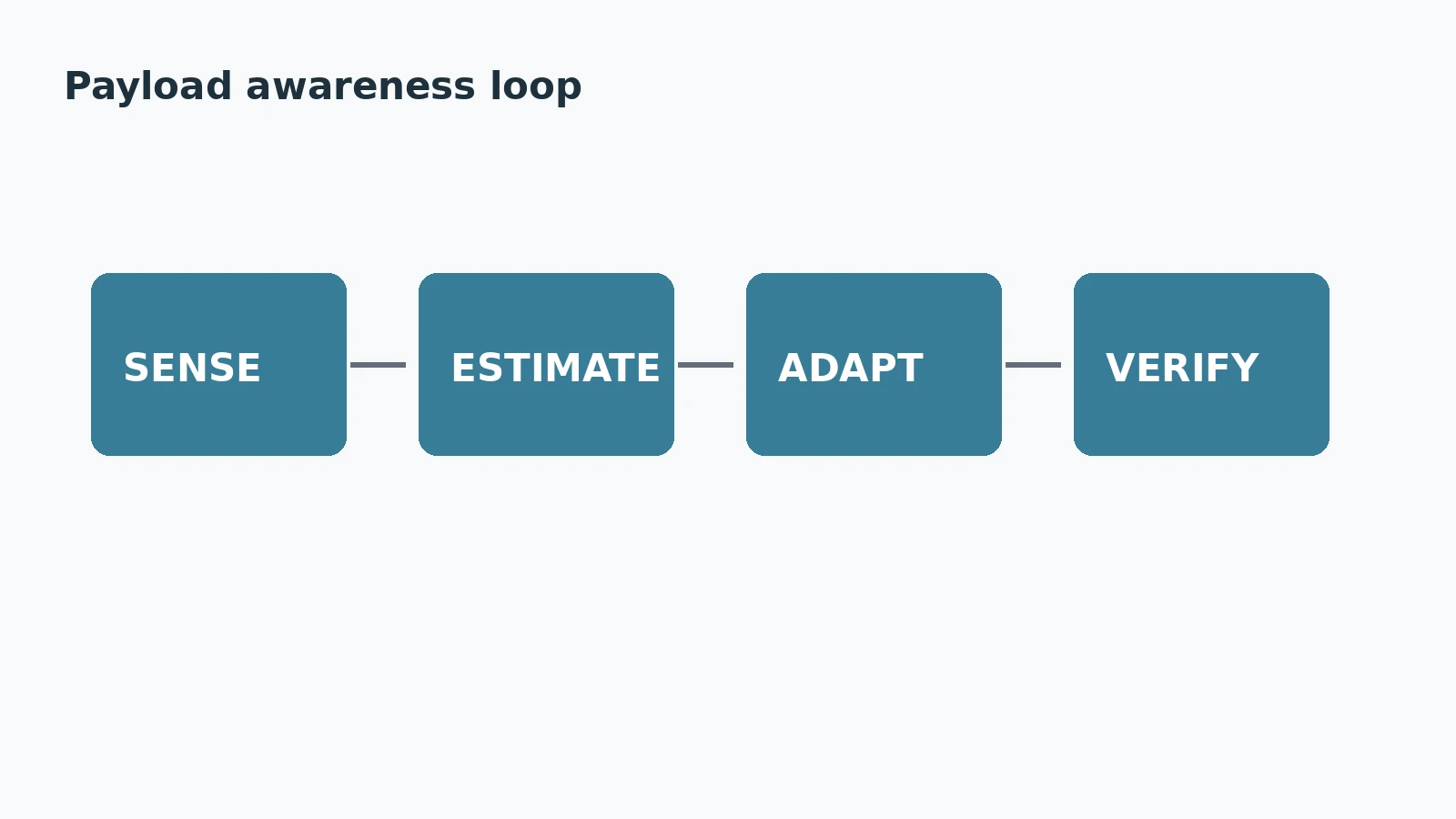
Payload awareness lets humanoids estimate mass, center of gravity and external forces so motion remains stable, efficient, responsive and safe.
The Robot Changes When It Picks Something Up
A humanoid is not the same dynamic system before and after grasping a box. The object adds mass, shifts the combined center of gravity, changes rotational inertia, consumes actuator torque and changes how much braking, balance and thermal margin remain. A payload specification cannot describe those changes because the same ten kilograms behave differently close to the torso, at arm's length, in one hand or shared between both hands. The architectural requirement is payload awareness: estimate the load that is physically present and propagate that estimate into planning, whole-body control, energy management and safety.
Payload Is More Than Mass
Mass sets gravity compensation, but center of gravity determines balance geometry, inertia determines acceleration and braking effort, and an external wrench captures forces and torques from an object, person or environment. The useful payload state also includes contact condition and remaining actuator margin.
The Load Can Be Estimated Online
Recent humanoid research shows that payload properties need not be known beforehand. Baek and colleagues estimate object mass, center of mass and inertia online during wheeled-humanoid manipulation, then update the robot equilibrium point from those estimates. [w4m-src-baek-object-parameter-2025] French research using TALOS likewise reports estimation of manipulated-object weight, center of mass and inertial parameters using torque sensing and artificial skin. [w4m-src-anr-skin-model-2026] The pattern is clear: identify the load, update the dynamic model, then adapt motion.
Forces Reveal What Vision Cannot
Vision can suggest what an object might weigh, but it cannot know whether a container is full, another person is supporting one side, or the object has snagged. Whole-body tactile research shows how distributed skin can identify contact regions and derive external wrenches for compliance, force regulation and collision avoidance. [w4m-src-armleder-tactile-wbc-2025] DLR's TORO combines torque sensing in most joints with foot force-torque sensors and inertial sensing for dynamic balance research. [w4m-src-dlr-toro-2025]
Observers Turn Motor Signals into Load Information
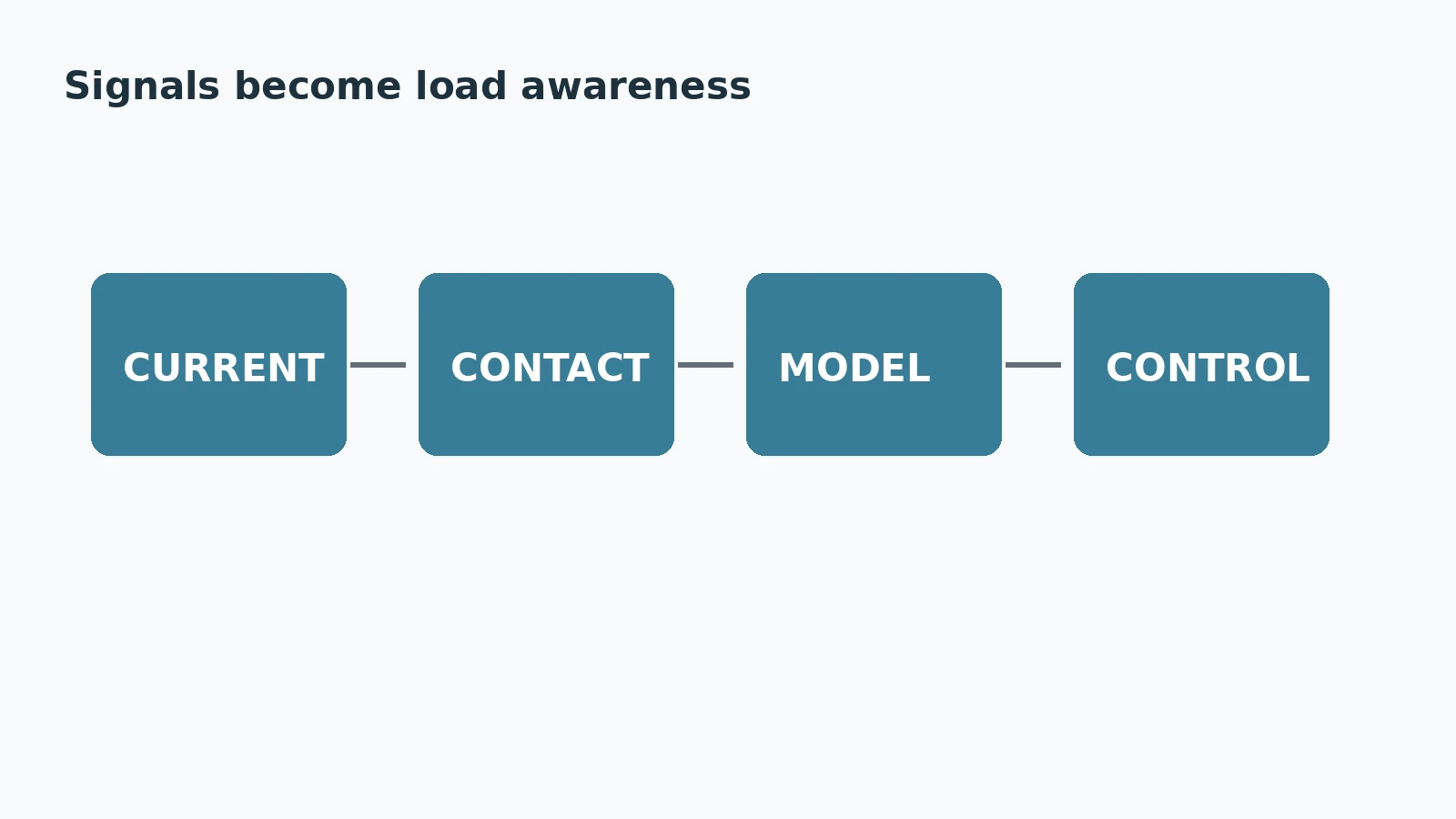
Dedicated force sensors add cost, volume and calibration. A complementary torque observer compares measured motion and motor behavior with the expected dynamic model. MOB-Net demonstrates humanoid external-joint-torque estimation from internal sensors for contact-wrench feedback, collision detection and reaction. [w4m-src-mobnet-2025] Accurate current, rotor-position and inertial measurements can therefore become virtual sensing channels for whole-body physical state.
Unknown Loads Consume Stability Margin
Whole-body control operates inside friction, contact, joint, torque and balance constraints. Unknown payloads make those constraints harder to respect. Experimental humanoid work explicitly tests unmodeled additional weights alongside friction, sensor noise and disturbances. [w4m-src-sovukluk-wbc-2025] The practical variable is not kilograms alone but remaining torque, current, thermal and power headroom. A load can be statically supportable yet leave insufficient margin for acceleration or controlled stopping.
The Semiconductor Signal Chain
Motor current is closely related to electromagnetic torque when motor constants and drive state are known. Current sensing therefore contributes to both field-oriented control and higher-level load inference. Position sensing adds motion context, inertial sensors describe base motion, force and tactile sensors add direct contact evidence, and real-time controllers fuse the signals. Infineon's humanoid portfolio spans controllers, gate drivers, power switches, current sensing, position feedback, diagnostics and communication. [w4m-src-ifx-humanoid-robots-2026] Its NVIDIA collaboration similarly positions PSOC Control, gate drivers and XENSIV current sensors for scalable humanoid motion. [w4m-src-ifx-precise-motion-2025]
Confidence Matters as Much as the Estimate
A robot should not treat every inferred payload value as equally trustworthy. Estimates need confidence, validity range and update logic. A stationary observation may estimate mass well but inertia poorly. A visual prior can initialize an estimator but should not override contradictory force evidence. When confidence is low, acceleration can be reduced, balance margin increased and exploratory motion constrained.
Design Rules
Estimate robot plus payload dynamics, not the robot alone. Fuse electrical and mechanical evidence. Track load location as well as mass. Propagate uncertainty into motion and safety. Manage actuator margin before saturation. Re-estimate after handover, regrasping or release. Treat unexpected load residuals as diagnostic evidence for payload change, collision, slipping contact or hardware degradation.
Conclusion
A useful humanoid cannot assume that its dynamics stop at its own skin. The moment it lifts, pushes, carries or shares an object, the external world becomes part of the controlled mechanical system. Research already demonstrates online inertial-property estimation, whole-body tactile wrench estimation and sensorless external-torque observers on humanoid platforms. [w4m-src-baek-object-parameter-2025][w4m-src-armleder-tactile-wbc-2025][w4m-src-mobnet-2025] The architectural goal is simple: the robot should know how the object in its hands changes what is physically possible.
References
- [w4m-src-baek-object-parameter-2025] Baek et al., Whole-Body Bilateral Teleoperation with Multi-Stage Object Parameter Estimation for Wheeled Humanoid Locomanipulation, 2025-08-13. https://arxiv.org/abs/2508.09846
- [w4m-src-armleder-tactile-wbc-2025] Armleder et al., Real-Time Control of a Humanoid Robot for Whole-Body Tactile Interaction, 2025-07-13. https://advanced.onlinelibrary.wiley.com/doi/full/10.1002/aisy.202500149
- [w4m-src-mobnet-2025] Lim et al., MOB-Net: Limb-modularized uncertainty torque learning of humanoids for sensorless external torque estimation, 2025. https://journals.sagepub.com/doi/10.1177/02783649241260428
- [w4m-src-sovukluk-wbc-2025] Sovukluk et al., Experimental Comparison of Whole-Body Control Formulations for Humanoid Robots in Task Acceleration and Task Force Spaces, 2025-07-24. https://arxiv.org/abs/2507.18502
- [w4m-src-anr-skin-model-2026] French National Research Agency, Skin and whole-body motion of large objects with torque and position controlled humanoid robots, 2026. https://anr.fr/Project-ANR-22-CE92-0029
- [w4m-src-ifx-humanoid-robots-2026] Infineon Technologies, Humanoid robots, 2026. https://www.infineon.com/applications/industrial/robotics/humanoid-robots
- [w4m-src-ifx-precise-motion-2025] Infineon Technologies, Infineon to enable humanoid robots with precise motion and efficiency powered by NVIDIA Technology, 2025-08-25. https://www.infineon.com/press-release/2025/INFXX202508-134
- [w4m-src-dlr-toro-2025] German Aerospace Center DLR, TORO, 2025. https://www.dlr.de/en/rm/research/robotic-systems/humanoids/toro
Glossary
- Actuator margin
- Remaining torque, current, thermal or power capability beyond the demand imposed by current motion and payload.
- Center of gravity
- Effective point through which gravitational force of a body or combined robot-load system acts for balance calculations.
- External wrench
- Combined force and torque applied to a robot body or contact frame by an object, person or environment.
- Payload awareness
- Continuous estimation of mass, center of gravity, inertia and external loading that alter a robot's dynamic behavior.
- Torque observer
- Estimator inferring joint or external torque from measured motion, motor signals and a dynamic model rather than direct sensing alone.
Sources
- Experimental Comparison of Whole-Body Control Formulations for Humanoid Robots in Task Acceleration and Task Force Spaces · 2025-07-24 · Sovukluk et al.
https://arxiv.org/abs/2507.18502 - Humanoid robots · 2026 · Infineon Technologies
https://www.infineon.com/applications/industrial/robotics/humanoid-robots - Infineon to enable humanoid robots with precise motion and efficiency powered by NVIDIA Technology · 2025-08-25 · Infineon Technologies
https://www.infineon.com/press-release/2025/INFXX202508-134 - MOB-Net: Limb-modularized uncertainty torque learning of humanoids for sensorless external torque estimation · 2025 · Lim et al.
https://journals.sagepub.com/doi/10.1177/02783649241260428 - Real-Time Control of a Humanoid Robot for Whole-Body Tactile Interaction · 2025 · Advanced Intelligent Systems
https://doi.org/10.1002/aisy.202500149 - Skin and whole-body motion of large objects with torque and position controlled humanoid robots · 2026 · French National Research Agency
https://anr.fr/Project-ANR-22-CE92-0029 - TORO · 2025 · German Aerospace Center DLR
https://www.dlr.de/en/rm/research/robotic-systems/humanoids/toro - Whole-Body Bilateral Teleoperation with Multi-Stage Object Parameter Estimation for Wheeled Humanoid Locomanipulation · 2025-08-13 · Baek et al.
https://arxiv.org/abs/2508.09846