DXresearch.eu · Robo Weekly
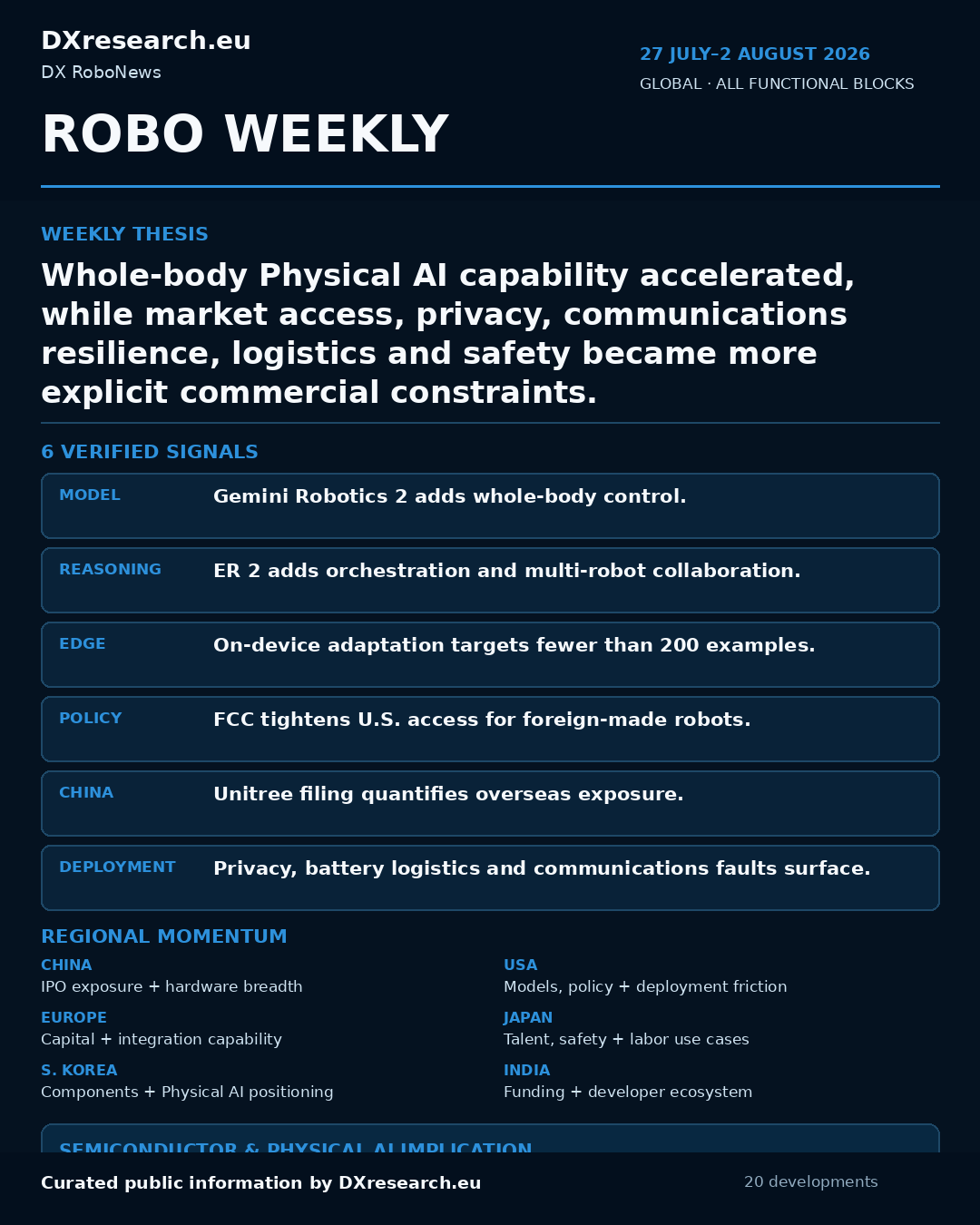
Capability Meets Constraint
Humanoid Robotics · Embodied AI · Physical AI
What’s Changed Since Last Week
Whole-body model capability advanced
Google DeepMind extended its robotics stack into whole-body control, multi-robot collaboration and faster on-device adaptation.
https://deepmind.google/blog/gemini-robotics-2-brings-whole-body-intelligence-to-robots/
U.S. market access tightened
The FCC added foreign-made advanced robots to its covered-list framework, creating a new barrier for future models.
Unitree quantified geopolitical exposure
Unitree’s IPO filing disclosed material overseas dependence and connected future U.S. certification risk to growth.
Public deployment governance slowed
A New York school district paused its planned humanoid pilot following privacy and stakeholder objections.
https://www.theguardian.com/us-news/2026/jul/27/new-york-school-humanoid-robot-plan-paused
Whole-body intelligence advances as policy and reliability become platform constraints
The week’s defining development was not a single robot launch but a convergence of software capability, policy intervention and deployment discipline. Google DeepMind moved its robotics stack into whole-body humanoid control, multi-robot coordination, safety-aware embodied reasoning and faster on-device adaptation. At the same time, the United States introduced a structural barrier for foreign-made advanced robots, converting geopolitical risk into a direct certification and market-access constraint. Unitree’s IPO disclosure showed why that matters commercially: overseas revenue is already material to leading Chinese suppliers. Capital continued to favor reusable robot intelligence, but the week also supplied reminders that deployment quality decides credibility. A school pilot was paused over privacy concerns, airlines tightened transport restrictions around large robot batteries, and a live humanoid demonstration reportedly entered a safety shutdown after a communication fault. The market therefore remains balanced. Physical AI models are becoming more capable, but dependable sensing, real-time control, secure connectivity, power management, fail-safe behavior and evidence-based governance still determine whether prototypes become durable infrastructure.
Impact to Infineon
The opportunity shifts toward dependable edge compute, motor control, power conversion, sensing, secure connectivity, functional safety and diagnostics that let increasingly capable models operate predictably in real machines.
Robo News Review
U.S. blocks new foreign-made advanced robots
Trump administration bans new Chinese humanoid robots, to protect US AI buildout
The FCC barred new foreign-made humanoid and quadruped platforms from equipment authorization, sharply increasing U.S. market-access risk.
Unitree IPO filing quantifies U.S. exposure
China's Unitree flags US sales risk ahead of Shanghai IPO
Unitree disclosed material overseas revenue and warned that new U.S. restrictions could constrain certification and sales of future models.
China threatens retaliation over robot restrictions
China warns of retaliation if US sticks with robot ban
China’s commerce ministry threatened retaliation if Washington maintained restrictions on new Chinese robots and connected power equipment.
Gemini Robotics 2 reaches whole-body control
Gemini Robotics 2 brings whole body intelligence to robots
Google DeepMind expanded its robotics model from upper-body tasks to coordinated locomotion, posture changes and manipulation across embodiments.
https://deepmind.google/blog/gemini-robotics-2-brings-whole-body-intelligence-to-robots/
Embodied reasoning becomes task orchestration
Introducing Gemini Robotics ER 2
ER 2 adds video understanding, multi-step planning, progress checking and higher-level orchestration above lower-level robot control.
Human-proximity behavior enters model evaluation
Introducing Gemini Robotics ER 2
DeepMind reported stronger safety-instruction and proximity behavior, including stopping a humanoid when a person approached its operating area.
On-device adaptation reduces cloud dependence
Gemini Robotics On-Device 2
The local model targets rapid adaptation to new robot bodies and objects using fewer than two hundred examples.
Multi-robot collaboration enters the model stack
Gemini Robotics 2
The updated model family supports multiple robots coordinating in shared spaces rather than treating each machine as an isolated agent.
Generalist AI seeks another valuation step-up
Robotics startup Generalist AI is in talks to raise a new funding round at a $3 billion valuation
Reported fundraising talks indicate investor appetite is concentrating around cross-embodiment robot foundation models and reusable intelligence platforms.
https://www.businessinsider.com/startup-generalist-ai-in-talks-to-raise-at-billion-valuation-2026-7
Live demo failure highlights communications resilience
Qualcomm-powered robot collapses spectacularly on stage during company's keynote
A humanoid demonstration reportedly entered a safety shutdown after a communication fault, spotlighting fail-safe behavior and integration quality.
School humanoid pilot pauses over privacy
New York school district halts plan to use humanoid robot amid backlash
A New York school district postponed a classroom humanoid deployment pending stakeholder engagement, privacy safeguards and governance clarity.
https://www.theguardian.com/us-news/2026/jul/27/new-york-school-humanoid-robot-plan-paused
Airlines tighten transport rules for humanoids
United and Delta Join Southwest in Banning 'Humanoid' Robots on Planes
Major airlines restricted transport of humanoid robots, highlighting logistics constraints created by large lithium-battery configurations.
https://people.com/united-and-delta-join-southwest-in-banning-humanoid-robots-on-planes-12031741
Booster T2 broadens China’s developer-platform market
Welcome, Booster T2!
Booster’s T2 targets universities and developers with a mid-sized biped platform for motion-control and task-learning research.
Soft biomimetic hands gain visibility
Welcome, Rochu Hand!
Rochu’s tendon-driven soft hand illustrates movement from rigid mechanisms toward compliant, humanlike manipulation architectures.
India’s Physical AI challenge reaches submission close
Build something real: Join the Arduino Physical AI Challenge India 2026!
A nationwide challenge connected students and makers with edge-AI hardware, Qualcomm mentorship and real-world Physical AI projects.
Indian Physical AI funding reaches new scale
Indian Physical AI attracts $155 Mn in 2026 as robotics, real-world data gain traction
Entrackr reported approximately $155 million across thirty-one Indian Physical AI deals during 2026, indicating broader investor participation.
Japan’s robotics foundation-model talent build continues
Research Scientist (VLAs) – AI Robot Association
AIRoA advertised work involving humanoid fleets, GPU infrastructure, tactile manipulation and large-scale evaluation for vision-language-action models.
https://www.tokyodev.com/companies/ai-robot-association/jobs/research-scientist-vlas
Japan’s airport use case remains a deployment reference
Japanese airport trials robot baggage handler
Coverage of Japan’s airport robot trial reinforced labor-shortage-driven interest in machines handling physically demanding baggage operations.
South Korea’s Physical AI agenda gains visibility
Seoul — Humanoids Summit
The Seoul agenda centers national strategy, actuators, hands, sensors and compute, reflecting Korea’s hardware-led Physical AI position.
Critical commentary challenges dexterity generalization
Quick Takes: Four Time Scales for Technology
Rodney Brooks argued that impressive manipulation demonstrations still fall short of robust generalization across ordinary tasks and environments.
Regional Synthesis
China
Unitree’s IPO disclosure made geopolitical exposure measurable, while developer platforms and compliant manipulation components showed continuing hardware breadth.
USA
Frontier model progress and policy intervention dominated. Privacy objections, transport restrictions and a communication-related demo failure exposed deployment friction.
Europe
Capital remained concentrated around reusable robot intelligence, while integration expertise continued to underpin industrial commercialization.
Japan
The week’s evidence centered on foundation-model talent, safety engineering and targeted labor-shortage use cases rather than volume production.
South Korea
No major commercial launch was verified. Korea’s signal remained structural: components, actuators, sensors, compute and Physical AI positioning.
India
Funding data and a national Physical AI challenge showed ecosystem expansion through capital, edge-AI hardware, education and developer participation.
Market Sentiment, Evidence and Outlook
Market sentiment: Balanced.
Reported actuals: the FCC action, Unitree’s IPO disclosure, model releases, the school pilot pause and published transport restrictions. Company claims or targets: model performance. Analyst estimates: funding and market data. DXresearch synthesis: reliable system engineering is becoming a larger differentiator as foundation-model capability converges.
| Year | Conservative | Base | Accelerated |
|---|---|---|---|
| 2025 | 18,000 | 30,000 | 45,000 |
| 2026 | 65,000 | 125,000 | 180,000 |
| 2027 | 115,000 | 240,000 | 380,000 |
| 2028 | 190,000 | 430,000 | 750,000 |
| 2029 | 300,000 | 720,000 | 1,350,000 |
| 2030 | 460,000 | 1,150,000 | 2,250,000 |
| 2031 | 680,000 | 1,750,000 | 3,500,000 |
| 2032 | 950,000 | 2,500,000 | 5,100,000 |
| 2033 | 1,300,000 | 3,450,000 | 7,100,000 |
| 2034 | 1,700,000 | 4,600,000 | 9,500,000 |
| 2035 | 2,150,000 | 5,900,000 | 12,300,000 |
| 2036 | 2,650,000 | 7,350,000 | 15,500,000 |
| 2037 | 3,200,000 | 8,900,000 | 19,200,000 |
| 2038 | 3,800,000 | 10,500,000 | 23,400,000 |
| 2039 | 4,500,000 | 12,200,000 | 28,100,000 |
| 2040 | 5,200,000 | 14,000,000 | 33,500,000 |
Methodology: Annual global units for humanoid and humanoid-like robots. Scenario analysis informed by public production plans, deployments, pilot-to-series conversion, price decline, policy and infrastructure constraints. These values are not reported shipment actuals.
Evidence change versus previous issue: No verified shipment or production disclosure justified revising the prior forecast curve. Model capability strengthened while market-access, privacy and deployment risks increased.
Weekly news infographic