Chapter 15
The Robot Has a Passport
When a Robot Must Prove What It Is
A humanoid entering a factory, hospital or warehouse can move mass, operate tools, observe people and accept software that changes its behaviour. Before an operator grants that machine network access or physical authority, the operator needs answers: which robot is this, which configuration is running, who is responsible, and what changed since approval?
A serial number is insufficient. The durable model is a device identity anchored in silicon and linked to measured software state, component history and lifecycle authority. The robot passport is therefore not a marketing profile. It is a controlled chain of evidence connecting physical origin, embedded keys, approved configuration, maintenance state and current authorization.
Trust Is Becoming a Lifecycle Obligation
The European Cyber Resilience Act makes lifecycle cybersecurity a market-access issue for products with digital elements Cyber Resilience Act. IEC 62443-4-1 similarly addresses secure development, verification, defect management, patching and end-of-life processes IEC 62443-4-1.
These frameworks do not prescribe one universal robot passport. They do, however, create pressure for manufacturers to provide auditable evidence that a connected machine was designed securely, can be updated, and can be identified when vulnerabilities emerge. CISA’s secure-by-design approach places the burden of protection increasingly on manufacturers rather than end users CISA Secure by Design.
The Trust Chain Starts in Silicon
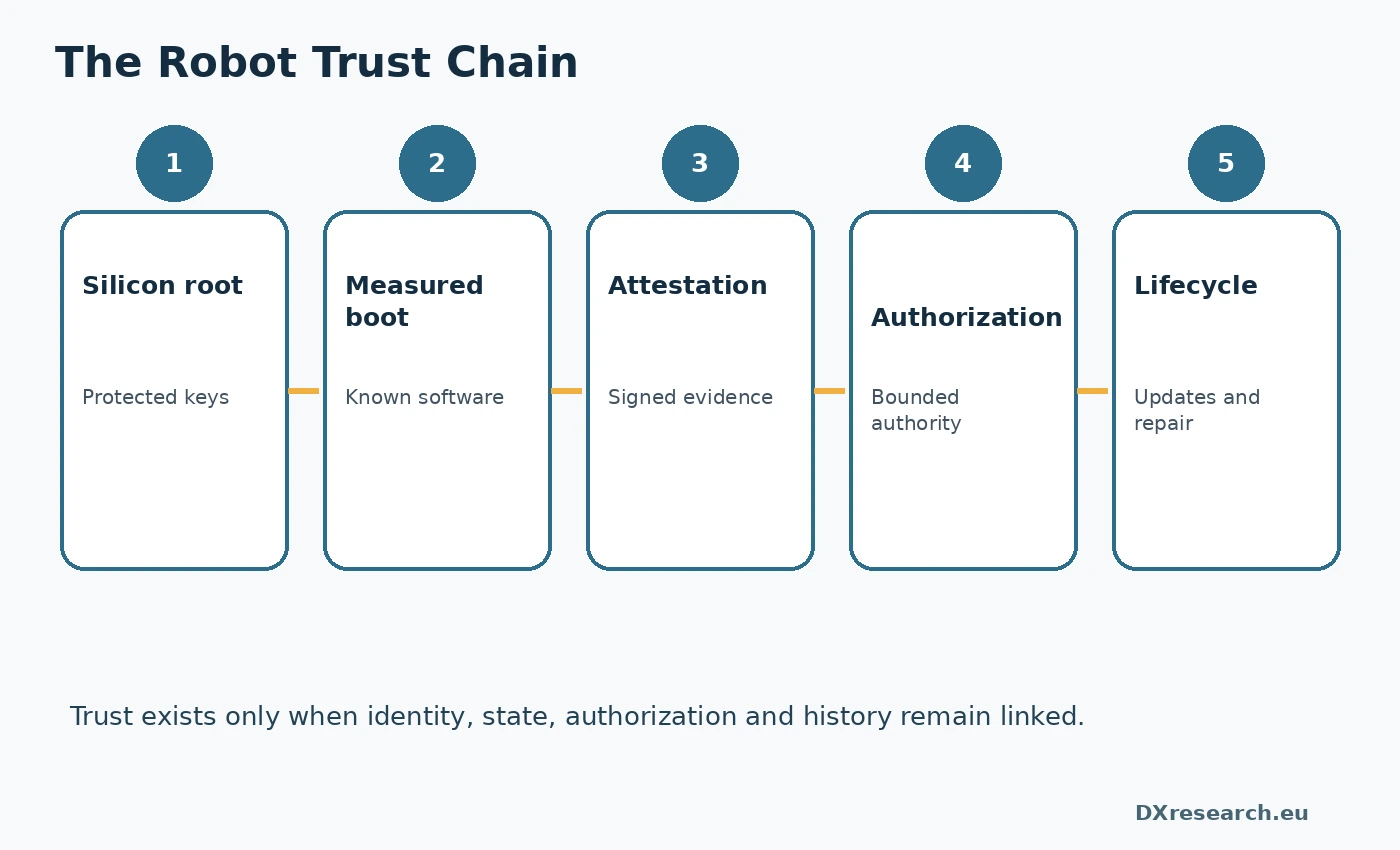
The first layer is a hardware root of trust. It may be a secure element, a Trusted Platform Module, a security island inside a microcontroller or a dedicated security controller. Its purpose is to protect private keys and critical operations from ordinary application software. TCG describes TPM-backed identity and attestation keys as a means to create durable device identity and report platform measurements TCG device identity guidance.
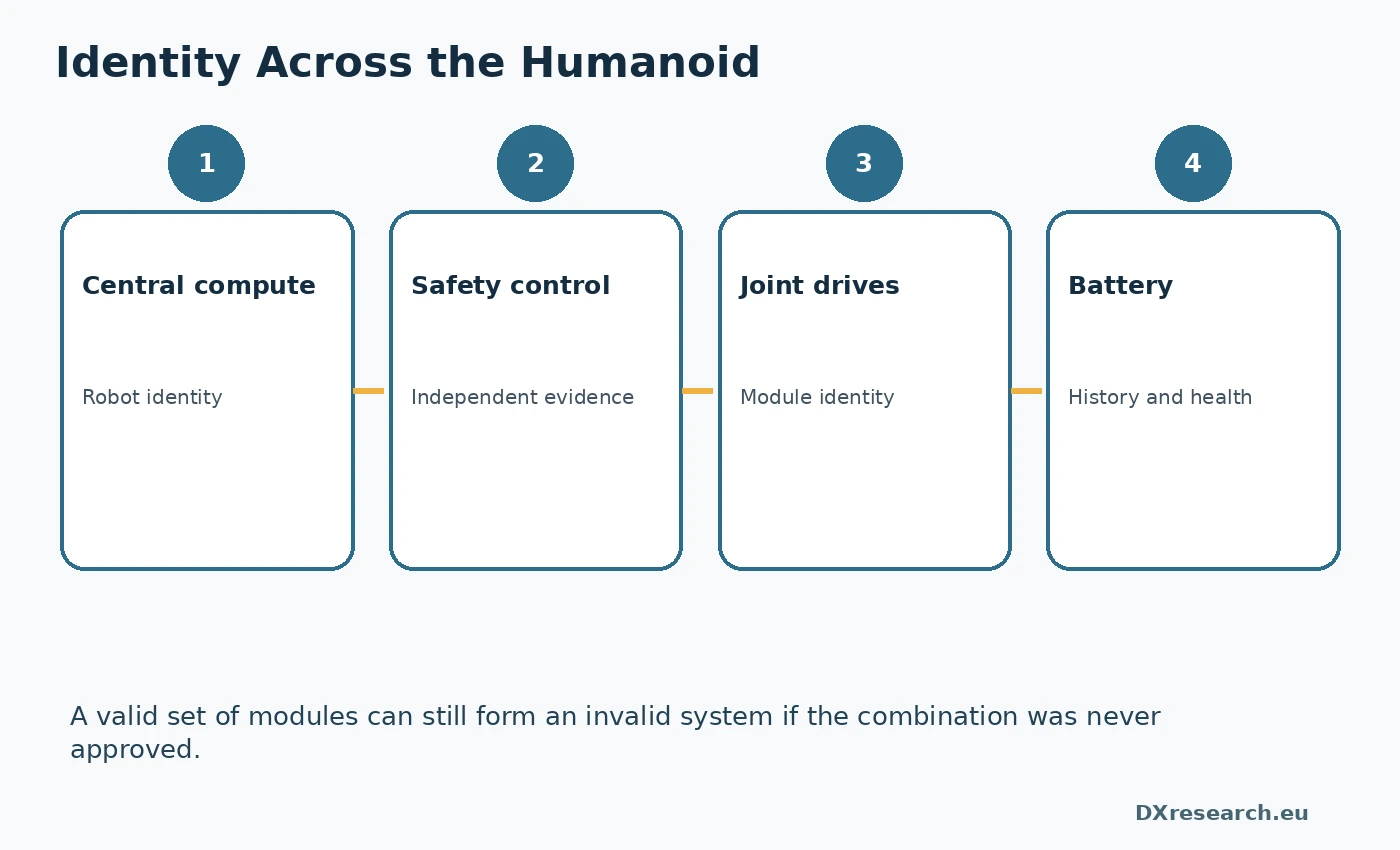
Secure boot verifies authorized software before execution. Measured boot records hashes of firmware, bootloaders, operating systems and selected configuration. A humanoid contains many processors, so the trust chain must span central compute, safety control, motor drives, battery systems and connectivity gateways.
Attestation Converts State into a Decision
Remote attestation lets a robot present signed evidence about identity and state to a verifier. RFC 9334 separates the attester, verifier and relying party, allowing evidence collection to remain distinct from policy IETF RATS architecture. The same configuration might be accepted inside a fenced pilot cell but rejected for close human collaboration.
Attestation should support bounded responses. Missing evidence may trigger quarantine, a restricted service network or a reduced-authority mode. It should not automatically cause an uncontrolled stop when a safe degraded mode remains possible.
Authorization, Updates and Repair
Authentication establishes what is present; authorization determines what it may do. A practical zero-trust architecture binds identity to task, location, tool and operational context. NIST’s trusted onboarding work shows how identity, credentials and lifecycle posture can be combined when devices join networks NIST trusted onboarding.
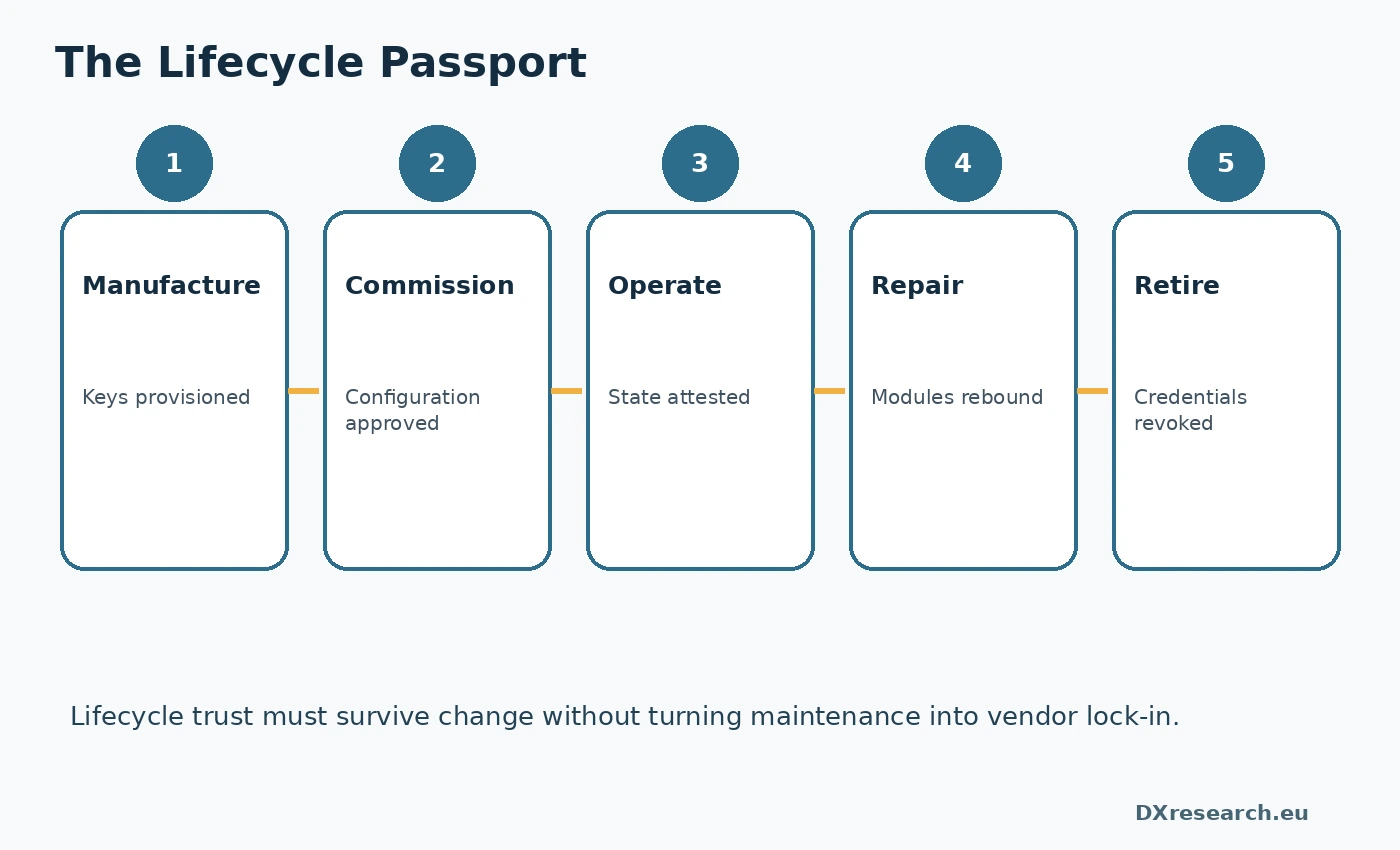
Updates are identity events because software-defined robots change after shipment. Each update should be authenticated, installed safely and followed by new measurements. An SBOM describes composition, while measured evidence indicates what is actually running. Repair should be handled as a signed configuration transition: the old module leaves, the replacement proves identity, calibration is recorded and the robot-level passport is updated.
Revocation and Ownership Transfer
Revocation is as important as credential issuance. Compromised service credentials, stolen robots, counterfeit modules and unsupported software versions must be removable from trust. A mature public key infrastructure supports renewal and revocation without manual fleet reconfiguration.
Ownership transfer raises governance questions. Manufacturers may issue device credentials, service partners may sign repairs and asset owners may control task authorization. No party necessarily owns the entire record. Interoperability will require common claim formats and APIs even when implementation details remain proprietary.
The Commercial Meaning of a Passport
Identity and lifecycle evidence will influence commissioning, cybersecurity approval, insurance, service contracts, residual value and secondary markets. The semiconductor implementation determines whether identity is durable, whether evidence can be trusted and whether ownership can change without rebuilding the security foundation.
A robot that can walk but cannot prove what it is remains difficult to authorize. A robot that can establish identity, state, authority and history can become infrastructure.
References
- Cyber Resilience Act, European Commission. https://digital-strategy.ec.europa.eu/en/policies/cyber-resilience-act
- Remote ATtestation procedureS Architecture, RFC 9334, IETF. https://datatracker.ietf.org/doc/rfc9334/
- TPM 2.0 Keys for Device Identity and Attestation, Trusted Computing Group. https://trustedcomputinggroup.org/resource/tpm-2-0-keys-for-device-identity-and-attestation/
- Trusted IoT Device Network-Layer Onboarding and Lifecycle Management, NIST NCCoE. https://www.nccoe.nist.gov/projects/trusted-iot-device-network-layer-onboarding-and-lifecycle-management
- IEC 62443-4-1 Secure Product Development Lifecycle, IEC. https://webstore.iec.ch/en/publication/33615
- Secure by Design, CISA. https://www.cisa.gov/resources-tools/resources/secure-by-design
- ETSI EN 303 645 Cyber Security for Consumer IoT, ETSI. https://www.etsi.org/deliver/etsi_en/303600_303699/303645/03.01.03_60/en_303645v030103p.pdf
- Secure by Design and Default Playbook, ENISA. https://www.enisa.europa.eu/publications/secure-by-design
Glossary
- Device identity
Cryptographically verifiable identity bound to a device.
- Measured boot
Recording cryptographic measurements of loaded components.
- Public key infrastructure
Systems and policies for certificates and keys.
- Remote attestation
Signed evidence about device identity or operating state.
- Revocation
Invalidation of a credential or authorization.
- Root of trust
A hardware- or firmware-protected foundation whose integrity is relied upon for security-critical operations such as identity, boot and attestation.
- Secure boot
A startup process that cryptographically verifies executable components before allowing them to run.
- Software bill of materials
Structured inventory of software components and dependencies.
- Trusted Platform Module
Standardized secure cryptoprocessor for protected keys and attestation.
- Zero trust
Continuous evaluation of identity, posture and context.
References
- Cyber Resilience Act. Source
- ETSI EN 303 645 Cyber Security for Consumer IoT. Source
- IEC 62443-4-1 Secure Product Development Lifecycle. Source
- Remote ATtestation procedureS Architecture, RFC 9334. Source
- Secure by Design. Source
- Secure by Design and Default Playbook. Source
- TPM 2.0 Keys for Device Identity and Attestation. Source
- Trusted IoT Device Network-Layer Onboarding and Lifecycle Management. Source