Chapter 16
The Memory Wall Has Legs
Compute Is Not the Same as Intelligence
Humanoid computing is often described through tera-operations per second. That number says little about whether cameras, force sensors, joint states, maps and model weights can reach the correct processor at the correct time. The practical bottleneck is increasingly the memory wall: arithmetic capacity grows faster than the robot’s ability to move and organize data.
A robot executes perception, localization, language, planning, whole-body control, diagnostics and safety concurrently. Each workload creates a working set with different latency and retention requirements. Whole-body intelligence therefore depends on memory architecture as much as accelerator throughput.
Why the Memory Wall Has Legs
In a data center, a bandwidth bottleneck reduces throughput. In a walking robot it can destabilize perception-to-action timing. A stale depth frame, delayed contact estimate or evicted control state can alter physical behaviour. Memory is part of the feedback loop.
NVIDIA documents memory-bandwidth monitoring and scaling on Jetson Thor Jetson Thor documentation. Its platform overview combines high AI throughput with a large LPDDR5X subsystem Jetson platform overview. These are vendor specifications, but they illustrate why physical-AI platforms are marketed through both compute and memory.
The Robot Data Path
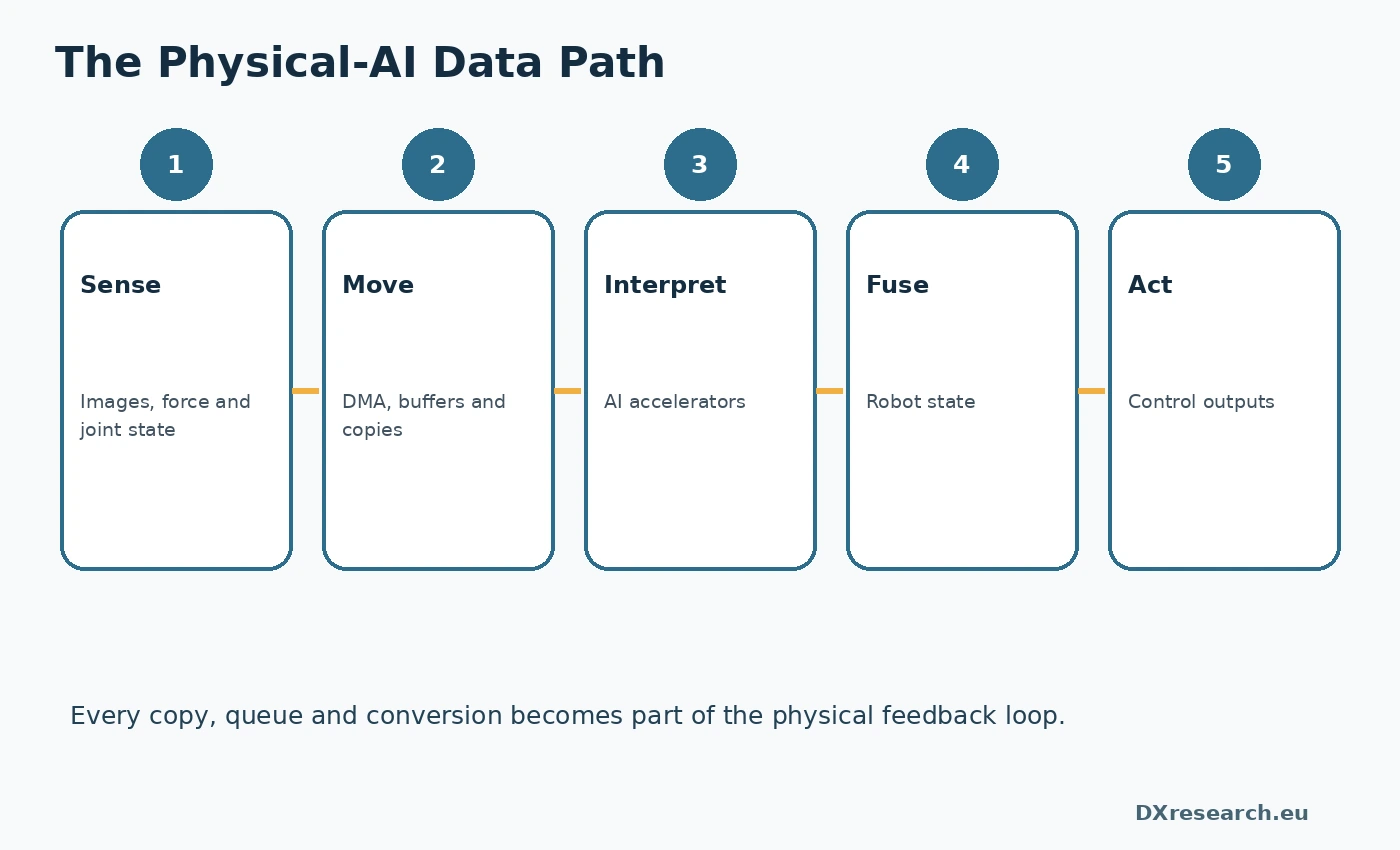
Data begins at sensors, crosses interfaces through direct memory access, enters buffers, is transformed by accelerators, fused into state estimates and consumed by planners and controllers. Every copy adds latency, energy and memory traffic.
Camera-over-Ethernet pipelines can use hardware-assisted zero-copy DMA into application-visible memory Camera-over-Ethernet overview. The lesson is not that all data should always be shared, but that copies must be intentional and measured.
Zero Copy Is a Contract
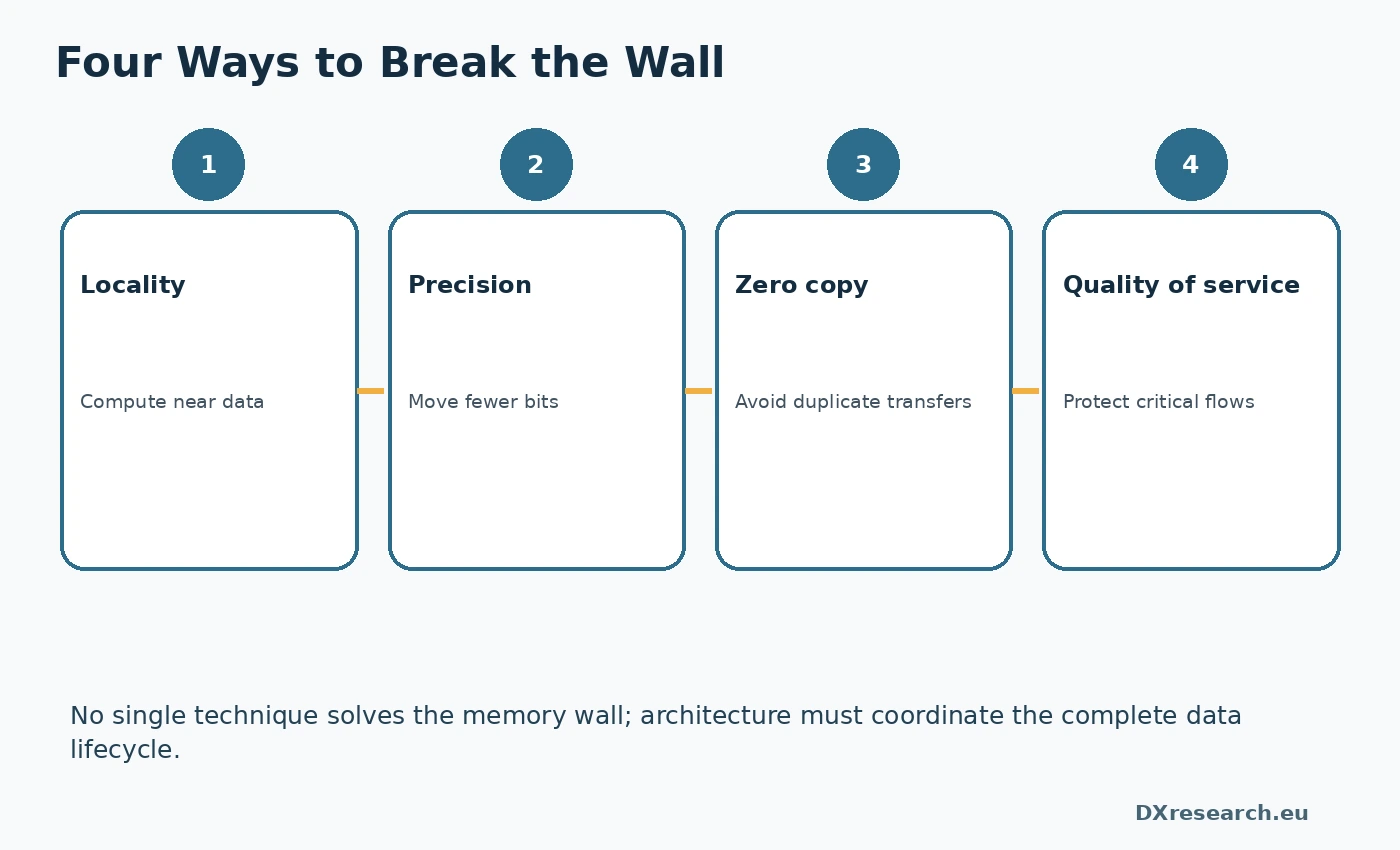
Zero-copy designs allow producers and consumers to work on the same storage or transfer ownership without replication. ROS 2 provides loaned message mechanisms associated with publishers ROS 2 LoanedMessage. Buffer backends also describe CUDA-oriented zero-copy paths ROS 2 buffer backends.
Zero copy is not automatically faster. Shared buffers require lifetime management, synchronization and cache coherence. The target is minimum end-to-end movement, not ideological elimination of every copy.
Locality Becomes Architecture
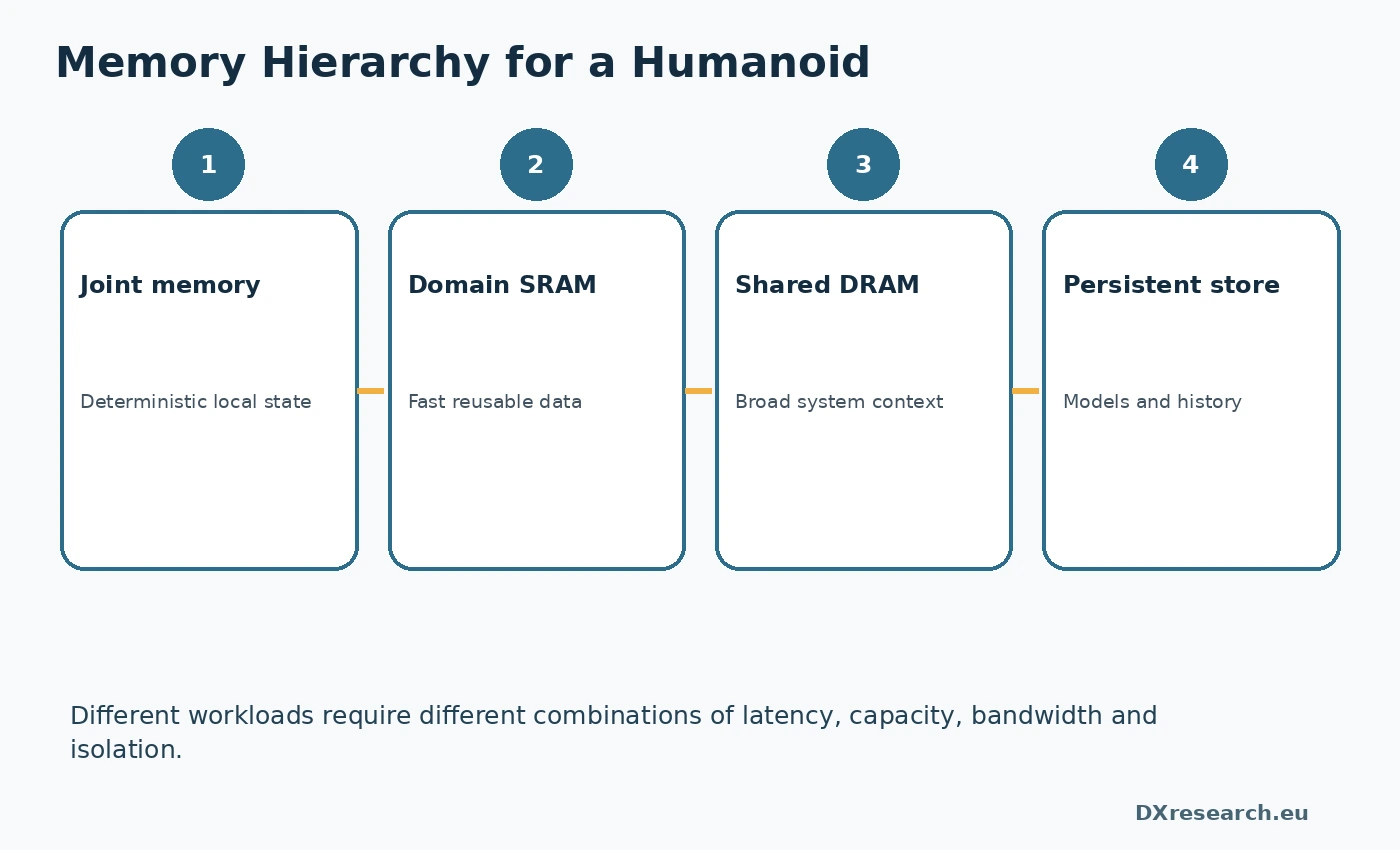
Data locality means placing computation close to data and retaining reusable information in the appropriate memory hierarchy. Joint controllers should not stream every inner-loop variable to central memory. Perception accelerators should reuse feature maps locally. Safety controllers need independent state when central AI is overloaded.
This creates a distributed architecture: edge preprocessing, domain aggregation and central models with broad context. The optimal partition balances traffic, latency, global coordination and software complexity.
Precision Is a Bandwidth Decision
Quantization reduces model size and traffic by using fewer bits. Arm’s FP8 work and NVIDIA’s lower-precision support illustrate the industry’s effort to increase effective throughput Arm FP8 overview Jetson Thor introduction. Compression and sparsity can likewise lower external-memory demand Arm NPU optimization.
Reduced precision is not free. Sensitive layers, calibration logic and safety-relevant estimators may require higher precision. Precision must therefore follow uncertainty and consequence.
Physical Coherence Before Shared Memory
A robot can share buffers efficiently and still misunderstand the world. Physical coherence requires aligned timestamps, coordinate frames, calibration versions and trusted source identity. Sensor fusion is meaningful only when samples describe approximately the same physical instant and geometry.
This is distinct from timing and synchronization. Timing explains when events occurred. Memory architecture determines whether corresponding data remains available, correctly versioned and economically accessible when computation needs it.
Measure Bytes, Not Only Operations
Architecture reviews should track bytes moved per frame, inference and control interval. Arithmetic intensity exposes workloads performing little computation per transferred byte. Tegrastats reports memory usage and bandwidth activity on Jetson systems NVIDIA tegrastats.
Useful metrics include copy count, cache-miss rate, buffer age, queue depth, memory energy, worst-case access latency and bandwidth consumed during degraded modes. They must be measured under concurrent workloads, not isolated benchmarks.
The Semiconductor Implication
Future humanoids need more than larger DRAM. They need memory controllers with quality of service, coherent interconnects, protected regions, deterministic DMA, local scratchpads, compression engines and observability. Microcontrollers require tightly coupled memory for control. AI accelerators need high-bandwidth reusable data. Safety domains require isolation from bandwidth starvation.
The winning architecture will maximize useful intelligence per joule and per byte moved. The memory wall has legs because, in Physical AI, data movement becomes motion.
References
- Jetson Thor Product Family, NVIDIA. https://docs.nvidia.com/jetson/archives/r38.4/DeveloperGuide/SD/PlatformPowerAndPerformance/JetsonThor.html
- NVIDIA Jetson Platform Overview, NVIDIA. https://docs.nvidia.com/learning/physical-ai/getting-started-with-isaac-sim/latest/leveraging-ros-2-and-hil-in-isaac-sim/02-nvidia-jetson-platform-overview.html
- Introducing NVIDIA Jetson Thor, NVIDIA. https://developer.nvidia.com/blog/introducing-nvidia-jetson-thor-the-ultimate-platform-for-physical-ai/
- LoanedMessage API, Open Robotics. https://docs.ros.org/en/humble/p/rclcpp/generated/classrclcpp_1_1LoanedMessage.html
- Using rosidl Buffer Backends, Open Robotics. https://docs.ros.org/en/lyrical/How-To-Guides/Using-Buffer-Backends.html
- Optimizing AI Workloads with Ethos NPUs, Arm. https://developer.arm.com/community/arm-community-blogs/b/ai-blog/posts/optimizing-ai-workloads-with-ethos-npus
- Arm Supports FP8, Arm. https://developer.arm.com/community/arm-community-blogs/b/announcements/posts/arm-supports-fp8-a-new-8-bit-floating-point-interchange-format-for-neural-network-processing
- Tegrastats Utility, NVIDIA. https://docs.nvidia.com/jetson/archives/r36.5/DeveloperGuide/AT/JetsonLinuxDevelopmentTools/TegrastatsUtility.html
- Camera-over-Ethernet Solution Overview, NVIDIA. https://docs.nvidia.com/jetson/archives/r38.4/DeveloperGuide/SD/CameraDevelopment/CoECameraDevelopment/SIPL-for-L4T/CoE-Solution-Overview.html
Glossary
- Arithmetic intensity
Computation performed per byte transferred.
- Cache coherence
Mechanisms ensuring consistent shared cached data.
- Data locality
Placement and reuse of data near the processor that consumes it.
- Direct memory access
Hardware data transfer without continuous CPU intervention.
- Loaned message
Middleware message using publisher-provided storage.
- Memory bandwidth
Rate at which data moves between memory and processing elements.
- Memory hierarchy
Storage levels balancing latency, capacity and energy.
- Memory wall
Performance limit caused by data access failing to keep pace with computation.
- Physical coherence
Consistency of time, coordinates, calibration and identity across robot data.
- Quantization
Reduced-precision representation of model values.
- Sensor fusion
Combination of multiple sensor streams to estimate physical state more robustly than any single modality.
- Working set
Data actively required by a workload.
- Zero-copy
Exchange avoiding redundant memory copies.
References
- Arm Supports FP8. Source
- Camera-over-Ethernet Solution Overview. Source
- Introducing NVIDIA Jetson Thor. Source
- Jetson Thor Product Family. Source
- LoanedMessage API. Source
- NVIDIA Jetson Platform Overview. Source
- Optimizing AI Workloads with Ethos NPUs. Source
- Tegrastats Utility. Source
- Using rosidl Buffer Backends. Source