System Architecture and Energy Efficiency
Chapter 1
The Invisible Constraint: Why Thermal Management, Not Battery Capacity, Will Define the Humanoid Robot Revolution
For much of the public discussion surrounding humanoid robots, battery capacity has become the dominant performance metric. Headlines compare operating hours, charging times, battery chemistry, and battery swapping concepts as though these alone determine commercial success. It is an understandable perspective. Batteries are tangible, easy to compare, and familiar from smartphones and electric vehicles.
Yet experienced engineers recognize that this perspective tells only part of the story. A battery stores energy. It does not determine how efficiently that energy becomes useful mechanical work.
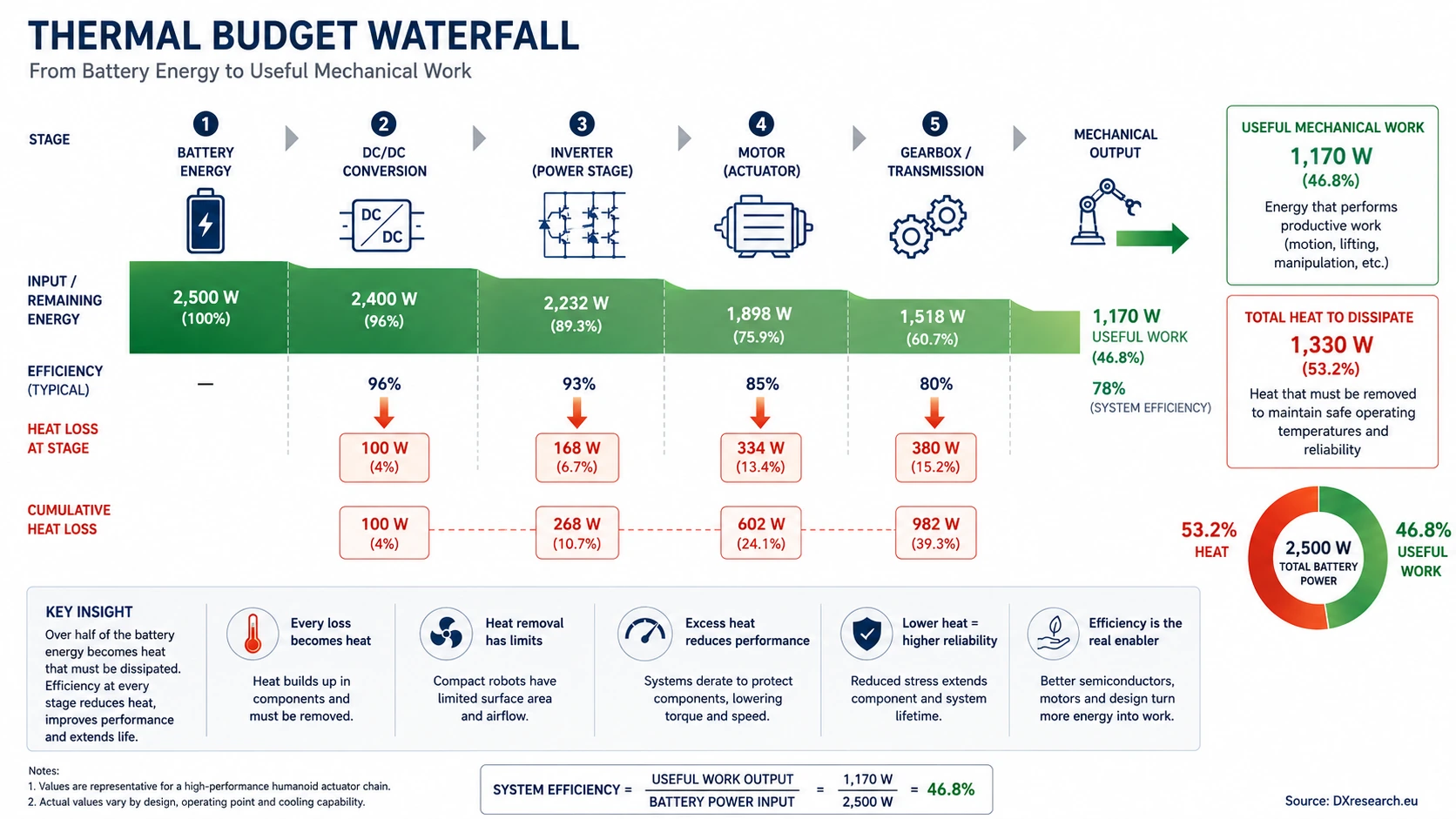
Every watt consumed by a humanoid robot ultimately has only two possible destinations. It either performs useful work—moving an actuator, processing sensor information, communicating with another system—or it becomes heat. That heat must then be transported, dissipated and managed within an exceptionally compact machine that closely resembles the size and proportions of the human body.
The implication is profound. Commercially successful humanoid robots will not necessarily be those carrying the largest batteries. They will be the robots that convert stored electrical energy into useful work with the highest overall system efficiency while maintaining acceptable operating temperatures throughout continuous industrial use.
This chapter argues that thermal management—not battery capacity—is emerging as one of the defining engineering constraints of humanoid robotics. More importantly, it argues that semiconductor technology has become one of the primary enablers for overcoming this constraint.
The discussion builds upon the previous chapter, which established that energy efficiency is an architectural enabler rather than merely a mechanism for extending battery runtime. Here we extend that argument one level deeper. Energy efficiency matters because every electrical loss becomes thermal load. Thermal load determines mechanical architecture, reliability, maintenance requirements and ultimately the total cost of ownership.
This systems perspective represents a significant shift in engineering thinking. Instead of asking, “How can we store more energy?”, future humanoid designers increasingly need to ask, “How can we avoid wasting it?”
The Battery Is Not the First Limit
The automotive industry has already experienced this transition. High-performance electric vehicles frequently reduce power output despite having considerable battery capacity remaining. Drivers may notice reduced acceleration during repeated launches or sustained high-speed driving. This behaviour is not caused by insufficient stored energy. Instead, electronic control systems intentionally limit performance once motors, inverters or batteries approach thermal operating limits to protect long-term reliability.
Humanoid robots operate under similar physical principles, but with considerably tighter design constraints. Imagine an industrial humanoid assigned to unload containers over an eight-hour warehouse shift. During the first hours, the robot repeatedly lifts, walks, twists and manipulates packages weighing between ten and twenty kilograms. Internal diagnostics indicate that forty percent of battery capacity remains available. Nevertheless, joint torque gradually decreases. Motion becomes slower and more deliberate. The robot remains operational, but productivity declines.
The battery is not empty. The robot has exhausted its thermal budget. This scenario is not hypothetical. It reflects a fundamental consequence of physics. Every electrical conversion introduces losses. Every loss becomes heat. If that heat cannot be removed at the same rate it is generated, temperatures rise until protective derating becomes unavoidable.
As the Fraunhofer Institute for Manufacturing Engineering and Automation (IPA) notes in its analysis of the humanoid hardware value chain, scalable industrial deployment depends not only on advances in artificial intelligence but equally on robust, manufacturable and reliable hardware architectures capable of sustained operation (Reference 02 – Humanoid Hardware Value Chain).
The consequence for humanoid robotics is clear. Continuous performance is increasingly determined by thermal engineering rather than battery chemistry alone.
Understanding the Thermal Budget
The concept of a thermal budget is familiar in aerospace, high-performance computing and automotive engineering. Every system has a maximum amount of heat that can be safely generated while maintaining reliable operation. Once this limit is exceeded, performance must be reduced or additional cooling must be introduced.
Humanoid robots are no exception. Unlike industrial robotic arms bolted to factory floors, humanoids operate inside compact, enclosed limbs with very limited space for airflow or large heat exchangers. Their architecture must remain lightweight, anthropomorphic and energy efficient. Every additional gram of cooling hardware reduces payload capacity or operating time. Every fan consumes electrical power. Every pump introduces another component that can fail.
Consequently, thermal management is no longer an isolated subsystem. It becomes an architectural constraint influencing almost every engineering discipline.
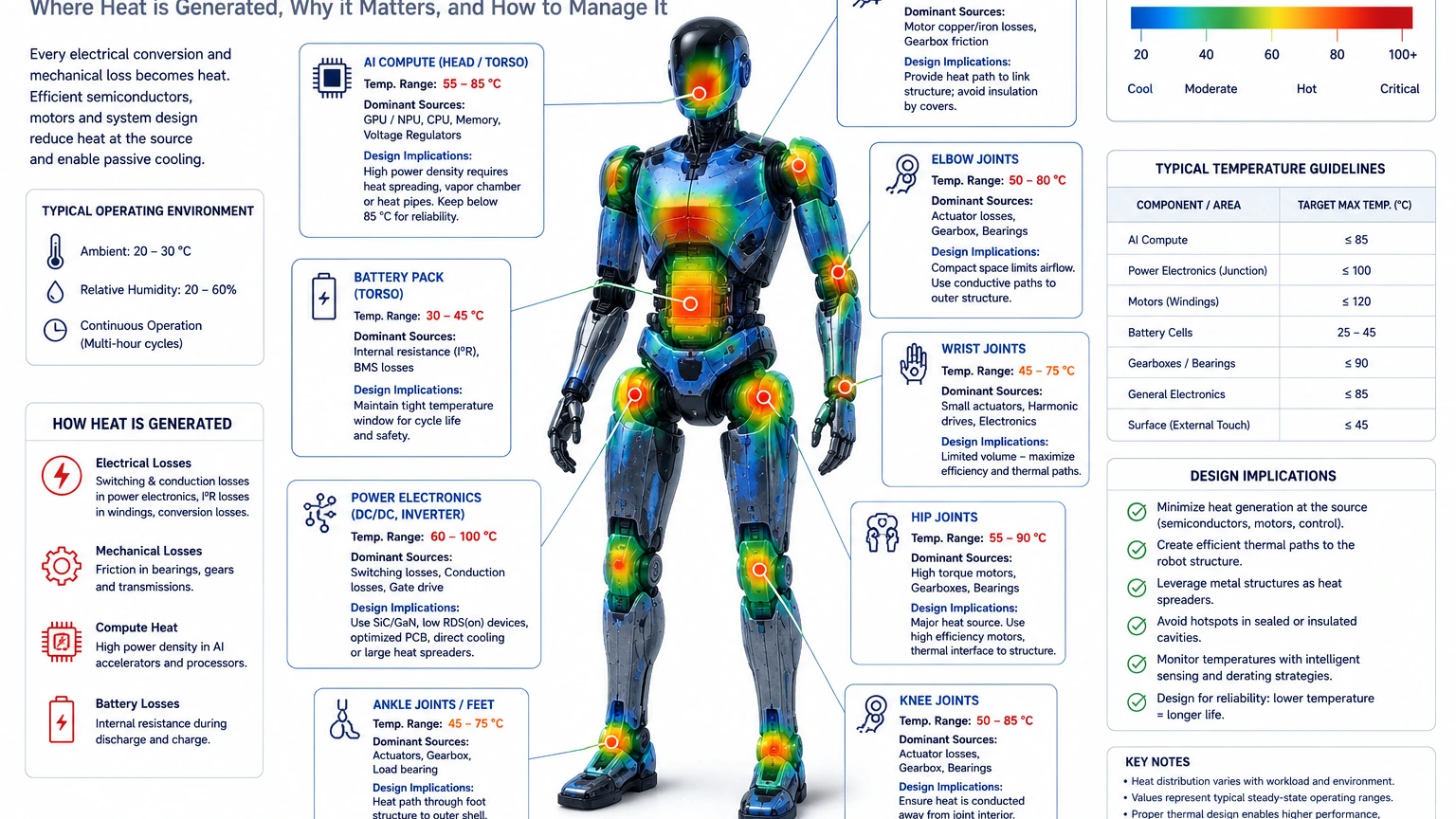
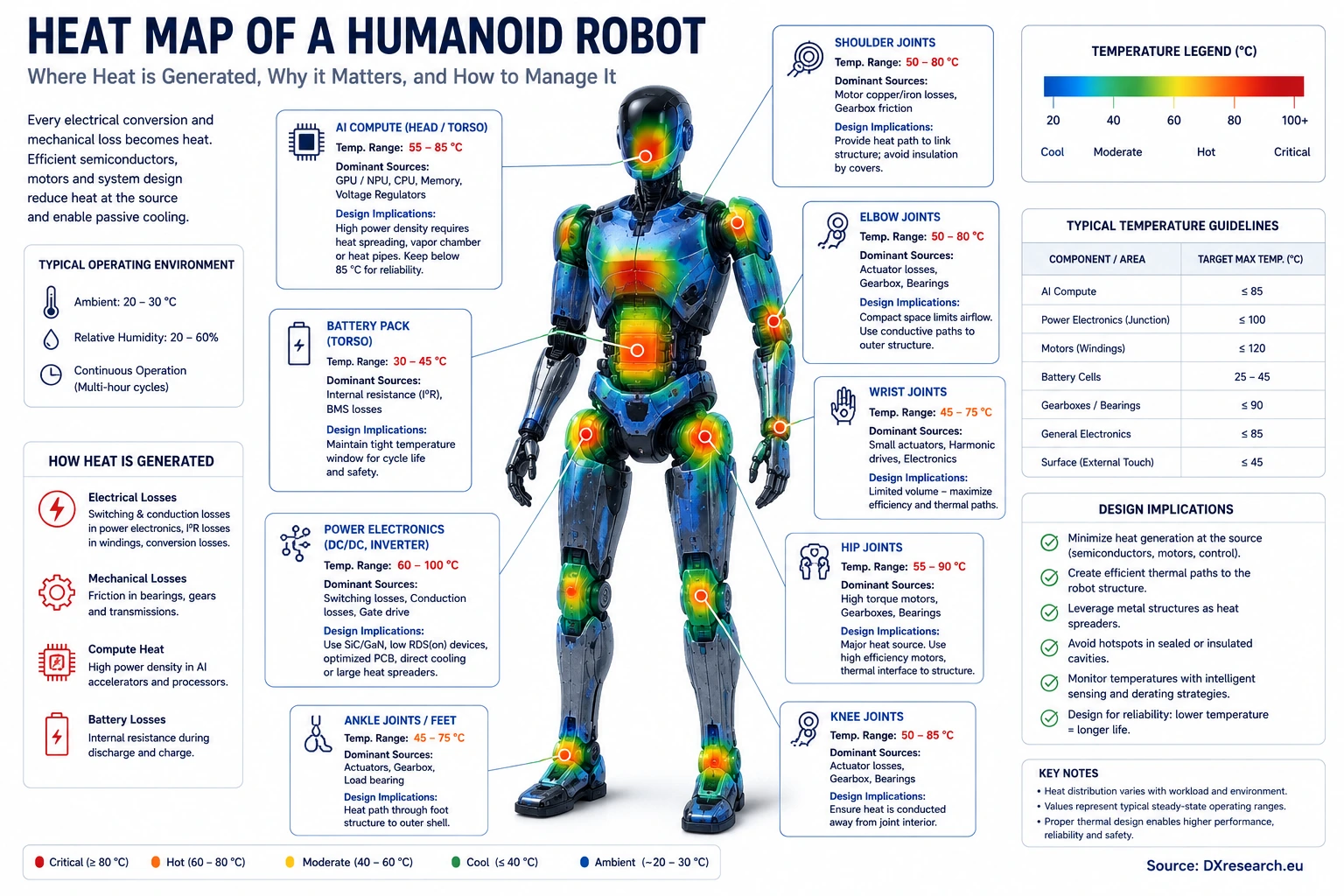
Table 1 illustrates the principal sources of heat generation within a modern humanoid robot.
| Subsystem | Primary Heat Source | Relative Contribution | Engineering Challenge |
|---|---|---|---|
| Joint Motors | Copper and iron losses | Very High | Continuous torque limitation |
| Power Inverters | Switching and conduction losses | High | Junction temperature management |
| AI Compute | GPU, CPU and NPU power density | High | Localized hot spots |
| DC/DC Converters | Conversion efficiency | Medium | Distributed heating |
| Battery System | Internal resistance | Medium | Lifetime and charging performance |
| Gearboxes | Friction | Medium | Mechanical efficiency |
| Communications | Electronics | Low | Generally non-limiting |
Although individual losses appear modest, their combined effect determines the operating envelope of the complete robot.
This observation leads to an important engineering principle: Every watt that never becomes heat is more valuable than a watt removed later through cooling.
That statement appears deceptively simple, yet it fundamentally changes system optimisation.
The Semiconductor Multiplier
Historically, semiconductor efficiency improvements were often evaluated locally. Engineers compared inverter efficiencies, converter losses or processor power consumption as isolated component specifications.
Humanoid robotics demands a broader perspective. Consider a representative actuator delivering approximately 2.5 kW of peak electrical power. A power stage operating at 97% efficiency dissipates approximately 75 W as heat.
An equivalent design operating at 99% efficiency dissipates roughly 25 W. The numerical difference appears insignificant. Only two percentage points. However, the architectural consequences are anything but small.
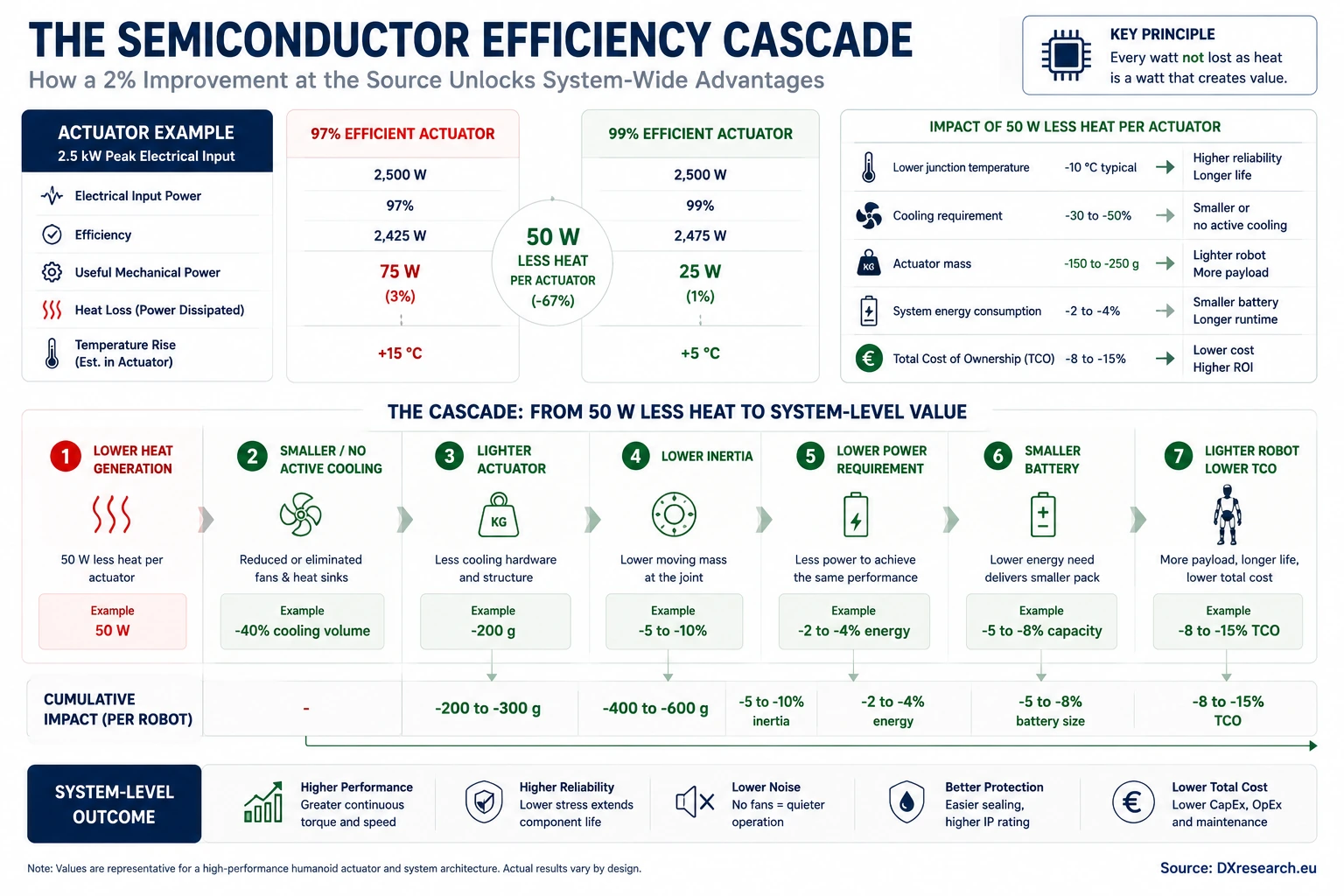
Fifty watts less heat inside a single actuator can reduce cooling requirements sufficiently to eliminate a fan, shrink the heat spreader, reduce actuator dimensions and decrease total actuator mass. A lighter actuator reduces arm inertia. Lower inertia requires lower motor torque. Reduced torque lowers current demand, enabling smaller conductors, lighter harnesses and potentially a smaller battery.
The optimisation compounds throughout the robot. What begins as a seemingly minor semiconductor improvement ultimately influences mechanical design, payload capacity, operating noise, maintenance intervals and manufacturing cost.
This phenomenon can be described as the Semiconductor Multiplier Effect. Rather than improving only electrical efficiency, advanced semiconductor technologies enable an entirely different class of robot architecture.
This systems-level perspective is increasingly recognised across the robotics industry. NVIDIA’s collaborations with industrial robotics partners, including semiconductor suppliers, emphasise integrated optimisation across AI computing, motion control, sensing, power electronics and digital twins rather than isolated component improvements (Reference 03 – NVIDIA Robotics Platform Announcements).
For semiconductor manufacturers, including Infineon, this shift is strategically important. Competitive differentiation no longer depends solely on producing lower-loss devices. It increasingly depends on enabling complete architectures that deliver superior thermal behaviour, reliability and system economics.
Passive Cooling: An Engineering Ideal
For decades, engineering practice has often followed a predictable sequence. As electronic power increased, designers added larger heat sinks. When heat sinks became insufficient, they introduced fans. When fans became inadequate, liquid cooling followed.
Humanoid robots challenge this progression. Every cooling component introduces additional complexity, weight, power consumption, acoustic noise and maintenance requirements. Passive cooling therefore represents more than a thermal solution.
It represents an architectural objective.
A passively cooled humanoid offers compelling advantages:
- No moving cooling components
- Reduced acoustic emissions
- Improved ingress protection
- Lower maintenance requirements
- Higher long-term reliability
- Lower parasitic energy consumption
- Simplified manufacturing
Passive cooling cannot be achieved through mechanical design alone. It begins by reducing heat generation at the source.
Efficient wide-bandgap power semiconductors, high-performance motor-control microcontrollers, intelligent gate drivers, precise current sensing and efficient power-management integrated circuits all contribute to lowering the thermal load before cooling solutions become necessary.
In other words, passive cooling is not merely enabled by better heat sinks. It is enabled by better semiconductors. This distinction will become increasingly important as humanoid robots evolve from low-volume demonstrators into high-volume industrial products competing on reliability and total cost of ownership.
From One Robot to Thousands: Thermal Management as a Fleet Economics Problem
The importance of thermal management becomes even more apparent when a humanoid robot is no longer evaluated as an individual machine but as one member of an industrial fleet.
A manufacturer deploying ten robots certainly values reliability. A logistics company operating one thousand robots depends upon it. Once fleets scale, every engineering decision is multiplied thousands of times across millions of operating hours. What appears to be a minor efficiency improvement inside one actuator becomes a measurable business advantage across an entire deployment.
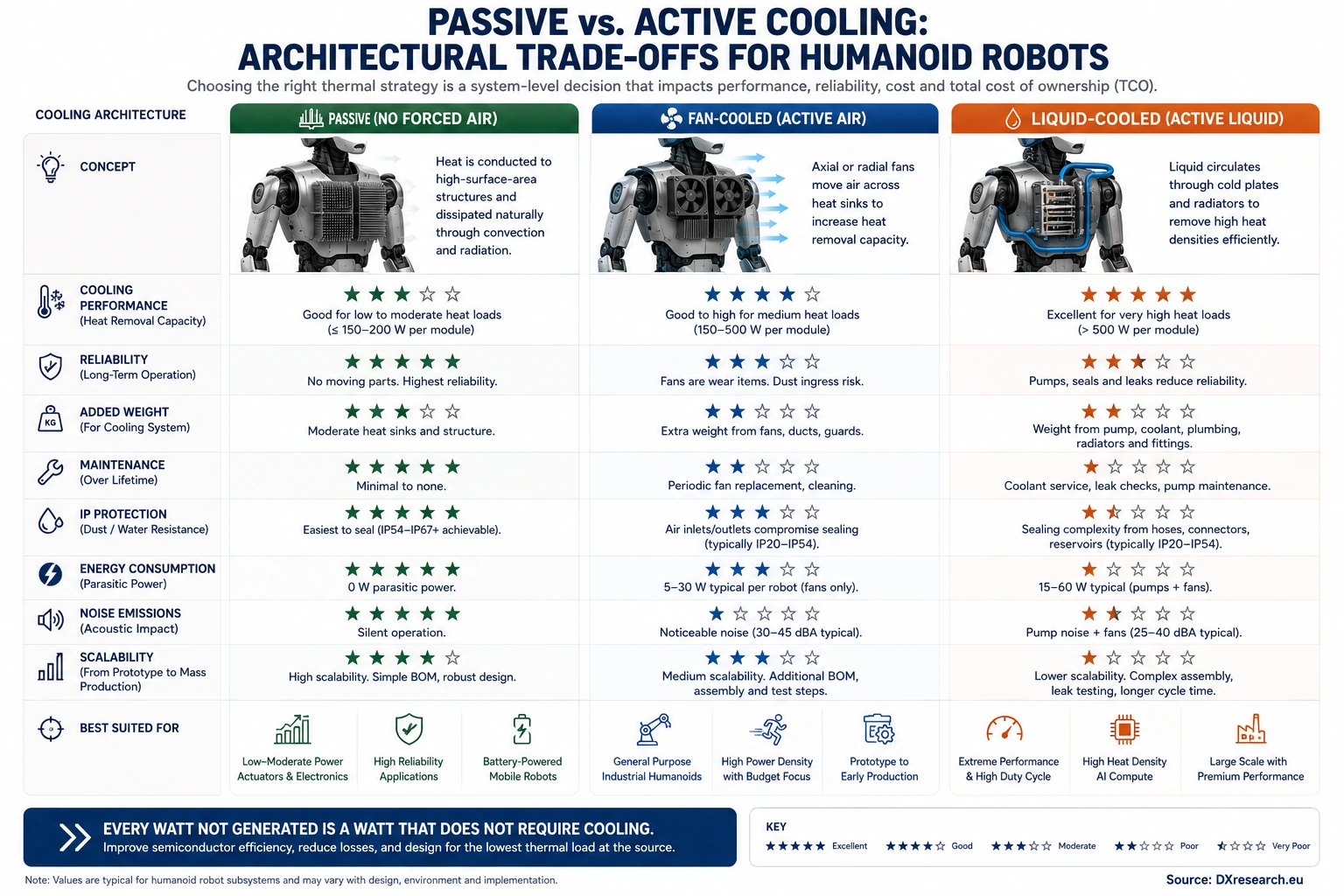
Consider two otherwise identical humanoid platforms. The first relies on multiple cooling fans distributed throughout its torso and actuators. The second achieves the same continuous performance using passive cooling enabled through highly efficient power electronics, motor control and optimized mechanical design.
Initially, both robots may appear equally capable. After several years of industrial operation, however, their ownership costs begin to diverge. The actively cooled platform requires periodic fan replacement, filter maintenance and additional inspection intervals. Dust accumulation gradually reduces cooling effectiveness, increasing operating temperatures and accelerating component ageing. Fans consume electrical power continuously, reducing overall system efficiency while introducing acoustic noise that may limit deployment in healthcare, hospitality or office environments.
The passively cooled platform avoids these penalties entirely. No fan bearings wear out. No air filters become clogged. No airflow paths compromise ingress protection. No additional electrical power is consumed simply to remove waste heat.
What initially appeared to be a thermal design decision becomes a maintenance strategy. It also becomes a manufacturing strategy. It becomes an operational strategy. Ultimately, it becomes a business strategy.
As McKinsey & Company observes in its analysis of emerging humanoid supply chains, long-term commercial competitiveness depends not only on advances in artificial intelligence but equally on scalable, reliable hardware capable of industrial production and economical lifecycle operation (Reference 04 – Turning Humanoid Supply Chain Constraints into Billion-Dollar Wins).
Thermal management therefore affects virtually every component of Total Cost of Ownership (TCO).
| Fleet Metric | Thermal Influence | Business Outcome |
|---|---|---|
| Continuous availability | Reduced thermal derating | Higher productivity |
| Maintenance intervals | Fewer cooling components | Lower service cost |
| Component lifetime | Lower junction temperatures | Reduced replacement rate |
| Battery ageing | Lower operating temperature | Longer battery life |
| Energy consumption | Lower conversion losses | Reduced electricity cost |
| Robot reliability | Reduced thermal cycling | Higher Mean Time Between Failures (MTBF) |
| Manufacturing complexity | Simpler cooling architecture | Lower production cost |
For fleet operators, these metrics matter far more than isolated component specifications. Robots are purchased to perform work consistently over years of operation. A robot capable of maintaining full productivity throughout an entire shift delivers significantly greater economic value than one requiring frequent thermal derating, even if both possess identical battery capacities.
This is where semiconductor engineering moves beyond electronics and becomes a driver of business performance.
The Architectural Perspective
Throughout this book, a recurring theme has emerged. Humanoid robotics should not be viewed as a collection of independent subsystems. Instead, it should be understood as a tightly coupled system in which improvements in one engineering discipline propagate throughout the entire architecture.
Thermal management provides perhaps the clearest example of this systems thinking. Improving semiconductor efficiency does far more than reduce electrical losses. It enables:
- smaller actuators
- lower structural mass
- simplified cooling systems
- quieter operation
- higher ingress protection
- longer component lifetime
- improved reliability
- lower maintenance
- reduced operating cost
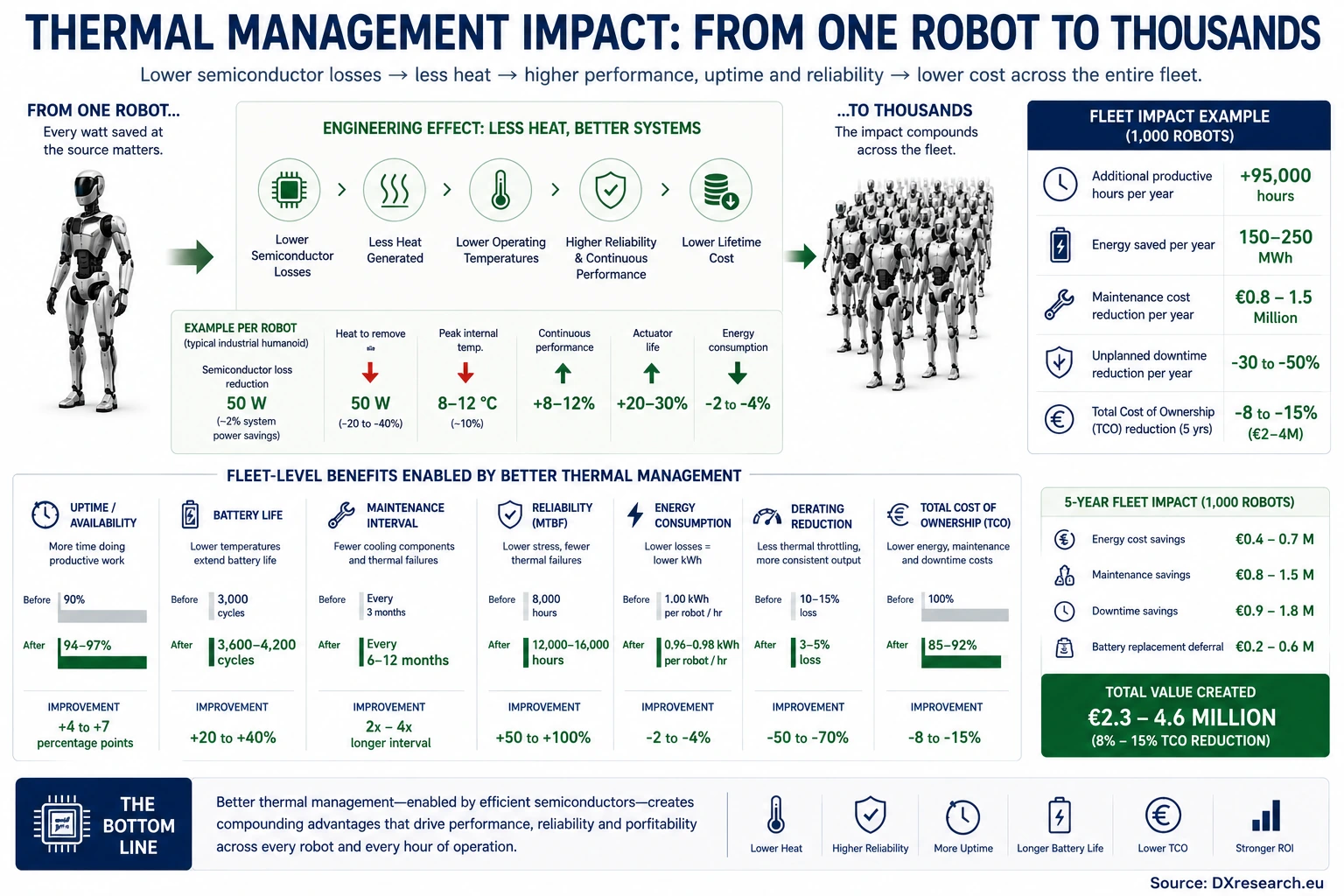
Each improvement amplifies the next. The result is a compounding engineering advantage rather than a single isolated optimisation. This observation has important implications for semiconductor suppliers. Historically, semiconductor value has often been communicated using conventional electrical parameters such as RDS(on), switching frequency, current capability or efficiency curves.
While these remain technically essential, they do not fully describe the system-level value created inside a humanoid robot.
The more relevant discussion increasingly becomes: “How does this semiconductor enable a fundamentally better robot?” From this perspective, semiconductor innovation is no longer confined to the electrical domain.
It shapes mechanical architecture. It shapes industrial design. It shapes reliability engineering. It shapes fleet economics. This is particularly relevant for companies such as Infineon, whose portfolio spans power semiconductors, microcontrollers, sensors, functional safety, connectivity and power management. Individually, each technology improves subsystem performance. Collectively, they enable highly integrated robot architectures capable of delivering higher efficiency, lower thermal load and greater industrial robustness.
The competitive advantage therefore lies not in a single component but in the interaction between technologies.
This systems view mirrors the evolution previously observed within the automotive industry. Modern electric vehicles are no longer optimized component by component. They are engineered as integrated electrical, thermal and mechanical systems.
Humanoid robots are beginning the same journey.
Looking Ahead
The previous chapter argued that energy efficiency is not primarily about extending battery runtime. This chapter has demonstrated why. Every electrical loss ultimately becomes heat. Heat determines continuous performance.
Continuous performance determines robot capability. Robot capability determines commercial value. Battery capacity therefore represents only one side of the engineering equation. The other—and increasingly decisive—side is thermal management.
Future breakthroughs in humanoid robotics will not be achieved solely through larger batteries or more powerful processors. They will emerge from architectures that intelligently minimise unnecessary heat generation while efficiently converting stored electrical energy into useful mechanical work.
As robots become increasingly capable, another architectural question naturally arises. If reducing electrical losses is so important, should future humanoids continue distributing electrical power at today’s relatively low voltages?
Or will they follow the same path as modern electric vehicles by adopting higher-voltage power distribution architectures to reduce current, conductor mass and conversion losses?
That question forms the foundation of the next chapter: “Rethinking the Electrical Backbone: Why 48 V May Not Be Enough for the Next Generation of Humanoid Robots.”
Key Takeaways
| Verified Fact | Assumption | Author Interpretation |
|---|---|---|
| Every electrical conversion generates heat that must be dissipated. | Future industrial humanoids will increasingly require continuous multi-hour operation. | Thermal architecture will become a stronger competitive differentiator than battery capacity alone. |
| Lower semiconductor losses reduce junction temperature and improve reliability. | Passive cooling will become feasible for a growing number of humanoid applications. | Efficient semiconductors enable entirely new robot architectures rather than merely improving efficiency. |
| High operating temperatures accelerate ageing of semiconductors and batteries. | Fleet operators will increasingly optimise for TCO rather than purchase price. | Thermal engineering will become one of the defining disciplines of commercial humanoid robotics. |
Glossary
- Artificial Intelligence
Artificial Intelligence
- DC/DC Converter
Power converter changing one DC voltage level to another with minimal losses.
- Drain-source on-resistance
Drain-source on-state resistance of a MOSFET, influencing conduction losses.
- Field-oriented control
A motor-control method that regulates orthogonal current components to control torque and magnetic flux.
- Gallium Nitride
Gallium Nitride; wide-bandgap semiconductor technology offering high switching speed and efficiency.
- Graphics Processing Unit
Graphics Processing Unit used for AI inference and perception.
- Ingress Protection rating
Ingress Protection classification defining resistance to dust and water.
- Mean Time Between Failures
Mean Time Between Failures; statistical reliability metric.
- Microcontroller Unit
Microcontroller Unit controlling embedded functions.
- Neural Processing Unit
Neural Processing Unit optimized for AI workloads.
- Silicon Carbide
Silicon Carbide; wide-bandgap semiconductor technology enabling high-voltage, high-efficiency power conversion.
- Thermal Budget
Maximum heat generation that a system can safely dissipate while maintaining reliable operation.
- Total Cost of Ownership
Total Cost of Ownership over the operational lifetime of equipment.
- Wide-Bandgap Semiconductor
Semiconductor materials such as SiC and GaN offering lower losses, higher switching frequency and higher operating temperature than conventional silicon.
References
- Fundamentals of Heat and Mass Transfer (9th Edition). Standard engineering reference explaining heat transfer, conduction, convection and radiation principles forming the basis of thermal system design. Source
- Humanoid Hardware Value Chain. Fraunhofer IPA analyses component technologies, manufacturing scalability, hardware challenges and European opportunities for industrial humanoid robotics. Source
- Humanoid Robot Production Surges Tenfold in 2025 but Commercial Deployments Remain Limited. Interact Analysis reviews production growth, deployment trends and industrial adoption challenges in the emerging humanoid robotics market. Source
- NVIDIA Robotics Platform Announcements. Overview of integrated AI, simulation, motion control and robotics platform developments supporting next-generation embodied AI systems. Source
- Turning Humanoid Supply Chain Constraints into Billion-Dollar Wins. McKinsey examines manufacturing scale, hardware bottlenecks and supply-chain economics shaping future humanoid robot commercialization. Source