Physical AI Systems
Chapter 8
The Robot’s Skin Is a Sensor Network
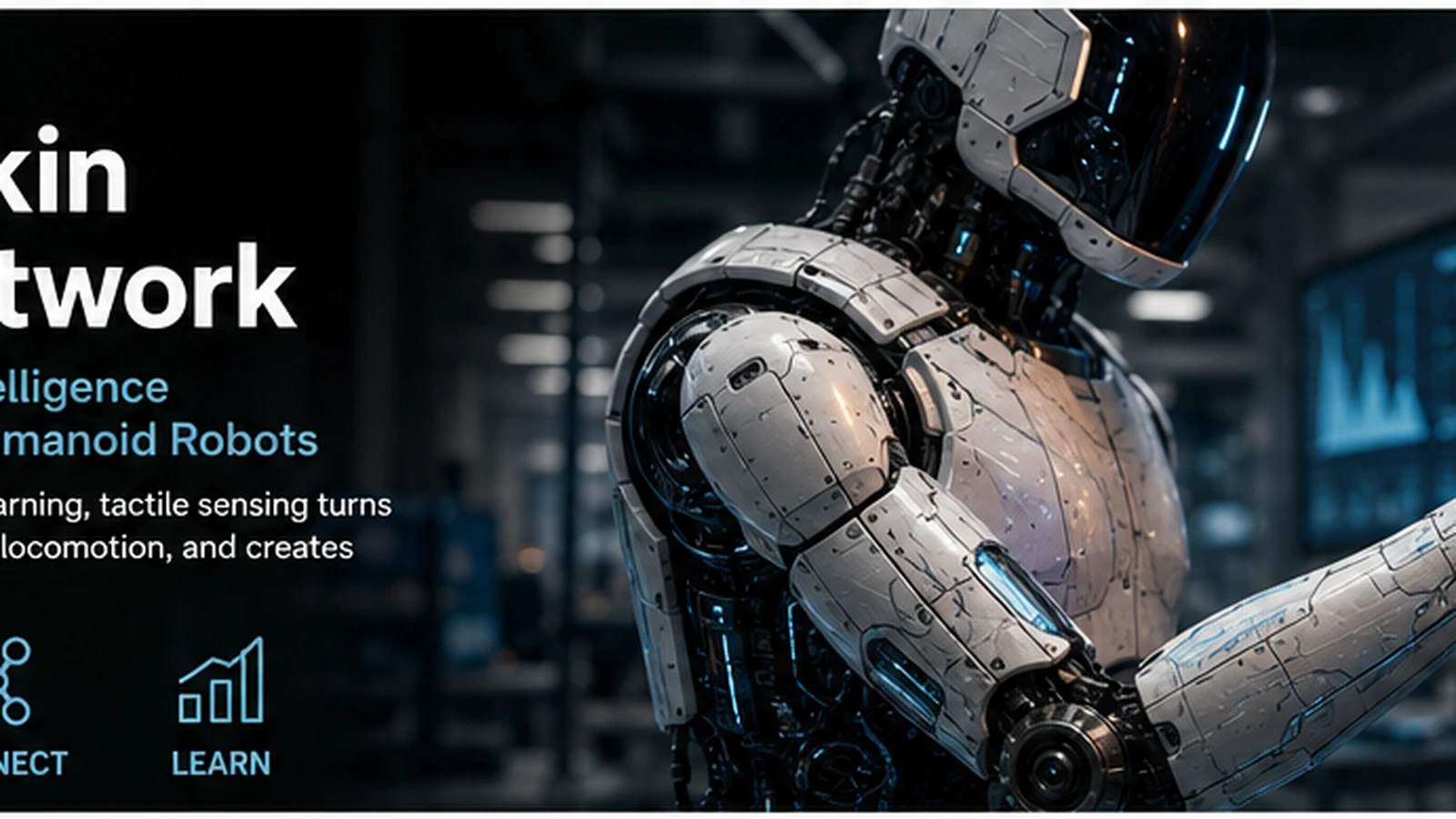
The central thesis of this chapter is that whole-body touch becomes useful only when the complete signal path is architected: transduction, analog acquisition, local processing, timing, networking, perception, control, safety and fleet learning. This shifts semiconductor value from isolated sensing elements toward scalable signal chains with local intelligence, robust communication, synchronization, power efficiency, diagnostics and security. The robot’s skin is therefore best understood as a sensor network wrapped around a moving machine.
From Contact Detection to Physical Intelligence
Vision tells a robot what may happen; touch tells it what is happening at the physical interface. Once a humanoid grasps a tool, leans against a fixture, brushes a person, kneels, catches itself, carries an irregular load or manipulates an object under occlusion, contact becomes part of the robot’s state. Research has long recognized the value of distributed tactile coverage on humanoids Tajima et al. and contemporary work extends that principle toward large-area adaptive perception EmArm.
The important change is architectural. Tactile sensing is expanding from fingertips and wrist force/torque sensors toward spatially distributed surfaces. GENE.01, for example, is presented by its developer as combining tactile, force and vision at high frequency, while the July 2026 announcement describes distributed detection of touch, proximity, force and temperature GENE.01 company announcement. These are company claims rather than independent performance validation, but they are significant because they show full-body tactile sensing moving into the product narrative of humanoid platforms.
| Contact question | Useful modalities | Robot response | Semiconductor implication |
|---|---|---|---|
| Is something approaching? | Proximity, ToF, capacitive, optical | Slow, replan, prepare compliant contact | Low-latency multi-channel sensing and edge classification |
| Where is contact? | Pressure array, optical skin, capacitive array | Localize contact and update body model | Scalable multiplexing, ADCs, local MCUs, synchronization |
| How is contact evolving? | Force, shear, vibration, acceleration | Detect slip, impact, rubbing or instability | High-bandwidth acquisition and deterministic processing |
| Is contact safe? | Multimodal skin plus joint state | Limit force, stop, retreat or redistribute load | Independent monitors, diagnostics and safety mechanisms |
| What can be learned? | Contact history plus mission context | Improve grasping, maintenance and interaction policies | Secure logging, memory, connectivity and edge/cloud analytics |
The Skin Is a Multimodal Transduction Layer
No single sensing principle is optimal across a humanoid body. Reviews of bionic skin describe capacitive, piezoresistive, piezoelectric, optical, magnetic, electrochemical and multimodal approaches bionic-skin review. The design trade space includes sensitivity, dynamic range, hysteresis, drift, spatial resolution, flexibility, mechanical robustness, manufacturability, temperature dependence, power, calibration and wiring.
Capacitive sensing is attractive for touch, deformation and proximity because it can be highly sensitive and implemented in arrays. A 2026 origami-inspired capacitive e-skin demonstrated large-area force, shear and proximity sensing while explicitly addressing wiring complexity and spatial resolution Xu et al.. Infineon’s capacitive sensing portfolio illustrates semiconductor capabilities relevant to such architectures, including high sensitivity, multi-channel measurement and active shielding Infineon capacitive sensing. This does not make an automotive capacitive sensor a complete robot-skin solution; it shows that precision capacitance measurement and robust front ends are transferable building blocks.
Optical and vision-based tactile sensing offers another path. A 2026 humanoid-forearm study used a compliant interface with internal optical tracking and reported high touch-gesture classification performance humanoid forearm study. Multispectral approaches can combine force, position, temperature, proximity and vibration, as demonstrated by SuperTac SuperTac. These architectures shift some complexity from dense electrical taxels toward imaging, illumination and local compute.
Mechanical embodiment also matters. Experiments with modular e-skin show that compliance and exploratory interaction affect what the robot can infer about soft objects Dutta et al.. Skin is therefore not merely an electrical interface. Its elastomers, protective layers, mounting, adhesive, curvature and structural coupling become part of the sensor transfer function.
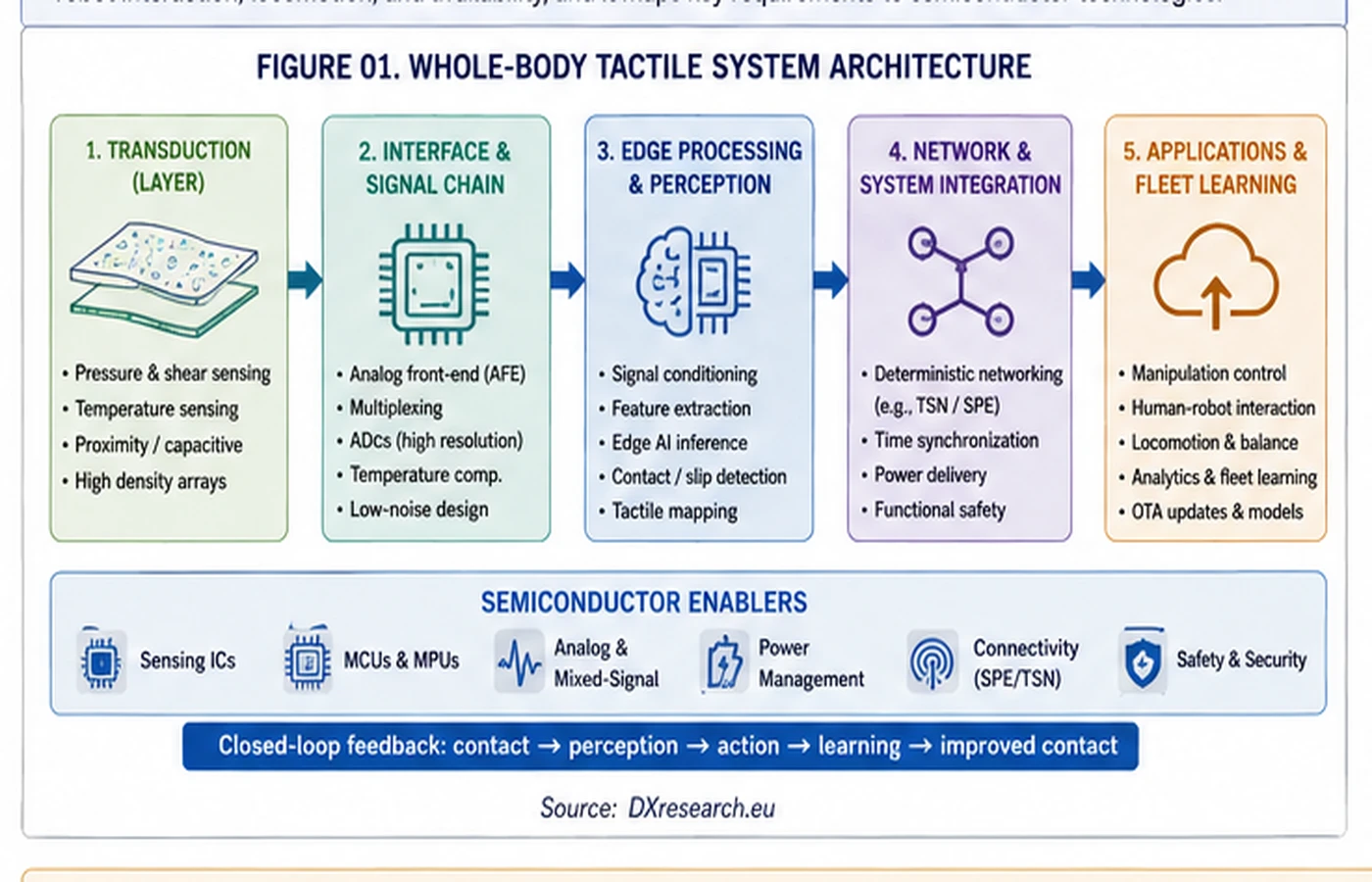
Whole-Body Tactile System Architecture
1. Distributed acquisition
A large humanoid can contain hundreds or thousands of tactile channels. Routing every analog node directly to a central processor creates harness mass, connector count, EMC exposure and bandwidth problems. The scalable pattern is hierarchical: sensor cells or patches feed local analog front ends, conversion and processing; regional nodes aggregate features; body networks move time-aligned events and health information to higher-level controllers.
Scalable fabrication research is increasingly co-locating deformable pressure and bending sensors with temperature, proximity and compact IC modules Lim et al.. This points toward skin tiles as electronic subsystems with identity, calibration and local diagnostics rather than passive sheets.
2. Edge processing
Raw tactile arrays are data-intensive, but most samples are operationally uninteresting. Local processing can filter noise, compensate temperature, estimate contact location, detect slip and impact, compress spatial maps and transmit events. Event-based sensing is particularly attractive because contact is sparse over much of the body much of the time. Local edge AI can classify contact patterns without forcing the central compute platform to ingest every waveform.
A July 2026 Nature Sensors study demonstrates a broader architectural direction: tactile signals can be routed into a fast spiking path for rapid perception and a slower language-model path for deeper semantic reasoning, with confidence-based gating between them Sun et al.. The exact implementation is research, not a production blueprint, but the hierarchy is compelling: reflexive contact handling belongs close to the body; deliberative interpretation can occur higher in the compute stack.
3. Networking and time
Whole-body tactile perception is inseparable from deterministic networking and synchronization. A contact map has limited value if timestamps cannot be correlated with joint position, motor current, IMU state, vision and commanded torque. The network must therefore carry not only values but time, quality and sensor-health metadata. Regional processing also reduces traffic and creates fault-containment boundaries.
4. Power and thermal design
Sensor skin competes for the same mass, volume and energy budget as actuation and compute. Thousands of continuously active channels can become a meaningful thermal load beneath compliant covers. Duty cycling, wake-on-event behavior, low-power analog, efficient local compute and power-domain segmentation are system requirements. Thermal drift also changes sensor behavior, so temperature is both an environmental quantity and a calibration variable.
Contact Must Close the Control Loop
A robot does not gain physical intelligence by measuring touch; it gains it by changing behavior correctly. Whole-body tactile data can inform grasp-force regulation, slip detection, collision response, balance, support contacts and whole-body control. EmArm demonstrates tactile-driven trajectory replanning and contact-rich manipulation using whole-arm sensing Nature Sensors. That result supports the broader interpretation that distributed touch can become an active motion input rather than a passive safety alarm.
Proximity adds a valuable pre-contact phase. Combining Time-of-Flight and self-capacitance has been studied specifically for collaborative proximity and tactile sensing Tsuji. In a humanoid, this can create a continuum from approach detection to first touch, sustained force and release. Infineon similarly positions 3D ToF, radar, magnetic, current, microphone and capacitive technologies across robotic perception and interaction Infineon robotics portfolio 3D ToF and RGB fusion.
Skin Extends Safety, but Does Not Replace Safety Engineering
Distributed contact sensing can improve awareness of unexpected human contact, trapping, collision and unstable interaction. It can also support more nuanced reactions than a binary bumper. However, a tactile array is not automatically a safety function. If it participates in risk reduction, the complete chain requires defined fault detection, diagnostic coverage, latency, independence, failure response and validation consistent with the applicable safety concept. This is where functional safety changes the architecture: sensing quality, processor supervision, communication integrity and safe actuation response must be treated together.
Skin itself can fail through puncture, delamination, cable damage, moisture, drift, contamination or local mechanical wear. A robust system therefore needs self-test and plausibility checking. Contact inferred by skin can be cross-checked against joint torque, motor current, IMU acceleration or vision. A failed patch should be localized and reported rather than silently creating a blind area.
The Semiconductor Stack Beneath the Skin
Whole-body tactile intelligence creates semiconductor demand across sensing, analog/mixed-signal, microcontrollers, connectivity, memory, power and security. The decisive metric is not simply sensor accuracy. It is the cost, energy and reliability of converting a square meter of mechanically complex robot surface into synchronized, trustworthy contact information.
| Layer | System requirement | Semiconductor role | Design priority |
|---|---|---|---|
| Transduction | Pressure, shear, proximity, temperature, vibration | Capacitive/optical/MEMS/magnetic sensor interfaces | Dynamic range, drift, robustness, channel density |
| Signal chain | Many low-level channels | AFE, multiplexers, ADCs, references | Noise, power, calibration, active shielding |
| Local intelligence | Feature extraction and event detection | MCUs, DSP, NPU/AI acceleration | Latency, power, memory, deterministic execution |
| Body network | Time-aligned regional data | PHYs, transceivers, switches, timing | Bandwidth, jitter, EMC, fault containment |
| Protection | Safe reaction to contact or faults | Safety MCU mechanisms, supervisors, protected interfaces | Diagnostics, independence, bounded response |
| Lifecycle | Calibration, identity, logs, updates | Nonvolatile memory, secure identity, connectivity | Traceability, cybersecurity, maintainability |
For Infineon, the opportunity is broader than a hypothetical dedicated “skin chip.” Current capabilities already touch several layers: high-sensitivity capacitive sensing, PSOC-class local control and capacitive interfaces, REAL3 3D ToF, XENSIV magnetic/current sensing, MEMS microphones, radar, security and industrial/automotive connectivity capacitive sensing robotics solutions. Infineon’s FY2026 investor material explicitly identifies broad humanoid sensor usage and capacitive sensing for dexterous hands among the opportunities created by its expanded sensor portfolio FY2026 investor presentation. The strategic product question is therefore how to integrate these technologies into repeatable tactile-node and body-network reference architectures.
Acoustic sensing can also complement tactile skin. MEMS microphones are normally considered hearing devices, but robust low-latency acoustic channels can detect contact sound, vibration signatures and mechanical anomalies; Infineon positions its microphones for robotics and industrial monitoring as well as audio interaction XENSIV MEMS microphones.
From Touch to Fleet Learning
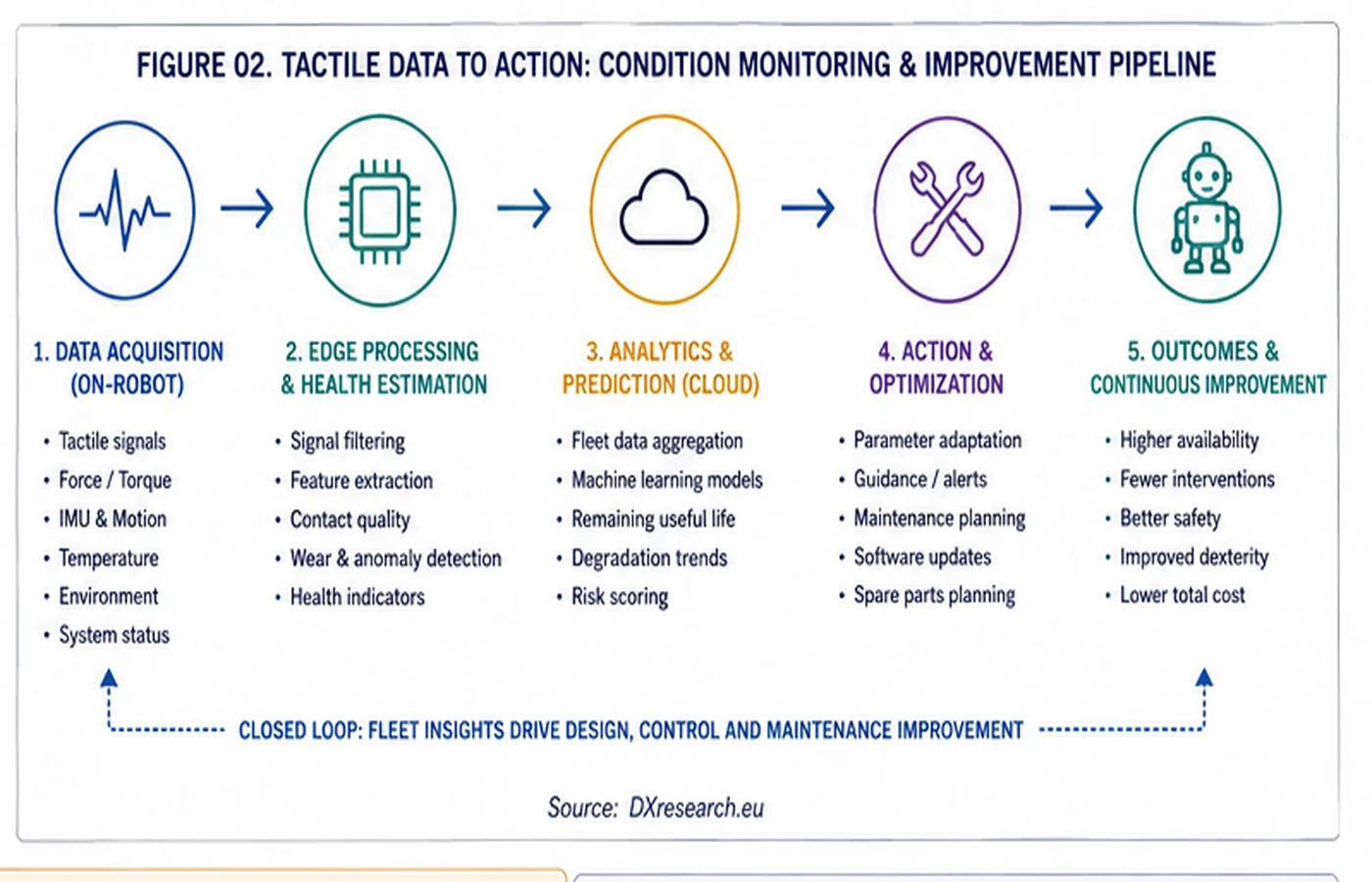
The same tactile network that improves manipulation can become a condition-monitoring layer. Repeated contact signatures can expose worn coverings, loose structures, degraded joints or changed compliance. This creates a second time scale: milliseconds for reflexes and control, hours to months for maintenance and fleet learning. The architecture should separate these functions so that cloud analytics can improve the robot without becoming necessary for immediate safe response.
Secure event histories should retain context: location, contact type, joint state, software version, calibration status and maintenance action. Fleet analytics can then identify recurring blind spots, overstressed body regions and sensor designs that drift in specific environments. The skin becomes both an interaction surface and a field-data generator.
Engineering the Skin as a Network
- Start from contact use cases. Map manipulation, collision, support, HRI and maintenance needs to measurable variables and latency.
- Partition the body. Define sensor patches and regional nodes around mechanical modules, harness routes, replacement boundaries and fault containment.
- Choose modality by physics. Do not force one transducer technology across fingertips, forearms, torso and feet.
- Budget data and power. Estimate channel count, sampling, local features, network traffic, wake modes and thermal dissipation.
- Synchronize contact with motion. Correlate skin data with joint, current, IMU and vision state.
- Design degradation awareness. Detect drift, dead cells, delamination, saturation and communication faults.
- Validate representative contact. Test curved surfaces, repeated deformation, contamination, impacts, human interaction and field replacement.
The research frontier is moving quickly. Recent work demonstrates scalable fabrication multimodal e-skin fabrication, high-resolution multimodal sensing SuperTac, adaptive whole-arm control EmArm and hierarchical tactile reasoning spike–language framework. The durable engineering problem is integrating these advances into manufacturable robot architectures.
Evidence Boundaries
Verified evidence: cited peer-reviewed work supports the feasibility of large-area, multimodal and adaptive tactile sensing. Infineon sources verify relevant semiconductor capabilities and portfolio positioning. Company claim: GENE.01’s full-body sensing capabilities are described by Generative Bionics and its release material; independent system-level validation is not established here. Interpretation: treating robot skin as a hierarchical sensor network is the architectural thesis of this chapter, derived from the convergence of distributed sensing, edge processing, deterministic communication and embodied control.
Conclusion: The Body Becomes an Information Surface
The next generation of humanoid robots will not experience the physical world through cameras alone. Contact will be measured across the body, interpreted locally, fused with motion state and converted into safe action. As tactile coverage scales, the difficult problem shifts from inventing another sensor material to architecting a dependable distributed system. The robot’s skin becomes a sensor network: mechanically embodied, electronically distributed, synchronized with control and connected to learning. That transition creates a substantial semiconductor opportunity because every useful touch requires trusted transduction, signal conditioning, processing, communication, power, safety and lifecycle evidence. Physical AI becomes more physical when the entire body can feel.
Glossary
- Analog front end
Signal-conditioning circuitry between a physical sensor element and digital conversion or processing.
- Capacitive sensing
Sensing based on changes in electrical capacitance caused by proximity, touch, deformation or material properties.
- Deterministic networking
Communication engineered for bounded latency, controlled jitter and predictable delivery needed by real-time physical systems.
- Edge AI
Machine-learning inference executed close to sensors or actuators to reduce latency, bandwidth and cloud dependence.
- Electronic skin
A conformable distributed sensor system that covers robot surfaces and provides spatially resolved physical interaction data.
- Event-based sensing
Data acquisition or transmission that emphasizes meaningful signal changes rather than continuously forwarding unchanged samples.
- Fleet learning
Use of aggregated operational evidence from multiple deployed robots to improve models, thresholds, maintenance and future designs.
- Functional safety
Risk reduction achieved through correct operation of safety-related electrical, electronic and programmable functions.
- Proximity sensing
Non-contact detection of nearby objects or people before physical contact occurs.
- Sensor fusion
Combination of multiple sensor streams to estimate physical state more robustly than any single modality.
- Slip detection
Recognition of relative motion between a grasped object and robot contact surface before grasp failure.
- Tactile sensing
Measurement and interpretation of physical contact variables such as pressure, force, shear, vibration, texture or temperature.
- Time of Flight
Distance measurement using the travel time or phase behavior of emitted and returned light or other signals.
- Whole-body control
Coordinated control of multiple robot contacts and degrees of freedom to achieve system-level motion objectives.
References
- A bio-inspired origami capacitive robotic e-skin with multimodal sensing capabilities. Large-area capacitive e-skin combines force, shear and proximity sensing while addressing wiring complexity and spatial resolution. Source
- A spike–language dual framework bridges fast perception and deep reasoning in artificial tactile somatosensory systems. A dual tactile architecture combines fast spiking inference with higher-level language reasoning through confidence-based routing. Source
- Beyond 2D: Unlocking Robotic Environmental Awareness with 3D ToF and RGB Sensor Fusion. Infineon describes 3D ToF and RGB fusion for robotic depth perception, obstacle avoidance and safer navigation. Source
- Biomimetic multimodal tactile sensing enables human-like robotic perception. Multimodal tactile sensing integrates force, position, temperature, proximity and vibration with learned interpretation for robotic perception. Source
- Capacitive sensors. Infineon capacitive sensing supports high sensitivity, multi-channel measurement, active shielding and functional-safety-oriented applications. Source
- Development of soft and distributed tactile sensors and the application to a humanoid robot. Early full-body humanoid work established distributed tactile coverage and compliant sensing as system-level engineering challenges. Source
- Embodied sensorimotor integration for whole-arm tactile sensing and adaptive robotic manipulation. Large-area soft tactile skin and proprioception support whole-arm contact perception and adaptive control in dynamic environments. Source
- Embodied tactile perception of soft objects properties. Research shows tactile perception depends jointly on mechanical compliance, multimodal sensing and purposeful physical interaction. Source
- First Quarter FY 2026 Investor Presentation. Infineon identifies broad humanoid sensing demand including environmental, capacitive, position and current sensing across robot systems. Source
- GENE.01 Comes to Life. GENE.01 presents whole-body tactile, force and vision sensing as a core Physical AI capability for safe interaction. Source
- Generative Bionics Introduces Gene.01, a Fully Functional Smart-Skin Humanoid Robot Platform. Company announcement describes distributed skin sensing touch, proximity, force and temperature and an open robot model. Source
- MEMS microphones. MEMS microphones provide low-latency acoustic sensing useful for robot interaction, localization and condition-monitoring signal chains. Source
- Proximity and Tactile Sensor Combining Multiple ToF Sensors and a Self-Capacitance Proximity and Tactile Sensor. Combined time-of-flight and self-capacitance sensing illustrates how proximity and contact modalities can coexist in collaborative robotics. Source
- Robotics. Infineon maps radar, ToF, magnetic, current, microphone and capacitive sensing technologies to robotic perception and interaction. Source
- Scalable in-situ fabrication of multimodal electronic skin for intelligent robotics and interactive systems. Scalable fabrication integrates pressure, bending, temperature and proximity sensing with flexible circuitry and compact electronic modules. Source
- Tactile sensing technology in bionic skin: A review. Review compares capacitive, piezoresistive, piezoelectric, optical, magnetic, electrochemical and multimodal tactile sensing principles. Source
- Towards human-like tactile perception in humanoid robot forearms. A distributed vision-based tactile forearm demonstrates large-surface perception and touch-gesture classification for humanoid interaction. Source