Chapter 8
When Carmakers Build Robots
When Carmakers Build Robots
How the Automotive Industry Is Rebuilding Its OEM, Tier-1 and Semiconductor Value Chain Around Physical AI
Automotive OEMs become robot makers transferring electric drive sensing safety AI manufacturing and supplier architectures into emerging Physical AI ecosystems.
Executive Summary
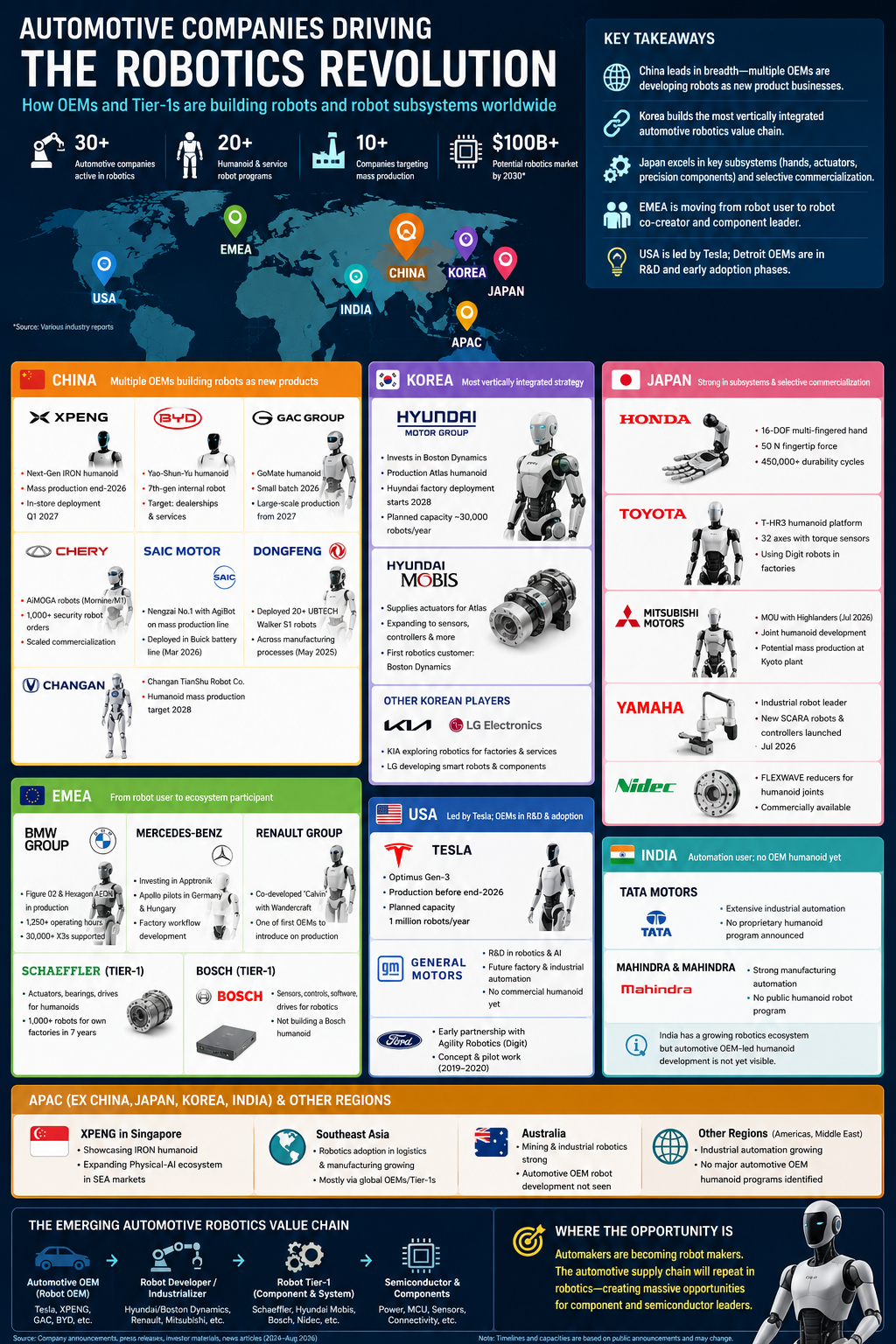
Automotive companies are no longer only customers for industrial robots. Across China, Korea, Japan, Europe and the United States, selected vehicle manufacturers are developing humanoids, dexterous hands, actuators, robot controllers and embodied-AI platforms themselves. Automotive Tier-1 suppliers are simultaneously converting capabilities in motors, reducers, sensing, controls and high-volume industrialization into robot subsystems. This chapter argues that humanoid robotics is beginning to reproduce the structure of the automotive value chain: robot OEMs define platforms, Tier-1 suppliers industrialize motion and sensing modules, and semiconductor companies provide the distributed power, control, sensing, connectivity and trust foundation. Regional strategies differ sharply. China shows the broadest direct OEM participation; Hyundai has assembled an unusually integrated Korean value chain; Japan retains deep manipulation and actuator IP; Europe is moving from deployment toward co-development and components; and Tesla dominates direct automotive humanoid development in the United States.
1. The automotive industry crosses into robotics
For decades, automotive factories have been among the world’s largest users of industrial robots. That relationship is changing. Automotive companies are moving from robot customer to robot developer, subsystem supplier, industrializer and, increasingly, robot manufacturer.
The shift is logical. A modern electric vehicle and a humanoid share battery systems, power conversion, electric motors, real-time control, sensing, networking, functional safety, cybersecurity, high-performance compute and software-defined behavior. A humanoid multiplies these functions across dozens of tightly coordinated motion axes while adding dexterous manipulation and direct human interaction.
The central thesis follows: the automotive industry is not simply adopting Physical AI. It is beginning to recreate its own value-chain structure inside Physical AI.
2. Three paths from carmaker to robot company
Some OEMs are becoming robot OEMs. Tesla, XPENG, GAC, BYD and Chery illustrate the direct form: proprietary robot platforms are treated as future products rather than factory equipment alone.
Other automakers are becoming robot co-developers and industrializers. Renault with Wandercraft and Mitsubishi Motors with Highlanders show how automotive requirements, manufacturing know-how and production assets can combine with specialist robotics IP.
Automotive Tier-1 suppliers are also becoming robot Tier-1 suppliers. Schaeffler, Hyundai Mobis, Bosch and Nidec span actuators, reducers, sensors, controls, drives, software and industrialization. This distinction matters because a robot OEM defines architectures while a Tier-1 can propagate component choices across multiple platforms.
3. China: the broadest migration
China presents the broadest set of automotive OEMs treating embodied robotics as a product opportunity. XPENG’s IRON program explicitly connects autonomous-driving AI, proprietary compute and embodied intelligence, with a roadmap moving toward mass production.
GAC’s GoMate demonstrates in-house locomotion, manipulation and intelligent control. BYD is strategically important because its vertical integration already spans batteries, power electronics, semiconductors, motors, controllers and high-volume electromechanical manufacturing. Chery and AiMOGA show how dealerships, security and service scenarios can become early robot markets.
SAIC and Dongfeng demonstrate the complementary role of vehicle factories as real-world training and deployment environments. China’s pattern is therefore larger than a race to announce humanoids: product platforms, deployment environments, supply chains and commercialization channels are developing simultaneously.
4. Korea: an integrated robotics value chain
Hyundai Motor Group represents perhaps the clearest automotive group assembling an end-to-end robotics structure. Boston Dynamics supplies advanced robot design and control; Hyundai Motor and Kia provide manufacturing environments and industrialization expertise; Hyundai Mobis is migrating component capability into robot actuators and potentially sensing and control modules.
Production Atlas makes this more than a technology investment. The group can learn simultaneously at robot-platform, component, factory-integration and manufacturing levels. This resembles the automotive industry’s layered architecture and offers a plausible template for industrializing humanoids at scale.
For semiconductor suppliers, architecture decisions can propagate vertically. A power device, MCU, position sensor or communication technology selected at actuator level can multiply across dozens of joints and thousands of robots.
5. Japan: subsystem knowledge matters
Japan’s position is easy to underestimate if analysis focuses only on new humanoid production volumes. Honda and Toyota have accumulated important robot engineering knowledge over decades.
Honda’s multi-fingered hand highlights the semiconductor density of dexterous manipulation: motors, drivers, position feedback, force or tactile information, real-time control and communications must fit into human-scale geometry. Toyota’s T-HR3 and Torque Servo Module demonstrate another foundational concept: integrating motor, reduction gear and torque sensing into a controllable joint module.
Mitsubishi Motors adds a newer industrial dimension through cooperation with Highlanders covering joint development and potential automotive-factory robot production. Yamaha Motor and Nidec further show commercially mature robot and precision-motion capability in the Japanese mobility ecosystem.
6. Europe: deployment moves upstream
BMW’s work with Figure and Hexagon and Mercedes-Benz’s work with Apptronik provide operating data on material handling, component supply and production workflows. Even when robot hardware is external, these programs build competence in safety, process integration, connectivity and Physical-AI operations.
The more consequential change is movement upstream. Renault’s Calvin program with Wandercraft introduces co-development around an automotive-production robot. Schaeffler is positioning itself as both humanoid user and supplier of actuators, bearings, drives and industrialization capability. Bosch has chosen a component-and-platform strategy rather than building a proprietary humanoid.
Europe may therefore develop a robotics structure resembling its automotive supply base: fewer vertically integrated robot OEMs than China, but strong engineering and Tier-1 participation in high-value subsystems.
7. USA, India and whitespace
In the United States, Tesla is the dominant automotive OEM directly becoming a humanoid developer. Optimus reuses capabilities built for electric vehicles and autonomy: batteries, motors, power electronics, cameras, AI training, inference compute, software and manufacturing. General Motors maintains robotics research, while Ford’s earlier Digit collaboration did not evolve publicly into a sustained proprietary humanoid program.
India presents a different picture. Tata and Mahindra operate highly automated automotive manufacturing systems, but this research did not identify a comparable publicly announced proprietary humanoid platform from a major Indian automotive OEM. This is strategic whitespace rather than absence of capability.
Across Southeast Asia and other regions, current activity is primarily deployment, manufacturing expansion and market entry by foreign robot and automotive companies rather than indigenous automotive-led humanoid platforms.
8. The supply chain starts to look automotive
The emerging structure has four layers. Robot OEMs define bodies, intelligence and electrical architectures. Robot Tier-1 suppliers provide intelligent actuators, hands, sensor modules, batteries, power systems and computing subsystems. Semiconductor suppliers provide power switches, gate drivers, MCUs, sensors, connectivity, security and memory. Manufacturing and service ecosystems industrialize, validate, maintain and improve fleets.
This is familiar territory for automotive organizations. Platform reuse, qualified components, modular architectures, supply assurance, design-to-cost, functional safety and long product lifecycles are established disciplines.
Humanoid robotics therefore offers automotive suppliers more than a new customer segment. It creates a neighboring industry whose industrial structure may increasingly resemble their existing one.
9. Semiconductors become system-defining
A humanoid can contain dozens of high-dynamic servo axes. Every axis creates requirements for switching power, gate driving, current measurement, rotor or joint position sensing, real-time control and deterministic communication. Hands add extreme integration density. Batteries add monitoring, protection and power conversion. Perception and human proximity add sensing, safety, cybersecurity and diagnostics.
Semiconductor choices become architectural. Efficiency determines heat and runtime. Sensor accuracy determines torque and position control. MCU latency determines servo bandwidth. Network determinism affects coordinated motion. Safety mechanisms determine whether faults can be contained without collapsing the robot.
As robots move toward continuous factory operation, automotive-grade diagnostics, degradation monitoring, safe states, secure update and traceability become increasingly relevant.
10. The next vehicle platform may have legs
Not every carmaker will manufacture humanoids. Many will remain customers, some will partner, some will supply components, and a smaller number will become major robot OEMs.
What matters is that the boundary between automotive and robotics is becoming porous. Electric-drive engineering migrates into actuators. ADAS perception and AI migrate into embodied intelligence. Vehicle E/E architectures inform distributed robot control. Automotive factories become robot training grounds. Tier-1 suppliers reuse precision motion and mass-production expertise. Semiconductor suppliers encounter familiar functions multiplied across a more distributed machine.
The automotive industry’s accumulated capability in electrification, safety, sensing, control and industrialization may become one foundation on which humanoid robotics scales. The robot revolution will not only arrive in automotive factories. Parts of it will be built by the automotive industry itself.
References
- Tesla AI & Robotics — https://www.tesla.com/AI
- XPENG CVPR 2026 — https://www.xpeng.com/pressroom/news/019e95aed2899e8226228a028d650112
- GAC GoMate — https://www.gacgroup.com/cn/news/detail?baseid=18961
- Honda Multi-Fingered Hand — https://global.honda/en/RandD/field/hgrx/honda-multi-fingered-hand/
- Toyota T-HR3 — https://global.toyota/en/newsroom/corporate/19841525.html
- Mitsubishi Motors / Highlanders — https://www.mitsubishi-motors.com/en/newsroom/newsrelease/2026/20260709_1.html
- Hyundai AI Robotics Strategy — https://www.hyundai.com/worldwide/en/newsroom/detail/0000001225
- Hyundai Mobis / Boston Dynamics — https://www.mobis.com/en/aboutus/press.do?category=press&idx=6159
- BMW humanoid deployment — https://www.bmwgroup.com/en/news/general/2026/humanoid-robot-in-leipzig.html
- Mercedes-Benz humanoid robotics — https://group.mercedes-benz.com/unternehmen/produktion/produktionsnetzwerk/mbdfc-humanoide-roboter.html
- Renault Calvin — https://www.renaultgroup.com/en/magazine/technology/calvin-a-new-generation-robot-is-born/
- Schaeffler humanoid robots — https://www.schaeffler.com/en/technology-innovation/technology/humanoid-robots/
- Bosch robotics strategy — https://www.bosch.com/stories/reasons-why-bosch-in-robotics/
- SAIC deployment — https://www.saicmotor.com/m/xwzx/xwk/2026/64052.shtml
- Dongfeng / UBTECH — https://www.dongfengforthing.com/news/global-first-dongfeng-liuzhou-motor-to-deploy-no-fewer-than-20-ub/
| Automotive company | Region | Role | Robot activity — 20 words | Announced robot solutions — 20 words | Availability / commercialization evidence | Sources |
| Tesla | USA | OEM | Develops general-purpose humanoid robotics internally, reusing automotive AI, vision, batteries, motors, power electronics, controls, manufacturing and inference-compute expertise directly today. | Optimus is an autonomous bipedal humanoid integrating Tesla-developed perception, navigation, balance, manipulation, AI inference and eventually scalable electromechanical manufacturing systems globally. | Tesla says Gen-3 Optimus production is planned before end-2026. Initial manufacturing lines are being installed at Fremont; eventual planned capacity is 1 million robots/year, although this is a long-term target, not current output. | Tesla AI & Roboticsâ · Reuters production reportâ |
| General Motors | USA | OEM | Maintains dedicated robotics research spanning future factories, industrial automation, AI-enabled robotics, smart manufacturing and scalable robotic systems for production applications worldwide. | GM has not publicly announced a proprietary humanoid product; research focuses instead on advanced robotics technologies supporting manufacturing and future products. | GM lists Future Factory and Robotics as a strategic R&D program and was recruiting dedicated automotive robotics researchers in July 2026. No commercial humanoid launch or SOP has been announced. | GM Research & Developmentâ · GM robotics researcher roleâ |
| Ford | USA | OEM | Explored integration between autonomous vehicles and bipedal robots, demonstrating how automotive perception and logistics platforms could cooperate with walking robots. | Ford and Agility developed a last-mile concept combining autonomous delivery vehicles with Digit robots capable of carrying parcels across pedestrian environments. | Digit partnership announced 2019 with planned 2020 trials. I found no evidence that Ford has since converted this into a current proprietary humanoid program; therefore classify this as historically important, currently low activity. | Ford/Agility partnershipâ · Ford Digit projectâ |
| BMW Group | EMEA / Germany | OEM | Operates humanoids inside vehicle manufacturing while building internal Physical-AI integration, safety, connectivity, process-engineering and deployment competency across its production network globally. | Figure 02 and Hexagon AEON perform material handling, component positioning, battery-related assembly and other adaptable production tasks within BMW facilities currently. | Figure 02 completed approximately 1,250 operating hours, 90,000 components, 1.2 million steps, supporting production of 30,000+ X3s at Spartanburg. AEON entered Leipzig testing December 2025; full pilot planned summer 2026. | BMW Leipzig/Spartanburg programâ |
| Mercedes-Benz | EMEA / Germany | OEM | Invests directly in Apptronik while developing factory workflows, AI integration and operating experience for humanoids alongside conventional Mercedes manufacturing automation systems. | Apollo humanoids move components, supply production stations and perform quality-inspection tasks, targeting repetitive, ergonomically difficult and labor-constrained manufacturing operations initially. | Apollo pilots underway at Berlin-Marienfelde and Kecskemét. Mercedes also became an Apptronik investor. No fleet-volume/SOP commitment has yet been publicly disclosed. | Mercedes Digital Factory Campusâ |
| Renault Group | EMEA / France | OEM | Co-developed a factory humanoid with Wandercraft, combining Renault industrial requirements and production expertise with specialized French dynamic-biped robotics engineering capabilities directly. | Calvin is a bipedal industrial robot developed for Renault factories to walk, handle heavy objects and adapt dynamically around production environments. | Renault publicly presented Calvin in June 2026 and describes itself as among the first automakers introducing this generation of robot onto production lines. Commercial external availability has not been announced. | Renault Calvin announcementâ |
| Schaeffler | EMEA / Germany | T1 | Is explicitly transforming automotive motion expertise into humanoid actuation, industrialization, integration and aftermarket support while deploying humanoids across Schaeffler factories globally too. | Offers high-precision rotary actuator platforms using strain-wave and planetary gearing, complemented by bearings, sensors, drives and industrialization expertise for humanoids. | Strategic agreements with Humanoid, Hexagon Robotics and Leju. Hexagon agreement includes 1,000+ humanoids for Schaeffler factories within seven years. Humanoid agreement targets 1,000–2,000 deployments by 2032 and large actuator supply. | Schaeffler humanoid roboticsâ · Hexagon partnershipâ |
| Bosch | EMEA / Germany | T1 | Positions itself as robot technology supplier rather than humanoid OEM, leveraging sensors, drives, controls, software and industrial automation expertise globally today. | Bosch proposes sensing, automation controls, ctrlX platforms, drive technology and supporting systems forming perception, control and automation layers for robots. | Bosch states robotics can become a billions-scale business and established dedicated efforts around automation and robotics. It explicitly says it is not developing a Bosch humanoid. | Bosch robotics strategyâ |
| BYD | China | OEM | Has quietly developed humanoids internally since 2022, exploiting deep vertical integration across electronics, batteries, motors, semiconductors, manufacturing and artificial intelligence. | Yao-Shun-Yu targets dealership, service and ultimately domestic applications, representing a proprietary BYD humanoid platform rather than third-party factory deployment alone. | BYD EVP Stella Li/Ke disclosed the program publicly in 2026. Reports describe a seventh-generation internal robot. Dealership deployment is targeted first; no firm public SOP volume has yet been published. | BYD program reportingâ |
| XPENG | China | OEM | Operates one of automotive industry’s deepest Physical-AI programs, sharing VLA models, proprietary AI chips, perception and software between vehicles and humanoids. | Next-Gen IRON combines 82 degrees of freedom, bionic structure, tactile capability, three Turing AI chips and full-stack XPENG intelligence architecture. | Formal mass production targeted by end-2026. In-store shopping-guide deployment begins Q1 2027. Baosteel is an industrial ecosystem partner. This is one of the clearest published automotive humanoid commercialization schedules. | XPENG CVPR 2026 updateâ · XPENG AI Dayâ |
| GAC Group | China | OEM | Develops embodied robots fully in-house including mechanical systems, hands, drives, control algorithms, perception and autonomous-driving-derived spatial intelligence technologies for deployment. | GoMate uses variable wheel-leg mobility, 38-DOF whole-body control, multimodal perception, teleoperation and internally developed dexterous hands and actuators for industry. | 2025: self-developed components and demonstrations. 2026: small-batch whole-robot production. Updated roadmap says large-scale production from 2027. GAC formed dedicated robotics company Huilun Technology in February 2026. | GAC GoMate launchâ · GAC robotics companyâ |
| Chery Group | China | OEM | Treats robotics as a third growth curve, combining automotive engineering, AI, global distribution and scenario validation through affiliated AiMOGA Robotics operations. | AiMOGA portfolio includes Mornine/Moine humanoids, service robots, security robots and robotic dogs for dealerships, public spaces and industrial applications globally. | By April 2026 Chery said robotics had moved into scaled commercialization. Chinese reporting cites 1,000 security-robot orders and 100-unit batch delivery; humanoid M1 has also been publicly listed for purchase. | Chery/AiMOGA partnershipâ |
| SAIC Motor / SAIC-GM | China | OEM | Uses strategic investment and joint engineering to place embodied humanoids directly onto real automotive series-production lines rather than laboratory pilots only. | Nengzai No.1, jointly developed with AgiBot, handles battery-cell picking and feeding processes in SAIC-GM’s Buick battery manufacturing line today autonomously. | On 27 March 2026, Nengzai No.1 officially started work on the Buick Electra E7 battery mass-production line. This is production deployment, not merely a laboratory demonstration. | SAIC production deploymentâ |
| Dongfeng Liuzhou Motor | China | OEM | Is scaling humanoids as manufacturing assets, collaborating with UBTECH rather than developing an entirely proprietary robot hardware platform internally from scratch. | Walker S1 robots perform manufacturing operations across vehicle-production processes, supporting material handling, inspection and increasingly complex intelligent factory workflows at Dongfeng. | Dongfeng announced deployment of at least 20 Walker S1 robots within 30 days in May 2025, making this unusually concrete compared with most automotive pilots. | Dongfeng Walker deploymentâ |
| Changan Automobile | China | OEM | Created a dedicated robotics company to develop industrial and service humanoids, transferring automotive AI, energy and electric-drive competencies toward robotics products. | Planned humanoids address factories, dealerships and later homes using an architecture emphasizing robot brain, energy systems, actuation and ecosystem integration capabilities. | Changan TianShu Intelligent Robot company registered March 2026. Company disclosures target humanoid mass production in 2028, followed by household-service expansion after 2030. | Changan investor disclosure reportingâ |
| Honda | Japan | OEM | Continues proprietary humanoid and manipulation research, concentrating current engineering particularly on human-scale dexterous hands, remote manipulation and human-robot collaboration systems capabilities. | Honda Multi-Fingered Hand provides sixteen active joints, high fingertip force, high joint velocity, impact robustness and human-tool manipulation capability at scale. | Current Honda R&D platform published for Humanoids Summit 2026: 16 actuated DOF, 180°/s joint velocity, 50 N continuous fingertip force, 450,000+ durability cycles. No commercial SOP announced. | Honda Multi-Fingered Handâ |
| Toyota Motor | Japan | OEM | Built substantial proprietary humanoid technology around whole-body force control, teleoperation, balance and modular torque-controlled joints years before today’s humanoid investment wave. | T-HR3 integrates Toyota Torque Servo Modules combining motors, reduction gears and torque sensors across 32 robot axes and ten fingers. | T-HR3 remains primarily an R&D platform rather than announced mass-production product. Toyota has also begun using third-party Digit robots in Canadian manufacturing, showing renewed industrial humanoid adoption. | Toyota T-HR3â |
| Mitsubishi Motors | Japan | OEM | Is moving beyond robot deployment toward joint humanoid development and potentially using automotive manufacturing facilities for commercial robot production at industrial scale. | Mitsubishi and Highlanders plan jointly developed humanoids for Mitsubishi manufacturing plus possible mass production of Highlanders robot products at Kyoto facilities. | MOU signed 9 July 2026. Feasibility covers joint robot development and mass production at Mitsubishi Motors’ Kyoto plant. Production quantity and SOP remain undecided. | Mitsubishi Motors–Highlanders MOUâ |
| Yamaha Motor | Japan | OEM/T1 | Operates a mature industrial-robot business alongside mobility businesses, providing unusually direct overlap between vehicle engineering and high-volume factory robotics capabilities globally. | Yamaha supplies SCARA, Cartesian, pick-and-place and robotic automation systems, including new YE4/YE10 robots and RCX440 multi-axis controller products for factories. | YE4 and YE10 SCARA robots plus RCX440 controller launched July 23, 2026, particularly targeting China and Asian markets. These are commercial industrial robots, not humanoids. | Yamaha robot launchâ |
| Nidec | Japan | T1 | Extends precision automotive motor and motion expertise into humanoid joints through high-precision reducers addressing torque density, backlash and positioning requirements globally. | FLEXWAVE strain-wave reducers and related high-precision gearboxes target compact humanoid joints requiring high torque, low backlash and accurate positioning performance characteristics. | FLEXWAVE is commercially available today. Nidec specifically marketed humanoid-compatible gearboxes at CIIF 2025 in China, indicating an active commercial component strategy rather than research only. | Nidec humanoid solutionsâ · Nidec CIIF announcementâ |
| Hyundai Motor Group / Boston Dynamics | Korea | OEM | Has created perhaps the industry’s most vertically integrated automotive-to-humanoid strategy spanning robot development, components, manufacturing, AI training, validation and deployment globally. | Production Atlas combines electric humanoid hardware, manipulation, tactile sensing, autonomous battery handling and factory integration with Boston Dynamics software and Hyundai manufacturing. | Production Atlas unveiled CES 2026. First fleets are being built in 2026. Hyundai factory deployment starts 2028, initially parts sequencing; assembly expands toward 2030. Hyundai disclosed planned robot-factory capacity around 30,000 units/year. | Hyundai AI Robotics Strategyâ |
| Hyundai Mobis | Korea | T1 | Is deliberately converting automotive steering, motor and mass-production capabilities into a dedicated humanoid actuator business targeting external robotics customers globally now. | Mobis will supply actuators for Boston Dynamics Atlas, then plans expansion into robot sensors, controllers and broader high-value robotics components subsequently. | Agreement announced CES 2026. Atlas is Hyundai Mobis’ first official robotics customer. Group plan includes tens of thousands of robots and a 30,000-unit annual factory, creating credible component scale. | Hyundai Mobis–Boston Dynamicsâ |
| Tata Motors / Tata ecosystem | India | OEM | Uses extensive industrial robotics in automotive production, but public evidence does not yet establish a proprietary general-purpose humanoid development program today internally. | No Tata-branded humanoid or major commercial robot subsystem could be verified from reliable current public disclosures during this research cycle today. | No verified announced humanoid product, SOP or robot production capacity as of August 7, 2026. Important negative finding: India’s largest automotive groups are not yet publicly matching Chinese OEM robot-product programs. | No sufficiently authoritative current product announcement found. |
| Mahindra & Mahindra | India | OEM | Applies automation extensively in manufacturing but has not publicly disclosed a credible proprietary humanoid robot product or major humanoid subsystem program yet. | No verified Mahindra humanoid, dexterous hand, humanoid actuator platform or comparable embodied-AI robot solution has been announced publicly to date either. | No validated humanoid launch/SOP found as of August 7, 2026. I would classify Mahindra as an automation user rather than an automotive robot producer today. | No sufficiently authoritative current product announcement found. |
Glossary
- Actuator
An electromechanical subsystem converting electrical energy and control commands into robot motion.
- Dexterous hand
A multi-joint robotic hand designed for adaptable grasping and manipulation.
- E/E architecture
The electrical and electronic architecture connecting compute, sensing, power, communication and control functions.
- Humanoid robot
A robot with a human-inspired body structure designed for human environments and tasks.
- OEM
Original equipment manufacturer responsible for the complete vehicle or robot platform.
- Physical AI
AI systems embodied in machines that perceive, decide and act in the physical world.
- Tier-1 supplier
A supplier providing major systems or modules directly to an OEM.
References
- BMW humanoid deployment. Source
- Bosch robotics strategy. Source
- Dongfeng / UBTECH. Source
- GAC GoMate. Source
- Honda Multi-Fingered Hand. Source
- Hyundai AI Robotics Strategy. Source
- Hyundai Mobis / Boston Dynamics. Source
- Mercedes-Benz humanoid robotics. Source
- Mitsubishi Motors / Highlanders. Source
- Renault Calvin. Source
- SAIC deployment. Source
- Schaeffler humanoid robots. Source
- Tesla AI & Robotics. Source
- Toyota T-HR3. Source
- XPENG CVPR 2026. Source