DX RoboNews · Dedicated focused edition
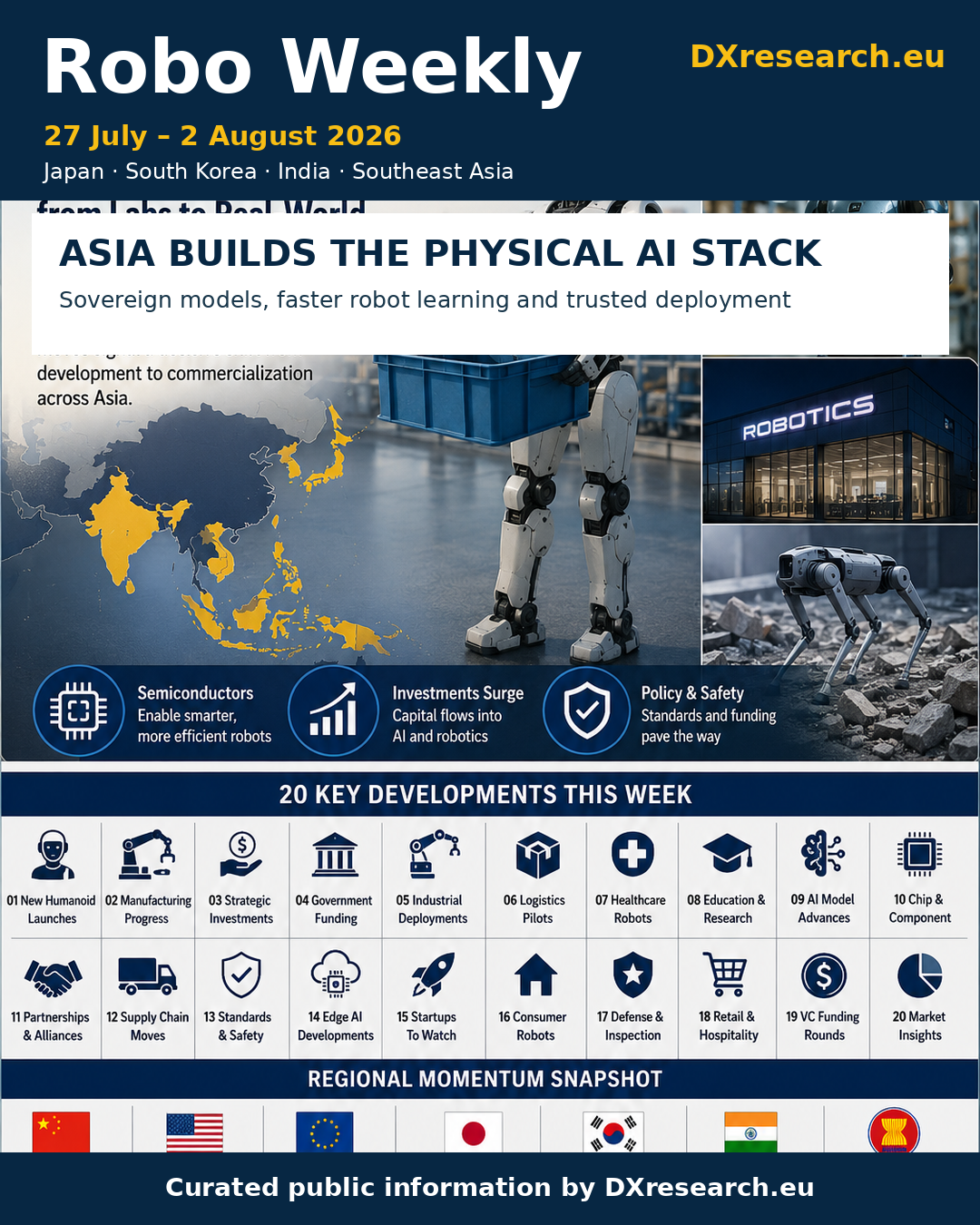
Asia’s Physical AI Stack Moves from National Strategy to Robot Learning
Reporting window: 27 July–2 August 2026 · Focus: Japan, South Korea, India and Southeast Asia
What’s Changed Since Last Week
▲ Robot-learning research accelerated
Three in-window publications advanced autonomous skill acquisition, on-robot learning speed, and physics-aware representations.
● Trusted supply became a product requirement
Reported import restrictions increased the strategic value of cybersecurity, provenance, and exportable reference architectures.
▲ Robotics broadened beyond engineering discourse
IEEE’s July synthesis placed robotics more explicitly within business, social, and cultural change.
Lead Story: Asia Builds the Physical AI Stack
Asia’s robotics race is no longer defined only by who can build an impressive humanoid. Japan is assembling sovereign compute, multimodal models, industrial partners, and deployment ambitions. South Korea is concentrating corporate resources while confronting workforce governance directly. India is emphasizing lower-complexity industrial forms and locally relevant economics. Southeast Asia is strengthening the developer and innovation base required for later deployment.
Executive Synthesis
The week’s clearest new evidence came from research rather than product launches. Three publications showed how robots can gather their own manipulation experience, accelerate physical learning through symmetry-based augmentation, and expose what multimodal world models do—and do not—retain about hidden physical properties. Together, these studies move the discussion from larger models toward deployable learning systems.
Commercial context remains uneven. Japan and South Korea possess deep component, manufacturing, and corporate capacity, but must convert that depth into repeatable deployment. India is building a pragmatic path through industrial logistics and lower-cost compute. Southeast Asia remains earlier, with the strongest near-term signals in talent, software ecosystems, and innovation policy. Across the region, trusted supply, cybersecurity, labor acceptance, and lifecycle support are becoming inseparable from robot performance.
Impact to Infineon
Asia’s shift toward deployable Physical AI expands demand for efficient motor control, power conversion, battery management, secure MCUs, sensing, connectivity, and deterministic edge architectures. The strategic opening is application-ready reference designs that combine reliability, safety, cybersecurity, and lifecycle support.
20 Consequential Developments
IEEE review frames robots as an increasingly visible social and business force
IEEE’s monthly review highlights robotics moving beyond specialized industrial systems into broader social, commercial, and cultural visibility.
DXresearch interpretation: The signal is structural: adoption debates now include public legitimacy, workforce impact, and institutional readiness alongside technical performance.
IEEE Robotics and Automation Society: Robots in Society, Business and Culture: July 2026
HERO demonstrates self-improving manipulation without human demonstrations
Researchers introduced HERO, a hierarchical embodied agent that autonomously gathers experience and consolidates reusable manipulation policies.
DXresearch interpretation: Reducing dependence on teleoperation data could lower deployment cost, but safety validation and real-world robustness remain open engineering requirements.
SymmGrid accelerates direct on-robot learning for contact tasks
Symmetry-based trajectory augmentation improved training speed and success rates on real robot insertion, routing, and relocation tasks.
DXresearch interpretation: Faster physical learning strengthens the case for local adaptation, raising the value of efficient inference and high-bandwidth sensor processing.
World-model research identifies limits in learning hidden physical parameters
A controlled study found prediction objectives determine whether robot world models retain mass, stiffness, drag, and force information.
DXresearch interpretation: Model architecture alone is insufficient; sensor selection and training objectives jointly determine which physics becomes operationally usable.
US import restrictions create a strategic shock for Asian robot suppliers
Reported US restrictions on foreign-made humanoids and quadrupeds add security and market-access risk for Asian robotics supply chains.
DXresearch interpretation: Japan, Korea, India, and Southeast Asia may benefit from trusted-supply positioning, but component provenance and cybersecurity assurance become commercial requirements.
Business Standard / AP: US bans foreign-made humanoid robots, targeting China on security grounds
Japan’s Noetra positions sovereign physical AI as national infrastructure
Government-backed Noetra plans national AI infrastructure and a Japanese physical-AI model supported by major industrial groups.
DXresearch interpretation: Japan is attempting to connect sovereign compute, industrial data, and robotics deployment rather than competing only at the foundation-model layer.
Reuters: Robot AI company Noetra is ‘last chance’ for Japan, CEO says
Samsung creates a dedicated robotics organization and international research hubs
Samsung formed a robotics strategy unit and outlined research hubs in the United States, China, and Japan.
DXresearch interpretation: The move turns robotics from an adjacent technology theme into an organized corporate growth platform spanning components, AI, and systems.
Reuters: Samsung Electronics creates robotics division; ex-Hyundai executive to lead
Nvidia deepens partnerships with Japanese robotics companies
Nvidia announced collaboration with Japanese robotics firms and linked national AI infrastructure directly to physical-AI development.
DXresearch interpretation: Japan’s robotics incumbents are increasingly pairing mechanical depth with imported accelerated-computing platforms to shorten software-development cycles.
Reuters: Nvidia partners with Japan robotics firms on AI development
Noetra begins full-scale development of a Japan-made multimodal foundation model
Noetra, Sony, SoftBank, NEC, Honda, AIST, and partners started full-scale development of a sovereign multimodal model.
DXresearch interpretation: The consortium approach is designed to aggregate industrial data and deployment channels that isolated robotics developers often lack.
Sony Group: Noetra Launches Full-Scale R&D for Japan-Developed Multimodal Foundation Model
Sony opens aibo research platform to university collaboration
Sony announced university collaboration and an R&D-use aibo prototype to expand learning, interaction, and service capabilities.
DXresearch interpretation: Consumer robots remain a valuable testbed for long-duration autonomy, personalization, and socially acceptable human-robot interaction.
AMD embedded processors enter a new humanoid platform program
Foundation selected AMD Ryzen AI Embedded processors for its next humanoid platform, linking embedded compute directly to industrial deployment.
DXresearch interpretation: The deal illustrates growing processor competition below the data-center layer, where power, latency, safety, and lifecycle support matter.
Reuters: Eric Trump-backed Foundation partners with AMD to develop humanoid robots
Hyundai labor dispute makes humanoid governance a board-level deployment issue
Hyundai workers challenged future Atlas deployment, linking humanoid adoption to job protection, compensation, and governance.
DXresearch interpretation: Technical readiness will not secure deployment without workforce agreements, transparent task allocation, and credible reskilling pathways.
RoboCup 2026 reinforces Korea’s talent and research pipeline
Korea hosted RoboCup 2026 in Incheon, using the competition to connect robotics research, students, and industrial policy.
DXresearch interpretation: Competitions remain ecosystem infrastructure: they create benchmarks, engineering talent, and reusable software before commercial scale emerges.
Korea Ministry of Trade, Industry and Resources: Future M.AX Talents to Compete at RoboCup 2026
RoboCup coverage highlights widening tasks beyond robot football
RoboCup 2026 showcased humanoids and service robots addressing household, logistics, and human-assistance tasks beyond competition football.
DXresearch interpretation: Benchmark diversity is expanding toward manipulation and service work, closer to commercial embodied-AI requirements.
Korea JoongAng Daily: The future comes to RoboCup 2026 Incheon
Tokyo summit exposes Japan’s commercialization gap and precision advantage
Tokyo demonstrations contrasted Japanese precision and public acceptance with faster, lower-cost Chinese humanoid commercialization.
DXresearch interpretation: Japan’s opportunity lies in converting component quality, durability, and social acceptance into scalable products and deployment economics.
Japan Airlines tests humanoids in airport ground operations
Japan Airlines and GMO AI & Robotics began testing humanoids for baggage and ground-support tasks at Haneda Airport.
DXresearch interpretation: Airports offer structured but safety-critical environments where labor shortages can justify high utilization and measurable task economics.
People: Humanoid Robots Are Being Tested as Baggage Handlers at Airport in Japan
Addverb advances India’s domestically engineered wheeled humanoid
Addverb unveiled Elixis-W, a made-in-India wheeled humanoid designed for industrial logistics and material-handling applications.
DXresearch interpretation: Wheeled humanoids offer India a pragmatic route to embodied AI by prioritizing manipulation and workflow integration over bipedal complexity.
The Economic Times: Addverb unveils wheeled humanoid Elixis-W at LogiMAT India 2026
Qualcomm presents a task-oriented humanoid stack in India
Qualcomm demonstrated a robotics stack in India targeting logistics, manufacturing, and retail through task-specific embodied-AI capabilities.
DXresearch interpretation: Mobile-derived compute architectures could lower power and cost barriers for Indian robot developers and system integrators.
Business Standard: Qualcomm showcases AI humanoid robots at India AI Impact Summit
Singapore launches a regional AI-builder program spanning Southeast Asia
A Singapore hackathon program is planned to expand into Indonesia, Vietnam, Taiwan, and Malaysia, widening applied-AI developer networks.
DXresearch interpretation: Although software-led, the program strengthens the regional talent substrate required for future embodied-AI integration and robotics applications.
Tech in Asia: Sea and OpenAI unite Singapore’s AI builders at Codex hackathon
ASEAN innovation review identifies persistent commercialization and coordination gaps
A regional policy review finds Southeast Asian innovation systems expanding while coordination, commercialization, and capability gaps remain.
DXresearch interpretation: Robotics growth will depend less on isolated pilots and more on procurement, integrators, skills, and cross-border industrial ecosystems.
Regional Synthesis
China
Used only as essential comparison: cost, production speed, and export scale continue to pressure other Asian ecosystems toward differentiated trusted-supply and quality strategies.
USA
Policy and processor competition increasingly shape Asian market access, semiconductor choices, and requirements for cybersecurity and provenance.
Europe
Europe remains a safety, industrial-integration, and premium-engineering benchmark, especially for Indian and Southeast Asian partnerships.
Japan
The strongest strategic signal is sovereign Physical AI: national infrastructure, multimodal models, robotics partnerships, and precision engineering are being connected.
South Korea
Corporate concentration is accelerating, while labor governance shows that social license and deployment rules can become gating factors.
India
Industrial wheeled humanoids, low-power compute, and domestic engineering offer a pragmatic path toward commercially relevant embodied AI.
Southeast Asia
The near-term opportunity lies in developer ecosystems, system integration, logistics, electronics manufacturing, and public-sector innovation capacity.
Market Sentiment, Evidence and Outlook
Sentiment: Constructive but selective. Research capability and national commitment are rising faster than verified operating-fleet evidence.
Evidence: High confidence for official corporate actions and published research; lower maturity for prototypes, demonstrations, targets, and ecosystem programs.
Outlook: The next competitive boundary is dependable deployment: robot learning, safety assurance, trusted components, workforce integration, and service economics.
Annual Global Humanoid Shipment Scenarios, 2025–2040
Methodology: DXresearch compound-growth scenarios calibrated to public analyst estimates for 2026 and 2030. Values are scenario outputs, not reported actuals. Conservative, Base, and Accelerated cases vary adoption, manufacturing capacity, regulation, and deployment economics.
| Year | Conservative | Base | Accelerated |
|---|---|---|---|
| 2025 | 45,000 | 55,000 | 65,000 |
| 2026 | 62,100 | 81,400 | 102,700 |
| 2027 | 85,698 | 120,472 | 162,266 |
| 2028 | 118,263 | 178,299 | 256,380 |
| 2029 | 163,203 | 263,882 | 405,081 |
| 2030 | 225,221 | 390,545 | 640,028 |
| 2031 | 310,804 | 578,007 | 1,011,244 |
| 2032 | 428,910 | 855,450 | 1,597,765 |
| 2033 | 591,896 | 1,266,066 | 2,524,469 |
| 2034 | 816,816 | 1,873,778 | 3,988,661 |
| 2035 | 1,127,206 | 2,773,191 | 6,302,085 |
| 2036 | 1,555,545 | 4,104,323 | 9,957,294 |
| 2037 | 2,146,652 | 6,074,398 | 15,732,524 |
| 2038 | 2,962,379 | 8,990,110 | 24,857,388 |
| 2039 | 4,088,083 | 13,305,362 | 39,274,673 |
| 2040 | 5,641,555 | 19,691,936 | 62,053,983 |
Editorial Disclosure
All information is public and curated by DXresearch.eu. Publication dates and evidence classes are preserved. Because the selected regions produced fewer than 20 qualifying in-window public developments, contextual items outside the reporting window are included and flagged in the package validation report.
Weekly news infographic