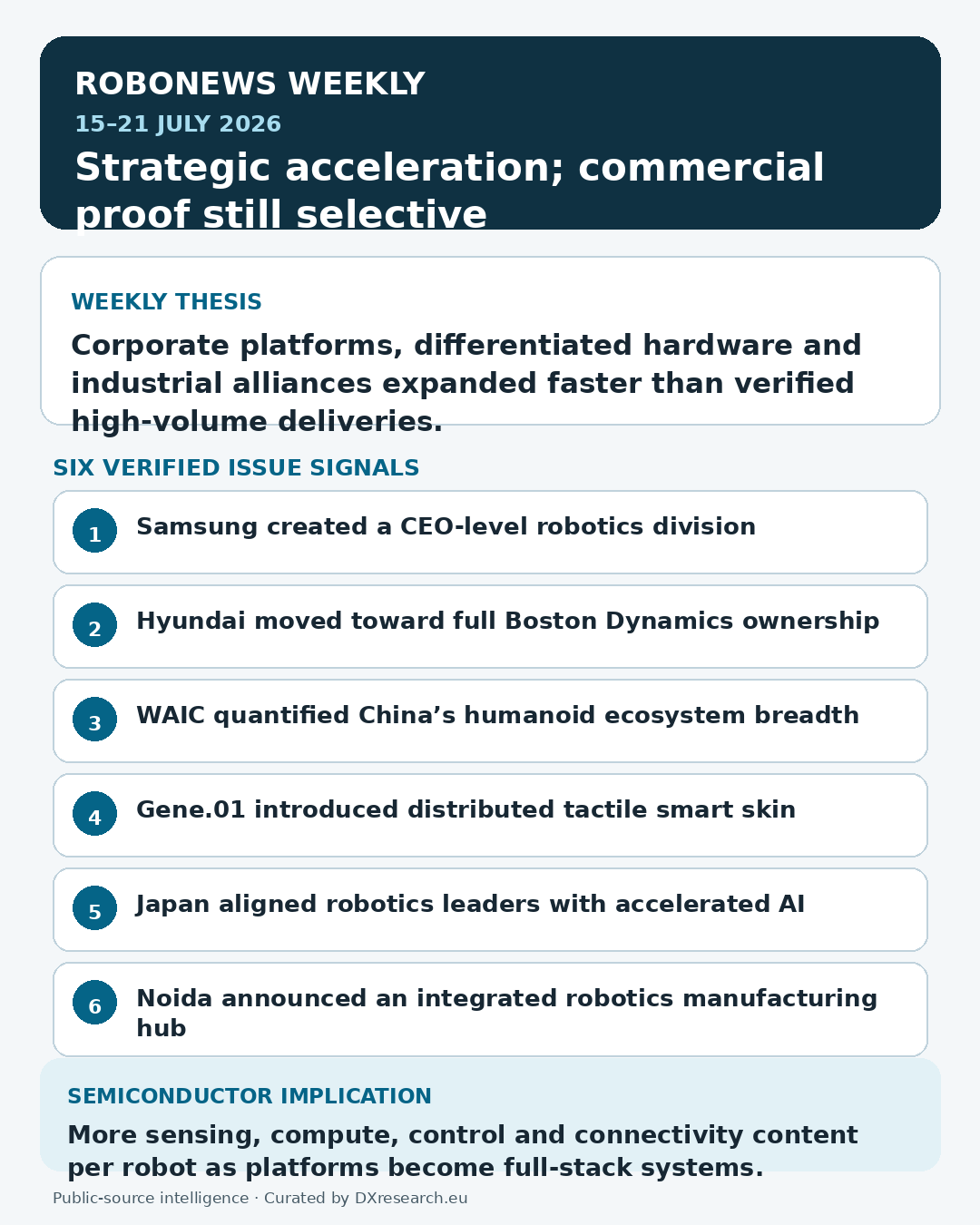
RoboNews weekly 2026.07.21

Market Updates
Samsung formalizes robotics as a growth platform
A CEO-level division and planned international research hubs convert prior ambition into a dedicated operating structure.
Europe adds a tactile-skin humanoid platform
Gene.01 expands Europe’s differentiated hardware set with distributed touch, proximity, force and temperature sensing.
WAIC adds quantified ecosystem evidence
Post-event reporting supplied a clearer measure of China’s platform and product density, without proving equivalent commercial deployment.
Forecast held constant
New corporate structures and product launches strengthen ecosystem breadth, but no verified shipment evidence justifies a unit-forecast revision.
Samsung turns Physical AI into a corporate growth platform
The creation of a CEO-level robotics division extends the humanoid race from specialist startups into diversified electronics groups with global R&D, manufacturing and supply-chain leverage.
Samsung’s RX division is the week’s clearest structural signal. It creates a dedicated organization for robotics strategy, core technology and commercialization, led by an executive with prior responsibility for Hyundai’s robotics strategy and Boston Dynamics. Planned research hubs in the United States, China and Japan point to a multinational capability model rather than a Korea-only program.
The broader week shows three parallel movements. China used WAIC to demonstrate portfolio density, multi-embodiment architectures and world-model stacks. Europe strengthened hardware differentiation through tactile skin, dexterous hands and robot-data platforms. Japan and South Korea tightened the coupling between accelerated AI, precision mechatronics, corporate ownership and industrial deployment. The evidence remains strategically significant but commercially uneven: production targets, demonstrations and funding continue to outnumber independently verified deliveries.
Twenty consequential developments
Use the search and region controls above. Product performance, production targets and funding figures are treated as attributed claims unless independently verified.
Samsung Creates a CEO-Level Robotics Division
Samsung Electronics creates robotics division; ex-Hyundai executive to head strategy
Samsung established the RX division, reporting directly to the CEO, with research hubs planned for the United States, China and Japan.
Gene.01 Adds Full-Body Tactile Skin
Generative Bionics Introduces Gene.01, a Fully Functional Smart-Skin Humanoid Robot Platform Designed for Safe Human Collaboration
Italy’s Generative Bionics unveiled a humanoid with distributed touch, proximity, force and temperature sensing and an open digital robot model.
WAIC Quantifies China’s Humanoid Breadth
Shanghai science forum photos show China’s AI and robotics advances in rivalry with US
Post-event reporting cited more than 1,100 exhibitors and a state-media estimate of over 400 Chinese humanoid products.
ACE Robotics Links World Models to Deployment
ACE ROBOTICS Unveils Kairos 3.1 and Expands Its Embodied AI Stack from Data to Deployment at WAIC 2026
ACE Robotics introduced Kairos 3.1 and presented an embodied-AI stack spanning data generation, world models, control and deployment.
AGIBOT Launches Four WAIC Products
AGIBOT Unveils Four New Products at WAIC 2026, Showcasing Embodied AI in Real-World Operations
AGIBOT introduced four platforms spanning humanoid, service and embodied-intelligence applications, reinforcing its portfolio commercialization strategy.
PUDU Shows One Brain Across Multiple Bodies
PUDU Robotics Highlights Its “One Brain, Multiple Embodiments” Physical Agent at WAIC 2026
PUDU presented a shared Physical Agent architecture and publicly demonstrated its industrial-grade D7 semi-humanoid.
https://www.pudurobotics.com/news/waic-2026-pudu-d7-industrial-semi-humanoid-robot-launch
mimic Robotics Goes Full-Stack Around the Hand
mimic robotics Goes Full-Stack at the Frontier of Physical AI
mimic introduced the M1 hand and U1 wearable, linking manipulation hardware, human demonstration data and robot-learning models.
microagi Raises Capital for Robot Learning Data
F1 engineer quit Red Bull to build an army of factory robots. Now his startup has raised $55 million.
The reported $55 million round supports industrial robot learning through scalable collection of human physical-task data.
https://www.businessinsider.com/f1-engineer-quit-redbull-to-build-army-of-factory-robots-2026-7
Ukraine Opens a Humanoid Grant Track
Ukraine wants combat humanoid robots — but expect Wall-E over Terminator
Ukraine’s Brave1 initiative opened funding for domestic bipedal systems while battlefield evidence still favors simpler wheeled and tracked robots.
Hyundai Moves to Full Boston Dynamics Ownership
Hyundai Motor Group to own Boston Dynamics in full with SoftBank stake buy
Hyundai announced plans to acquire SoftBank’s remaining stake, consolidating strategic control over Atlas development and commercialization.
Humanoid Concerns Reach the Factory Gate
The Fight Over Humanoid Robots Has Shut Down a Car Factory for the First Time
A Hyundai labor dispute linked humanoid deployment concerns with a partial Ulsan factory shutdown and job-protection demands.
KAIST Demonstrates Self-Dressing Soft Robotics
South Korea-US team unveils robotic technology that dresses the wearer
KAIST and Stanford researchers demonstrated pneumatic vine robots that pull clothing onto a moving wearer in roughly ten seconds.
Japan Builds a Physical-AI Industrial Alliance
Nvidia partners with Japan robotics firms on AI development
NVIDIA aligned with Fanuc, Yaskawa and other Japanese industrial players to accelerate AI-enabled robotics and national compute infrastructure.
Fujitsu Connects Japanese Robot Makers to NVIDIA
Fujitsu and leading Japanese robotics companies to use Nvidia technology in ‘physical AI’
Fujitsu, Fanuc, Yaskawa and Kawasaki Heavy Industries outlined collaboration around NVIDIA technology for adaptable robots working alongside people.
XPeng Sets a Four-Digit Monthly Robot Target
XPeng Aims to Produce Over 1,000 Robots a Month as It Plans Global Rollout
XPeng reportedly targets more than 1,000 IRON humanoids per month by year-end 2026 before a broader international rollout.
Sunday Robotics Claims Cross-Home Laundry Generalization
Sunday Robotics says its robot can fold clothes it has never seen in unfamiliar homes
Sunday Robotics said its ACT-2 model enables Memo to fold unfamiliar clothing in new homes with more than 99% task accuracy.
https://www.businessinsider.com/sunday-robotics-memo-home-robot-fold-laundry-99-success-2026-7
Faraday Future Expands Its Embodied-AI Developer Push
Faraday Future Showcases Its EAI Robot World Across Three High-Level Silicon Valley Robotics and AGI Summits
Faraday Future demonstrated humanoid and quadruped platforms while promoting a developer-oriented embodied-AI ecosystem and full-stack strategy.
Embodied AI Enters a K–12 Classroom Pilot
Humanoid robot ‘Sally’ to join Seneca Nation K-12 classrooms
A Realbotix humanoid was reported for a classroom pilot intended to support interactive learning and demonstrate embodied AI.
https://nypost.com/2026/07/18/us-news/humanoid-robot-sally-to-join-seneca-nation-k-12-classrooms/
Noida Plans a Major Robotics Manufacturing Hub
UP plans India’s largest robotics hub in Noida, aims to rule in AI and deep tech
Uttar Pradesh announced plans for an integrated robotics and advanced-manufacturing hub in Noida plus two deep-tech centers.
AGIBOT Builds an Australia–New Zealand Channel
AGIBOT Brings APC 2026 to Australia and New Zealand
AGIBOT expanded its partner program to Australia and New Zealand to support local embodied-AI deployment and commercial integration.
Where momentum moved
China
WAIC concentrated attention on deployable portfolios, shared intelligence across multiple embodiments and world-model stacks. XPeng added a measurable production target, while AGIBOT and PUDU emphasized commercialization and international channels.
USA
US activity centered on home manipulation, education pilots and ecosystem promotion. Evidence improved around task generalization, yet large-volume shipments and sustained customer utilization remain limited.
Europe
Europe’s strongest signals came from differentiated hardware and robot-learning infrastructure: tactile skin, dexterous hands, wearables and physical-task data. Ukraine also opened a defense-oriented humanoid grant track.
Japan
NVIDIA, Fujitsu and major industrial-robotics suppliers tightened the link between accelerated compute, national infrastructure and precision mechatronics, reinforcing Japan’s Physical-AI industrial strategy.
South Korea
Samsung created a dedicated robotics division and Hyundai moved toward full Boston Dynamics ownership. Labor resistance at Ulsan showed that deployment governance is becoming a material execution risk.
India
The Noida robotics hub was the main new signal. India remains focused on ecosystem formation, manufacturing capability and deep-tech infrastructure rather than verified humanoid production scale.
Strategic acceleration; commercial proof still selective
Cautiously constructive
Reported actuals: The week added research demonstrations, product introductions, organizational changes and a reported classroom pilot. It did not add independently verified high-volume humanoid deliveries.
Company targets and claims: XPeng’s monthly production objective, Sunday Robotics’ reported task accuracy and multiple WAIC product claims remain forward-looking or company-reported evidence.
DXresearch interpretation: The market is broadening from individual robots toward corporate platforms, multi-embodiment software and vertically integrated supply chains. Execution risk remains concentrated in reliability, economics, workforce acceptance and pilot-to-series conversion.
| Year | Conservative | Base | Accelerated |
|---|---|---|---|
| 2025 | 18,000 | 35,000 | 60,000 |
| 2026 | 35,000 | 70,000 | 130,000 |
| 2027 | 70,000 | 150,000 | 300,000 |
| 2028 | 130,000 | 300,000 | 650,000 |
| 2029 | 230,000 | 550,000 | 1,200,000 |
| 2030 | 380,000 | 900,000 | 2,000,000 |
| 2031 | 600,000 | 1,400,000 | 3,100,000 |
| 2032 | 900,000 | 2,200,000 | 5,100,000 |
| 2033 | 1,300,000 | 3,450,000 | 7,100,000 |
| 2034 | 1,700,000 | 4,600,000 | 9,500,000 |
| 2035 | 2,150,000 | 5,900,000 | 12,300,000 |
| 2036 | 2,650,000 | 7,350,000 | 15,500,000 |
| 2037 | 3,200,000 | 8,900,000 | 19,200,000 |
| 2038 | 3,800,000 | 10,500,000 | 23,400,000 |
| 2039 | 4,500,000 | 12,200,000 | 28,100,000 |
| 2040 | 5,200,000 | 14,000,000 | 33,500,000 |
Methodology: Annual global unit shipments of bipedal humanoids, wheeled humanoids and human-environment mobile manipulators. The synthesis combines disclosed deliveries, production capacity, orders, funding, public financial statements and credible analyst estimates, then applies utilization, pilot-to-series conversion, price-decline and execution-risk adjustments.
Evidence change versus previous issue: Samsung’s RX division, Gene.01 and post-WAIC portfolio quantification strengthen ecosystem and technology breadth. No verified shipment evidence warrants changing near-term unit assumptions.
Weekly news infographic