Chapter 13
The Robot Must Survive the Weather
Environmental Robustness for Humanoids Leaving the Factory Floor
Executive Summary
Humanoid robots are beginning to leave controlled factory floors for construction sites, logistics yards, farms, campuses, and other semi-structured environments. Outdoors, intelligence is exposed to rain, dust, condensation, temperature swings, sunlight, mud, corrosion, and changing thermal conditions. This chapter argues that environmental robustness must therefore become a first-order electronic-architecture requirement rather than an enclosure specification added late in development. IEC ingress and environmental test standards provide useful qualification building blocks, but humanoids add moving joints, serviceable modules, cameras, microphones, pressure ports, cooling paths, and high-power connectors that continuously challenge sealing assumptions. The semiconductor response spans wide-temperature devices, protected sensors, local diagnostics, humidity and pressure monitoring, resilient communications, power protection, and controllers that adapt operating limits to environmental state. Outdoor readiness is ultimately a system property: the robot must sense its own exposure, preserve electrical integrity, degrade gracefully, and retain perception and motion when the environment stops behaving like a laboratory.
The Laboratory Boundary Is Disappearing
The first commercially serious humanoid deployments are concentrated in structured industrial environments, but the technical trajectory points outward. Construction, agriculture, energy, logistics yards, campuses and maintenance work all reward machines that can use human tools and infrastructure without requiring a dedicated automation cell. Recent humanoid navigation research has already demonstrated a Unitree G1 moving through previously unseen indoor and outdoor environments, with training data deliberately spanning rain, nighttime, rough ground and off-road paths [ref-egonav-2026]. The locomotion and AI problem is therefore expanding into an environmental-engineering problem.
A robot that can plan a path through rain is not necessarily a robot that can survive rain. Cameras may remain optically functional while connectors accumulate moisture. A sealed torso may pass an enclosure test while condensation forms on an internal cold plate. A motor inverter may remain within its electrical ratings while mud changes cooling airflow. Outdoor intelligence fails whenever the physical environment invalidates assumptions embedded in electronics, packaging, sensing, cooling or control.
This chapter uses environmental robustness to mean the system-level ability to preserve required function and integrity across specified environmental stresses. It is broader than rugged housing. For humanoids, environmental robustness must include exposure sensing, protective design, diagnostic evidence and operating policies that adapt before environmental stress becomes a latent fault.
Ingress Protection Is Necessary, but It Is Not the Architecture
IEC 60529 classifies the degree of protection provided by enclosures against access, solid foreign objects and water [ref-iec-60529-1989]. This makes ingress protection an important engineering language, but an IP code describes performance under defined tests; it does not automatically prove robot-wide robustness across every pose, joint motion, connector cycle, thermal state or service event.
Humanoids are difficult to seal because they are intentionally articulated. Cable exits move. Joint interfaces rotate. Covers are removed for service. Speakers and microphones need acoustic paths. Pressure sensors need exposure to air. Cameras need transparent windows that remain clear. Cooling needs heat rejection, and some architectures need airflow. Hands may be expected to touch wet, dirty or chemically contaminated objects. The design target is therefore not “seal everything.” The target is to create controlled environmental boundaries with known leak paths, drains, vents, membranes, protective coatings, isolation zones and measurable failure behavior.
Infineon’s DPS368 pressure sensor illustrates the principle at component and integration level. The device is described as protected against water, dust and humidity and rated IPx8, while application guidance discusses O-rings, adhesive gels and conformal-coating considerations for water-resistant systems [ref-ifx-dps368] [ref-ifx-dps368-integration]. The lesson is architectural: component robustness only becomes system robustness when packaging, PCB treatment, port geometry and enclosure design are co-engineered.
Condensation Is the Hidden Outdoor Failure Mode
Rain is visible; condensation is more subtle. A robot can be externally dry and still form water internally when a surface falls below the local dew point. Humanoids are especially exposed because they combine high-power heat sources, cooled compute, sealed cavities and repeated transitions between warm buildings and cold outdoor air.
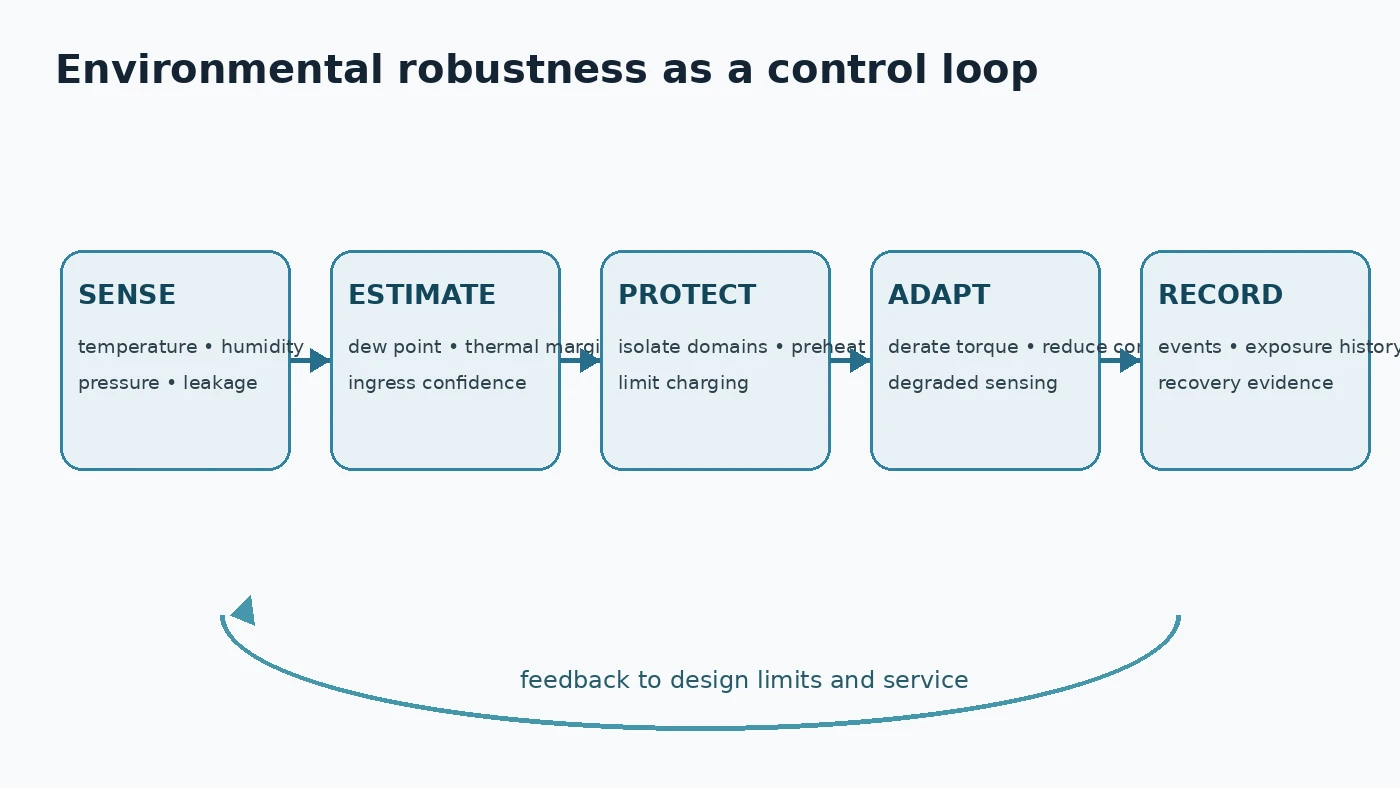
IEC 60068-2-30:2025 explicitly addresses high humidity combined with cyclic temperature changes that generally produce condensation on a specimen [ref-iec-60068-2-30-2025]. For humanoids, condensation risk should be treated as a dynamic state rather than a one-time qualification result. Temperature and humidity measurements distributed through the torso, battery, compute bay and selected limbs can estimate dew-point margin. Controllers can then delay high-risk power-up, preheat electronics, alter fan behavior, reduce local dissipation, or keep vulnerable rails disabled until conditions recover.
This is a semiconductor opportunity because environmental state can become machine-readable. Low-power sensors, microcontrollers, nonvolatile event logs and power switches can transform a passive enclosure into an active environmental-control layer. The robot does not merely resist moisture; it detects whether the assumptions behind its resistance remain valid.
Temperature Changes Consume Margin Everywhere
IEC 60068-2-14:2023 provides tests for the effects of specified ambient temperature changes [ref-iec-60068-2-14-2023]. A humanoid experiences those changes simultaneously across mechanics, batteries, power electronics, sensors and compute, but not at the same rate. Large thermal gradients can distort structural geometry, shift sensor offsets, change lubricant viscosity, reduce battery power capability, raise semiconductor losses and move calibration outside its original operating envelope.
The control implication is environmental derating. Instead of a single global temperature limit, the robot should manage multiple local limits with explicit confidence. Joint peak torque may be reduced when inverter or winding margin narrows. Charging power may be limited when battery temperature is unfavorable. AI compute clocks may be constrained if cooling effectiveness drops. Perception confidence may be adjusted when lens heaters, windows or sensors approach conditions where fogging, ice or noise becomes likely.
This creates a strong link between semiconductor selection and robot capability. Wide-temperature controllers, sensors, power stages, memories and security devices preserve design margin, but their value is highest when diagnostics expose actual operating state. The book’s broader semiconductor architecture is already distributed across motor control, sensing, power, connectivity, safety and security [ref-ifx-humanoid-2026]. Environmental robustness cuts horizontally across the same blocks.
Outdoor Perception Is an Electronics Problem Too
Outdoor sensing is not solved by adding a better neural network. Sun glare, low light, rain on optical windows, dust films, fog, temperature drift and water droplets all change the physical signal before AI receives it. The correct response is diversity and observability: optical sensors should be complemented where practical by modalities with different failure physics, while local electronics expose health indicators such as temperature, supply margin, communication errors, heater status or signal-quality metrics.
The G1 outdoor navigation evidence is instructive because it combines color, depth and semantic information and reports deployment across environmental diversity rather than one controlled scene [ref-egonav-2026]. The durable engineering lesson is not the specific model architecture. It is that useful autonomy increasingly depends on sensing stacks able to operate under changing light, weather, traffic and terrain. Robust Physical AI therefore requires sensor-fusion policies that distinguish “the environment changed” from “the sensor failed.”
Protection Must Be Zonal
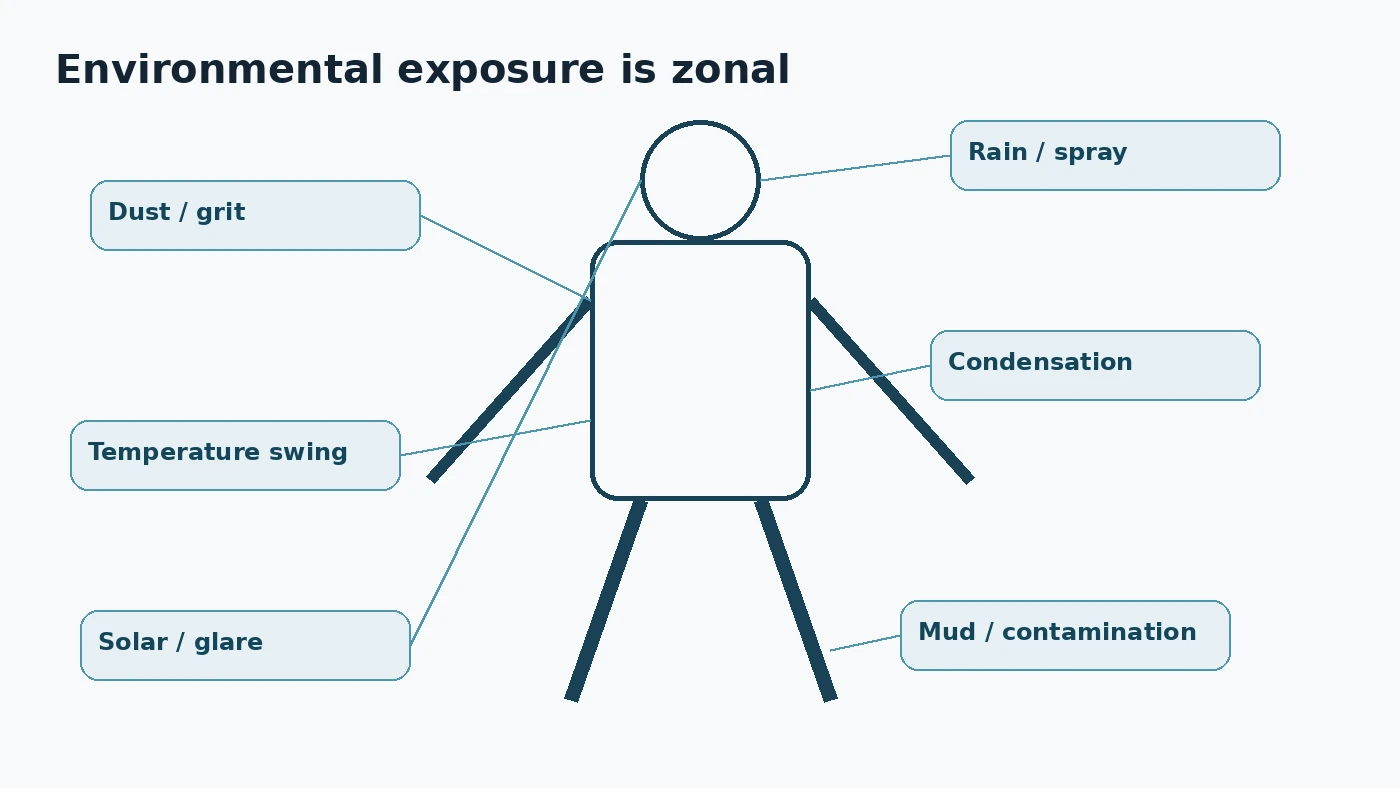
A humanoid should not be treated as one environmental enclosure. The feet face water, grit and impact. Hands face contact contamination and cleaning agents. Joint cavities experience pumping action as volume and pressure change. The torso carries high-value compute and power. The head carries exposed perception surfaces and acoustic openings. A practical architecture therefore allocates different environmental zones and interfaces.
| Robot zone | Dominant exposure | Electronic design response | Semiconductor leverage |
|---|---|---|---|
| Feet / lower legs | Water, grit, mud, impact | Sealed connectors, local current limiting, drain paths, contact diagnostics | Protected power switching, current sensing, local controller |
| Joints | Moving seals, dust, temperature gradients | Short local harnesses, protected encoders, thermal monitoring, fault containment | Position sensors, motor control, diagnostics, communications |
| Hands | Water, dirt, chemicals, abrasion | Replaceable modules, protected tactile electronics, isolated local power | Sensor interfaces, compact controllers, load switches |
| Torso | Condensation, thermal load, service access | Dew-point monitoring, controlled airflow, domain isolation, event logging | Environmental sensors, power-management ICs, nonvolatile memory, controllers |
| Head | Rain, glare, dust films, fogging | Window heating/cleaning, multimodal sensing, health monitoring | Radar / time-of-flight interfaces, power drivers, sensor diagnostics |
From Binary Protection to Graceful Environmental Degradation
Environmental limits should not always produce an immediate binary shutdown. ISO 10218-1:2025 provides a foundation for inherently safe robot design and risk reduction [ref-iso-10218-1-2025], but practical outdoor operation also needs defined intermediate states. A robot that detects moisture in a noncritical hand module may be able to isolate that hand, reduce manipulation capability and walk to service. A robot approaching thermal limits may slow or suspend high-torque motion while preserving communication and balance.
This is graceful degradation: capability is reduced in a controlled way while preserving safety and useful function where the risk analysis permits it. Environmental diagnostics therefore need to connect directly to the robot state machine. Moisture flags, thermal margins, enclosure-pressure anomalies, insulation checks, communication error counters and sensor confidence should not disappear into maintenance logs; they should influence behavior.
Validation Must Follow Mission States
Environmental qualification of components and enclosures remains essential, but humanoid validation should add mission-state combinations. Water exposure during static standby is different from rain during walking. Dust exposure is different when joint seals are continuously moving. Temperature transition is different during charging than during peak actuator loading. Condensation risk changes after the robot returns from a cold yard into a warm service bay.
A useful validation matrix therefore combines standardized environmental tests with robot states: idle, walking, manipulation, charging, high-compute operation, recovery after exposure and maintenance reopening. Engineers should monitor not only survival but functional drift—sensor offsets, communication errors, leakage current, power-rail stability, torque derating, perception confidence and fault-memory content.
The result is evidence that can be reused in fleet engineering. Environmental event histories correlated with field failures can refine thresholds and expose weak interfaces. This also creates a design feedback loop for semiconductor requirements: which sensors need wider operating range, which transceivers need better fault visibility, which power switches need stronger protection, and which local controllers need persistent diagnostic memory.
Semiconductor Implications
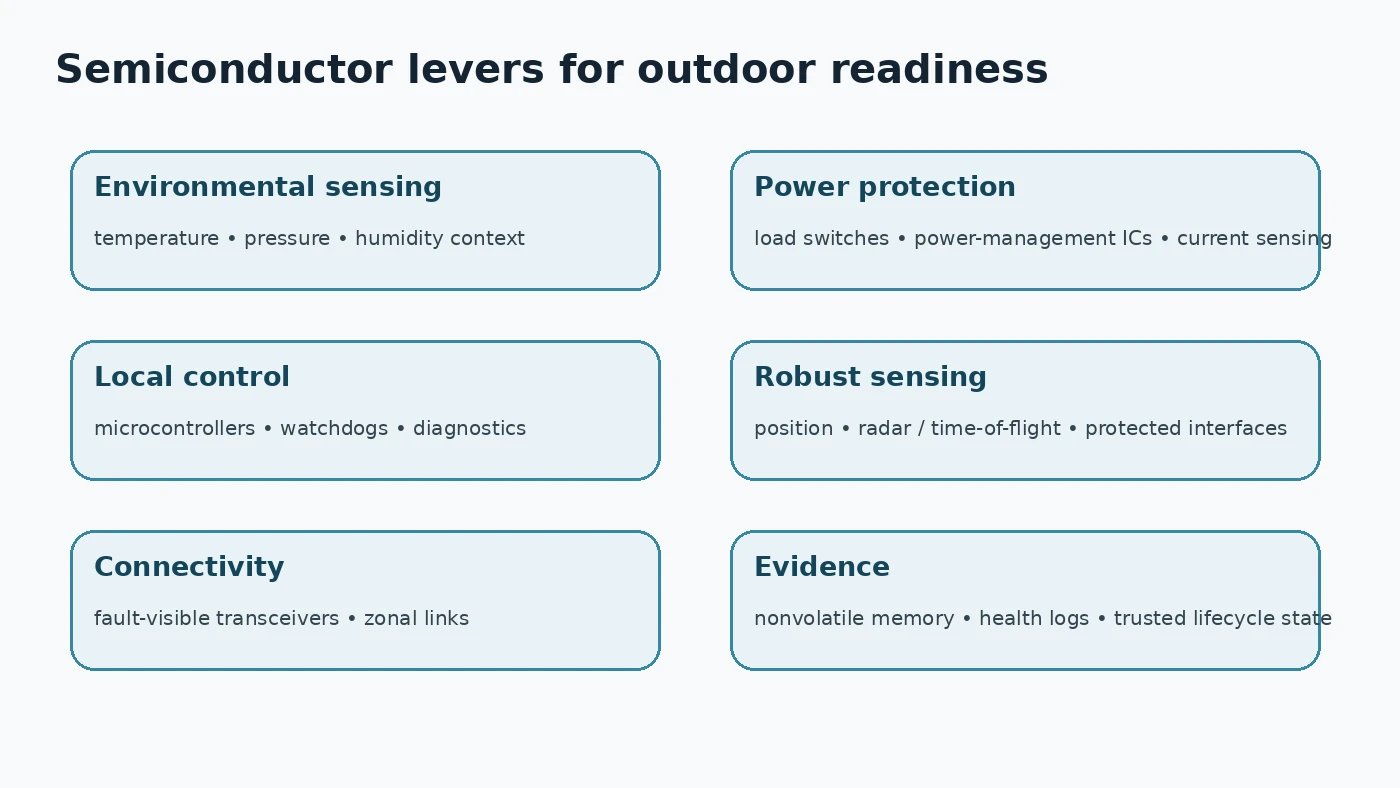
The semiconductor opportunity is horizontal. Power devices and gate drivers need predictable behavior over temperature and fault conditions. Current sensors and position sensors need stable accuracy and diagnostics. Pressure, temperature and other environmental sensors provide exposure context. Microcontrollers execute local protection when central compute is unavailable. Power-management ICs and load switches isolate wet or suspect domains. Robust transceivers keep distributed nodes observable. Nonvolatile memory records exposure and fault history. Security controllers preserve identity and trusted updates through harsh field deployment.
Most importantly, component qualification should be translated into architectural contracts. Each electronic module can declare environmental operating range, transient limits, sealing assumptions, diagnostic signals, allowed degraded states and recovery procedure. That makes environmental robustness composable rather than dependent on undocumented integration knowledge.
Conclusion
Humanoid robots become economically interesting when they can work where people already work. That eventually includes places that are wet, dusty, cold, hot, bright, dirty and thermally unpredictable. The transition from indoor demonstration to real-world deployment therefore requires more than stronger locomotion policies or larger AI models.
The design principle is straightforward: define environmental zones, control ingress paths, detect condensation risk, monitor thermal margin, protect vulnerable domains, fuse sensing with health information, and degrade capability deliberately when exposure consumes margin. IEC and ISO standards provide essential test and safety foundations, but the humanoid architecture must connect those foundations to distributed electronics and runtime behavior. A robot that cannot tell whether its own environment is invalidating its electronics cannot be trusted to act intelligently in that environment.
References
- International Electrotechnical Commission. IEC 60529:1989 — Degrees of protection provided by enclosures (IP Code). 1989-11-30. https://webstore.iec.ch/en/publication/2447
- International Electrotechnical Commission. IEC 60068-2-14:2023 — Environmental testing — Change of temperature. 2023-07-27. https://webstore.iec.ch/en/publication/71503
- International Electrotechnical Commission. IEC 60068-2-30:2025 — Environmental testing — Damp heat, cyclic. 2025-08-07. https://webstore.iec.ch/en/publication/82356
- International Organization for Standardization. ISO 10218-1:2025 — Robotics — Safety requirements — Part 1: Industrial robots. 2025-02. https://www.iso.org/standard/73933.html
- Infineon Technologies. Humanoid robots application presentation. 2026-06-08. https://www.infineon.com/de/gated/infineon-humanoid-robots-applicationpresentation-en_92915ea9-7f47-4893-9d7e-234f52ef8e35
- Infineon Technologies. XENSIV DPS368 — waterproof barometric pressure sensor. 2026-accessed. https://www.infineon.com/part/DPS368
- Infineon Technologies. Integrating DPS368 into water-resistant systems. 2025. https://www.infineon.com/dgdl/Infineon-AN591_DPS368_system_integration_solutions-ApplicationNotes-v01_00-EN.pdf?da=t&fileId=5546d46269bda8df0169d869d1b63f3a&redirId=274255
Glossary
- Condensation
Formation of liquid water when a surface falls below the local dew point, potentially bridging, corroding, or biasing electronics and sensors.
- Environmental derating
Intentional reduction of electrical, thermal, mechanical, or performance limits as environmental conditions consume design margin.
- Environmental robustness
Ability of a robot and its electronics to preserve required function and integrity across specified environmental stresses and exposure conditions.
- Graceful degradation
Controlled reduction of capability that preserves safe useful operation when conditions or components no longer support nominal performance.
- Ingress protection
Degree to which an enclosure limits access by solid particles and water under defined test conditions.
References
- Humanoid robots application presentation. Source
- IEC 60068-2-14:2023 — Environmental testing — Change of temperature. Source
- IEC 60068-2-30:2025 — Environmental testing — Damp heat, cyclic. Source
- IEC 60529:1989 — Degrees of protection provided by enclosures (IP Code). Source
- Integrating DPS368 into water-resistant systems. Source
- ISO 10218-1:2025 — Robotics — Safety requirements — Part 1: Industrial robots. Source
- XENSIV DPS368 — waterproof barometric pressure sensor. Source