Perception, Contact, and Embodied Intelligence
Chapter 23
The Physics of Touch
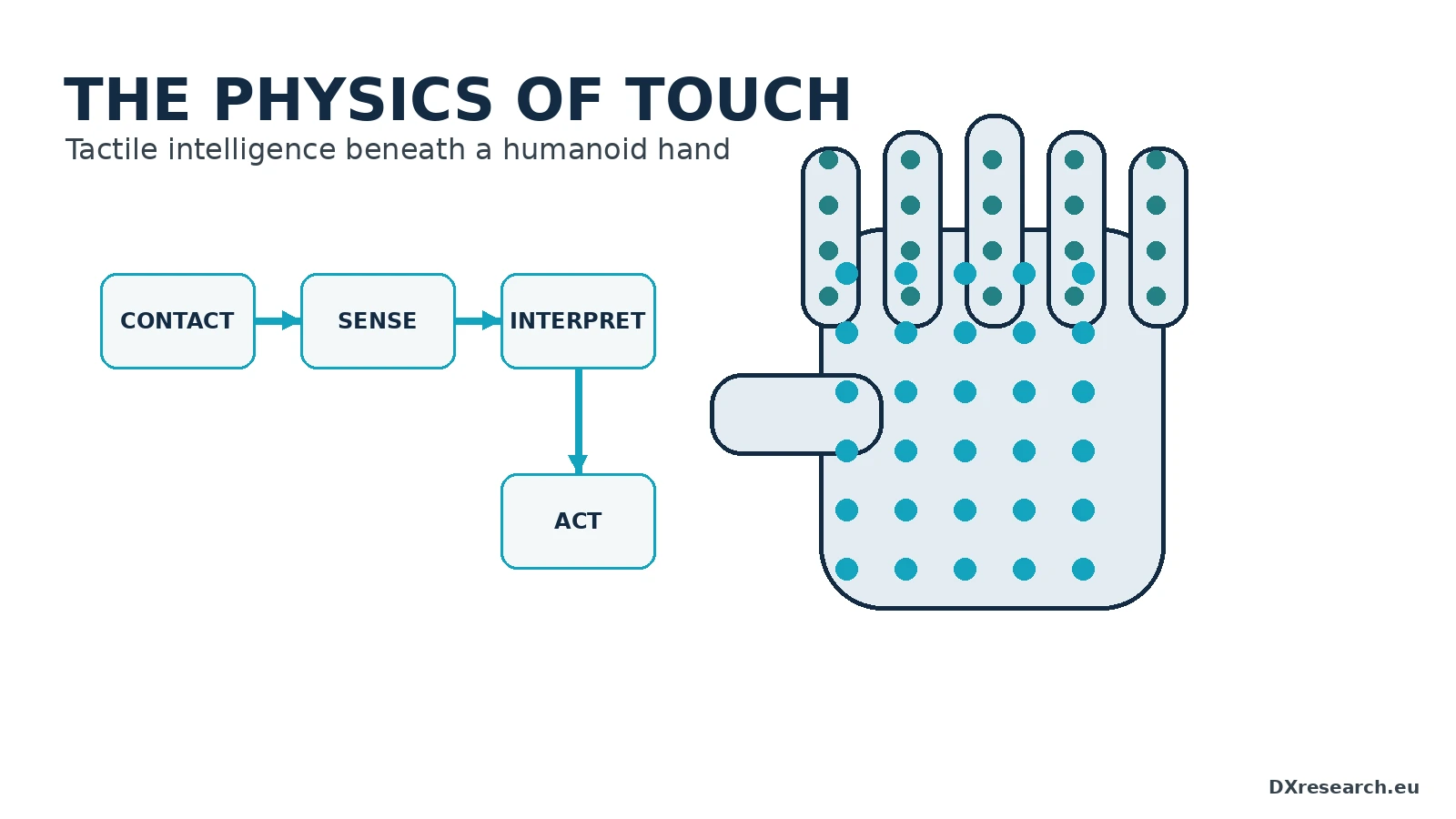
Humanoid robots are becoming progressively better at seeing objects, estimating poses, and planning grasps. Yet vision stops being sufficient at the moment of contact. A camera can predict where a glass is; it cannot reliably confirm whether the glass is beginning to slip, whether a cable is pinched, whether a package surface is deforming, or whether a handshake is becoming uncomfortable. Those questions belong to touch.
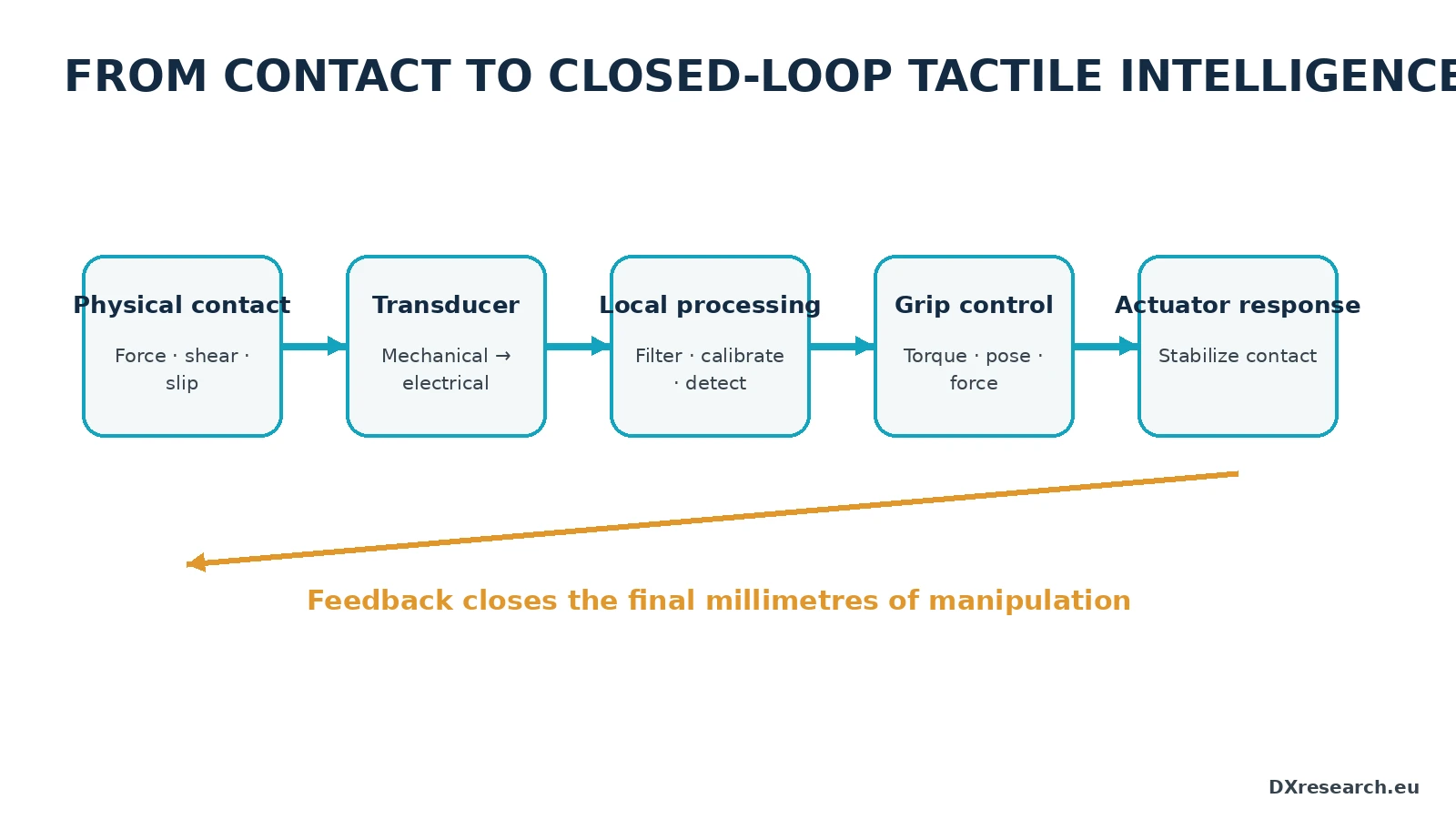
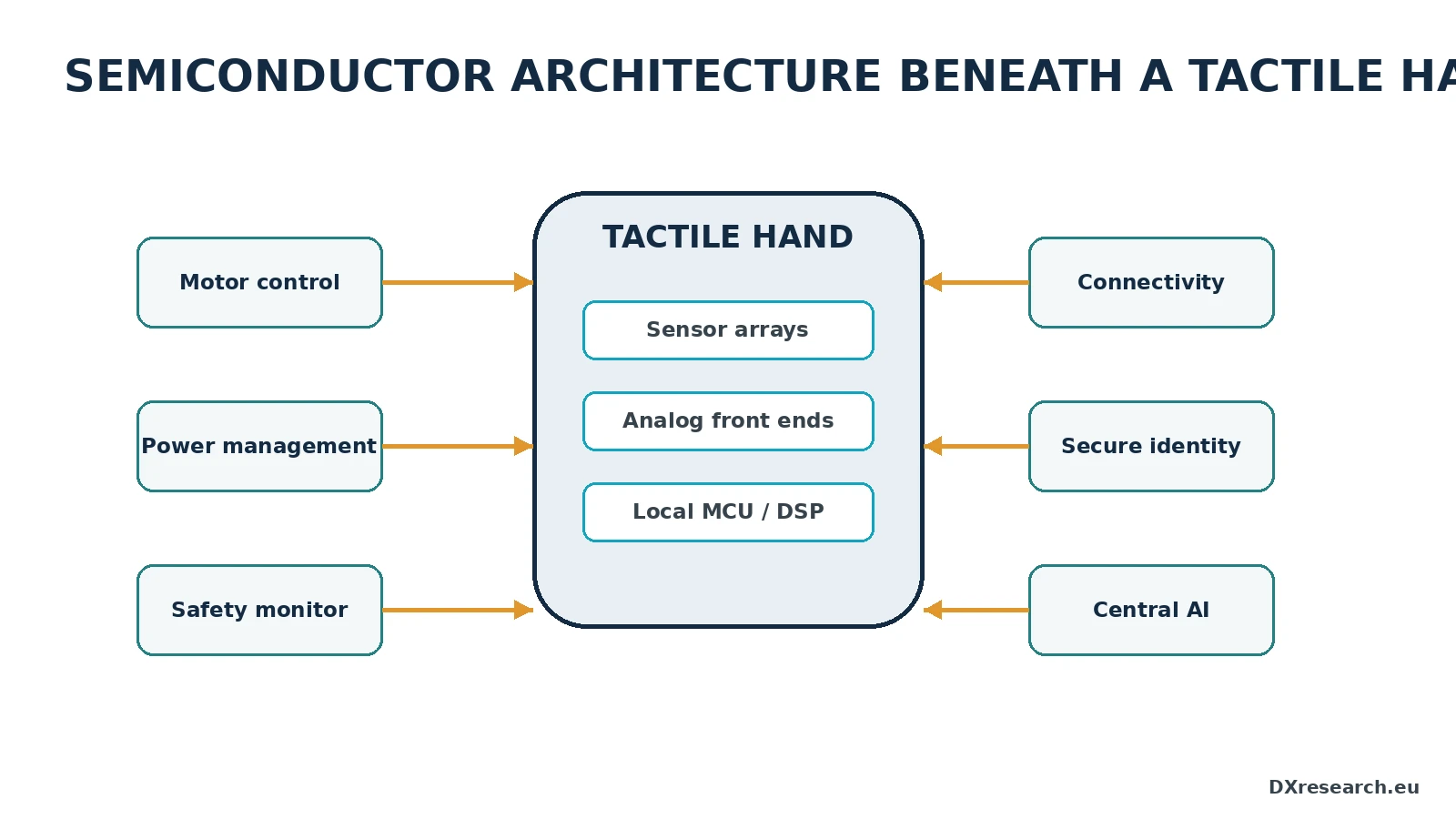
This chapter argues that tactile intelligence is not simply another sensor modality. It is the feedback layer that closes the final millimetres of manipulation. Dexterous mechanics create possible motion, but tactile sensing determines whether that motion is physically appropriate after contact begins. The semiconductor challenge is therefore broader than producing a sensitive transducer. It includes analog signal conditioning, multiplexing, local processing, synchronization, connectivity, power management, calibration, safety monitoring, and reliable packaging across large numbers of sensing points.
Verified evidence already shows the direction of travel. Current humanoid architectures explicitly include sensing across hands, body, environment, and motion-control domains (Reference 01 – Humanoid robots). High-resolution tactile research has demonstrated distributed sensing across much of a robotic hand, while multimodal designs combine pressure, temperature, texture, material response, and rapid slip detection (Reference 03 – Embedding high-resolution touch across robotic hands enables adaptive human-like grasping) (Reference 04 – Multimodal tactile sensing fused with vision for dexterous robotic manipulation). The interpretation developed here is that tactile performance will increasingly be constrained by the electronics architecture beneath the skin.
1. Vision Predicts Contact; Touch Explains It
Before contact, vision estimates geometry, object identity, pose, and reachable grasp points. After contact, the robot must resolve a different set of variables: where force is actually distributed, whether the contact patch is stable, whether tangential loading is rising, whether deformation is elastic or damaging, and whether the object is moving relative to the fingertips. These quantities are difficult to infer from external cameras because contact surfaces are partly occluded and material behaviour is often unknown.
The distinction can be expressed as a change in observability. Vision observes the scene around the hand. Touch observes the mechanical boundary condition between the hand and the world. Neither is complete alone. Vision can guide approach and global placement; touch can regulate force and recover from local uncertainty. The practical system is therefore multimodal rather than competitive. Research combining tactile and visual data has shown why pressure, temperature, texture, and slip information become valuable when a robot must manipulate fragile or slippery objects (Reference 04 – Multimodal tactile sensing fused with vision for dexterous robotic manipulation).
Verified fact: commercial sensor suppliers now describe pressure sensors and inertial sensors as building blocks for robotic tactile functions such as contact-force estimation, pressure distribution, and grip adjustment (Reference 02 – Robotics: Tactile sensing). Engineering assumption: no single sensing principle will dominate every part of a humanoid body because fingertips, palms, forearms, feet, and torso surfaces face different ranges, geometries, and cost constraints. Interpretation: the winning architecture will be heterogeneous at the transducer level but standardized at the data, timing, power, and diagnostic interfaces.
2. What a Robot Must Feel
Human touch is not one scalar measurement, and robotic touch should not be treated as one either. Reliable contact control requires multiple physical observables that operate over different bandwidths and ranges. A slow normal-force estimate may be sufficient to maintain a stable grasp on a rigid box, while a fast vibration channel may be required to detect incipient slip on polished metal. Temperature can help distinguish materials and protect the robot from hazardous surfaces. Distributed pressure reveals whether contact is concentrated at an edge or spread over a compliant surface.
| Observable | Why it matters | Typical bandwidth need | Electronics implication |
|---|---|---|---|
| Normal force | Controls grip strength and prevents crushing | Low to medium | Low-noise analog front end, calibration, drift compensation |
| Shear force | Reveals tangential loading and stability margin | Medium | Multiaxis sensing and cross-talk compensation |
| Slip and vibration | Triggers rapid corrective grip action | High | Fast sampling, local feature extraction, low-latency interrupt path |
| Contact location | Identifies where force enters the hand or body | Low to medium | Dense arrays, multiplexing, addressing, spatial reconstruction |
| Temperature and thermal response | Supports material recognition and hazard detection | Low | Precision sensing, thermal isolation, slow compensation loops |
| Compliance and deformation | Distinguishes soft objects and changing contact geometry | Medium | Nonlinear models, sensor fusion, mechanical-electrical co-calibration |
A tactile pixel, or taxel, is often treated as the fundamental unit of tactile resolution. However, taxel count alone can be misleading. A dense array with high noise, slow readout, large drift, or poor mechanical coupling may provide less useful information than a lower-density array with high bandwidth and stable calibration. Spatial resolution, force resolution, dynamic range, latency, coverage, durability, and manufacturability must be evaluated together.
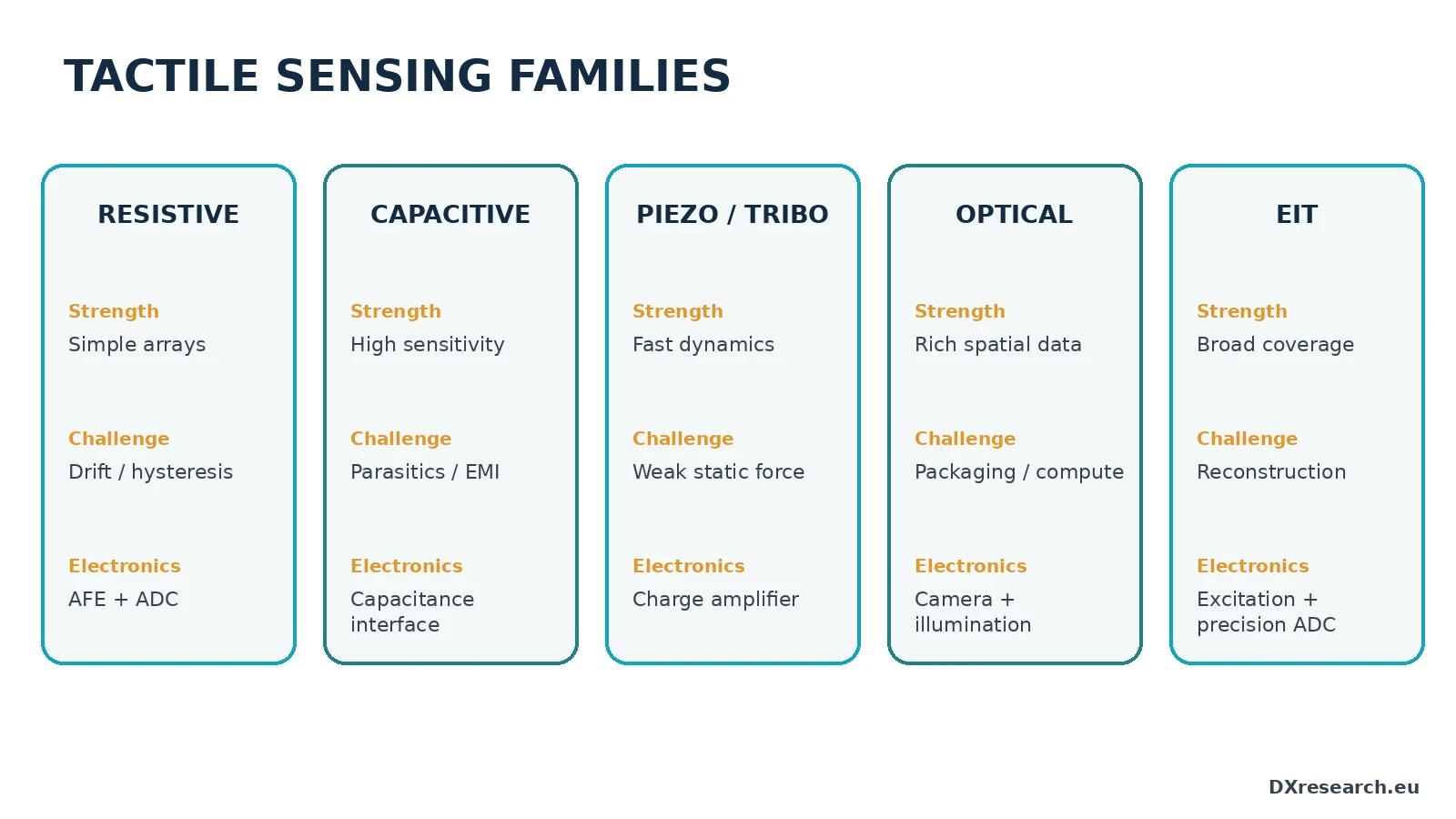
3. The Main Tactile Sensing Families
3.1 Piezoresistive and resistive arrays
Resistive tactile sensors translate deformation into a resistance change. They can be thin, flexible, inexpensive, and relatively simple to scan. Their limitations may include drift, hysteresis, temperature sensitivity, and variation between sensing elements. These limitations do not make the technology unsuitable; they shift value into calibration, compensation, and local signal processing.
3.2 Capacitive sensing
Capacitive sensors detect geometry or dielectric changes caused by pressure and deformation. They can provide high sensitivity and low static power, but parasitic capacitance, environmental contamination, electromagnetic interference, and long interconnects can degrade performance. Capacitive touch technologies already emphasize signal-to-noise performance, low power, and environmental robustness, principles that transfer directly to robotic skin even when the mechanical structures differ (Reference 09 – Capacitive touch control).
3.3 Piezoelectric and triboelectric sensing
Piezoelectric and triboelectric structures are strong candidates for dynamic events such as vibration, impact, and slip. They can be highly responsive but may be less suited to measuring static force without complementary channels. A multimodal tactile stack can exploit this distinction by combining a slow force channel with a fast dynamic channel.
3.4 Optical and vision-based tactile sensing
Vision-based tactile sensing uses an internal camera to observe deformation, marker displacement, or light patterns inside a compliant contact surface. The approach can produce rich spatial data, but it introduces optical packaging, illumination, image processing, and thermal challenges. Physically accurate optical simulation is now being used to design such sensors more systematically rather than relying only on repeated physical prototypes (Reference 05 – Vision-based tactile sensor design using physically accurate light simulation).
3.5 Electrical impedance tomography
Electrical impedance tomography estimates contact or deformation by measuring electrical responses around a conductive region and reconstructing a spatial distribution. It offers the prospect of broad coverage with fewer wires than one conductor per taxel, but reconstruction quality depends on electrode placement, material behaviour, analog accuracy, and algorithms. Robotic implementations have demonstrated the feasibility of distributed tactile sensing based on this principle (Reference 06 – Robotic Tactile Sensing System Based on Electrical Impedance Tomography).
4. The Tactile Signal Chain
A tactile system begins with mechanical coupling, not electronics. The protective skin, elastomer, adhesive, electrode geometry, and substrate determine how external force reaches the sensing element. A poorly designed mechanical stack can spread contact excessively, create dead zones, introduce creep, or detach under repeated bending. Electronics can compensate some imperfections, but they cannot recover information that the mechanical interface never transmits.
After transduction, the analog front end must preserve small signals in the presence of switching noise from motors, DC/DC converters, radios, displays, and high-performance compute. The robot hand is an electrically hostile environment: high di/dt motor phases run close to sensitive conductors, flexible cables change impedance as fingers move, and compact mechanical packaging limits shielding. This makes signal-to-noise ratio a system property rather than a data-sheet number.
Dense arrays require multiplexing or local conversion. A direct wire from every sensing element to the wrist is rarely scalable. Large-area robot-skin research has long emphasized local scanning and serial communication as a way to reduce wiring and modularize the sensing surface (Reference 07 – Methods and Technologies for the Implementation of Large-Scale Robot Tactile Sensors). The modern extension is to place more intelligence near the sensor: offset correction, linearization, filtering, event detection, compression, and health monitoring.
Local processing changes the traffic model. Instead of streaming every raw sample continuously, a fingertip module can send contact maps at moderate rate, emit high-priority slip events immediately, and retain high-frequency waveform buffers for diagnosis. This approach lowers bus load while preserving rapid reaction. It also creates mixed-criticality requirements: a high-level texture classifier may tolerate delay, but a slip interrupt must reach grip control within a deterministic bound.
5. The Data-Rate Problem Under the Skin
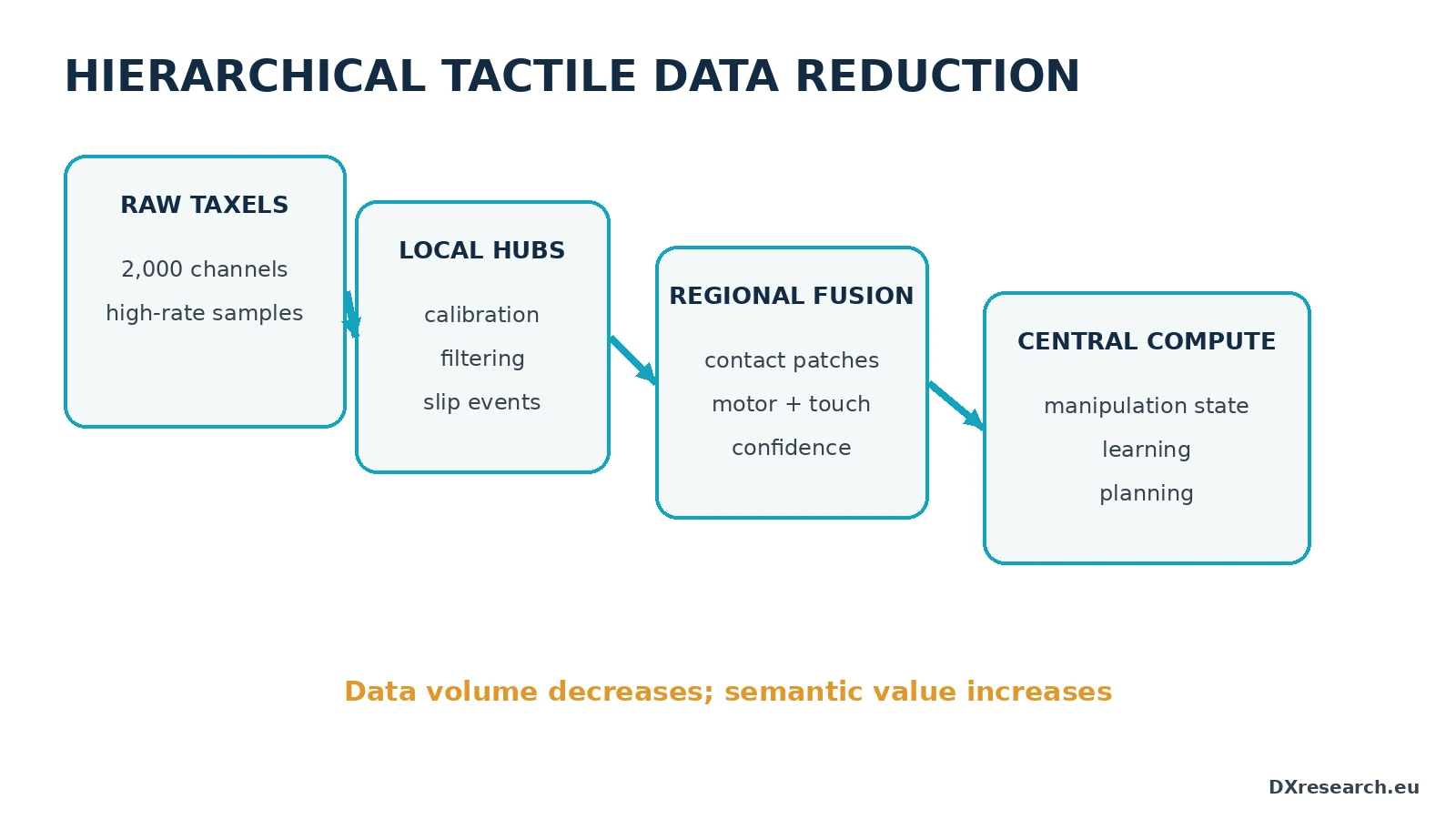
Suppose a hand contains 2,000 taxels, each sampled at 1 kHz with 16-bit resolution. The uncompressed payload is 32 Mbit/s before timestamps, addressing, diagnostics, protocol overhead, redundancy, and additional modalities. Increase coverage to forearms and torso, add shear channels, and raise vibration bandwidth, and the internal data volume rises quickly. The challenge is not merely bandwidth; it is moving the right information at the right latency.
A hierarchical architecture is therefore preferable. Taxels feed local acquisition circuits. Local microcontrollers or sensor hubs convert raw measurements into contact patches, centroids, force vectors, slip indicators, and confidence values. Regional controllers fuse tactile data with joint torque, motor current, and proprioceptive state. The central compute receives compressed representations for manipulation planning and learning.
Standardized representations may eventually become important. IEEE has published a haptic codec standard for tactile-internet applications, illustrating that tactile and force information can be treated as structured data rather than an application-specific stream (Reference 08 – IEEE 1918.1.1-2024 Standard for Haptic Codecs for the Tactile Internet). A humanoid internal network is not the same as a remote haptic system, but the architectural lesson is relevant: encoding, quality, timing, and reconstruction rules determine whether touch information remains useful after transmission.
6. Latency: Why Slip Cannot Wait for the Cloud
Slip can develop faster than a central perception stack can complete image processing, world-model update, planning, and command distribution. The stabilizing response should therefore be local or regional. A fingertip sensor detects vibration or tangential motion, a local processor classifies the event, and the hand controller increases grip force or changes finger pose. The central controller is informed, but it does not need to authorize every corrective micro-action.
This is edge processing in its most physical form. The edge is not merely close to the data source; it is inside the feedback loop that prevents an object from falling. Semiconductor requirements follow directly: deterministic microcontrollers, low-noise acquisition, timer synchronization, fast interrupt paths, reliable local memory, and communication interfaces that preserve event priority.
The architecture also needs graceful degradation. If one tactile region fails, the robot may reduce permitted grip force, rely more heavily on motor-current estimation, restrict object classes, or request human assistance. This differs from declaring the entire hand unavailable. Tactile health should be represented as confidence and coverage, not just a single binary status.
7. Calibration Is the Hidden Manufacturing Challenge
A laboratory sensor can be calibrated carefully with controlled fixtures. A production humanoid may contain thousands of sensing elements distributed across curved, compliant, replaceable surfaces. Manufacturing variation affects thickness, adhesive layers, electrode alignment, preload, cable routing, and material stiffness. Ageing introduces additional drift through wear, contamination, ultraviolet exposure, repeated bending, and temperature cycling.
Calibration must therefore be designed as a lifecycle process. Factory calibration establishes baseline gain, offset, cross-talk, and spatial mapping. Startup self-tests identify open circuits, short circuits, saturated channels, or disconnected modules. In-use calibration can exploit known events, such as pressing a fingertip against an internal reference surface or comparing tactile force with actuator torque during a controlled motion.
Calibration data also needs secure identity. A replaceable fingertip should carry its own sensor-map version, serial number, compensation coefficients, and health history. The hand controller must know whether the module is compatible and whether its calibration belongs to the installed mechanical stack. This introduces nonvolatile memory, secure communication, and configuration-management requirements that are easy to overlook when tactile sensing is treated as a simple analog input.
8. Safety: Touch as Both Sensor and Safeguard
Tactile skin can contribute to human-robot safety by detecting unexpected contact, estimating contact location, and enabling faster local reaction. A forearm that detects pressure before joint torque rises significantly can stop or redirect motion. A palm can distinguish intentional support from an unstable grasp. A torso skin can detect contact outside the primary camera field.
However, a tactile sensor should not automatically be assumed to be safety-rated. The safety contribution depends on diagnostic coverage, failure modes, independence, response time, mechanical coverage, and validation. A soft skin may reduce impact severity even if its electronics fail; an electronic contact channel may provide additional detection. These are different safety mechanisms and should be analysed separately.
Verified fact: semiconductor suppliers increasingly position sensing, control, connectivity, functional safety, and security as integrated foundations for scalable humanoid systems (Reference 10 – Infineon accelerates deployment of robots with improved semiconductor solutions). Assumption: body-scale tactile sensing will initially supplement rather than replace joint-torque and proximity safety channels. Interpretation: the strongest safety case will use tactile data as one layer in a diverse contact-detection architecture, not as a single point of truth.
9. Tactile Intelligence for Dexterous Hands
Hands are the most demanding tactile subsystem because they combine dense sensing, complex motion, severe space constraints, repeated impact, and direct interaction with uncertain objects. A useful hand must not only detect contact; it must regulate distributed force while fingers move relative to one another. It must sense through compliant pads, around curved surfaces, and near joints where wiring and packaging are difficult.
High-resolution tactile coverage across a large fraction of a robotic hand has already been demonstrated in research, supporting adaptive grasping under dynamic conditions (Reference 03 – Embedding high-resolution touch across robotic hands enables adaptive human-like grasping). The semiconductor challenge is translating such demonstrations into manufacturable modules. A production design needs repeatable sensor films, robust interconnects, compact local electronics, self-test, replaceable surfaces, and software abstractions that remain stable across sensor revisions.
The hand also illustrates why tactile and motor control must converge. Grip force is produced by actuators but observed at the contact surface. Motor current estimates tendon or joint effort, while tactile sensors observe how that effort is distributed. Fusing both allows the controller to detect situations such as high actuator force with poor contact, indicating misalignment or a jammed mechanism.
10. Beyond the Hand: Feet, Forearms, and the Whole Body
Feet need tactile sensing for contact distribution, terrain adaptation, and balance. Force-torque sensors at the ankle provide global load information, but distributed sole pressure can reveal heel-to-toe transition, edge loading, local obstacles, and partial contact. The required range is much higher than at fingertips, while spatial resolution may be lower.
Forearms and upper arms benefit from broad, durable contact detection rather than extreme spatial resolution. Torso skin can support safe navigation through clutter and detect contact during lifting or collaboration. The head may use soft proximity and contact zones around vulnerable structures. Each region has a different optimum balance of cost, density, compliance, and bandwidth.
This heterogeneity reinforces the case for modular electronics. A common regional sensor-hub architecture can support different transducers while presenting normalized contact events and health data upstream. The robot should not require the central manipulation stack to understand every electrode geometry or material coefficient.
11. Power, Heat, and Packaging
Tactile electronics are distributed over surfaces with limited cooling. Even modest power per module becomes significant when multiplied across a body. Continuous high-rate sampling and local inference must therefore be duty-cycled or event-driven where possible. Low-power analog acquisition, efficient microcontrollers, and selective wake-up can keep the skin thermally compatible with compliant materials and human contact.
Packaging is equally critical. The sensing surface must tolerate abrasion, sweat, oils, dust, cleaning agents, impacts, flexing, and local puncture. The electronics underneath must remain repairable. A replaceable outer skin may protect the transducers, but replacement changes mechanical coupling and may require recalibration. Encapsulation improves robustness but can reduce sensitivity or make repair impossible.
Connector count is a major reliability driver. Large-area skins should minimize individual wiring and use regional modules with short local interconnects. Flexible printed circuits can conform to anatomy, but bend radius, strain relief, and repeated motion must be validated. The tactile architecture therefore sits at the intersection of semiconductor design, materials science, mechanical integration, and manufacturing engineering.
12. A Reference Architecture for Tactile Intelligence
A scalable humanoid tactile system can be organized into five layers. The first layer is the mechanical skin and transducer. The second is analog acquisition and multiplexing. The third is local processing for calibration, filtering, feature extraction, and health monitoring. The fourth is regional fusion with motor and proprioceptive data. The fifth is central perception, manipulation planning, and learning.
| Layer | Primary function | Representative semiconductor content | Key design metric |
|---|---|---|---|
| Mechanical and transducer | Convert contact into electrical or optical change | MEMS, sensor films, electrodes, optical emitters and imagers | Sensitivity, range, durability, spatial fidelity |
| Acquisition | Excite, condition, multiplex, and digitize | Analog front ends, ADCs, capacitance interfaces, current sources | Noise, drift, channel density, power |
| Local intelligence | Calibrate, filter, detect events, compress data | MCUs, DSPs, local memory, secure identity | Latency, determinism, energy per sample |
| Regional fusion | Combine tactile, motor, and body-state information | Real-time controllers, communication PHYs, safety monitors | Synchronization, bandwidth, fault containment |
| Central cognition | Interpret contact and plan manipulation | Application processors, AI accelerators, high-bandwidth memory | Model quality, generalization, task performance |
The architecture should support both periodic data and asynchronous events. Contact maps can update at a scheduled rate, while slip, impact, overtemperature, or sensor failure can trigger immediate messages. Common timing allows tactile events to align with motor current, joint position, camera frames, and control commands. This makes post-event diagnosis and learning far more reliable.
13. Design Rules for Production Systems
The first design rule is to specify the physical question before choosing a sensing technology. “Detect touch” is too vague; “detect incipient tangential slip within five milliseconds under a specified force and temperature range” is actionable. The second rule is to design mechanics and electronics together. The third is to process events locally when reaction time matters. The fourth is to make calibration and module identity part of the product architecture.
The fifth rule is to separate raw sensing from stable semantic interfaces. Sensor technologies will evolve faster than manipulation software. A normalized representation of contact patches, forces, slip probability, temperature, and confidence allows the hand or skin hardware to improve without rewriting the entire robot stack. The sixth rule is to design degradation modes explicitly. Missing taxels, disconnected modules, and drifting channels should reduce capability predictably rather than create silent uncertainty.
The seventh rule is to validate the entire lifecycle: assembly, factory calibration, field use, cleaning, replacement, software update, and end-of-life diagnosis. Tactile intelligence is only useful when the measurements remain trustworthy after thousands of hours and millions of contacts.
14. Conclusion: Intelligence Begins at the Contact Patch
Humanoid manipulation will not become reliable through better vision and larger models alone. The decisive information often appears only after the robot touches the world. Pressure distribution, shear, slip, vibration, temperature, and deformation reveal whether a planned action is succeeding in physical reality.
The tactile system is therefore a distributed semiconductor platform beneath the robot’s skin. Its performance depends on transducers, analog interfaces, conversion, local compute, communication, synchronization, power management, security, diagnostics, and packaging. The number of taxels matters, but the trustworthiness and timing of the full signal chain matter more.
As humanoids move from demonstrations into repetitive work, tactile intelligence will become a differentiator between robots that merely reach objects and robots that can handle them. The last millimetre of motion is governed by contact, and contact becomes useful only when the machine can feel, interpret, and respond.
Glossary
- Tactile Sensing
- Measurement of contact-related variables such as pressure, force, shear, vibration, slip, texture, and temperature.
- Tactile Pixel (Taxel)
- A spatially discrete sensing element within a tactile array, analogous to a pixel in an image sensor.
- Normal Force
- Force acting perpendicular to a contact surface.
- Shear Force
- Force acting tangentially along a contact surface.
- Slip Detection
- Detection of relative motion or impending motion between a grasped object and a contact surface.
- Hysteresis
- Difference in sensor output for the same input depending on whether the input is increasing or decreasing.
- Cross-Talk
- Unwanted coupling in which one sensing channel influences another channel’s measured output.
- Electrical Impedance Tomography (EIT)
- A reconstruction technique that estimates spatial material or contact changes from electrical measurements around a sensing region.
- Vision-Based Tactile Sensing (VBTS)
- A tactile method that uses an internal camera to observe deformation of a compliant contact surface.
- Sensor Fusion
- Combination of measurements from multiple sensors to obtain a more reliable or complete state estimate.
- Edge Processing
- Processing performed close to the sensor or actuator to reduce latency, data volume, and communication dependence.
- Signal-to-Noise Ratio (SNR)
- Ratio between the desired measurement signal and unwanted electrical or physical noise.
- Calibration
- Process of relating sensor output to known physical inputs and compensating systematic errors.
- Proprioception
- Measurement of a robot’s own joint positions, velocities, forces, and body state.
- Haptic Codec
- A representation and compression method for transmitting haptic or tactile information efficiently.
References
- Humanoid robots. Infineon Technologies AG, 2026. Maps humanoid sensing, motor control, power, connectivity, safety, security, and compute functions to semiconductor technologies and system design priorities. https://www.infineon.com/applications/industrial/robotics/humanoid-robots
- Robotics: Tactile sensing. Bosch Sensortec, 2026. Describes pressure sensors and inertial sensors used to estimate contact pressure, force distribution, grip state, and hand orientation in robots. https://www.bosch-sensortec.com/en/applications-solutions/robotics/
- Embedding high-resolution touch across robotic hands enables adaptive human-like grasping. Nature Machine Intelligence, 2025. Presents a biomimetic hand with high-resolution tactile coverage across most of its surface, supporting adaptive grasping under dynamic conditions. https://www.nature.com/articles/s42256-025-01053-3
- Multimodal tactile sensing fused with vision for dexterous robotic manipulation. Nature Communications, 2024. Demonstrates pressure, temperature, material, texture, and fast slip sensing integrated with vision for more reliable dexterous robotic control. https://www.nature.com/articles/s41467-024-51261-5
- Vision-based tactile sensor design using physically accurate light simulation. Communications Engineering, 2025. Shows how physically accurate optical simulation can improve the design process for compact, high-resolution vision-based tactile sensors. https://www.nature.com/articles/s44172-025-00350-4
- Robotic Tactile Sensing System Based on Electrical Impedance Tomography. IEEE, 2023. Demonstrates distributed tactile sensing using electrical impedance tomography, illustrating scalable contact localization through electrode measurements and reconstruction algorithms. https://ieeexplore.ieee.org/document/10347905/
- Methods and Technologies for the Implementation of Large-Scale Robot Tactile Sensors. IEEE Transactions on Robotics, 2011. Explains modular tactile skin architectures using local scanning and serial communication to reduce wiring and support large sensing areas. https://ieeexplore.ieee.org/document/5771603/
- IEEE 1918.1.1-2024 Standard for Haptic Codecs for the Tactile Internet. IEEE Standards Association, 2024-02-15. Defines standardized haptic coding concepts relevant to efficient representation and transmission of tactile and force-feedback information over networks. https://standards.ieee.org/about/sasb/sba/15feb2024/
- Capacitive touch control. Infineon Technologies AG, 2025-09-26. Describes capacitive sensing technologies emphasizing signal-to-noise performance, low power, environmental robustness, and reliable touch detection under practical conditions. https://www.infineon.com/applications/solutions/human-machine-interface/touch-control
- Infineon accelerates deployment of robots with improved semiconductor solutions. Infineon Technologies AG, 2026-03-16. Positions sensing, motion, connectivity, safety, security, and efficient power technologies as integrated semiconductor foundations for scalable humanoid deployment. https://www.infineon.com/press-release/2026/infxx202603-073
Glossary
- Calibration
Process of relating sensor output to known physical inputs and compensating systematic errors.
- Cross-Talk
Unwanted coupling in which one sensing channel influences another channel’s measured output.
- Edge Processing
Processing performed close to the sensor or actuator to reduce latency, data volume, and communication dependence.
- Electrical Impedance Tomography
A reconstruction technique that estimates spatial material or contact changes from electrical measurements around a sensing region.
- Haptic Codec
A representation and compression method for transmitting haptic or tactile information efficiently.
- Hysteresis
Difference in sensor output for the same input depending on whether the input is increasing or decreasing.
- Normal Force
Force acting perpendicular to a contact surface.
- Proprioception
Measurement of a robot’s own joint positions, velocities, forces, and body state.
- Sensor fusion
Combination of multiple sensor measurements.
- Shear Force
Force acting tangentially along a contact surface.
- Signal-to-Noise Ratio
Ratio between the desired measurement signal and unwanted electrical or physical noise.
- Slip Detection
Detection of relative motion or impending motion between a grasped object and a contact surface.
- Tactile Pixel
A spatially discrete sensing element within a tactile array, analogous to a pixel in an image sensor.
- Tactile Sensing
Measurement of contact-related variables such as pressure, force, shear, vibration, slip, texture, and temperature.
- Vision-Based Tactile Sensing
A tactile method that uses an internal camera to observe deformation of a compliant contact surface.
References
- Capacitive touch control. Describes capacitive sensing technologies emphasizing signal-to-noise performance, low power, environmental robustness, and reliable touch detection under practical conditions. Source
- Embedding high-resolution touch across robotic hands enables adaptive human-like grasping. Presents a biomimetic hand with high-resolution tactile coverage across most of its surface, supporting adaptive grasping under dynamic conditions. Source
- Humanoid robots. Maps humanoid sensing, motor control, power, connectivity, safety, security, and compute functions to semiconductor technologies and system design priorities. Source
- IEEE 1918.1.1-2024 Standard for Haptic Codecs for the Tactile Internet. Defines standardized haptic coding concepts relevant to efficient representation and transmission of tactile and force-feedback information over networks. Source
- Infineon accelerates deployment of robots with improved semiconductor solutions. Positions sensing, motion, connectivity, safety, security, and efficient power technologies as integrated semiconductor foundations for scalable humanoid deployment. Source
- Methods and Technologies for the Implementation of Large-Scale Robot Tactile Sensors. Explains modular tactile skin architectures using local scanning and serial communication to reduce wiring and support large sensing areas. Source
- Multimodal tactile sensing fused with vision for dexterous robotic manipulation. Demonstrates pressure, temperature, material, texture, and fast slip sensing integrated with vision for more reliable dexterous robotic control. Source
- Robotic Tactile Sensing System Based on Electrical Impedance Tomography. Demonstrates distributed tactile sensing using electrical impedance tomography, illustrating scalable contact localization through electrode measurements and reconstruction algorithms. Source
- Robotics: Tactile sensing. Describes pressure sensors and inertial sensors used to estimate contact pressure, force distribution, grip state, and hand orientation in robots. Source
- Vision-based tactile sensor design using physically accurate light simulation. Shows how physically accurate optical simulation can improve the design process for compact, high-resolution vision-based tactile sensors. Source